
- Home
- »
- Next Generation Technologies
- »
-
Ambient Intelligence Market Size & Share Report, 2023-2030GVR Report cover

Ambient Intelligence Market (2023 - 2030)
Size, Share & Trends Analysis Report By Platform (Solution, Services), By Technology, By End-use Industry, By Region, And Segment Forecasts
Market Size, 2022
$18.4BMarket Estimate, 2026
$37.9BMarket Forecast, 2030
$99.4BCAGR, 2023–2030
24.4%Ambient Intelligence Market Summary
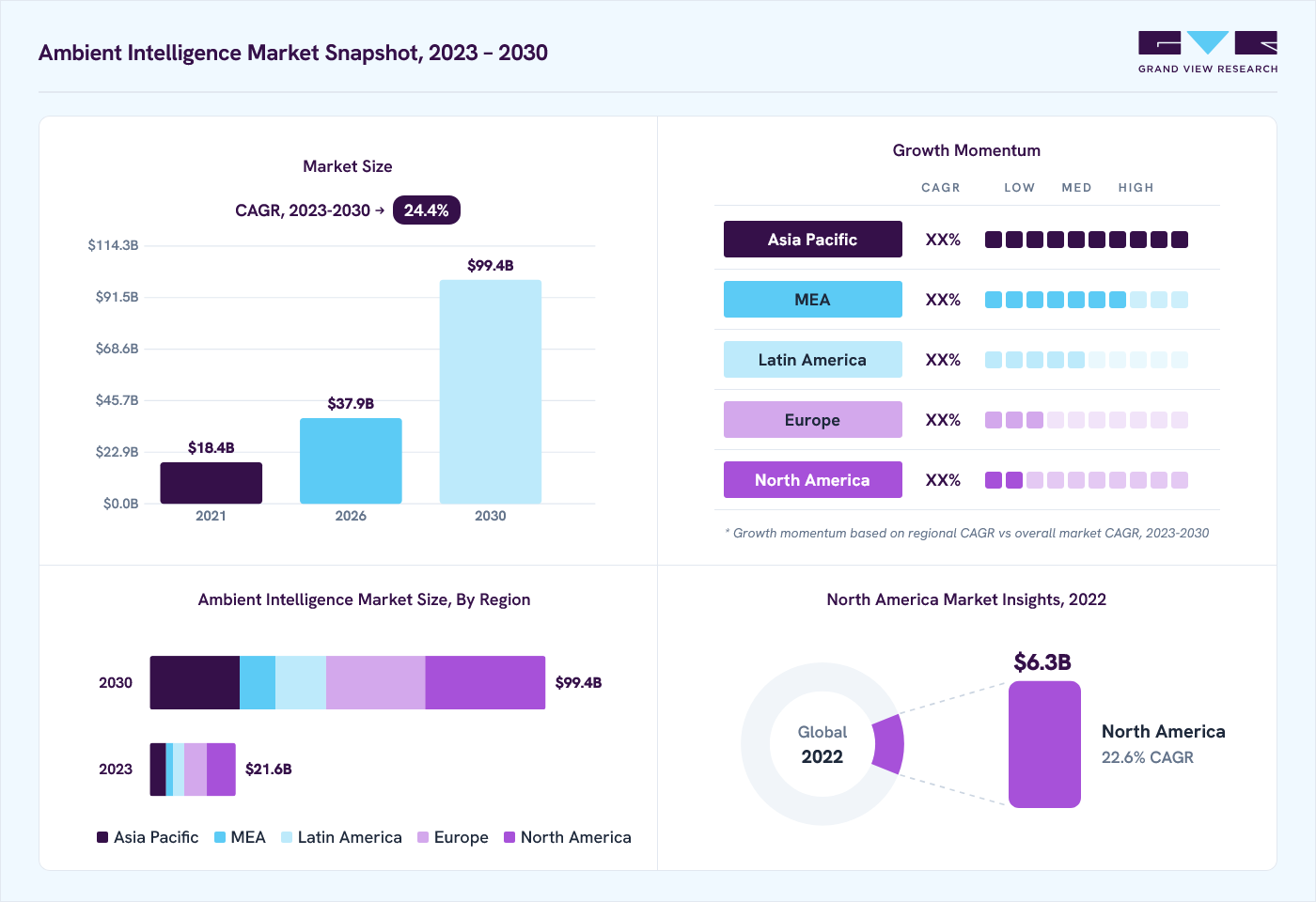
The global Ambient intelligence market size was valued at USD 18.4 billion in 2022 and is projected to grow from USD 37.9 billion in 2026 to USD 99.4 billion by 2030, at a CAGR of 24.4% from 2023 to 2030. North America dominated the market, accounting for a revenue share of 34.1% in 2022. The increasing number of smart city projects and growing preference for smart homes with the support of Ambient Intelligence (AMI) creates intelligent environments that can adapt to the changing needs and preferences of the users and provide a more seamless and convenient experience, monitors and controls energy consumption and optimize waste management.
 Source: Grand View Research, IR Documents, Primary Interviews, Paid DatabasesTo learn more about this report,
 Download Free Sample Report
 Key Market Trends & Insights
- By platform, the solution segment led the market with the largest revenue share of 61.5% in 2022.
- By technology, the affective computing segment led the market with the largest revenue share of 20.3% in 2022.
- By end use industry, the education sector is anticipated to witness at the fastest CAGR of 28.6% over the forecast period.
Market Size & Forecast
- 2022 Market Size: USD 18.4 Billion
- 2030 Projected Market Size: USD 99.4 Billion
- CAGR (2023-2030): 24.4%
Three ways to get this report
Buy it, customize it, or ask a question.Ask an Analyst
Analyst response in 1 business day
- AccessReport author, directly
- Reply timeWithin 1 working day
- No sales callDirect answer only
- FormatEmail reply
- CostFree, no cost
Get the Full Report
What the study covers
- FormatsPDF · Excel · Dashboard
- Timeline2023–2030 annual, 2022 base
- Coverage20+ countries, 5 regions
- Companies10+ key players profiled
Customize the Report
20% free customization
- IncludeCountries, segments, points
- TailorTo your product definition
- ExtendDeeper competitor detail
- OrA fully bespoke study
- Turnaround5–10 working days
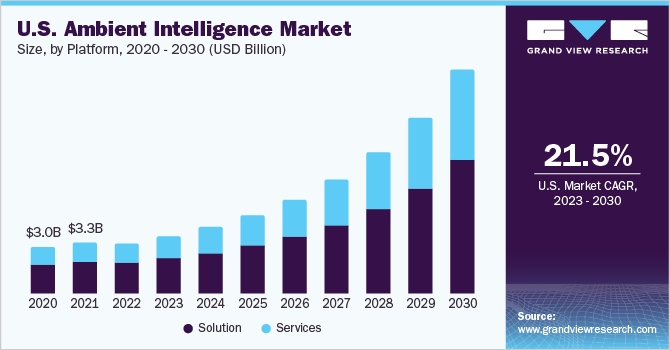
It assists cities in becoming more sustainable and reducing their carbon footprint by providing real-time data and insights. The United Nations expects 70.0% of the world's population to be residing in cities and urban areas by 2050, which means AmI systems would also have a vital role to play in smart urban transportation networks for improving transportation efficiency, facilitating eco-friendly water disposal facilities, and enhancing energy efficiency of the buildings.
 To learn more about this report, Download Free Sample Report
 The proliferation of IoT devices, which are connected to the internet, has led to an increase in the number of connected devices that can be integrated into an ambient intelligence ecosystem. AI technology can analyze the vast amount of data generated by these devices and provide insights that can be used to improve the user experience and make the environment more responsive. The increasing demand for smart homes and buildings, which are equipped with IoT devices and AI technology, is further driving the adoption of these technologies in ambient intelligence. Smart homes and buildings can provide a more convenient and energy-efficient living and working environment.
COVID-19 has highlighted the importance of healthcare applications for ambient intelligence systems, such as remote monitoring and support for patients. The COVID-19 outbreak has accelerated the adoption of software agents. Due to the implementation of social distancing measures, many patients were seeking remote healthcare services to avoid exposure to the virus. Affective Computing helps to reduce the cost of healthcare services by providing remote medical care that is less expensive than in-person visits to the healthcare facilities.
For instance, in April 2022, Emmaus Life Sciences, Inc. launched a full-service telehealth solution. The telehealth program leverages the growth of telemedicine in the U.S. to enable patients and healthcare providers to on-line access to Endari, the prescription-grade L-glutamine oral powder developed by the company for the treatment of sickle cell disease.
Platform Insights
In terms of platform, the market is further segmented into solution and services. The solution segment accounted for the largest revenue share of 61.5% in 2022 and is expected to continue to dominate the market during the forecast period. The segment growth is driven by the rise in the development of smart devices to provide an improved virtual experience for the day-to-day tasks. The solution segment includes both hardware and software. The presence of specific sensors and components in the device is referred to as hardware, while software allows users to pair up and control various smart devices.
Virtual environments are developed more seamlessly owing to the system's software and hardware integration. Furthermore, smart companies are incorporating artificial intelligence into their product lines to generate an additional revenue stream. With such innovative components and unique advancements in ambient intelligence technology, users give voice instructions for controlling gadgets such as lights, audio systems, air conditioning units, and other digital equipment.
The services segment is anticipated to witness the highest growth rate of 25.5% during the forecast period. The services in the ambient intelligence industry refer to consulting, integration, maintenance, and support services. The demand for ambient intelligence services is driven by a combination of the factors, including the complexity of implementation and the need for ongoing support & maintenance.
Technology Insights
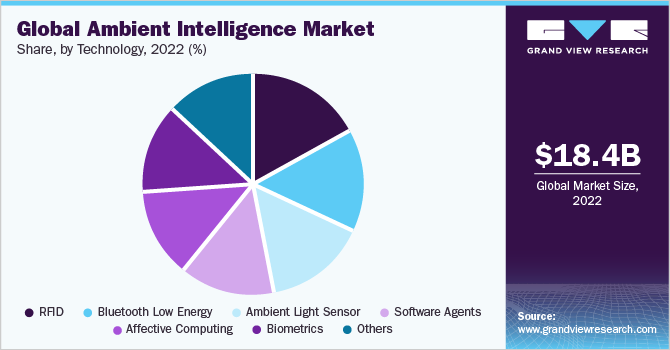
Based on the technology, the global market is sub-segmented into, Bluetooth low energy, RFID, ambient light sensor, software agents, affective computing, biometrics and others. The affective computing segment accounted for the largest revenue share of 20.3% % in 2022 and is expected to continue to dominate the market during the forecast period. With the development of more powerful processors, sensors, and machine learning algorithms, it has become increasingly possible to create systems that can accurately recognize and interpret human emotions.
This has created an opportunity for the integration of affective computing in ambient intelligence. There is growing recognition of the importance of emotional intelligence in various fields, including healthcare, education, and customer services. Affective computing can help to create more empathetic and responsive systems that can better meet the emotional needs of the users. The aim of developing more emotional and adaptable devices, which can better align the personal demands of consumers, is driving segment growth.
 To learn more about this report, Download Free Sample Report
 On the other hand, the RFID segment is expected to witness the highest CAGR rate of 29.3% during the forecast period. RFID is increasingly being used in supply chain management to track the movement of goods from production to delivery. By integrating RFID into ambient computing systems, businesses can create more efficient and responsive supply chains, thus reducing costs and improving customer satisfaction.
For instance, in October 2022, Wiliot, an Internet of Things (IoT) company, collaborated with Identiv, Inc., a manufacturer of specialty RFID tags, inlays, and labels, to produce an initial batch of 25.0 million units of its IoT pixel labels. Wiliot is pioneering the ambient IoT evolution with a vital advancement in ambient computer technologies provided by its IoT Pixels. The Pixels are stamp-sized computer labels that attach to any goods or packaging and power themselves by generating power from radio signals broadcasted by other IoT systems.
End-use Industry Insights
Based on the end-use industry, the market is segmented into IT and telecommunication, healthcare, retail, residential, manufacturing, automotive, education, and others. The healthcare segment held the largest revenue share of 20.5% in 2022 and is expected to maintain its position during the forecast period. Remote Patient Monitoring (RPM) applications, sensors, and ambient assisted living (AAL) systems are gaining popularity worldwide. Rising awareness of health systems and solutions such as electronic medical records and mobile health applications are fueling market growth. According to an MSI International survey conducted in June 2021, 70.0% of Americans prefer remote patient monitoring, and among 70.0% of Americans, nearly 40.0% of Americans refer to its incorporation into medical treatment.
On the other hand, the education segment is anticipated to witness the highest CAGR rate of 28.6% during the forecast period. The increased demand for ambient computing in education is driven by the need for more innovative and effective learning experiences that can enhance students’ academic achievements and increase access to education. Ambient computing can be used to support remote learning, allowing students to access educational content and resources from anywhere in the world.
According to a study from the University of Potomac in 2020, a high percentage of its students chose e-learning compared to traditional educational environments. This preferred approach to education is based on the advantages like lower expenses, improved efficiency, and the ability to learn on a flexible schedule using new technologies.
Regional Insights
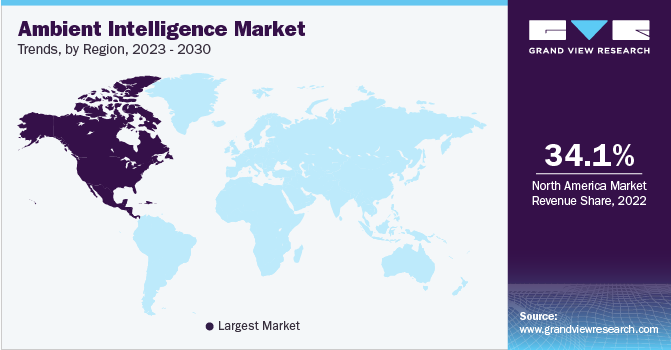
North America dominated the market with a share of 34.1% in 2022 and is anticipated to retain its dominance during the forecast period. The presence of smart home product providers, coupled with rising awareness towards energy efficiency is driving the market demand in the region. As per International Energy Agency (IEA), investments toward electricity grids in the U.S. increased by 10.0% in 2021. Furthermore, demand for smart energy has significantly increased in the region in recent years, encouraging investors to inject funds into the energy management sector.
 To learn more about this report, Download Free Sample Report
 In January 2022, Andreessen Horowitz announced a funding of USD 52.0 million to California-based software company, Ambient.ai to introduce the first computer vision intelligence platform. After being installed on any video surveillance system, the Ambient.ai platform can instantly handle hundreds of physical security incidents and dangers. Ambient.ai uses human-in-the-loop feedback to prepare threat signatures and ensure accuracy in detection systems and automated feedback to constantly improve efficiency.
Asia Pacific is anticipated to expand at the highest CAGR of 27.5% during the forecast period. The rise in the adoption of the 5G network is expected to drive the market growth in the region. Edge deployments in Asia-Pacific are growing four times quicker than digital core implementations. According to Equinix, a digital infrastructure company, the global infrastructure edge footprint is expected to reach 40.0 gigatons by 2028, with 63.0% assisting healthcare, manufacturing, energy, commerce, and transportation.
Key Companies & Market Share Insights
The market has a fragmented competitive landscape as it features various global and regional market players. Leading industry players are undertaking strategies such as product launches, collaborations, and partnerships to survive the highly competitive environment and expand their business footprints.
For instance, in January 2023, BioIntelliSense, Inc. partnered with care.ai to improve the delivery of patient care by enabling continuous biometric data and ambient intelligent tracking. The partnership integrates the complementary services of these transformative technologies to optimize clinical processes, enhance client satisfaction, and seamlessly address the overburdened health workforce's key challenges. Some of the prominent players in the global ambient intelligence market include:
-
Johnson Controls
-
Siemens
-
Honeywell International
-
Nuance Communications, Inc.
-
Infosys Limited
-
Zippin
-
Ambient
-
Noonum
-
Accel Robotics
-
Elos Health, Inc.
-
Spark Works
-
Eyeris Technologies, Inc.
-
care.ai
-
BioIntelliSense, Inc.
Recent Developments
-
In April 2023, Infosys announced the signing of a Memorandum of Understanding with Aramco, to work on advancing HR technologies. Through artificial intelligence technology, Infosys and Aramco hope to offer the latest insights to HR data and analytics, and scale the usage of automation tools
-
In June 2022, Accenture and Johnson Controls collaborated to create, and run two new OpenBlue Innovation Centers. The centers promoted Johnson Controls' rollout of building control system products and services by leveraging technologies including artificial intelligence (AI), digital twins, the internet of things (IoT), 5G, and the cloud, thus a prolific contribution to the ambient intelligence market
Ambient Intelligence Market Report Scope
Report Attribute
Details
Market size in 2022
USD 18.4 billion
Estimated Market size in 2026
USD 37.9 billion
Projected Market size by 2030
USD 99.4 billion
Growth rate
CAGR of 24.4% from 2023 to 2030
Base year for estimation
2022
Historical data
2017 - 2021
Forecast Period 2023 - 2030 Report published April 2023 Quantitative units
Revenue in USD million/billion, CAGR from 2023 to 2030
Report coverage
Revenue forecast, company ranking, competitive landscape, growth factors, and trends
Segments covered
Platform, technology, end-use industry, region
Regional scope
North America; Europe; Asia Pacific; Latin America; MEA
Country scope
U.S.; Canada; U.K.; Germany; France; Italy; Spain; Sweden; Netherlands; China; India; Japan; Australia; Singapore; South Korea; Brazil; Mexico; Chile; Argentina; UAE; Saudi Arabia; South Africa
Key companies profiled
Johnson Controls; Siemens; Honeywell International; Nuance Communications, Inc.; Infosys Limited; Zippin; Ambient; Noonum; Accel Robotics; Elos Health, Inc.; Spark Works; Eyeris Technologies, Inc.; care.ai; BioIntelliSense, Inc.
Customization scope
Free report customization (equivalent up to 7 analyst’s working days) with purchase. Addition or alteration to country, regional, and segment scope.
Pricing and purchase options
Avail customized purchase options to meet your exact research needs. Explore purchase options
Global Ambient Intelligence Market Report Segmentation
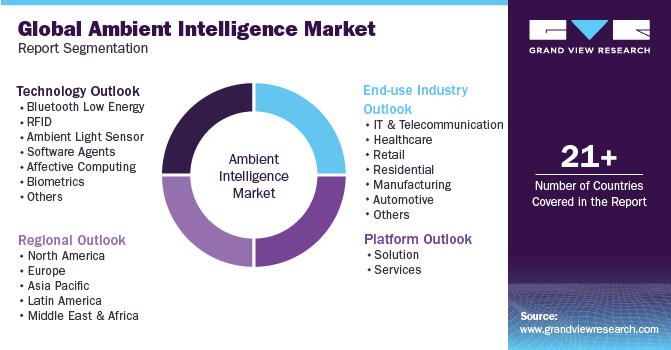
This report forecasts revenue growth at global, regional, and country levels in addition to provides an analysis of the latest industry trends and opportunities in each of the sub-segments from 2017 to 2030. For this study, Grand View Research has segmented the global ambient intelligence market report based on the platform, technology, end-use industry, and region:
 To learn more about this report, Download Free Sample Report
 -
Platform Outlook (Revenue, USD Million, 2017 - 2030)
-
Solution
-
Services
-
-
Technology Outlook (Revenue, USD Million, 2017 - 2030)
-
Bluetooth Low Energy
-
RFID
-
Ambient Light Sensor
-
Software Agents
-
Affective Computing
-
Biometrics
-
Others
-
-
End-use Industry Outlook (Revenue, USD Million, 2017 - 2030)
-
IT And Telecommunication
-
Healthcare
-
Retail
-
Residential
-
Manufacturing
-
Automotive
-
Education
-
Others
-
-
Regional Outlook (Revenue, USD Million, 2017 - 2030)
-
North America
-
U.S.
-
Canada
-
-
Europe
-
U.K.
-
Germany
-
France
-
Italy
-
Spain
-
Sweden
-
Netherlands
-
-
Asia Pacific
-
China
-
India
-
Japan
-
Australia
-
Singapore
-
South Korea
-
-
Latin America
-
Brazil
-
Mexico
-
Chile
-
Argentina
-
-
Middle East & Africa
-
UAE
-
Saudi Arabia
-
South Africa
-
-
Frequently Asked Questions About This Report
The global Ambient intelligence market size was valued at USD 18.4 billion in 2022 and is estimated at USD 37.9 billion for 2026.
The global Ambient intelligence market is expected to grow at a CAGR of 24.4% from 2023 to 2030, reaching USD 99.4 billion by 2030.
North America dominated with a revenue share of 34.1% in 2022.
Some key players operating in the ambient intelligence market include Johnson Controls, Siemens, Honeywell International, Nuance Communications, Inc., Infosys Limited, Zippin, Ambient, Noonum, Accel Robotics, Elos Health, Inc, Spark Works, Eyeris Technologies, Inc., care.ai, BioIntelliSense, Inc.
Key factors driving the market growth include increasing smart cities & smart home projects across the globe and potential use cases for ambient intelligence in Artificial Intelligence (AI) & Internet of Things (IoT) deployments.
About the Author(s)
Next Generation Technologies Research Team
Technology · Next Generation TechnologiesThis report was authored by the next generation technologies research team at Grand View Research - comprising two research analysts, one senior research analyst, and one industry expert - with specialized expertise in the next generation technologies segment of the technology industry. All findings are based on proprietary technology databases, executive interviews, and regulatory analysis, subject to internal peer review prior to publication.
Last Updated:
Speak to Analyst

Customize this report to your needs - add regions, segments, or data points, with 20% free customization.
Or view our licence options:


ISO 9001:2015 & 27001:2022 Certified
We are GDPR and CCPA compliant! Your transaction & personal information is safe and secure. For more details, please read our privacy policy.


