
- Home
- »
- Animal Feed and Feed Additives
- »
-
Animal Feed Enzymes Market Size, Share Report, 2026-2033GVR Report cover

Animal Feed Enzymes Market (2026 - 2033)
Size, Share & Trends Analysis Report By Product (Phytases, Carbohydrases, Proteases), By Formulation (Dry, Liquid), By Application (Poultry, Pigs, Equine, Aqua), By Region, And Segment Forecasts
Market Size, 2025
$1.4BMarket Estimate, 2026
$1.5BMarket Forecast, 2033
$2.2BCAGR, 2026–2033
5.0%Animal Feed Enzymes Market Summary
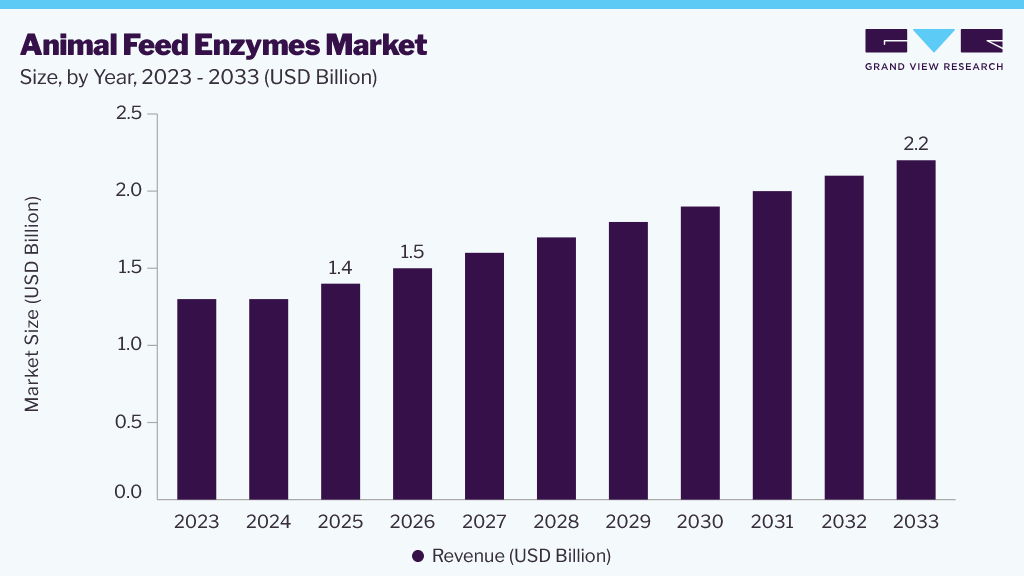
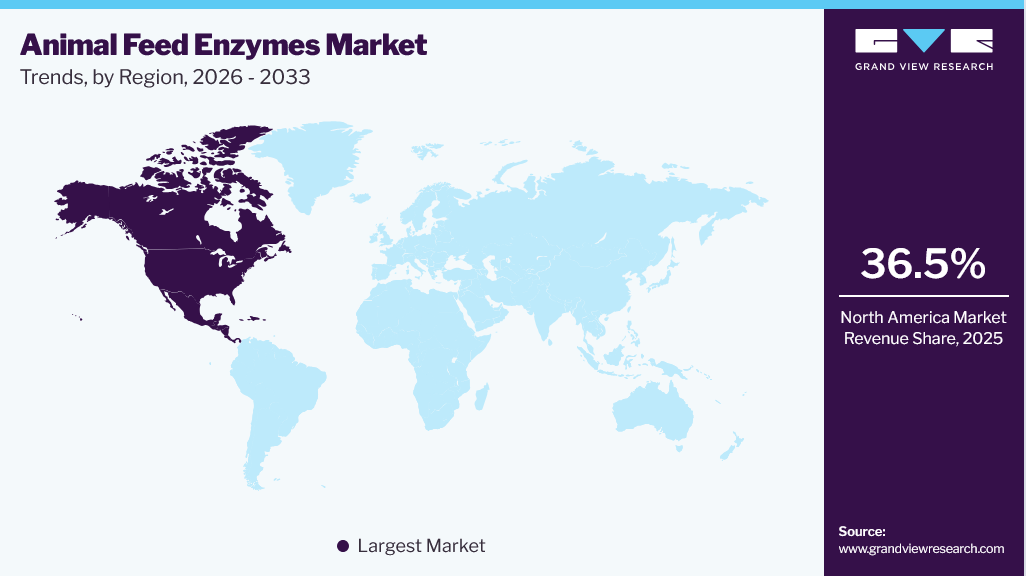
The global animal feed enzymes market was valued at USD 1.4 billion in 2025 and is projected to grow from USD 1.5 billion in 2026 to USD 2.2 billion in 2033, at a CAGR of 5.0% from 2026 to 2033. North America dominated the market, accounting for a revenue share of 36.5% in 2025. This is driven by the rapid expansion of the livestock sector, which propels the demand for nutritional enhancement and digestion efficiency.
 Source: Grand View Research, IR Documents, Primary Interviews, Paid DatabasesTo learn more about this report,
 Download Free Sample Report
Key Market Trends & Insights
- By product: The phytases segment held the largest market share of approximately 83.5% in 2025.
- By formulation: The dry animal feed enzymes segment held the largest market share in 2025.
- By application: The poultry segment held the largest market share of over 44.0% in 2025.
Regional Highlights
- Largest regional market: North America (36.5% revenue share, 2025)
Market Size & Forecast
- Market size in 2025: USD 1.4 Billion
- Estimated market size in 2026: USD 1.5 Billion
- Projected market size by 2033: USD 2.2 Billion
- CAGR (2026-2033): 5.0%
Three ways to get this report
Buy it, customize it, or ask a question.Ask an Analyst
Analyst response in 1 business day
- AccessReport author, directly
- Reply timeWithin 1 working day
- No sales callDirect answer only
- FormatEmail reply
- CostFree, no cost
Get the Full Report
What the study covers
- FormatsPDF · Excel · Dashboard
- Timeline2026–2033 annual, 2025 base
- Coverage20+ countries, 5 regions
- Companies10+ key players profiled
Customize the Report
20% free customization
- IncludeCountries, segments, points
- TailorTo your product definition
- ExtendDeeper competitor detail
- OrA fully bespoke study
- Turnaround5–10 working days
With competent fodder becoming scarcer, livestock producers have increasingly used enzymes to help compensate for nutritional deficiencies, ensuring healthier livestock.
The market saw a major shift in preferences for synthetic and inorganic fertilizers. The excessive use of synthetic and inorganic fertilizers led crops to lose their nutritional qualities. As a result, harmful by-products are formed when these crops are ingested by livestock. Manufacturers have primarily used enzymes to break down and absorb naturally occurring compounds such as fiber and phytate in animal feed ingredients. They used essential enzymes to aid livestock digestion, leading to improved feed efficiency and overall health.
In addition, cellulase enzymes facilitate the digestion of cellulose polysaccharides, breaking down fiber. Animal feed enzymes, including proteases, act on protein components, degrading them into amino acids, which are the building blocks for livestock. These enzymes enhance energy levels and metabolic rates in livestock, boosting their resistance to diseases.
The growing global population and urbanization have resulted in the increased demand for meat and dairy products. Enzymes contribute to better livestock health and productivity with optimized feed utilization, waste reduction, and environmental impact, meeting the rising demand and aligning with sustainability.
Analyst Perspective
The animal feed enzymes market is experiencing steady growth, driven by increasing demand for high-quality animal nutrition, a growing focus on livestock productivity, and the growing adoption of feed additives to improve animal health and performance. Livestock producers are increasingly using feed enzymes as an integral part of animal feed to improve feed efficiency and sustainably produce animals. The growth of the poultry, swine, and aquaculture industry, as well as the concerns over feed cost and environmental impact, has also aided the market growth. Moreover, improvements in enzyme technology and customization in feed solutions have further enhanced the efficacy and usability of the products. With the increasing demand for sustainable, efficient, and nutritionally optimized animal feed solutions, companies that focus on product innovation, enzyme development, and application-specific solutions will be well-positioned to capture long-term growth opportunities.
Product Insights
The phytases segment held the largest market share of approximately 83.5% in 2025. The significant use of an essential enzyme that enhances the digestibility of phytate-rich feed materials supports the growth of the market. These enzymes break down to release essential minerals, including phosphorus, for better absorption by livestock, including metabolism and reproduction. This cost-effective approach reduces the need for expensive inorganic phosphates in animal diets. Furthermore, phytases optimize nutrient utilization and minimize phosphorus wastage, mitigating environmental impact. This has aligned with consumer preferences for healthier meat and dairy products. Furthermore, ongoing research initiatives aimed at improving feed conversion efficiency and nutrient absorption in livestock and aquaculture species are driving innovation in phytase applications. For instance, in February 2025, ICAR–Central Institute of Brackishwater Aquaculture (India) collaborated with Nutricape Pvt. Ltd. to assess the efficacy of nano-encapsulated phytase technology in improving Pacific white shrimp growth performance, nutrient utilization, and overall health.
The proteases segment is expected to grow at the fastest CAGR over the forecast period. The segment is experiencing growth owing to the rising demand for eggs and meat with higher protein content. Proteases are protein-digesting enzymes that play a vital role in the poultry and pig sectors by breaking down dietary proteins into amino acids, thereby supporting optimal growth, feed efficiency, waste reduction, and the use of less expensive protein sources. In addition, the growing industrialization in livestock farming in developing countries, including Brazil, China, and India, has driven the demand for proteases as these enhance metabolic rates in poultry, ruminants, pigs, and aquaculture.
Formulation Insights
Dry animal feed enzymes have exhibited the largest share of the global revenue in 2025 owing to greater stability that enables longer shelf life. Dry formulations are manageable and spill-free. They require minimal handling effort during mixing into feed. Livestock rearers and feed manufacturers have increasingly preferred their stability during storage and transportation which ensures consistent enzyme activity, optimizing nutrient utilization in animal diets. In addition, dry enzymes sustain temperature during fodder processing and have greater thermal stability.
The liquid formulations segment is expected to grow at the fastest CAGR over the forecast period. The segment is experiencing growth owing to cost efficiency and ease of use. These offer practical advantages over dry forms. For instance, these are easier to mix into feed and readily absorbable, ensuring uniform distribution, bioavailability, and better nutrient utilization. In addition, these formulations allow precise dosing, which helps livestock rearers to tailor diets based on specific enzyme requirements to optimize performance and minimize waste.
Application Insights
The poultry segment held the largest market share of over 44.0% in 2025. The segment is experiencing growth owing to the major shifts in consumer dietary preferences. Consumers have increasingly inclined toward leaner poultry products such as eggs and chicken, which offer a versatile and affordable protein source. Enzymes help enhance the health and performance of livestock through digestion and nutrient absorption, including proteins and fibers. Moreover, enzymes optimize nutrient utilization, reduce waste, and contribute to sustainable livestock production. Furthermore, feed manufacturers continue to introduce enzyme-based solutions to improve feed conversion efficiency and nutrient utilization in poultry production. For instance, in April 2025, NOVUS introduced CIBENZA XCEL Xylanase Enzyme Feed Additive in India, designed to improve nutrient utilization in poultry diets. The product uses enzyme technology to support digestion and feed efficiency.
The pigs segment is expected to grow at the fastest CAGR over the forecast period. Pigs, as monogastric animals, have a limited ability to fully digest certain components of their diet. Livestock rearers use specific enzymes such as carbohydrases, proteases, and phytases to break down complex carbohydrates, proteins, and phytate. Improved digestibility ensures better nutrient absorption, leading to healthier pigs and efficient growth. Proteases break down proteins into amino acids, essential for pig growth and muscle development, and phytases release phosphorus from phytate, improving bone health and overall well-being. For instance, in March 2023, IFF’s Danisco Animal Nutrition & Health introduced Axtra PRIME, an advanced enzyme blend formulated to optimize piglet production outcomes. The solution combines xylanase, beta-glucanase, alpha-amylase, and protease enzymes to improve nutrient breakdown and absorption, support intestinal health, and enhance overall piglet growth performance and efficiency.
Regional Insights
North America dominated the animal feed enzymes market, accounting for approximately 36.5% of revenue in 2025. The increasing demand for high-quality meat products is driven by consumers' growing demand for them. With increased disposable incomes, consumers have prioritized healthier diets. Enzymes enhance livestock health, leading to better meat quality and nutritional value. These have increasingly served as alternatives to antibiotics in livestock production. In addition, stringent regulations regarding antibiotic use in animal feed and growing concerns about antimicrobial resistance are encouraging livestock producers to adopt enzyme-based feed additives to improve animal performance naturally. The presence of a well-established livestock industry, advanced feed manufacturing infrastructure, and increasing investments in animal nutrition research are also supporting the widespread adoption of feed enzymes across the region.
 To learn more about this report, Download Free Sample Report
U.S. Animal Feed Enzymes Market Trends
The U.S. animal feed enzymes market was propelled by increasing consumer awareness about animal health and nutrition. Consumers have increasingly sought meat and dairy products with better nutritional profiles, which significantly emphasized the role of enzymes in livestock diets. Furthermore, research and innovation in enzyme formulations to improve digestion, nutrient absorption, and livestock performance have contributed to their effectiveness, driving adoption. For instance, in January 2023, BASF and Cargill expanded their collaboration, extending their existing feed enzyme development and distribution to the U.S. Their joint commitment lies in introducing innovative enzyme-based solutions to the market, creating unique value for animal feed customers. By leveraging BASF’s expertise in enzyme research and development and combining it with Cargill’s application knowledge and extensive market presence, the two companies are set to establish a collaborative innovation pipeline for animal protein producers
Europe Animal Feed Enzymes Market Trends
The animal feed enzyme market in Europe secured approximately 28.5% of the market share in 2025, owing to efficient feed processing and cost-effectiveness. European livestock producers prioritize efficient feed utilization and enzymes that break down complex nutrients, improving digestion and overall animal health. Moreover, by enhancing nutrient absorption, enzymes reduce waste and minimize environmental impact, aligning with the eco-friendly preferences of European consumers. For instance, in June 2025, the European Food Safety Authority (EFSA) published an assessment regarding the renewal of authorization for AB Enzymes Finland Oy’s 6-phytase (Quantum Blue) as a zootechnical feed additive. The enzyme was evaluated for use in poultry, piglets, fattening pigs, and other porcine species to improve nutrient digestibility.
Asia Pacific Animal Feed Enzymes Market Trends
The Asia Pacific animal feed enzymes market held over 22.0% of the market share in 2025. The factors owing to the increased demand for protein-rich meat and dairy products. This has led to an increased adoption of enzymes that enhance livestock health and productivity. In addition, APAC countries, including China, Japan, Thailand, and India, have increasingly emphasized sustainable agriculture and influenced the usage of enzymes for minimizing waste and optimizing feed efficiency. For instance, in March 2024, EW Nutrition introduced Axxess XY, a thermostable xylanase enzyme, at VICTAM Asia 2024 in Thailand.
Key Animal Feed Enzymes Company Insights
The animal feed enzymes market is fairly fragmented, featuring key players such as AB Enzymes, BASF, Antozyme Biotech, and others. These companies have increasingly focused on research and development to expand their product lines and capacity, and on acquisitions and mergers to strengthen their market presence.
- AB Enzymes is an industrial biotech company specializing in enzymes including pectinase enzymes, marketed as ROHAPECT. They offer enzyme products for food, animal feed, and technical applications. Their product portfolio includes enzymes for baking, beverages, grain, vegetable oil seeds processing, and more.
- Antozyme Biotech is a well-integrated enzyme manufacturing and formulation organization. The company collaborates with innovative customers globally, helping them enhance product quality, and reduce costs. Antozyme Biotech caters to various industries, including food, starch, and juice clarification. Their eco-friendly enzymes are available in quantities ranging from small to large scale.
Key Animal Feed Enzymes Companies
The following key companies have been profiled for this study on the animal feed enzymes market:
-
AB Enzymes
-
BASF
-
ADM
-
Novus International, Inc.
-
DSM-FIRMENICH
-
Cargill, Incorporated
-
Elanco
-
Kerry Group plc.
-
Antozyme Biotech
-
ABF Ingredients
Recent Developments
-
In September 2025, ADM and Alltech announced the formation of a joint venture combining their North American feed milling operations. The partnership is expected to strengthen animal nutrition capabilities and support the development of value-added feed solutions for livestock producers across the region.
-
In June 2025, Novonesis completed the acquisition of dsm-firmenich’s stake in the Feed Enzymes Alliance for approximately USD 1.7 billion, gaining full ownership of the feed enzyme business. The transaction expanded Novonesis’ animal biosolutions portfolio, including enzyme solutions designed to improve nutrient utilization and feed efficiency.
Animal Feed Enzymes Market Report Scope
Report Attribute
Details
Market size in 2025
USD 1.4 billion
Estimated market size in 2026
USD 1.5 billion
Projected market size by 2033
USD 2.2 billion
Growth rate
CAGR of 5.0% from 2026 to 2033
Base year for estimation
2025
Actual data
2021 – 2024
Forecast period
2026 – 2033
Quantitative units
Revenue in USD billion, and CAGR from 2026 to 2033
Report coverage
Revenue forecast, company ranking, competitive landscape, growth factors, and trends
Segments covered
Product, formulation, application, region
Regional Scope
North America; Europe; Asia Pacific; Latin America; MEA
Country Scope
U.S.; Canada; Mexico; Germany; UK; France; Spain; Italy; China; Japan; India; South Korea; Brazil; Argentina; South Africa; Saudi Arabia
Key companies profiled
AB Enzymes; BASF; ADM; Novus International, Inc.; DSM-FIRMENICH; Cargill, Incorporated; Elanco; Kerry Group plc.; Antozyme Biotech; ABF Ingredients
Customization scope
Free report customization (equivalent up to 8 analysts working days) with purchase. Addition or alteration to country, regional & segment scope.
Pricing and purchase options
Avail of customized purchase options to meet your exact research needs. Explore purchase options
Global Animal Feed Enzymes Market Report Segmentation
This report forecasts revenue growth at global, regional, and country levels and provides an analysis of the latest industry trends and opportunities in each of the sub-segments from 2021 to 2033. For the purpose of this study, Grand View Research has segmented the global animal feed enzymes market report by product, end-use, and region:
-
Product Outlook (Revenue, USD Million, 2021 - 2033)
-
Phytases
-
Carbohydrases
-
Proteases
-
Others
-
-
Formulation Outlook (Revenue, USD Million, 2021 - 2033)
-
Dry
-
Liquid
-
-
Application Outlook (Revenue, USD Million, 2021 - 2033)
-
Poultry
-
Pigs
-
Ruminant
-
Pets
-
Aqua
-
Equine
-
-
Regional Outlook (Revenue, USD Million, 2021 - 2033)
-
North America
-
U.S.
-
Canada
-
Mexico
-
-
Europe
-
Germany
-
UK
-
France
-
Spain
-
Italy
-
-
Asia Pacific
-
China
-
Japan
-
India
-
South Korea
-
-
Latin America
-
Brazil
-
Argentina
-
-
Middle East and Africa (MEA)
-
South Africa
-
Saudi Arabia
-
-
Frequently Asked Questions About This Report
The global animal feed enzymes market size was valued at USD 1.4 billion in 2025 and is estimated at USD 1.5 billion for 2026.
The global animal feed enzymes market is expected to grow at a CAGR of 5.0% from 2026 to 2033, reaching USD 2.2 billion by 2033.
Some key players operating in the animal feed enzymes market include AB Enzymes; BASF; ADM; Novus International, Inc.; DSM-FIRMENICH; Cargill, Incorporated; Elanco; Kerry Group plc.; Antozyme Biotech; ABF Ingredients
North America dominated with a 36.5% revenue share in 2025.
Phytases dominated the animal feed enzymes market with a share of 83.5% in 2025, while proteases is the fastest-growing segment.
About the Author(s)
Animal Feed and Feed Additives Research Team
Specialty & Chemicals · Animal Feed and Feed AdditivesThis report was authored by the animal feed and feed additives research team at Grand View Research - comprising two research analysts, one senior research analyst, and one industry expert - with specialized expertise in the animal feed and feed additives segment of the specialty & chemicals industry. All findings are based on proprietary specialty & chemicals databases, executive interviews, and regulatory analysis, subject to internal peer review prior to publication.
Last Updated:
Speak to Analyst

Customize this report to your needs - add regions, segments, or data points, with 20% free customization.
Or view our licence options:


ISO 9001:2015 & 27001:2022 Certified
We are GDPR and CCPA compliant! Your transaction & personal information is safe and secure. For more details, please read our privacy policy.


