
- Home
- »
- Personal Care & Cosmetics
- »
-
Anisole Market Size, Share & Trends Report, 2026-2033GVR Report cover

Anisole Market (2026 - 2033)
Size, Share & Trends Analysis Report By Grade (Up To 99.5%, Above 99.5%), By End-use (Perfumes, Pharmaceutical, Insect Pheromones), By Region (North America, Europe, Asia Pacific, Middle East and Africa), And Segment Forecasts
Market Size, 2025
$96.3MMarket Estimate, 2026
$102.2MMarket Forecast, 2033
$155.1MCAGR, 2026–2033
6.1%Anisole Market Summary
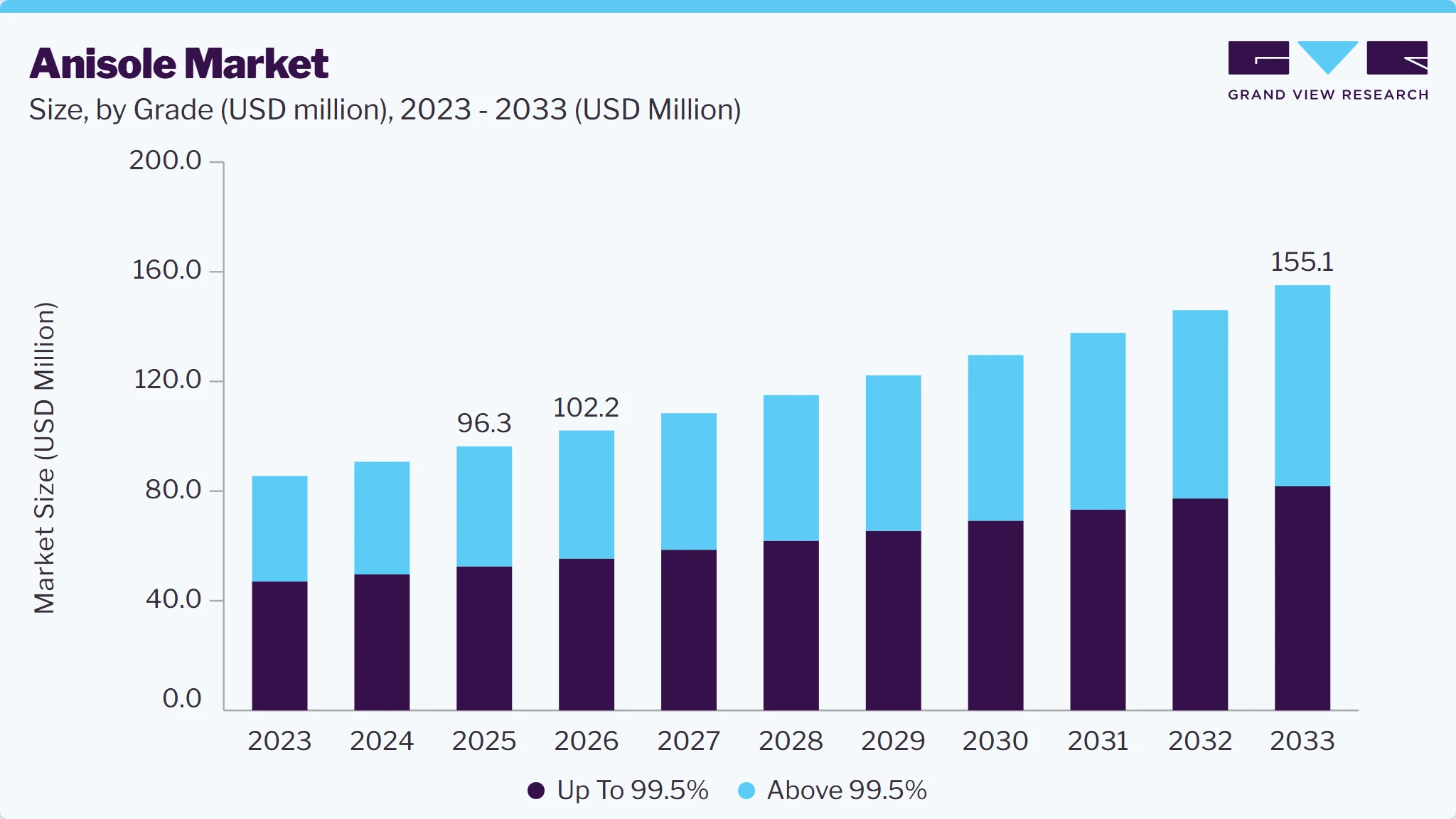
The global anisole market size was valued at USD 96.3 million in 2025 and is projected to grow from USD 102.2 million in 2026 to USD 155.1 million by 2033, at a CAGR of 6.1% from 2026 to 2033. Asia Pacific dominated the market, accounting for a revenue share of 31.0% in 2025. This growth is attributed to the growing demand in the pharmaceutical and cosmetics industries, as anisole is widely used in fragrances and drug formulations.
 Source: Grand View Research, IR Documents, Primary Interviews, Paid DatabasesTo learn more about this report,
 Download Free Sample Report
Key Market Trends & Insights
- By grade: Up to 99.5% segment led the market with the largest revenue share of 54.5% in 2025.
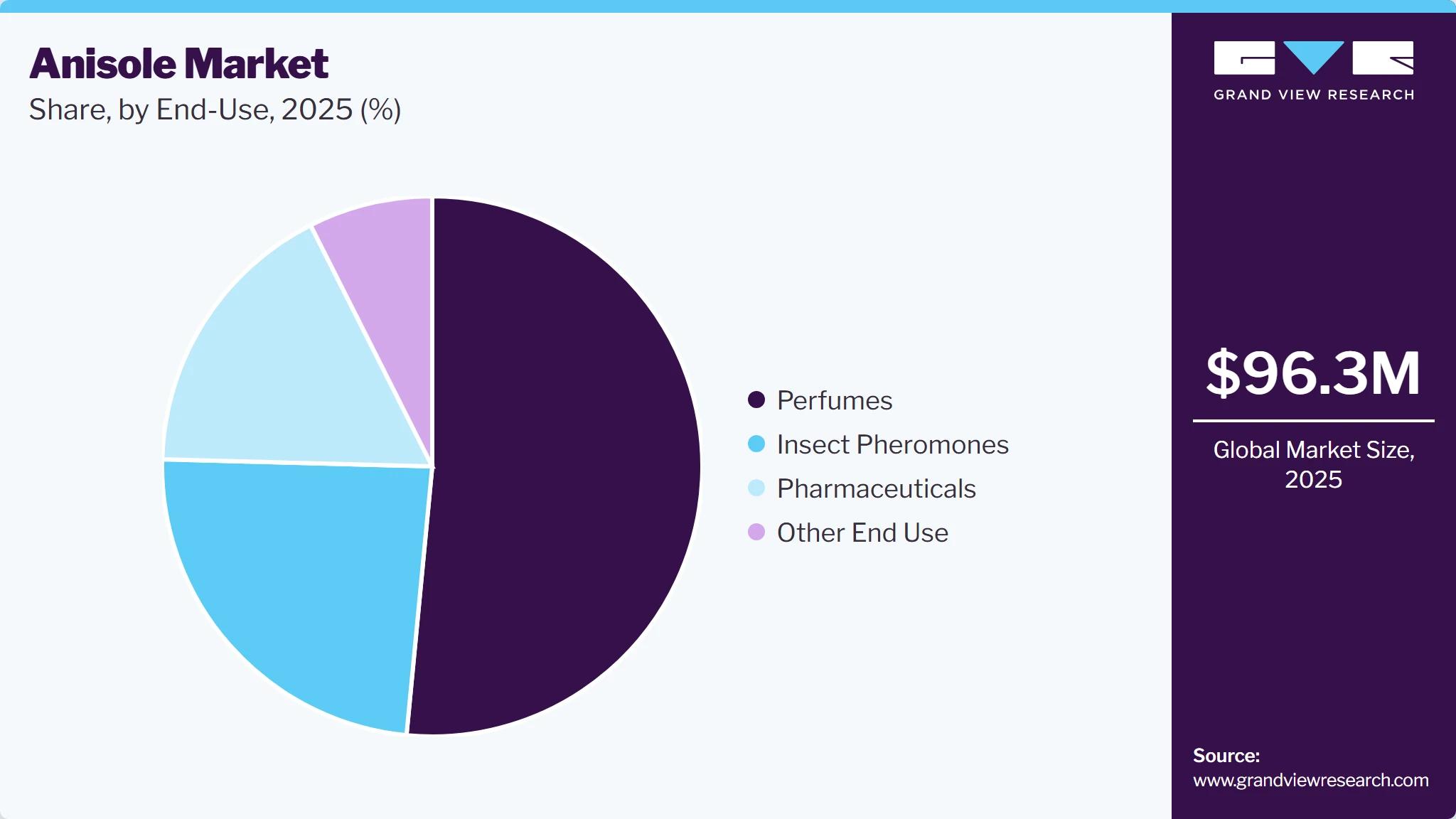
- By end-use: Perfumes segment by end use, accounted for the dominating revenue share of 51.5%.
Regional Highlights
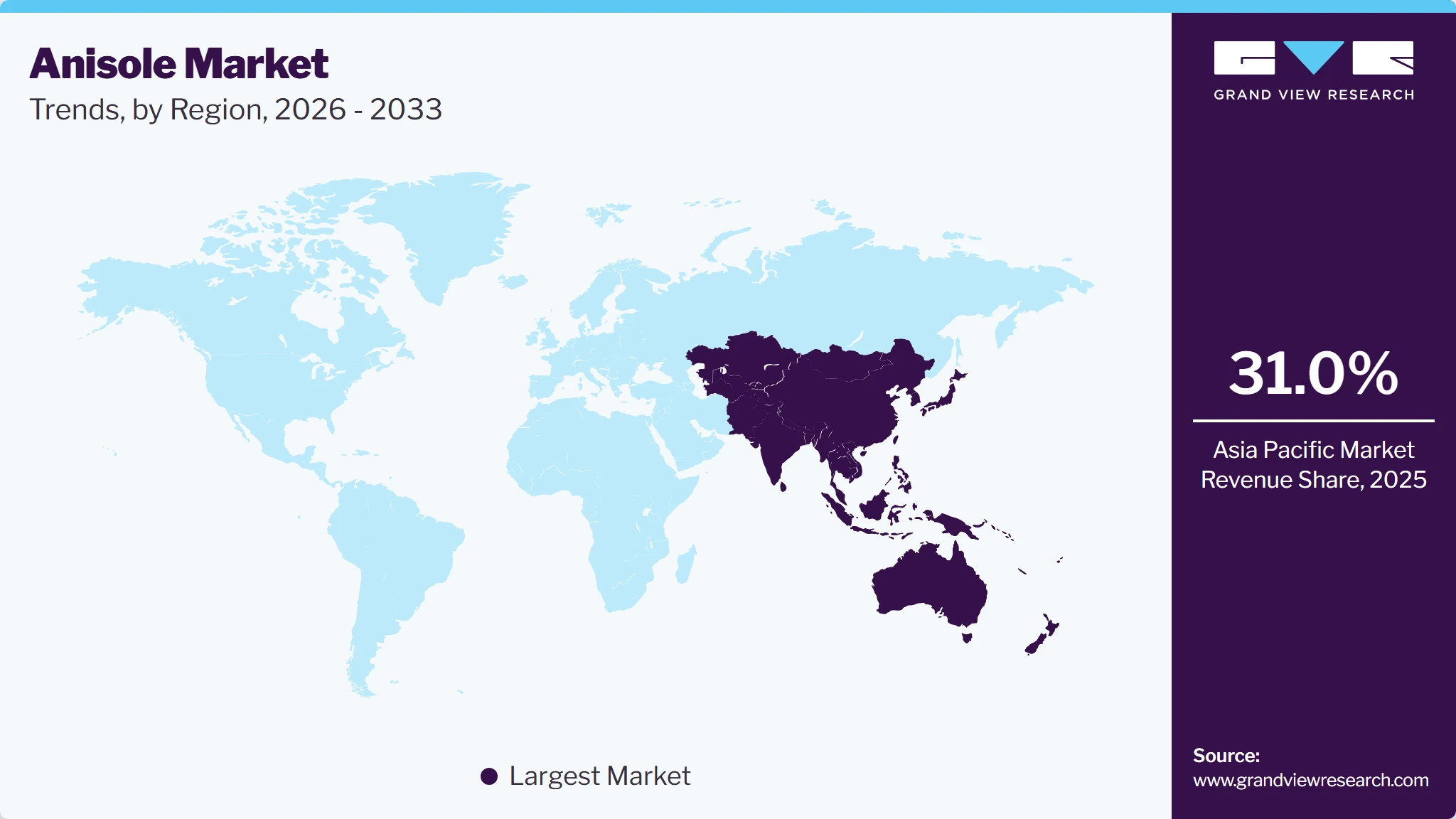
- Largest regional market: Asia Pacific (31.0% revenue share, 2025)
- By country: The China held the largest market share in 2025.
Market Size & Forecast
- Market size in 2025: USD 96.3 Million
- Estimated market size in 2026: USD 102.2 Million
- Projected market size by 2033: USD 155.1 Million
- CAGR (2026-2033): 6.1%
Three ways to get this report
Buy it, customize it, or ask a question.Ask an Analyst
Analyst response in 1 business day
- AccessReport author, directly
- Reply timeWithin 1 working day
- No sales callDirect answer only
- FormatEmail reply
- CostFree, no cost
Get the Full Report
What the study covers
- FormatsPDF · Excel · Dashboard
- Timeline2026–2033 annual, 2025 base
- Coverage20+ countries, 5 regions
- Companies10+ key players profiled
Customize the Report
20% free customization
- IncludeCountries, segments, points
- TailorTo your product definition
- ExtendDeeper competitor detail
- OrA fully bespoke study
- Turnaround5–10 working days
In addition, the rise in disposable incomes, particularly in developing regions, boosts consumer spending on personal care products. Furthermore, supportive regulations for anisole production and a shift towards eco-friendly alternatives enhance its market potential.Anisole is an organic compound characterized by its aromatic structure, consisting of a methoxy group attached to a benzene ring. The increasing interest in bio-based anisole presents numerous opportunities within the market as various industries transition towards more sustainable practices. This shift is largely influenced by global trends favoring eco-friendly chemical products, supported by regulatory measures such as the European Green Deal that advocate for greener industrial policies.
 To learn more about this report, Download Free Sample Report
In addition, the pharmaceutical sector significantly propels the anisole market, as it serves as a crucial intermediate in producing many drugs, including anti-inflammatory and analgesic medications. With an aging population and a growing prevalence of chronic diseases, the need for pharmaceuticals continues to rise, thereby increasing the demand for anisole. Furthermore, the flavor and fragrance industry utilizes anisole extensively in perfumes, cosmetics, and household products. The expanding luxury goods market and the popularity of essential oils further enhance this demand.
Moreover, anisole plays a vital role in agrochemicals, which create pesticides and herbicides. The need for effective crop protection solutions drives its consumption as agricultural demands grow alongside population increases.
Market Dynamics
Anisole is an aromatic ether widely used as an intermediate and solvent in the production of perfumes, pharmaceuticals, insect pheromones, and specialty chemical formulations. Its pleasant odor profile and chemical reactivity make it an important building block in fragrance synthesis and fine chemical manufacturing. Growing demand from the fragrance industry and expanding applications in agrochemicals and pharmaceuticals continue to support market growth globally.
The growing global fragrance and personal care industry is a major factor driving the anisole market. Anisole is widely used as a key intermediate in the synthesis of perfumes, aromatic compounds, and specialty fragrance ingredients. Rising consumer spending on personal care products, luxury fragrances, and cosmetic formulations continues to support demand across developed and emerging markets.
In addition, increasing innovation in fine fragrance formulations and growing demand for premium scent profiles are encouraging manufacturers to use anisole-based intermediates in complex aromatic synthesis. The expansion of the cosmetics and personal care sector further strengthens market growth prospects.
Stringent regulations related to the handling, storage, and usage of aromatic ether compounds pose a challenge for anisole manufacturers. Compliance with occupational safety standards, environmental emission norms, and chemical registration requirements can increase production and operational costs. Furthermore, increasing scrutiny on volatile organic compounds (VOCs) and potential environmental impact may limit usage in certain formulations. These regulatory pressures can restrict market expansion, particularly in regions with strict chemical safety frameworks.
Expanding applications of anisole in pharmaceuticals and insect pheromone synthesis are creating new growth opportunities. The compound is increasingly utilized as an intermediate in the production of active pharmaceutical ingredients and specialty chemical compounds. Additionally, rising demand for pheromone-based pest control solutions in sustainable agriculture is expected to support market expansion. Increasing investment in fine chemicals and specialty intermediates further strengthens long-term growth potential.
Analyst Perspective
The anisole market is increasingly being influenced by the expansion of high-value pharmaceutical intermediates and specialty aroma chemical applications. While pharmaceutical synthesis remains the dominant demand driver, emerging opportunities are developing in agrochemical intermediates, fine chemical manufacturing, and advanced industrial synthesis processes. Manufacturers are focusing on process optimization, purity enhancement, and sustainable chemical production methods to improve competitiveness. Additionally, rising demand for specialty chemicals in personal care and fragrance formulations is expected to support steady long-term growth of the anisole market.
Grade Insights
Based on grade, the up to 99.5% segment led the market with the largest revenue share of 54.5% in 2025. This growth is attributed to its extensive applications in pharmaceuticals and cosmetics. This grade is often favored for its cost-effectiveness while meeting the purity standards for various formulations. In addition, the increasing demand for affordable yet effective ingredients in personal care products and medications propels the consumption of anisole within this purity range as manufacturers seek to balance quality with production costs.
Above 99.5% grade is expected to grow at the fastest CAGR of 6.6% over the forecast period, owing to benefits from rising demand for high-purity anisole in specialized applications, particularly in the pharmaceutical industry. In addition, this segment is essential for producing active pharmaceutical ingredients and high-end fragrances, where superior purity is crucial for efficacy and safety. Furthermore, advancements in manufacturing processes that enhance purity levels contribute to the growth of this segment as industries increasingly prioritize quality and regulatory compliance in their products.
End-use Insights
In 2025, the perfumes segment by end use, accounted for the dominating revenue share of 51.5%, primarily driven by the increasing demand for unique and personalized fragrances. Anisole's sweet, pleasant aroma makes it a popular ingredient in luxury and mass-market perfumes, enhancing their overall scent profiles. Furthermore, expanding the cosmetics industry and rising disposable incomes contribute to greater spending on personal care products, further driving the demand for anisole in fragrance formulations.
 To learn more about this report, Download Free Sample Report
Insect pheromones are expected to grow at a CAGR of 6.0% from 2025 to 2030, owing to the growing emphasis on eco-friendly pest control solutions. In addition, anisole serves as a key component in synthesizing these pheromones, which are increasingly used in agricultural practices to manage pest populations sustainably. Furthermore, the shift towards green chemistry and natural alternatives in agriculture propels the demand for insect pheromones, positioning anisole as essential in developing effective and environmentally friendly pest management strategies.
Regional Insights
Asia Pacific dominated the anisole market with the highest revenue share of 31.0% in 2025. This growth is attributed to the rising demand for personal care products, particularly cosmetics and fragrances. In addition, as disposable incomes increase and consumer preferences shift towards premium products, the market for anisole is expanding rapidly. Furthermore, the growing population in urban areas and a heightened focus on grooming and self-care drive the consumption of scented products.
 To learn more about this report, Download Free Sample Report
China Anisole Market Trends
China accounted for a dominating revenue share of 28.0% of the Asia Pacific Anisole market in 2025, driven by its large population and urbanization trends that create a vast consumer base for cosmetics and personal care items. In addition, the increasing focus on quality and brand awareness among Chinese consumers is propelling demand for high-purity anisole in fragrance formulations. Furthermore, government initiatives promoting green chemistry encourage using bio-based chemicals, including anisole, thereby enhancing its market potential within the country.
North America Anisole Market Trends
North America anisole market is expected to grow at the fastest CAGR of 6.5% over the forecast period, owing to technological advancements and innovation within the chemical sector. In addition, the region's well-established pharmaceutical and cosmetic industries are driving demand for high-quality anisole as an essential ingredient in various formulations. Furthermore, ongoing research and development efforts aim to improve production methods, making them more efficient and environmentally friendly.
The U.S. anisole market dominated the North American market with the highest revenue share in 2024, primarily driven by a robust pharmaceutical sector that relies heavily on high-purity ingredients for drug formulation. Furthermore, the growing prevalence of chronic diseases has increased the demand for pharmaceuticals, boosting the need for anisole as a key intermediate. Moreover, the rising trend of eco-conscious consumers is prompting manufacturers to explore sustainable sourcing options, further driving the demand for bio-based anisole in various applications.
Europe Anisole Market Trends
Europe anisole market is expected to grow significantly over the forecast period, owing to strong demand from the pharmaceutical and fragrance industries. Furthermore, Germany’s well-established chemical sector emphasizes high-quality standards, which enhances the need for pure anisole in drug manufacturing and scent compositions. Moreover, regulatory frameworks promoting sustainable practices encourage manufacturers to adopt greener alternatives, thus increasing interest in bio-based anisole production within the region.
Key Anisole Company Insights
Key players in the global anisole industry include Evonik Industries AG, Solvay, Tokyo Chemical Industry Co., Ltd., and others. These companies employ several strategies to enhance their competitive edge, including investing in research and development to innovate and improve production processes and ensure higher purity levels and efficiency. Furthermore, companies are forming strategic partnerships and collaborations to expand their market reach and access new customer segments.
-
Solvay manufactures a diverse range of products, including anisole. The company operates within several segments, focusing on pharmaceuticals, agrochemicals, and specialty chemicals. Anisole is utilized as a key ingredient in various applications, such as fragrances, and as an intermediate in drug formulations.
-
Camlin Fine Sciences Ltd. offers various products, including anisole. The company operates primarily in the food, pharmaceutical, and agrochemical segments, focusing on providing high-quality ingredients for these industries. Anisole produced by the company is used in applications ranging from flavoring agents to intermediate pharmaceutical compounds.
Key Anisole Companies:
The following key companies have been profiled for this study on the anisole market.
- Evonik Industries AG
- Atul Ltd
- Solvay
- Tokyo Chemical Industry Co., Ltd.
- SURYA LIFE SCIENCES LTD.
- Thermo Fisher Scientific
- Emmennar Pharma Pvt. Ltd.
- Benzo Chem Industries Pvt. Ltd.
- Merck KGaA
- Camlin Fine Sciences Ltd.
Competitive Benchmarking
Category
Operating Strategies
Competitive Edge
Weakness
Established Players (Evonik Industries AG, Atul Ltd, Solvay, Merck KGaA, Thermo Fisher Scientific, Tokyo Chemical Industry Co., Ltd., Camlin Fine Sciences Ltd.)
- Expanding high-purity specialty chemical production for pharmaceutical and fragrance applications.
- Strengthening global supply chains to ensure consistent availability for industrial and research customers.
- Strong global presence supports reliable supply across pharmaceutical and fine chemical industries.
- Advanced chemical manufacturing expertise enables high-purity and consistent product quality.
- Exposure to regulatory restrictions on volatile organic compounds may impact production flexibility.
- High compliance and safety requirements increase operational and manufacturing costs.
Emerging Players (SURYA LIFE SCIENCES LTD., Emmennar Pharma Pvt. Ltd., Benzo Chem Industries Pvt. Ltd.)
- Focusing on regional production and cost-efficient supply of anisole for domestic pharmaceutical markets.
- Expanding customer base through contract manufacturing and niche chemical supply relationships.
- Competitive pricing structures support strong positioning in price-sensitive markets.
- Flexible production capabilities enable faster response to customized industrial requirements.
- Limited global presence restricts access to large multinational pharmaceutical customers.
- Smaller production scale reduces economies of scale compared to established global manufacturers.
Anisole Market Report Scope
Report Attribute
Details
Market size in 2025
USD 96.3 million
Estimated market size in 2026
USD 102.2 million
Projected market size by 2033
USD 155.1 million
Growth rate
CAGR of 6.1% from 2026 to 2033
Base year for estimation
2025
Historical data
2021 - 2024
Forecast period
2026 - 2033
Quantitative units
Revenue in USD million/billion, Volume in Kilotons and CAGR from 2026 to 2033
Report coverage
Revenue forecast, company ranking, competitive landscape, growth factors, and trends
Segments covered
Grade, End-Use, Region
Regional scope
North America; Europe; Asia Pacific; Latin America; MEA
Country scope
U.S.; Canada; Mexico; Germany; UK; France; Spain; Italy; China; Japan; India; South Korea; Brazil; Argentina; South Africa; Saudi Arabia
Key companies profiled
Evonik Industries AG; Atul Ltd; Solvay; Tokyo Chemical Industry Co., Ltd.; SURYA LIFE SCIENCES Ltd.; Thermo Fisher Scientific; Emmennar Pharma Pvt. Ltd.; Benzo Chem Industries Pvt. Ltd.; Merck KGaA; Camlin Fine Sciences Ltd.
Customization scope
Free report customization (equivalent up to 8 analysts' working days) with purchase. Addition or alteration to country, regional & segment scope.
Pricing and purchase options
Avail customized purchase options to meet your exact research needs. Explore purchase options
Global Anisole Market Report Segmentation
This report forecasts revenue growth at global, regional, and country levels and analyzes the latest industry trends in each sub-segment from 2021 to 2033. For this study, Grand View Research has segmented the global anisole market report based on grade, end-use, and region:
 To learn more about this report, Download Free Sample Report
-
Grade Outlook (Volume, Kilotons; Revenue, USD Million, 2021 - 2033)
-
Up to 99.5%
-
Above 99.5%
-
-
End-use Outlook (Volume, Kilotons; Revenue, USD Million, 2021 - 2033)
-
Perfumes
-
Pharmaceuticals
-
Insect Pheromones
-
Others
-
-
Regional Outlook (Volume, Kilotons; Revenue, USD Million, 2021 - 2033)
-
North America
-
U.S.
-
Canada
-
Mexico
-
-
Europe
-
Germany
-
UK
-
France
-
Italy
-
Spain
-
-
Asia Pacific
-
China
-
India
-
Japan
-
South Korea
-
-
Latin America
-
Brazil
-
Argentina
-
-
Middle East and Africa
-
Saudi Arabia
-
South Africa
-
-
Research Methodology
The anisole market figures in this report are based on a proven research process that combines executive interviews with secondary research from proprietary databases, company filings, and recognized regulatory and institutional sources. Market size is built through value-chain sizing - reconciling supply-side and demand-side estimates - and triangulated with bottom-up and top-down approaches. Every estimate passes multiple levels of expert validation before publication, with each anisole segment quantified using the revenue-capture definitions in the table below.
Segment Definition
Segment - Grade
Revenue capture definition
Up To 99.5%
As the dominant grade segment, revenue is generated through large-scale supply of anisole used in fragrance synthesis, pharmaceutical intermediates, and industrial chemical applications where cost efficiency and adequate purity levels are required.
Above 99.5%
Revenue is driven by high-purity anisole demand in specialty pharmaceutical synthesis, advanced fragrance formulations, and precision chemical manufacturing processes requiring stringent quality standards.
Segment - End-Use
Revenue capture definition
Perfumes
As the largest end-use segment, revenue is generated through anisole utilization in fragrance synthesis for perfumes, personal care products, cosmetics, and aroma chemicals requiring aromatic ether intermediates.
Pharmaceuticals
Market value is derived from anisole use as a chemical intermediate in active pharmaceutical ingredient synthesis and specialty drug manufacturing applications.
Insect Pheromones
Revenue is supported by anisole’s role in pheromone synthesis used for sustainable pest control solutions in agricultural applications.
Other End Use
This segment captures revenue from agrochemicals, fine chemicals, laboratory reagents, and specialty industrial applications utilizing anisole as a solvent or intermediate.
Estimation Model
Layer Name
Key Question
Description
Chemical Production Layer
What forms the addressable base?
Identify global production volumes of aromatic intermediates and ether compounds used in fragrance synthesis, pharmaceutical manufacturing, and specialty chemical industries.
Application Adoption Layer
Where is anisole utilized?
Estimate the proportion of anisole consumed in perfumes, pharmaceuticals, insect pheromone synthesis, and other chemical applications based on industrial demand patterns.
Consumption Intensity Layer
How much anisole is consumed?
Analyze formulation ratios, synthesis requirements, production volumes, and end-use manufacturing processes to determine annual anisole consumption across key application segments.
Revenue Layer
How is market revenue generated?
Market revenue is quantified through the sale of anisole supplied to fragrance manufacturers, pharmaceutical companies, agrochemical producers, and specialty chemical industries for downstream synthesis and formulation applications.
Delivered Customizations
This report has been delivered with the following In-depth customizations
Client Request
Customization Delivered
Value Adds
Regional Segmentation
The study delivers additional country-level insights covering Indonesia, Thailand, and Vietnam, evaluating anisole consumption trends across pharmaceutical, fragrance, and specialty chemical industries, along with demand dynamics and growth patterns across key industrial applications.
Enables stakeholders to identify emerging Asia Pacific demand hubs, assess country-specific consumption intensity, and develop targeted expansion strategies across high-growth pharmaceutical, fragrance, and specialty chemical markets.
Cross-Segmentation Analysis
The study delivers detailed cross-segmentation analysis assessing cyclohexanone demand across major grade by applications, highlighting consumption patterns, market attractiveness, utilization trends, and growth opportunities across downstream sectors.
Helps companies identify high-value application-industry combinations, optimize market positioning strategies, and prioritize investments based on evolving demand dynamics across end-use markets.
Opportunity Assessment
The study delivers comprehensive benchmarking of leading and emerging manufacturers based on production capacity, value chain integration, geographic presence, operational capabilities, product portfolio strength, and strategic developments.
Assists stakeholders in evaluating competitive positioning, identifying operational advantages, benchmarking industry performance, and supporting informed investment and business expansion decisions.
Frequently Asked Questions About This Report
Some key players operating in the anisole market Evonik Industries AG; Atul Ltd; Solvay; Tokyo Chemical Industry Co., Ltd.; SURYA LIFE SCIENCES Ltd.; Thermo Fisher Scientific; Emmennar Pharma Pvt. Ltd.; Benzo Chem Industries Pvt. Ltd.; Merck KGaA; Camlin Fine Sciences Ltd.
The anisole market is primarily driven by rising demand from the pharmaceutical, fragrance, and specialty chemical industries, where it is widely used as an intermediate in the synthesis of active ingredients and aromatic compounds. Growing consumption of personal care products, coupled with increasing investments in fine chemical manufacturing and research applications, is further supporting market growth.
The global anisole market size was valued at USD 96.3 million in 2025 and is expected to reach USD 102.2 million in 2026.
The global anisole market is expected to grow at a compound annual growth rate of CAGR of 6.1% from 2026 to 2033 to reach USD 155.1 million by 2033.
Based on grade, the up to 99.5% segment led the market with the largest revenue share of 54.5% in 2025. The segment's dominance is attributed to its cost-effectiveness and widespread use in fragrance formulations, chemical intermediates, and industrial manufacturing processes where ultra-high purity is not essential.
In 2025, the perfumes segment by end use, accounted for the dominating revenue share of 51.5%. Its leading position is supported by the widespread use of anisole as a key aromatic intermediate in fragrance formulations, driven by sustained demand for premium perfumes and personal care products.
The anisole market is driven by increasing demand from the pharmaceutical, fragrance, and specialty chemical industries, while opportunities are emerging from the growing adoption of high-purity anisole in advanced formulations and expanding applications in developing economies.
The anisole market faces restraints from stringent environmental and chemical safety regulations, fluctuations in raw material prices, and the availability of alternative aromatic intermediates that can limit its adoption in certain applications.
Asia Pacific dominated the anisole market with the highest revenue share of 31.0% in 2025. The region’s leadership is supported by its large-scale chemical manufacturing base, expanding pharmaceutical production, and strong demand from the fragrances and specialty chemicals industries, particularly in China and India.
About the Author(s)
Personal Care & Cosmetics Research Team
Bulk Chemicals · Personal Care & CosmeticsThis report was authored by the personal care & cosmetics research team at Grand View Research - comprising two research analysts, one senior research analyst, and one industry expert - with specialized expertise in the personal care & cosmetics segment of the bulk chemicals industry. All findings are based on proprietary bulk chemicals databases, executive interviews, and regulatory analysis, subject to internal peer review prior to publication.
Last Updated:
Speak to Analyst

Customize this report to your needs - add regions, segments, or data points, with 20% free customization.
Or view our licence options:


ISO 9001:2015 & 27001:2022 Certified
We are GDPR and CCPA compliant! Your transaction & personal information is safe and secure. For more details, please read our privacy policy.


