
- Home
- »
- Paints, Coatings & Printing Inks
- »
-
Antimicrobial Coatings Market Size, Share Report 2026-2033GVR Report cover

Antimicrobial Coatings Market (2026 - 2033)
Size, Share & Trends Analysis Report By Product (Antimicrobial Powder Coatings, Surface Modifications & Coatings), By Application (Construction, Medical Devices), By Region, And Segment Forecasts
Market Size, 2025
$14.5BMarket Estimate, 2026
$16.5BMarket Forecast, 2033
$44.0BCAGR, 2026–2033
15.0%Antimicrobial Coatings Market Summary
The global antimicrobial coatings market size was valued at USD 14.5 billion in 2025 and is projected to grow from USD 16.5 billion in 2026 to USD 44.0 billion by 2033, at a CAGR of 15.0% from 2026 to 2033. North America dominated the market, accounting for a revenue share of 45.4% in 2025. Growing concern regarding cleanliness in various professional industries has led to the rapid development of this industry.
 Source: Grand View Research, IR Documents, Primary Interviews, Paid DatabasesTo learn more about this report,
 Download Free Sample Report
 Key Market Trends & Insights
- By product: Surface modifications and coatings accounted for the highest market share, representing 53.5% of total revenue in 2025.
- By application: Medical devices held a dominant position, contributing 38.7% of total revenue in 2025.
Regional Highlights
- By country: The U.S. held the largest market share in 2025.
- Largest regional market: North America (45.4% revenue share, 2025)
Market Size & Forecast
- Market size in 2025: USD 14.5 Billion
- Estimated market size in 2026: USD 16.5 Billion
- Projected market size by 2033: USD 44.0 Billion
- CAGR (2026-2033): 15.0%
Three ways to get this report
Buy it, customize it, or ask a question.Ask an Analyst
Analyst response in 1 business day
- AccessReport author, directly
- Reply timeWithin 1 working day
- No sales callDirect answer only
- FormatEmail reply
- CostFree, no cost
Get the Full Report
What the study covers
- FormatsPDF · Excel · Dashboard
- Timeline2026–2033 annual, 2025 base
- Coverage20+ countries, 5 regions
- Companies10+ key players profiled
Customize the Report
20% free customization
- IncludeCountries, segments, points
- TailorTo your product definition
- ExtendDeeper competitor detail
- OrA fully bespoke study
- Turnaround5–10 working days
These are used to protect surfaces against micro-organisms, which primarily include parasites, germs, bacteria, and unwanted micro-organisms. However, the segment is expected to grow at a higher rate than the sanitary facilities, kitchen, and air conditioning and ventilation systems application segment. Rising concerns regarding Hospital-acquired Infections (HAIs) are also boosting the overall industry growth. Doctors prefer antimicrobial coatings over disinfectants and cleaning agents. To learn more about this report, Download Free Sample Report
 This would also help reduce both cost and time for the hospitals in which they are prominently used. They help in curbing the spread of germs, which can otherwise cause weakened immune systems among people. Nevertheless, health concerns related to silver usage in various applications along with strict regulations in the European Union and the U.S. are presumed to create a hindrance to the overall demand.
In the recent past, the antibiotic application directly on the local surface is considered more efficient as compared to the antibiotics penetration through biofilm. The bacteria are killed instantly before the biofilm is formed. These antibiotics can be applied in bone cement that is used to fix implants associated with orthopedic and orthodontic implants.
The SHER-NAR coating must conform to the requirements of the American Architectural Manufacturers Association, which primarily involves a three-coat finishing procedure. The most efficient coatings option, AAMA 2605-13, is frequently used in architectural applications.
Market Dynamics
The antimicrobial coatings market is being driven by increasing emphasis on infection prevention, stringent hygiene regulations, and rising awareness of surface-borne disease transmission across healthcare, food processing, and public infrastructure. Demand is accelerating as hospitals, pharmaceutical manufacturers, and food packaging companies adopt antimicrobial coatings to enhance product safety, reduce microbial contamination, and extend the service life of treated surfaces. Technological advancements in silver-, copper-, and bio-based antimicrobial formulations are improving coating durability, efficacy, and compatibility with diverse substrates, further supporting market expansion. However, high production costs associated with advanced antimicrobial agents and evolving environmental regulations governing chemical compositions pose challenges for manufacturers. Companies are therefore focusing on research and development to develop sustainable, non-toxic, and long-lasting coating solutions that comply with regulatory standards while delivering superior antimicrobial performance. Strategic collaborations, product innovation, and expanding industrial adoption are expected to sustain long-term market growth and strengthen the competitive landscape.
The growing emphasis on infection prevention and hygiene management is a primary driver of the antimicrobial coatings market. Healthcare facilities, including hospitals, clinics, diagnostic laboratories, and long-term care centers, are increasingly incorporating antimicrobial coatings on medical devices, surgical equipment, walls, door handles, and high-touch surfaces to minimize the risk of healthcare-associated infections (HAIs). Beyond healthcare, industries such as food processing, hospitality, transportation, and commercial buildings are adopting antimicrobial coatings to maintain cleaner environments and comply with stringent hygiene protocols. This expanding awareness of microbial contamination is significantly increasing the demand for advanced coating technologies.
Regulatory agencies and industry standards promoting sanitation and workplace safety are encouraging manufacturers to integrate antimicrobial functionality into their products. The increasing construction of healthcare infrastructure, coupled with investments in public transportation systems, educational institutions, and smart buildings, is creating sustained demand for antimicrobial coatings. Continuous innovation in silver, copper, and other antimicrobial technologies is also improving coating performance, durability, and application versatility, enabling broader adoption across multiple end-use industries.
The high cost associated with advanced antimicrobial coating formulations remains a significant restraint for the antimicrobial coatings market. Premium antimicrobial agents such as silver nanoparticles and specialized copper compounds substantially increase production costs compared to conventional coating materials. In addition to expensive raw materials, manufacturers incur considerable expenses related to research and development, performance validation, regulatory compliance, and quality assurance to ensure long-term antimicrobial effectiveness and product safety. These elevated costs often translate into higher product prices, limiting adoption among price-sensitive industries and small- and medium-sized enterprises. Fluctuating raw material prices and increasingly stringent environmental regulations add further financial pressure on manufacturers. Although technological advancements are gradually improving production efficiency, cost competitiveness continues to be a critical challenge, particularly in emerging markets where purchasing decisions are heavily influenced by budget constraints rather than value-added performance.
The transition toward environmentally sustainable and high-performance antimicrobial coating solutions presents a significant growth opportunity for market participants. Increasing regulatory scrutiny over hazardous chemicals and volatile organic compound (VOC) emissions is encouraging manufacturers to develop eco-friendly coatings with reduced environmental impact while maintaining long-lasting antimicrobial efficacy. Innovations in bio-based antimicrobial agents, nanotechnology, and multifunctional coatings are enabling companies to differentiate their product portfolios and address evolving customer requirements.
Expanding applications across residential construction, consumer appliances, HVAC systems, antimicrobial textiles, and food packaging are opening new revenue streams for manufacturers. Emerging economies are investing heavily in healthcare facilities, urban infrastructure, and industrial modernization, creating favorable conditions for antimicrobial coating adoption. Companies that invest in research and development, strategic collaborations, and customized coating solutions for industry-specific applications are well positioned to capitalize on these emerging opportunities and strengthen their competitive presence in the global market.
Analyst Perspective
The antimicrobial coatings market is supported by increasing demand for infection control, stringent hygiene regulations, and expanding applications across healthcare, food processing, and construction industries. Technological advancements in silver-, copper-, and bio-based antimicrobial formulations are enhancing coating performance, durability, and environmental compliance. Manufacturers are increasingly focusing on sustainable, low-VOC, and multifunctional coating solutions to address evolving regulatory and customer requirements. Emerging economies present significant growth potential due to rising investments in healthcare infrastructure and commercial construction. Companies that prioritize innovation, strategic partnerships, and application-specific product development are expected to strengthen their competitive position and capture long-term market opportunities.
Product Insights
Based on product, the surface modifications and coatings accounted for the highest market share, representing 53.5% of total revenue in 2025. This high share is attributed to its ability to modify the surface of a material by bringing physical, chemical, or biological characteristics different from the ones originally found on the surface of a material. This modification is usually made to solid materials, but it is possible to find examples of the modification to the surface of specific liquids.
The modification can be done by different methods to alter a wide range of characteristics of the surface, such as roughness, hydrophilicity, surface charge, surface energy, and biocompatibility. The formation of biofilm on an orthopedic implant surface is one of the major problems for the patient prognosis and increases the overall cost associated with the treatment of patients.
 To learn more about this report, Download Free Sample Report
 The use of surface modifications in a manner would help in imparting antimicrobial benefits to the implant devices. Owing to their unique properties, such as surface adhesion prevention, antimicrobial-eluting, bactericidal, and Osseo integration promotion, surface modifications, and coatings are expected to drive demand during the forecast period. Based on the products, the antimicrobial powder coatings market can be categorized into silver, copper, and others.
Silver has the largest consumption among all these coatings. This is owing to the use of silver in coatings has experienced a dramatic revival. Inorganic silver antimicrobial coating systems based on silver salts, colloidal silver, silver zeolite or ion exchange resins, complex glasses containing metal ions, and Nano-silver have been in high demand in the healthcare industry.
Application Insights
By application, medical devices held a dominant position, contributing 38.7% of total revenue in 2025. Its high share is attributable to the rising demand for antimicrobial coatings in catheters, implantable, and surgical instruments, as they are biocompatible, non-toxic, and biostable, which will promote industry development over the forecast period. The presence of key medical equipment players including GE Healthcare Technologies, Johnson & Johnson, Baxter International Inc., and Stryker Corp. is likely to boost the production of antimicrobial coated medical devices.
This, in turn, is expected to drive the market during the forecast period. North America will witness immense market growth owing to the rising healthcare expenditure in the U.S. The presence of various coating manufacturers in the U.S. including SurModics, Inc., Hydromer, Inc., Materion Corp., Specialty Coating Systems, Inc., and Precision Coating Co., Inc., will also propel industry expansion during the forecast period.
Medical devices have been one of the leading applications of antimicrobial coatings over the past few years. The rising number of hospitals along with the increasing requirement for healthcare facilities creates a need for sophisticated devices and equipment, which will augment product demand.
Regional Insights
North America dominated the antimicrobial coatings market with the highest revenue share of 45.4% in 2025. North America construction industry is expected to witness considerable growth owing to increasing demand for non-residential construction projects, such as hospitals, schools, and colleges, during the forecast period. The implementation of the “Affordable Healthcare Act” in the U.S. has triggered the construction of healthcare units and hospitals. The growing population is expected to further boost the construction of office spaces, industrial plants, schools, and colleges, thereby, driving the demand for antimicrobial coatings in construction applications.
 To learn more about this report, Download Free Sample Report
 U.S. accounted for 80.9% of the North American antimicrobial coatings market in 2025. The robust manufacturing base of the packaging products industry in China, Japan, and India coupled with increased sales of e-commerce and packed food products is anticipated to augment the market growth in the near future. In addition, favorable policies, such as Foreign Direct Investments (FDI) and Make in India, implemented by the government of India are expected to create ample growth opportunities for the food processing and healthcare industry, which, in turn, is expected to increase the consumption of antimicrobial coatings in the region.
Key Companies & Market Share Insights
Companies in the global antimicrobial coatings market compete based on the product quality offered and the technology used for the production. Major players focus on infrastructural development and expansion of their manufacturing facilities. Companies also invest in R&D and seek opportunities to vertically integrate across the value chain. These initiatives help them cater to the increasing global demand, ensure competitive effectiveness, enhance their sales & operations planning, develop innovative products & technologies, bring down their production costs, and expand their customer base.
For, instance, in March 2023, AkzoNobel formed a strategic partnership with BioCote to extend the reach of their antimicrobial powder coatings under the “Interpon” brand. This collaboration enables the application of these coatings on a wide range of internal surfaces including ceiling tiles, window frames, metal doors, metal office partitions, and elevator doors. By expanding its product portfolio in this manner, AkzoNobel aims to meet the diverse needs of its customers and enhance its market presence in the anti-microbial coatings industry
Key Antimicrobial Coatings Companies
The following key companies have been profiled for this study on the antimicrobial coatings market.
-
AkzoNobel N.V.
-
AK Steel Corp.
-
Lonza
-
Diamond Vogel
-
DuPont
-
Axalta Coating Systems
-
Nippon Paint Holdings Co., Ltd.
-
PPG Industries, Inc.
-
RPM International Inc.
-
Koninklijke DSM N.V.
-
Burke Industrial Coatings
-
The Sherwin-Williams Company
-
Troy Corporation
Competitive Benchmarking
Operating Strategies
Competitive Edge
Weaknesses
Established Players (AkzoNobel N.V., Lonza, DuPont, Axalta Coating Systems, Nippon Paint Holdings Co., Ltd., PPG Industries, Inc., RPM International Inc., Koninklijke DSM N.V., The Sherwin-Williams Company)
- Invest heavily in R&D to develop advanced antimicrobial coating technologies.
- Expand portfolios through acquisitions, strategic partnerships, and licensing agreements.
- Maintain global manufacturing and distribution networks to serve diverse end-use industries.
- Focus on sustainability by introducing low-VOC and environmentally compliant coating solutions.
- Strong global brand recognition and established customer relationships.
- Extensive intellectual property portfolios and advanced formulation expertise.
- Broad product offerings across healthcare, construction, food processing, and industrial sectors.
- Robust financial resources supporting continuous innovation and capacity expansion.
- Large organizational structures may slow decision-making and product commercialization.
- High operating and compliance costs associated with global manufacturing operations.
- Dependence on premium raw materials increases exposure to price volatility.
- Complex product portfolios can limit flexibility in addressing niche market requirements.
Emerging Players (AK Steel Corp., Diamond Vogel, Burke Industrial Coatings, Troy Corp.)
- Concentrate on niche applications and customized antimicrobial formulations.
- Expand regional presence through collaborations with local distributors and OEMs.
- Prioritize flexible manufacturing to address specialized customer requirements.
- Increase investments in product development to strengthen market positioning.
- Faster response to evolving customer needs through agile product development.
- Ability to provide tailored coating solutions for specific industries and applications.
- Lean organizational structures enable quicker commercialization of new products.
- Competitive pricing strategies enhance penetration in regional and emerging markets.
- Limited geographic reach and distribution capabilities compared to multinational competitors.
- Lower R&D budgets may restrict the pace of technological innovation.
- Smaller production capacities can constrain large-scale project execution.
- Reduced brand recognition may create challenges in securing contracts with major industrial and healthcare customers.
Antimicrobial Coatings Market Report Scope
Report Attribute
Details
Market size in 2025
USD 14.5 billion
Estimated market size in 2026
USD 16.5 billion
Projected market size by 2033
USD 44.0 billion
Growth rate
CAGR of 15.0% from 2026 to 2033
Base year for estimation
2025
Historical data
2021 - 2024
Forecast period
2026 - 2033
Quantitative units
Revenue in USD million/million, Volume in Kilotons and CAGR from 2026 to 2033
Report coverage
Revenue forecast, company ranking, competitive landscape, growth factors, and trends
Segments covered
Product, application, region
Regional scope
North America; Europe; Asia Pacific; Central & South America; Middle East & Africa
Country scope
U.S.; Germany; UK; France; China; India
Key companies profiled
AkzoNobel N.V.; AK Steel Corp.; Lonza; Diamond Vogel; DuPont; Axalta Coating Systems; Nippon Paint Holdings Co., Ltd.; PPG Industries, Inc.; RPM International Inc.; Koninklijke DSM N.V.; Burke Industrial Coatings; The Sherwin-Williams Company; Troy Corp.
Customization scope
Free report customization (equivalent up to 8 analysts' working days) with purchase. Addition or alteration to country, regional & segment scope.
Pricing and purchase options
Avail customized purchase options to meet your exact research needs. Explore purchase options
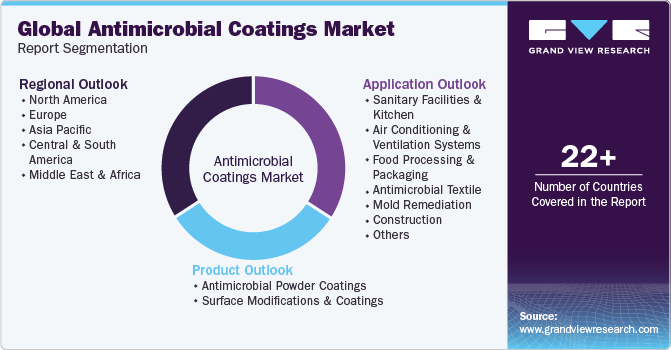
Global Antimicrobial Coatings Market Report Segmentation
This report forecasts revenue growth at global, regional, and country levels and provides an analysis of the latest industry trends and opportunities in each of the sub-segments from 2021 to 2033. For this report, Grand View Research has segmented the global antimicrobial coatings market report based on the product, application, and region:
 To learn more about this report, Download Free Sample Report
 -
Product Outlook (Volume, Kilotons; Revenue, USD Million, 2021 - 2033)
-
Antimicrobial Powder Coatings
-
Silver
-
Copper
-
Others
-
-
Surface Modifications & Coatings
-
Silver
-
Copper
-
Others
-
-
-
Application Outlook (Volume, Kilotons; Revenue, USD Million, 2021 - 2033)
-
Sanitary Facilities And Kitchen
-
Air Conditioning And Ventilation Systems
-
Food Processing And Packaging
-
Antimicrobial Textile
-
Mold Remediation Construction
-
Medical Devices
-
Others
-
-
Regional Outlook (Volume, Kilotons; Revenue, USD Million, 2021 - 2033)
-
North America
-
U.S.
-
-
Europe
-
Germany
-
U.K.
-
France
-
-
Asia Pacific
-
China
-
India
-
-
Central & South America
-
Middle East & Africa
-
Research Methodology
The antimicrobial coatings market figures in this report are based on a proven research process that combines executive interviews with secondary research from proprietary databases, company filings, and recognized regulatory and institutional sources. Market size is built through value-chain sizing-reconciling supply-side and demand-side estimates-and triangulated with bottom-up and top-down approaches. Every estimate passes multiple levels of expert validation before publication, with each antimicrobial coatings segment quantified using the revenue-capture definitions in the table below.
Segment Definition
Segment – Product
Revenue capture definition
Antimicrobial powder coatings
Revenue is generated through the manufacturing and distribution of durable powder-based antimicrobial coatings applied to metal and industrial surfaces across healthcare, construction, appliances, and public infrastructure. Demand is supported by their long-lasting protection, corrosion resistance, and reduced maintenance requirements.
Surface modification and coatings
Market revenue originates from advanced surface treatment technologies that impart antimicrobial functionality to substrates without significantly altering their physical properties. Increasing deployment in medical equipment, food-contact surfaces, and high-touch environments strengthens commercial adoption.
Segment – Application
Revenue capture definition
Sanitary facilities and kitchen
Commercial returns are derived from antimicrobial coating applications on sinks, countertops, fixtures, cabinets, and food preparation surfaces where enhanced hygiene, stain resistance, and microbial control are essential for residential and commercial environments.
Air conditioning and ventilation systems
Revenue is supported by coating solutions applied to HVAC ducts, filters, coils, and ventilation components to inhibit microbial growth, improve indoor air quality, and reduce maintenance requirements in commercial and institutional buildings.
Food processing and packaging
Sales are driven by antimicrobial coatings used on food-contact equipment, processing lines, storage systems, and packaging materials to minimize contamination risks, extend product shelf life, and ensure compliance with food safety regulations.
Antimicrobial textile
Income is generated from specialty coatings incorporated into medical fabrics, protective clothing, upholstery, and consumer textiles that provide continuous microbial protection while improving product durability and hygiene performance.
Mold remediation
Revenue is created through protective coating systems designed to suppress mold, mildew, and fungal growth on walls, ceilings, and structural surfaces, supporting long-term building maintenance and indoor environmental quality.
Construction
Market value is captured through antimicrobial coatings applied to building materials, interior finishes, and frequently touched architectural surfaces, enhancing durability, cleanliness, and occupant safety across residential and commercial projects.
Medical devices
Revenue stems from antimicrobial surface technologies integrated into surgical instruments, diagnostic equipment, implants, catheters, and other medical devices to reduce infection risks and improve patient outcomes in healthcare settings.
Other Applications
Earnings are generated from diverse end-use sectors including transportation, consumer electronics, marine equipment, and industrial machinery, where antimicrobial coatings enhance product longevity, hygiene standards, and operational reliability.
Estimation Model
Layer Name
Key Question
Description
Raw Material & Production Layer
What forms the supply base?
Examine the global manufacturing ecosystem for antimicrobial coatings based on antimicrobial agents such as silver, copper, zinc, and specialty organic compounds, along with resins, binders, pigments, solvents, additives, and nanomaterials. Assess raw material availability, formulation technologies, production capabilities, manufacturing facilities, supplier networks, and regional production centers supporting commercial-scale coating development.
Application Adoption Layer
Where are antimicrobial coatings utilized?
Evaluate deployment across key end-use sectors including healthcare facilities, food processing and packaging, HVAC systems, sanitary infrastructure, construction materials, textiles, and medical devices. Adoption is influenced by stringent hygiene standards, infection prevention initiatives, regulatory compliance, infrastructure modernization, and growing demand for durable antimicrobial surface protection.
Consumption Intensity Layer
How much antimicrobial coating is utilized?
Quantify coating consumption by assessing application rates across medical equipment, building materials, ventilation components, food-contact surfaces, textiles, and public infrastructure. The analysis considers coating thickness, substrate coverage, replacement cycles, production volumes, and sector-specific demand patterns to estimate annual product utilization across major regional markets.
Revenue Layer
How is market revenue generated?
Market revenue is generated through the development, production, and commercialization of antimicrobial coating solutions supplied to healthcare, construction, food processing, consumer goods, and industrial sectors. Commercial performance is driven by formulation effectiveness, coating durability, regulatory certifications, technological advancements, customer-specific requirements, strategic partnerships, and expanding investments in hygienic and high-performance surface protection solutions.
Delivered Customizations
This report has been delivered with the following In-depth customizations
Client Request
Customization Delivered
Value Adds
Cross-segmentation
The assessment covers production capacity, healthcare infrastructure development, regulatory frameworks, raw material availability, manufacturing capabilities, end-use demand, and adoption trends across antimicrobial powder coatings and surface modification technologies.
Enables stakeholders to identify high-growth regional markets, evaluate end-use demand patterns, benchmark manufacturing capabilities, understand regulatory environments, and formulate effective market expansion and investment strategies.
Trade Assessment
The report delivers an in-depth evaluation of historical and current trade dynamics for antimicrobial coatings, covering imports, exports, leading manufacturing and consuming countries, international supply chains, pricing trends, raw material sourcing, and logistics networks. The analysis also examines regional production concentration, procurement practices, and cross-border distribution influencing product availability and market competitiveness.
Supports strategic procurement decisions by identifying sourcing risks, strengthening supply chain resilience, uncovering export opportunities, improving supplier diversification, and enhancing visibility into global trade movements affecting the antimicrobial coatings industry.
Opportunity Assessment
The study presents a detailed evaluation of emerging growth opportunities across healthcare, medical devices, food processing and packaging, HVAC systems, construction, antimicrobial textiles, and sanitary applications. It further analyzes opportunities created by rising infection prevention requirements, sustainable coating technologies, increasing healthcare investments, and expanding demand for high-performance antimicrobial surface solutions across developed and emerging economies.
Assists organizations in prioritizing high-potential application areas, identifying attractive investment opportunities, aligning product development with evolving customer requirements, and capturing long-term growth driven by innovation, regulatory compliance, and expanding hygiene-focused industries.
Frequently Asked Questions About This Report
Some of the key players operating in the antimicrobial coatings market include AkzoNobel N.V.; AK Steel Corp.; Lonza; Diamond Vogel; DuPont; Axalta Coating Systems; Nippon Paint Holdings Co., Ltd. and others.
Surface modifications and coatings accounted for the highest market share, representing 53.5% of total revenue in 2025.
North America dominated the antimicrobial coatings market with the highest revenue share of 45.4% in 2025. The region's leadership is supported by robust healthcare infrastructure, stringent infection control regulations, widespread adoption of advanced coating technologies, and strong investments in medical devices and hygienic building materials.
By application, medical devices held a dominant position, contributing 38.7% of total revenue in 2025. The segment's leadership is supported by the growing adoption of antimicrobial-coated surgical instruments, implants, catheters, and diagnostic equipment to reduce healthcare-associated infections and improve patient safety.
The antimicrobial coatings market is primarily driven by rising demand for infection prevention across healthcare, food processing, and public infrastructure, along with increasingly stringent hygiene and safety regulations. Technological advancements in durable, eco-friendly antimicrobial formulations and growing investments in healthcare infrastructure and high-performance building materials are further accelerating market growth.
The global antimicrobial coatings market size was estimated at USD 14.5 billion in 2025 and is expected to reach USD 16.5 billion in 2026.
The global antimicrobial coatings market is expected to grow at a compound annual growth rate of 15.0% from 2026 to 2033 to reach USD 44.0 billion by 2033.
Based on product, the surface modifications and coatings accounted for the highest market share, representing 53.5% of total revenue in 2025. The segment's leadership is supported by its broad adoption across healthcare, food processing, construction, and public infrastructure, where long-lasting antimicrobial protection and enhanced surface functionality are critical requirements.
About the Author(s)
Paints, Coatings & Printing Inks Research Team
Bulk Chemicals · Paints, Coatings & Printing InksThis report was authored by the paints, coatings & printing inks research team at Grand View Research - comprising two research analysts, one senior research analyst, and one industry expert - with specialized expertise in the paints, coatings & printing inks segment of the bulk chemicals industry. All findings are based on proprietary bulk chemicals databases, executive interviews, and regulatory analysis, subject to internal peer review prior to publication.
Last Updated:
Speak to Analyst

Customize this report to your needs - add regions, segments, or data points, with 20% free customization.
Or view our licence options:


ISO 9001:2015 & 27001:2022 Certified
We are GDPR and CCPA compliant! Your transaction & personal information is safe and secure. For more details, please read our privacy policy.


