
- Home
- »
- Next Generation Technologies
- »
-
Application Transformation Market Size Report 2026-2033GVR Report cover

Application Transformation Market (2026 - 2033)
Size, Share & Trends Analysis Report By Type (Modernization, Cloud Migration, Application Integration), By End-use (BFSI, Retail), By Enterprise Size (Large Enterprises, Small & Medium Enterprises), By Region, And Segment Forecasts
Market Size, 2025
$18.0BMarket Estimate, 2026
$19.8BMarket Forecast, 2033
$51.7BCAGR, 2026–2033
14.7%Application Transformation Market Summary
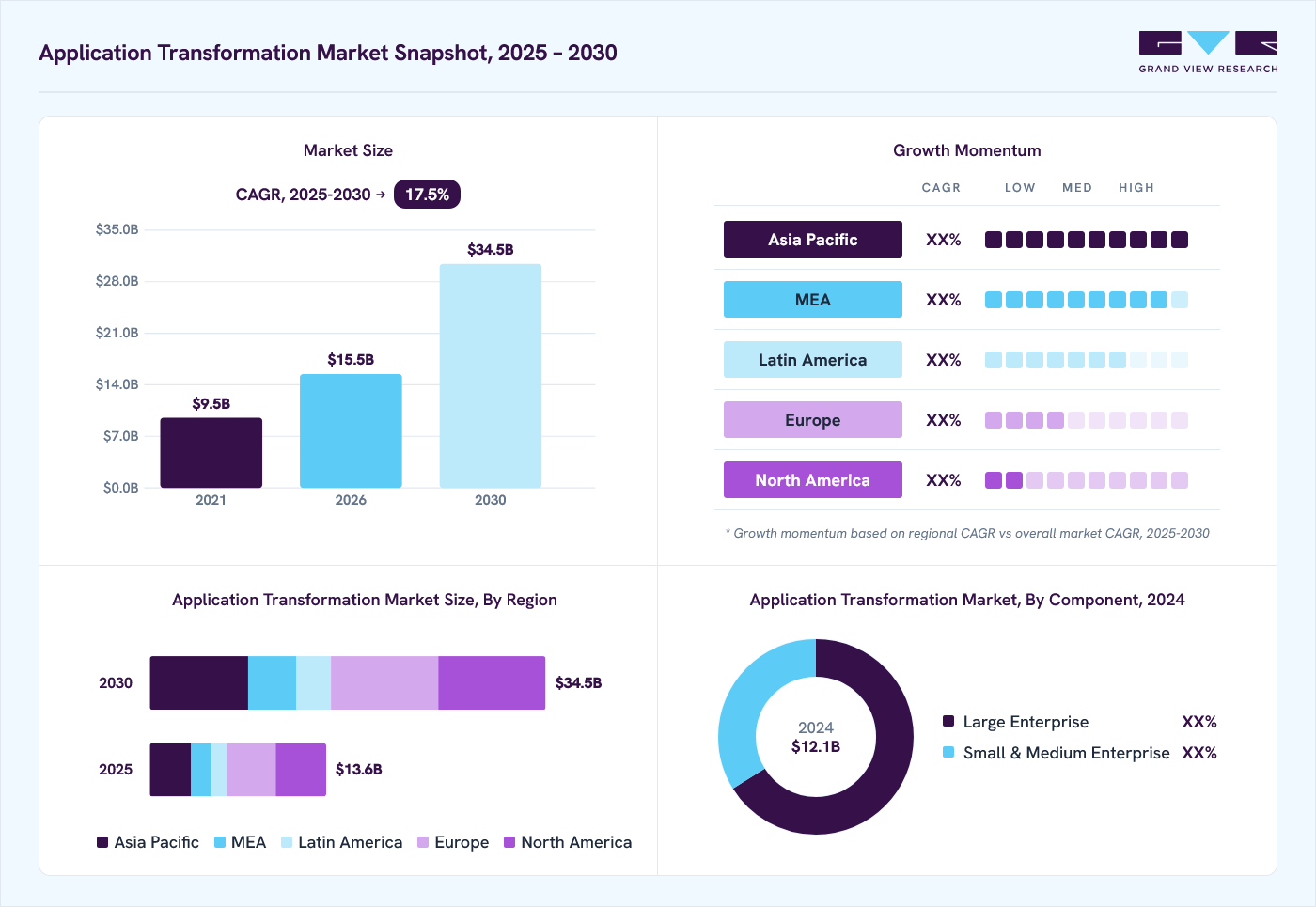
The global application transformation market size was valued at USD 18.0 billion in 2025 and is projected to grow from USD 19.8 billion in 2026 to USD 51.7 billion by 2033, at a CAGR of 14.7% from 2026 to 2033. The market in North America dominated with a revenue share of 35.4% in 2025. This growth is driven by growing enterprise investment in legacy application modernization and AI-driven cloud transformation across the region.
 Source: Grand View Research, IR Documents, Primary Interviews, Paid DatabasesTo learn more about this report,
 Download Free Sample Report
 Key Market Trends & Insights
- By type: Application integration segment dominated the market, with a revenue share of 27.5% in 2025.
- By enterprise size: Large enterprises segment dominated the market, with a revenue share of 66.0% in 2025.
- By end use: BFSI segment held the largest revenue share of 25.7% in 2025.
Regional Highlights
- Largest regional market: North America (35.4% revenue share, 2025)
- Fastest-growing regional market: Asia Pacific (highest CAGR, 2026-2033)
- By country: The U.S. held the largest market share in 2025.
Market Size & Forecast
- Market size in 2025: USD 18.0 Billion
- Estimated market size in 2026: USD 19.8 Billion
- Projected market size by 2033: USD 51.7 Billion
- CAGR (2026–2033): 14.7%
GVR research-powered AIAsk Prism AI about the application transformation marketGet cited answers from GVR research on market growth, segments, regulations and forecasts.Start with✓ Source-linked answers ✓ Market-specific context ✓ Traceable figuresExplore Prism AI ↗
The shift towards cloud-native applications, which offer greater scalability and flexibility, and the rise of digital transformation initiatives as organizations seek to enhance operational efficiency, improve customer experience, and remain competitive in the digital economy are also fueling the demand for application transformation solutions. Companies are increasingly embracing microservices architecture and DevOps practices to accelerate software development and deployment. Microservices break down large applications into smaller, independent types, allowing for greater agility and scalability. Coupled with DevOps, which integrates development and operations teams for continuous delivery, organizations can enhance the speed and quality of software delivery. This shift is driving the need for application transformation solutions that support modern architectures and agile methodologies. To learn more about this report, Download Free Sample Report
 In highly regulated industries such as finance, healthcare, and telecommunications, there is growing pressure to comply with evolving regulatory standards and data privacy laws. Application transformation helps businesses modernize their systems to meet compliance requirements while ensuring secure data management, proper reporting, and governance frameworks. This is particularly important for industries dealing with sensitive customer data.
With the increasing frequency and sophistication of cyberattacks, security has become a critical concern for businesses across all sectors. Legacy applications often have outdated security protocols, making them vulnerable to breaches. Application transformation allows businesses to enhance security by integrating modern authentication methods, encryption techniques, and real-time monitoring capabilities. In addition, modernized applications can more easily adhere to new data privacy regulations such as GDPR, CCPA, or HIPAA, reducing the risk of non-compliance and costly penalties.
The shift towards remote and hybrid work models has accelerated the adoption of cloud collaboration tools, communication platforms, and mobile-friendly applications. Businesses now need applications that are easily accessible and functional across multiple devices and networks. Legacy systems, often not designed for such mobility and flexibility, must be transformed to support modern workforce requirements. Application transformation ensures that organizations can provide their employees with secure, scalable, and mobile-friendly applications that enhance productivity and collaboration.
Market Dynamics
The global application transformation market is experiencing strong growth as enterprises accelerate digital transformation initiatives to modernize legacy applications, improve business agility, and support cloud-native operations. Organizations across banking, financial services, healthcare, manufacturing, retail, government, telecommunications, and other industries are transforming traditional applications into scalable, secure, and intelligent digital platforms to meet evolving customer expectations and operational requirements. Application transformation services encompass application modernization, cloud migration, replatforming, rehosting, refactoring, containerization, microservices adoption, API integration, DevSecOps implementation, and AI-assisted software engineering. The increasing adoption of hybrid and multi-cloud environments, artificial intelligence (AI), automation, low-code development, and agile software delivery is accelerating demand for application transformation solutions that enhance performance, reduce technical debt, strengthen cybersecurity, and enable continuous innovation.
The increasing need to modernize legacy applications and accelerate enterprise cloud adoption is a major driver of the global application transformation market. Organizations are replacing outdated, monolithic systems with cloud-native, API-driven, and microservices-based architectures to improve scalability, flexibility, resilience, and user experience. Application transformation enables enterprises to migrate workloads to public, private, and hybrid cloud environments while integrating AI, automation, analytics, and DevSecOps practices into software development and operations. These initiatives help businesses reduce infrastructure costs, accelerate application delivery, improve security, and support rapidly evolving digital business models. As enterprises prioritize modernization to remain competitive, demand for end-to-end application transformation services continues to expand across industries. For instance, in March 2026, Accenture launched its Microsoft Forward Deployed Engineering Practice to help organizations rapidly modernize legacy applications, build cloud-native solutions, and operationalize AI across the enterprise, highlighting the increasing enterprise investment in application transformation and cloud modernization initiatives.
The complexity of modernizing legacy applications and integrating them with existing enterprise systems remains a significant restraint for the global application transformation market. Many organizations operate highly customized applications with intricate dependencies, making migration and modernization technically challenging, time-consuming, and resource-intensive. Enterprises must minimize business disruption while ensuring data integrity, regulatory compliance, application compatibility, and cybersecurity throughout the transformation process. Additionally, shortages of skilled cloud architects, software engineers, and modernization specialists, along with budget constraints and organizational resistance to change, can delay implementation and increase project risks, particularly for large-scale enterprise transformation initiatives.
The rapid advancement of AI-driven software engineering, cloud-native application development, and intelligent automation presents a significant growth opportunity for the global application transformation market. Organizations are increasingly adopting generative AI, automated code conversion, intelligent testing, application observability, and predictive performance monitoring to accelerate modernization while improving software quality and operational efficiency. Growing investments in containerization, Kubernetes orchestration, serverless computing, platform engineering, and API-first architectures are enabling enterprises to build highly scalable and resilient applications. Furthermore, the expansion of industry-specific digital transformation initiatives, low-code development platforms, and continuous modernization strategies is creating sustained demand for application transformation solutions that support innovation, operational excellence, and long-term business competitiveness.
Analyst Perspective
The application transformation market is positioned at the convergence of enterprise digital transformation, cloud computing adoption, and the growing demand for modern, agile software architectures. Organizations across BFSI, retail, healthcare, manufacturing, IT & telecom, government, and other industries are increasingly investing in application transformation solutions to modernize legacy systems, improve operational efficiency, and accelerate innovation. Unlike traditional monolithic applications, modern application transformation leverages cloud-native architectures, microservices, containerization, APIs, DevSecOps, and AI-assisted development to enhance scalability, security, performance, and business agility while enabling seamless integration across hybrid and multi-cloud environments.
Type Insights
Based on type, the application integration segment led the market with the largest revenue share of 27.5% in 2025. Organizations are adopting new cloud-based services, enterprise applications, and third-party solutions to enhance operational efficiency and improve customer experiences. However, these new systems often operate in silos, making it challenging to share data and workflows across the organization. Application integration solutions enable businesses to connect these disparate systems, ensuring a unified view of data and processes. This integration fosters better collaboration and accelerates innovation, driving the demand for application integration services as part of broader transformation efforts.
The UI modernization segment is expected to grow at a CAGR of 18.7% during the forecast period. Modern consumers expect personalized, seamless experiences across digital channels, which drives organizations to prioritize customer experience. Legacy applications often struggle to deliver the real-time, personalized interactions that customers demand. Application modernization allows organizations to leverage advanced analytics, artificial intelligence (AI), and machine learning (ML) to better understand customer behavior and preferences. By modernizing their applications, businesses can create more engaging, personalized experiences that improve customer satisfaction and loyalty, particularly in sectors such as retail, travel, and hospitality. For instance, in November 2023, Kyndryl, a U.S.-based IT infrastructure services provider, expanded its partnership with Amazon Web Services (AWS) to help customers streamline and expedite their mainframe modernization initiatives. The collaboration introduces new capabilities that enable the integration of mainframe applications and data with AWS technologies and the migration of mainframe workloads to AWS. Kyndryl enables the AWS Mainframe Modernization service, a specialized platform that allows customers to shift their on-premises mainframe applications to a fully managed cloud-native environment on AWS.
Enterprise Size Insights
Based on enterprise size, the large enterprises segment led the market with the largest revenue share of 66.0% in 2025. With the increasing frequency of cyberattacks, large enterprises are prioritizing the security of their applications. Legacy systems may lack the necessary security features to protect against modern threats, putting sensitive data at risk. Application transformation enables organizations to integrate advanced security measures, such as encryption, multi-factor authentication, and real-time monitoring, into their applications. By modernizing their systems, large enterprises can enhance their security posture and reduce vulnerabilities, which is essential for maintaining customer trust and regulatory compliance.
The small and medium enterprises segment is expected to grow at a CAGR of 18.0% during the forecast period as application transformation allows SMEs to streamline their operations by modernizing their applications, automating processes, and reducing manual intervention. By adopting modern, integrated solutions, SMEs can enhance productivity, minimize downtime, and ensure that their resources are allocated effectively, resulting in cost savings and improved overall performance.
End Use Insights
Based on end use, BFSI segment led the market with the largest revenue share of 25.7% in 2025. The rise of digital payments and contactless solutions, accelerated by the COVID-19 pandemic, has transformed the BFSI sector. Financial institutions have modernized their applications to support various payment methods, including mobile wallets, peer-to-peer transactions, and cryptocurrency. Application transformation enables organizations to integrate these functionalities, enhancing customer convenience and satisfaction.
 To learn more about this report, Download Free Sample Report
 The manufacturing segment is expected to grow at a CAGR of 18.8% during the forecast period. The shift toward Industry 4.0, characterized by the integration of advanced technologies such as IoT, big data analytics, artificial intelligence (AI), and automation, is a major driver of application transformation in the manufacturing sector. Manufacturers are modernizing their applications to connect machines, systems, and processes in real time, enabling enhanced visibility and control over operations. By transforming legacy systems into smart applications that can leverage real-time data analytics, manufacturers can optimize production schedules, reduce downtime, and improve overall equipment effectiveness (OEE). This shift towards connected manufacturing is facilitating smarter decision-making and fostering greater innovation in production processes.
Regional Insights
North America dominated the global application transformation market with the largest revenue share of 35.4% in 2025. North America leads in cloud adoption, with businesses migrating legacy systems to platforms such as AWS, Microsoft Azure, and Google Cloud. The need for scalability, flexibility, and cost efficiency drives this shift. As enterprises look to optimize their operations and enhance their competitive edge, application transformation becomes crucial in modernizing legacy systems to take full advantage of cloud capabilities. Cloud migration also supports hybrid cloud strategies, where organizations leverage a mix of public and private clouds, creating additional demand for transformation services.
 To learn more about this report, Download Free Sample Report
 U.S. Application Transformation Market Trends
The application transformation market in the U.S. held the largest share in the North America region in 2025. In the U.S., companies are heavily investing in digital transformation initiatives aimed at improving customer experience, streamlining operations, and increasing competitiveness. These initiatives often require the modernization of legacy applications to integrate with emerging technologies such as artificial intelligence (AI), machine learning (ML), big data analytics, and the Internet of Things (IoT). Modern applications that support real-time data processing, automation, and personalization are critical to achieving these goals. The need for organizations to stay relevant in a digitally driven economy is a key driver behind application transformation in the U.S.
Asia Pacific Application Transformation Market Trends
The application transformation market in Asia Pacific is growing significantly at a CAGR of 20.0% from 2025 to 2033. The Asia Pacific region has one of the highest mobile penetration rates globally, with millions of people accessing services via smartphones and mobile devices. As a result, businesses are increasingly adopting a mobile-first approach, modernizing their applications to deliver seamless, user-friendly experiences on mobile platforms. In addition, customer expectations for real-time, personalized services are driving the need for applications that can integrate with advanced technologies such as AI, machine learning (ML), and data analytics.
The China application transformation market is expanding rapidly due to the country’s ongoing digitalization efforts and the government's focus on building a robust digital economy. The Chinese government’s initiatives, such as the “New Infrastructure” plan, which emphasizes the development of 5G, AI, and cloud computing, are key drivers of application modernization across various industries.
The Japan application transformation market is driven by the need to modernize aging IT systems across industries such as manufacturing, automotive, and financial services. Japanese companies are focusing on integrating emerging technologies like AI, machine learning, and IoT into their existing applications to improve operational efficiency and meet customer demands.
Europe Application Transformation Market Trends
The application transformation market in Europe is growing significantly at a CAGR of 16.6% from 2025 to 2033. Businesses are investing heavily in digital transformation as they seek to improve operational efficiency, enhance customer experiences, and drive innovation across Europe. Legacy applications, however, often struggle to integrate with new digital technologies such as artificial intelligence (AI), machine learning (ML), and big data analytics. Application transformation enables businesses to modernize their systems, making them more flexible, scalable, and capable of supporting emerging technologies. Sectors such as banking, retail, and manufacturing are particularly focused on transforming applications to support digitalization efforts, allowing them to provide seamless, data-driven experiences to customers and improve operational processes.
The UK application transformation market is driven by the increasing adoption of cloud technologies and the push for digital transformation across industries such as finance, healthcare, and retail.
The Germany application transformation market is propelled by the country’s strong industrial base and the rise of Industry 4.0 initiatives. German companies are increasingly modernizing their IT applications to support automation, IoT, and advanced manufacturing processes.
Key Application Transformation Company Insights
Key players operating in the market include Microsoft, IBM Corporation, Accenture, Cognizant, and Capgemini. The companies are focusing on various strategic initiatives, including new product development, partnerships & collaborations, and agreements to gain a competitive advantage over their rivals. The following are some instances of such initiatives.
-
In January 2024, Accenture announced the acquisition of Navisite, a U.S.-based provider of digital transformation and managed services, to enhance its application and infrastructure management services in North America. This acquisition strengthens Accenture’s capabilities in helping clients modernize their IT systems for the AI-driven future. Navisite brings extensive expertise in cloud platforms, enterprise applications, and digital technologies, serving industries such as technology, healthcare, life sciences, manufacturing, and business services.
-
In January 2024, Eviden, a French technology company that specializes in data-driven digital transformation, and Microsoft unveiled a five-year strategic partnership that enhances their current collaboration by introducing innovative solutions powered by Microsoft Cloud and AI for various industries. This initiative is part of Eviden's broader strategy to strengthen and expand its global partnership network by reinforcing existing relationships and establishing new ones. Through its DevSecOps framework, Eviden aims to expedite IT application transformation with a focus on security and sustainability while also enhancing agility and optimizing cloud spending using FinOps to create significant business value. The partnership also emphasizes migrating and modernizing legacy systems with rapid migration and application innovation accelerators, as well as modernizing applications and developing new AI-driven solutions using Power Platform and Dynamics 365.
Key Application Transformation Companies
The following key companies have been profiled for this study on the application transformation market.
-
Accenture
-
Atos SE
-
BELL-INTEGRATION.COM
-
Capgemini
-
Cognizant
-
Fujitsu
-
HCL Technologies Limited
-
International Business Machines Corporation
-
Infosys Limited
-
Microsoft
-
Open Text
-
Oracle
-
Trianz
Competitive Benchmarking
Operating Strategies
Competitive Edge
Weaknesses
Established Players (Accenture, Capgemini, Cognizant, Fujitsu, HCL Technologies Limited, IBM, Microsoft, Oracle )
- Expand application transformation portfolios by integrating cloud migration, application modernization, AI-assisted software engineering, DevSecOps, API management, microservices, containerization, and hybrid cloud solutions.
- Strengthen strategic partnerships with hyperscalers, enterprise software vendors, and cloud providers while investing in generative AI, automation, cybersecurity, platform engineering, and industry-specific digital transformation capabilities.
- Extensive global consulting and delivery networks, deep enterprise relationships, comprehensive end-to-end modernization capabilities, and strong cloud partnerships enable execution of complex, large-scale transformation programs across multiple industries.
- Broad technology portfolios, domain expertise, and continuous investment in AI and cloud innovation support high customer retention and long-term managed services revenue.
- Large-scale transformation engagements often involve lengthy implementation timelines, high consulting costs, and complex organizational change management.
- Broad service portfolios and legacy service models may reduce agility and delay innovation compared with specialized cloud-native providers.
Emerging Players (Atos SE, OpenText, Trianz, BELL-INTEGRATION.COM)
- Focus on cloud-native application modernization, AI-driven automation, platform engineering, application integration, managed cloud services, and industry-focused digital transformation solutions.
- Differentiate through rapid implementation, specialized modernization frameworks, flexible engagement models, cloud ecosystem partnerships, and customized solutions for mid-market and enterprise clients..
- Agile delivery models, specialized expertise in cloud migration and application modernization, flexible pricing structures, and strong technology partnerships enable faster project execution and tailored customer solutions.
- Their focus on niche transformation capabilities allows quicker adaptation to evolving enterprise modernization requirements.
- Comparatively smaller global delivery footprints, lower brand recognition, and limited resources for large multinational transformation programs may restrict market expansion.
- Greater dependence on strategic partnerships and selected industry verticals can also limit competitiveness against global consulting leaders with broader service portfolios.
Application Transformation Market Report Scope
Report Attribute
Details
Market size in 2025
USD 18.0 billion
Estimated market size in 2026
USD 19.8 billion
Projected market size by 2033
USD 51.7 billion
Growth rate
CAGR of 14.7% from 2026 to 2033
Base year for estimation
2025
Historical data
2021 - 2024
Forecast period
2026 - 2033
Quantitative units
Revenue in USD million/billion and CAGR from 2026 to 2033
Report coverage
Revenue forecast, company market share analysis, competitive landscape, growth factors, and trends
Segments covered
Type, enterprise size, end use, and region
Regional scope
North America; Europe; Asia Pacific; Latin America; MEA
Country scope
U.S.; Canada; Mexico; Germany; UK; France; China; Japan; India; South Korea; Australia; Brazil; Saudi Arabia; South Africa; UAE
Key companies profiled
Accenture, Atos SE, BELL-INTEGRATION.COM, Capgemini, Cognizant, Fujitsu, HCL Technologies Limited, International Business Machines Corporation, Infosys Limited, Microsoft, Open Text, Oracle, Trianz
Customization scope
Free report customization (equivalent up to 8 analysts' working days) with purchase. Addition or alteration to country, regional & segment scope.
Pricing and purchase options
Avail customized purchase options to meet your exact research needs. Explore purchase options
Global Application Transformation Market Report Segmentation
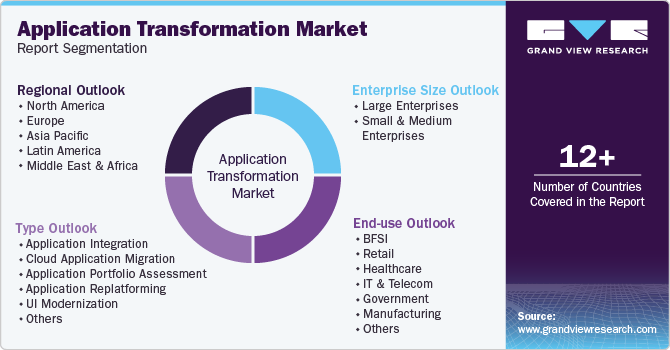
This report forecasts revenue growth at the global, regional, and country levels and provides an analysis of the latest industry trends from 2021 to 2033 in each of the sub-segments. For this study, Grand View Research has segmented the global application transformation market report based on type, enterprise size, end use, and region:
 To learn more about this report, Download Free Sample Report
 -
Type Outlook (Revenue; USD Billion, 2021 - 2033)
-
Application Integration
-
Cloud Application Migration
-
Application Portfolio Assessment
-
Application Replatforming
-
UI Modernization
-
Others
-
-
Enterprise Size Outlook (Revenue; USD Billion, 2021 - 2033)
-
Large Enterprises
-
Small & Medium Enterprises
-
-
End Use Outlook (Revenue; USD Billion, 2021 - 2033)
-
BFSI
-
Retail
-
Healthcare
-
IT & Telecom
-
Government
-
Manufacturing
-
Others
-
-
Regional Outlook (Revenue: USD Billion, 2021 - 2033)
-
North America
-
U.S.
-
Canada
-
Mexico
-
-
Europe
-
UK
-
Germany
-
France
-
-
Asia Pacific
-
China
-
India
-
Japan
-
Australia
-
South Korea
-
-
Latin America
-
Brazil
-
-
Middle East & Africa (MEA)
-
UAE
-
Saudi Arabia
-
South Africa
-
-
Research Methodology
The application transformation market figures in this report are based on a proven research process that combines executive interviews with secondary research from proprietary databases, company filings, and recognized regulatory and institutional sources. Market size is built through value-chain sizing-reconciling supply-side and demand-side estimates-and triangulated with bottom-up and top-down approaches. Every estimate passes multiple levels of expert validation before publication, with each application transformation segment quantified using the revenue-capture definitions in the table below.
Segment Definition
Segment – Type
Revenue capture definition
Application Integration
Revenue is generated from services and software that integrate enterprise applications, databases, cloud platforms, APIs, middleware, and third-party systems to enable seamless data exchange, workflow automation, and interoperability across on-premises and cloud environments. Revenue includes consulting, implementation, integration platforms, API management, testing, and managed integration services.
Cloud Application Migration
Revenue is generated from services and solutions that migrate enterprise applications from on-premises infrastructure or legacy environments to public, private, or hybrid cloud platforms. Revenue includes assessment, migration planning, rehosting, refactoring, containerization, data migration, testing, deployment, and post-migration optimization services.
Application Portfolio Assessment
Revenue is generated from consulting and assessment services that evaluate enterprise application portfolios to identify modernization opportunities, rationalization strategies, technical debt, cloud readiness, security gaps, performance improvements, and cost optimization initiatives. Revenue includes application discovery, dependency mapping, architecture assessment, and transformation roadmap development.
Application Replatforming
Revenue is generated from services that migrate applications to modern technology platforms with minimal code changes while improving scalability, performance, security, and cloud compatibility. Revenue includes platform migration, middleware modernization, database migration, containerization, runtime optimization, and deployment services.
UI Modernization
Revenue is generated from services and software that modernize application user interfaces and user experiences through responsive design, mobile enablement, front-end redevelopment, accessibility improvements, and digital experience enhancements. Revenue includes UI/UX consulting, frontend development, redesign, testing, and implementation services.
Others
Revenue is generated from other application transformation services, including application refactoring, legacy application modernization, application reengineering, DevSecOps implementation, API modernization, performance optimization, application testing, managed application services, and AI-assisted software modernization solutions.
Segment - Enterprise Size
Revenue capture definition
Small & Medium Enterprises
The SMEs segment, with respect to the number of employees, generally includes organizations employing between 10 and 999 employees.
Large Enterprise
The large enterprises segment, with respect to the number of employees, typically comprises organizations employing more than 1,000 employees for multinational corporations.
Segment – End Use
Revenue capture definition
BFSI
Revenue is generated from application transformation solutions deployed by banks, financial institutions, insurance companies, and fintech organizations to modernize core banking systems, payment platforms, digital banking applications, customer portals, regulatory systems, and fraud management applications.
Retail
Revenue is generated from application transformation initiatives undertaken by retailers, e-commerce companies, supermarkets, and consumer goods organizations to modernize omnichannel commerce platforms, inventory management systems, customer engagement applications, supply chain solutions, and digital storefronts.
Healthcare
Revenue is generated from application modernization projects across hospitals, clinics, pharmaceutical companies, healthcare providers, and life sciences organizations to upgrade electronic health record (EHR) systems, telehealth platforms, patient engagement applications, healthcare analytics, and clinical management systems.
IT & Telecom
Revenue is generated from application transformation services adopted by IT service providers, software companies, telecommunications operators, and cloud providers to modernize OSS/BSS platforms, customer management applications, network management systems, enterprise software, and digital service platforms.
Government
Revenue is generated from application modernization initiatives undertaken by central, state, and local government agencies to transform citizen service portals, tax systems, public administration platforms, judicial applications, healthcare systems, and other mission-critical public sector applications.
Manufacturing
Revenue is generated from application transformation solutions deployed by manufacturing companies to modernize ERP systems, production management applications, supply chain platforms, industrial IoT applications, quality management systems, and factory automation software.
Others
Revenue is generated from application transformation services adopted across education, energy & utilities, transportation & logistics, media & entertainment, travel & hospitality, real estate, and other industry verticals to modernize business-critical enterprise applications and digital platforms.
Estimation Model
Layer Name
Key Question
Description
Enterprise Application Modernization Demand Layer
Who can benefit from application transformation solutions?
Identify organizations operating legacy or business-critical applications that require modernization to improve agility, scalability, security, operational efficiency, and digital customer experiences. These include enterprises across BFSI, retail, healthcare, manufacturing, IT & telecom, government, energy, logistics, and other industries seeking to modernize legacy systems, reduce technical debt, accelerate innovation, and support cloud-native business models.
Cloud & Digital Transformation Readiness Layer
Who can deploy application transformation solutions?
Evaluate organizations based on cloud adoption maturity, digital transformation initiatives, hybrid or multi-cloud strategies, DevOps/DevSecOps implementation, API adoption, application portfolio complexity, IT modernization budgets, and AI integration initiatives. Enterprises investing in cloud infrastructure, software modernization, automation, cybersecurity, and agile software delivery possess the operational readiness to deploy application transformation solutions successfully.
Adoption & Utilization Layer
Who actively uses application transformation solutions?
Analyze the adoption of application transformation services across enterprises modernizing legacy applications, migrating workloads to cloud platforms, integrating enterprise systems, replatforming business applications, modernizing user interfaces, and implementing microservices, containerization, API management, and DevSecOps practices. Active users include organizations seeking greater application scalability, resilience, security, operational efficiency, and faster software delivery.
Monetization Layer
How much revenue is generated?
Assess revenue generated through consulting, application portfolio assessment, cloud migration, application integration, replatforming, UI/UX modernization, application refactoring, API development, DevSecOps implementation, containerization, testing, deployment, managed application services, software licensing, cloud platform subscriptions, maintenance, technical support, training, and long-term managed modernization and digital transformation contracts.
Delivered Customizations
This report has been delivered with the following In-depth customizations
Client Request
Customization Delivered
Value Adds
AI-Driven Application Modernization & Software Engineering Trends
Conducted a structured analysis of application transformation technologies focused on AI-assisted code modernization, generative AI for software development, intelligent application testing, automated code refactoring, DevSecOps, and AI-powered application lifecycle management.
Helps stakeholders understand emerging AI-enabled application modernization technologies, identify high-growth innovation areas, and evaluate commercialization opportunities across enterprise software transformation initiatives.
Cloud-Native Application Modernization & Hybrid Cloud Transformation Trends
Conducted a comprehensive analysis of application transformation strategies across cloud migration, microservices adoption, containerization, Kubernetes, API-led integration, hybrid and multi-cloud architectures, and platform engineering.
Helps stakeholders identify opportunities in enterprise cloud transformation, assess modernization investment strategies, and evaluate technologies that improve application scalability, resilience, security, and operational efficiency.
Legacy Application Modernization & Enterprise Digital Transformation Trends
Conducted a comprehensive analysis of legacy application modernization initiatives, focusing on application portfolio assessment, replatforming, cloud migration, application integration, UI modernization, technical debt reduction, and continuous modernization strategies across enterprises.
Helps stakeholders understand enterprise application transformation priorities, evaluate modernization roadmaps, and assess growth opportunities driven by digital transformation, cloud adoption, and business agility across multiple industries.
Frequently Asked Questions About This Report
The global application transformation market size was valued at USD 18.0 billion in 2025 and is estimated at USD 19.8 billion for 2026.
The global application transformation market is expected to grow at a CAGR of 14.7% from 2026 to 2033, reaching USD 51.7 billion by 2033.
Asia Pacific is the fastest-growing region over the forecast period.
The application integration segment led with a 27.5% revenue share in 2025, while the UI modernization segment is the fastest-growing segment.
The large enterprises segment led with a 66.0% revenue share in 2025, while the SMEs segment is the fastest-growing segment.
BFSI segment held the largest share (over 25.0%) in 2025, while the manufacturing segment is the fastest-growing segment.
Key players operating in the application transformation market include Accenture, Atos SE, BELL-INTEGRATION.COM, Capgemini, Cognizant, Fujitsu, HCL Technologies Limited, International Business Machines Corporation, Infosys Limited, Microsoft, Open Text, Oracle, and Trianz
Key factors include the increasing need to modernize legacy applications and accelerate enterprise cloud adoption
North America dominated with 35.4% revenue share in 2025.
About the Author(s)
Next Generation Technologies Research Team
Technology · Next Generation TechnologiesThis report was authored by the next generation technologies research team at Grand View Research - comprising two research analysts, one senior research analyst, and one industry expert - with specialized expertise in the next generation technologies segment of the technology industry. All findings are based on proprietary technology databases, executive interviews, and regulatory analysis, subject to internal peer review prior to publication.
Last Updated:
Speak to Analyst

Customize this report to your needs - add regions, segments, or data points, with 20% free customization.
Or view our licence options:


ISO 9001:2015 & 27001:2022 Certified
We are GDPR and CCPA compliant! Your transaction & personal information is safe and secure. For more details, please read our privacy policy.


