
- Home
- »
- Next Generation Technologies
- »
-
Applied AI Service Market Size & Share Report, 2026-2033GVR Report cover

Applied AI Service Market (2026 - 2033)
Size, Share & Trends Analysis Report By Component, By Deployment, By Technology (Machine Learning, Computer Vision), By Industry Vertical, By Region (North America, Europe, Asia Pacific, Latin America, MEA), And Segment Forecasts
Market Size, 2025
$333.7MMarket Estimate, 2026
$404.8MMarket Forecast, 2033
$2,204.1MCAGR, 2026–2033
27.4%Applied AI Service Market Summary
The global applied AI services market size was valued at USD 333.7 million in 2025 and is projected to grow from USD 404.8 million in 2026 to USD 2,204.1 million by 2033, at a CAGR of 27.4% from 2026 to 2033. North America dominated the market, accounting for a revenue share of 30.9% in 2025. The market is driven by the rapid adoption of enterprise AI solutions, substantial investments in digital transformation, and the presence of leading AI service providers, cloud infrastructure companies, and technology consulting firms.
 Source: Grand View Research, IR Documents, Primary Interviews, Paid DatabasesTo learn more about this report,
 Download Free Sample Report
Key Market Trends & Insights
- By component: Software segment led the market and held the largest revenue share of over 35.1% in 2025.
- By technology: Deep learning segment led the market and held the largest revenue share of over 34.7% in 2025.
- By deployment: Cloud segment is the fastest growing segment with CAGR 28.5% during the forecast period 2026 to 2033.
Regional Highlights
- Largest regional market: North America (30.9% revenue share, 2025)
- Fastest-growing regional market: Asia Pacific (Highest CAGR,2026-2033)
- By country: The U.S. held the largest market share in 2025
Market Size & Forecast
- Market size in 2025: USD 333.7 Million
- Estimated market size in 2026: USD 404.8 Million
- Projected market size by 2033: USD 2,204.1 Million
- CAGR (2026-2033): 27.4%
Prism AI by Grand View Research Free to tryAsk a question about the applied AI service marketTry asking✓Every figure cited from GVR research Prefer the report? Download free sample →
The growing recognition of AI's capabilities, coupled with the need for businesses to remain competitive, is likely to accelerate the integration of AI solutions into core business functions. As organizations seek to leverage AI for improved decision-making and automation, the demand for applied AI services is anticipated to surge, making it a critical area for future growth and innovation in the technology landscape. Across various industries, including healthcare, retail, finance, and manufacturing, AI is becoming increasingly influential.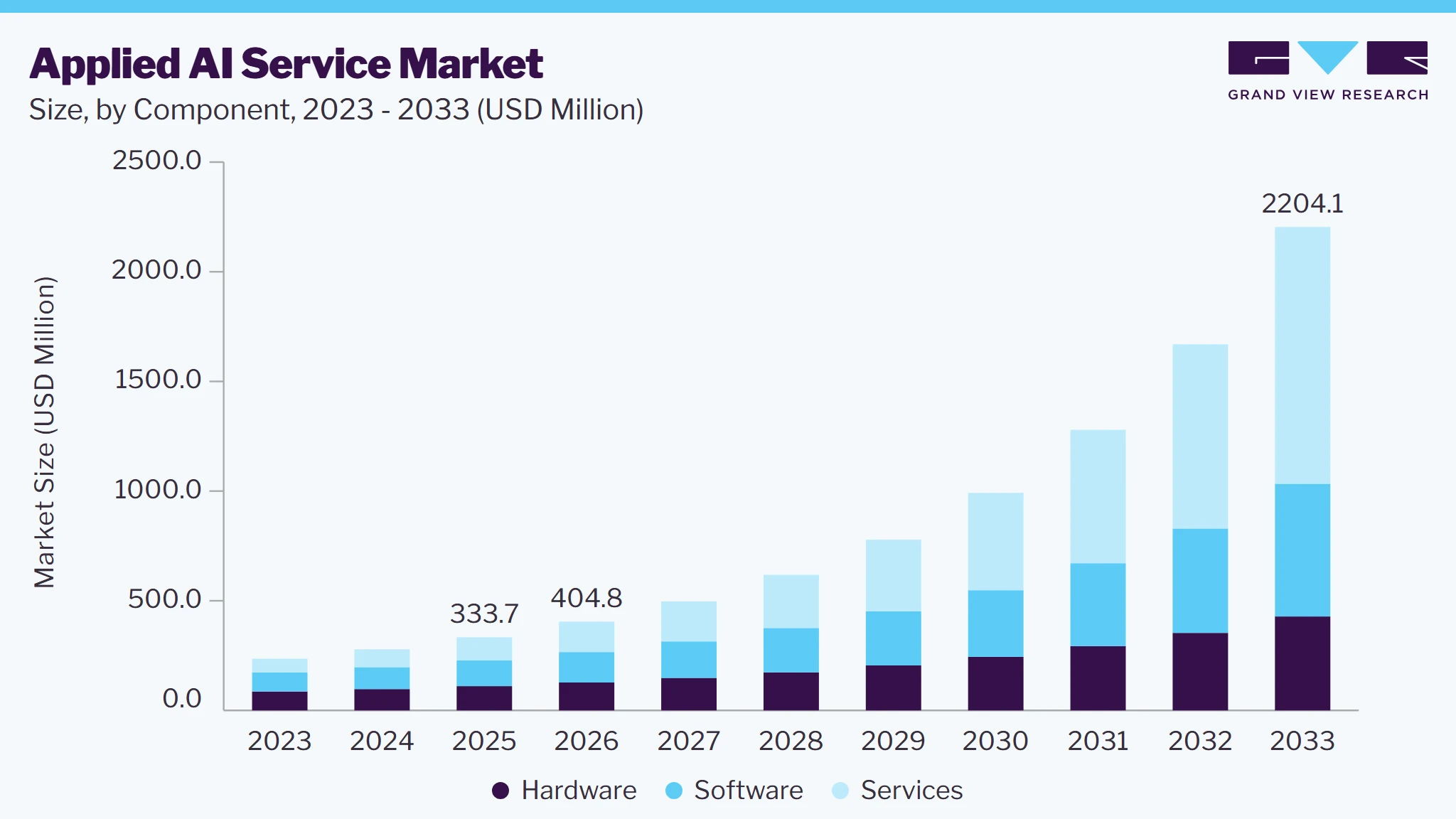 To learn more about this report, Download Free Sample Report
Technological advancements are continually influencing the evolution of the Applied AI market. AI algorithms are growing more advanced, enabling them to manage increasingly complex tasks. The integration of AI with other emerging technologies, such as the Internet of Things (IoT) and blockchain, is creating new opportunities for innovation and automation. Cloud-based AI solutions are also on the rise, favored for their scalability and cost-effectiveness. Additionally, improvements in natural language processing and computer vision are enhancing AI systems' ability to understand and interact with humans, leading to better customer service and user experiences. These technological advancements are poised to drive further growth and innovation in the Applied AI market.
Market Dynamics
The applied AI service market is witnessing strong growth, driven by the increasing adoption of artificial intelligence across enterprises to accelerate digital transformation, automate business processes, and enhance operational efficiency. Organizations are increasingly relying on applied AI services, including consulting, implementation, integration, customization, managed services, and AI model optimization, to successfully deploy AI solutions tailored to their business needs. The rapid advancement of generative AI, machine learning, natural language processing, computer vision, and predictive analytics is expanding the scope of AI-powered applications across industries. Growing investments in cloud-based AI platforms, rising demand for AI-enabled customer experiences, and the need for scalable AI deployment are further fueling market expansion. However, challenges related to data privacy, shortage of skilled AI professionals, high implementation costs, and integration with legacy systems continue to hinder market growth. Nevertheless, increasing enterprise investments in AI modernization, industry-specific AI solutions, and AI-as-a-Service (AIaaS) offerings are expected to create significant opportunities throughout the forecast period.
The applied AI service market is primarily driven by the growing demand for AI expertise to accelerate enterprise digital transformation initiatives. Organizations across industries are increasingly adopting applied AI services to design, deploy, integrate, and manage AI solutions that improve decision-making, automate repetitive tasks, optimize operations, and enhance customer engagement. As AI technologies become more sophisticated, enterprises are seeking specialized service providers to reduce implementation complexity, improve return on investment, and ensure seamless integration with existing IT environments. The expanding use of AI across healthcare, BFSI, manufacturing, retail, telecommunications, and public sector organizations continues to drive demand for applied AI consulting and managed services.
Despite robust growth prospects, the applied AI service market faces challenges associated with the complexity of AI implementation and the limited availability of skilled AI professionals. Deploying enterprise-grade AI solutions requires expertise in data engineering, model development, system integration, governance, and continuous monitoring, making implementation resource-intensive. Many organizations also face difficulties integrating AI services with legacy infrastructure while ensuring data quality, regulatory compliance, cybersecurity, and model transparency. These challenges, combined with high initial investment and ongoing maintenance requirements, can slow AI adoption, particularly among small and medium-sized enterprises.
The increasing adoption of cloud computing and AI-as-a-Service (AIaaS) presents substantial growth opportunities for the applied AI service market. Enterprises are increasingly leveraging managed AI services to reduce infrastructure costs, accelerate deployment, and access advanced AI capabilities without significant in-house expertise. Rising demand for customized AI solutions across healthcare, financial services, manufacturing, retail, logistics, and government sectors is creating new opportunities for AI service providers. Additionally, advancements in generative AI, agentic AI, MLOps, responsible AI, and cloud-native AI platforms are enabling service providers to deliver scalable, secure, and industry-specific AI implementations, supporting sustained market growth over the forecast period.
Market Concentration & Characteristics
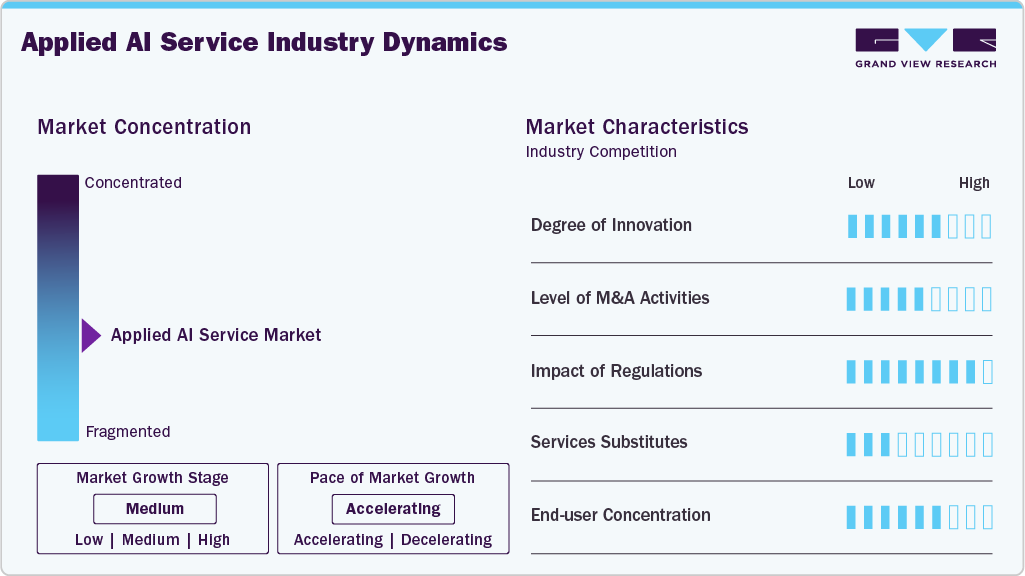
The applied AI service market is moderately concentrated, with competition led by global technology companies, cloud service providers, AI platform developers, and semiconductor firms that offer end-to-end AI services and infrastructure. Market participants compete on the basis of AI consulting capabilities, model development and deployment, cloud-native AI services, scalability, industry-specific solutions, security, responsible AI frameworks, and integration with enterprise IT ecosystems. Continuous advancements in generative AI, agentic AI, large language models (LLMs), multimodal AI, MLOps, and AI accelerators are reshaping the competitive landscape. Strategic investments in AI infrastructure, cloud platforms, foundation models, enterprise AI services, and ecosystem partnerships are further strengthening market competitiveness.
 To learn more about this report, Download Free Sample Report
Key market participants include Amazon Web Services (AWS); Apple; Baidu; Google (Alphabet Inc.); IBM; Intel; Meta; Microsoft; NVIDIA; Open AI. These companies are focused on expanding their applied AI service portfolios through AI consulting, model training and deployment, generative AI platforms, AI infrastructure, cloud-based AI services, intelligent automation, and enterprise AI integration. Their strategies emphasize continuous innovation in foundation models, industry-specific AI solutions, responsible AI development, strategic collaborations, and scalable AI platforms that enable organizations to accelerate digital transformation, improve operational efficiency, and unlock business value through applied artificial intelligence.
Analyst Perspective
The Applied AI Service Market is experiencing rapid growth as organizations increasingly rely on specialized AI services to accelerate the development, deployment, and optimization of artificial intelligence solutions across enterprise operations. Growing demand for intelligent automation, generative AI, predictive analytics, and data-driven decision-making is driving enterprises to partner with AI service providers for consulting, implementation, integration, and managed services. Industries including BFSI, healthcare, manufacturing, retail, automotive, media, and telecommunications are leveraging applied AI services to improve operational efficiency, enhance customer experiences, and unlock new revenue opportunities.
Component Insights
Based on component, the software segment led the market with the largest revenue share of 35.1% in 2025. The growth of applied AI service in software development is driven by advancements in AI and machine learning, increased data availability, and the scalability of cloud computing. The integration of AI with existing technologies, rising business demand, and supportive regulatory frameworks further fuel this expansion. Additionally, open-source tools, talent development, ethical AI practices, and global market opportunities play significant roles in accelerating the adoption and innovation of AI-driven software solutions. significant initiatives by key players, for instance in May 2024, SolarWinds, a prominent provider of robust, secure, and user-friendly observability and IT management software, has announced the launch of SolarWinds AI, aimed at revolutionizing IT operations. This generative AI engine, specifically designed to empower technology professionals in managing the complexities of modern digital environments, was developed using the company’s newly introduced AI by Design framework, which prioritizes privacy, security, and reliability in the advancement of AI technologies.
The service segment is predicted to foresee significant growth in the forecast period. The growth is attributed to the rising adoption of edge AI. Edge AI, which involves processing AI algorithms on devices closer to the source of data rather than in a centralized cloud, is gaining traction. This trend is driven by the need for faster processing and reduced latency, especially in applications like autonomous vehicles, IoT, and smart devices. Moreover, As AI adoption grows, there is an increasing focus on ethical AI, data privacy, and transparency. Governments and organizations are developing regulations and frameworks to ensure the responsible use of AI, which is influencing how AI services are designed and deployed.
Technology Insights
Based on technology, the deep learning segment led the market with the largest revenue share of 34.7% in 2025. The growth of deep learning in applied AI service is being driven by several key factors. Advancements in computational power, particularly through GPUs, TPUs, and scalable cloud computing platforms, have made it easier to train complex deep learning models. The availability of large datasets, fueled by big data and open data initiatives, provides the necessary inputs for these models, enhancing their accuracy and applicability. Improved algorithms, such as convolutional neural networks (CNNs) and transformers, along with techniques like transfer learning, have expanded the range of deep learning applications across industries.
The NLP segment is estimated to grow significantly over the forecast period. Innovations in deep learning, particularly the development of transformer-based models like BERT, GPT, and T5, have significantly improved the ability of NLP systems to understand and generate human language. These models enable more accurate and contextually aware language processing, driving their application in various AI services. The exponential growth of textual data from social media, emails, customer reviews, and other digital sources provides a vast amount of data for training and refining NLP models. This data richness allows for the development of more sophisticated and nuanced language processing systems.
Deployment Insights
Based on deployment, the cloud segment led the market with the largest revenue share of 53.1% in 2025. The on-premises deployment in applied AI service is experiencing a nuanced evolution as organizations balance the need for control, security, and performance with the growing appeal of cloud-based solutions. While cloud deployments have gained significant traction due to their scalability and flexibility, on-premises deployments remain crucial, particularly for industries with stringent data privacy, regulatory, and latency requirements, such as finance, healthcare, and government sectors. Companies are increasingly adopting hybrid approaches, combining on-premises infrastructure with cloud resources to optimize workloads. On-premises deployments are also favored for applications requiring real-time processing, where latency must be minimized, or in scenarios where data sovereignty is a concern.
The cloud segment is estimated to grow significantly over the forecast period. Cloud deployment in applied AI service is rapidly becoming the dominant model, driven by its scalability, flexibility, and cost-efficiency. Organizations increasingly prefer cloud platforms for AI workloads because they offer on-demand access to powerful computational resources and a wide range of AI tools and services, enabling faster development and deployment of AI applications. The cloud also facilitates collaboration and innovation by providing seamless access to large datasets, pre-trained models, and integrated machine learning pipelines. Additionally, the cloud's ability to support distributed computing makes it ideal for processing the vast amounts of data required for AI, particularly in big data analytics, natural language processing, and machine learning.
Industry Vertical Insights
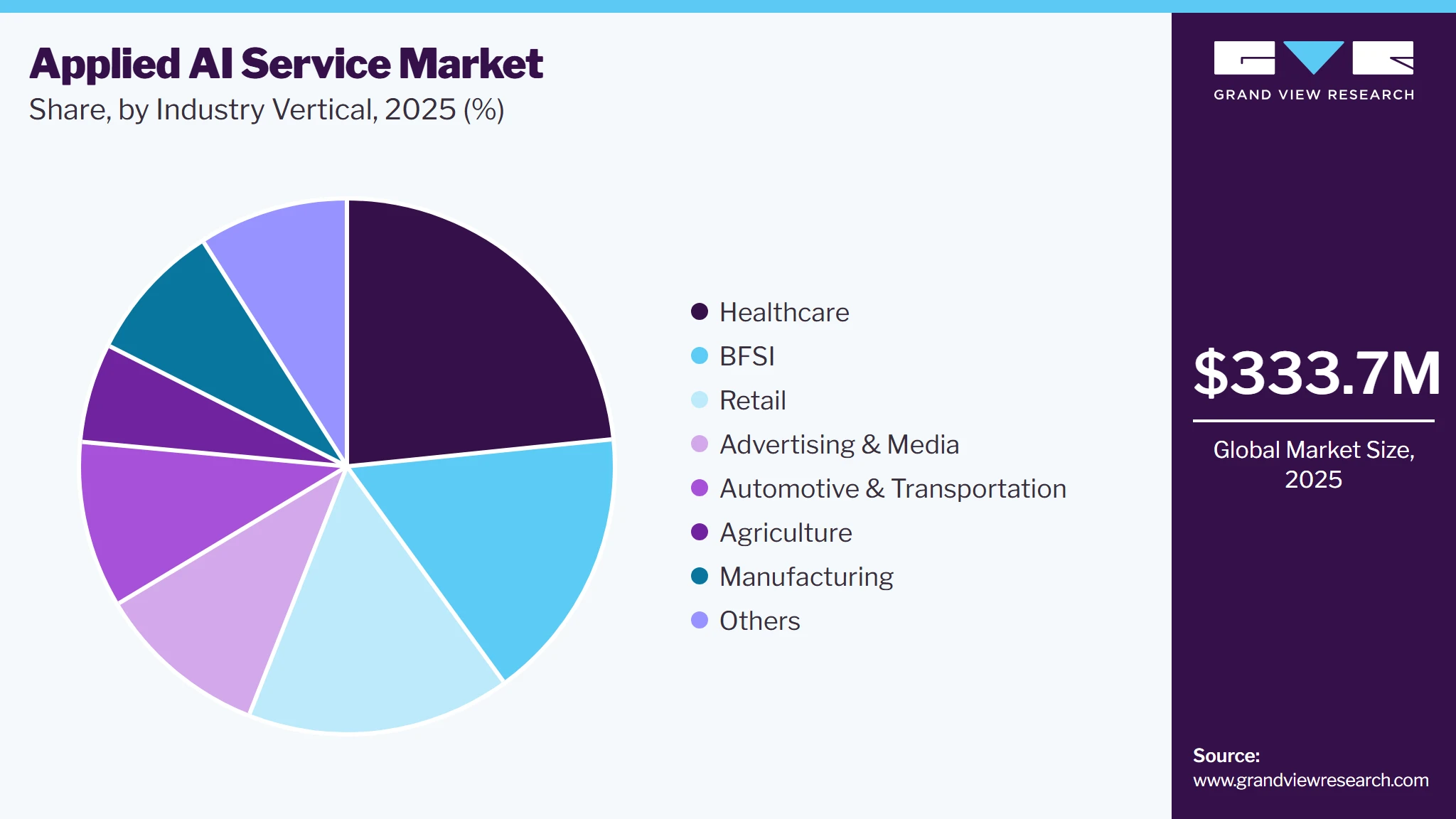
Based on industry vertical, the healthcare segment led the market with the largest revenue share of 23.9% in 2025. The growth factor for applied AI service in healthcare is poised for significant expansion, driven by advancements in technology and increasing adoption across the industry. Key drivers of this transformation include the integration of generative AI (GenAI) in clinical decision support, which is expected to enhance the accuracy and efficiency of healthcare delivery. As healthcare organizations pilot these solutions, the focus will be on reducing administrative burdens, improving decision-making for clinicians, and streamlining research processes. The ongoing evolution of AI capabilities, alongside the increasing demand for data-driven insights and personalized care, positions applied AI service as a critical component of future healthcare innovations.
 To learn more about this report, Download Free Sample Report
The BFSI segment is estimated to grow significantly over the forecast period. The growth factor for applied AI service in the Banking, Financial Services, and Insurance (BFSI) sector is substantial, with projections indicating a significant market expansion. AI applications in BFSI are diverse, encompassing areas such as customer service, risk management, fraud detection, and financial advisory services. The demand for personalized customer experiences is particularly influencing growth in the customer service segment, where AI-driven solutions like chatbots and predictive analytics are becoming integral to enhancing client interactions and trust. Furthermore, the automation of routine tasks through AI is expected to streamline operations, reduce errors, and improve compliance with regulatory demands, thereby enhancing overall efficiency in financial institutions.
Regional Insights
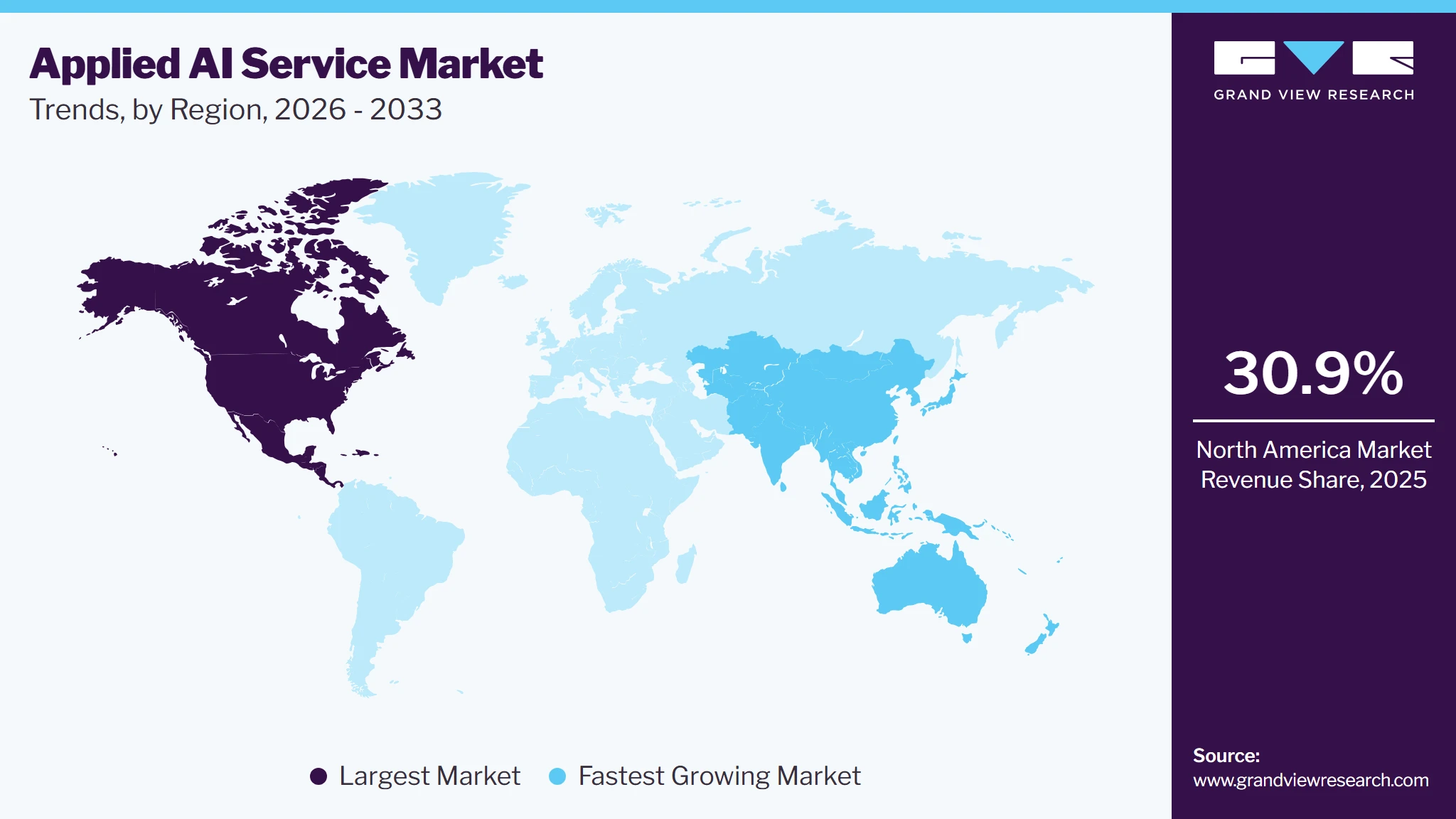
The North America applied AI service market accounted for the highest share, with over 30.9% of the global revenue in 2025. The growth of applied AI service in North America is driven by several key factors that collectively contribute to its robust expansion. The growth of applied AI service in North America is driven by a combination of strong technological infrastructure, significant investment, and a highly skilled talent pool. The region benefits from substantial funding in AI research and development from both private and public sectors, with tech giants and venture capital firms heavily investing in AI startups and technologies. North America's leading universities and research institutions contribute to a continuous supply of AI expertise, while the region's diverse industries, including healthcare, finance, and manufacturing, provide ample opportunities for AI application. Government support through AI-focused initiatives and policies further promotes the adoption of AI, creating a favorable environment for growth.
 To learn more about this report, Download Free Sample Report
U.S. Applied AI Service Market Trends
The applied AI service market in the U.S. held a dominant position in 202.5 The U.S. has been investing in AI research and development for more than three decades, positioning it as one of the largest contributors to the global AI market. This sustained investment has led to the development of sophisticated AI algorithms and models, enabling the performance of complex tasks that previously required human intervention.
Europe Applied AI Service Market Trends
The adoption of applied AI service in Europe is particularly strong this growth is driven by the introduction of the EU's AI Act establishes a comprehensive legal framework for AI development and deployment, prioritizing responsible use and ethical considerations. This regulatory environment aims to ensure that AI systems adhere to fundamental rights and safety standards, fostering trust and encouraging businesses to adopt AI technologies more broadly. The General Data Protection Regulation (GDPR) also affects AI development, particularly concerning data privacy and availability, which are critical for effective AI applications.
Asia Pacific Applied AI Service Market Trends
The Asia-Pacific applied AI service market is experiencing rapid growth, and governments in Asia Pacific are actively implementing strategies to promote AI research, innovation, and responsible development. These initiatives often include funding, regulatory frameworks, and collaborations between government bodies, academia, and industry. For example, China has established the "Interim Administrative Measures for Generative Artificial Intelligence Services," the first comprehensive framework to govern generative AI services in the region.
Key Applied AI Service Company Insights
Prominent firms have used product launches and developments, followed by expansions, mergers and acquisitions, partnerships, collaborations contracts, and agreements, as their primary business strategy to increase their market share. The companies have used various techniques to enhance market penetration and boost their position in the competitive industry. For instance, In February 2024, FWD Group Holdings Limited had announced an extension of its partnership with Microsoft through a new four-year agreement aimed at accessing the latest generative artificial intelligence (AI) advancements. This collaboration will further support FWD’s cloud-first technology strategy. The company plans to enhance its generative AI initiatives by utilizing Microsoft’s Azure OpenAI Service and other enterprise-grade innovations. FWD Group anticipates benefiting from Microsoft Azure's private networking, monitoring, and security features, along with its advanced AI models.
Key Applied AI Service Companies:
The following are the leading companies in the applied AI service market.
-
Amazon Web Services (AWS)
-
Apple
-
Baidu
-
Google (Alphabet Inc.)
-
IBM
-
Intel
-
Meta
-
Microsoft
-
NVIDIA
-
Open AI
Competitive Benchmarking
Category
Operating Strategies
Competitive Edge
Weakness
Established Players: Amazon Web Services (AWS), Google (Alphabet Inc.), IBM, Microsoft, NVIDIA
- Focus on delivering end-to-end applied AI services through cloud AI platforms, AI infrastructure, foundation models, enterprise AI consulting, MLOps, intelligent automation, and industry-specific AI solutions. These companies emphasize strategic partnerships, continuous AI innovation, cloud-native deployments, and scalable AI ecosystems to accelerate enterprise AI adoption.
- Extensive global customer base, robust cloud infrastructure, advanced AI platforms, strong R&D capabilities, comprehensive AI service portfolios, established partner ecosystems, and the ability to support large-scale enterprise AI deployments.
- High infrastructure and R&D investment requirements, increasing regulatory scrutiny surrounding AI governance, intense competition, complex enterprise integration requirements, and the need to continuously enhance AI models and servic
Emerging & Innovation-Focused Players: Apple, Baidu, Intel, Meta, OpenAI
- Focus on advancing applied AI through foundation models, generative AI, AI hardware, multimodal AI, edge AI, and developer platforms. Their strategies emphasize innovation, ecosystem expansion, AI model optimization, strategic collaborations, and enabling organizations to build next-generation AI-powered applications and intelligent services.
- Strong innovation capabilities, leadership in AI research, advanced foundation models, specialized AI hardware and software expertise, rapidly expanding developer ecosystems, and differentiated AI technologies supporting diverse enterprise and consumer applications.
- Dependence on evolving AI regulations, increasing infrastructure costs for large-scale AI deployment, limited enterprise service portfolios in certain segments, talent competition, and growing pressure to ensure responsible AI, security, and model transparency.
Recent Developments
-
In June 2024, Chinese search engine giant Baidu revealed an enhanced version of its artificial intelligence (AI) model, Ernie 4.0 Turbo, in its effort to sustain its leadership in China’s competitive AI market. The new model will be available to the public through mobile app and web interfaces, and developers will be able to integrate the technology via Baidu's Qianfan AI platform.
-
In January 2024, IBM Consulting is launching IBM Consulting Advantage, an AI services platform aimed at helping IBM consultants deliver consistent, repeatable, and swift solutions for clients. The platform features a range of proprietary methods, assets, and assistants that utilize technology from IBM and its strategic partners Early adopter teams achieved productivity improvements of up to 50% by integrating IBM Consulting Advantage into their application design, development, and testing client pilots.
Applied AI Service Market Report Scope
Report Attribute
Details
Market size in 2025
USD 333.7 million
Estimated market size in 2026
USD 404.8 million
Projected market size by 2033
USD 2,204.1 million
Growth rate
CAGR of 27.4% from 2026 to 2033
Base year for estimation
2025
Historical data
2021 - 2024
Forecast period
2026 - 2033
Quantitative units
Revenue in USD million/billion and CAGR from 2026 to 2033
Report coverage
Revenue forecast, company ranking, competitive landscape, growth factors, and trends
Segments covered
Components, technology. application, end-use, region
Regional scope
North America; Europe; Asia Pacific; Latin America; MEA
Country scope
U.S.; Canada; UK; Germany; China; India; Japan; South Korea; Australia; Brazil; Mexico; KSA; UAE; South Africa
Key companies profiled
Amazon Web Services (AWS); Apple; Baidu; Google (Alphabet Inc.); IBM; Intel; Meta; Microsoft; NVIDIA; Open AI
Customization scope
Free report customization (equivalent up to 8 analysts' working days) with purchase. Addition or alteration to country, regional & segment scope.
Pricing and purchase options
Avail customized purchase options to meet your exact research needs. Explore purchase options
Global Applied AI Service Market Report Segmentation
This report forecasts revenue growth at global, regional, and country levels and provides an analysis of the latest industry trends in each of the sub-segments from 2021 to 2033. For this study, Grand View Research has segmented the global applied AI service market report based on component, deployment, technology, industry vertical, and region:
-
Component Outlook (Revenue, USD Million, 2021 - 2033)
-
Hardware
-
Software
-
Services
-
-
Deployment Outlook (Revenue, USD Million, 2021 - 2033)
-
On-premises
-
Cloud
-
-
Technology Outlook (Revenue, USD Million, 2021 - 2033)
-
Machine Learning
-
Music & Entertainment
-
Natural Language Processing
-
Others
-
-
Industry Vertical Outlook (Revenue, USD Million, 2021 - 2033)
-
Healthcare
-
Retail
-
BFSI
-
Manufacturing
-
Retail & e-commerce
-
Transportation & Logistics
-
Media & Entertainment
-
Others
-
-
Regional Outlook (Revenue, USD Million, 2021 - 2033)
-
North America
-
U.S.
-
Canada
-
-
Europe
-
Germany
-
UK
-
France
-
-
Asia Pacific
-
China
-
Japan
-
India
-
South Korea
-
Australia
-
-
Latin America
-
Brazil
-
Mexico
-
-
Middle East and Africa (MEA)
-
Kingdom of Saudi Arabia
-
UAE
-
South Africa
-
-
Research Methodology
The applied ai service market figures in this report are based on a proven research process that combines executive interviews with secondary research from proprietary databases, company filings, and recognized regulatory and institutional sources. Market size is built through value-chain sizing - reconciling supply-side and demand-side estimates - and triangulated with bottom-up and top-down approaches. Every estimate passes multiple levels of expert validation before publication, with each applied ai service segment quantified using the revenue-capture definitions in the table below.
Segment Definition
Segment -Components
Revenue capture definition
Hardware
Revenue in this segment is generated through AI hardware infrastructure that supports the development, training, deployment, and execution of applied AI solutions across enterprise environments. This includes AI accelerators, GPUs, CPUs, edge AI devices, high-performance computing (HPC) systems, servers, networking equipment, and data storage solutions that provide the computational power required for machine learning, generative AI, computer vision, natural language processing, and real-time AI inference workloads.
Software
Revenue in this segment is generated through AI software platforms and applications that enable organizations to develop, deploy, manage, and optimize artificial intelligence solutions across business functions. These platforms include machine learning frameworks, generative AI platforms, natural language processing tools, computer vision software, MLOps solutions, AI orchestration platforms, and analytics software that support intelligent automation, predictive insights, and enterprise decision-making.
Service
Revenue in this segment is generated through professional and managed services that support the design, implementation, integration, customization, deployment, and ongoing optimization of artificial intelligence solutions. These services include AI consulting, system integration, model development, training, maintenance, managed AI operations, and technical support, enabling organizations to accelerate AI adoption, improve operational efficiency, and maximize the value of their AI investments.
Segment -Deployment
Revenue capture definition
Cloud
Revenue in this segment is generated through cloud-based applied AI services that enable organizations to develop, deploy, manage, and scale AI applications over cloud infrastructure. These services provide on-demand access to AI platforms, machine learning tools, generative AI models, data storage, and high-performance computing resources, allowing enterprises to accelerate AI adoption while reducing infrastructure costs and improving scalability, flexibility, and accessibility.
On-Premises
Revenue in this segment is generated through on-premises deployment of applied AI solutions within an organization's own IT infrastructure. This model provides greater control over data, security, and AI workloads while supporting compliance with industry regulations. It enables enterprises to deploy customized AI applications, integrate seamlessly with legacy systems, and perform low-latency AI processing for mission-critical business operations.
Segment -Technology
Revenue capture definition
Deep Learing
Revenue in this segment is generated through the adoption of deep learning technologies across enterprises in industries such as healthcare, BFSI, retail, manufacturing, automotive, and telecommunications. These technologies support applications including image and speech recognition, natural language processing, predictive analytics, fraud detection, autonomous systems, recommendation engines, and intelligent automation, helping organizations improve decision-making, operational efficiency, and customer experiences.
Machine Learning
Revenue in this segment is generated through the adoption of machine learning technologies across enterprises in industries such as healthcare, BFSI, retail, manufacturing, automotive, and telecommunications. These technologies support predictive analytics, fraud detection, customer behavior analysis, recommendation systems, demand forecasting, predictive maintenance, and process automation, helping organizations improve decision-making, operational efficiency, and business performance.
Natural Language Processing
Revenue in this segment is generated through the adoption of natural language processing (NLP) technologies across enterprises in industries such as healthcare, BFSI, retail, telecommunications, and customer service. These technologies support applications including conversational AI, virtual assistants, sentiment analysis, document processing, language translation, text summarization, and intelligent search, helping organizations enhance customer engagement, automate language-based workflows, and improve decision-making.
Others
Revenue in this segment is generated through the adoption of other adaptive AI technologies, including reinforcement learning, computer vision, generative AI, and hybrid AI models, across industries such as healthcare, BFSI, manufacturing, retail, and automotive. These technologies support applications such as intelligent automation, anomaly detection, visual inspection, autonomous decision-making, and real-time optimization, helping organizations improve operational efficiency, adaptability, and business performance.
Segment -Industry Vertical
Revenue capture definition
Healthcare
Revenue in this segment is generated through the adoption of applied AI services across hospitals, healthcare providers, pharmaceutical companies, and life sciences organizations. These services support clinical decision-making, medical imaging analysis, drug discovery, patient monitoring, personalized treatment planning, administrative workflow automation, and predictive analytics, helping improve patient outcomes, operational efficiency, and healthcare delivery.
BFSI
Revenue in this segment is generated through the adoption of applied AI services by banks, financial institutions, and insurance companies to enhance fraud detection, risk assessment, customer service, credit scoring, regulatory compliance, and process automation. These services leverage machine learning, predictive analytics, and generative AI to improve decision-making, streamline operations, personalize financial services, and strengthen cybersecurity.
Retail
Revenue in this segment is generated through the adoption of applied AI services by retailers and e-commerce companies to optimize inventory management, personalize customer experiences, enhance demand forecasting, automate pricing strategies, and improve supply chain operations. These services leverage machine learning, generative AI, computer vision, and predictive analytics to increase operational efficiency, boost sales, and deliver data-driven retail experiences.
Advertising & Media
Revenue in this segment is generated through the adoption of applied AI services by advertising agencies, media companies, publishers, and digital marketing platforms. These services enable audience segmentation, personalized content recommendations, campaign optimization, programmatic advertising, content generation, sentiment analysis, and performance analytics, helping organizations improve customer engagement, maximize advertising effectiveness, and enhance content monetization.
Automotive & Transportation
Revenue in this segment is generated through the adoption of applied AI services by automotive manufacturers, mobility providers, and transportation companies to enable predictive maintenance, autonomous driving, fleet management, route optimization, intelligent traffic management, and supply chain optimization. These services leverage machine learning, computer vision, and predictive analytics to improve operational efficiency, enhance safety, reduce costs, and support connected mobility solutions.
Agriculture
Revenue in this segment is generated through the adoption of applied AI services by agricultural enterprises, agritech companies, and farming operations to support precision farming, crop health monitoring, yield prediction, irrigation optimization, pest and disease detection, and farm automation. These services leverage machine learning, computer vision, drone analytics, and predictive models to improve productivity, optimize resource utilization, and promote sustainable agricultural practices.
Manufacturing
Revenue in this segment is generated through the adoption of applied AI services by manufacturers to optimize production processes, enable predictive maintenance, improve quality inspection, automate industrial operations, and enhance supply chain management. These services leverage machine learning, computer vision, robotics, and predictive analytics to increase productivity, reduce downtime, improve product quality, and support smart manufacturing initiatives.
Others
Revenue in this segment is generated through the adoption of applied AI services across industries such as energy & utilities, education, telecommunications, government, logistics, and hospitality. These services support intelligent automation, predictive analytics, asset optimization, customer engagement, and data-driven decision-making, enabling organizations to improve operational efficiency, reduce costs, and accelerate digital transformation.
Estimation Model
Layer Name
Key Question
Description
Addressable End-user Base Layer
Which organizations generate demand for applied AI services?
Identify the global addressable base of organizations investing in applied AI services. This includes enterprises across BFSI, healthcare, retail, manufacturing, automotive, media & advertising, agriculture, IT & telecommunications, government, logistics, and other industries leveraging AI services to accelerate digital transformation, automate business processes, and improve operational efficiency.
Service Application Layer
Which business applications drive demand for applied AI services?
Assess demand across key enterprise applications, including intelligent process automation, predictive analytics, customer experience optimization, fraud detection, supply chain optimization, quality inspection, virtual assistants, generative AI applications, recommendation engines, demand forecasting, and AI-enabled business intelligence solutions.
Technology & Deployment Layer
How extensively are applied AI services being adopted?
Estimate adoption based on the deployment of machine learning, generative AI, natural language processing (NLP), computer vision, large language models (LLMs), AI agents, predictive analytics, MLOps, cloud AI platforms, and enterprise AI infrastructure delivered through cloud and on-premises deployment models across industries.
Revenue Generation Layer
How much revenue is generated?
Calculate market revenue by assessing enterprise spending on AI consulting, implementation, integration, customization, model development, managed AI services, training, maintenance, cloud-based AI platforms, and AI lifecycle management. Revenue is generated through professional services, managed services, subscription-based AI platforms, cloud consumption models, and long-term enterprise AI service contracts.
Delivered Customizations
This report has been delivered with the following In-depth customizations
CLIENT REQUEST
CUSTOMIZATION DELIVERED
VALUE ADDS
Competitive Intelligence & Market Positioning Assessment
Delivered a comprehensive assessment of leading applied AI service providers, evaluating their market positioning, AI capabilities, service portfolios, cloud integration, strategic collaborations, industry expertise, geographic footprint, and recent strategic initiatives.
Helps stakeholders benchmark competitors, identify strategic growth opportunities, evaluate partnership prospects, and gain a clearer understanding of the competitive dynamics within the Applied AI Service Market.
Application Adoption & End-user Analysis
Conducted a detailed analysis of applied AI service adoption across major enterprise applications and end-use industries, highlighting implementation trends, investment priorities, and evolving business use cases.
Enables organizations to identify high-growth application areas, understand customer adoption patterns, and make informed decisions regarding product strategy, market entry, and business expansion.
Technology Advancements & Future Growth Potential Evaluation
Evaluated the impact of emerging AI technologies and evolving service delivery models on market growth, while identifying innovation trends and future opportunities across enterprise AI adoption.
Assists decision-makers in prioritizing technology investments, recognizing emerging revenue opportunities, strengthening innovation roadmaps, and preparing for future market developments.
Frequently Asked Questions About This Report
Software leads the component segment with revenue share of 35.1% in 2025, While service is the fastest growing component segment in the market.
Deep learning leads the technology segment with revenue share of 34.7% in 2025, While Natural Language Processing is the fastest growing technology segment in the market
Cloud segment leads the market with revenue share of 53.1% in 2025 & is the fastest growing deployment segment in the market
Healthcare leads the industry vertical segment with revenue share of 23.9% in 2025 & is the fastest growing end use segment in the market
Some key players operating in the applied AI service market include Amazon Web Services (AWS); Apple; Baidu; Google (Alphabet Inc.); IBM; Intel; Meta; Microsoft; NVIDIA; Open AI
Key factors that are driving the market growth include technological advancements are continually influencing the evolution of the Applied AI market. AI algorithms are growing more advanced, enabling them to manage increasingly complex tasks. The integration of AI with other emerging technologies, such as the Internet of Things (IoT) and blockchain, is creating new opportunities for innovation and automation.
North America dominated the applied AI service market with a share of 30.9% in 2025. The growth of applied AI service in North America is driven by a combination of strong technological infrastructure, significant investment, and a highly skilled talent pool.
The global applied AI service market size was estimated at USD 333.7 million in 2025 and is expected to reach USD 404.8 million in 2026
The global applied AI service market is expected to grow at a compound annual growth rate of 30.9% from 2026 to 2033 to reach USD 2,204.1 million by 2033.
About the Author(s)
Next Generation Technologies Research Team
Technology · Next Generation TechnologiesThis report was authored by the next generation technologies research team at Grand View Research - comprising two research analysts, one senior research analyst, and one industry expert - with specialized expertise in the next generation technologies segment of the technology industry. All findings are based on proprietary technology databases, executive interviews, and regulatory analysis, subject to internal peer review prior to publication.
Last Updated:
Speak to Analyst

Customize this report to your needs - add regions, segments, or data points, with 20% free customization.
Or view our licence options:


ISO 9001:2015 & 27001:2022 Certified
We are GDPR and CCPA compliant! Your transaction & personal information is safe and secure. For more details, please read our privacy policy.


