
- Home
- »
- Advanced Interior Materials
- »
-
Arc Welding Market Size, Share & Growth Report, 2026-2033GVR Report cover

Arc Welding Market (2026 - 2033)
Size, Share & Trends Analysis Report By Product type (Equipment, Consumables), By End Use (Aerospace, Transportation, Building & Construction, Energy, Oil & Gas, Shipbuilding, Agriculture & Heavy Equipment), By Region, And Segment Forecasts
Market Size, 2025
$25.7BMarket Estimate, 2026
$27.1BMarket Forecast, 2033
$41.2BCAGR, 2026–2033
6.1%Arc Welding Market Summary
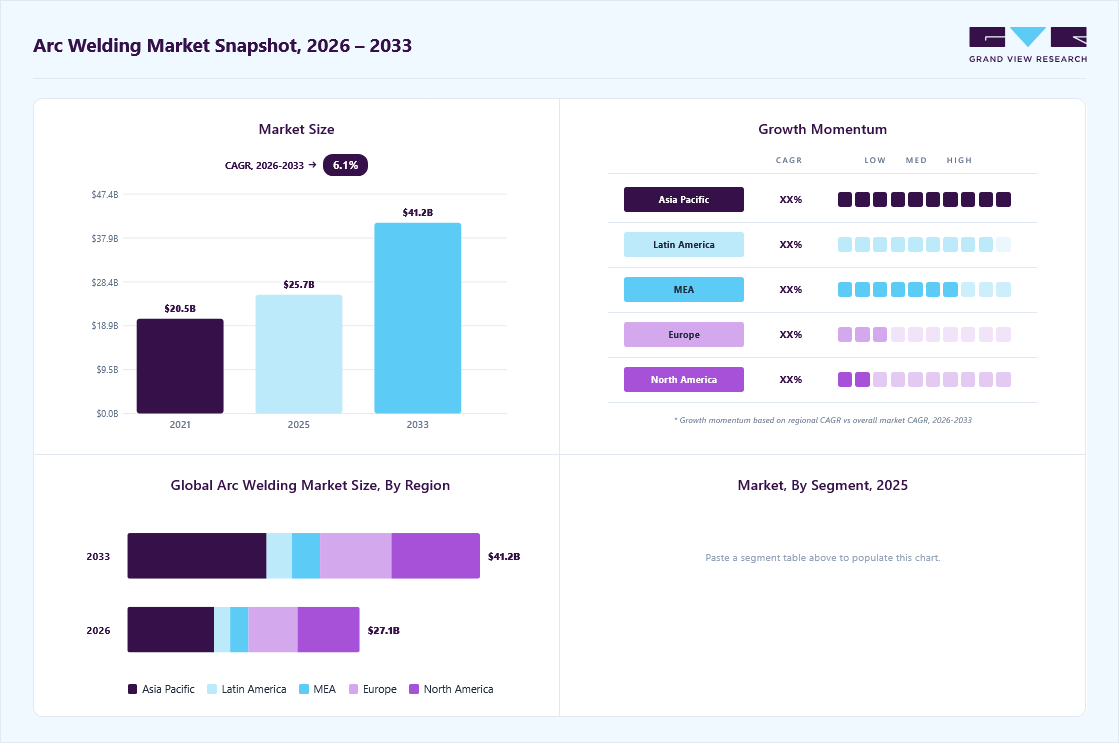
The global arc welding market size was valued at USD 25.7 billion in 2025 and is projected to grow from USD 27.1 billion in 2026 to USD 41.2 billion by 2033, at a CAGR of 6.1% from 2026 to 2033. The market in Asia Pacific dominated with a revenue share of 37.0% in 2025. Market growth is primarily driven by strong demand from the construction, automotive, shipbuilding, and heavy manufacturing industries for reliable, efficient metal-joining solutions.
 Source: Grand View Research, IR Documents, Primary Interviews, Paid DatabasesTo learn more about this report,
 Download Free Sample Report
 Key Market Trends & Insights
- By product type: Consumable segment held the largest market share of 62.9% in 2025.
- By end use: Transportation segment held the largest market share of 24.9% in 2025.
Regional Highlights
- Largest regional market: Asia Pacific (37.0% revenue share, 2025)
- By country: China held the largest market share in 2025
Market Size & Forecast
- Market size in 2025: USD 25.7 Billion
- Estimated market size in 2026: USD 27.1 Billion
- Projected market size by 2033: USD 41.2 Billion
- CAGR (2026-2033): 6.1%
Three ways to get this report
Buy it, customize it, or ask a question.Ask an Analyst
A direct answer, usually in 1 working day
- AccessReport author, directly
- Reply timeWithin 1 working day
- No sales callDirect answer only
- FormatEmail reply
- CostFree, no cost
Get the Full Report
What the study covers
- FormatsPDF · Excel · Dashboard
- Timeline2026–2033 annual, 2025 base
- Coverage20+ countries, 5 regions
- Companies10+ key players profiled
Customize the Report
20% free customization
- IncludeCountries, segments, points
- TailorTo your product definition
- ExtendDeeper competitor detail
- OrA fully bespoke study
- Turnaround5–10 working days
Expansion of infrastructure projects, increasing industrial fabrication activities, and wider adoption of automated and inverter-based welding equipment are contributing to higher utilization of arc welding systems across industrial applications.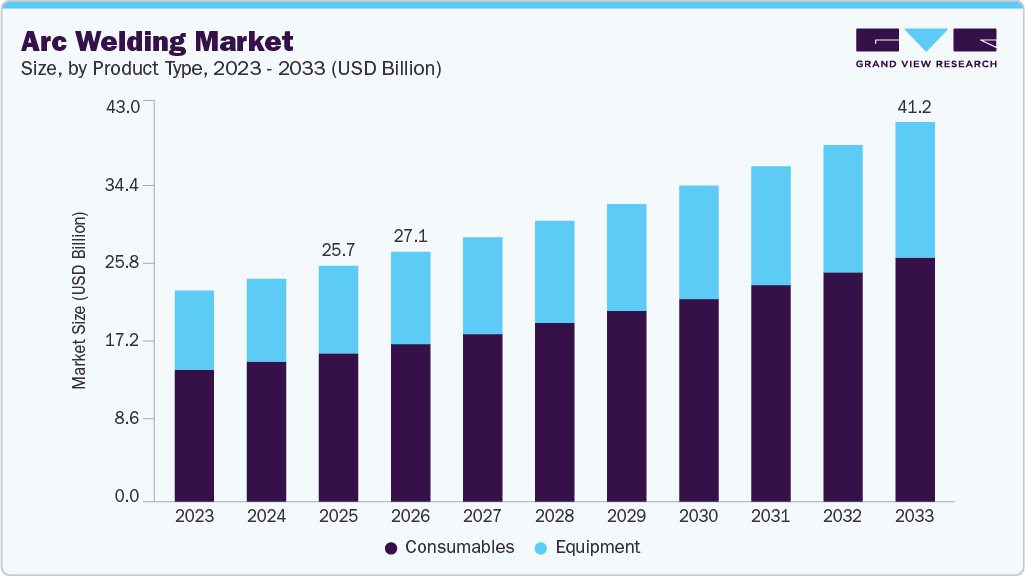 To learn more about this report, Download Free Sample Report
 Expansion of industrial manufacturing, infrastructure development, and metal fabrication activities across sectors such as construction, transportation, shipbuilding, and energy is increasing the demand for arc welding equipment worldwide. Industries are focusing on improving welding precision, operational efficiency, and production capacity through the adoption of advanced welding technologies and automated systems. Additionally, manufacturers are integrating inverter-based equipment, robotic welding solutions, and digitally controlled welding processes to achieve better weld consistency, lower energy consumption, and reduced material defects. The growing preference for high-performance welding systems capable of meeting complex fabrication requirements is further driving market expansion.
Market Dynamics
Increasing investments in infrastructure development, industrial manufacturing, transportation equipment, and large-scale construction projects are contributing to higher demand for arc welding equipment across global markets. Extensive use of welded metal structures in automotive production, shipbuilding, energy facilities, pipelines, and heavy machinery manufacturing is further accelerating equipment adoption. Industries are increasingly shifting toward automated fabrication processes and precision welding technologies to improve productivity, operational efficiency, and weld consistency across manufacturing operations.
Restraints: High Capital Investment and Increasing Operational Expenditure in Arc Welding Operations
High capital investment requirements associated with advanced welding equipment and automation systems remain a challenge for small and medium-sized enterprises operating under budget constraints. Fluctuating raw material costs, maintenance expenses, and reliance on skilled welders can influence purchasing decisions and production efficiency in cost-sensitive industries. Workplace safety concerns related to welding fumes, heat exposure, and operational hazards are also increasing the need for regulatory compliance measures and workforce training, resulting in additional operational expenditure for industrial users.
Market Concentration & Characteristics
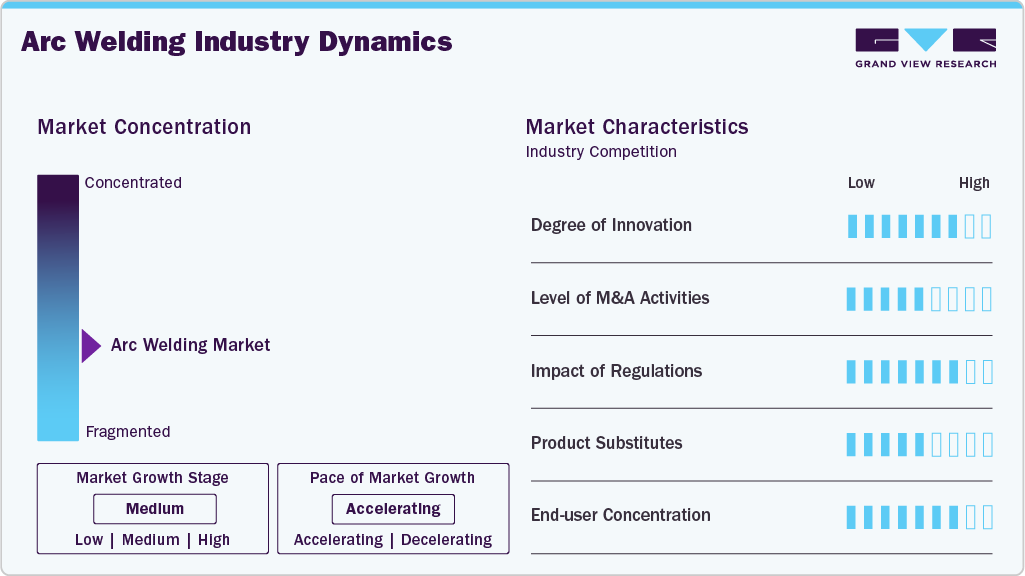
The presence of established international manufacturers and strong regional suppliers has created a considerably competitive environment within the arc welding equipment industry. Companies compete through product quality, welding performance, technological capabilities, pricing strategies, and after-sales service support across industries such as construction, aerospace, shipbuilding, energy, and heavy equipment. Large manufacturers continue to strengthen their positions through broad distribution networks, diversified welding portfolios, and long-term industrial supply agreements, while regional players focus on cost-effective and application-specific equipment offerings.
Technological advancement remains a major factor shaping industry competition and product development. Increasing adoption of inverter-based systems, robotic welding technologies, automated welding cells, and digitally controlled equipment is improving operational efficiency, welding precision, and production consistency across industrial applications. Manufacturers are also emphasizing energy-efficient designs, lower maintenance requirements, and advanced monitoring features to meet evolving industrial production standards and automation requirements.
 To learn more about this report, Download Free Sample Report
 End-user requirements across fabrication, infrastructure, transportation, machinery, and energy sectors continues to influence product demand and purchasing behavior. Industrial customers increasingly prefer welding equipment that can handle high-volume production, complex metal fabrication, and multi-material applications with consistent performance. Expansion of distributor partnerships, localized service capabilities, manufacturing investments, and product customization strategies remain important approaches for companies seeking to strengthen their competitive position across both developed and emerging industrial markets.
Product Type Insights
The consumables segment accounted for the largest share of global revenue in 2025, driven by rising welding activity across industrial production and fabrication operations. The rising use of welding electrodes, filler materials, fluxes, welding wires, and shielding gases in automated and high-volume manufacturing environments is driving strong segment growth. Demand for high-performance consumables that improve weld quality, reduce material defects, and enhance operational efficiency is also encouraging manufacturers to develop specialized welding materials for diverse industrial applications.
The equipment segment is projected to grow at a CAGR of 5.6% over the forecast period, driven by the widespread use of welding machines and power sources across construction, automotive, shipbuilding, heavy engineering, and industrial fabrication industries. The growing demand for efficient and reliable welding systems for continuous production, precision welding, and large-scale metal joining applications is driving segment growth.
End Use Insights
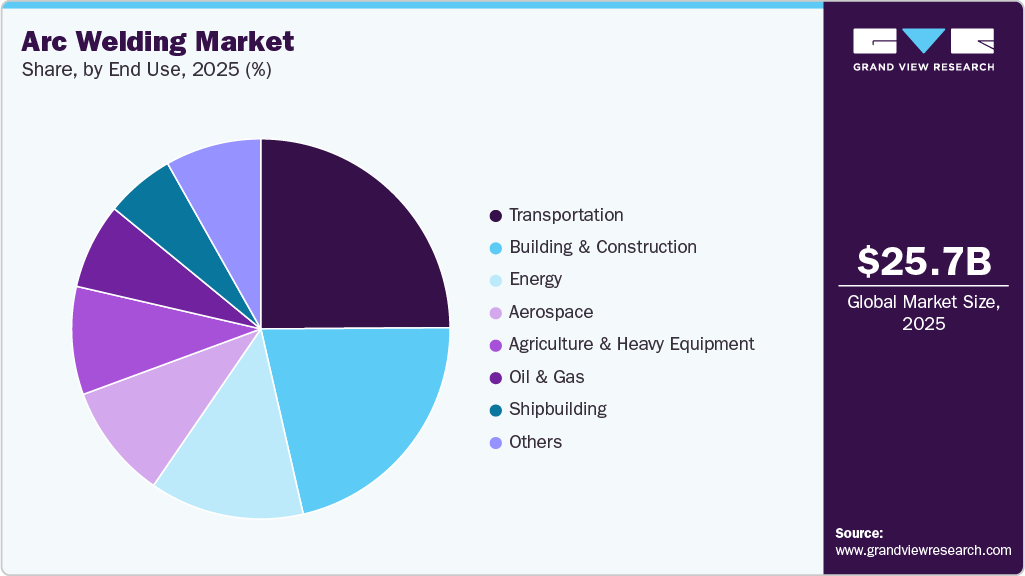
The transportation segment accounted for the largest revenue share of 24.9% in the arc welding market, driven by the extensive use of arc welding technologies in automotive manufacturing, railway production, shipbuilding, and commercial vehicle fabrication. Growing production of passenger vehicles, heavy-duty transportation equipment, and metal structural components is supporting strong demand for welding equipment and consumables across transportation-related industries. Increasing focus on lightweight metal joining, production efficiency, and automated manufacturing processes is further contributing to segment growth.
 To learn more about this report, Download Free Sample Report
 The energy segment is expected to register the fastest CAGR during the forecast period, driven by rising investments in power generation, renewable energy infrastructure, oil & gas pipelines, and transmission network development. Increasing deployment of welding systems in wind tower fabrication, solar infrastructure, offshore platforms, and industrial energy facilities is supporting market expansion. Demand for high-strength and corrosion-resistant welded structures in critical energy applications is also accelerating the adoption of advanced arc welding technologies across the global energy sector.
Regional Insights
North America held a considerable share of the arc welding market due to the strong presence of automotive, aerospace, construction, and heavy machinery manufacturing in the region. Increasing infrastructure renovation projects, expansion of commercial construction activities, and growth in industrial equipment manufacturing are driving utilization of arc welding equipment and consumables across diverse applications. Demand for high-strength metal fabrication and complex structural components is also increasing the need for reliable and high-performance welding systems.
U.S. Arc Welding Market Trends
The U.S. arc welding industry represented the largest market within the region due to extensive metal fabrication operations and ongoing investments in transportation, energy, and industrial infrastructure projects. Manufacturers across the country are incorporating robotic welding systems, inverter-based power sources, and automated production technologies to improve throughput and reduce operational inefficiencies. Continued activity in shipbuilding, railway equipment production, oil & gas pipeline installation, and heavy engineering projects is sustaining equipment demand across industrial sectors. In addition, refurbishment of aging infrastructure and expansion of domestic manufacturing capabilities are contributing to long-term market growth in the U.S.
Asia Pacific Arc Welding Market Trends
Asia Pacific accounted for the largest share of the arc welding industry with strong manufacturing activity across automotive, construction, shipbuilding, heavy machinery, and industrial fabrication sectors. Expansion of infrastructure projects and increasing production of metal components continue to drive demand for welding equipment and consumables across the region. Manufacturers are adopting automated welding technologies and advanced fabrication systems to improve production efficiency, welding precision, and operational consistency in large-scale industrial facilities.
 To learn more about this report, Download Free Sample Report
 The China arc welding market remained the leading market in the region with extensive utilization of arc welding technologies across a robust manufacturing base across end user industries. Moreover, industrial facilities are increasingly integrating robotic welding systems and digitally controlled power sources to strengthen production capabilities and maintain fabrication accuracy. Additionally, growth in renewable energy installations, transportation infrastructure projects, and heavy industrial operations continues to increase the requirement for advanced welding solutions across the country.
India is recording notable growth in the arc welding market with increasing investments in industrial manufacturing, transportation infrastructure, and construction activities. Welding equipment demand is increasing across railway projects, automotive assembly operations, oil & gas pipeline installation, and heavy engineering applications. Expansion of domestic manufacturing facilities and growth in metal fabrication workshops are encouraging wider adoption of modern welding technologies. Increasing industrial maintenance requirements and the development of energy infrastructure are also contributing to market expansion across the country.
Europe Arc Welding Market Trends
Europe held a significant position in the arc welding industry due to its well-established manufacturing sector and extensive metal processing activities across construction, aerospace, and industrial machinery industries. The region continues to generate strong demand for welding equipment used in structural fabrication, transportation systems, and heavy engineering applications. Manufacturers are increasingly adopting automated welding solutions and energy-efficient systems to improve production output, maintain welding accuracy, and optimize fabrication processes. Ongoing industrial upgrades and investments in modern production facilities are further contributing to market growth across Europe.
The Germany arc welding market remained one of the leading markets within the region owing to its large automotive production base and advanced engineering industry. Welding technologies are widely utilized in vehicle manufacturing, industrial equipment production, railway systems, and precision metal fabrication. Industrial companies are incorporating robotic welding cells and digitally controlled power sources to strengthen manufacturing capabilities and maintain consistent product quality. Continued expansion of industrial automation and high-volume manufacturing operations is contributing to steady demand for arc welding systems in Germany.
The France arc welding market is witnessing increasing adoption of arc welding equipment across aerospace manufacturing, transportation infrastructure, industrial construction, and energy-related applications. Demand for durable welded components and reliable fabrication processes is encouraging the use of advanced welding consumables and precision welding technologies. The country’s maintenance and refurbishment activities are also growing across industrial facilities and public infrastructure projects. In addition, renewable energy developments and the modernization of production plants are creating new opportunities for arc welding equipment and consumable manufacturers operating in France.
Latin America Arc Welding Market Trends
Latin America continues to generate demand for arc welding equipment through expanding industrial activities, infrastructure construction, and growth in metal fabrication operations across the region. Welding technologies are widely utilized in construction, transportation, mining, energy, and industrial manufacturing applications that require durable metal joining and large-scale fabrication capabilities. Modernization of manufacturing facilities and gradual integration of automated welding processes are contributing to greater adoption of advanced welding systems and consumables across industrial sectors.
The Brazil arc welding market accounted for the largest share of the regional market owing to its well-established industrial sector and extensive automotive, machinery, construction, and energy-related operations. Investments in industrial infrastructure, fabrication facilities, and transportation equipment production are increasing the utilization of arc welding equipment across the country. Industrial manufacturers are also adopting inverter-based welding systems, robotic welding technologies, and digitally controlled fabrication solutions to improve production efficiency, weld precision, and operational performance.
Middle East & Africa Arc Welding Market Trends
The Middle East & Africa arc welding industry is benefiting from continued expansion of industrial infrastructure, energy projects, transportation networks, and large-scale construction activities across the region. Arc welding technologies are widely utilized in oil & gas facilities, pipeline installations, metal fabrication plants, heavy engineering operations, and industrial maintenance applications requiring durable and high-precision metal joining. Increasing focus on industrial capacity expansion and modernization of fabrication operations is contributing to greater adoption of advanced welding equipment, automated systems, and high-performance consumables across regional industries.
The Saudi Arabia arc welding market remains one of the leading markets in the region with ongoing investments in industrial development programs, manufacturing expansion, renewable energy projects, and infrastructure construction under long-term economic diversification initiatives. Growth in industrial fabrication, petrochemical facilities, transportation infrastructure, and large commercial construction projects is increasing utilization of arc welding systems across the country.
Key Arc Welding Company Insights
Some of the key players operating in the market include Lincoln Electric Holdings, Inc. and ESAB Corporation, among others.
-
Lincoln Electric Holdings, Inc. is a U.S.-based manufacturer of welding equipment, arc welding systems, robotic welding solutions, plasma cutting equipment, and welding consumables serving industrial sectors worldwide. The company operates across automotive, construction, shipbuilding, energy, heavy engineering, and metal fabrication industries through a broad portfolio of welding technologies and automation solutions. Lincoln Electric focuses on product innovation, industrial automation integration, and expansion of its global manufacturing and distribution network to strengthen its position in the welding equipment industry.
-
ESAB Corporation is an industrial company engaged in welding, cutting, and metal fabrication technologies. It provides a broad portfolio that includes arc welding equipment, filler metals and consumables, plasma and oxy-fuel cutting systems, as well as automation and digital solutions designed to improve productivity and weld quality. The company’s offerings are used across a range of industries such as construction, automotive, energy, shipbuilding, and general manufacturing, supporting both large-scale industrial operations and smaller fabrication environments through its international presence and distribution network.
Key Arc Welding Companies:
The following key companies have been profiled for this study on the arc welding market.
- Lincoln Electric Holdings, Inc.
- ESAB
- Illinois Tool Works Inc.(ITW)
- Miller Electric Mfg. LLC (ITW)
- Hobart Brothers LLC (ITW)
- American Weldquip (Profax Group)
- Fronius International GmbH
- Panasonic Connect Co., Ltd. (Panasonic Holdings Corporation)
- Kemppi Oy
- JASIC Technology Co., Ltd.
- SHANGHAI HUGONG ELECTRIC (GROUP)CO.,LTD
- Lorch Schweißtechnik GmbH
- HYUNDAI WELDING CO., LTD
- CEA Costruzioni Elettromeccaniche Annettoni S.p.A.
- Migatronic A/S
- Ador Welding
- voestalpine Böhler Welding Group GmbH
Competitive Benchmarking
Operating Strategies
Competitive Edge
Weaknesses
Mature Players: Lincoln Electric Holdings, Inc.; ESAB; Illinois Tool Works Inc. (ITW); Panasonic Connect Co., Ltd.; voestalpine Böhler Welding Group GmbH - Focus on end-to-end solutions (equipment, consumables, automation, digital integration)
- Strong emphasis on global expansion and acquisitions to strengthen market share
- Continuous investment in R&D and advanced welding technologies
- Extensive product portfolio covering all major welding processes
- Strong global distribution network and brand recognition
- Advanced capabilities in automation, robotics, and digital welding solutions
- High-cost structures compared to regional competitors
- Slower adaptability due to large organizational complexity
- Dependence on cyclical industries like construction and energy
Emerging Players: Kemppi Oy; HYUNDAI WELDING CO., LTD.; Lorch Schweißtechnik GmbH; JASIC Technology Co., Ltd.; SHANGHAI HUGONG ELECTRIC (GROUP)CO., LTD - Focus on cost-competitive products and regional market expansion
- Target specific segments (equipment or consumables) rather than full integration
- Gradual shift toward technology upgrades and automation offerings
- Price competitiveness with flexible product offerings
- Strong presence in local and developing markets
- Faster decision-making and agility in product customization
- Limited global presence and brand recognition
- Narrower product portfolio compared to established leaders
- Lower investment capacity in advanced technologies and R&D
Recent Developments
-
In February 2026, Lincoln Electric Holdings, Inc. launched the Frontier 500X engine-driven welder generator for use in demanding field conditions. It delivers high welding output along with auxiliary power to run tools and equipment on-site. The system includes improved arc performance features to support better weld control and consistency. It is designed for industries that require durable and efficient equipment in challenging work environments.
-
In February 2026, ESAB Corporation announced that it has entered into an agreement to acquire Eddyfi Technologies for about USD 1.45 billion. The acquisition expands its capabilities into inspection and monitoring technologies, complementing its welding and fabrication portfolio. Eddyfi brings expertise in advanced sensing, robotics, and asset integrity solutions across industries such as aerospace, energy, and infrastructure. The deal is expected to close in mid-2026, subject to regulatory approvals
Arc Welding Market Report Scope
Report Attribute
Details
Market size in 2025
USD 25.7 billion
Estimated market size in 2026
USD 27.1 billion
Projected market size by 2033
USD 41.2 billion
Growth rate
CAGR of 6.1% from 2026 to 2033
Base year for estimation
2025
Historical data
2021 - 2024
Forecast period
2026 - 2033
Quantitative units
Revenue in USD billion, Volume Units & Kilo Tons and CAGR from 2026 to 2033
Report coverage
Revenue forecast, company market position analysis, competitive landscape, growth factors, and trends
Segments covered
Product type, end use, region
Regional scope
North America; Europe; Asia Pacific; Latin America; Middle East & Africa
Country Scope
U.S.; Canada; Mexico; Germany; UK; Italy; France; Spain; China; Japan; India; Australia; South Korea; Brazil; Northern Latin America; Southern Latin America; Saudi Arabia; South Africa
Key companies profiled
Lincoln Electric Holdings, Inc.; ESAB; Illinois Tool Works Inc.(ITW); Miller Electric Mfg. LLC (ITW); Hobart Brothers LLC (ITW); American Weldquip (Profax Group); Fronius International GmbH; Panasonic Connect Co., Ltd. (Panasonic Holdings Corporation); Kemppi Oy; JASIC Technology Co., Ltd.; SHANGHAI HUGONG ELECTRIC (GROUP)CO.,LTD; Lorch Schweißtechnik GmbH; HYUNDAI WELDING CO., LTD; CEA Costruzioni Elettromeccaniche Annettoni S.p.A.; Migatronic A/S; Ador Welding; voestalpine Böhler Welding Group GmbH
Customization scope
Free report customization (equivalent up to 8 analysts working days) with purchase. Addition or alteration to country, regional & segment scope.
Pricing and purchase options
Avail customized purchase options to meet your exact research needs. Explore purchase options
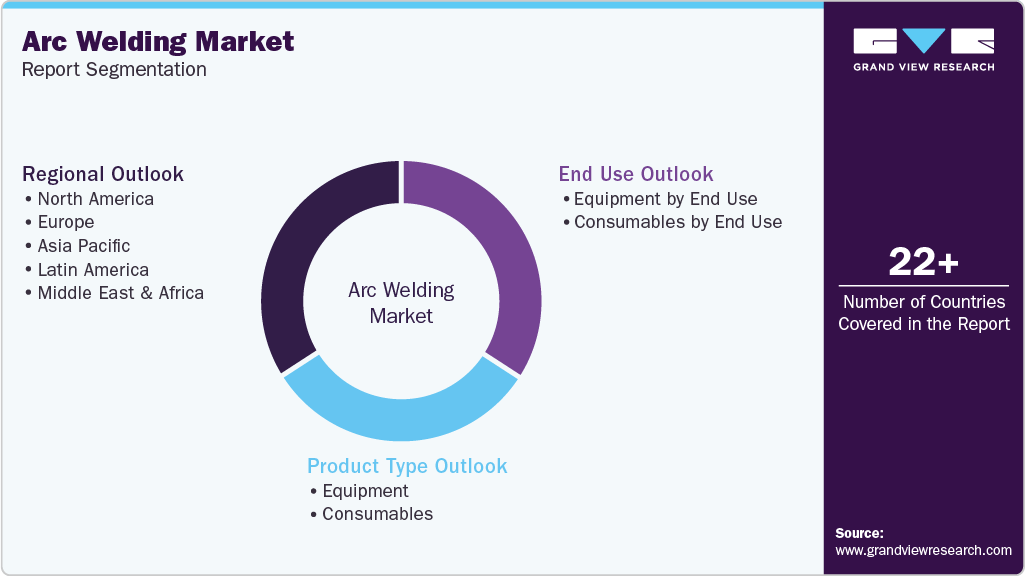
Global Arc Welding Market Report SegmentationThis report forecasts revenue growth at global, regional & country levels and provides an analysis on the industry trends in each of the sub-segments from 2021 to 2033. For the purpose of this study, Grand View Research has segmented the arc welding market on the basis of product type, end use, and region:
 To learn more about this report, Download Free Sample Report
 -
Product Type Outlook (Revenue, USD Billion; Volume, Units & Kilo Tons; 2021 - 2033)
-
Equipment
-
Shielded Metal/Stick Arc Welding
-
MIG
-
Up to 300 amps
-
Above 300 amps
-
-
TIG
-
Submerged Arc Welding
-
Flux Cored Welding
-
Plasma Cutting Systems
-
Gas & Diesel Engine Drive
-
Others
-
-
Consumables
-
Stick Electrodes
-
Solid MIG Wires
-
Solid TIG Cut Length
-
Flux-Cored Wires
-
Saw Wires and Fluxes
-
Others
-
-
-
End Use Outlook (Revenue, USD Billion; Volume, Units & Kilo Tons; 2021 - 2033)
-
Equipment by End Use
-
Aerospace
-
Transportation
-
Building & Construction
-
Energy
-
Oil & Gas
-
Shipbuilding
-
Agriculture & Heavy Equipment
-
Others
-
-
Consumables by End Use
-
Aerospace
-
Transportation
-
Building & Construction
-
Energy
-
Oil & Gas
-
Shipbuilding
-
Agriculture & Heavy Equipment
-
Others
-
-
-
Regional Outlook (Revenue, USD Billion; Volume, Units & Kilo Tons; 2021 - 2033)
-
North America
-
U.S.
-
Canada
-
Mexico
-
-
Europe
-
Germany
-
UK
-
France
-
Spain
-
Italy
-
-
Asia Pacific
-
China
-
India
-
Japan
-
South Korea
-
Australia
-
-
Latin America
-
Brazil
-
Northern Latin America
-
Southern Latin America
-
-
Middle East & Africa
-
Saudi Arabia
-
South Africa
-
-
Delivered Customizations
This report has been delivered with the following In-depth customizations
Client Request
Customization Delivered
Value Adds
Pricing Analysis
Comprehensive regional pricing analysis covering average selling prices (ASP) of arc welding equipment and consumables across major markets including North America, Europe, Asia Pacific, Latin America, and Middle East & Africa. The assessment includes price benchmarking for welding machines, power sources, electrodes, wires, fluxes, and shielding gases, along with observed price ranges showing the lowest and highest transaction prices recorded for each product category within a given region. This helps capture pricing spread across premium, mid-range, and economy product offerings.
Help clients understand regional pricing structures and identify the most commercially attractive markets for equipment sales and consumable distribution. Support pricing strategy, procurement planning, distributor selection, and margin optimization by highlighting where price bands are widest, where premium pricing is sustainable, and where cost-sensitive competition drives tighter pricing pressure across the market.
Cross segmentation
Detailed cross-segmentation analysis across product type, equipment type, consumables type, end-use industries, and regional markets to identify the highest-value demand intersections within the arc welding market.
Help identify the most commercially attractive product-application-region combinations and uncover underserved market pockets for strategic expansion. Support portfolio optimization, sales prioritization, distributor alignment, and production planning by revealing where equipment demand, consumables replacement cycles, and end-use concentration generate the strongest long-term revenue opportunities across multiple segment layers.
Company Market Analysis
Assessment of company-wise market share across the global arc welding market based on revenue contribution, regional presence and competitive positioning among other aspects. The analysis includes benchmarking of key market players, share movement trends, market concentration, and evaluation of regional challengers across both equipment and consumables segments.
Provide a clear view of competitive leadership, market concentration, and whitespace opportunities to support strategic decision-making. Enable clients to benchmark competitors, identify dominant and emerging players, and assess vulnerable market positions for potential share capture. Support partnership evaluation, acquisition targeting, and growth strategy development by highlighting areas where competitive advantage and market share gains are most commercially achievable.
Frequently Asked Questions About This Report
The consumables segment led with a 62.9% revenue share in 2025.
The transportation segment led with a 24.9% revenue share in 2025, while energy is the fastest-growing segment.
The global arc welding market size was valued at USD 25.7 billion in 2025 and is estimated at USD 27.1 billion for 2026.
Asia Pacific dominated with a 37.0% revenue share in 2025.
Key players include Lincoln Electric Holdings, Inc.; ESAB; Illinois Tool Works Inc.(ITW); Miller Electric Mfg. LLC (ITW); Hobart Brothers LLC (ITW); American Weldquip (Profax Group); Fronius International GmbH; Panasonic Connect Co., Ltd. (Panasonic Holdings Corporation); Kemppi Oy; JASIC Technology Co., Ltd.; SHANGHAI HUGONG ELECTRIC (GROUP)CO.,LTD; Lorch Schweißtechnik GmbH; HYUNDAI WELDING CO., LTD; CEA Costruzioni Elettromeccaniche Annettoni S.p.A.; Migatronic A/S; Ador Welding; voestalpine Böhler Welding Group GmbH.
Key factors driving the arc welding market include rising industrial manufacturing activities, increasing infrastructure and construction projects, and growing demand from the automotive, shipbuilding, and heavy equipment sectors.
The global arc welding market is expected to grow at a CAGR of 6.1% from 2026 to 2033, reaching USD 41.2 billion by 2033.
About the Author(s)
Advanced Interior Materials Research Team
Advanced Materials · Advanced Interior MaterialsThis report was authored by the advanced interior materials research team at Grand View Research - comprising two research analysts, one senior research analyst, and one industry expert - with specialized expertise in the advanced interior materials segment of the advanced materials industry. All findings are based on proprietary advanced materials databases, executive interviews, and regulatory analysis, subject to internal peer review prior to publication.
Last Updated:
Speak to Analyst

Customize this report to your needs - add regions, segments, or data points, with 20% free customization.
Or view our licence options:


ISO 9001:2015 & 27001:2022 Certified
We are GDPR and CCPA compliant! Your transaction & personal information is safe and secure. For more details, please read our privacy policy.


