
- Home
- »
- Advanced Interior Materials
- »
-
Arc Welding Equipment Market Size, Industry Report, 2033GVR Report cover

Arc Welding Equipment Market (2025 - 2033) Size, Share & Trends Analysis Report By Type (Shielded Metal/Stick Arc Welding, Metal Inert Gas Welding), By Product (Automatic, Semi-automatic), By End-use (Aerospace, Automotive), By Region, And Segment Forecasts
Market Size, 2024
$14.6BMarket Estimate, 2026
$15.2BMarket Forecast, 2033
$22.5BCAGR, 2025–2033
5.0%Arc Welding Equipment Market Summary
The global arc welding equipment market size was estimated at USD 14.55 billion in 2024 and is projected to reach USD 22.49 billion by 2033, growing at a CAGR of 5.0% from 2025 to 2033. This growth is primarily driven by increasing demand from the construction and infrastructure sectors, where arc welding plays a critical role in fabricating steel structures, pipelines, and frameworks.
 Source: Grand View Research, IR Documents, Primary Interviews, Paid DatabasesTo learn more about this report,
 Download Free Sample Report
 Key Market Trends & Insights
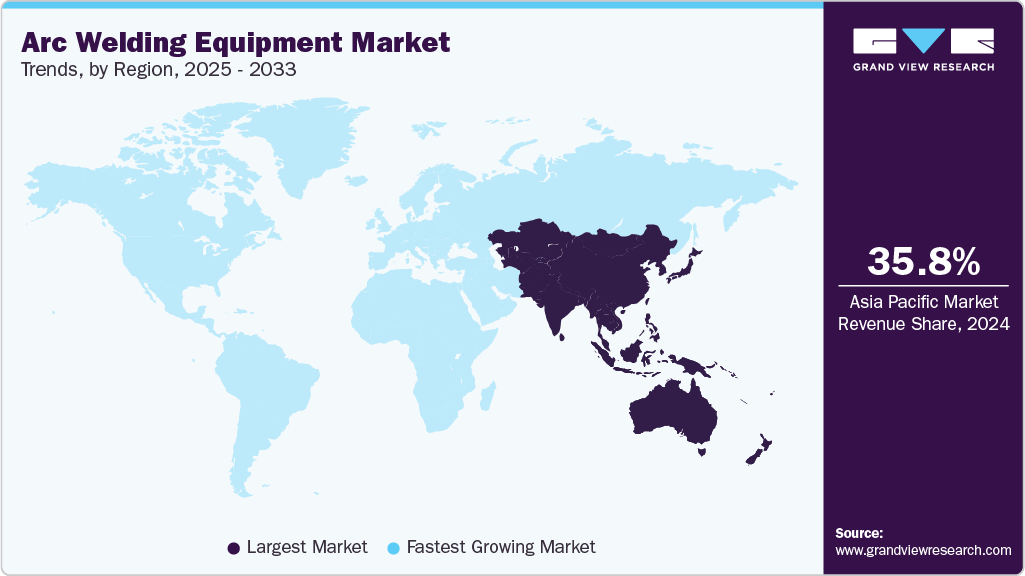
- Asia Pacific dominated the arc welding equipment market with the largest revenue share of 35.8% in 2024.
- The arc welding equipment market in the U.S. is expected to grow at a substantial CAGR of 4.0% from 2025 to 2033.
- By product, the automatic arc welding equipment segment holds a 56.1% share due to its high efficiency, precision, and reduced reliance on manual labor.
- By type, the tungsten inert gas welding (TIG) segment is expected to grow at a considerable CAGR of 6.0% from 2025 to 2033 in terms of revenue.
- By end use, the aerospace segment is expected to grow at a considerable CAGR of 6.1% from 2025 to 2033 in terms of revenue.
Market Size & Forecast
- 2024 Market Size: USD 14.55 Billion
- 2033 Projected Market Size: USD 22.49 Billion
- CAGR (2025-2033): 5.0%
- Asia Pacific: Largest market in 2024
Three ways to get this report
Buy it, customize it, or ask a question.Ask an Analyst
Analyst response in 1 business day
- AccessReport author, directly
- Reply timeWithin 1 working day
- No sales callDirect answer only
- FormatEmail reply
- CostFree, no cost
Get the Full Report
What the study covers
- FormatsPDF · Excel · Dashboard
- Timeline2025–2033 annual, 2024 base
- Coverage20+ countries, 5 regions
- Companies10+ key players profiled
Customize the Report
20% free customization
- IncludeCountries, segments, points
- TailorTo your product definition
- ExtendDeeper competitor detail
- OrA fully bespoke study
- Turnaround5–10 working days
Rapid urbanization and industrialization, particularly in developing economies across Asia Pacific and Latin America, are intensifying the need for durable and cost-effective welded components. In addition, government investments in public infrastructure, including roads, bridges, railways, and energy facilities, are further fueling market expansion.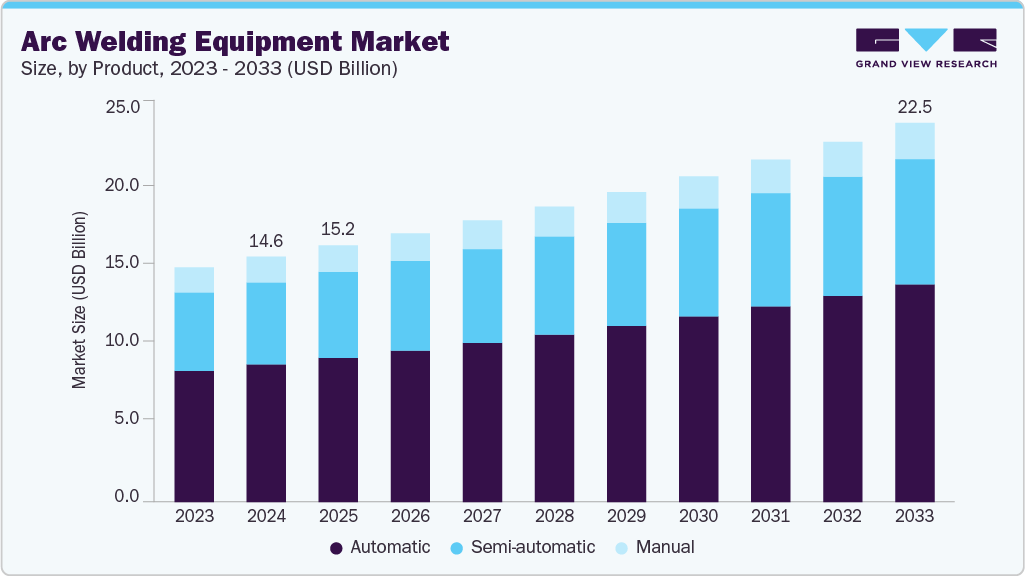 To learn more about this report, Download Free Sample Report
 In addition, the expansion of the automotive and shipbuilding industries is contributing significantly to market growth. Automakers increasingly rely on automated and robotic arc welding for precision, speed, and production efficiency. Rising global vehicle production and increased focus on lightweight materials have further accelerated adoption. This industrial shift enhances the demand for advanced welding technologies and integrated welding solutions.
Market Dynamics
Governments and private sector companies across both developed and emerging economies are investing heavily in transportation infrastructure, commercial buildings, industrial facilities, and energy projects. Arc welding equipment plays a critical role in structural steel fabrication, bridge construction, pipeline installation, and industrial assembly operations. The expansion of urban infrastructure and smart city initiatives is therefore generating significant opportunities for welding equipment manufacturers.
Growing investments in renewable energy facilities, railways, oil & gas pipelines, and public infrastructure modernization projects are further strengthening equipment demand. Developing countries in Asia Pacific, the Middle East, and Latin America are witnessing substantial construction and industrial growth, which continues to increase the need for reliable and high-performance welding solutions. Portable and durable welding equipment remains particularly important for field construction and heavy industrial applications.
The shortage of skilled welding professionals is a significant challenge affecting the growth of the arc welding equipment market globally. Advanced welding operations, particularly automated and precision welding applications, require trained operators and technicians capable of handling sophisticated equipment, interpreting welding parameters, and maintaining quality standards. However, many industries are experiencing an aging workforce and declining availability of certified welding professionals, especially in developed economies.
Market Concentration & Characteristics
The global arc welding equipment industry is moderately concentrated, with a few major players dominating a significant share. Leading companies focus on technological advancements, automation, and strategic partnerships to maintain their market positions. However, the presence of numerous regional and niche players adds a fragmented element to the competitive landscape. This mix creates a market where both global brands and local suppliers coexist.
The market shows a high degree of innovation, driven by automation, robotics, and smart welding technologies. Manufacturers are investing in AI-integrated systems and IoT-enabled machines for real-time monitoring and efficiency. These innovations improve precision, reduce human error, and enhance safety. The focus on energy-efficient and eco-friendly solutions further supports technological advancement.
 To learn more about this report, Download Free Sample Report
 Mergers and acquisitions are common in this market as major players aim to expand their product portfolios and global reach. Companies often acquire regional firms to gain access to new customer bases and technologies. This consolidation helps strengthen competitive positioning and economies of scale. M&A activities also promote innovation by integrating complementary expertise.
Regulations related to worker safety, emissions, and energy consumption significantly influence the market. Compliance with standards such as OSHA and ISO requires continual product upgrades and testing. Environmental regulations push companies to develop sustainable and low-emission equipment. These regulatory pressures encourage ongoing improvement and investment in advanced systems.
Type Insights
The shielded metal/stick arc welding segment currently dominates the market and accounted for a 29.5% share in 2024, due to its simplicity, low equipment cost, and versatility. It is widely used in construction, repair, and maintenance across various industries. The process is suitable for outdoor and remote locations, requiring minimal setup. Its adaptability to different metals and environments ensures continued high demand.
TIG welding is witnessing the fastest growth owing to its precision, clean welds, and suitability for high-quality applications. It is increasingly used in aerospace, automotive, and fabrication of stainless steel and thin metals. The growing focus on quality standards and aesthetic finish is driving its adoption. Technological enhancements and automation are further accelerating TIG welding’s market expansion.
Product Insights
The automatic arc welding equipment segment holds a 56.1% share due to its high efficiency, precision, and reduced reliance on manual labor. It is widely used in large-scale industries such as automotive and shipbuilding, where consistency and speed are crucial. Automation minimizes errors and enhances production rates, making it ideal for repetitive tasks. Rising labor costs and demand for quality are pushing industries toward full automation.
Semi-automatic welding systems are experiencing notable growth as they offer a balance between manual flexibility and automation benefits. These systems are preferred by small to mid-sized manufacturers due to lower investment costs compared to fully automated setups. They improve productivity while allowing human control over critical welds. The rising need for scalable solutions in developing regions is driving demand.
End Use Insights
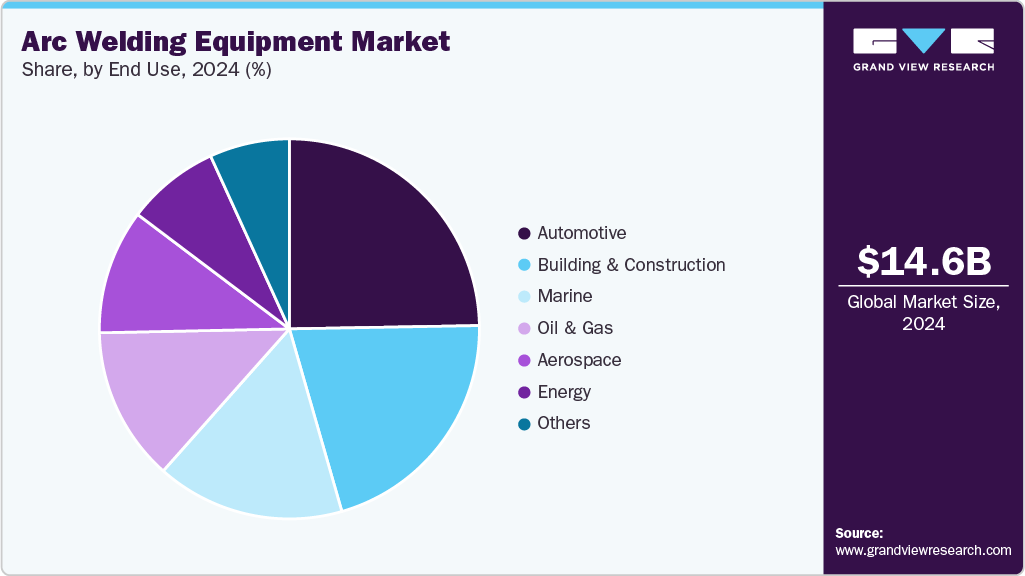
The automotive sector dominated the market and accounted for a 24.7% share in 2024, due to its high-volume production and need for consistent, strong welds. Welding is essential in assembling vehicle frames, exhaust systems, and other structural components. Automation and robotic welding are extensively used for efficiency and precision. Growing global vehicle demand continues to drive equipment adoption in this sector.
 To learn more about this report, Download Free Sample Report
 The aerospace industry is the fastest-growing end use segment, driven by its demand for high-precision and lightweight welds. TIG and advanced arc welding methods are vital for joining sensitive materials like aluminum and titanium. Increased aircraft production and stringent safety standards fuel this growth. Technological innovation and rising global air travel further support market expansion.
Regional Insights
North America arc welding equipment industry is, anticipated to grow at a significant CAGR of 4.1% over the forecast period due to its mature industrial base and widespread adoption of automation technologies. The region benefits from strong demand in the automotive, aerospace, and energy sectors. Major manufacturers and technology providers are headquartered here driving continuous innovation. High safety and quality standards further push the adoption of advanced welding solutions. Government initiatives supporting infrastructure modernization also contribute to sustained market leadership.
U.S. Arc Welding Equipment Market Trends
The U.S. arc welding equipment industry dominates the North American region, due to its large-scale industrial base and advanced manufacturing capabilities. High demand from automotive, aerospace, and energy sectors drives equipment adoption. Strong presence of key manufacturers and early adoption of automation support market leadership. Government infrastructure spending further fuels consistent demand for welding technologies.
The arc welding equipment industry in Canada is experiencing steady growth supported by investments in construction, transportation, and energy projects. The country’s focus on sustainable development and infrastructure renewal increases demand for efficient welding solutions. Adoption of semi-automatic and automated systems is rising among industrial players. Workforce training programs and technological upgrades are further enhancing market potential.
Europe Arc Welding Equipment Market Trends
The Europe arc welding equipment industry is growing steadily, owing to its focus on advanced manufacturing and environmentally sustainable practices. Countries such as Germany, Italy, and France lead in precision welding technologies, especially in the automotive and machinery sectors. Strict regulatory standards encourage the adoption of energy-efficient and high-performance equipment. The presence of globally recognized welding companies strengthens the regional market. Ongoing investments in smart factories and Industry 4.0 solutions drive demand for automated welding systems.
Germany arc welding equipment industry dominates the European region due to its strong industrial and engineering sectors. The country leads in automotive manufacturing, machinery, and metal fabrication, all of which heavily rely on welding technologies. High levels of automation and precision welding drive demand for advanced equipment. Government support for Industry 4.0 and innovation further strengthens its market position.
The arc welding equipment industry in the UK is growing steadily, driven by increased investment in infrastructure, aerospace, and renewable energy projects. Demand for high-quality and efficient welding solutions is rising, especially in offshore wind and defense sectors. Adoption of automated and energy-efficient welding systems is expanding across industries. Supportive policies and efforts to boost domestic manufacturing are contributing to growth.
Asia Pacific Arc Welding Equipment Market Trends
Asia Pacific arc welding equipment industry is a dominant force in the global market and accounted for a share of 35.8% in 2024, fueled by rapid industrialization and urbanization in China, India, and Southeast Asia. The region is home to a robust manufacturing base, especially in automotive, shipbuilding, and construction. Government policies promoting domestic manufacturing and foreign direct investment bolster market growth. Rising demand for cost-effective and scalable welding solutions supports high equipment consumption. Technological adoption is increasing, particularly in large-scale production facilities.
 To learn more about this report, Download Free Sample Report
 China arc welding equipment industry is witnessing strong growth due to its vast manufacturing base and infrastructure development. High demand from the construction, automotive, and shipbuilding sectors drives equipment sales. Government initiatives like "Made in China 2025" promote industrial automation and smart manufacturing. The presence of local manufacturers offering cost-effective solutions further boosts market expansion.
India arc welding equipment industry is growing rapidly, supported by industrialization, urban infrastructure projects, and the expanding automotive sector. Government programs like “Make in India” are encouraging domestic production and foreign investment. Small and medium enterprises are increasingly adopting semi-automatic and automatic welding systems. Rising demand for skilled labor and technological upgrades also contribute to market growth.
Middle East & Africa Arc Welding Equipment Market Trends
The Middle East and Africa arc welding equipment industry is showing promising growth due to investments in oil & gas, construction, and renewable energy. Welding demand is increasing for pipeline construction, structural fabrication, and industrial facilities. While overall industrial development is uneven, some countries like the UAE and Saudi Arabia are leading regional growth. Governments are focusing on diversification beyond oil, promoting industrialization and infrastructure development. As technology awareness spreads, the market is expected to grow steadily.
Saudi Arabia arc welding equipment industry is experiencing growing demand, driven by large-scale infrastructure and industrial projects under Vision 2030. The construction of smart cities, energy facilities, and transportation networks boosts welding applications. The oil & gas sector continues to be a major contributor, requiring advanced welding for pipelines and refineries. Government efforts to diversify the economy and localize manufacturing are further accelerating market growth.
Latin America Arc Welding Equipment Market Trends
Latin America arc welding equipment industry is a growing market, driven by infrastructure development and industrial expansion. Countries like Brazil and Mexico are seeing increased demand in automotive assembly and construction. However, economic instability in some areas can hinder growth momentum. Local manufacturers are gradually adopting semi-automatic and automated welding systems to boost productivity. With rising foreign investment and regional trade agreements, long-term growth prospects remain positive.
Brazil arc welding equipment industry is growing steadily due to rising investments in infrastructure, energy, and industrial sectors. Projects in construction, oil & gas, and transportation are driving the demand for welding technologies. The automotive and shipbuilding industries further contribute to equipment usage across fabrication and assembly. Supportive government policies and increased focus on modernizing manufacturing practices are fueling market expansion.
Key Arc Welding Equipment Company Insights
Some of the key players operating in the market include The Lincoln Electric Company, ACRO Automation Systems, Inc., and Illinois Tool Works Inc.
-
The Lincoln Electric Company specializes in advanced welding and cutting technologies with a strong focus on automation and system integration. It offers industry-specific solutions, including robotic welding cells, CNC plasma systems, and welding consumables tailored for high-performance applications. The company is known for integrating IoT and real-time monitoring features into its equipment for enhanced productivity. Lincoln also provides custom-engineered systems for complex manufacturing environments. Its solutions are widely used in automotive, shipbuilding, and structural steel sectors.
-
ACRO Automation Systems, Inc. is a provider of custom robotic welding and assembly systems, focusing on turnkey automation for industrial manufacturers. The company designs and builds automated production lines that include precision welding, vision inspection, and material handling systems. ACRO specializes in handling complex, high-precision components in the automotive and heavy equipment industries. Their expertise lies in seamlessly integrating robotics with advanced motion control and part tracking. They also offer post-installation support, including system upgrades and process optimization.
Key Arc Welding Equipment Companies
The following are the leading companies in the arc welding equipment market. These companies collectively hold the largest market share and dictate industry trends.
- The Lincoln Electric Company
- ACRO Automation Systems, Inc
- Illinois Tool Works Inc.
- Ador Welding Limited
- Mitco Weld Products Pvt. Ltd.
- voestalpine Böhler Welding Group GmbH
- Carl Cloos Schweisstechnik GmbH
- OTC DAIHEN Inc.
- Panasonic Industry Co., Ltd.
- Coherent, Inc.
- ESAB
- Polysoude S.A.S.
- Kemppi Oy.
- Cruxweld Industrial Equipment Pvt. Ltd.
- Fronius International GmbH
Competitive Benchmarking
Operating Strategies
Competitive Edge
Weaknesses
Mature Players: The Lincoln Electric Company, Illinois Tool Works Inc., voestalpine Böhler Welding Group GmbH, OTC DAIHEN Inc., Panasonic Industry Co., Ltd., ESAB, Kemppi Oy.
- Emphasize large-scale industrial automation and robotic arc welding integration across automotive, aerospace, and heavy engineering industries.
- Expand global market presence through acquisitions, strategic partnerships, and strong distributor networks.
- Invest heavily in digital welding technologies, AI-enabled monitoring systems, and energy-efficient welding equipment development.
- Strong global brand recognition supported by extensive product portfolios covering MIG, TIG, plasma, and automated welding systems.
- Advanced R&D capabilities and technological expertise in robotic and intelligent welding solutions.
- Well-established aftersales service networks and long-term relationships with industrial customers strengthen market leadership.
- High dependence on industrial manufacturing investments and capital expenditure cycles.
- Premium pricing of advanced automated welding systems can limit adoption among small and medium enterprises.
Emerging Players: ACRO Automation Systems, Inc, Ador Welding Limited, Mitco Weld Products Pvt. Ltd., Coherent, Inc., Polysoude S.A.S., Cruxweld Industrial Equipment Pvt. Ltd.
- Focus on regional market expansion and cost-effective welding solutions targeting SMEs and local fabrication industries.
- Develop customized and application-specific welding systems to strengthen niche market presence.
- Increase market reach through local distributors, industrial partnerships, and product diversification strategies.
- Greater operational flexibility in addressing customer-specific welding requirements and regional industrial needs.
- Competitive pricing strategies help capture demand in cost-sensitive and developing markets.
- Faster adaptability to changing local manufacturing trends and emerging industrial opportunities.
- Limited international presence and lower brand visibility compared to established multinational competitors.
- Smaller R&D investments may restrict development of advanced automation and smart welding technologies.
Recent Developments
-
In June 2025, ESAB Corporation is set to acquire German welding equipment manufacturer EWM GmbH. The deal is aimed at expanding ESAB’s capabilities in heavy industrial welding and automation. EWM is expected to contribute around €120 million in revenue in 2025, with the acquisition closing later that year. This move will strengthen ESAB’s position in Europe and enhance its product offerings in advanced welding solutions.
-
In July 2024, Lincoln Electric acquired Vanair Manufacturing, a U.S.-based company known for its vehicle-mounted power solutions, including compressors, generators, and welders. This acquisition enhances Lincoln’s capabilities in the mobile power sector, especially for service trucks. Vanair’s offerings align well with Lincoln’s maintenance and repair product lines, expanding its reach in key markets. The move is expected to support long-term growth and innovation in portable industrial solutions.
Arc Welding Equipment Market Report Scope
Report Attribute
Details
Market size value in 2025
USD 15.22 billion
Revenue forecast in 2033
USD 22.49 billion
Growth rate
CAGR of 5.0% from 2025 to 2033
Base year for estimation
2024
Historical data
2021 - 2023
Forecast period
2025 - 2033
Quantitative units
Revenue in USD million/billion and CAGR from 2025 to 2033
Report coverage
Revenue forecast, company market position analysis, competitive landscape, growth factors, and trends
Segments covered
Product, type, end use, and region
Regional scope
North America; Europe; Asia Pacific; Latin America; Middle East & Africa
Country Scope
U.S.; Canada; Mexico; Germany; France; UK; Germany; Italy; Spain; China; Japan; India; South Korea; Australia; Brazil; Argentina; South Africa; Saudi Arabia
Key companies profiled
The Lincoln Electric Company; ACRO Automation Systems, Inc; Illinois Tool Works Inc.; Ador Welding Limited; Mitco Weld Products Pvt. Ltd.; voestalpine Böhler Welding Group GmbH; Carl Cloos Schweisstechnik GmbH; OTC DAIHEN Inc.; Panasonic Industry Co., Ltd.; Coherent, Inc.; ESAB; Polysoude S.A.S.; Kemppi Oy.; Cruxweld Industrial Equipments Pvt. Ltd.; Fronius International GmbH
Customization scope
Free report customization (equivalent up to 8 analysts working days) with purchase. Addition or alteration to country, regional & segment scope.
Pricing and purchase options
Avail customized purchase options to meet your exact research needs. Explore purchase options
Global Arc Welding Equipment Market Report Segmentation
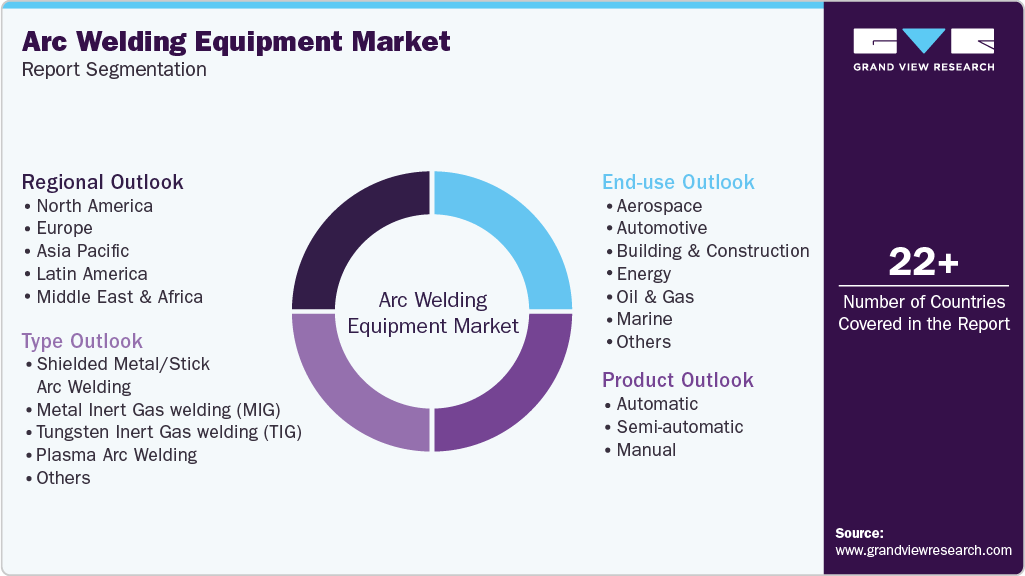
This report forecasts revenue growth at global, regional & country levels and provides an analysis on the industry trends in each of the sub-segments from 2021 to 2033. For this study, Grand View Research has segmented the global arc welding equipment market report based on product, type, end use, and region:
 To learn more about this report, Download Free Sample Report
 -
Product Outlook (Revenue, USD Million, 2021 - 2033)
-
Automatic
-
Semi-automatic
-
Manual
-
-
Type Outlook (Revenue, USD Million, 2021 - 2033)
-
Shielded Metal/Stick Arc Welding
-
Metal Inert Gas welding (MIG)
-
Tungsten Inert Gas welding (TIG)
-
Plasma Arc Welding
-
Others
-
-
End Use Outlook (Revenue, USD Million, 2021 - 2033)
-
Aerospace
-
Automotive
-
Building & Construction
-
Energy
-
Oil & Gas
-
Marine
-
Others
-
-
Regional Outlook (Revenue, USD Million, 2021 - 2033)
-
North America
-
U.S.
-
Canada
-
Mexico
-
-
Europe
-
Germany
-
UK
-
France
-
Italy
-
Spain
-
-
Asia Pacific
-
China
-
India
-
Japan
-
Australia
-
South Korea
-
-
Latin America
-
Brazil
-
Argentina
-
-
Middle East & Africa
-
South Africa
-
Saudi Arabia
-
-
Delivered Customizations
This report has been delivered with the following In-depth customizations
Client Request
Customization Delivered
Value Adds
Regional segmentation
The study provided a detailed breakdown of the arc welding equipment market across major regions including North America, Europe, Asia Pacific, Latin America, and the Middle East & Africa, along with key country-level insights. The analysis highlighted regional industrial trends, infrastructure investments, manufacturing growth, and sector-wise demand variations influencing market expansion.
Supported clients in identifying region-specific growth opportunities, prioritizing target markets, and understanding localized industry dynamics for strategic business expansion.
Opportunity assessment
A focused opportunity analysis was conducted across product types, welding technologies, and end-use industries to identify high-growth segments within the market. The assessment examined factors such as industrial automation adoption, electric vehicle production growth, infrastructure development activities, and increasing demand for advanced welding solutions.
Helped stakeholders recognize emerging revenue opportunities, evaluate future growth areas, and align investment strategies with evolving market trends and industrial demand patterns.
Competitive benchmarking
A comprehensive competitive analysis was delivered comparing key market participants based on technological capabilities, automation expertise, product offerings, geographic presence, strategic developments, and industrial application focus. The benchmarking also assessed the competitive positioning of established and emerging players within the global market landscape.
Enabled companies to evaluate competitive strengths, identify market gaps, strengthen strategic positioning, and develop effective differentiation strategies within the arc welding equipment industry.
Frequently Asked Questions About This Report
The global arc welding equipment market size was estimated at USD 14,545.9 million in 2024 and is expected to reach USD 15,220.4 million in 2025.
The arc welding equipment market, in terms of revenue, is expected to grow at a compound annual growth rate of 5.0% from 2025 to 2033 to reach USD 22,491.8 million by 2033.
Automatic arc welding equipment segment holds a 56.1% share due to its high efficiency, precision, and reduced reliance on manual labor. It is widely used in large-scale industries such as automotive and shipbuilding, where consistency and speed are crucial. Automation minimizes errors and enhances production rates, making it ideal for repetitive tasks.
Some of the key players operating in the arc welding equipment market include The Lincoln Electric Company, ACRO Automation Systems, Inc, Illinois Tool Works Inc., Ador Welding Limited, Mitco Weld Products Pvt. Ltd., voestalpine Böhler Welding Group GmbH, Carl Cloos Schweisstechnik GmbH, and among others
Key factors driving the arc welding equipment market include rapid industrialization and infrastructure development across emerging economies. Growing demand from automotive, construction, and energy sectors boosts the need for advanced welding technologies. Additionally, increased adoption of automation and robotics enhances efficiency, further fueling market growth.
About the Author(s)
Advanced Interior Materials Research Team
Advanced Materials · Advanced Interior MaterialsThis report was authored by the advanced interior materials research team at Grand View Research - comprising two research analysts, one senior research analyst, and one industry expert - with specialized expertise in the advanced interior materials segment of the advanced materials industry. All findings are based on proprietary advanced materials databases, executive interviews, and regulatory analysis, subject to internal peer review prior to publication.
Last Updated:
Speak to Analyst

Customize this report to your needs - add regions, segments, or data points, with 20% free customization.
Or view our licence options:


ISO 9001:2015 & 27001:2022 Certified
We are GDPR and CCPA compliant! Your transaction & personal information is safe and secure. For more details, please read our privacy policy.


