
- Home
- »
- Plastics, Polymers & Resins
- »
-
Architectural Coatings Market Size, Industry Report, 2033GVR Report cover

Architectural Coatings Market (2026 - 2033) Size, Share & Trends Analysis Report By Resin Type (Acrylic, Alkyd, Epoxy, Polyurethane), By Technology (Waterborne Coatings, Solvent-borne Coatings), By End-use (Residential, Non-residential), By Region, And Segment Forecasts
Market Size, 2025
$89.8BMarket Estimate, 2026
$92.5BMarket Forecast, 2033
$119.9BCAGR, 2026–2033
3.8%Architectural Coatings Market Summary
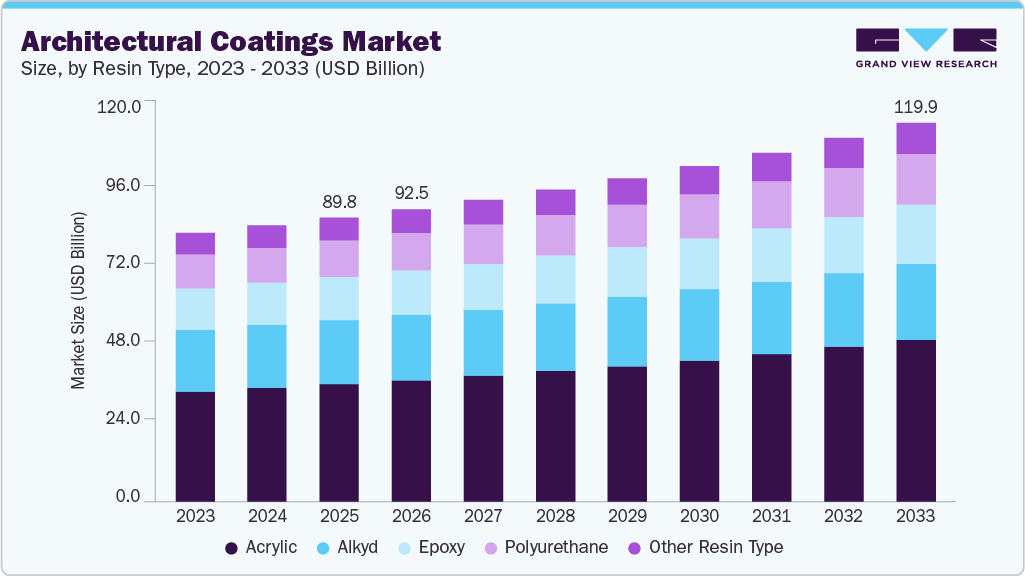
The global architectural coatings market size was valued at USD 89.8 billion in 2025 and is projected to grow from USD 92.5 billion in 2026 to USD 119.9 billion by 2033, at a CAGR of 3.8% from 2026 to 2033. The Asia Pacific architectural coatings market held the largest share of 42.9% of the global market in 2025. The market is expanding as buildings require longer lasting protection and stronger visual appeal.
 Source: Grand View Research, IR Documents, Primary Interviews, Paid DatabasesTo learn more about this report,
 Download Free Sample Report
 Key Market Trends & Insights
- By resin type: Acrylic segment dominated the architectural coatings market in 2025, accounting for 41.3%.
- By technology: Waterborne coatings segment led the architectural coatings market in 2025, accounting for 55.2%.
- By end-use: Residential segment accounted for the largest revenue share of 60.9% in 2025.
Regional Highlights
- Largest regional market: Asia Pacific (42.9% revenue share, 2025)
- Fastest-growing regional market: Latin America (highest CAGR, 2026-2033)
- By country: China held over 57.5% revenue share of the Asia Pacific market.
Market Size & Forecast
- Market size in 2025: USD 89.8 Billion
- Estimated market size in 2026: USD 92.5 Billion
- Projected market size by 2033: USD 119.9 Billion
- CAGR (2026-2033): 3.8%
Three ways to get this report
Buy it, customize it, or ask a question.Ask an Analyst
Analyst response in 1 business day
- AccessReport author, directly
- Reply timeWithin 1 working day
- No sales callDirect answer only
- FormatEmail reply
- CostFree, no cost
Get the Full Report
What the study covers
- FormatsPDF · Excel · Dashboard
- Timeline2026–2033 annual, 2025 base
- Coverage20+ countries, 5 regions
- Companies10+ key players profiled
Customize the Report
20% free customization
- IncludeCountries, segments, points
- TailorTo your product definition
- ExtendDeeper competitor detail
- OrA fully bespoke study
- Turnaround5–10 working days
Rising renovation cycles, regulatory preference for low emission materials, and higher expectations for surface performance are reshaping product demand across residential and non-residential construction worldwide in both mature and emerging economies today.Architectural coatings increasingly serve as a functional layer that extends building life and lowers maintenance intensity. Property owners and developers now prioritize coatings that resist moisture, sunlight, chemicals, and microbial growth, particularly in climates with harsh environmental exposure. This has shifted demand toward higher quality formulations with better durability and consistency. The replacement cycle of coatings also plays a central role; as repainting activity often exceeds new construction volumes in established markets. As housing stock ages, refurbishment spending continues to rise, sustaining steady consumption even during slower construction phases. At the same time, end users show stronger awareness of indoor air quality and safety, shaping purchasing decisions toward compliant and performance oriented solutions.
 To learn more about this report, Download Free Sample Report
 The market is also evolving through changes in product composition and application preferences. Water based systems continue gaining acceptance as regulations tighten around emissions and as application ease improves for contractors and homeowners. Performance oriented solutions are seeing higher penetration in commercial buildings, healthcare facilities, and public infrastructure where hygiene, durability, and lifecycle cost matter more than upfront pricing. Product differentiation increasingly comes from finish quality, coverage efficiency, and long term surface protection rather than color alone. Manufacturers respond by refining resin systems and additive combinations that deliver predictable performance across varied substrates, climates, and usage conditions.
Market Dynamics
Rising residential renovation and remodeling activities are increasing the consumption of architectural coatings across interior and exterior building applications. Homeowners are investing in repainting projects, decorative finishes, waterproof coatings, and surface protection products to improve property appearance and durability. Growing interest in modern interior design, premium textures, and customized color solutions is also driving demand for high-performance decorative paints across both developed and developing housing markets.
Property maintenance requirements and aging building infrastructure further support the recurring demand for architectural coatings. Builders and contractors are increasingly using advanced coatings with stain resistance, weather protection, and antimicrobial properties to extend surface life and reduce maintenance frequency. The expansion of home improvement spending, driven by rising disposable income and changing consumer preferences, continues to strengthen demand for architectural coatings in residential construction and renovation projects globally.
Stringent environmental regulations regarding volatile organic compound emissions are limiting the use of solvent-based architectural coatings in several developed and emerging economies. Regulatory authorities are enforcing stricter standards for chemical composition, manufacturing processes, storage, and application of decorative paints and protective coatings. Compliance with these regulations increases formulation costs and requires ongoing investment in product redevelopment and testing. Small and medium-sized manufacturers often struggle to adapt their production facilities to meet evolving environmental standards. Restrictions on solvent-heavy coatings also reduce product availability in certain applications where high-performance alternatives remain comparatively expensive for contractors and end users.
Market Concentration & Characteristics
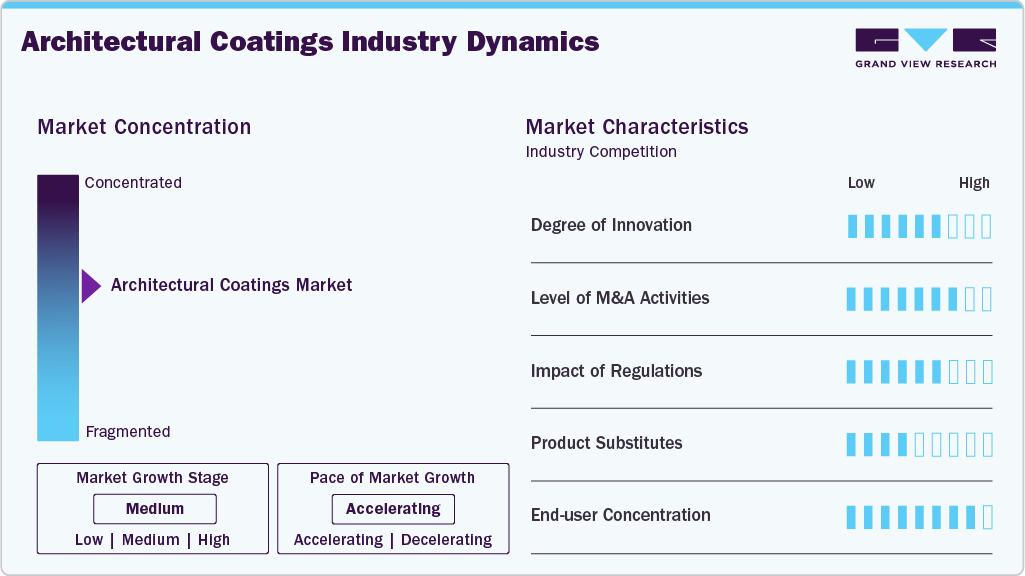
The architectural coatings market shows moderate concentration, with a mix of large multinational producers and a wide base of regional and local manufacturers. Global players benefit from strong brand recognition, broad product portfolios, and established distribution networks, while smaller companies compete through localized offerings, pricing flexibility, and close relationships with contractors and retailers. This structure creates a competitive environment where scale matters, but regional presence and responsiveness remain equally important.
 To learn more about this report, Download Free Sample Report
 Market characteristics are shaped by high product variety, frequent reformulation, and strong dependence on construction and renovation cycles. Demand is relatively stable due to recurring repainting needs, though purchasing behavior varies by end use, climate, and regulatory conditions. Customer preference often leans toward trusted brands for critical applications, while cost sensitivity remains high in volume segments. Innovation tends to focus on performance, ease of application, and compliance, rather than disruptive shifts, resulting in steady and incremental market evolution.
Resin Type Insights
The acrylic segment dominated the architectural coatings market in 2025, accounting for 41.3% of total revenue, due to their wide use across interior and exterior applications, supported by balanced cost, durability, and ease of application. Their compatibility with waterborne formulations aligns well with regulatory expectations and user preference for low-odor, fast-drying products. Acrylic systems perform reliably across varied climates and substrates, making them the preferred choice for high-volume residential and commercial repainting activities.
The polyurethane segment is projected to record the fastest growth, with a CAGR of 4.6% from 2026 to 2033, as demand shifts toward high-performance and longer-lasting surface protection. These coatings offer superior resistance to abrasion, chemicals, and ultraviolet exposure, making them suitable for premium residential finishes, commercial flooring, and exterior surfaces. Increasing focus on lifecycle cost, durability, and aesthetic retention encourages adoption in applications where performance outweighs initial material cost considerations.
Technology Insights
The waterborne coatings segment led the architectural coatings market in 2025, accounting for 55.2% of total revenue, due to their widespread adoption across residential and non-residential applications. Their low odor, ease of application, and reduced environmental impact make them suitable for interior and exterior use. These coatings align well with evolving regulatory expectations and consumer preference for safer living environments, which has strengthened their acceptance among contractors, homeowners, and institutional users.
The specialty coatings segment is expected to grow at the fastest rate, with a CAGR of 5.3% from 2026 to 2033. Specialty coatings are projected to expand rapidly as demand rises for surfaces that offer more than basic protection and aesthetics. Applications requiring resistance to microbes, moisture, heat, and surface contamination are increasing across healthcare, commercial, and infrastructure settings. End users are placing greater emphasis on durability and functional performance, which supports higher adoption of advanced formulations despite their relatively higher cost.
End-use Insights
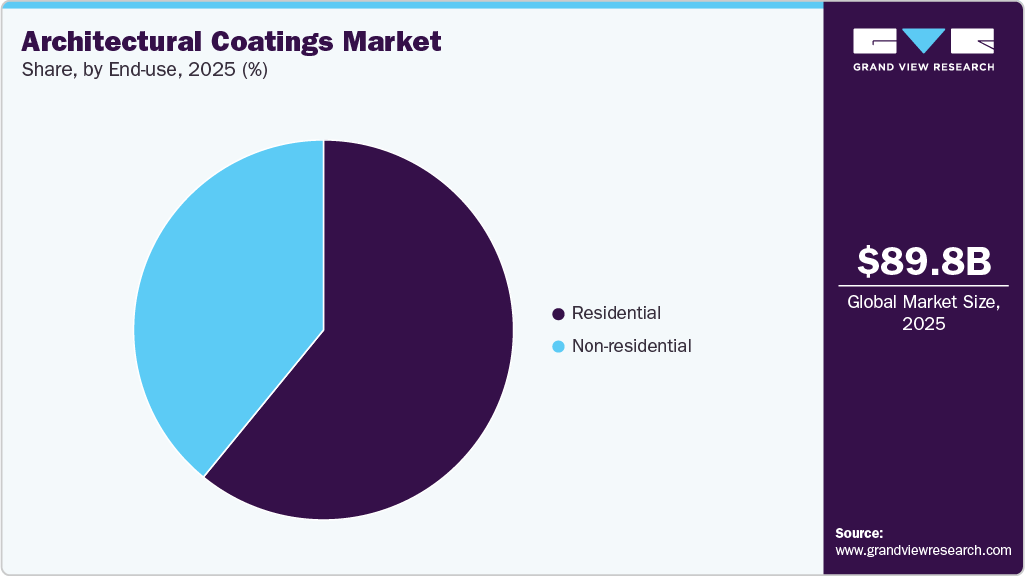
The residential segment dominated the market and accounted for the largest revenue share of 60.9% in 2025. The residential segment led demand due to the high volume of housing units and recurring repainting requirements across both interior and exterior surfaces. Home renovation and maintenance activities generate steady consumption of architectural coatings, supported by frequent aesthetic upgrades and surface protection needs. The segment also benefits from strong consumer preference for decorative finishes, ease of application, and availability of a wide color and formulation range suited for residential environments.
 To learn more about this report, Download Free Sample Report
 The non-residential segment demand was driven by commercial, industrial, and infrastructure construction activity. Non-residential buildings require coatings that focus on durability, hygiene, and long service life rather than frequent aesthetic changes. Offices, healthcare facilities, manufacturing sites, and public structures use coatings to protect surfaces exposed to wear, chemicals, and environmental stress. Larger project sizes and specification-based purchasing help sustain steady demand across this segment despite longer repaint cycles.
Regional Insights
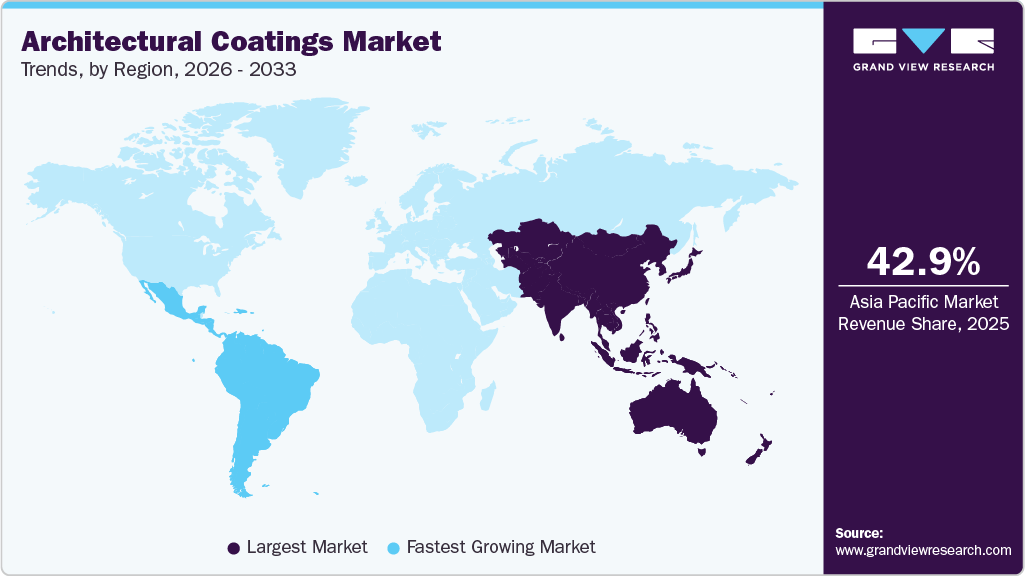
Asia Pacific held the largest share of the market in 2025, accounting for 42.9% of revenue, due to high construction activity across residential, commercial, and public infrastructure projects. Rapid housing development, rising refurbishment needs, and expanding urban populations support strong demand for architectural coatings. The region also benefits from cost-competitive manufacturing and wide product availability, which encourages high consumption volumes across both new construction and repainting applications.
 To learn more about this report, Download Free Sample Report
 China Architectural Coatings Market Trends
Chinaheld over 57.5% revenue share of the Asia Pacific architectural coatings market. China architectural coatings market is driven by the scale of residential construction and ongoing urban redevelopment. Large housing developments and high population density generate substantial volume demand for architectural coatings. Government-led infrastructure projects and public housing programs contribute to non-residential usage. Price sensitivity remains important, while growing awareness of indoor air quality is gradually shifting demand toward safer, compliant formulations.
North America Architectural Coatings Market Trends
The North America architectural coatings market is driven largely by renovation and maintenance activity rather than new construction. An aging housing stock, especially in suburban areas, sustains steady repainting demand for both interior and exterior applications. Energy efficiency requirements and strict environmental standards influence product selection, encouraging use of low-emission and durable coatings. Strong contractor networks and established retail channels support consistent consumption across residential and non-residential buildings.
U.S. architectural coatings market is shaped by high per-capita paint usage and a strong culture of home improvement. Frequent remodeling, seasonal repainting, and emphasis on property value preservation support steady demand. Climate variation across regions increases the need for coatings that resist moisture, sunlight, and temperature fluctuations. Large commercial property portfolios and institutional buildings also contribute to stable non-residential coating consumption.
Europe Architectural Coatings Market Trends
Europe’s architectural coatings market is influenced by strict environmental regulation and a focus on refurbishment rather than large-scale new construction. Many buildings are older and require periodic surface maintenance, particularly in urban centers. Demand is shaped by preference for durable, long-lasting coatings that reduce maintenance frequency. Energy efficiency initiatives and heritage building preservation also guide formulation choices across the region.
Latin America Architectural Coatings Market Trends
Latin America is projected to grow at the fastest rate, with a CAGR of 4.3% from 2026 to 2033, due to housing demand and public construction investment gradually increase. Improving economic stability in select countries supports renovation activity and the adoption of higher quality coatings. Growth is also supported by rising awareness of surface protection and longer service life requirements, which encourage the use of architectural coatings across residential and non-residential buildings.
Middle East & Africa Architectural Coatings Market Trends
The Middle East & Africa market is influenced by infrastructure development, commercial construction, and climate conditions. High temperatures, sand exposure, and intense sunlight increase demand for coatings with strong protective performance. Public investment in transport, healthcare, and civic buildings supports non-residential consumption. In residential segments, demand varies widely by country, reflecting differences in income levels and construction activity.
Key Architectural Coatings Company Insights
The two key dominant manufacturers in the architectural coatings market are The Sherwin-Williams Company and PPG Industries, Inc.
-
The Sherwin-Williams Company focuses on architectural coatings designed for residential and non-residential buildings, emphasizing durability, finish quality, and ease of application. The company supports renovation and new construction needs through a broad range of interior and exterior solutions. Strong attention to formulation refinement and color development helps maintain consistent surface performance across varied environments.
-
PPG Industries, Inc. develops architectural coatings that address decorative and protective requirements across building types. Its offerings focus on long-lasting surface protection, aesthetic consistency, and adaptability to different climates. The company’s approach centers on advancing coating performance while aligning with evolving building standards and maintenance expectations.
Key Architectural Coatings Companies:
The following key companies have been profiled for this study on the architectural coatings market.
- The Sherwin-Williams Company
- PPG Industries, Inc.
- AkzoNobel N.V.
- BASF SE
- Jotun A/S
- Asian Paints Limited
- Kansai Paint Co., Ltd.
- Nippon Paint Holdings Co., Ltd.
- RPM International, Inc.
Competitive Benchmarking
Operating Strategies
Competitive Edge
Weaknesses
Mature Players: The Sherwin-Williams Company; PPG Industries, Inc.; AkzoNobel N.V.; Asian Paints Limited; Nippon Paint Holdings Co., Ltd.
- Major manufacturers focus on expanding premium decorative coating portfolios and strengthening retail distribution networks across residential and commercial construction markets.
- These companies invest heavily in low-VOC technologies, digital color solutions, and acquisitions supporting regional manufacturing expansion and customer reach enhancement.
- Leading companies maintain strong brand recognition supported by extensive dealer networks, large-scale production capabilities, and diversified architectural coating product portfolios.
- Advanced research capabilities and long-term contractor relationships help these manufacturers maintain pricing strength and customer loyalty across mature construction markets.
- Large operational structures increase manufacturing and distribution costs, reducing flexibility during raw material price fluctuations and regional demand instability.
- Dependence on developed construction markets exposes revenue performance to economic slowdowns, housing declines, and reduced infrastructure investment activities.
Emerging Players: BASF SE; Jotun A/S; Kansai Paint Co., Ltd.; RPM International, Inc.
- Emerging participants emphasize niche coating technologies, regional market expansion, and customized solutions targeting climate-specific residential and industrial applications.
- These companies strengthen market presence through local partnerships, cost-competitive products, and selective investments in environmentally compliant coating formulations.
- Regional expertise and flexible production operations allow emerging manufacturers to respond quickly to changing contractor requirements and local construction trends.
- Competitive pricing strategies and focused specialty coatings support growth opportunities in underserved markets with rising infrastructure development activities.
- Limited global distribution capabilities restrict large-scale market penetration and reduce bargaining power against established multinational coating manufacturers.
- Lower research investment and narrower product portfolios create challenges in competing within premium decorative and technologically advanced coating segments.
Recent Developments
-
In January 2026, Henniker Plasma introduced CoatX, an advanced nano-scale plasma coating technology that creates permanent functional surfaces using plasma-assisted polymerization. The technology enables uniform, ultra-thin coatings across diverse materials while preserving underlying structural properties.
-
In September 2025, Engineered Polymer Solutions (EPS) launched EPS® 2736, an all-acrylic, film-forming polymer for exterior architectural coatings. It enhances durability, UV resistance, color retention, and dirt resistance across flat to satin finishes for both professional and DIY applications.
-
In June 2025, PPG showcased innovations in paints, coatings, and specialty products at its global Coatings Innovation Center, highlighting sustainable, high-performance solutions that improve productivity, reduce energy use, and enhance durability across architectural, automotive, industrial, marine, and packaging applications.
Architectural Coatings Market Report Scope
Report Attribute
Details
Market size in 2025
USD 89.8 billion
Estimated market size in 2026
USD 92.5 billion
Projected market size by 2033
USD 119.9 billion
Growth rate
CAGR of 3.8% from 2026 to 2033
Base year for estimation
2025
Historical data
2018 - 2025
Forecast period
2026 - 2033
Quantitative units
Revenue in USD million/billion, volume in kilotons, and CAGR from 2025 to 2033
Report coverage
Revenue forecast, company ranking, competitive landscape, growth factors, and trends
Segments covered
Resin type, technology, application, region
Regional scope
North America; Europe; Asia Pacific; Latin America; Middle East & Africa
Country scope
U.S.; Canada; Mexico; Brazil; Argentina; Germany; UK; Italy; Spain; France; China; Japan; South Korea; Saudi Arabia; South Africa
Key companies profiled
The Sherwin-Williams Company; PPG Industries, Inc.; AkzoNobel N.V.; BASF SE; Jotun A/S; Asian Paints Limited; Kansai Paint Co., Ltd.; Nippon Paint Holdings Co., Ltd.; RPM International, Inc.
Customization scope
Free report customization (equivalent to up to 8 analysts’ working days) with purchase. Addition or alteration to country, regional & segment scope.
Pricing and purchase options
Avail customized purchase options to meet your exact research needs. Explore purchase options
Global Architectural Coatings Market Report Segmentation
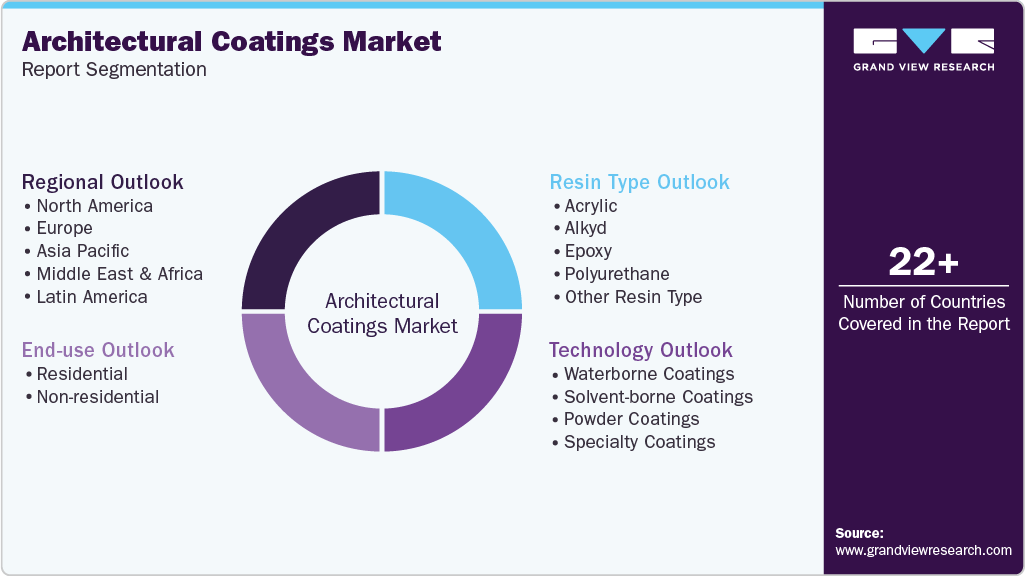
This report forecasts revenue growth at global, regional, and country levels and provides an analysis of the latest industry trends in each of the sub-segments from 2018 to 2033. For this study, Grand View Research has segmented the global architectural coatings market report based on resin type, technology, end-use, and region:
 To learn more about this report, Download Free Sample Report
 -
Resin Type Outlook (Volume, Kilotons; Revenue, USD Billion, 2018 - 2033)
-
Acrylic
-
Alkyd
-
Epoxy
-
Polyurethane
-
Other Resin Type
-
-
Technology Outlook (Volume, Kilotons; Revenue, USD Billion, 2018 - 2033)
-
Waterborne Coatings
-
Solvent-borne Coatings
-
Powder Coatings
-
Specialty Coatings
-
-
End-use Outlook (Volume, Kilotons; Revenue, USD Billion, 2018 - 2033)
-
Residential
-
Non-residential
-
Commercial
-
Industrial
-
Infrastructure
-
-
-
Regional Outlook (Volume, Kilotons; Revenue, USD Billion, 2018 - 2033)
-
North America
-
U.S.
-
Canada
-
Mexico
-
-
Europe
-
Germany
-
UK
-
Italy
-
Spain
-
France
-
-
Asia Pacific
-
China
-
Japan
-
South Korea
-
-
Middle East & Africa
-
Saudi Arabia
-
South Africa
-
-
Latin America
-
Brazil
-
Argentina
-
-
Delivered Customizations
This report has been delivered with the following In-depth customizations
Client Request
Customization Delivered
Value Adds
Cross-segmentation
Detailed cross-segment analysis covering interactions between resin type, technology, application, and end-use sectors across residential, commercial, and industrial construction activities. The study evaluates demand variations for waterborne and solvent-borne coatings by interior and exterior applications, along with regional consumption patterns and performance requirements.
Support product positioning and portfolio planning through a deeper understanding of high-demand segment combinations, application trends, and customer preferences across different construction environments.
Competitive Benchmarking
Comparative assessment of architectural coatings manufacturers based on coating technology offerings, regional presence, production capabilities, sustainability initiatives, pricing strategies, distribution networks, and new product development activities. The analysis also reviews the company's focus on low-VOC formulations and specialty coatings.
Assist competitive intelligence and strategic planning activities through improved visibility into manufacturer strengths, market positioning, innovation capabilities, and expansion strategies across key regional markets.
Opportunity Assessment
Evaluation of growth opportunities associated with green building projects, renovation activities, rising demand for premium decorative coatings, smart coating technologies, and increasing adoption of eco-friendly paint solutions in residential and commercial infrastructure projects globally.
Help identify high-growth investment areas and emerging application trends aligned with sustainability regulations, changing consumer preferences, and long-term construction development activities across major economies.
Frequently Asked Questions About This Report
The global architectural coatings market size was valued at USD 89.8 billion in 2025 and is estimated at USD 92.5 billion for 2026.
The global architectural coatings market is expected to grow at a CAGR of 3.8% from 2026 to 2033, reaching USD 119.9 billion by 2033.
The acrylic segment led with a 41.3% revenue share in 2025, due to their wide use across interior and exterior applications, supported by balanced cost, durability, and ease of application. Their compatibility with waterborne formulations aligns well with regulatory expectations and user preference for low-odor, fast-drying products. Acrylic systems perform reliably across varied climates and substrates, making them the preferred choice for high-volume residential and commercial repainting activities.
Key players include The Sherwin-Williams Company; PPG Industries, Inc.; AkzoNobel N.V.; BASF SE; Jotun A/S; Asian Paints Limited; Kansai Paint Co., Ltd.; Nippon Paint Holdings Co., Ltd.; RPM International, Inc.
The market is expanding as buildings require longer lasting protection and stronger visual appeal. Rising renovation cycles, regulatory preference for low emission materials, and higher expectations for surface performance are reshaping product demand across residential and non-residential construction worldwide in both mature and emerging economies today.
Asia Pacific dominated with a 42.9% revenue share in 2025.
Latin America is the fastest-growing region over the forecast period.
The residential segment dominated the market and accounted for a revenue share of 60.9% in 2025.
Waterborne coatings held the largest share (over 55.0%) in 2025, while specialty coatings is the fastest-growing technology.
About the Author(s)
Plastics, Polymers & Resins Research Team
Bulk Chemicals · Plastics, Polymers & ResinsThis report was authored by the plastics, polymers & resins research team at Grand View Research - comprising two research analysts, one senior research analyst, and one industry expert - with specialized expertise in the plastics, polymers & resins segment of the bulk chemicals industry. All findings are based on proprietary bulk chemicals databases, executive interviews, and regulatory analysis, subject to internal peer review prior to publication.
Last Updated:
Speak to Analyst

Customize this report to your needs - add regions, segments, or data points, with 20% free customization.
Or view our licence options:


ISO 9001:2015 & 27001:2022 Certified
We are GDPR and CCPA compliant! Your transaction & personal information is safe and secure. For more details, please read our privacy policy.


