
- Home
- »
- Advanced Interior Materials
- »
-
Architectural Flat Glass Market Size Report, 2026-2033GVR Report cover

Architectural Flat Glass Market (2026 - 2033)
Size, Share & Trend Analysis Report By Product (Basic, Tempered, Laminated, Industrial, Insulated), By Application (Residential, Non Residential, Industrial), By Region, And Segment Forecasts
Market Size, 2025
$236.3BMarket Estimate, 2026
$245.3BMarket Forecast, 2033
$313.9BCAGR, 2026–2033
4.2%Architectural Flat Glass Market Summary
The global architectural flat glass market size was valued at USD 236.3 billion in 2025 and is projected to grow from USD 245.3 billion in 2026 to USD 313.9 billion by 2033, at a CAGR of 4.2% from 2026 to 2033. The market in Asia Pacific dominated with a revenue share of 58.9% in 2025. The strong expansion of global construction and infrastructure activities primarily drives the market growth.
 Source: Grand View Research, IR Documents, Primary Interviews, Paid DatabasesTo learn more about this report,
 Download Free Sample Report
 Key Market Trends & Insights
- By product: Insulated segment held the largest market share of 38.0% in 2025.
- By application: Residential segment held the largest market share of 54.7% in 2025.
Regional Highlights
- Largest regional market: Asia Pacific (58.9% revenue share, 2025)
- By country: China held the largest market share in 2025
Market Size & Forecast
- Market size in 2025: USD 236.3 Billion
- Estimated market size in 2026: USD 245.3 Billion
- Projected market size by 2033: USD 313.9 Billion
- CAGR (2026-2033): 4.2%
Three ways to get this report
Buy it, customize it, or ask a question.Ask an Analyst
Analyst response in 1 business day
- AccessReport author, directly
- Reply timeWithin 1 working day
- No sales callDirect answer only
- FormatEmail reply
- CostFree, no cost
Get the Full Report
What the study covers
- FormatsPDF · Excel · Dashboard
- Timeline2026–2033 annual, 2025 base
- Coverage20+ countries, 5 regions
- Companies10+ key players profiled
Customize the Report
20% free customization
- IncludeCountries, segments, points
- TailorTo your product definition
- ExtendDeeper competitor detail
- OrA fully bespoke study
- Turnaround5–10 working days
Rapid urbanization, particularly in emerging economies such as China and India, has significantly increased demand for residential buildings, commercial complexes, and high-rise structures that extensively utilize flat glass in windows, facades, and interiors. Governments across regions are also investing heavily in infrastructure development and smart city projects, further accelerating glass consumption in modern construction applications.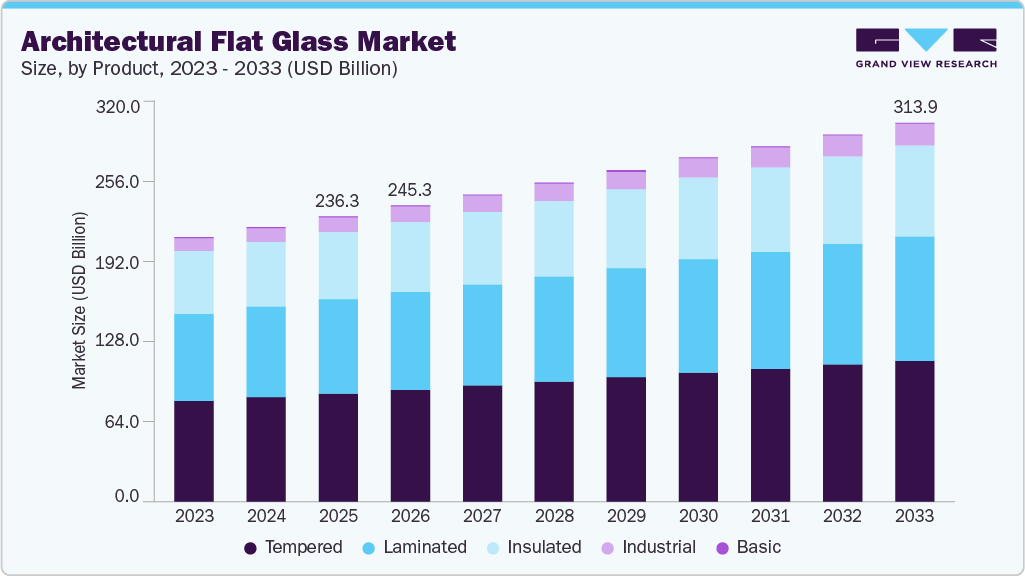 To learn more about this report, Download Free Sample Report
 Architectural flat glass, especially low-emissivity and insulated glazing units, plays a critical role in improving thermal insulation and reducing energy consumption in buildings. With stricter building energy codes and growing environmental awareness, developers are increasingly adopting advanced glass solutions that enhance natural lighting while minimizing heat gain and loss. This trend is further supported by global sustainability initiatives and green building certifications, which are boosting the penetration of high-performance glass products.
Technological advancements in glass manufacturing are also contributing significantly to market growth. Innovations such as smart glass, laminated glass, coated glass, and self-cleaning glass are enhancing functionality, safety, and aesthetics in architectural applications. These advanced products offer features like solar control, sound insulation, and improved durability, making them highly attractive for modern building designs. As architects and developers increasingly prioritize design flexibility and performance, the adoption of technologically advanced flat glass solutions continues to rise.
The rapid growth of renewable energy, particularly solar power, is another important factor supporting the demand for flat glass. It is widely used in photovoltaic panels integrated into building structures, such as solar facades and rooftops. The increasing deployment of solar energy systems across residential and commercial buildings has created additional demand for high-quality flat glass, closely linking the market to the global energy transition.
Moreover, evolving consumer preferences toward modern architecture and aesthetic appeal are driving the use of glass-intensive designs. Contemporary buildings increasingly feature large glass panels, curtain walls, and transparent structures that enhance visual appeal and natural lighting. Alongside this, rising disposable incomes and changes in urban lifestyles are driving the adoption of premium construction materials, including specialized glass products. These factors, combined with ongoing urban expansion and economic growth, continue to reinforce the long-term demand for the market globally.
Drivers, Opportunities & Restraints
The architectural flat glass industry is primarily driven by the rapid expansion of construction and infrastructure activities worldwide. Increasing urbanization, especially in emerging economies, is fueling demand for residential housing, commercial complexes, and high-rise buildings that extensively use flat glass in facades, windows, and interiors.
Significant growth opportunities are emerging from advancements in glass technology and the global shift toward sustainable construction. Innovations such as smart glass, solar-control coatings, and self-cleaning glass are expanding the functional scope of architectural flat glass in modern buildings. Rapid infrastructure development and urban expansion in regions such as the Asia Pacific and the Middle East are also creating long-term opportunities for market players, supported by rising investments in green buildings and modern architectural designs.
Despite strong growth potential, the architectural flat glass industry faces several constraints, primarily related to high production and installation costs. The manufacturing of flat glass is energy-intensive and requires significant capital investment, thereby increasing overall product costs and limiting adoption in price-sensitive markets.
Product Insights
The insulated segment led the market with the largest revenue share of 38.0% in 2025. Insulated glass, which typically consists of double- or triple-glazed units with air or inert gas fills, plays a critical role in reducing heat transfer and improving thermal performance in both residential and commercial structures. Increasing enforcement of green building codes and energy efficiency standards across regions such as North America and Europe has accelerated the adoption of insulated glass in modern construction. In addition, rapid urbanization and infrastructure development in emerging economies are further boosting demand, as developers prioritize materials that enhance indoor comfort while lowering heating and cooling costs.
The industrial segment is anticipated to register at the fastest CAGR over the forecast period. It refers to glass types specifically engineered for enhanced strength, durability, and functional performance, making them suitable for demanding structural and safety applications. This segment is experiencing notable growth due to the rising demand for high-performance glass products, such as tempered, laminated, and coated glass, that can withstand mechanical stress, thermal fluctuations, and impact. Increasing urbanization and the development of large-scale commercial and infrastructure projects are driving the adoption of industrial-grade glass products, particularly in façades, skylights, and structural glazing systems, where safety and longevity are critical.
Application Insights
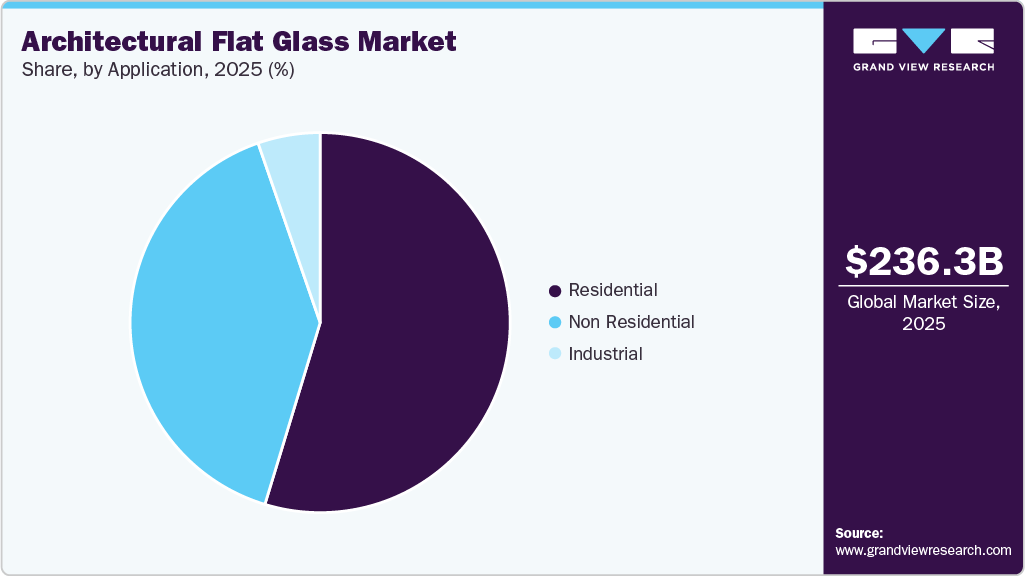
The residential segment led the market with the largest revenue share of 54.7% in 2025, largely propelled by rapid global urbanization and the rising construction of modern, glass-heavy residential complexes. As populations increasingly shift toward urban centers, demand for high-performance building materials that balance aesthetic appeal with functionality is growing.
 To learn more about this report, Download Free Sample Report
 The non-residential segment is projected to grow at the fastest CAGR during the forecast period, primarily driven by the rapid expansion of commercial, institutional, and infrastructure projects worldwide. This segment includes office buildings, retail complexes, hotels, airports, hospitals, and educational institutions, all of which extensively utilize flat glass in façades, curtain walls, partitions, and skylights. The surge in urbanization and increasing investments in large-scale infrastructure and commercial real estate development, particularly across the Asia Pacific and the Middle East, are significantly boosting demand for architectural glass in non-residential applications.
Regional Insights
The architectural flat glass market in North America is largely driven by the growing adoption of energy-efficient, sustainable building practices across the region. Governments and regulatory bodies are actively promoting green construction through programs such as LEED and energy efficiency mandates, which have accelerated the demand for high-performance glazing solutions, including low-emissivity and insulated glass units. These products help reduce energy consumption, improve thermal insulation, and enhance indoor comfort, making them essential in modern construction.
U.S. Architectural Flat Glass Market Trends
The architectural flat glass market in the U.S. accounted for the largest market revenue share in North America in 2025. The U.S. market is being shaped by safety regulations and specialized resilience requirements in disaster-prone regions. In the "Hurricane Alley" states along the Gulf and Atlantic coasts, building codes now mandate high-velocity hurricane zone (HVHZ) glass, which uses robust laminated interlayers to prevent windborne debris from breaching the building envelope.
Asia Pacific Architectural Flat Glass Market Trends
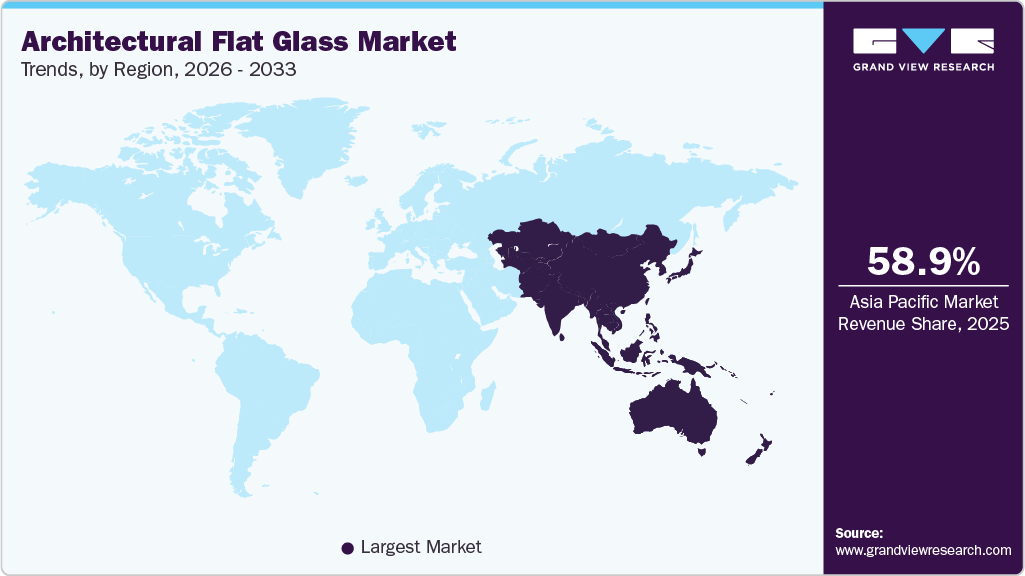
Asia Pacific dominated the global architectural flat glass market with the largest revenue share of 58.94% in 2025 and is projected to grow at the fastest CAGR during the forecast period, primarily driven by massive, government-backed infrastructure and urbanization projects that prioritize modern, glass-heavy designs. For instance, India’s National Infrastructure Pipeline (NIP) and China’s 14th Five-Year Plan have allocated trillions of dollars to urban renewal, smart city development, and the expansion of high-rise commercial and residential complexes. These initiatives create a sustained, high-volume demand for float, tempered, and laminated glass, as architects increasingly specify glass facades and curtain walls to achieve the sleek, aesthetic appeal required for modern urban skylines.
 To learn more about this report, Download Free Sample Report
 Europe Architectural Flat Glass Market Trends
The architectural flat glass market is fundamentally driven by the European Green Deal and the subsequent "Renovation Wave" strategy, which aims to double the annual energy renovation rate of buildings by 2030. Unlike the U.S., where new construction is a major driver, the European market is heavily focused on retrofitting aging buildings to meet strict thermal insulation standards. For instance, the Energy Performance of Buildings Directive (EPBD), with key implementation milestones in 2026, mandates that the most energy-inefficient non-residential buildings must be upgraded.
Latin America Architectural Flat Glass Market Trends
The architectural flat glass market in Latin America is anticipated to grow at a significant CAGR during the forecast period. Increasing construction activities and ongoing urbanization across major economies such as Brazil & Argentina primarily drive the growth of the Latin America market. Rising investments in residential housing, commercial buildings, and tourism-related infrastructure are significantly boosting demand for flat glass in applications such as windows, facades, and interior partitions. The expansion of smart city initiatives and urban development projects is further supporting market growth, as modern architectural designs increasingly rely on glass for aesthetics, natural lighting, and space optimization.
Key Architectural Flat Glass Company Insights
Some of the key players operating in the market include AGC Inc., Guardian Industries, and industrial
-
AGC Inc. is a Japanese glass manufacturer and a core subsidiary of the AGC Group, recognized globally for its advanced glass, chemicals, electronics, and ceramic solutions. The company operates an extensive international manufacturing and distribution network across Asia Pacific, Europe, and the Americas, serving architectural, automotive, and industrial markets.
-
Guardian Industries is a U.S.-based global manufacturer of float glass, fabricated glass products, fiberglass insulation, and building materials, and operates as a subsidiary of Koch Industries. Headquartered in Auburn Hills, Michigan, the company has a strong international footprint with manufacturing, fabrication, and distribution facilities across North America, Europe, South America, Africa, the Middle East, and Asia. Guardian Industries is a key player in the architectural and automotive glass markets, offering advanced solutions such as energy-efficient coated glass, laminated glass, and tempered glass.
Key Architectural Flat Glass Companies:
The following key companies have been profiled for this study on the architectural flat glass market.
- AGC Inc.
- CARDINAL GLASS INDUSTRIES, INC
- Guardian Industries
- Paragon Tempered Glass, LLC
- Saint-Gobain
- Schott AG,
- Şişecam
- Vitro Architectural Glass
- Vitrum Glass Group.
- Xinyi Glass Holdings Limited.
Recent Development
- In October 2025, GlassKote Float Glass Industries (GK) announced a funding to construct two advanced low-iron float glass plants, with the first in Queensland, Australia, starting early 2026 at 700 tons per day for architectural, solar, and specialty uses, featuring waste-to-energy tech for green hydrogen, silicon nanotube integration, DNA AI 'Living Glass' for self-healing properties, and solar glass production.
Architectural Flat Glass Market Report Scope
Report Attribute
Details
Market definition
Market size represents the total annual revenue generated from sale of architectural flat glass used for different applications.
Market size in 2025
USD 236.3 billion
Estimated Market size in 2026
USD 245.3 billion
Projected Market size by 2033
USD 313.9 billion
Growth rate
CAGR of 4.2% from 2026 to 2033
Base year for estimation
2025
Historical data
2021 - 2024
Forecast period
2026 - 2033
Quantitative units
Revenue in USD million/billion, volume in kilotons, and CAGR from 2026 to 2033
Report coverage
Revenue & volume forecast, competitive landscape, growth factors, and trends
Segments covered
Product, application, region
Regional scope
North America; Europe; Asia Pacific; Latin America; Middle East & Africa
Country scope
U.S.; Canada; Mexico; Germany; Italy; France; Russia; China; India; Japan; Brazil; Saudi Arabia; UAE
Key companies profiled
AGC Inc.; Guardian Industries; Saint-Gobain; Şişecam; Vitro Architectural Glass; Cardinal Glass Industries, Inc.; Schott AG; Paragon Tempered Glass, LLC; Xinyi Glass Holdings Limited; Vitrum Glass Group
Customization scope
Free report customization (equivalent up to 8 analysts working days) with purchase. Addition or alteration to country, regional & segment scope.
Pricing and purchase options
Avail customized purchase options to meet your exact research needs. Explore purchase options
Global Architectural Flat Glass Market Report Segmentation
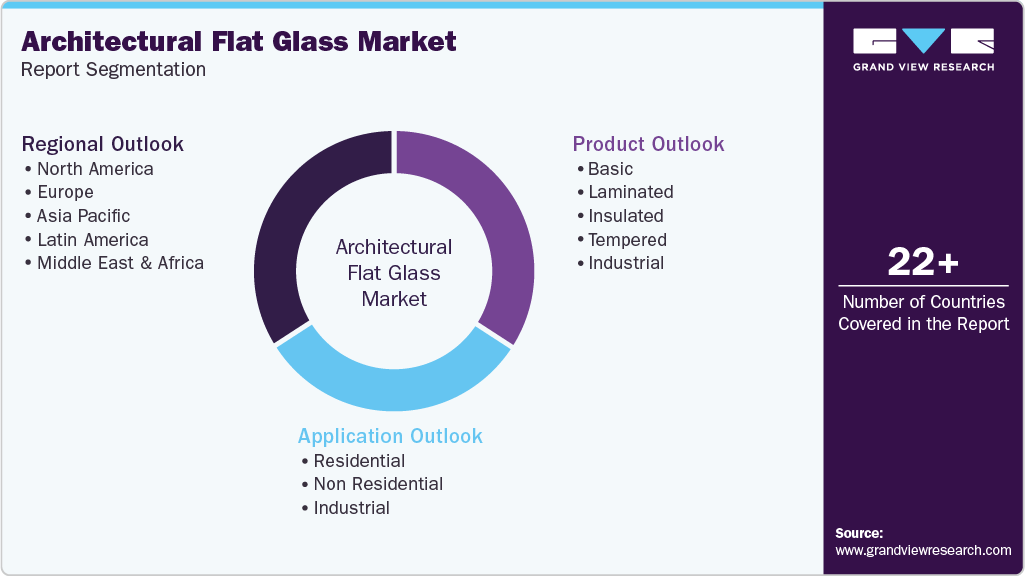
This report forecasts revenue and volume growth at global, regional, and country levels and provides an analysis of the latest industry trends in each of the sub-segments from 2021 to 2033. For this study, Grand View Research has segmented the global architectural flat glass market report based on the product, application, and region.
 To learn more about this report, Download Free Sample Report
 -
Product Outlook (Volume, Kilotons; Revenue, USD Million, 2021 - 2033)
-
Basic
-
Laminated
-
Insulated
-
Tempered
-
Industrial
-
-
Application Outlook (Volume, Kilotons; Revenue, USD Million, 2021 - 2033)
-
Residential
-
Non Residential
-
Industrial
-
-
Regional Outlook (Volume, Kilotons; Revenue, USD Million, 2021 - 2033)
-
North America
-
U.S.
-
Canada
-
Mexico
-
-
Europe
-
Germany
-
Italy
-
France
-
Russia
-
-
Asia Pacific
-
China
-
India
-
Japan
-
-
Latin America
-
Brazil
-
-
Middle East & Africa
-
Saudi Arabia
-
UAE
-
-
Frequently Asked Questions About This Report
Asia Pacific dominated with a 58.9% revenue share in 2025.
The insulated segment led with a 38.0% revenue share in 2025.
The global architectural flat glass market size was estimated at USD 236.3 billion in 2025 and is expected to reach USD 245.3 billion in 2026.
The global architectural flat glass market is expected to grow at a compound annual growth rate of 4.2% from 2026 to 2033 to reach USD 313.9 billion by 2033.
Residential segment held the revenue share of over 54.7% in 2025.
Some of the key players of the global architectural flat glass market are AGC Inc., Guardian Industries, Saint-Gobain, Şişecam, Vitro Architectural Glass, Cardinal Glass Industries, Inc., Schott AG, Paragon Tempered Glass, LLC, Xinyi Glass Holdings Limited, Vitrum Glass Group, and others.
The key factor driving the growth of the global architectural flat glass market is the rapid expansion of the construction sector, fueled by increasing urbanization, infrastructure development, and rising demand for energy efficient and sustainable building materials.
About the Author(s)
Advanced Interior Materials Research Team
Advanced Materials · Advanced Interior MaterialsThis report was authored by the advanced interior materials research team at Grand View Research - comprising two research analysts, one senior research analyst, and one industry expert - with specialized expertise in the advanced interior materials segment of the advanced materials industry. All findings are based on proprietary advanced materials databases, executive interviews, and regulatory analysis, subject to internal peer review prior to publication.
Last Updated:
Speak to Analyst

Customize this report to your needs - add regions, segments, or data points, with 20% free customization.
Or view our licence options:


ISO 9001:2015 & 27001:2022 Certified
We are GDPR and CCPA compliant! Your transaction & personal information is safe and secure. For more details, please read our privacy policy.


