
- Home
- »
- Advanced Interior Materials
- »
-
Argon Gas Market Size, Share & Trends Report, 2026-2033GVR Report cover

Argon Gas Market (2026 - 2033)
Size, Share & Trends Analysis Report By Form (Gas, Liquid), By End Use (Healthcare, Food & Beverages, Electronics, Manufacturing), By Region (North America, Europe, Asia Pacific, Central & South America, MEA), And Segment Forecasts
Market Size, 2025
$12.4BMarket Estimate, 2026
$13.2BMarket Forecast, 2033
$20.4BCAGR, 2026–2033
6.3%Argon Gas Market Summary
The global argon gas market size was valued at USD 12.4 billion in 2025 and is projected to grow from USD 13.2 billion in 2026 to USD 20.4 billion in 2033, at a CAGR of 6.3%from 2026 to 2033. Asia Pacific region held the largest revenue share of around 34.0% in 2025. Growing consumption of the product in automobiles, transportation equipment, stainless steel manufacturing plants, fabricated metalworking units, among others is likely to boost the market growth in the coming years. In addition, due to its superior thermal insulation capabilities over air, it is one of the most often utilized gases to fill scuba divers' dry suits.
Key Market Trends & Insights
- By form: Gas segment accounted for the largest revenue share of 53.5% in 2025.
- By end use: Manufacturing segment accounted for the largest revenue share of around 32.0% in 2025.
Regional Highlights
- Largest regional market: Asia Pacific (34.0% revenue share, 2025)
- Fastest-growing regional market: Europe (highest CAGR, 2026-2033)
Market Size & Forecast
- Market size in 2025: USD 12.4 Billion
- Estimated market size in 2026: USD 13.2 Billion
- Projected market size by 2033: USD 20.4 Billion
- CAGR (2026-2033): 6.3%
Three ways to get this report
Buy it, customize it, or ask a question.Ask an Analyst
Analyst response in 1 business day
- AccessReport author, directly
- Reply timeWithin 1 working day
- No sales callDirect answer only
- FormatEmail reply
- CostFree, no cost
Get the Full Report
What the study covers
- FormatsPDF · Excel · Dashboard
- Timeline2026–2033 annual, 2025 base
- Coverage20+ countries, 5 regions
- Companies10+ key players profiled
Customize the Report
20% free customization
- IncludeCountries, segments, points
- TailorTo your product definition
- ExtendDeeper competitor detail
- OrA fully bespoke study
- Turnaround5–10 working days
Argon is produced through fractional distillation of liquid air. It is frequently used as an alternative to nitrogen, thereby leading to its surged consumption in various applications across the globe. It is utilized to create an inert barrier between molten metals and slags and atmospheric oxygen, nitrogen, or carbon dioxide. In addition, the product’s resistance to heat cracking and other properties, such as its high thermal conductivity, allows for quick travel rates throughout the welding process, make it vital when welding stainless steel.The growing adoption of the internet of things (IoT) technologies to link machinery and smart devices in order to get real-time insights and find manufacturing process gaps is expected to further expand the growth of the overall market. Smart systems provide data on the operation and performance of chemical reactors with embedded analytics capabilities to alert plant managers and operators of potential machine failures. Praxair-Linde and Air Products are two significant product manufacturers that have embraced IoT technology.
 Source: Grand View Research, IR Documents, Primary Interviews, Paid DatabasesTo learn more about this report,
 Download Free Sample Report
 Rising prices may hamper the overall expansion or market growth. An increase in the production expenses as a result of the rising cost of raw materials reduced the funds available for new product development and research. The rising freight prices for trucks, railroads, dry bulk, and air freight and the demand for businesses to safeguard margins while preserving the quality of their products increased as a result of the rise in operational costs.
Argon is also difficult to separate from oxygen due to its diffusive and adsorptive qualities. The sales of the product are being restricted by the development of nitrogen microwave inductively coupled with atmospheric pressure plasma (MICAP), which is more affordable in comparison. In addition, manufacturers are switching from krypton since it is denser and gives greater thermal efficiency. Therefore, the presence of substitutes which offer better features is likely to create barriers in industry growth.
Market Dynamics
The argon gas market is witnessing steady growth due to its increasing use as an inert shielding gas across welding, metallurgy, electronics manufacturing, and high-precision industrial processes. Its non-reactive nature makes it essential in applications where oxidation prevention and controlled atmospheric conditions are critical, particularly in steel manufacturing, metal fabrication, and high-temperature processing industries. Expanding industrialization and rising demand from automotive, construction, and heavy engineering sectors are further supporting market growth, as these industries rely heavily on welding and fabrication processes where argon is widely used.
The argon gas market is mainly driven by high demand from the metallurgy and welding industries. Argon is widely used as a shielding gas in TIG and MIG welding to prevent oxidation and ensure strong weld quality. Growing infrastructure development, rapid urbanization, and increasing automotive production are raising steel consumption. This, in turn, boosts the demand for argon in fabrication and manufacturing activities. Moreover, the expanding semiconductor industry is becoming a vital growth factor. Ultra-high purity argon is used in wafer fabrication, etching, and precise manufacturing processes. For instance, India’s semiconductor ecosystem continued to grow in 2026, with 13 approved projects in development. New investments in ATMP/OSAT and front-end fabrication include a partnership between Tata Electronics and ASML to set up India’s first semiconductor fabrication facility in Gujarat. This ongoing growth in semiconductor manufacturing capacity is likely to significantly support long-term demand for high-purity argon gases worldwide.
The market faces restraints due to the high energy-intensive nature of argon production, which is typically obtained as a by-product of oxygen and nitrogen separation in air separation units (ASUs). This makes argon supply dependent on overall industrial gas production and energy costs. Fluctuations in electricity prices and limited flexibility in standalone argon production can lead to supply constraints and price volatility. In addition, logistical challenges in storage and transportation of cryogenic gases add to operational costs, which may impact adoption in cost-sensitive industries.
The argon gas market presents significant opportunities with the increasing demand for high-purity gases in advanced manufacturing applications such as semiconductors, additive manufacturing (3D metal printing), and specialty metallurgy. The growing adoption of Industry 4.0 technologies and automation in manufacturing is further enhancing the need for controlled atmospheric processing environments. In addition, expanding investments in semiconductor fabrication plants (fabs), particularly in Asia Pacific and North America, along with advancements in high-performance materials and clean energy technologies, are expected to create strong growth opportunities for argon gas suppliers over the forecast period.
Analyst Perspective
The argon gas market is supported by strong long-term growth driven by expanding industrial manufacturing, increasing steel production, and rising demand from welding and metal fabrication industries across automotive, construction, and heavy engineering sectors. The growing semiconductor and electronics industry is further strengthening demand for high-purity argon, particularly in precision processes such as plasma etching, sputtering, and crystal growth. In addition, continuous investments in air separation unit (ASU) infrastructure by major industrial gas companies are improving argon supply reliability and supporting large-scale industrial consumption.
Form Insights
The gas segment dominated the argon gas market in 2025, accounting for around 53.5% of the total market share. This dominance is driven by the widespread availability and ease of distribution of argon in gaseous form through industrial air separation units (ASUs), which supply argon alongside oxygen and nitrogen for large-scale industrial applications. Industrial gas manufacturers such as Linde, Air Liquide, and Air Products continuously expand ASU capacity and distribution infrastructure to meet rising demand from steel manufacturing, welding, semiconductor fabrication, and other high-temperature industrial processes. For instance, in October 2024, Linde expanded its air separation unit operations in India to enhance the supply of industrial gases, including argon, to major steel producers such as Tata Steel, reinforcing the strong dependence of end use industries on gaseous argon supply chains. The ease of storage, transportation via cylinders and bulk delivery systems, and consistent availability for continuous manufacturing operations further strengthen the dominance of the gas segment in the global argon gas market.
The growth of the liquid segment is driven by the increasing demand for high-volume and high-purity argon storage and transportation across large-scale industrial applications. Liquid argon offers higher storage efficiency compared to gaseous form, enabling easier transportation over long distances and reduced logistical constraints for end use industries. Its growing adoption in semiconductor manufacturing, metal fabrication, and advanced research applications is further supporting segment expansion, as these industries require stable and ultra-high purity gas supply for precision processes. In addition, the rising establishment of air separation units (ASUs) and cryogenic storage infrastructure by industrial gas companies is enhancing the availability of liquid argon, particularly in regions with expanding manufacturing and electronics production bases.
End Use Insights
The manufacturing segment dominated the argon gas market with a revenue share of around 32.0% in 2025. The growth of the segment is driven by its extensive use in metal fabrication, welding, and high-temperature industrial processing, where argon is used as a shielding and inerting gas to prevent oxidation and ensure product quality. Strong demand from steel, automotive, construction, heavy machinery, and industrial equipment manufacturing industries has significantly contributed to argon consumption, as these sectors rely heavily on precision welding and controlled atmospheric conditions during production processes. Rising investments in infrastructure development and industrial expansion projects across emerging economies are also contributing to sustained demand for steel and fabricated metal products. In addition, the increasing focus on improving operational efficiency, weld quality, and material durability is encouraging manufacturers to adopt argon-based processes over conventional alternatives, thereby reinforcing its critical role in modern manufacturing systems.
The electronics segment is expected to grow at a significant CAGR during the forecast period. The growth of the segment is driven by the rapid expansion of the semiconductor and advanced electronics industries across key global manufacturing hubs. Increasing demand for high-performance computing, artificial intelligence, 5G infrastructure, and consumer electronics is significantly boosting the need for ultra-high purity argon in semiconductor fabrication processes such as plasma etching, sputtering, and crystal growth. In addition, the ongoing miniaturization of semiconductor components and the shift toward advanced chip architectures are increasing process complexity, thereby requiring highly controlled inert gas environments. Furthermore, the expansion of semiconductor fabrication facilities (fabs) and rising investments in electronics manufacturing across Asia Pacific, North America, and Europe are further strengthening argon consumption in precision electronics applications.
Regional Insights
Asia Pacific dominated the market with a share of around 34.0% in 2025. This growth is attributed to the strong presence of large-scale manufacturing hubs, rapid industrialization, and expanding steel production capacity across key economies such as China, India, Japan, and South Korea. The region benefits from high demand for argon in welding, metal fabrication, and high-temperature industrial processes, supported by growing automotive, construction, and heavy machinery industries. In addition, Asia Pacific is witnessing significant expansion in semiconductor and electronics manufacturing, which further boosts demand for high-purity argon used in chip fabrication processes such as plasma etching and sputtering. Rising infrastructure development, government-led industrial expansion initiatives, and increasing foreign direct investments in manufacturing sectors are further reinforcing the region’s dominance in the global argon gas market.
 To learn more about this report, Download Free Sample Report
 Europe Argon Gas Market Trends
Europe argon gas market is expected to grow at the significant CAGR during the forecast period, driven by the rapid expansion of advanced manufacturing industries, particularly in automotive, aerospace, and precision engineering sectors that extensively use argon for high-quality welding and metal fabrication processes. The region’s strong focus on industrial decarbonization and adoption of energy-efficient manufacturing technologies is further increasing the use of controlled atmospheric processes where argon plays a critical role in preventing oxidation and improving product quality. Strict environmental regulations are also encouraging industries to adopt cleaner and more efficient industrial gas solutions, thereby supporting the shift toward advanced argon-based processes. In addition, increasing investments in air separation units (ASUs) and industrial gas infrastructure by key market players are enhancing regional supply capabilities, supporting sustained market growth over the forecast period.
Key Argon Gas Company Insights
The competitive environment of the argon gas market is moderately consolidated, with a few global industrial gas companies accounting for a significant share of supply due to their extensive air separation unit (ASU) infrastructure and integrated production capabilities. Key players dominate the market through large-scale production and distribution networks that ensure a stable supply of high-purity argon across industries including metallurgy, welding, semiconductor manufacturing, and advanced industrial processing. Competition is primarily driven by production efficiency, energy optimization in gas separation processes, expansion of ASU capacity, and long-term supply agreements with steel manufacturers and electronics companies.
-
In July 2025, Linde plc expanded its air separation unit (ASU) infrastructure in the United States to increase production of industrial gases including argon, strengthening supply for steel manufacturing, electronics, and advanced fabrication industries.
-
In July 2025, Air Liquide expanded its industrial gas capacity in Gujarat through a new air separation unit and cylinder filling facility, increasing supply of argon and other industrial gases for automotive, electronics, and manufacturing industries.
Key Argon Gas Companies
The following key companies have been profiled for this study on the argon gas market.
-
Air Products & Chemicals Inc.
-
Gulf Cyro
-
Universal Industrial Gases, Inc.
-
NEXAIR
-
Southern Industrial Gas
-
Praxair
-
Taiyo Nippon Sanso
-
Axcel Gases
-
Linde Plc
-
Omega Air
-
Ellenbarrie Industrial Gases Ltd
-
Messer Group
-
Parker Hannifin Corp.
-
Dubai Industrial Gases
-
Yingde Gases Group
Argon Gas Market Report Scope
Report Attribute
Details
Market size in 2025
USD 12.4 billion
Estimated market size in 2026
USD 13.2 billion
Projected market size by 2033
USD 20.4 billion
Growth rate
CAGR of 6.3% from 2026 to 2033
Base year for estimation
2025
Historical data
2021 - 2024
Forecast period
2026 - 2033
Quantitative units
Volume in kilo tons, revenue in USD billion, and CAGR from 2026 to 2033
Report coverage
Revenue forecast, company ranking, competitive landscape, growth factors, and trends
Segments covered
Form, end use, region
Regional Scope
North America; Europe; Asia Pacific; Central & South America; Middle East & Africa
Country Scope
U.S.; Canada; Mexico; Germany; UK; France; Switzerland; Italy; Spain Netherland; Russia; China; India; Japan; Malaysia; Vietnam; Indonesia; Australia; New Zealand; Brazil; Argentina; Chile; Columbia; Saudi Arabia; South Africa; UAE; Iran; Oman; UAE; Qatar; Kuwait; Nigeria; Angola
Key companies profiled
Air Products and Chemicals, Inc.; Gulf Cyro; Universal Industrial Gases, Inc.; nexAir; Southern Industrial Gas; Praxair; Taiyo Nippon Sanso; Axcel Gases; Linde Plc; Omega Air; Ellenbarrie Industrial Gases Ltd; Messer Group; Parker Hannifin Corp.; Dubai Industrial Gases; Yingde Gases Group.
Customization scope
Free report customization (equivalent up to 8 analysts working days) with purchase. Addition or alteration to country, regional & segment scope.
Pricing and purchase options
Avail of customized purchase options to meet your exact research needs. Explore purchase options
Global Argon Gas Market Report Segmentation
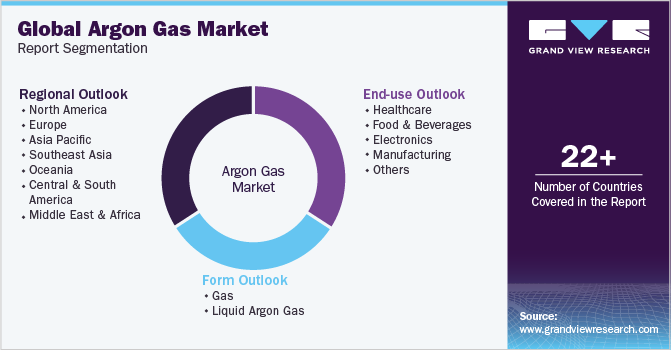
This report forecasts revenue growth at the regional, and country levels and provides an analysis on the latest industry trends and opportunities in each of the sub-segments from 2021 to 2033. For the purpose of this study, Grand View Research has segmented the global argon gas market report on the basis of form, end use, and region:
 To learn more about this report, Download Free Sample Report
 -
Form Outlook (Volume, Kilotons; Revenue, USD Million, 2021 - 2033)
-
Gas
-
Liquid Argon Gas
-
-
End-Use Outlook (Volume, Kilotons; Revenue, USD Million, 2021 - 2033)
-
Healthcare
-
Food & Beverages
-
Electronics
-
Manufacturing
-
Others
-
-
Regional Outlook (Volume, Kilotons; Revenue, USD Million, 2021 - 2033)
-
North America
-
U.S.
-
Canada
-
Mexico
-
-
Europe
-
Germany
-
UK
-
Switzerland
-
France
-
Italy
-
Spain
- The Netherlands
-
Russia
-
-
Asia Pacific
-
China
-
India
-
Japan
-
South Korea
-
-
Southeast Asia
-
Malaysia
-
Indonesia
-
Vietnam
-
-
Oceania
-
Australia
-
New Zealand
-
-
Central & South America
-
Brazil
-
Argentina
-
Chile
-
Colombia
-
-
Middle East & Africa
-
Saudi Arabia
-
South Africa
-
Iran
-
Oman
-
UAE
-
Qatar
-
Kuwait
-
Nigeria
-
Angola
-
-
About the Author(s)
Advanced Interior Materials Research Team
Advanced Materials · Advanced Interior MaterialsThis report was authored by the advanced interior materials research team at Grand View Research - comprising two research analysts, one senior research analyst, and one industry expert - with specialized expertise in the advanced interior materials segment of the advanced materials industry. All findings are based on proprietary advanced materials databases, executive interviews, and regulatory analysis, subject to internal peer review prior to publication.
Last Updated:
Speak to Analyst

Customize this report to your needs - add regions, segments, or data points, with 20% free customization.
Or view our licence options:


ISO 9001:2015 & 27001:2022 Certified
We are GDPR and CCPA compliant! Your transaction & personal information is safe and secure. For more details, please read our privacy policy.


