
- Home
- »
- IT Services & Applications
- »
-
ARM-Based Servers Market Size & Share Report, 2026-2033GVR Report cover

ARM-Based Servers Market (2026 - 2033)
Size, Share, & Trends Analysis Report By Core Type (ARM Cortex-A Core, ARM Cortex-M Core), By OS, By Processor, By Application, By Vertical, By Region, And Segment Forecasts
Market Size, 2025
$9.8BMarket Estimate, 2026
$10.7BMarket Forecast, 2033
$30.3BCAGR, 2026–2033
16.0%ARM-Based Servers Market Summary
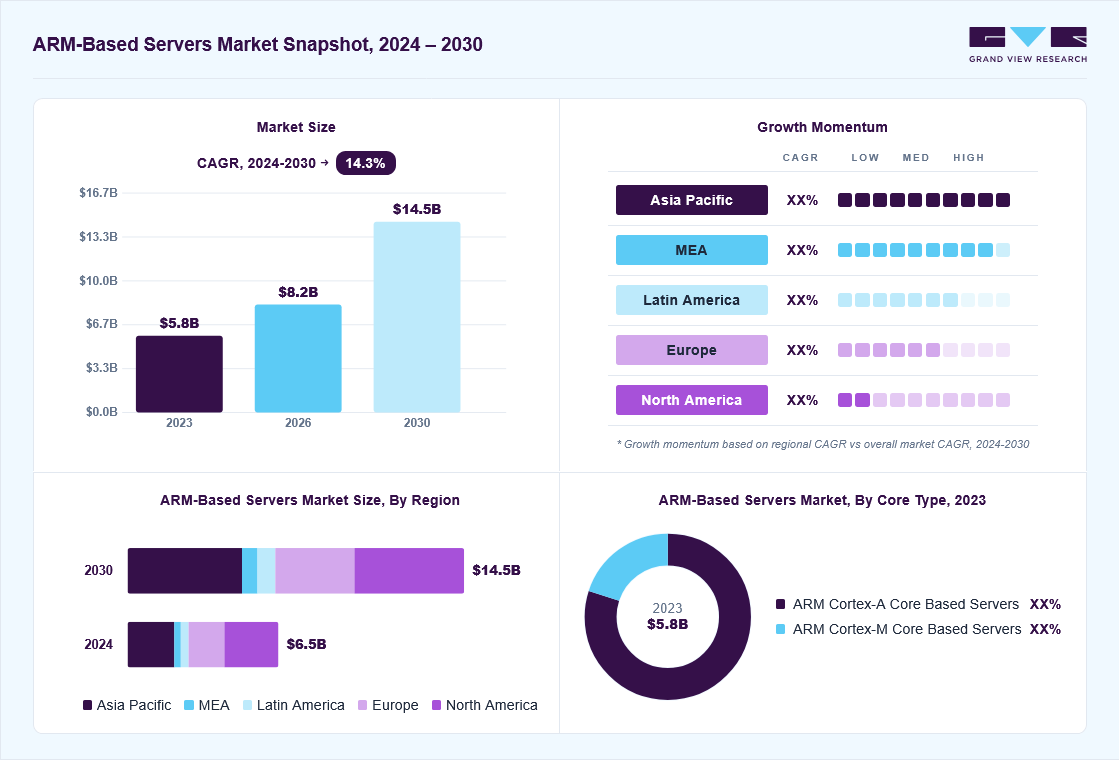
The global ARM-based servers market size was valued at USD 9.8 billion in 2025 and is projected to grow from USD 10.7 billion in 2026 to USD 30.3 billion in 2033 at a CAGR of 16.0% from 2026 to 2033. North America dominated the market, accounting for a revenue share of 35.3% in 2025. North America is experiencing significant investments in AI-ready hyperscale data centers by leading cloud providers such as AWS, Microsoft, Google, and Oracle.
 Source: Grand View Research, IR Documents, Primary Interviews, Paid DatabasesTo learn more about this report,
 Download Free Sample Report
 Key Market Trends & Insights
- By core type: ARM Cortex-A Core based servers segment dominated the market, with a revenue share of 78.9% in 2025
- By processor: 64-bit segment held the largest market share of 88.3% in 2025
- By application: Cloud computing segment held the largest revenue share of 28.3% in 2025
- By vertical: Cloud service providers segment held the largest revenue share in 2025
Regional Highlights
- Largest regional market: North America (35.3% revenue share, 2025)
- Fastest-growing regional market: Asia Pacific (highest CAGR, 2026-2033)
- By country: The U.S. held the largest market share in 2025.
Market Size & Forecast
- Market size in 2025: USD 9.8 Billion
- Estimated market size in 2026: 10.7 Billion
- Projected market size by 2033: 30.3 Billion
- CAGR (2026-2033): 16.0%
Three ways to get this report
Buy it, customize it, or ask a question.Ask an Analyst
Analyst response in 1 business day
- AccessReport author, directly
- Reply timeWithin 1 working day
- No sales callDirect answer only
- FormatEmail reply
- CostFree, no cost
Get the Full Report
What the study covers
- FormatsPDF · Excel · Dashboard
- Timeline2026–2033 annual, 2025 base
- Coverage20+ countries, 5 regions
- Companies10+ key players profiled
Customize the Report
20% free customization
- IncludeCountries, segments, points
- TailorTo your product definition
- ExtendDeeper competitor detail
- OrA fully bespoke study
- Turnaround5–10 working days
The growing deployment of AI training clusters and GPU-accelerated infrastructure is driving demand for ARM-based servers, which deliver high performance-per-watt, lower energy consumption, and cost-efficient computing for large-scale AI and cloud workloads. ARM processors are known for their energy efficiency and low power consumption, which is critical for servers. The growing demand for energy-efficient computing solutions, especially in data centers and cloud environments, is driving the adoption of ARM-based servers.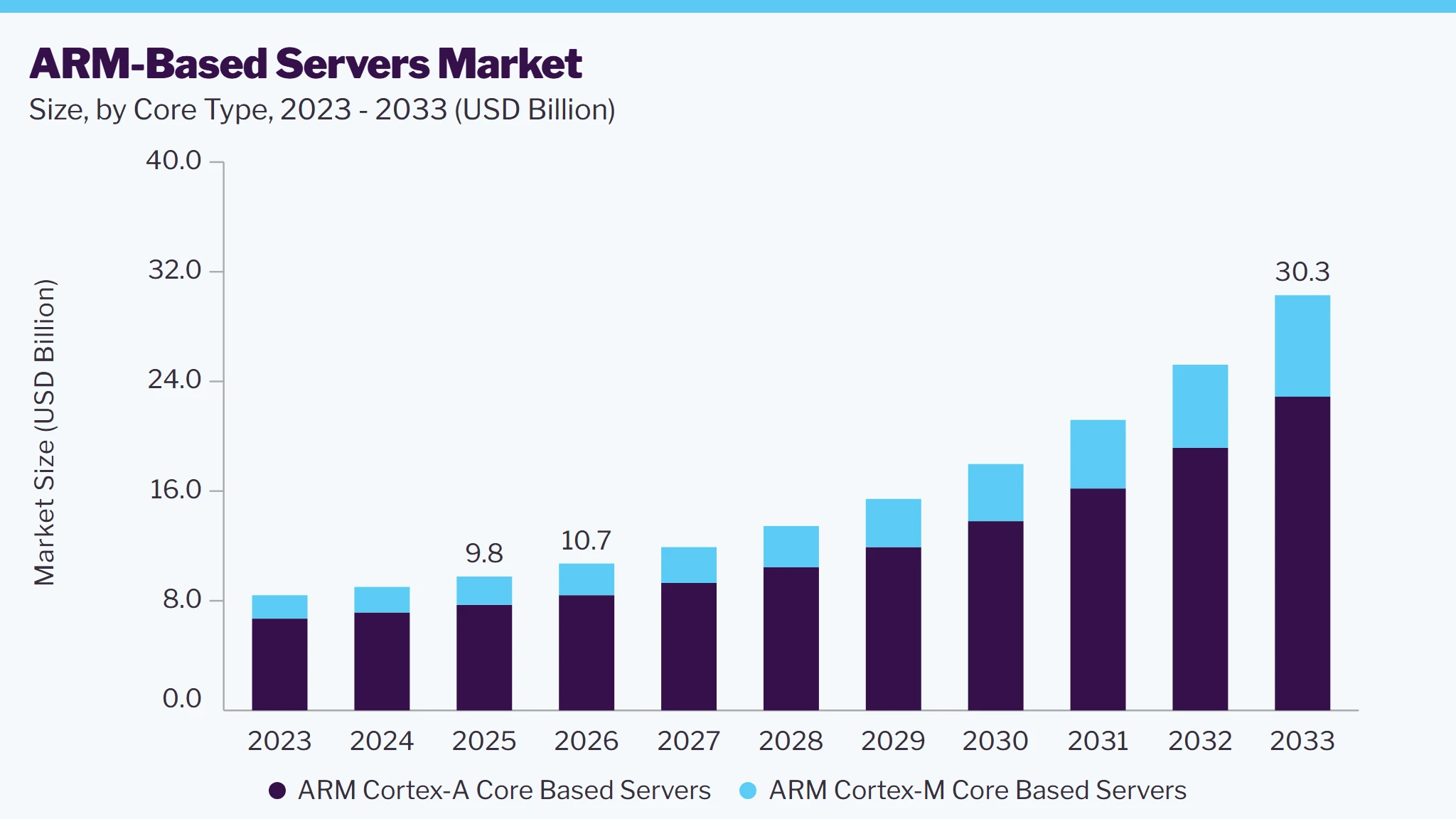 To learn more about this report, Download Free Sample Report
 The rapid growth of cloud computing and the increasing adoption of hyperscale data centers are also key drivers of the ARM-based server market. Cloud service providers, such as Amazon Web Services (AWS) and Microsoft Azure, continually expand their infrastructure to meet the rising demand for on-demand computing resources. ARM-based servers offer a scalable and cost-effective solution for these providers, enabling them to manage vast amounts of data and support large-scale workloads efficiently.
Hyperscale data centers, designed to support major cloud providers' needs, benefit from ARM processors' modular architecture and scalability. ARM servers can handle parallel processing and distributed computing tasks efficiently, making them ideal for workloads like data analytics, AI, machine learning, and content delivery networks (CDNs). This trend is further accelerated by the growing use of containers and microservices, which ARM-based servers are well-suited to handle due to their energy-efficient, scalable design.
As businesses and governments prioritize sustainability, there is a growing focus on green computing and reducing the carbon footprint of data centers. With their energy-efficient architecture, ARM-based servers are well-positioned to support this trend. Data centers consume vast amounts of electricity, and with the global push toward reducing greenhouse gas emissions, there is significant interest in deploying eco-friendly computing solutions. ARM-based servers enable organizations to achieve their performance goals while consuming less energy, aligning with sustainability objectives, and reducing operational costs related to power and cooling.
Market Dynamics
The ARM-based servers market is experiencing robust growth as enterprises, hyperscale cloud providers, and telecommunications operators increasingly adopt energy-efficient and high-performance computing infrastructure to support AI, cloud-native, and data-intensive workloads. The rapid expansion of hyperscale data centers and AI infrastructure is driving demand for ARM-based servers, which deliver superior performance-per-watt, reduced power consumption, and lower total cost of ownership (TCO) compared to conventional server architectures. Growing investments by cloud service providers in custom ARM processors, such as AWS Graviton, Google Axion, and NVIDIA Grace, are accelerating the deployment of ARM servers across public cloud environments for web hosting, databases, containerized applications, and AI inference workloads. The increasing adoption of cloud-native applications, Kubernetes, microservices, and DevOps practices is further strengthening the ARM server ecosystem, as modern software stacks are increasingly optimized for ARM architecture. Advancements in ARM server processors featuring higher core counts, enhanced memory bandwidth, chiplet-based designs, and support for PCIe Gen5, DDR5, and CXL technologies are enabling ARM servers to address increasingly demanding enterprise and AI workloads. In addition, the growing focus on sustainable data center operations and carbon reduction initiatives is encouraging organizations to replace legacy x86 infrastructure with power-efficient ARM-based systems that reduce energy consumption and cooling requirements. Continuous investments in AI infrastructure, sovereign cloud initiatives, high-performance computing (HPC), and digital transformation across industries such as BFSI, healthcare, manufacturing, retail, media, government, and research organizations are expected to sustain strong market growth throughout the forecast period.
The rapid expansion of AI infrastructure and hyperscale cloud data centers is a major driver of the ARM-based servers market. Leading cloud providers such as AWS, Google Cloud, Microsoft Azure, and Oracle Cloud are increasingly deploying ARM-based servers powered by custom processors, including AWS Graviton, Google Axion, and NVIDIA Grace, to support AI, cloud-native, and high-performance computing workloads. ARM servers offer superior performance-per-watt, lower power consumption, and reduced total cost of ownership (TCO), enabling hyperscalers to improve operational efficiency while meeting the growing demand for generative AI, machine learning, data analytics, and scalable cloud services.
Software compatibility limitations and migration complexity remain significant restraints for the ARM-based servers market. Many enterprise applications, legacy databases, and proprietary software environments continue to be optimized for x86 architectures, making migration to ARM platforms resource-intensive and time-consuming. Organizations may need to modify, recompile, or validate applications to ensure compatibility, while addressing challenges related to virtualization, third-party software support, and operational continuity. These migration costs and technical complexities can slow ARM server adoption, particularly among enterprises with extensive legacy IT infrastructure.
The increasing emphasis on sustainable data center operations and the rapid expansion of edge computing present significant opportunities for the ARM-based servers market. Enterprises and telecommunications providers are investing in energy-efficient computing platforms to reduce power consumption, cooling requirements, and carbon emissions while supporting distributed AI, 5G, IoT, and real-time analytics applications. ARM-based servers are well suited for these deployments due to their high energy efficiency, compact architecture, and scalability. Additionally, the growing adoption of cloud-native applications, sovereign cloud initiatives, and AI inference workloads is expected to accelerate ARM server deployment across edge locations and next-generation data centers.
Analyst Perspective
The ARM-based servers market is becoming a critical component of next-generation computing infrastructure. Enterprises, hyperscale cloud providers, and telecom operators are increasingly adopting energy-efficient, high-performance server platforms. The rapid growth of AI, cloud computing, HPC, and edge computing is accelerating demand for ARM-based servers. These platforms offer superior performance-per-watt, lower power consumption, and reduced total cost of ownership (TCO). Growing investments in hyperscale data centers and custom ARM processors, including AWS Graviton, Google Axion, and NVIDIA Grace, are supporting adoption. Demand is expanding across cloud-native, AI inference, and enterprise workloads. Competitive advantage will favor vendors offering efficient ARM processors and integrated platforms with advanced CPU architectures and AI optimization. High core densities, enhanced memory bandwidth, and compatibility with cloud-native software ecosystems will further drive adoption. Strong partnerships with hyperscale cloud providers, server OEMs, operating system developers, and enterprise software vendors will support market expansion. As organizations prioritize energy efficiency, sustainability, and data center modernization, demand for scalable and secure ARM-based solutions will increase. Vendors with software-optimized platforms and robust ecosystem support will be best positioned to capture long-term growth opportunities.
Core Type Insights
Based on core type, the ARM Cortex-A Core based servers segment led the market with the largest revenue share of 78.9% in 2025 and is expected to grow at the significant CAGR over the forecast period. The growing focus on open-source software and ARM's collaboration with companies like Microsoft and Amazon Web Services (AWS) to optimize software for ARM-based servers are helping accelerate adoption. This ecosystem development ensures that ARM Cortex-A core-based servers can efficiently run a broad range of applications, driving market growth.
The ARM cortex-M core based servers segment is anticipated to grow at the fastest CAGR over the forecast period. The ARM Cortex-M cores are designed with energy efficiency at their core, consuming far less power than traditional x86 or higher-end ARM Cortex-A processors. This makes them an attractive option for enterprises and data centers focused on reducing energy costs and minimizing carbon footprint. The demand for low-power server solutions is rising with growing concerns about energy consumption, especially in large-scale server environments.
OS Insights
The Android segment accounted for the largest market share of 52.4% in 2023, driven by the rise of mobile and edge computing environments where Android systems are becoming more prevalent. ARM's power-efficient architecture aligns well with Android's focus on mobile devices, and as Android continues to expand into more IoT and edge use cases, the demand for ARM-based servers to support these applications is rising.
The iOS segment is anticipated to grow at the fastest CAGR over the forecast period due to the rise of cloud computing and edge computing for scalable, efficient servers with ARM-based architectures. The growing interest in 5G technology and its associated infrastructure boosts the market, as ARM processors are well-suited for low-latency, high-speed networks.
Processor Insights
Based on processor, 64-bit segment led the market with the largest revenue share of 88.3% in 2025. The competitive landscape for ARM-based servers is evolving, with major players investing in developing advanced 64-bit architectures. Innovations such as the ARM Neoverse platform and specialized processors such as the Ampere Altra are enhancing the performance and scalability of ARM-based solutions. These advancements attract more enterprises to consider ARM architecture a viable alternative to traditional server solutions, particularly as the ecosystem matures and software compatibility improves.
The 32-bit operating system ARM-Based servers segment is anticipated to grow at the fastest CAGR over the forecast period. The proliferation of Internet of Things (IoT) devices contributes to the segment's growth. Many IoT applications require lightweight and efficient processing capabilities, which 32-bit ARM architecture provides. The Cortex-A32 processor, for instance, is designed specifically for embedded and IoT applications, offering high efficiency and the ability to run rich operating systems. This specialization allows organizations to deploy 32-bit ARM servers in resource-constrained environments, where power efficiency and compact form factors are critical.
Application Insights
Based on application, the cloud computing segment led the market with the largest revenue share of 28.3% in 2025. The ongoing advancements in 5G networks have accelerated the segment's growth. With 5G enabling faster data transmission and improved connectivity, mobile applications are becoming more sophisticated, requiring robust server infrastructures to support real-time processing, low latency, and high throughput. ARM-based servers, known for their scalability and efficiency, are crucial in meeting the demands of 5G-enabled mobile applications, from streaming services to augmented and virtual reality.
The sensors segment is anticipated to grow at the fastest CAGR over the forecast period due to the rising demand for energy-efficient solutions in data centers. With data centers consuming significant amounts of power, there is a growing focus on reducing energy costs and improving operational efficiency. ARM-based servers, equipped with sensors, provide real-time data on various operational parameters such as temperature, humidity, and power consumption. This data allows for proactive management of cooling systems and energy usage, ultimately reducing operational costs and enhancing sustainability.
Vertical Insights
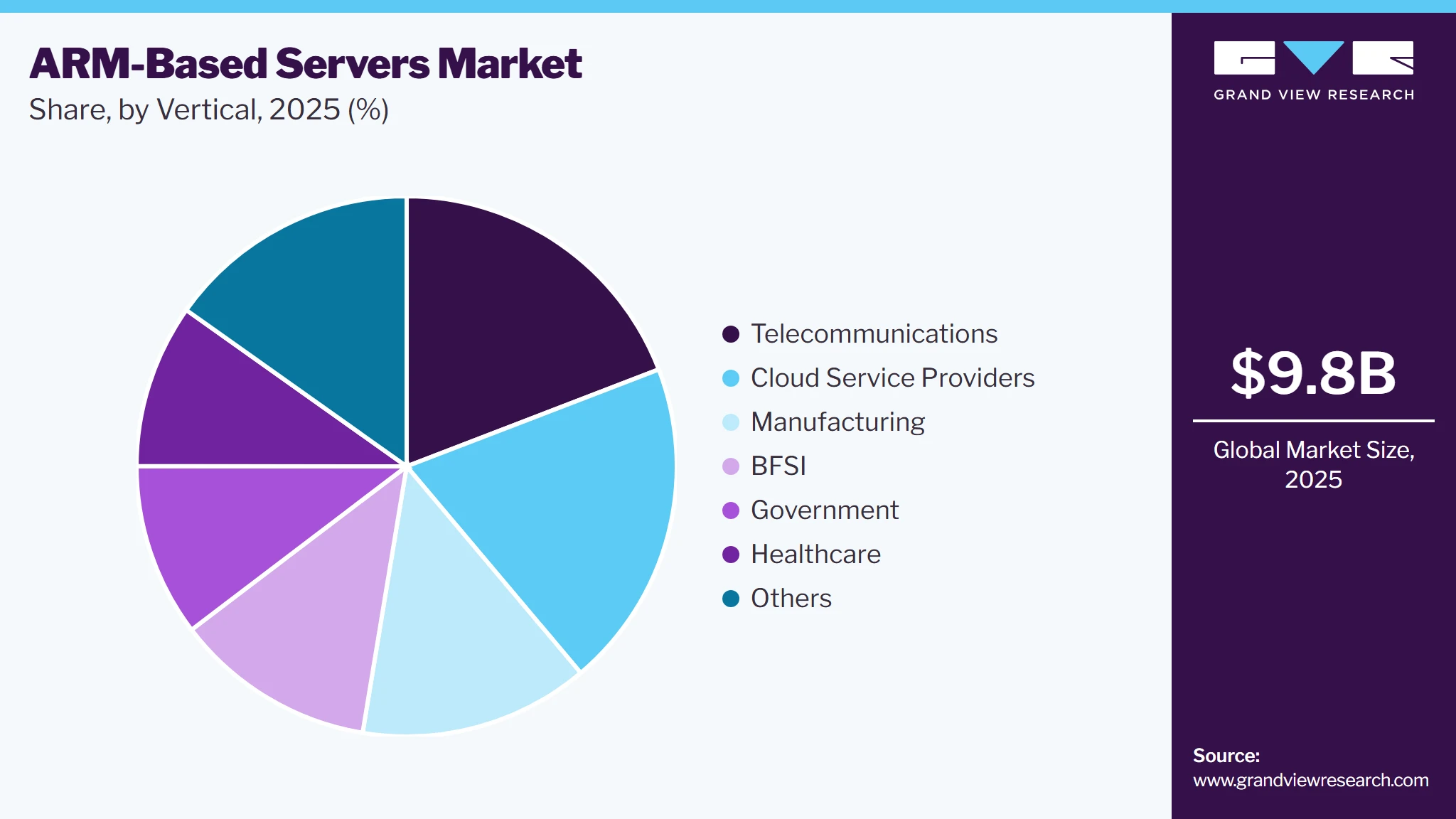
Based on vertical, the cloud service providers segment led the market with the largest revenue share of 19.7% in 2025. due to the increasing adoption of edge computing within the telecommunications industry. Edge computing requires smaller, decentralized data centers closer to the source of data generation. ARM-based servers are well-suited for edge computing environments due to their compact design, low power consumption, and ability to handle real-time data processing at the network's edge. This trend is expected to accelerate as more telecom companies adopt edge solutions to support low-latency applications, such as autonomous vehicles, augmented reality, and smart cities.
 To learn more about this report, Download Free Sample Report
 The bioscience segment is anticipated to grow at the fastest CAGR over the forecast period, driven by the unique computational needs of modern biosciences, including genomics, proteomics, bioinformatics, and pharmaceutical development. Bioscience research often involves processing massive datasets, requiring efficient and scalable computing architectures to handle complex simulations, data analysis, and real-time processing. ARM-based servers, known for their energy efficiency and performance per watt, align well with these needs, offering high computational power with lower operational costs. This particularly appeals to labs and research institutions working with limited budgets but large computational demands.
Regional Insights
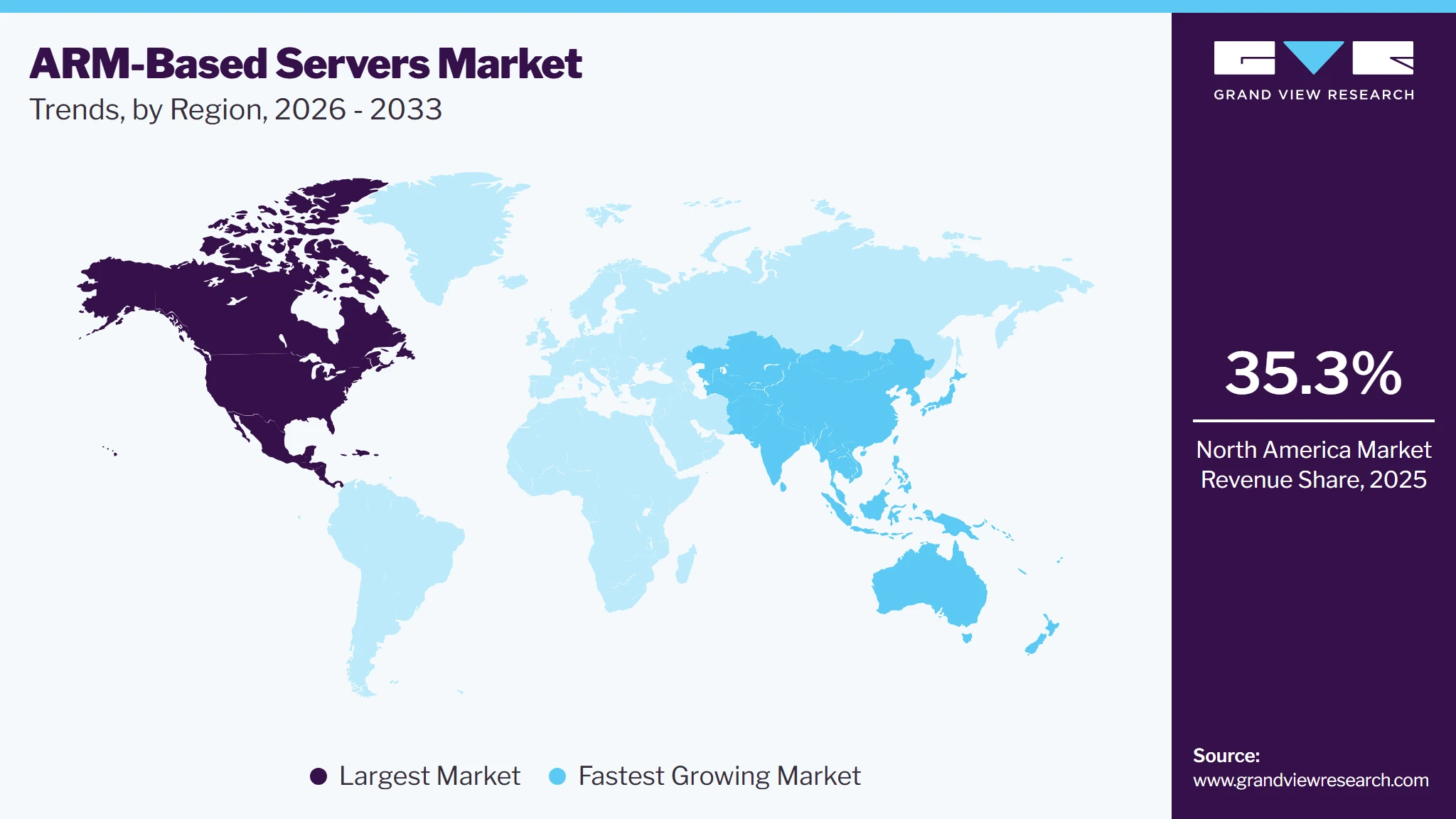
North America dominated the ARM-based servers market with the largest revenue share of 35.3% in 2025. The growth can be attributed to the growing adoption of emerging technologies such asartificial intelligence (AI), machine learning (ML), and high-performance computing (HPC). ARM-based servers are increasingly being adopted to support these emerging technologies due to their ability to handle parallel processing and specialized workloads efficiently. As businesses and research institutions continue to invest in AI and ML, the demand for ARM-based servers capable of supporting these technologies is growing.
 To learn more about this report, Download Free Sample Report
 U.S. ARM-Based Servers Market Trends
The ARM-based servers market in the U.S. held the largest share in the North America region in 2025. Many U.S. companies are adopting ARM-based servers as part of their broader sustainability initiatives. By leveraging ARM’s low power consumption and reduced heat generation, organizations can meet their environmental goals while also achieving significant operational cost savings.
Europe ARM-Based Servers Market Trends
The ARM-based servers market in Europe is growing significantly at a CAGR of 14.1% from 2024 to 2033. Data sovereignty and compliance with European data protection regulations, such as the General Data Protection Regulation (GDPR), are key considerations for European organizations. There is a growing interest in localizing IT infrastructure and leveraging data centers within Europe to ensure compliance with data privacy laws.
Asia Pacific ARM-Based Servers Market Trends
The ARM-based servers market in Asia Pacific is anticipated to grow at the fastest CAGR from 2026 to 2033. The APAC region is witnessing rapid expansion in cloud computing and data center infrastructure. Major cloud providers such as Alibaba Cloud, Tencent Cloud, and Google Cloud are investing heavily in building and upgrading data centers across the region. These cloud providers are increasingly incorporating ARM-based servers into their infrastructure to offer cost-effective and energy-efficient solutions. For instance, in March 2023, Amazon Web Services (AWS) announced a USD 6 billion investment in Malaysia to develop cloud data centers. AWS's total investment in Southeast Asian countries, including Indonesia, Singapore, and Thailand, amounts to USD 22.5 billion. Major cloud providers such as Alibaba Cloud, Microsoft, and Tencent have collectively invested USD 6 billion in Malaysia for data center development.
Key ARM-based Servers Company Insights
Key players operating in the service analytics market include Ampere Computing LLC, Marvell, Advanced Micro Devices, Inc., ARM Limited, Huawei Technologies Co., Ltd., and Linaro Limited. The companies are focusing on various strategic initiatives, including new product development, partnerships and collaborations, and agreements, to gain a competitive advantage over their rivals. The following are some instances of such initiatives.
Key ARM-based Servers Companies
The following key companies have been profiled for this study on the ARM-based servers market.
-
Advanced Micro Devices, Inc
-
Ampere Computing LLC
-
ARM Limited
-
Cloud Software Group, Inc.
-
Huawei Technologies Co., Ltd.
-
Linaro Limited
-
Marvell
-
Red Hat, Inc.
-
SUSE
-
Texas Instruments Incorporated
Competitive Benchmarking
Category
Operating Strategies
Competitive Edge
Weakness
Established Players (Arm Holdings, NVIDIA, Ampere Computing, Marvell Technology, Hewlett Packard Enterprise (HPE), Dell Technologies, Lenovo, Supermicro, Fujitsu)
- Established vendors focus on developing high-performance, energy-efficient ARM-based server processors and integrated server platforms for hyperscale cloud, AI, HPC, enterprise, and edge computing. Their strategies emphasize continuous processor innovation, AI-optimized architectures, partnerships with hyperscale cloud providers, server OEMs, and software vendors, along with investments in advanced manufacturing technologies, cloud-native software optimization, and ecosystem expansion.
- These companies benefit from strong R&D capabilities, mature server ecosystems, global distribution networks, extensive enterprise customer bases, and strategic partnerships with hyperscalers such as AWS, Microsoft, Google, and Oracle. Their competitive advantages include high-performance ARM CPUs, optimized software compatibility, comprehensive support services, established supply chains, and the ability to deliver scalable server solutions for AI, cloud, and mission-critical enterprise workloads.
- Established vendors face high semiconductor development costs, long product development cycles, supply chain dependencies, and intense competition from Intel Xeon and AMD EPYC processors. Software migration challenges, maintaining ecosystem compatibility, rapid advancements in AI hardware, and significant capital investments in advanced chip manufacturing can impact profitability and market expansion.
Emerging Players (SiPearl, Ventana Micro Systems, Esperanto Technologies, Axiado)
- Emerging vendors primarily focus on developing next-generation ARM-based processors and specialized server platforms targeting AI inference, edge computing, telecommunications, HPC, and energy-efficient enterprise infrastructure. Their strategies emphasize innovative processor architectures, chiplet designs, RISC-V and ARM ecosystem collaborations, cloud-native optimization, strategic partnerships with system integrators, and customized solutions for specific industry workloads.
- Emerging companies offer highly specialized and energy-efficient server solutions optimized for AI, edge, and cloud-native applications. Their agility enables faster innovation cycles, customized processor designs, competitive pricing, and quicker adoption of advanced technologies such as CXL, PCIe Gen5, DDR5, and AI acceleration. Their focused product strategies allow them to address niche markets and evolving enterprise requirements more rapidly than larger competitors.
- Emerging vendors often have limited production capacity, smaller customer bases, lower brand recognition, and restricted global sales and support networks. Dependence on third-party semiconductor foundries, software ecosystem maturity, limited enterprise deployment experience, and strong competition from established processor vendors may hinder large-scale commercial adoption. Additionally, securing long-term hyperscale contracts and expanding software compatibility remain significant challenges.
Recent Developments
-
In July 2024, Marvell introduced the Marvell Structera product line, featuring Compute Express Link (CXL) devices created to enhance memory performance and scaling in general-purpose servers for cloud data centers. The CXL offers a solution by enabling new server architectures that allow for efficient memory expansion, thereby improving overall system performance and resource utilization.
-
In May 2024, Ampere Computing LLC partnered with Qualcomm Incorporated to develop an AI server based on ARM architecture, combining their expertise to enhance performance and efficiency in data centers. This collaboration aims to leverage Ampere's strength in high-performance processors and Qualcomm's advanced AI technologies, providing a scalable solution for AI workloads. The new server is designed to meet the increasing demand for energy-efficient, high-performance computing in cloud environments, particularly for AI applications and data-intensive tasks.
-
In April 2024, Google unveiled the Google Axion Processors, the company's first custom CPUs based on ARM architecture, specifically designed for data centers. These processors aim to optimize performance, efficiency, and scalability for cloud computing and data center operations, offering improved processing power tailored for Google's infrastructure. The introduction of Axion marks a significant step in enhancing the performance of cloud services while also meeting growing demands for energy-efficient and high-performance computing in modern data centers.
ARM-Based Servers Market Report Scope
Report Attribute
Details
Market size in 2025
USD 9.8 Billion
Estimated market size in 2026
USD 10.7 Billion
Projected market size by 2033
USD 30.3 Billion
Growth rate
CAGR of 16.0% from 2026 to 2033
Base year for estimation
2025
Historical data
2021 - 2024
Forecast period
2026 - 2033
Quantitative units
Revenue in USD billion and CAGR from 2026 to 2033
Report coverage
Revenue forecast, company ranking, competitive landscape, growth factors, and trends
Segments covered
Core type; processor; application; vertical; region
Regional scope
North America; Europe; Asia Pacific; Latin America; MEA
Country scope
U.S.; Canada; Mexico; Germany; UK; France; China; Japan; India; South Korea; Australia; Brazil; Saudi Arabia; South Africa; UAE
Key companies profiled
Arm Holdings plc; NVIDIA Corporation; Ampere Computing LLC; Amazon Web Services (AWS); Google LLC; Marvell Technology, Inc.; Huawei Technologies Co., Ltd.; Fujitsu Limited; Hewlett Packard Enterprise (HPE); Dell Technologies Inc.; Lenovo Group Limited; Super Micro Computer, Inc. (Supermicro); Oracle Corporation; Microsoft Corporation; MiTAC Computing Technology Corporation
Customization scope
Free report customization (equivalent up to 8 analysts' working days) with purchase. Addition or alteration to country, regional & segment scope.
Pricing and purchase options
Avail customized purchase options to meet your exact research needs. Explore purchase options
Global ARM-Based Servers Market Report Segmentation
This report forecasts revenue growth at the global, regional, and country levels and provides an analysis of the latest industry trends in each of the sub-segments from 2021 to 2033. For this study, Grand View Research has segmented the ARM-based servers market report based on core type, processor, application, vertical, and region:
-
ARM-Based Servers Core Type Outlook (Revenue, USD Billion, 2021 - 2033)
-
ARM Cortex-A Core Based Servers
-
ARM Cortex-M Core Based Servers
-
-
ARM-Based Servers Processor Outlook (Revenue, USD Billion, 2021 - 2033)
-
32-bit
-
64-bit
-
-
ARM-Based Servers Application Outlook (Revenue, USD Billion, 2021 - 2033)
-
Cloud Computing
-
AI & ML
-
HPC
-
Database
-
Web Hosting
-
Big Data Analytics
-
Virtualization
-
CDN
-
-
ARM-Based Servers Vertical Outlook (Revenue, USD Billion, 2021 - 2033)
-
Manufacturing
-
BFSI
-
Cloud Service Providers
-
Government
-
Healthcare
-
Telecommunications
-
Others
-
-
ARM-Based Servers Regional Outlook (Revenue, USD Billion, 2021 - 2033)
-
North America
-
U.S.
-
Canada
-
Mexico
-
-
Europe
-
U.K.
-
Germany
-
France
-
-
Asia Pacific
-
China
-
India
-
Japan
-
South Korea
-
Australia
-
-
Latin America
-
Brazil
-
-
Middle East & Africa
-
UAE
-
Saudi Arabia
-
South Africa
-
-
Research Methodology
The caffeine supplements market figures in this report are based on a proven research process that combines executive interviews with secondary research from proprietary databases, company filings, and recognized regulatory and institutional sources. Market size is built through value-chain sizing - reconciling supply-side and demand-side estimates - and triangulated with bottom-up and top-down approaches. Every estimate passes multiple levels of expert validation before publication, with each caffeine supplements segment quantified using the revenue-capture definitions in the table below.
Segment Definition
Core Type
Revenue capture definition
ARM Cortex-A Core Based Servers
This segment includes servers powered by processors based on the ARM Cortex-A architecture, designed for application processing and operating system support. Cortex-A cores offer high computational performance, energy efficiency, and support for 64-bit processing, making them suitable for cloud computing, edge computing, and enterprise server workloads.
ARM Cortex-M Core Based Servers
This segment includes servers utilizing ARM Cortex-M architecture for highly specialized, low-power edge or embedded server applications. Cortex-M cores are optimized for real-time control and microcontroller applications rather than general-purpose server computing, resulting in limited adoption in the commercial server market.
Processor
Revenue capture definition
32-bit
This segment comprises ARM-based servers built on 32-bit processor architecture. These systems are primarily deployed in legacy embedded applications and lightweight workloads requiring limited memory and processing capabilities.
64-bit
This segment includes ARM-based servers utilizing 64-bit (AArch64) processors capable of supporting large memory capacities, virtualization, AI workloads, and high-performance computing. The 64-bit architecture represents the dominant segment in today's ARM server market, offering enhanced scalability, security, and application compatibility.
Application
Revenue capture definition
Cloud Computing
ARM-based servers deployed for public, private, and hybrid cloud infrastructure to host virtual machines, containers, cloud-native applications, and platform services while optimizing power consumption and operating costs.
AI & ML
Servers designed to support artificial intelligence and machine learning workloads, including AI inference, model training coordination, data preprocessing, and GPU host processing in AI data centers.
HPC (High-Performance Computing)
ARM servers used for computationally intensive applications such as scientific simulations, engineering analysis, weather forecasting, genomics, and academic research requiring parallel processing capabilities.
Database
Servers optimized to run relational, NoSQL, in-memory, and distributed database workloads, providing high throughput, efficient query processing, and scalable data management.
Web Hosting
ARM-based servers deployed for hosting websites, web applications, application servers, APIs, and internet services, offering cost-effective and energy-efficient computing for high-volume web traffic.
Big Data Analytics
Servers supporting large-scale data processing, business intelligence, data lakes, distributed computing frameworks, and real-time analytics across enterprise environments.
Virtualization
ARM servers used to host virtual machines, containers, and cloud-native environments through hypervisors and container orchestration platforms, improving infrastructure utilization and workload isolation.
CDN (Content Delivery Network)
Servers deployed across geographically distributed edge locations to accelerate the delivery of web content, video streaming, software downloads, and digital media while reducing latency and bandwidth consumption.
Vertical
Revenue capture definition
Manufacturing
Deployment of ARM-based servers for industrial automation, smart manufacturing, Industrial IoT (IIoT), predictive maintenance, robotics, and digital twin applications.
BFSI
Adoption of ARM-based servers by banks, financial institutions, and insurance companies for cloud banking, transaction processing, fraud detection, cybersecurity, risk analytics, and regulatory compliance.
Cloud Service Providers
Use of ARM servers by hyperscale cloud providers and managed cloud platforms to deliver Infrastructure-as-a-Service (IaaS), Platform-as-a-Service (PaaS), cloud storage, AI services, and enterprise cloud applications. This is the largest end-user segment for ARM-based servers.
Government
Deployment across government agencies, public sector organizations, defense establishments, and research institutions for secure computing, digital services, high-performance computing, and sovereign cloud infrastructure.
Healthcare
Use of ARM-based servers for electronic health records (EHR), medical imaging, genomics research, healthcare analytics, AI-assisted diagnostics, telemedicine, and hospital information systems.
Telecommunications
Deployment by telecom operators for 5G core networks, network function virtualization (NFV), Open RAN, mobile edge computing (MEC), and distributed cloud infrastructure supporting next-generation communication networks.
Others
Includes education, retail, media & entertainment, energy & utilities, transportation & logistics, and other industries adopting ARM-based servers for enterprise applications, edge computing, AI, and digital transformation initiatives.
Estimation Model
Layer No.
Layer
Question
Analysis
01
AI, Cloud & Data Center Infrastructure Demand Layer
Who generates demand for ARM-Based Servers?
Identify organizations deploying ARM-based server infrastructure, including hyperscale cloud providers, colocation operators, telecom operators, enterprises, government agencies, research institutions, and managed service providers. Assess investments in AI infrastructure, cloud computing, digital transformation, high-performance computing (HPC), and edge computing to determine the total addressable market for ARM-based servers.
02
Server Deployment & Workload Adoption Layer
Where is demand for ARM-Based Servers generated?
Evaluate demand across hyperscale data centers, enterprise data centers, edge facilities, telecom networks, and HPC clusters. Assess adoption across cloud computing, AI & ML, big data analytics, databases, virtualization, content delivery networks (CDN), and web hosting workloads. Analyze enterprise migration from x86 to ARM platforms based on workload compatibility, performance-per-watt, and total cost of ownership (TCO).
03
Processor & Infrastructure Adoption Layer
Who actively adopts ARM-Based Servers?
Analyze adoption across cloud service providers, telecommunications, BFSI, healthcare, manufacturing, government, research organizations, and other enterprises. Evaluate deployment of ARM processors such as AWS Graviton, Google Axion, NVIDIA Grace, Ampere Altra/AmpereOne, and other ARM-based server platforms. Assess adoption by server OEMs, system integrators, and colocation providers to estimate annual server deployments and installed base.
04
Revenue Generation Layer
How is revenue generated?
Assess revenue generated through ARM server processor sales, server hardware shipments, integrated server systems, storage and networking components, operating systems, virtualization software, infrastructure management software, professional services, deployment, maintenance, and technical support. Analyze server ASPs, processor configurations, shipment volumes, cloud infrastructure investments, and enterprise procurement trends to estimate overall market revenues.
Delivered Customizations
This report has been delivered with the following In-depth customizations
Client Request
Customization Delivered
Value Adds
ARM-Based Server Vendor Competitive Benchmarking
Assessed leading ARM-based server vendors based on processor portfolio, server platforms, AI and HPC capabilities, core architecture, performance-per-watt, software ecosystem compatibility, deployment capabilities, partnerships, geographic presence, pricing strategies, innovation roadmap, and market share.
Enables stakeholders to benchmark competitors, identify technology leaders, evaluate product differentiation, compare processor performance and energy efficiency, and develop competitive product and market entry strategies.
ARM vs x86 Competitive Analysis
Compared ARM-based servers with Intel Xeon and AMD EPYC processors across performance, power consumption, total cost of ownership (TCO), workload suitability, scalability, software ecosystem, virtualization support, and AI capabilities.
Enables stakeholders to understand the competitive positioning of ARM servers, identify migration opportunities, and make informed infrastructure investment decisions.
Industry Vertical Adoption Assessment
Evaluated ARM server adoption across cloud service providers, telecommunications, BFSI, healthcare, manufacturing, government, research institutions, retail, and media & entertainment, including key use cases and digital transformation initiatives.
Enables organizations to identify industry-specific growth opportunities, demand patterns, and customer adoption trends.
Frequently Asked Questions About This Report
The rapid expansion of the Internet of Things (IoT) market and the growing need for edge computing devices are fueling the demand for ARM-based servers. ARM processors are well-suited for IoT applications due to their scalability, flexibility, and energy efficiency. ARM processors are known for their energy efficiency and low power consumption, which is a critical factor for servers.
North America dominated with 35.3% revenue share in 2025.
Asia Pacific is the fastest-growing region over the forecast period.
The ARM Cortex-A Core based servers segment led with a 78.9% revenue share in 2025, while ARM Cortex-M Core based servers segment is the fastest-growing segment.
The 64-bit segment led with a 88.3% revenue share in 2025.The competitive landscape for ARM-based servers is evolving, with major players investing in developing advanced 64-bit architectures.
The cloud computing segment held the largest share of 28.3% in 2025, while sensors segment is the fastest-growing segment.
Some key players operating in the ARM-based servers market include Arm Holdings plc; NVIDIA Corporation; Amazon Web Services (AWS); Google LLC; Marvell Technology, Inc.; Huawei Technologies Co., Ltd.; Fujitsu Limited; Hewlett Packard Enterprise (HPE); Dell Technologies Inc.; Lenovo Group Limited among others.
The global ARM-Based servers market size was valued at USD 9.8 billion in 2025 and is estimated at USD 10.7 billion by 2026.
The global ARM-Based servers market is expected to grow at a CAGR of 16.0% from 2026 to 2033, reaching USD 30.3 billion by 2033.
About the Author(s)
IT Services & Applications Research Team
Technology · IT Services & ApplicationsThis report was authored by the it services & applications research team at Grand View Research - comprising two research analysts, one senior research analyst, and one industry expert - with specialized expertise in the it services & applications segment of the technology industry. All findings are based on proprietary technology databases, executive interviews, and regulatory analysis, subject to internal peer review prior to publication.
Last Updated:
Speak to Analyst

Customize this report to your needs - add regions, segments, or data points, with 20% free customization.
Or view our licence options:


ISO 9001:2015 & 27001:2022 Certified
We are GDPR and CCPA compliant! Your transaction & personal information is safe and secure. For more details, please read our privacy policy.


