
- Home
- »
- Next Generation Technologies
- »
-
AI In Mining Market Size, Share & Trends Report, 2026-2033GVR Report cover

AI In Mining Market (2026 - 2033)
Size, Share & Trends Analysis Report By Mining (Surface Mining, Underground Mining), By Technology (Machine Learning & Deep Learning, Robotics & Automation), By Deployment (Cloud, On-premises, Hybrid), By Region, And Segment Forecasts
Market Size, 2025
$41.8BMarket Estimate, 2026
$59.3BMarket Forecast, 2033
$685.6BCAGR, 2026–2033
41.9%AI In Mining Market Summary
The global AI in mining market size was valued at USD 41.8 billion in 2025 and is projected to grow from USD 59.3 billion in 2026 to USD 685.6 billion by 2033, at a CAGR of 41.9% from 2026 to 2033. North America dominated the market, accounting for a revenue share of 34.0% in 2025. The growth of Artificial Intelligence (AI) in the mining industry is being significantly accelerated by industry dynamics, including stringent environmental regulations, operators' focus on reducing costs through technology adoption, and the use of AI-enabled tools to improve worker safety during operations.
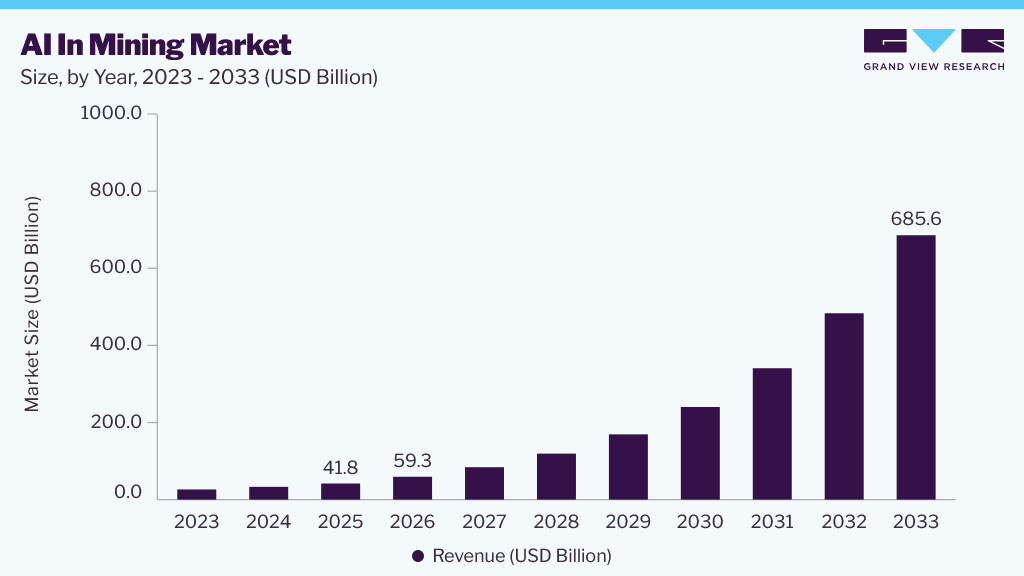 Source: Grand View Research, IR Documents, Primary Interviews, Paid DatabasesTo learn more about this report,
 Download Free Sample Report
Key Market Trends & Insights
- By mining: The surface mining segment led the market, holding the largest revenue share of over 50.0% in 2025.
- By technology: The machine learning and deep learning segment held the dominant position in the market and accounted for the leading revenue share of around 38.0% in 2025.
- By deployment: The cloud segment accounted for the largest revenue share in 2025.
Regional Highlights
- Largest regional market: North America (34.0% revenue share, 2025)
- Fastest-growing regional market: Asia Pacific (highest CAGR, 2026-2033)
Market Size & Forecast
- Market size in 2025: USD 41.8 Billion
- Estimated market size in 2026: USD 59.3 Billion
- Projected market size by 2033: USD 685.6 Billion
- CAGR (2026-2033): 41.9%
Prism AI by Grand View Research Free to tryAsk a question about the AI in mining marketTry asking✓Every figure cited from GVR research Prefer the report? Download free sample →
The AI in mining industry is mainly driven due to its capability to reduce carbon footprints, waste with efficient engineering cycles, and increase compliance with ESG targets to make better use of the natural resources of the Earth. It provides mining workers the digital guidance and learning for remote, safe operations, and also ensures that the budget aligns with the project operations and ensures faster projects with smooth delivery of the product. It implements the predictive strategies for maintenance of the assets so that it extends the organization’s asset lifecycle with increased operational efficiency in the field of materials, energy, yields, and quality.Furthermore, optimization in the organizations’ value chain and a rise in productivity through enhanced coordination and an improved balance of supply and demand, enhance the forecasts from mine to processing plant for maximum recovery by leveraging data management and control methods. AI in mining is used to improve the process by analyzing data from various sources such as surveys, sensors, and weather patterns, enhancing resource extraction, reducing waste, and improving the overall efficiency of the mining process.
Partnerships among key market participants highlight increasing investments and technology transition activities in this industry. For instance, in August 2026, one of the global mining and metals company, Vale, announced the expansion of its partnership with ABB, with aim to increase technology applications, specifically in areas such as automation, AI, and digitalization, based on Conceição II Model Plant developments.
Mining AI also has a unique role by offering safety in AI systems to detect potential hazards in environmental conditions such as landslides, structural failures, roof collapses, water rush-ins, and alert workers for such conditions to tackle such conditions and ensure safety. There are advanced AI wearables with IoT sensors equipped with AI that provide alerts for fatigue and other health issues that may be caused due to the mining process. AI can monitor the impact of mining activities on the environment, predict environmental risks and manage resource optimization, also helps to use renewable energy in mining operations for reducing carbon footprint and energy costs.
Analyst Perspective
The AI in mining market is witnessing steady growth owing to increasing demand for safer mining operations, improved productivity, predictive maintenance, resource optimization, and better control over operating costs. The market is witnessing growing adoption of AI powered autonomous equipment, computer vision, predictive analytics, digital twins, and intelligent exploration tools as mining companies seek to improve ore discovery, optimize extraction processes, monitor equipment performance, and reduce safety risks for workers. Advances in autonomous mining, edge computing, real-time monitoring, and AI driven decision making are creating new opportunities for more efficient and safer mining operations. Companies that combine AI with automation, connected equipment, and real-time operational data are expected to benefit from the market’s long-term growth.
Mining Insights
The surface mining segment led the market, holding the largest revenue share of over 50.0% in 2025. The growth of this industry is driven by the rising need for automation, digitalization in the AI tools that deliver improved efficiency and safety, which minimizes human interaction or exposure to risks while performing operations for enhancing fuel efficiency and productivity. Emerging technologies used for active on-site applications and investments in companies related to surface exploration activities in mining highlight growth potential of this technology. For instance, in June 2026, Terra AI announced it has secured USD 20 million investment through Series A funding round, from BHP Ventures.
The underground mining segment is expected to grow at the fastest CAGR during the forecast period driven by rising demand for safety of the workers by monitoring the real-time hazard while using the technology of autonomous machines which results in increasing efficiency with predictive analytics of the hazard activities and improving the resource extraction of geological data for better decision making. The use of AI in mining enables energy efficiency by following the regulatory compliance with lowering the costs and impact on the environment. For instance, in April 2025, the Ministry of Coal has introduced initiatives for underground coal mining in India, such as lowering the minimum revenue share and reducing financials. These policies are introduced to understand private investment, speed up project execution, and encourage the utilization of advanced, environmentally friendly mining technologies. This initiative aligns with India’s objectives of sustainable development, energy security, and the vision of Atmanirbhar Bharat by promoting a modern, efficient, and eco-conscious coal industry.
Technology Insights
The machine learning and deep learning segment accounted for the largest revenue share in 2025. The segment growth is attributed to its ability for the adoption of machine learning and deep learning and robotics & automation in mining. This adoption leads to increase in operational efficiency, lower costs, and enhance safety through automation and better data analysis which allows for the accurate exploration of mineral from the Earth by processing the geological data, which enhance the resource extraction optimization, and predict equipment failure to reduce the waste of time. AI-powered machinery and autonomous vehicles also minimize human exposure to dangerous conditions, improving safety. Furthermore, AI enhances environmental monitoring and promotes sustainable mining practices, offering safety and security.
The computer vision segment is expected to grow at the highest CAGR over the forecast period, driven by the need to reduce operational costs, mainly in energy and maintenance, and improving safety by reducing human presence in hazardous areas through automation and remote control. AI enhances efficiency and productivity by optimizing haulage routes, enabling predictive maintenance, and enhancing mineral processing, which collectively reduces downtime and minimize resource wastage. Moreover, the large volumes of data produced in mining operations further demand AI integration, as advanced analytics offer resource management and decision-making.
Deployment Insights
The cloud segment accounted for the largest revenue share in 2025, driven by its greater operational efficiency and real-time data insights, which support smarter decision-making and predictive maintenance across mining sites. The need to smoothly work with remote operations has raised the need for cloud models, which integrate local edge computing with centralized cloud analytics to address connectivity limitations across different mining sites. Moreover, cloud adoption enhances collaboration between mining sites and partners, lowers on-site labor costs through remote operations, and strengthens environmental compliance by ensuring transparent data for sustainability reporting.
The on-premises segment is anticipated to grow at the highest CAGR during the forecast period, driven by its ability to provide stronger data security and ease in regulatory compliance, as it lowers the risk of data breaches. This deployment method also delivers low latency and real-time processing, which is better for time-critical mining activities where fast decisions affect the safety and productivity of the workers at the sites. It provides more potential savings by eliminating cloud expenses and supporting better budget planning. For instance, in October 2025, Hexagon launched the Leica TS20 robotic total station with edge AI, enabling AI-powered automation and real-time processing directly on the device while supporting data privacy. The use of edge AI demonstrates the growing adoption of locally processed intelligence in demanding industrial environments, where faster decision-making, reduced dependence on network connectivity, and protection of operational data are important considerations. This development supports the growing relevance of on-premises and edge-based AI deployment models in mining operations.
Regional Insights
The AI in mining industry in North America dominated globally with a revenue share of over 34.0% in 2025, driven by the need to enhance operational efficiency, safety, and sustainability in the mining sector. Mining companies are deploying AI across the entire value chain to improve productivity, cut costs, and meet the increasing need for safety standards. With decarbonization and environmental control high, AI is being used to optimize energy use, safety, and reduce emissions. AI-powered solutions, including predictive maintenance, automation, robotics, digital twins, and advanced analytics, are essential for real-time decision-making and strengthening operational safety. The strong network of mining companies, technology partners, and regulators is working together to create a safer, more efficient, and sustainable mining landscape in North America.
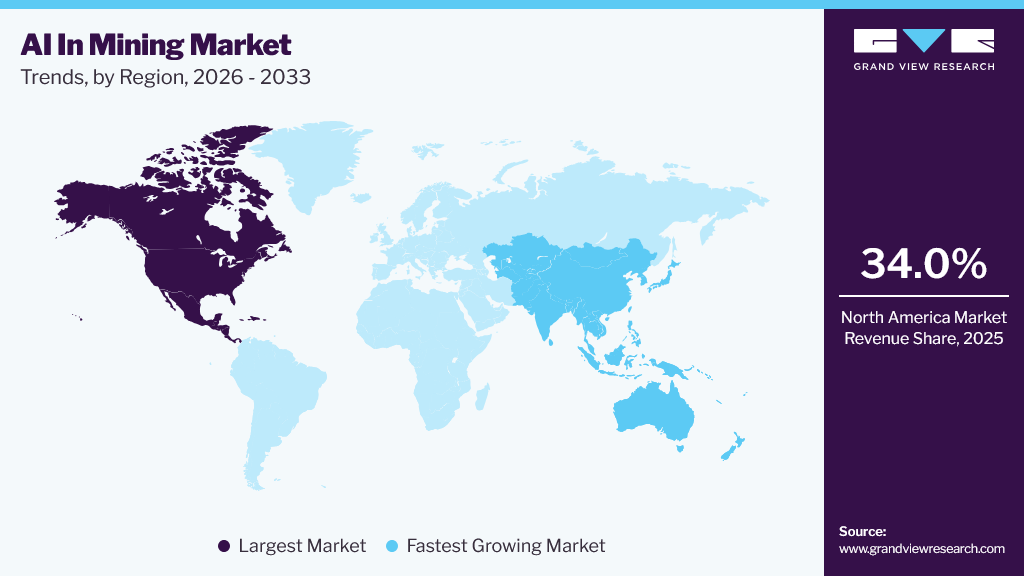 To learn more about this report, Download Free Sample Report
U.S. AI In Mining Market Trends
The AI in mining industry in the U.S. is expected to grow significantly in 2025, driven by regulatory requirements that allow companies to meet strict environmental and safety standards, enabling them to use AI solutions. The large number of operating mines presents many opportunities for implementing automation and predictive maintenance. AI is also important in enhancing mineral exploration by enabling more precise analysis of geological data. Meanwhile, autonomous machinery and robotics increase productivity and lower risks to human workers.
Europe AI In Mining Market Trends
The AI in mining industry in Europe is witnessing steady growth over the forecast period, due to the region’s strong focus on sustainability and its strategic objective to achieve raw material independence by 2030. Environmental regulations encourage companies to adopt AI to cut or reduce emissions and make better use of resources. At the same time, Europe is working to narrow the AI adoption gap with other parts of the world by investing in technology and workforce skills. AI supports greater process efficiency, predictive maintenance, and improved safety, all essential for achieving operational excellence in mining.
Asia Pacific AI In Mining Market Trends
The AI in mining industry in Asia Pacific region is anticipated to register the highest CAGR over the forecast period led by the AI adoption within the mining sector, driven by investments from both governments and corporations in countries like Australia, China, and India which is in demand by a strong need of enhancing operational efficiency, safety, and sustainability through AI technologies, including autonomous machinery, predictive maintenance, and real-time risk management. The region’s growing human in AI talent and digital transformation initiatives further speed up this adoption. Additionally, national AI strategies and supportive innovation ecosystems are driving the growth and scalability.
Key AI In Mining Company Insights
Some key companies in the AI in mining industry are Sandvik, Microsoft, IBM, SAP, and ABB.
-
Sandvik is in high-tech engineering, is advancing innovation in mining with AI-driven solutions that boost productivity, safety, and sustainability. Among their AI efforts is the Remote Monitoring Service, which leverages advanced analytics and machine learning for predictive maintenance to minimize equipment failures and enhance operational efficiency. Sandvik is also investing in AI projects centered on mining and rock processing, harnessing cloud data and AI to make mining more efficient and environmentally sustainable. Additionally, their AI technologies, including image and speech recognition, promote greater automation and smarter decision-making across mining operations.
-
SAP is in enterprise software and business AI, helping mining companies enhance their operations through powerful data insights and AI-driven solutions. Their specialized mining software improves asset performance, predictive maintenance, supply chain efficiency, and sustainability reporting, fostering more resilient and streamlined mining operations. SAP’s AI tools enable the prediction of equipment failures, integrate ESG metrics into procurement, and optimize workforce management, all contributing to the digital transformation of the mining industry.
Key AI In Mining Companies:
The following key companies have been profiled for this study on the AI in mining market.
-
IBM
-
SAP
-
Microsoft
-
Datarock
-
Earth AI
-
BHP
-
ABB
-
Sandvik
-
Caterpillar
-
Komatsu
Recent Developments
-
In June 2026, Komatsu announced strengthening its global AI deployment framework and begun scaling AI adoption across its value chain. It had established a central AI enablement function in April 2026 and appointed approximately 500 AI Transformation Leads in May 2026 to identify use cases and accelerate practical AI implementation.
-
In June 2025, Hexagon’s Mining division acquired Drill Assist from Phoenix Drill Control to strengthen its AI-based drill automation capabilities. Drill Assist uses artificial intelligence to continuously optimize drilling, with the technology designed to improve penetration rates, machine availability, and downhole data quality. The solution can also identify variations in rock hardness and fracture zones, supporting better blasting and fragmentation decisions while helping reduce energy consumption per ton mined.
-
In May 2025, BHP established its Industry AI Hub in Singapore to drive AI adoption and advance digital transformation within the mining and resources industry. This hub is dedicated to tackling enterprise-level challenges by applying AI to boost safety and productivity, focusing data-driven decision-making and automation into the heart of its operations.
-
In March 2025, ABB launched GMD Copilot, an AI-based digital assistant designed to enhance the performance and maintain gearless mill drives (GMDs), which are important in mineral extraction. The tool improves decision-making and helps cut downtime by providing real-time, and insights specifically to context through natural language. GMD Copilot enables mining operators to achieve greater efficiency and reliability due to security features and support of multiple languages, particularly in the copper sector where demand continues to grow.
-
In September 2024, Komatsu planned to acquire Octodots Analytics, a Chilean developer of mining optimization software, to strengthen its AI capabilities and assist customers in improving their mining operations. This acquisition will bolster Komatsu’s new modular ecosystem, which aims to unify data across mine sites and streamline workflows. Built on Komatsu’s dispatch fleet management system, the modular ecosystem enhances decision-making from individual machines to entire sites and organizations.
Global AI In Mining Market Report Scope
Report Attribute
Details
Market size in 2025
USD 41.8 billion
Estimated market size in 2026
USD 59.3 billion
Projected market size by 2033
USD 685.6 billion
Growth rate
CAGR of 41.9% from 2026 to 2033
Base year for estimation
2025
Historical data
2021 - 2025
Forecast period
2026 - 2033
Quantitative units
Revenue in USD billion and CAGR from 2026 to 2033
Report coverage
Revenue forecast, company ranking, competitive landscape, growth factors, and trends
Segments covered
Mining, technology, deployment, region
Regional scope
North America; Europe; Asia Pacific; Latin America; MEA
Country scope
U.S.; Canada; Mexico; UK; Germany; France; China; India; Japan; South Korea; Australia; Brazil; KSA; UAE; South Africa
Key companies profiled
IBM; SAP; Microsoft; Datarock; ABB; BHP; Sandvik; Caterpillar; Komatsu; Earth AI
Customization scope
Free report customization (equivalent to 8 analyst working days) with purchase. Addition or alteration to country, regional & segment scope.
Pricing and purchase options
Avail of customized purchase options to meet your exact research needs. Explore purchase options
Global AI In Mining Market Report Segmentation
This report forecasts revenue growth at the global, regional, and country levels and provides an analysis of the latest industry trends and opportunities across each sub-segment from 2021 to 2033. For this study, Grand View Research has segmented the global AI in mining market report based on mining, technology, deployment, and region:
- Mining Outlook (Revenue, USD Billion, 2021 - 2033)
- Surface Mining
- Underground Mining
- Others
- Technology Outlook (Revenue, USD Billion, 2021 - 2033)
- Machine Learning & Deep Learning
- Robotics & Automation
- Computer Vision
- NLP
- Others
- Deployment Outlook (Revenue, USD Billion, 2021 - 2033)
- Cloud
- On-premises
- Hybrid
- Regional Outlook (Revenue, USD Billion, 2021 - 2033)
- North America
- U.S.
- Canada
- Mexico
- Europe
- UK
- Germany
- France
- Asia Pacific
- China
- India
- Japan
- South Korea
- Australia
- Latin America
- Brazil
- Middle East and Africa
- KSA
- UAE
- South Africa
- North America
Frequently Asked Questions About This Report
The global AI in mining market size was valued at USD 41.8 billion in 2025 and is estimated at USD 59.3 billion for 2026.
The global AI in mining market is expected to grow at a CAGR of 41.9% from 2026 to 2033, reaching USD 685.6 billion.
Key players in the market include IBM. SAP. Microsoft. Datarock. ABB. BHP. Sandvik. Caterpillar. Komatsu. Earth AI, and others.
The surface mining segment led the market, holding the largest revenue share of over 50.0% in 2025.
North America dominated with an over 34.0% revenue share in 2025.
About the Author(s)
Next Generation Technologies Research Team
Technology · Next Generation TechnologiesThis report was authored by the next generation technologies research team at Grand View Research - comprising two research analysts, one senior research analyst, and one industry expert - with specialized expertise in the next generation technologies segment of the technology industry. All findings are based on proprietary technology databases, executive interviews, and regulatory analysis, subject to internal peer review prior to publication.
Last Updated:
Speak to Analyst

Customize this report to your needs - add regions, segments, or data points, with 20% free customization.
Or view our licence options:


ISO 9001:2015 & 27001:2022 Certified
We are GDPR and CCPA compliant! Your transaction & personal information is safe and secure. For more details, please read our privacy policy.


