
- Home
- »
- Plastics, Polymers & Resins
- »
-
Aseptic Carton Packaging Market Size Report, 2024-2030GVR Report cover
![Aseptic Carton Packaging Market (2024 - 2030)Report]()
Aseptic Carton Packaging Market (2024 - 2030)
Size, Share & Trends Analysis Report By Material (Plastics, Paper & Paperboard), By Type, By Application, By Distribution Channel, By Region, And Segment Forecasts
Market Size, 2023
$23.9BMarket Estimate, 2026
$29.5BMarket Forecast, 2030
$40.3BCAGR, 2024–2030
7.8%Aseptic Carton Packaging Market Trends
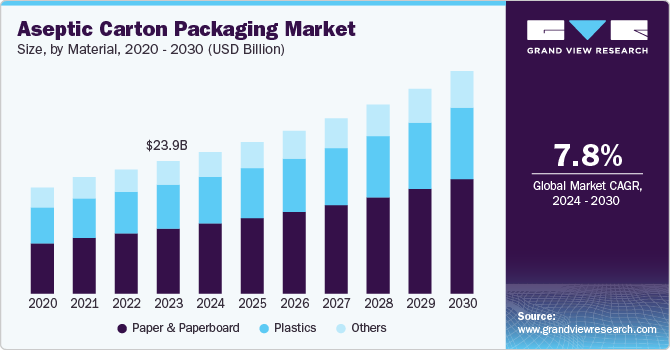
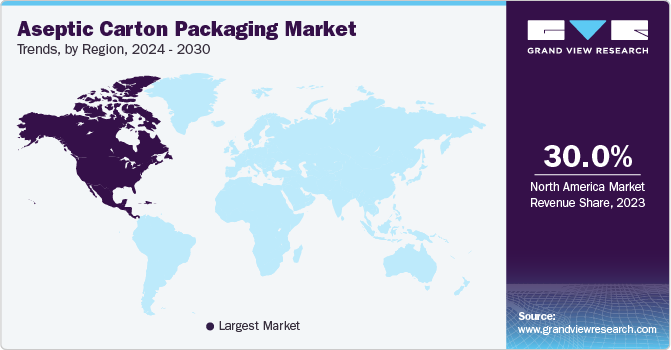
The global aseptic carton packaging market size was valued at USD 23.9 billion in 2023 and is projected to grow from USD 29.5 billion in 2026 to USD 40.3 billion by 2030, at a CAGR of 7.8% from 2024 to 2030. The market in North America dominated with a revenue share of 30.2% in 2023. Booming dairy and non-alcoholic beverage industry is driving the demand for the aseptic carton packaging across the globe. Additionally, increasing consumer preference for convenience is positively influencing the growth of the market.

The aseptic carton packaging market is driven by several key factors, including the increasing demand for extended shelf-life products, particularly in the food and beverage industry. Aseptic packaging involves sterilizing both the carton and the contents separately before sealing them in a sterile environment. This process eliminates the need for preservatives and refrigeration, which is highly beneficial for products such as dairy, juices, and non-alcoholic beverages. For example, milk and juice products can be stored for months without refrigeration, which appeals to consumers in both developed and developing markets where consistent refrigeration might not be available.
Another major driver is the rising consumer preference for convenience and on-the-go products. As lifestyles become more fast-paced, consumers are increasingly seeking easy-to-use, portable packaging solutions. Aseptic cartons, being lightweight, easy to transport, and offering resealability, meet these consumer demands. This trend is particularly noticeable in the growth of ready-to-drink (RTD) beverages and plant-based beverages, where aseptic packaging ensures product safety and longevity. Providing product safety without altering taste or nutritional content enhances its appeal among health-conscious consumers.
Moreover, sustainability is a significant driving factor in the aseptic carton packaging market. Aseptic cartons are primarily made from renewable resources, such as paperboard, and they have a lower environmental impact compared to plastic or glass packaging. The increasing consumer demand for environmentally friendly packaging has pushed companies to adopt aseptic cartons as a sustainable solution. For instance, in May 2023, Tetra Pak International S.A. and Lactogal Produtos Alimentares S.A. launched a new sustainable aseptic carton for milk, significantly reducing its carbon footprint by one-third and increasing the renewable content to 90%.
Market Dynamics
The growing consumption of shelf-stable dairy products, juices, plant-based beverages, soups, and other liquid food products is significantly driving the global aseptic carton packaging market. Consumers are increasingly seeking convenient packaged products with extended shelf life that do not require refrigeration during storage and transportation. Aseptic carton packaging enables manufacturers to preserve product freshness, nutritional value, and taste while reducing the need for preservatives and the cold-chain logistics required to maintain them. This makes aseptic cartons highly attractive for dairy producers, beverage manufacturers, and food processing companies aiming to improve distribution efficiency and reduce operational costs.
The expanding demand for ready-to-drink beverages and on-the-go consumption formats is also contributing to market growth. Urbanization, changing lifestyles, and rising disposable incomes are driving greater consumption of packaged beverages and liquid foods globally. In addition, growing awareness of sustainable packaging is supporting the adoption of carton-based solutions, as aseptic cartons are generally lightweight and increasingly made with recyclable paperboard. Technological advancements in barrier coatings, filling systems, and packaging designs are further improving product safety, packaging durability, and printing quality, helping manufacturers strengthen brand differentiation and operational efficiency.
Despite their sustainability advantages, aseptic carton packaging systems involve complex multilayer structures comprising paperboard, aluminum, and plastic layers, which can make recycling more difficult in regions with limited recycling infrastructure. Separating these layers during recycling requires specialized processing facilities, and inadequate recycling systems in some countries can restrict effective waste recovery. This remains a key concern for environmental organizations and regulatory authorities working to improve packaging circularity.
Maintaining strong product protection while improving packaging sustainability remains one of the biggest challenges in the aseptic carton packaging market. Aseptic cartons must provide excellent barriers against oxygen, light, moisture, and microbial contamination to preserve product quality over extended shelf-life periods. Achieving these protective properties while reducing dependence on plastic and aluminum layers requires continuous innovation in renewable materials, barrier technologies, and recyclable packaging structures.
Material Insights
Paper & paperboard dominated the overall market with a revenue market share of over 49.0% in 2023 and is expected to witness robust growth with a CAGR of 8.6% over the forecast period. It provides the main structure of the carton, giving it rigidity and strength. These materials are derived from wood pulp and offer an eco-friendly alternative to plastic-heavy packaging. Hence, the growing consumer preference for sustainable and environmentally friendly packaging solutions is the primary driver for paper and paperboard in aseptic cartons.
Plastics play a critical role in aseptic carton packaging, primarily used as protective layers to prevent contamination and enhance product shelf life. These layers, often made of polyethylene, act as moisture barriers and contribute to the structural integrity of the packaging.
Type Insights
Standard/base shape dominated the overall market with a revenue market share of over 46.0% in 2023. This shape is commonly rectangular, providing a straightforward design that is easy to handle and stack. Standard-shaped cartons are versatile, being used for a range of food and beverage products such as milk, juices, and liquid dairy alternatives. Their broad acceptance in retail settings makes them a familiar sight for consumers.
Slim-shaped aseptic cartons offer a more compact and sleek design compared to the standard shape. They are often used for single-serve beverages, health drinks, and specialized dairy products like flavored milk or energy drinks. This shape is designed for convenience and portability, appealing to on-the-go consumers.
Application Insights
Food application segment dominated the market and accounted for the largest revenue share of over 51.0% in 2023. In the food segment of the aseptic carton packaging market, packaging is widely used for products such as dairy, soups, sauces, puree, and processed foods that require extended shelf life. Driving factors for the food segment include increasing consumer demand for ready-to-eat meals, convenience foods, and healthier options that maintain nutritional value over time.
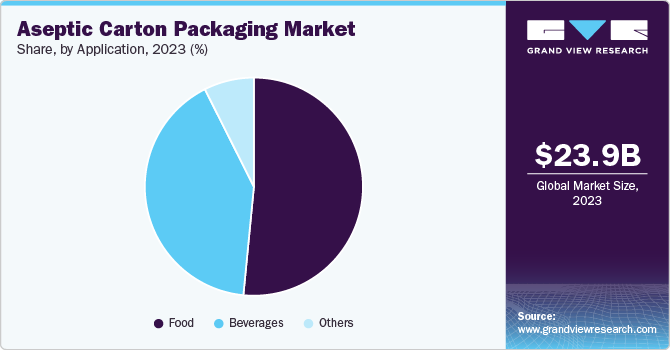
In the beverages segment, aseptic carton packaging is primarily used for products such as juices, dairy drinks, energy drinks, and alcoholic beverages. These cartons maintain the taste, texture, and nutritional content of beverages by preventing contamination from external factors. Driving factors for the beverage segment include the rising consumption of health-conscious drinks, such as plant-based beverages and fortified juices, and the growing non-alcoholic beverage industry.
Distribution Channel Insights
Direct distributors dominated the overall market with a revenue market share of over 47.0% in 2023. Direct distributors are driven by the increasing focus on reducing intermediaries in the supply chain, which lowers costs and improves profit margins. The demand for more transparent relationships between packaging suppliers and end-users, as well as the ability to offer bespoke packaging solutions directly, further propels the use of direct distribution channels.
GPOs distribution channel segment is expected to witness robust growth with a CAGR of 8.5% over the forecast period. GPOs are collective purchasing bodies that negotiate prices on behalf of a group of companies or institutions. In the aseptic carton packaging market, GPOs pool the purchasing power of multiple food and beverage manufacturers, healthcare institutions, or retail chains to secure better pricing and terms from suppliers.
Regional Insights
North America aseptic carton packaging dominated the global market and accounted for the largest revenue share of over 30.0% in 2023. The growth is attributed to several key factors, including the region's strong focus on food safety, innovation in packaging technologies, and growing consumer demand for convenience. Aseptic packaging, which allows products to be stored without refrigeration, has gained traction in the U.S. and Canada, particularly in the food and beverage sector. With rising concerns about foodborne illnesses and the need to extend the shelf life of perishable goods, manufacturers are increasingly adopting aseptic packaging solutions.
U.S. Aseptic Carton Packaging Market Trends
Aseptic carton packaging market in the U.S. is primarily driven by expanding U.S. food & beverage industry. The industry's constant innovation drives the adoption of aseptic carton packaging. New product categories, such as plant-based milk alternatives, ready-to-drink coffee, and functional beverages, often utilize aseptic packaging to extend shelf life without preservatives. For instance, brands such as Califia Farms and Silk have successfully launched various plant-based milk products in aseptic cartons, appealing to health-conscious consumers while ensuring product freshness.
Europe Aseptic Carton Packaging Market Trends
Europe has stringent food safety regulations, which have boosted the demand for aseptic packaging. Aseptic processing and packaging techniques ensure that food and beverages remain sterile and have a longer shelf life without the need for preservatives or refrigeration. This is particularly important in Europe, where there's a growing consumer preference for clean label products with minimal additives. For example, the popularity of organic and natural products in countries such as Germany, France, and the UK has driven the need for packaging solutions that can maintain product integrity without chemical preservatives.
Aseptic Carton packaging market in the Germany is growing due to robust food and beverage industry, coupled with changing consumer preferences for convenient and on-the-go products. Aseptic carton packaging offers extended shelf life without the need for refrigeration, making it ideal for busy German consumers. This has resulted in the growth of products such as ready-to-drink coffee, smoothies, and protein shakes in aseptic cartons.
Asia Pacific Aseptic Carton Packaging Market Trends
The underdeveloped cold chain infrastructure in many parts of Asia Pacific region makes aseptic packaging an attractive option for food and beverage companies. In countries with tropical climates or less developed logistics networks, aseptic cartons provide a cost-effective way to distribute perishable products without the need for constant refrigeration. This has been particularly important in expanding market reach to rural and semi-urban areas.
Aseptic carton packaging Market in China is growing due to the booming food and beverage industry, increasing urbanization, and strong focus on sustainability. As one of the largest consumers of packaged goods globally, the country has witnessed a surge in demand for aseptic packaging, particularly in the dairy, juice, and non-alcoholic beverage sectors. The country's growing middle class is driving this demand, as consumers increasingly prefer convenient, on-the-go packaging solutions that ensure product freshness and extended shelf life without the need for preservatives or refrigeration.
Key Aseptic Carton Packaging Company Insights
The competitive environment of the aseptic carton packaging market is marked by the presence of several major players, including Tetra Pak International S.A., SIG, and Elopak, who dominate the global market with their extensive product portfolios and advanced technologies. These companies compete on factors such as innovation, sustainability, and cost efficiency, focusing on developing eco-friendly packaging solutions to meet the increasing demand for sustainable packaging in the food and beverage industry. Moreover, increasing production capacity and expansion initiatives are undertaken by major players to gain competitive edge in the market.
-
In October 2023, SIG introduced a new product called the SIG DomeMini, an on-the-go carton bottle designed to combine convenience with sustainability. This small carton pack offers the ease of a plastic bottle while being environmentally friendly, as it is primarily made from FSC-certified paperboard and produced using 100% renewable electricity. The SIG DomeMini is aimed at the growing market for on-the-go beverages, providing consumers with a sustainable option that helps reduce plastic waste. The carton is designed for recycling and features a resource-efficient, space-saving design. The filling machine for the SIG DomeMini can fill up to 12,000 packages per hour and can handle seven different volume sizes ranging from 180 to 350 ml.
-
In September 2023, SIG announced the establishment of its first aseptic carton plant in India, located in Ahmedabad, Gujarat. This marks SIG's 10th aseptic carton facility globally and is part of a significant investment plan totaling approximately USD 104.9 million, to be implemented by 2025. The plant will initially aim for a production capacity of up to 4 billion packages per year, with future expansions expected to increase this to 10 billion.
Key Aseptic Carton Packaging Companies:
The following are the leading companies in the aseptic carton packaging market. These companies collectively hold the largest market share and dictate industry trends.
- Tetra Pak International S.A.
- SIG
- Elopak
- Nippon Paper Industries Co., Ltd.
- UFlex Limited
- IPI S.r.l.
- Greatview Aseptic Packaging Company Limited
- Mondi
- WestRock Company
- Heli Packaging Technology (Qingzhou) Co., Ltd
Competitive Benchmarking
Operating Strategies
Competitive Edge
Weakness
Mature Players: Tetra Pak; SIG Group; Elopak; Amcor plc; Smurfit Westrock
- Mature companies focus on expanding aseptic packaging capabilities for dairy, juice, plant-based beverages, and liquid food applications.
- Significant investments are being made in recyclable carton technologies, bio-based materials, lightweight packaging structures, and advanced aseptic filling systems.
- Established companies benefit from strong technological expertise, extensive global distribution networks, and integrated packaging and filling system capabilities.
- Advanced R&D infrastructure and large-scale manufacturing capacity support continuous innovation and operational efficiency.
- High capital investment requirements for aseptic production systems and recycling infrastructure can increase operational costs.
- Dependence on complex multilayer packaging materials may create sustainability and regulatory challenges over time.
Emerging Players: Greatview Aseptic Packaging; Mondi; Stora Enso; Refresco; Liquibox
- Emerging companies focus on sustainable carton innovations, cost-efficient aseptic packaging solutions, and customized packaging formats for regional beverage markets.
- Many players are investing in renewable paperboard materials, recyclable packaging structures, and lightweight designs to strengthen sustainability positioning.
- Emerging players are generally more flexible in addressing evolving sustainability demands and regional customer requirements.
- Specialized expertise in renewable materials and customized liquid packaging solutions supports product differentiation.
- Smaller manufacturing scale and limited global filling infrastructure may reduce competitiveness against dominant multinational suppliers.
- Rising raw material costs, technology investments, and recycling compliance requirements can pressure profitability and scalability.
Aseptic Carton Packaging Market Report Scope
Report Attribute
Details
Market size in 2023
USD 23.9 billion
Estimated market size in 2026
USD 29.5 billion
Projected market size by 2030
USD 40.3 billion
Growth rate
CAGR of 7.8% from 2024 to 2030
Historical data
2018 - 2022
Forecast period
2024 - 2030
Quantitative units
Revenue in USD million, Volume in Kilotons, and CAGR from 2024 to 2030
Report coverage
Volume Forecast, Revenue forecast, competitive landscape, growth factors and trends
Segments covered
Material, type, application, distribution channel, region
Regional scope
North America; Europe; Asia Pacific; Central & South America; Middle East & Africa
Country Scope
U.S.; Canada; Mexico; Germany; UK; France; Italy; Spain; China; India; Japan; South Korea; Brazil; Saudi Arabia; UAE
Key companies profiled
Tetra Pak International S.A.; SIG; Elopak; Nippon Paper Industries Co., Ltd.; UFlex Limited; IPI S.r.l.; Greatview Aseptic Packaging Company Limited; Mondi; WestRock Company; Heli Packaging Technology (Qingzhou) Co., Ltd
Customization scope
Free report customization (equivalent up to 8 analyst’s working days) with purchase. Addition or alteration to country, regional & segment scope
Pricing and purchase options
Avail customized purchase options to meet your exact research needs. Explore purchase options
Global Aseptic Carton Packaging Market Report Segmentation
This report forecasts revenue growth at global, regional, and country levels and provides an analysis of the latest industry trends in each of the sub-segments from 2018 to 2030. For this study, Grand View Research has segmented the aseptic carton packaging market report based on material, type, application, distribution channel, and region:
-
Material Outlook (Revenue, USD Million; Volume, Kilotons, 2018 - 2030)
-
Plastics
-
Paper & Paperboard
-
Others
-
-
Type Outlook (Revenue, USD Million; Volume, Kilotons, 2018 - 2030)
-
Standard / Base Shape
-
Slim Shape
-
Square Shape
-
Others
-
-
Application Outlook (Revenue, USD Million; Volume, Kilotons, 2018 - 2030)
-
Food
-
Milk
-
Dairy Products and Ice Cream
-
Fruit and Vegetable Puree
-
Others
-
-
Beverages
-
Alcoholic Beverages
-
Non-Alcoholic Beverages
-
-
Others
-
-
Distribution Channel Outlook (Revenue, USD Million; Volume, Kilotons, 2018 - 2030)
-
Group Purchasing Organizations (GPOs)
-
Corporate Distributors
-
Individual Distributors
-
Direct Distributors
-
Others
-
-
Regional Outlook (Revenue, USD Million; Volume, Kilotons, 2018 - 2030)
-
North America
-
U.S.
-
Canada
-
Mexico
-
-
Europe
-
Germany
-
UK
-
France
-
Italy
-
Spain
-
-
Asia Pacific
-
China
-
India
-
Japan
-
South Korea
-
-
Central & South America
-
Brazil
-
-
Middle East & Africa
-
Saudi Arabia
-
UAE
-
-
Delivered Customizations
This report has been delivered with the following In-depth customizations
Client Request
Customization Delivered
Value Adds
Regional Segmentation
Comprehensive evaluation of the global aseptic carton packaging market across North America, Europe, Asia Pacific, Latin America, and Middle East & Africa, including country-level dairy consumption trends, beverage packaging demand, recycling infrastructure, sustainability regulations, and aseptic processing capacity analysis.
Help identify high-growth beverage and dairy packaging markets, emerging manufacturing hubs, and region-specific expansion opportunities. Support strategic planning through analysis of consumer trends, packaging regulations, and sustainability initiatives.
Cross-Segmentation
In-depth segmentation analysis by material type, carton format, packaging size, application, end-use industry, and distribution channel, including both value and volume analysis across key global markets. The study further evaluates demand for dairy cartons, juice packaging, plant-based beverage cartons, and sustainable aseptic packaging technologies.
Enable identification of high-growth packaging categories and emerging liquid food applications. Support product innovation planning, investment prioritization, and portfolio diversification through deeper understanding of evolving market demand.
Trade Assessment
Detailed assessment of global trade activity, paperboard and aluminum supply dynamics, import-export trends, recycling regulations, filling equipment sourcing, and regional supply chain dependencies affecting the aseptic carton packaging market. The analysis also includes logistics trends, manufacturing shifts, and raw material procurement challenges.
Support sourcing optimization and supply chain risk management by identifying procurement opportunities, supplier regions, and trade bottlenecks. Help improve operational resilience, international expansion strategies, and long-term packaging supply planning.
Frequently Asked Questions About This Report
Paper and paperboard dominated the overall market with a revenue market share of over 49.0% in 2023 and is expected to witness robust growth with a CAGR of 8.6% over the forecast period. Paper and paperboard provide the main structure of the carton, giving it rigidity and strength.
Key players in the market include Tetra Pak International S.A.; SIG; Elopak; Nippon Paper Industries Co., Ltd.; UFlex Limited; IPI S.r.l.; Greatview Aseptic Packaging Company Limited; Mondi; WestRock Company; and Heli Packaging Technology (Qingzhou) Co., Ltd.
The global aseptic carton packaging market size was valued at USD 23.9 billion in 2023 and is estimated at USD 29.5 billion for 2026.
The global aseptic carton packaging market is expected to grow at a CAGR of 7.8% from 2024 to 2030, reaching USD 40.3 billion by 2030.
North America dominated with a 30.2% revenue share in 2023.
About the Author(s)
Plastics, Polymers & Resins Research Team
Bulk Chemicals · Plastics, Polymers & ResinsThis report was authored by the plastics, polymers & resins research team at Grand View Research - comprising two research analysts, one senior research analyst, and one industry expert - with specialized expertise in the plastics, polymers & resins segment of the bulk chemicals industry. All findings are based on proprietary bulk chemicals databases, executive interviews, and regulatory analysis, subject to internal peer review prior to publication.
Last Updated:
Speak to Analyst -


Customize this report to your needs — add regions, segments, or data points, with 20% free customization.
Or view our licence options:


ISO 9001:2015 & 27001:2022 Certified
We are GDPR and CCPA compliant! Your transaction & personal information is safe and secure. For more details, please read our privacy policy.


