
- Home
- »
- Next Generation Technologies
- »
-
Asset Performance Management Market Report, 2026-2033GVR Report cover
![Asset Performance Management Market (2026 - 2033)Report]()
Asset Performance Management Market (2026 - 2033)
Size, Share & Trends Analysis Report By Category (Predictive, Asset Reliability, Asset Strategy), By Deployment (On Premises, Hosted), By Vertical (Energy & Utilities, Oil & Gas, Manufacturing), By Region, And Segment Forecasts
Market Size, 2025
$26.5BMarket Estimate, 2026
$29.7BMarket Forecast, 2033
$67.5BCAGR, 2026–2033
12.5%Asset Performance Management Market Summary
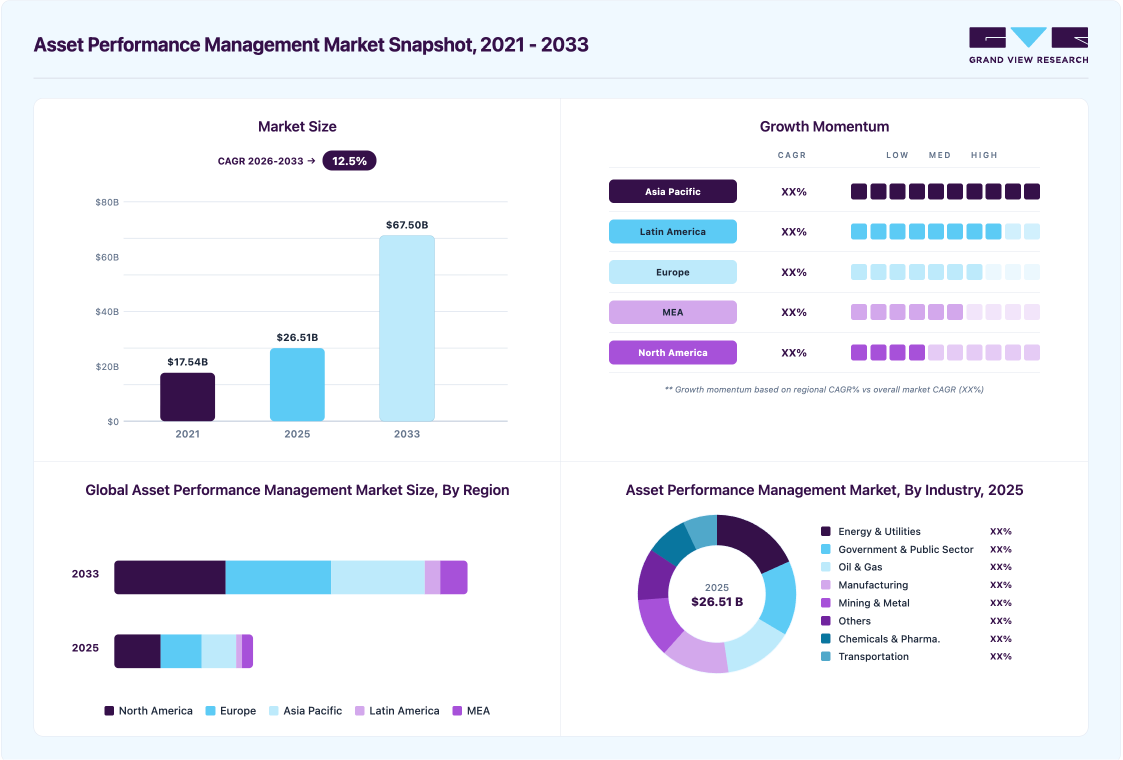
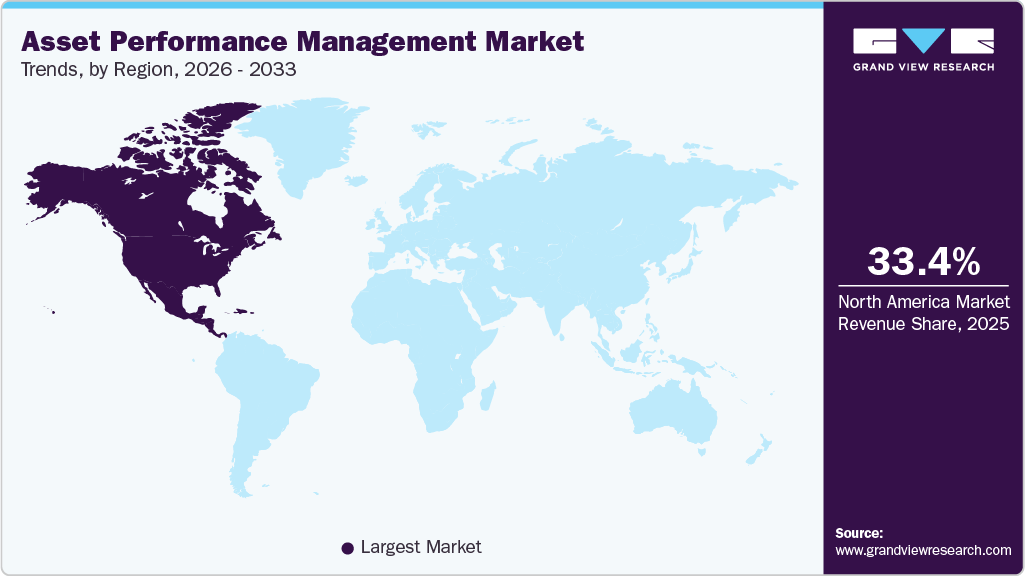
The global asset performance management market size was estimated at USD 26.5 billion in 2025 and is projected to grow from USD 29.7 billion in 2026 to USD 67.5 billion by 2033, growing at a CAGR of 12.5% from 2026 to 2033. North America dominated the market, accounting for the largest revenue share of 33.4% in 2025. The growing need for organizations to maximize asset reliability and extend lifecycles in capital-intensive industries is the major growth driver for the asset performance management market.
Key Market Trends & Insights
- By category: The asset reliability management segment held the largest market share of 32.5% in 2025.
- By deployment: The on-premises segment held the largest market share of 62.3% in 2025.
- By vertical: The energy & utilities segment held the largest market share of 18.2% in 2025.
Regional Highlights
- Largest regional market: North America (33.4% revenue share, 2025)
- Fastest-growing regional market: Asia Pacific (highest CAGR, 2026-2035)
Market Size & Forecast
- Market size in 2025: USD 26.5 Billion
- Estimated market size in 2026: USD 29.7 Billion
- Projected market size by 2033: USD 67.5 Billion
- CAGR (2026-2033): 12.5%
Additionally, asset performance management helps reduce unplanned downtime and, in turn, the overall costs associated with it. Advents of disruptive technologies are enhancing asset performance management (APM) capabilities. Technologies including artificial intelligence (AI), industrial internet of things (IIoT), machine learning (ML), and big data analytics are actively being incorporated to access, predict, and indicate asset conditions resulting in better management and reduce breakdown expenditures. Connected sensors and analytics platforms enable real-time asset monitoring, early fault detection, optimized maintenance scheduling, and shift from reactive to predictive maintenance strategies. According to Rockwell Automation's State of Smart Manufacturing Report 2025, organizations are increasingly planning to adopt AI and ML across areas such as cybersecurity, supply chain management, and quality control. The findings highlight the growing role of AI and ML in industrial operations and further support the adoption of data-driven technologies that can enhance asset monitoring, operational efficiency, and maintenance decision-making.
Growing investment in smart manufacturing and industrial automation is another key driver of the APM market. Industries are increasingly adopting Industry 4.0 technologies to improve production processes and process optimization. Features such as real-time monitoring, data-driven decision-making, and more automated operations help in providing asset-health monitoring, predictive analytics, and maintenance insights. This helps organizations to improve equipment reliability, minimize downtime, and optimize asset performance.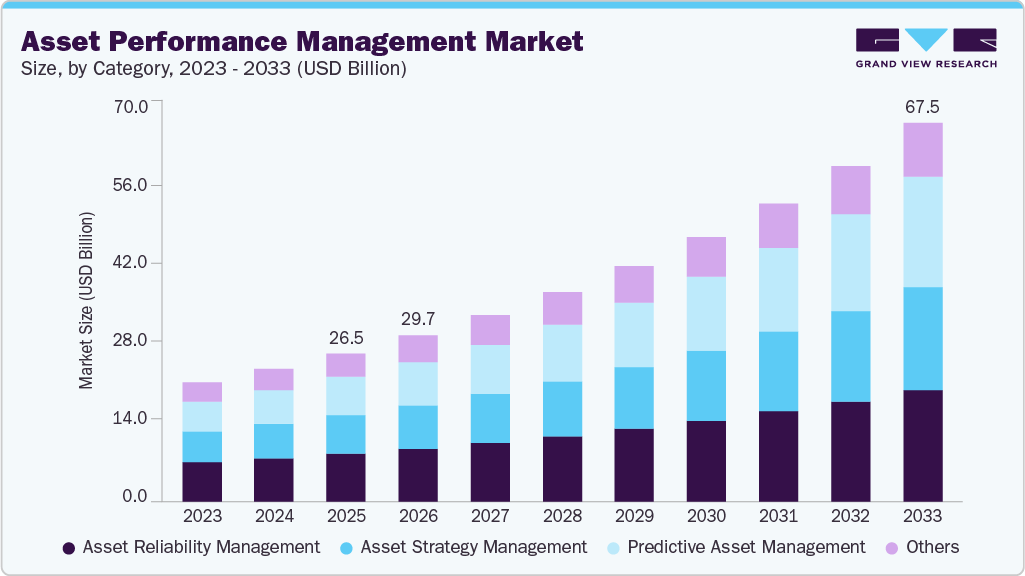 The APM market continues to evolve proportionally with technological advancements and the changing requirements of end-use industries. Companies are actively creating strategic partnerships with technology providers and industrial organizations to expand their capabilities and strengthen their offerings. For instance, in February 2025, Avathon partnered with Google Cloud to accelerate AI adoption across industrial applications, including manufacturing and energy. The collaboration is expected to expand Avathon's asset performance management, logistics, supply chain, and safety solutions through Google Cloud technologies and integration with its services.
Asset performance management is being actively used for aging infrastructures across utilities, energy, manufacturing, and transportation. APM is helping governments and organizations to ease the pressure to optimize capital and operating expenditures and extend asset lifecycles, improve safety, and enhance operational efficiency. APM are helping in managing dynamic regulatory and safety standards for industries such as oil and gas, aviation, and pharmaceuticals. Besides, APM adoption improves the documentation complexities, better trackability and ease in conducting audits.
Market Dynamics
The asset performance management (APM) market is being driven by the growing adoption of predictive maintenance as organizations transition from reactive and time-based maintenance toward data-driven asset management. APM solutions leveraging AI, machine learning, IoT, and advanced analytics enable early fault detection, reduce unplanned downtime, and improve asset reliability. However, high implementation costs, integration complexity, legacy system constraints, data-quality challenges, and shortages of specialized skills can limit adoption, particularly among smaller organizations. At the same time, the increasing integration of AI and digital twin technologies presents significant growth opportunities by enabling real-time asset monitoring, predictive maintenance, operational optimization, and data-driven decision-making. As industries accelerate digital transformation, Industry 4.0 adoption, and investments in connected infrastructure, demand for intelligent APM solutions is expected to increase.
The increasing adoption of predictive maintenance is driving demand for asset performance management (APM) solutions. Organizations are shifting from traditional maintenance approaches toward data-driven, condition-based approaches. APM platforms integrate real-time asset monitoring, disruptive technologies, and advanced analytics to identify early signs of equipment failure, optimize maintenance schedules, reduce unplanned downtime, and improve asset reliability. Adoption is particularly strong across energy & utilities, data centers, manufacturing, and other asset-driven industries where equipment availability, cost optimization, and operational continuity are critical.Companies are making significant investments to improve their offerings and ensure better asset management. For instance, Vertiv introduced Vertiv Next Predict, an AI-powered predictive maintenance service in January 2026. The platform will record and analyze asset behavior to identify potential risks to avoid possible downtime. The solution uses AI-based anomaly detection and predictive analytics to monitor cooling, power, and infrastructure in data centers. The growing deployment of such AI-enabled predictive maintenance solutions is expected to strengthen demand for APM platforms that support proactive asset monitoring and maintenance decision-making.High initial implementation costs and integration complexity are key restraints inhibiting the growth of asset performance management (APM) market. Appropriate platforms, analytics, hardware including real-time sensors, cloud or on-premises systems, and expert personnels are the primary requirements for the incorporation of any APM platform. Additionally, channelings and costs to integrate new APM in the legacy IT systems and exiting operational environments involves significant investments. Such investments discourage small and medium-sized enterprises and thus inhibit the growth of asset performance management market.Shortage of skilled professionals in the fields of data analytics, predictive maintenance, and industrial AI are another major restraining factors for the market. Absence of appropriate expertise can negatively affect the proper implementation and utilization of APM solutions.Challenges that can affect the accuracy of analytics and predictive insights arise without proper expertise. In addition, cybersecurity concerns and the potential operational disruption associated with integrating new systems into critical infrastructure can delay adoption, particularly across energy, manufacturing, and transportation industries.The growing adoption of artificial intelligence (AI) and digital twin technologies is creating significant growth opportunities for the asset performance management (APM) market. The integration of IoT sensors, cloud computing, machine learning, and automation is enabling the development of more connected and intelligent asset management ecosystems. These technologies provide organizations with real-time asset data and advanced analytics, supporting continuous asset monitoring, predictive maintenance, operational optimization, and data-driven decision-making.Organizations across manufacturing, energy, utilities, transportation, and infrastructure are increasingly adopting AI-powered analytics and digital twin platforms to improve asset reliability, reduce unplanned downtime, optimize maintenance activities, and extend asset lifecycles. For instance, in April 2026, the Greater Chennai Corporation announced the implementation of an AI-powered digital twin platform with asset management capabilities. This platform enables real-time infrastructure monitoring, predictive maintenance, and operational planning. Such developments highlight the adoption of advanced technologies to modernize existing infrastructures and improve asset management practices.Organizations are placing greater emphasis on digital transformation, Industry 4.0, and operational resilience. This is encouraging the integration of AI- and digital twin-enabled asset management solutions. This trend is anticipated to create further opportunities for APM providers offering advanced analytics, predictive capabilities, and intelligent asset optimization solutions.Market Concentration & Characteristics
The Asset Performance Management (APM) market is moderately concentrated, with a few leading global technology and industrial software providers holding a significant share of large enterprise deployments. Established players such as AVEVA, AspenTech, IBM, SAP, and GE Digital dominate the market due to their strong AI-driven analytics capabilities, digital twin integration, and deep penetration in asset-intensive industries such as manufacturing, energy, and utilities. Meanwhile, the market remains competitive and dynamic, as mid-sized vendors and niche players continue to innovate in predictive maintenance and cloud-based asset monitoring solutions.
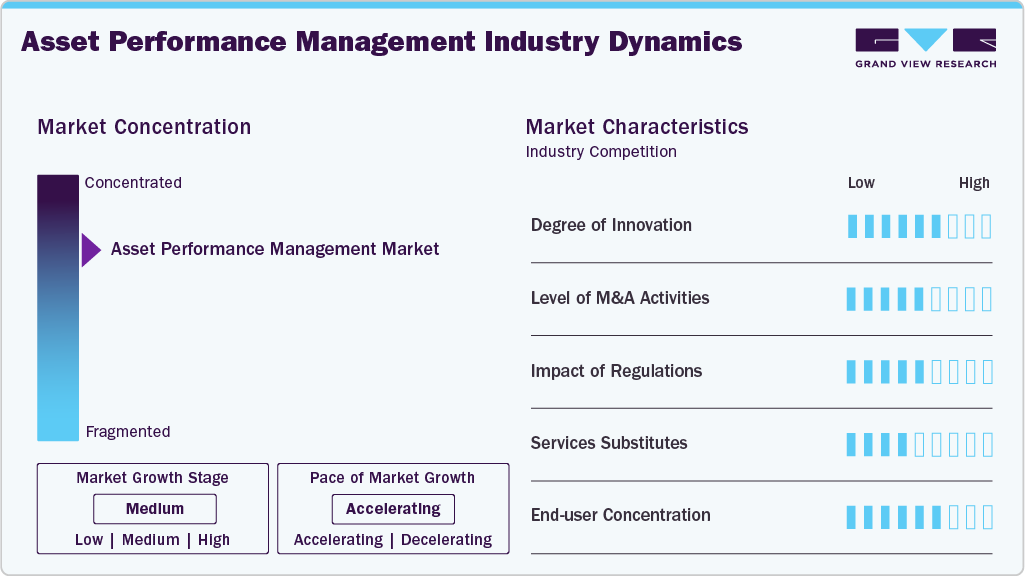
The market is highly innovation-driven, with a strong emphasis on AI, IoT-enabled monitoring, predictive and prescriptive analytics, and digital twin technologies to improve asset reliability. M&A activity is significant, as larger firms acquire specialized vendors to expand their technology capabilities and strengthen platform offerings. Regulatory compliance also plays an important role, especially in safety-critical industries such as oil & gas, power, and transportation, where data governance standards are strict. In addition, while integrated APM platforms are gaining traction, standalone IoT and ERP-based tools act as partial substitutes, influencing competitive dynamics. The market is further characterized by high-end-user concentration in capital-intensive sectors like energy, manufacturing, and utilities, where asset optimization and lifecycle management are mission-critical priorities.
Analyst Perspective
The asset performance management (APM) market is expected to maintain strong growth as industries accelerate digital transformation, smart manufacturing, and industrial automation initiatives. The integration of AI, IIoT, machine learning, and advanced analytics is enabling real-time asset monitoring, predictive maintenance, and data-driven decision-making, helping organizations improve reliability and reduce unplanned downtime. Aging infrastructure and increasing pressure to optimize capital and operating expenditures are further encouraging APM adoption across asset-intensive industries. Strategic partnerships between APM providers and technology companies are also expanding solution capabilities and accelerating deployment. In addition, growing regulatory and safety requirements are increasing the need for asset traceability, documentation, and audit readiness. As organizations prioritize operational resilience, asset lifecycle optimization, and efficiency, demand for intelligent APM solutions is expected to remain strong.
Category Insights
The asset reliability management segment accounted for the largest revenue share of 32.5% in 2025, supported by the increasing focus of asset-driven industries on improving equipment reliability, minimizing unexpected downtime, and extending asset lifecycles. Organizations across oil and gas, power generation, mining, manufacturing, utilities, and transportation rely on asset reliability management to monitor equipment condition, identify potential failure risks, optimize maintenance activities, and improve overall asset availability. Equipment failures in these industries can result in substantial production losses, higher maintenance costs, safety hazards, resulting in operational disruptions, and making reliability optimization a strategic priority. The growing deployment of condition-monitoring technologies, connected sensors, asset health analytics, and computerized maintenance systems is further enhancing reliability management capabilities and supporting segment growth.
The predictive asset management segment is projected to register the fastest growth, at a CAGR of 14.3% during the forecast period. Increasing pressure to reduce downtime, optimize asset utilization, and control maintenance expenditure is encouraging organizations to move beyond reactive and scheduled maintenance toward predictive, data-driven approaches. Predictive asset management combines real-time asset monitoring, IoT-generated data, artificial intelligence (AI), machine learning (ML), and advanced analytics to identify early indicators of equipment failure and determine the optimal timing for maintenance interventions. This approach is particularly valuable for industries to prevent unexpected failures of critical infrastructure leading to significant financial, safety, and productivity losses.
In addition, supply chain disruptions, longer procurement lead times, and rising costs of critical spare parts are encouraging organizations to use predictive insights to improve maintenance planning and inventory management. By forecasting equipment failures and maintenance requirements, predictive asset management can help organizations maintain appropriate spare-parts inventories, reduce unnecessary maintenance, and schedule repairs during planned downtime. As businesses increasingly prioritize operational resilience, asset utilization, and lifecycle cost optimization, the adoption of predictive asset management solutions is expected to accelerate throughout the forecast period.
Deployment Insights
The on-premises segment accounted for the largest revenue share of 62.3% in 2025, driven by the need for control over sensitive operational data, cybersecurity, and regulatory compliance. On-premises APM platforms enable organizations to maintain direct control over data storage, access permissions, audit trails, and cybersecurity protocols. Asset-intensive industries such as oil and gas, utilities, mining, chemicals, and defense often handle operational data and asset telemetry that are subject to stringent security and data-governance requirements. Control over the data and operation is significant for such organizations. Besides, complying with national regulations and internal industrial security policies restricts the adoption of cloud deployment across various public and private infrastructures.
The hosted segment is projected to register the fastest growth, at a CAGR of 14.4% during the forecast period, as organizations increasingly adopt cloud-based APM solutions and software-as-a-service (SaaS) delivery models. Hosted platforms offer greater scalability, faster deployment, lower upfront infrastructure requirements, and easier access to software updates compared with traditional on-premises systems. Growing internet connectivity, increasing availability of cost-effective cloud storage and computing resources, and rising demand for flexible and user-friendly enterprise software are further supporting adoption. In addition, cloud-based APM enables organizations to consolidate asset data across geographically distributed facilities and provide remote access to asset performance insights. This will make it increasingly attractive to enterprises seeking better operational visibility and reduce IT infrastructure requirements.
Vertical Insights
The energy and utilities segment accounted for the largest revenue share of 18.2% in 2025, driven by the sector’s extensive reliance on complex and high-value assets. Power generation facilities, transmission and distribution networks, pipelines, refineries, and renewable energy installations require continuous monitoring and maintenance to ensure reliability, safety, and uninterrupted service. APM solutions help organizations to monitor asset health, identify potential failures, optimize maintenance activities, and extend equipment lifecycles. The increasing integration of IoT sensors, AI-powered analytics, and predictive maintenance technologies is further strengthening asset visibility and operational efficiency across the sector. In addition, the transition toward renewable energy and modernization of aging power infrastructure are increasing the need for advanced asset management capabilities.
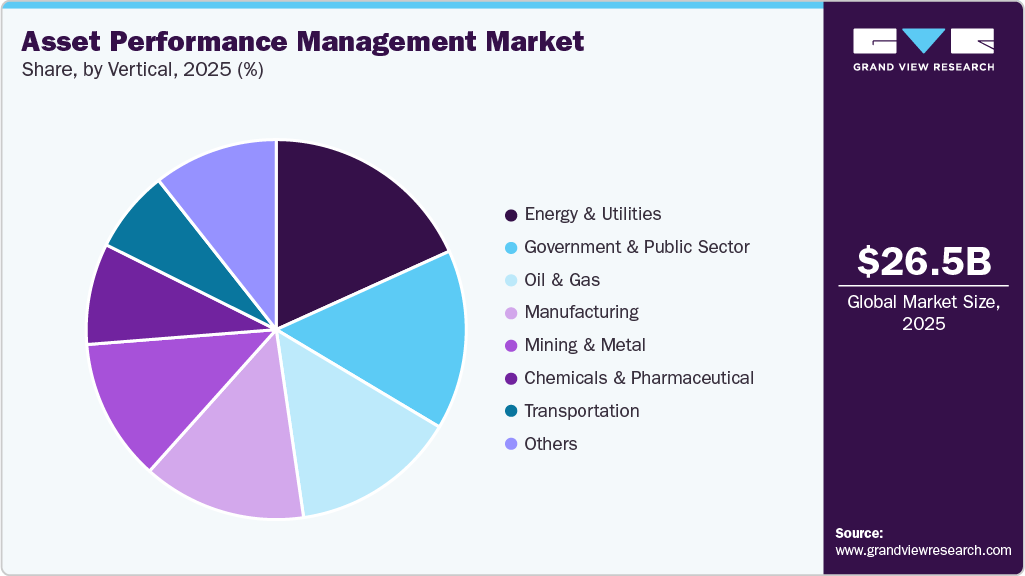
The government and public sector segment is projected to register the fastest growth during the forecast period, supported by increasing efforts to modernize aging public infrastructure and improve the reliability of essential services. Government agencies are increasingly deploying APM solutions across water and wastewater networks, power infrastructure, transportation systems, public buildings, and municipal assets to improve maintenance planning and asset utilization. Data-driven monitoring enables agencies to identify deterioration at an early stage, prioritize maintenance based on asset condition, and allocate limited budgets more effectively. Growing investments in smart cities, digital infrastructure, and public-sector modernization are further creating opportunities for APM adoption. As governments face increasing pressure to maintain critical infrastructure, improve service continuity, and optimize long-term asset expenditure, demand for APM solutions is expected to accelerate.
Regional Insights
North America asset performance management market dominated the global market, accounting for the largest revenue share of 33.4% in 2025. The region’s leadership is supported by the high penetration of industrial automation, cloud computing, Internet of Things (IoT), artificial intelligence (AI), and advanced analytics across asset-intensive industries. Organizations in oil and gas, power and utilities, manufacturing, transportation, and other industrial sectors are increasingly investing in APM solutions to improve asset reliability, reduce unplanned downtime, and optimize maintenance costs. The need to modernize aging infrastructure is further encouraging adoption of APM to improve asset utilization and extend equipment lifecycles without undertaking extensive capital replacement. In addition, stringent safety, environmental, and operational requirements are increasing demand for continuous asset monitoring, condition-based maintenance, and data-driven asset management.
U.S. Asset Performance Management Market Trends
The asset performance management market in the U.S. accounted for the largest market revenue share of 77.7% in North America in 2025. Strong adoption in the country is supported by modernization initiatives undertaken across the country’s power grid, transportation infrastructure, manufacturing facilities, and energy assets. U.S. utilities are increasingly using digital monitoring, predictive analytics, and asset health management to manage aging transmission and distribution infrastructure while improving grid reliability. For example, utilities such as Duke Energy and Pacific Gas & Electric have invested in grid modernization and digital technologies to improve asset monitoring, resilience, and operational performance. The transportation sector is also creating opportunities for APM providers as public agencies and infrastructure operators seek to improve the condition and reliability of roads, bridges, rail systems, and transit assets. The U.S. Department of Energy has also promoted predictive maintenance and advanced digital technologies as part of broader efforts to improve industrial energy efficiency and asset performance
Europe Asset Performance Management Market Trends
The asset performance management market in Europe is expected to register a considerable CAGR of 12.6% from 2026 to 2033, supported by the region’s strong focus on industrial digitalization, energy efficiency, sustainability, and infrastructure modernization. European industries are facing increasing pressure to improve asset productivity while reducing energy consumption, emissions, maintenance costs, and operational disruptions. APM solutions enable organizations to monitor asset health, implement predictive maintenance, optimize equipment performance, and extend asset lifecycles, helping them improve operational efficiency while meeting increasingly stringent environmental and safety requirements. The region’s adoption of Industry 4.0 technologies, including IoT, AI, digital twins, and advanced analytics, is further creating a favorable environment for APM deployment across manufacturing, energy, utilities, transportation, and other asset-intensive industries.
UK Asset Performance Management Market Trends
The UK asset performance management market is expected to expand at a significant CAGR of 11.7% during the forecast period, driven by continued investment in utilities, railways, energy infrastructure, and public assets. Aging infrastructure and increasing expectations for service reliability are encouraging operators to shift from reactive maintenance toward condition-based and predictive approaches. For example, NETWORK RAIL has been investing in digital technologies, remote monitoring, and predictive maintenance capabilities to improve the reliability and availability of railway infrastructure. Similarly, the UK water and energy utilities are increasingly deploying smart monitoring and asset-management technologies to improve infrastructure resilience and manage aging networks.
Germany Asset Performance Management Market Trends
Germany accounted for the largest share of 30.1% of the European APM market in 2025, supported by its large manufacturing base and strong adoption of Industry 4.0 technologies. German manufacturers increasingly use connected sensors, industrial IoT, digital twins, AI, and predictive analytics to monitor equipment condition and optimize highly automated production environments. The country’s automotive, machinery, chemicals, and industrial manufacturing sectors have a particularly strong need to minimize downtime and maintain high levels of production efficiency. In addition, the need to improve energy efficiency and optimize the performance of energy-intensive industrial assets is encouraging further investment in APM technologies.
Asia Pacific Asset Performance Management Market Trends
The asset performance management market in the Asia Pacific is expected to grow with the fastest CAGR of 13.4% during the forecast period, supported by rapid industrialization, urbanization, infrastructure development, and accelerating digital transformation across the region. Countries including China, India, Japan, South Korea, Australia, and ASEAN economies are increasing investments in smart manufacturing, industrial automation, energy infrastructure, and connected asset management. The growing deployment of industrial Internet of Things (IIoT), artificial intelligence (AI), cloud computing, and advanced analytics is enabling organizations to monitor asset conditions in real time, improve maintenance planning, reduce equipment downtime, and optimize asset lifecycles.
Japan Asset Performance Management Market Trends
Japan is expected to register strong growth of 13.7% during the forecast period, driven by the need to manage aging industrial equipment and infrastructure within a highly advanced manufacturing ecosystem. A declining workforce and rising labor costs are encouraging companies to increase automation and adopt predictive maintenance technologies to maintain operational continuity with fewer personnel. Japanese manufacturers also place strong emphasis on production precision, equipment reliability, and quality control, supporting the adoption of condition-monitoring systems, digital twins, AI-powered analytics, and reliability management solutions.
China Asset Performance Management Market Trends
China accounted for the largest share of the Asia Pacific APM market, at approximately 26.4% in 2025, supported by extensive industrial modernization, smart manufacturing initiatives, and investments in energy and infrastructure. The country’s large manufacturing base, combined with the development of smart factories and connected industrial facilities, provides a substantial addressable market for APM solutions. Chinese manufacturers and infrastructure operators are increasingly deploying IoT sensors, AI-enabled analytics, cloud platforms, and digital technologies to monitor asset health and transition from reactive maintenance toward predictive and condition-based approaches. Government-led initiatives promoting industrial digitalization and smart manufacturing are further supporting technology adoption.
Key Asset Performance Management Companies & Market Share Insights
Key players operating in the asset performance management industry are ABB, IBM Corporation, AVEVA Group Limited, Bentley Systems, Incorporated, Rockwell Automation, and Siemens Energy. Companies are focusing on various strategic initiatives, including new product development, partnerships & collaborations, and agreements to gain a competitive advantage over their rivals.
Key Asset Performance Management Companies:
The following key companies have been profiled for this study on the asset performance management market.
-
Det Norske Veritas (DNV)
-
SAP SE
-
SAS Institute, Inc.
Competitive Benchmarking
Operating Strategies
Operating Strategies
Operating Strategies
Mature Players: ABB; GE Vernova; Siemens Energy; IBM Corporation; SAP SE; Rockwell Automation; AVEVA Group Limited
- Integrating APM with OT and ERP systems to enable seamless end-to-end data connectivity.
- Tailoring APM solutions to asset-intensive industries such as power generation and process manufacturing.
- Acquiring AI and sensor technology firms to accelerate the transition from legacy systems to cloud-native APM platforms.
- Leveraging historical asset data and extensive hardware footprints to drive software upselling.
- Strong expertise in managing high-consequence assets where downtime creates significant financial or safety risks.
- Establishing industry benchmarks for asset data collection, storage, and integration across enterprise networks.
- Complex, multi-module platforms can require lengthy implementation and specialized resources.
- Legacy codebases may lag behind cloud-native competitors in speed, flexibility, and user experience.
- Complex organizational structures can slow the adoption of disruptive technologies such as GenAI-powered maintenance assistants.
Emerging Players: Aspen Technology Inc.; Bentley Systems; DNV; SAS Institute, Inc.
- Using reliability 3D modeling and simulation to predict asset behavior under varying operating conditions.
- Deploying advanced machine learning models to improve failure prediction accuracy.
- Prioritizing cloud-based, API-first architectures for faster deployment and seamless third-party integration.
- Combining physics-based modeling and advanced data science to deliver prescriptive insights.
- Using agile development cycles to rapidly integrate AI capabilities such as automated cause analysis.
- Leveraging deep industry expertise that generalist providers may struggle to replicate.
- Relying on third-party integrations to access data from monitored assets.
- Limited global field service and support capabilities compared to established players.
- Perceived as point solution providers, making it harder to compete for enterprise-wide contracts.
Recent Developments
-
In December 2025, IBM Corporation launched Maximo Condition Insight, an AI-powered upgrade to the Maximo Application Suite that delivers fast, explainable insights to support condition-based maintenance. The upgrade enables asset-intensive industries to shift from reactive to prescriptive maintenance, by providing real-time view of asset performance, reliability, and risk.
-
In April 2025, AVEVA Solutions Limited partnered with ServiceNow to integrate AVEVA’s CONNECT industrial intelligence platform with ServiceNow’s AI-powered Operational Technology Management solutions. The collaboration aims to connect industrial data and workflows, enabling AI-driven automation and analytics to improve operational efficiency, reduce unplanned downtime, and optimize production processes.
-
In April 2025, Bentley Systems enhanced its Blyncsy platform with asset analytics capabilities using Google Maps Platform’s Imagery Insights. The AI-powered solution combines crowdsourced imagery, Google Street View, and Vertex AI to automate roadway inspections, helping transportation agencies and engineering firms monitor infrastructure conditions and support maintenance and disaster recovery.
Asset Performance Management Market Report Scope
Report Attribute
Details
Market size in 2025
USD 26.5 billion
Estimated market size in 2026
USD 29.7 billion
Projected market size by 2033
USD 67.5 billion
Growth Rate
CAGR of 12.5% from 2026 to 2033
Base year for estimation
2025
Historical data
2021 - 2024
Forecast period
2026 - 2033
Quantitative units
Revenue in USD million/billion, and CAGR from 2026 to 2033
Report coverage
Revenue forecast, company ranking, competitive landscape, growth factors, and trends
Segments covered
Category, deployment, vertical, and region
Regional Scope
North America, Europe, Asia Pacific, Latin America, Middle East & Africa
Country Scope
U.S.; Canada; Mexico; UK; Germany; France; China; India; Japan; Australia; South Korea; Brazil; UAE; Kingdom of Saudi Arabia; South Africa
Key companies profiled
ABB; Aspen Technology Inc.; AVEVA Group Limited; Bentley Systems; Incorporated; DNV; GE Vernova; IBM Corporation; Rockwell Automation; SAP SE; SAS Institute, Inc.; Siemens Energy
Customization scope
Free report customization (equivalent to up to 8 analysts working days) with purchase. Addition or alteration to country, regional & segment scope.
Pricing and purchase options
Avail of customized purchase options to meet your exact research needs. Explore purchase options
Global Asset Performance Management Market Report Segmentation
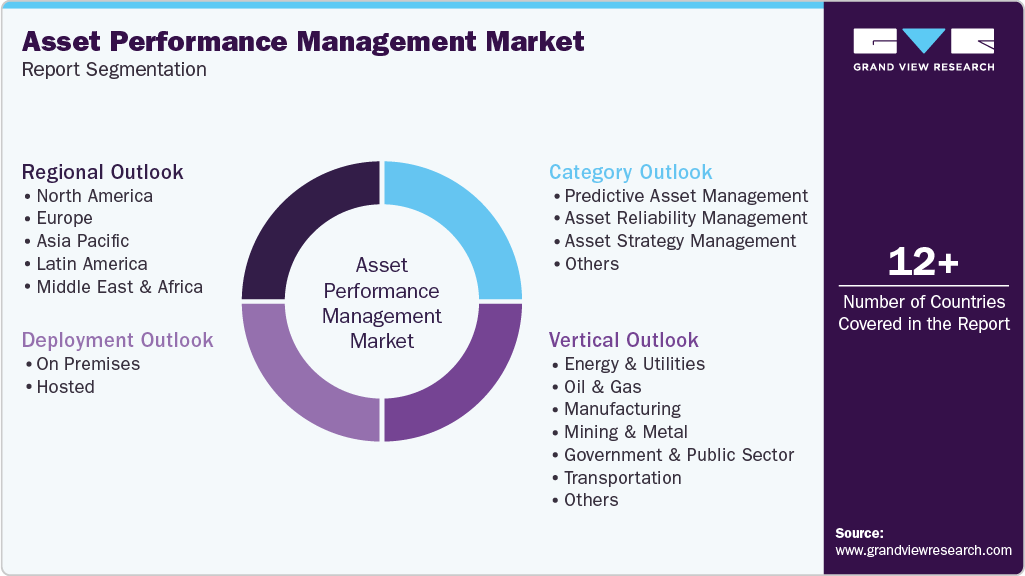
This report forecasts revenue growth at the global, regional, and country levels and provides an analysis of the latest industry trends in each of the sub-segments from 2021 to 2033. For this study, Grand View Research has segmented the global asset performance management market report based on category, deployment, vertical, and region:
-
Category Outlook (Revenue, USD Billion, 2021 - 2033)
-
Predictive Asset Management
-
Asset Reliability Management
-
Asset Strategy Management
-
Others
-
-
Deployment Outlook (Revenue, USD Billion, 2021 - 2033)
-
On Premises
-
Hosted
-
Public Cloud
-
Private Cloud
-
-
-
Vertical Outlook (Revenue, USD Billion, 2021 - 2033)
-
Energy & Utilities
-
Oil & Gas
-
Manufacturing
-
Mining & Metal
-
Government & Public Sector
-
Transportation
-
Chemicals & Pharmaceutical
-
Others
-
-
Regional Outlook (Revenue, USD Billion, 2021 - 2033)
-
North America
-
U.S.
-
Canada
-
Mexico
-
-
Europe
-
UK
-
Germany
-
France
-
-
Asia Pacific
-
China
-
India
-
Japan
-
South Korea
-
Australia
-
-
Latin America
-
Brazil
-
-
Middle East & Africa
-
UAE
-
Saudi Arabia
-
South Africa
-
-
Delivered Customizations
This report has been delivered with the following In-depth customizations
Client Request
Client Request
Client Request
Asset performance management pricing and licensing model assessment for an industrial software provider
Analysis of subscription-based, perpetual, and usage-based pricing models across leading APM vendors
Evaluation of pricing trends by deployment type and enterprise size
Supported competitive pricing strategy development
Identified customer preferences and cost optimization opportunities
Predictive maintenance adoption benchmarking for a manufacturing technology company
Comparative analysis of predictive maintenance adoption across automotive, aerospace, and heavy equipment industries
Assessment of AI and IoT integration levels in maintenance operations
Identified high-adoption industry segments
Supported investment prioritization for predictive analytics solutions
Asset reliability and downtime reduction strategy analysis for an energy sector client
Assessment of asset failure trends and maintenance optimization practices in utilities and power plants
Evaluation of reliability-centered maintenance (RCM) implementation trends
Identified operational efficiency improvement areas
Supported strategies for minimizing unplanned downtime and maintenance costs
Frequently Asked Questions About This Report
The global asset performance management market is expected to grow at a CAGR of 12.5% from 2026 to 2033, reaching USD 67.5 billion by 2033.
North America dominated with a 33.4% revenue share in 2025.
Some of the key players operating in asset performance management include ABB, Aspen Technology Inc., AVEVA Group Limited, Bentley Systems, Incorporated, DNV, GE Vernova, IBM Corporation, Rockwell Automation, SAP SE, SAS Institute, Inc., Siemens Energy
The emergence of the fourth industrial revolution (Industry 4.0) has encouraged the adoption of Internet of Things (IoT) technologies, such as industrial sensors, across several industry verticals. The growing adoption of industrial sensors has enabled the rapid deployment of APM solutions.
The global asset performance management market size was valued at USD 26.5 billion in 2025 and is estimated at USD 29.7 billion for 2026.
The asset reliability management segment led with a 32.5% revenue share in 2025, while the predictive asset management segment is the fastest-growing.
The on-premises segment held the largest revenue share in 2025, while the hosted segment is the fastest-growing.
The energy & utilities segment held the largest revenue share in 2025, while the government & public sector segment is the fastest-growing.
About the Author(s)
Next Generation Technologies Research Team
Technology · Next Generation TechnologiesThis report was authored by the next generation technologies research team at Grand View Research - comprising two research analysts, one senior research analyst, and one industry expert - with specialized expertise in the next generation technologies segment of the technology industry. All findings are based on proprietary technology databases, executive interviews, and regulatory analysis, subject to internal peer review prior to publication.
Last Updated:
Speak to Analyst


Customize this report to your needs — add regions, segments, or data points, with 20% free customization.
Or view our licence options:


ISO 9001:2015 & 27001:2022 Certified
We are GDPR and CCPA compliant! Your transaction & personal information is safe and secure. For more details, please read our privacy policy.


