
- Home
- »
- Next Generation Technologies
- »
-
Asset Tracking Market Size And Share Report, 2026-2033GVR Report cover

Asset Tracking Market (2026 - 2033)
Size, Share, & Trends Analysis Report By Component (Hardware, Software, Services), By Technology (RFID, M2M/IoT, GPS), By Deployment, By Enterprise Size, By End Use, By Region, And Segment Forecasts
Market Size, 2025
$25.8BMarket Estimate, 2026
$28.1BMarket Forecast, 2033
$84.8BCAGR, 2026–2033
17.1%Asset Tracking Market Summary
The global asset tracking market size was valued at USD 25.8 billion in 2025 and is projected to grow from USD 28.1 billion in 2026 to USD 84.8 billion in 2033, at a CAGR of 17.1% from 2026 to 2033. North America dominated the market, accounting for a revenue share of 35.0% in 2025. The global market is driven by the surge in demand for supply chain digitization and operational efficiency. The increasing adoption of IoT, RFID, GPS, and cloud-based tracking solutions is enabling businesses to improve asset visibility and reduce losses.
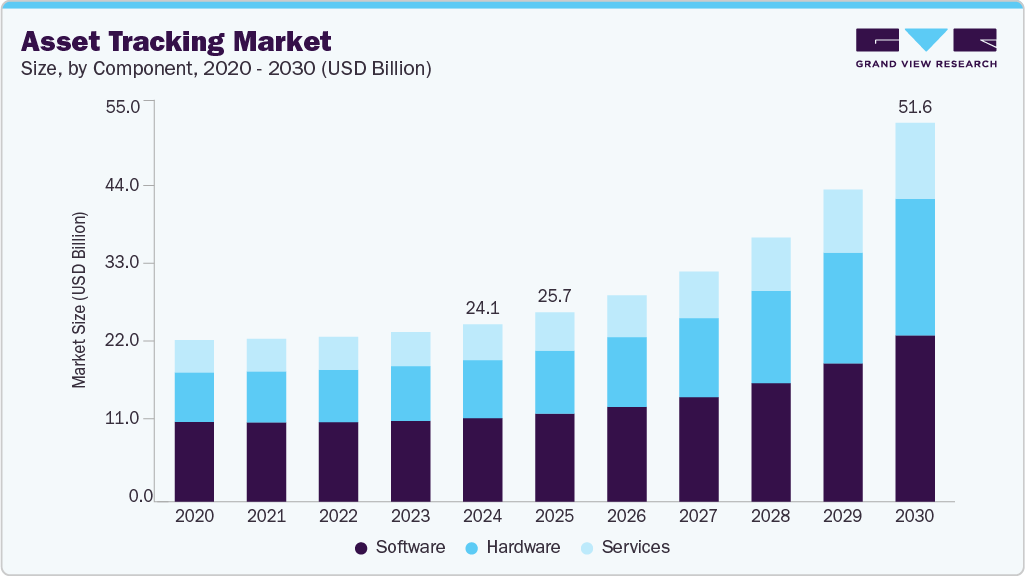 Source: Grand View Research, IR Documents, Primary Interviews, Paid DatabasesTo learn more about this report,
 Download Free Sample Report
 Key Market Trends & Insights
- By component: Software segment dominated the market and accounted for a revenue share of over 45.0% in 2025.
- By technology: RFID (radio-frequency identification) segment dominated the market and accounted for a revenue share of over 30.0% in 2025.
- By deployment: Cloud segment dominated the market and accounted for a revenue share of around 65.0% in 2025.
- By enterprise size: Large enterprises segment held the largest market share of over 65.0% in 2025.
- By end-use: The transportation & logistics segment held the largest market share of around 30.0% in 2025.
Regional Highlights
- Largest regional market: North America (35.0% revenue share, 2025)
- Fastest-growing regional market: Asia Pacific (highest CAGR, 2026-2033)
Market Size & Forecast
- Market size in 2025: USD 25.8 Billion
- Estimated market size in 2026: USD 28.1 Billion
- Projected market size by 2033: USD 84.8 Billion
- CAGR (2026-2033): 17.1%
Three ways to get this report
Buy it, customize it, or ask a question.Ask an Analyst
Analyst response in 1 business day
- AccessReport author, directly
- Reply timeWithin 1 working day
- No sales callDirect answer only
- FormatEmail reply
- CostFree, no cost
Get the Full Report
What the study covers
- FormatsPDF · Excel · Dashboard
- Timeline2026–2033 annual, 2025 base
- Coverage20+ countries, 5 regions
- Companies10+ key players profiled
Customize the Report
20% free customization
- IncludeCountries, segments, points
- TailorTo your product definition
- ExtendDeeper competitor detail
- OrA fully bespoke study
- Turnaround5–10 working days
In addition, growing investments in real-time monitoring, automation, and connected logistics are expected to support market growth across industries. Businesses across industries are adopting IoT-enabled tracking solutions to monitor assets in real-time, reducing losses and optimizing logistics. The rise of e-commerce and omnichannel retail has intensified the need for end-to-end visibility, with companies deploying RFID, GPS, and Bluetooth Low Energy (BLE) tags to track shipments from warehouses to last-mile delivery. The post-pandemic emphasis on resilient supply chains further accelerates adoption, as firms prioritize inventory accuracy and asset utilization analytics to mitigate disruptions.The advancement of wireless connectivity technologies, particularly 5G and LPWAN (Low-Power Wide-Area Network), also contributes to the growth of the asset tracking industry. These networks enable seamless, low-latency tracking of high-value assets, such as construction equipment, medical devices, and manufacturing tools, across large geographic areas. The integration of AI and predictive analytics into tracking platforms allows businesses to anticipate maintenance needs and prevent theft or misplacement, enhancing asset lifecycle management. In addition, regulatory compliance requirements in sectors such as pharmaceuticals (DSCSA), aviation (FAA), and automotive (ELD mandates) are pushing organizations to implement audit-ready tracking systems.
The industrial IoT (IIoT) revolution is also fueling growth, with smart factories and warehouses leveraging ultra-wideband (UWB) and sensor fusion technologies for indoor precision tracking. These systems provide centimeter-level accuracy, critical for automated guided vehicles (AGVs), robotic systems, and tool tracking in high-stakes environments. Moreover, sustainability initiatives are prompting firms to adopt asset tracking for circular economy practices, such as monitoring reusable packaging and reducing equipment idle time.
Analyst Perspective
The global asset tracking market is expected to grow robustly, driven by the increasing need for real-time asset visibility, improved inventory management, and enhanced operational efficiency across industries such as manufacturing, logistics, healthcare, retail, and transportation. The rapid adoption of Internet of Things (IoT), RFID, GPS, Bluetooth Low Energy (BLE), and cloud-based tracking platforms is accelerating market expansion by enabling accurate location monitoring and data-driven asset management. Growing supply chain digitization, rising predictive maintenance demand, and increasing investments in smart warehouse and logistics infrastructure represent emerging market opportunities. However, high deployment costs, cybersecurity concerns, and integration challenges with existing enterprise systems may hinder market growth.
Component Insights
The software segment dominated the market, accounting for around 45.0% of revenue in 2025, driven by the growing need for advanced analytics, real-time visibility, and seamless integration across supply chains. Businesses are shifting from standalone tracking solutions to cloud-based platforms that offer end-to-end asset lifecycle management, enabling predictive maintenance, geofencing, and automated alerts. The rise of AI-powered analytics enables companies to optimize asset utilization, reduce downtime, and improve decision-making, positioning software as a key differentiator for operational efficiency.
The hardware segment is anticipated to grow at the fastest CAGR during the forecast period, driven by the need for improved asset utilization and theft prevention, which is fueling investments in tracking devices. In sectors such as transportation and construction, where assets are highly mobile and valuable, deploying durable and tamper-proof tracking hardware helps organizations maintain control and accountability over their equipment. Moreover, as hardware costs continue to decline due to advancements in semiconductor and sensor technologies, more businesses, including SMEs, can afford to implement these solutions.
Technology Insights
The RFID (radio-frequency identification) segment dominated the market, accounting for over 30.0% of revenue in 2025, driven by declining costs of RFID tags and infrastructure, making the technology accessible to SMEs and large enterprises alike. Advances in chipless RFID and printed antenna designs have reduced tag prices, while cloud-based RFID software eliminates the need for expensive on-premises servers. In addition, regulatory mandates such as the FDA’s UDI (Unique Device Identification) system for medical devices and retailers’ RFID tagging requirements are compelling suppliers to adopt RFID to ensure compliance and enhance supply chain transparency.
The M2M/IoT segment is expected to grow at a significant CAGR over the forecast period. The proliferation of low-power, high-efficiency IoT sensors-such as GPS, BLE, and LoRaWAN-enabled devices-has unlocked unprecedented visibility into asset location, condition, and utilization. Industries such as logistics, agriculture, and energy are leveraging cellular IoT (4G/5G/NB-IoT) for end-to-end tracking of high-value cargo, heavy machinery, and perishable goods, thereby reducing losses and optimizing operational workflows. As reported in IoT Analytics' 2024 Summer edition of the State of IoT (171 pages), the number of active IoT-connected devices reached 16.6 billion by the end of 2024, marking a 15% year-over-year increase. Projections suggest this figure is expected to reach 40 billion by 2033.
Deployment Insights
The cloud segment dominated the market, accounting for around 65.0% of revenue in 2025, driven by the integration of advanced technologies such as AI, machine learning, and IoT with cloud platforms. Predictive analytics powered by cloud computing enables businesses to forecast maintenance needs, detect anomalies, and optimize asset routes in real time. The ability to process vast amounts of tracking data in the cloud without latency supports automated alerts, geofencing, and compliance reporting, thereby enhancing operational efficiency.
The on-premises segment is expected to grow at a significant CAGR over the forecast period, owing to organizations that prioritize data security, control, and regulatory compliance. Industries such as healthcare, government, defense, and manufacturing often handle sensitive data or operate in strict regulatory environments, making on-premises deployment a preferred choice. These organizations benefit from retaining full control over their infrastructure, ensuring that sensitive asset information remains within internal networks and is not exposed to external cloud-based risks.
Enterprise Size Insights
The large enterprises segment dominated the market, accounting for over 65.0% of revenue in 2025, driven by the scale and complexity of operations that demand robust, real-time visibility across assets, equipment, and inventory. Large organizations, spanning industries such as manufacturing, logistics, energy, aviation, and healthcare, manage physical assets distributed across multiple locations.
The SMEs segment is expected to grow at a significant CAGR during the forecast period, as the increasing adoption of digital transformation among SMEs is driving the uptake of asset-tracking technologies. As SMEs modernize their operations to compete in increasingly digital marketplaces, they are adopting IoT-enabled tools that provide data insights and automation capabilities. Asset tracking is often among the first investments in this transformation, offering tangible returns in operational transparency, customer service, and decision-making.
End Use Insights
The transportation & logistics segment dominated the market, accounting for over 30.0% of revenue in 2025, driven by rising demand for fleet optimization and predictive maintenance. For transportation companies, managing large fleets of trucks, vessels, or cargo equipment is resource-intensive and prone to inefficiencies if assets are not properly maintained. Asset tracking systems allow monitoring of vehicle health, usage patterns, and fuel consumption, enabling timely maintenance, reducing downtime, and extending asset lifespans.
The retail & e-commerce segment is expected to grow at a significant CAGR over the forecast period due to the surge in online shopping and demand for fast, accurate deliveries. As consumers expect faster delivery times and real-time updates on their purchases, retailers and e-commerce businesses are under pressure to optimize last-mile logistics and ensure accurate inventory tracking across the supply chain. Asset tracking systems, which include GPS, RFID, and barcode scanning technologies, help retailers track products from the warehouse to the final destination, enabling seamless order fulfillment and reducing delays.
Regional Insights
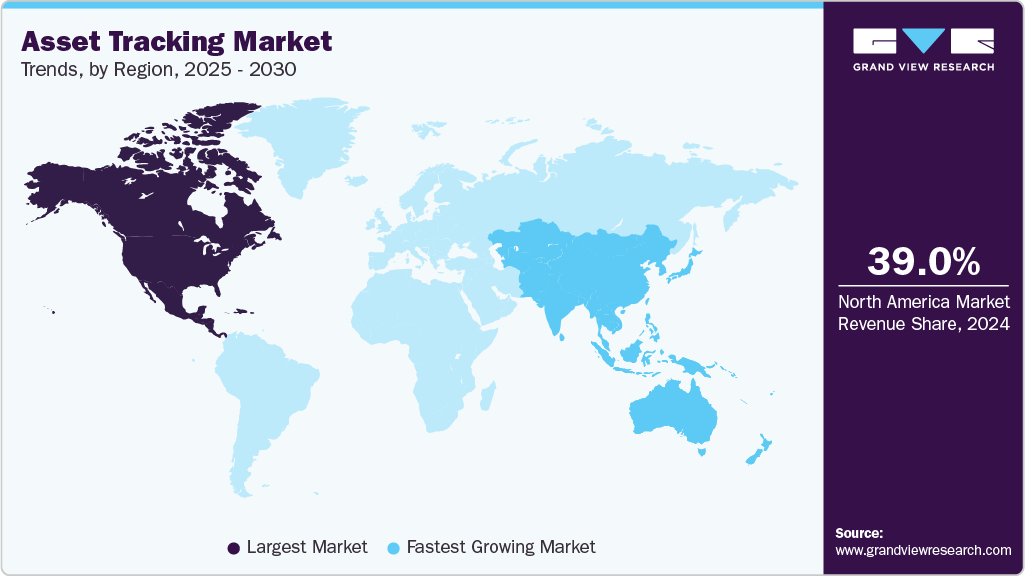
The asset tracking industry in North America dominated the global market, accounting for around 35.0% of revenue in 2025, driven by the region's strong focus on technological innovation and adoption, particularly in industries such as manufacturing, logistics, and retail. The increasing need for real-time asset visibility, improved supply chain efficiency, and operational cost reduction is fueling the demand for asset tracking solutions.
 To learn more about this report, Download Free Sample Report
 U.S. Asset Tracking Market Trends
The asset tracking industry in the U.S. is expected to grow significantly at the fastest CAGR from 2026 to 2033, driven by rapid advancements in IoT, cloud computing, and AI. These innovations allow businesses to manage vast numbers of assets more efficiently, improving operational visibility, inventory accuracy, and asset utilization. The expanding e-commerce sector, which requires optimized supply chains and last-mile delivery solutions, is a major catalyst for adoption.
Asia Pacific Asset Tracking Market Trends
The asset tracking industry in Asia Pacific is projected to emerge as the fastest-growing market, with a significant CAGR from 2026 to 2033, driven by a booming e-commerce industry, rising demand for supply chain optimization, and rapid industrialization. Countries such as India, China, and Southeast Asian nations are seeing a surge in logistics and transportation activity, which is driving demand for real-time tracking solutions.
The Japan’s asset-tracking industry is expected to grow rapidly in the coming years, driven by the country’s technological advancements and a strong focus on automation and efficiency. Japan’s robust manufacturing sector, particularly in the electronics and automotive industries, relies heavily on asset tracking to manage production lines, inventory, and logistics.
The asset tracking industry in China held a substantial share in 2025 due to the country's large-scale manufacturing and logistics industries. As the exporter, China’s supply chains demand greater efficiency and transparency, leading to the widespread adoption of asset tracking technologies. The government’s focus on Made in China 2025 and its push for digital transformation in manufacturing and logistics are key drivers.
Key Asset Tracking Company Insights:
The asset tracking industry is characterized by global, regional, and niche solution providers competing through technological innovation, strategic partnerships, acquisitions, and product portfolio expansion.
Key Asset Tracking Companies:
The following key companies have been profiled for this study on the asset tracking market:
-
Actsoft.com
-
ASAP Systems
-
Asset Panda
-
AT&T Inc.
-
Fleet Complete
-
GigaTrak (P&T Solutions Inc.)
-
OnAsset Intelligence Inc.
-
Qualcomm Technologies Inc.
-
Samsara Inc.
-
Spireon Inc.
-
Tenna
-
Trimble Inc.
-
Verizon
-
Wasp Barcode Technologies
-
Zebra Technologies Corp.
Recent Developments
-
In January 2025, Verizon unveiled two new solutions aimed at improving fleet safety, driver behavior, and overall operational performance. The Extended View Cameras provide nearly 360-degree coverage by incorporating rear, side, and cargo views, enhancing situational awareness. In addition, the customizable Driver Vehicle Inspection Report (DVIR), available through the Verizon Connect Reveal platform, streamlines regulatory compliance and maintenance workflows. These offerings equip fleet managers with robust tools to protect better vehicles, drivers, and the communities they operate in.
-
In January 2025, Trimble Inc. announced the expansion of its partnership with Qualcomm Technologies, Inc. to advance high-precision positioning solutions for automated vehicles, including passenger cars and heavy-duty trucks. As part of the collaboration, Trimble’s ProPoint Go positioning engine to be integrated into Qualcomm Technologies, Inc.’s 5G Modem-RF Gen 2 of Snapdragon Auto, a component of the Snapdragon Digital Chassis. This integration aims to deliver positioning accuracy of 10 cm.
-
In June 2024, Samsara Inc. introduced the enterprise-level Asset Tag, developed to address the growing need for tracking smaller, high-value assets. Utilizing the Samsara Network, this new device enhances asset visibility by providing real-time location data for essential equipment and tools. The solution aims to help organizations reduce downtime caused by misplaced or stolen items, lower related expenses, and streamline inventory control processes.
Asset Tracking Market Report Scope
Report Attribute
Details
Market size in 2025
USD 25.8 billion
Estimated market size in 2026
USD 28.1 billion
Projected market size by 2033
USD 84.8 billion
Growth rate
CAGR of 17.1% from 2026 to 2033
Base year for estimation
2025
Historical data
2021 - 2025
Forecast period
2026 - 2033
Quantitative units
Revenue in USD billion and CAGR from 2026 to 2033
Report coverage
Revenue forecast, company ranking, competitive landscape, growth factors, and trends
Segments covered
Component, technology, deployment, enterprise size, end use, region
Regional Scope
North America; Europe; Asia Pacific; Latin America; MEA
Country Scope
U.S.; Canada; Mexico; UK; Germany; France; China; India; Japan; Australia; South Korea; Brazil; UAE; Kingdom of Saudi Arabia; South Africa
Key companies profiled
Actsoft.com; ASAP Systems; Asset Panda; AT&T Inc.; Fleet Complete; GigaTrak (P&T Solutions Inc.); OnAsset Intelligence Inc.; Qualcomm Technologies Inc.; Samsara Inc.; Spireon Inc.; Tenna; Trimble Inc.; Verizon; Wasp Barcode Technologies; Zebra Technologies Corp.
Customization scope
Free report customization (equivalent to 8 analyst working days) with purchase. Addition or alteration to country, regional & segment scope.
Pricing and purchase options
Avail of customized purchase options to meet your exact research needs. Explore purchase options
Global Asset Tracking Market Report Segmentation
This report forecasts revenue growth at the global, regional, and country levels and provides an analysis of the latest industry trends and opportunities across each sub-segment from 2021 to 2033. For this study, Grand View Research has segmented the global asset tracking market report based on component, technology, deployment, enterprise size, end use, and region:
- Component Outlook (Revenue, USD Billion, 2021 - 2033)
- Hardware
- Software
- Services
- Technology Outlook (Revenue, USD Billion, 2021 - 2033)
- RFID (Radio-Frequency Identification)
- M2M/IoT
- GPS
- Barcode
- Others
- Deployment Outlook (Revenue, USD Billion, 2021 - 2033)
- Cloud
- On-premise
- Enterprise Size Outlook (Revenue, USD Billion, 2021 - 2033)
- Large Enterprises
- SMEs
- End Use Outlook (Revenue, USD Billion, 2021 - 2033)
- Transportation & Logistics
- Manufacturing
- Healthcare
- Retail & E-commerce
- Aviation
- Government
- Others
- Regional Outlook (Revenue, USD Billion, 2021 - 2033)
- North America
- U.S.
- Canada
- Mexico
- Europe
- UK
- Germany
- France
- Asia Pacific
- China
- India
- Japan
- South Korea
- Australia
- Latin America
- Brazil
- Middle East & Africa
- UAE
- Saudi Arabia
- South Africa
- North America
Frequently Asked Questions About This Report
The global asset tracking market size was valued at USD 25.8 billion in 2025 and is estimated at USD 28.1 billion in 2026.
The global asset tracking market is expected to grow at a CAGR of 17.1% from 2026 to 2033, reaching USD 84.8 billion.
The North America region dominated the global asset tracking market, accounting for approximately 35.0% of revenue in 2025.
Key players in the market include Actsoft.com, ASAP Systems, Asset Panda, AT&T Inc., Fleet Complete, GigaTrak (P&T Solutions Inc.), OnAsset Intelligence Inc., Qualcomm Technologies Inc., Samsara Inc., Spireon Inc., Tenna, Trimble Inc., Verizon, Wasp Barcode Technologies, and Zebra Technologies Corp., among others.
The software segment accounted for the largest revenue share, at around 45.0%, in 2025.
About the Author(s)
Next Generation Technologies Research Team
Technology · Next Generation TechnologiesThis report was authored by the next generation technologies research team at Grand View Research - comprising two research analysts, one senior research analyst, and one industry expert - with specialized expertise in the next generation technologies segment of the technology industry. All findings are based on proprietary technology databases, executive interviews, and regulatory analysis, subject to internal peer review prior to publication.
Last Updated:
Speak to Analyst

Customize this report to your needs - add regions, segments, or data points, with 20% free customization.
Or view our licence options:


ISO 9001:2015 & 27001:2022 Certified
We are GDPR and CCPA compliant! Your transaction & personal information is safe and secure. For more details, please read our privacy policy.


