
- Home
- »
- Biotechnology
- »
-
Automated Cell Culture Market Size, Industry Report, 2033GVR Report cover
![Automated Cell Culture Market Size, Share & Trends Report]()
Automated Cell Culture Market (2026 - 2033) Size, Share & Trends Analysis Report By Product Type (Instruments, Consumables), By Application (Drug Development, Biopharmaceutical Production), By End User, By Region, And Segment Forecasts
- Report ID: GVR-4-68040-894-4
- Number of Report Pages: 120
- Format: PDF
- Historical Range: 2021 - 2024
- Forecast Period: 2026 - 2033
- Industry: Healthcare
- Report Summary
- Table of Contents
- Segmentation
- Methodology
- Download FREE Sample
-
 Download Sample Report
Automated Cell Culture Market Summary
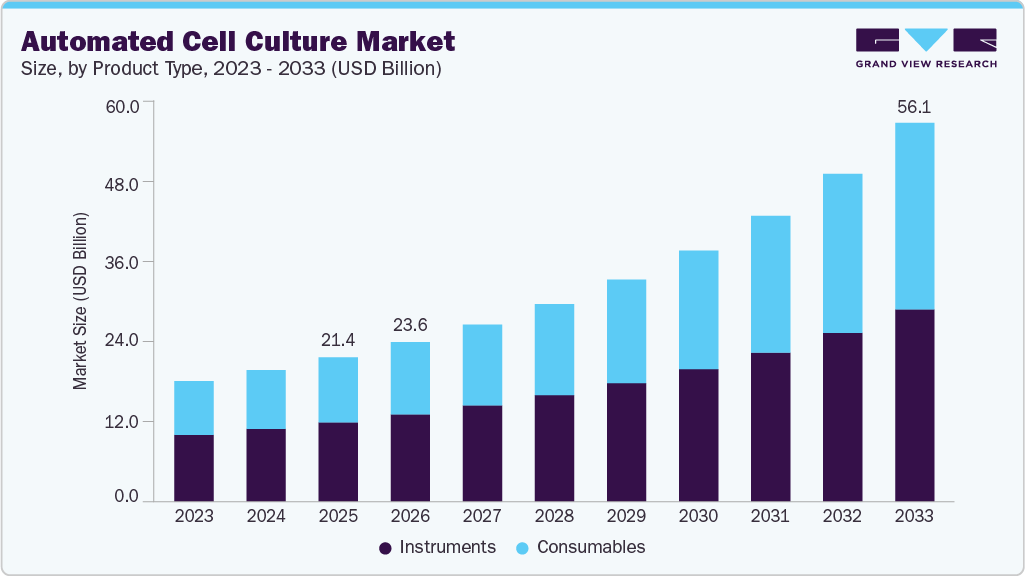
The global automated cell culture market size was estimated at USD 21.4 billion in 2025 and is projected to reach USD 56.1 billion by 2033, growing at a CAGR of 13.2% from 2025 to 2033. The market growth is driven by rising demand for scalable, reproducible cell-based processes and increasing adoption of automation, supported by advancements in robotics and AI.
Key Market Trends & Insights
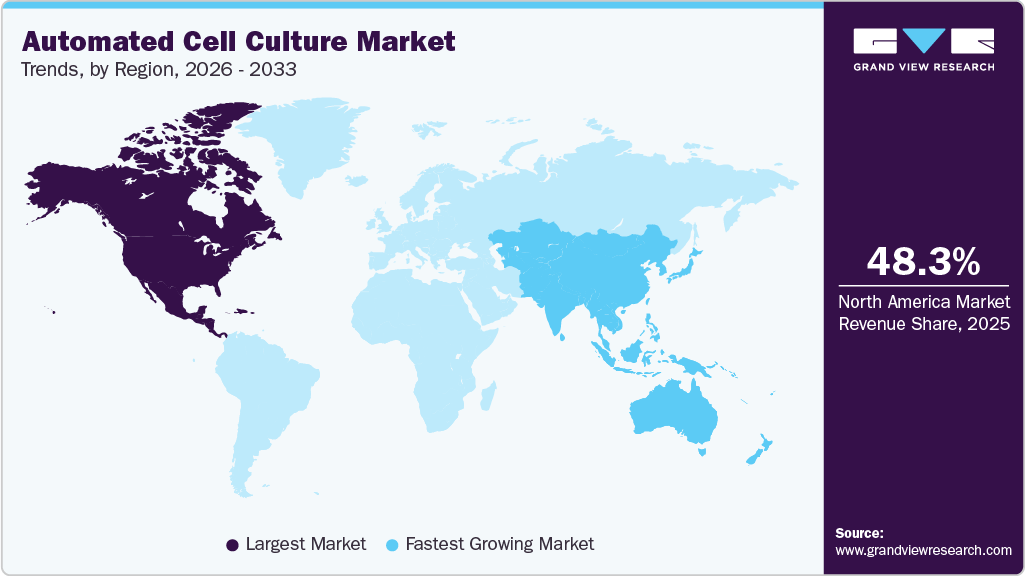
- The North America automated cell culture market held the largest global share of 48.3% in 2025.
- The U.S. automated cell culture industry is expected to grow due to the expanding aging population.
- Based on product type, the instruments segment dominated the market in 2025.
- Based on application, the biopharmaceutical production segment dominated the market with a share of 43.6% in 2025.
- Based on end user, the pharmaceutical & biotech companies segment dominated the market with revenue share of 52.7% in 2025.
Market Size & Forecast
- 2025 Market Size: USD 21.4 Billion
- 2033 Projected Market Size: USD 56.1 Billion
- CAGR (2026-2033): 13.2%
- North America: Largest market in 2025
- Asia Pacific: Fastest-growing market
Expansion of Biologics & Cell/Gene Therapy Pipelines
The rapid expansion of biologics and advanced therapy pipelines, particularly monoclonal antibodies, vaccines, and cell and gene therapies, is a key driver for the automated cell culture industry. Biopharmaceutical companies are increasingly focusing on complex, cell-based products that require controlled and reproducible culture conditions. At the same time, the growing number of cell and gene therapy candidates in clinical development is driving demand for precise cell expansion and maintenance, which is difficult to achieve through manual processes.
Approved Cellular and Gene Therapy Products
Product & Trade Name
Manufacturer
ABECMA (idecabtagene vicleucel)
Celgene Corporation, a Bristol-Myers Squibb Company
ADSTILADRIN (nadofaragene firadenovec-vcng)
Ferring Pharmaceuticals A/S
ALLOCORD (HPC, Cord Blood)
SSM Cardinal Glennon Children's Medical Center
AMTAGVI (lifileucel)
Iovance Biotherapeutics, Inc.
AUCATZYL (obecabtagene autoleucel)
Autolus Limited
BEQVEZ (fidanacogene elaparvovec-dzkt)
Pfizer, Inc.
BREYANZI (lisocabtagene maraleucel)
Juno Therapeutics, Inc., a Bristol-Myers Squibb Company
CARVYKTI (ciltacabtagene autoleucel)
Janssen Biotech, Inc.
CASGEVY (exagamglogene autotemcel [exa-cel])
Vertex Pharmaceuticals Incorporated
CLEVECORD (HPC Cord Blood)
Cleveland Cord Blood Center
Ducord, HPC Cord Blood
Duke University School of Medicine
ELEVIDYS (delandistrogene moxeparvovec-rokl)
Sarapeta Therapeutics, Inc.
ENCELTO (revakinagene taroretcel-lwey)
Neurotech Pharmaceuticals, Inc.
Source: FDA, Secondary Research, Primary Interviews, Grand View Research
As a result, automated cell culture systems are becoming essential for ensuring scalability, consistency, and process standardization. These platforms reduce variability, enable controlled environments, and support both small-batch personalized production and large-scale manufacturing. This is especially critical for patient-specific therapies, where accuracy and traceability are vital, thereby accelerating the adoption of automation in cell culture market.
Reduction of Variability & Human Error
Manual cell culture processes are prone to variability due to operator-dependent techniques, inconsistent timing, and differences in handling. Key steps such as seeding, media exchange, and passaging can vary across technicians, affecting cell growth, viability, and experimental outcomes. This lack of consistency is a major limitation in both research and manufacturing, where reproducibility is critical. In January 2026, researchers in the U.S. developed an open-source automated cell culture system that reduced manual handling time by 61% while improving seeding consistency and experimental reliability and further driving the demand of automated cell culture systems market.
Automated cell culture systems address this by standardizing workflows and reducing human intervention. Using programmed protocols and real-time monitoring, they ensure precise control over culture conditions, leading to improved reproducibility and reduced batch-to-batch variation. As demonstrated by recent developments, automation also enhances experimental success rates and operational efficiency, reinforcing its role as a key driver for adoption in modern cell culture workflows.
Market Concentration & Characteristics
The automated cell culture industry exhibits a high degree of innovation, driven by integration of robotics, AI, and real-time monitoring to enable scalable, reproducible, and low-contamination workflows, with modular and flexible systems supporting advanced applications like cell and gene therapy.
The automated cell culture market is witnessing a moderate to high level of M&A activity, driven by the need to expand technological capabilities, strengthen automation portfolios, and enhance end-to-end bioprocessing solutions, with companies focusing on acquiring niche technology providers and forming strategic partnerships to accelerate innovation and market reach.
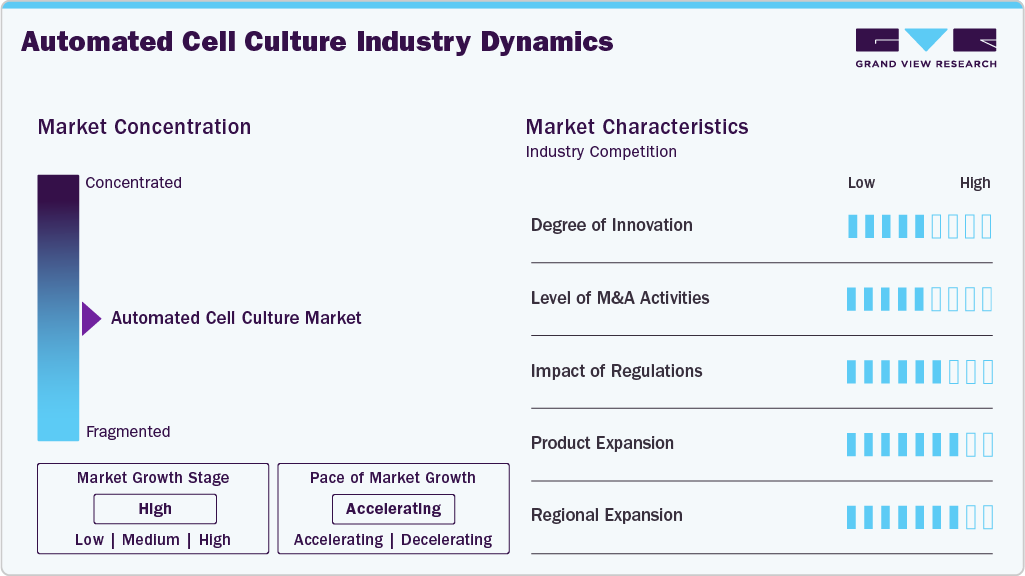
Regulations have a significant impact on the automated cell culture industry, as stringent guidelines for quality, sterility, and data integrity drive the adoption of standardized, automated, and closed systems while increasing compliance costs and time-to-market, particularly in biopharmaceutical and cell therapy applications.
Product expansion in the automated cell culture market is accelerating, with companies broadening their portfolios to include integrated, end-to-end solutions such as automated incubators, bioreactors, cell processing systems, and software platforms to address diverse applications and improve workflow efficiency.
Regional expansion is gaining momentum as companies strengthen their presence in high-growth regions such as Asia-Pacific and emerging markets, supported by increasing investments in biopharmaceutical manufacturing, expanding research infrastructure, and growing demand for advanced automation technologies.
Product Type Insights
In 2025, the instruments segment led the automated cell culture market, driven by the increasing adoption of advanced bioreactors, automated incubators, and liquid handling systems that enhance scalability, precision, and reproducibility in cell-based workflows. Growing demand for high-throughput screening, biologics production, and regenerative medicine applications has further accelerated the uptake of automated instruments, as they reduce manual intervention, minimize contamination risks, and improve operational efficiency across research and biopharmaceutical manufacturing settings.
The consumables segment is expected to grow at the fastest CAGR during the forecast period, driven by the recurring demand for media, sera, reagents, and single-use components. Increased adoption of automated systems in biopharma and cell therapy is boosting consumption, as these materials ensure consistency, sterility, and scalability in workflows.
Application Insights
The biopharmaceutical production segment led the automated cell culture industry in 2025, accounting for a share of 43.6%, driven by the rising demand for biologics, monoclonal antibodies, and vaccines, along with the increasing adoption of automated systems to enhance scalability, ensure product consistency, and meet stringent regulatory requirements in manufacturing processes.
The cell & gene therapy manufacturing segment is expected to grow at the fastest CAGR over the forecast period, driven by the increasing clinical pipeline of advanced therapies, rising investments in personalized medicine, and the growing need for scalable, automated solutions to ensure consistency, efficiency, and regulatory compliance in complex cell processing workflows.
End User Insights
The pharmaceutical & biotech companies segment dominated the automated cell culture market in 2025, accounting for a revenue share of 52.7%, driven by increasing R&D investments, rising biologics production, and the growing adoption of automation to enhance productivity, ensure reproducibility, and meet stringent regulatory standards.
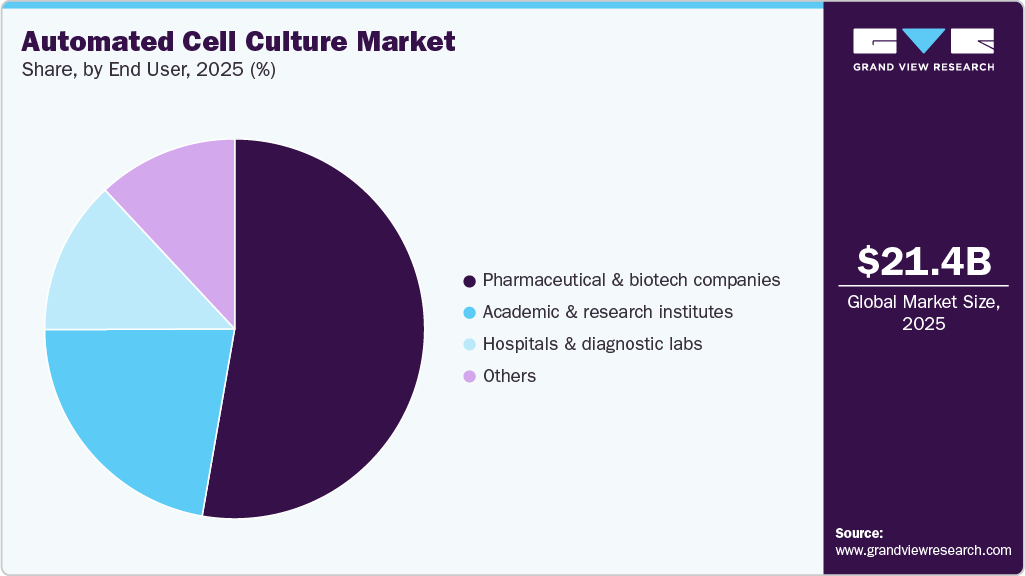
The hospitals & diagnostic labs segment is expected to witness significant growth from 2026 to 2033, driven by the increasing adoption of cell-based diagnostics, rising demand for personalized medicine, and the integration of automated systems to improve workflow efficiency, accuracy, and turnaround times in clinical settings.
Regional Insights
The North America automated cell culture industry dominated with a 48.3% share in 2025, due to its strong commercialization landscape, rapid integration of advanced automation technologies, and high concentration of biopharma manufacturing facilities, particularly in the U.S., where innovation and early technology adoption remain key growth drivers.
U.SAutomated Cell Culture Market Trends
The U.S. market’s growth is driven by a highly advanced biopharmaceutical ecosystem, strong venture funding, and rapid integration of cutting-edge automation technologies, particularly in cell and gene therapy manufacturing and translational research.
Europe Automated Cell Culture Market Trends
Europe’s automated cell culture industry is characterized by a strong emphasis on quality standards and process optimization, with widespread adoption of automated systems to meet strict regulatory and compliance requirements, alongside steady advancements in bioprocessing capabilities across countries like Germany, the UK, and Switzerland.
The automated cell culture market in the UK demonstrates steady growth supported by a strong academic base, innovation hubs, and government-backed life sciences initiatives, with increasing focus on scaling automated solutions for clinical and research applications.
Germany’s automated cell culture market is shaped by its engineering expertise and well-established bioprocessing industry, with a strong focus on precision, efficiency, and adoption of automated systems to enhance manufacturing reliability.
Asia Pacific Automated Cell Culture Market Trends
The automated cell culture industry in Asia Pacific is anticipated to witness the fastest growth at a CAGR of 16.5% from 2026 to 2033, driven by large-scale capacity expansions in biologics manufacturing, increasing localization of production, and rising investments from both global and domestic players seeking cost-efficient and scalable automation solutions.
The China automated cell culture marketis rapidly expanding its presence through large-scale investments in biomanufacturing infrastructure, increasing domestic innovation, and strong government support aimed at achieving self-sufficiency in advanced life sciences technologies.
The automated cell culture market in Japan is expected to grow during the forecast period. Japan emphasizes technological sophistication and process refinement, with growing adoption of automation to support regenerative medicine and ensure high-quality, standardized cell culture workflows.
MEA Automated Cell Culture Market Trends
The MEA automated cell culture industry is developing steadily, supported by government-led initiatives to build domestic life sciences capabilities, growing interest in technology transfer, and gradual adoption of automation in select research and clinical settings.
Kuwait’s automated cell culture market is at a nascent stage, with growth primarily driven by healthcare modernization efforts, gradual investment in research capabilities, and early adoption of advanced laboratory technologies in select institutions.
Key Automated Cell Culture Company Insights
The automated cell culture industry is moderately consolidated, with leading players such as Thermo Fisher Scientific, Danaher Corporation, Sartorius AG, Merck KGaA, and Corning Incorporated accounting for a significant share, supported by strong product portfolios, global presence, and continuous R&D investments. These companies leverage integrated solutions spanning equipment, consumables, and software to strengthen their market position.
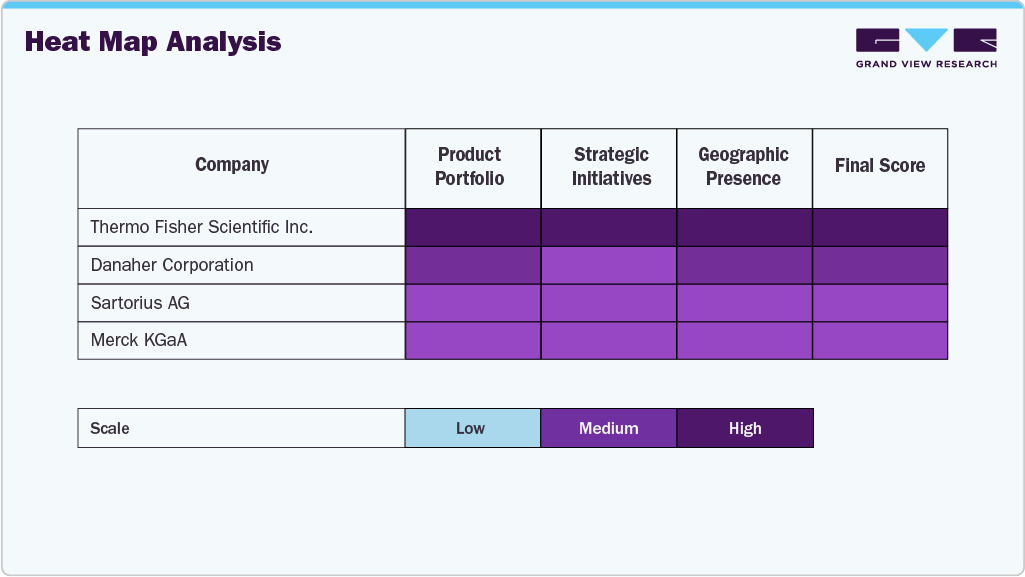
Other key participants, including Lonza Group, Becton, Dickinson and Company (BD), Eppendorf SE, Tecan Group, and Agilent Technologies, contribute through specialized capabilities in cell processing, automation, and analytical systems. The competitive landscape is shaped by ongoing innovation, strategic collaborations, and expansion of end-to-end automated platforms.
Key Automated Cell Culture Companies:
The following key companies have been profiled for this study on the automated cell culture market.
- Thermo Fisher Scientific
- Danaher Corporation
- Sartorius AG
- Merck KGaA
- Lonza Group
- Becton, Dickinson and Company (BD)
- Corning Incorporated
- Eppendorf SE
- Tecan Group
- Agilent Technologies
Recent Developments
-
In May 2024, Sinfonia Technology Co., Ltd. delivered its CellQualia Intelligent Cell Processing System in Japan, enabling automated, quality-controlled cell culture to support scalable regenerative medicine manufacturing in the automated cell culture market.
-
In January 2024, Thermo Fisher Scientific launched CTS Cellmation Software in the U.S., integrating instruments to automate cell therapy workflows, enhancing compliance, reproducibility, and scalability in the automated cell culture industry.
Automated Cell Culture Market Report Scope
Report Attribute
Details
Market size value in 2026
USD 23.6 billion
Revenue forecast in 2033
USD 56.1 billion
Growth rate
CAGR of 13.2% from 2026 to 2033
Base year for estimation
2025
Historical data
2021 - 2024
Forecast period
2026 - 2033
Quantitative units
Revenue in USD million/billion and CAGR from 2026 to 2033
Report coverage
Revenue forecast, company ranking, competitive landscape, growth factors, and trends
Segments covered
Product type, application, end user, region
Regional scope
North America; Europe; Asia Pacific; Latin America; MEA
Country scope
U.S.; Canada; Mexico; UK; Germany; France; Italy; Spain; Denmark; Sweden; Norway; Japan; China; India; Australia; Thailand; South Korea; Brazil; Argentina; South Africa; Saudi Arabia, UAE; Kuwait
Key companies profiled
Thermo Fisher Scientific; Danaher Corporation; Sartorius AG; Merck KGaA; Lonza Group; Becton, Dickinson and Company (BD); Corning Incorporated; Eppendorf SE; Tecan Group; Agilent Technologies
Customization scope
Free report customization (equivalent up to 8 analyst’s working days) with purchase. Addition or alteration to country, regional & segment scope.
Global Automated Cell Culture Market Report Segmentation
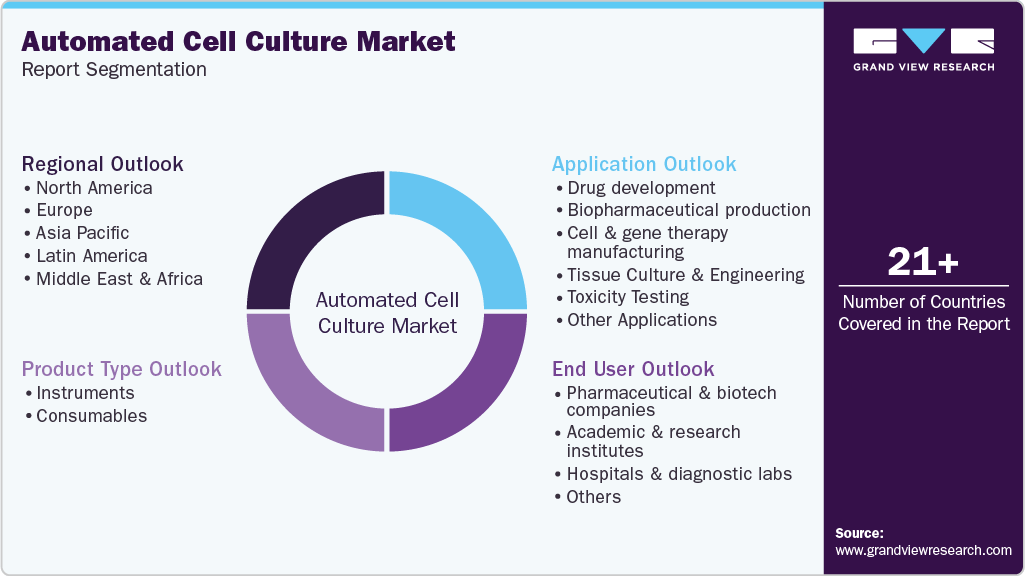
This report forecasts revenue growth and provides an analysis on the latest trends in each of the sub-segments from 2021 to 2033. For this study, Grand View Research has segmented the automated cell culture market report based on product type, application, end user, and region:
-
Product Type Outlook (Revenue, USD Million, 2021 - 2033)
-
Instruments
-
Consumables
-
-
Application Outlook (Revenue, USD Million, 2021 - 2033)
-
Drug development
-
Biopharmaceutical production
-
Cell & gene therapy manufacturing
-
Tissue Culture & Engineering
-
Toxicity Testing
-
Other Applications
-
-
End User Outlook (Revenue, USD Million, 2021 - 2033)
-
Pharmaceutical & biotech companies
-
Academic & research institutes
-
Hospitals & diagnostic labs
-
Others
-
-
Regional Outlook (Revenue, USD Million, 2021 - 2033)
-
North America
-
U.S.
-
Canada
-
Mexico
-
-
Europe
-
Germany
-
UK
-
France
-
Italy
-
Spain
-
Denmark
-
Sweden
-
Norway
-
-
Asia Pacific
-
China
-
Japan
-
India
-
South Korea
-
Australia
-
Thailand
-
-
Latin America
-
Brazil
-
Argentina
-
-
MEA
-
South Africa
-
Saudi Arabia
-
UAE
-
Kuwait
-
-
Frequently Asked Questions About This Report
b. The global automated cell culture market size was estimated at USD 21.4 billion in 2025 and is expected to reach USD 23.6 billion in 2026.
b. The global automated cell culture market is expected to grow at a compound annual growth rate of 13.2% from 2026 to 2033 to reach USD 56.1 billion by 2033.
b. North America automated cell culture industry dominated the global market and accounted for a 48.3% share in 2025, due to its strong commercialization landscape, rapid integration of advanced automation technologies, and high concentration of biopharma manufacturing facilities, particularly in the U.S., where innovation and early technology adoption remain key growth drivers.
b. Some key players operating in the automated cell culture market include Thermo Fisher Scientific; Danaher Corporation; Sartorius AG; Merck KGaA; Lonza Group; Becton, Dickinson and Company (BD); Corning Incorporated; Eppendorf SE; Tecan Group; Agilent Technologies
b. The market is driven by rising demand for scalable, reproducible cell-based processes and increasing adoption of automation, supported by advancements in robotics and AI.


Share this report with your colleague or friend.
Need a Tailored Report?
Customize this report to your needs — add regions, segments, or data points, with 20% free customization.


ISO 9001:2015 & 27001:2022 Certified
We are GDPR and CCPA compliant! Your transaction & personal information is safe and secure. For more details, please read our privacy policy.
Trusted market insights - try a free sample
See how our reports are structured and why industry leaders rely on Grand View Research. Get a free sample or ask us to tailor this report to your needs.













