
- Home
- »
- Next Generation Technologies
- »
-
Automated Machine Learning Market Size Report, 2026-2033GVR Report cover

Automated Machine Learning Market (2026 - 2033)
Size, Share & Trends Analysis Report By Offering (Solution, Services), By Deployment (On-Premises, Cloud), By Enterprise Size, By Application, By Vertical, By Region, And Segment Forecasts
Market Size, 2025
$4.7BMarket Estimate, 2026
$6.2BMarket Forecast, 2033
$61.2BCAGR, 2026–2033
38.6%Automated Machine Learning Market Summary
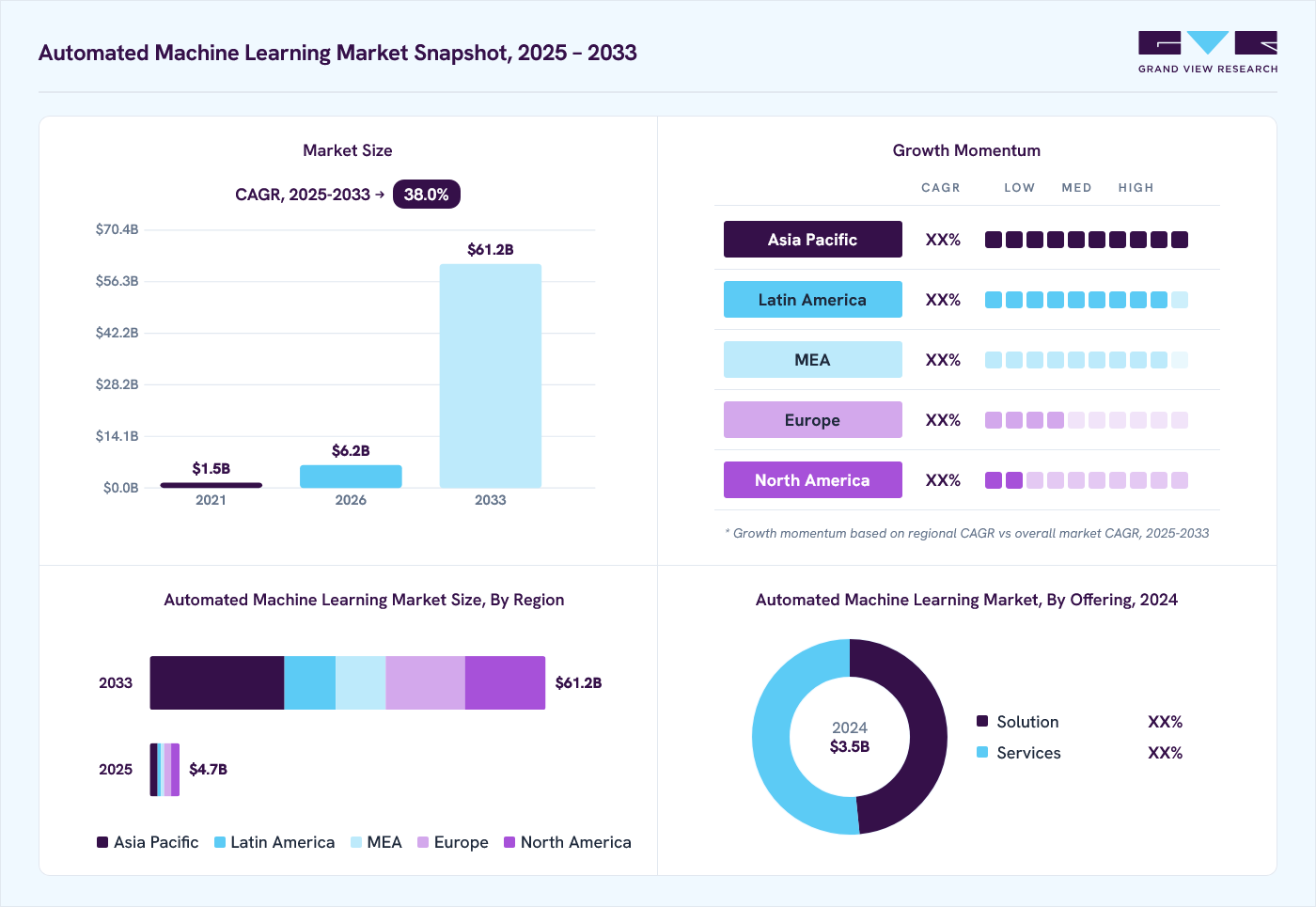
The global automated machine learning market size was valued at USD 4.7 billion in 2025 and is projected to grow from USD 6.2 billion in 2026 to USD 61.2 billion by 2033, at a CAGR of 38.6% from 2026 to 2033. North America dominated the global market with the largest revenue share of 28.6% in 2025. The region's leadership is driven by the strong presence of leading technology providers, cloud computing companies, and machine learning platform vendors, along with the widespread adoption of data-driven decision-making across industries.
 Source: Grand View Research, IR Documents, Primary Interviews, Paid DatabasesTo learn more about this report,
 Download Free Sample Report
 Key Market Trends & Insights
- By offering: Services segment led the Market and held the largest revenue share of over 50.9% in 2025.
- By enterprise size: Large enterprises segment led the Market and held the largest revenue share of over 69.7% in 2025
- By application: Data processing segment led the market with the largest revenue share of 29.9% in 2025.
- By deployment: Cloud segment led the market with the largest revenue share of 53.2% in 2025.
Regional Highlights
- Largest regional market: North America (28.6% revenue share, 2025)
- Fastest growing regional market: Asia Pacific (highest CAGR, 2026-2033)
- By country: The U.S. held the largest market share in 2025
Market Size & Forecast
- Market size in 2025: USD 4.7 Billion
- Estimated market size in 2026: USD 6.2 Billion
- Projected market size by 2033: USD 61.2 Billion
- CAGR (2026-2033): 38.6%
Three ways to get this report
Buy it, customize it, or ask a question.Ask an Analyst
A direct answer, usually in 1 working day
- AccessReport author, directly
- Reply timeWithin 1 working day
- No sales callDirect answer only
- FormatEmail reply
- CostFree, no cost
Get the Full Report
What the study covers
- FormatsPDF · Excel · Dashboard
- Timeline2026–2033 annual, 2025 base
- Coverage20+ countries, 5 regions
- Companies10+ key players profiled
Customize the Report
20% free customization
- IncludeCountries, segments, points
- TailorTo your product definition
- ExtendDeeper competitor detail
- OrA fully bespoke study
- Turnaround5–10 working days
Organizations across the U.S. & Canada are increasingly deploying automated machine learning solutions to accelerate model development, reduce dependency on specialized data science expertise, and improve operational efficiency. To learn more about this report, Download Free Sample Report
 This growth is attributed to Automated machine learning (AutoML’s) capability to identify discrepancies, errors, and other issues within the data, and present the user with choices, suggestions, as well as suggest outliers. Once the expert is presented with all this information, they can seamlessly curate multiple models, saving them time and effort. Currently, AutoML open-source and commercial tools such as TPOT, H2O.ai, Google AutoML, and DataRobot are some of the best suited for streamlining the development of tasks wherein the goal is to predict an outcome/ result. These popular solutions tend to automate some or all the ML pipelines. For instance, DataRobot, the enterprise AI platform, makes data science accessible to everyone and automates the entire process of creating, deploying, and managing AI solutions at scale. It eliminates the reliance on manual workflows, automates repetitive and time-intensive steps, enables new users to build highly accurate models, and provides a fast-path for getting AI into production.
Automated machine learning is an essential process of automating iterative and time-consuming tasks. It enables developers, analysts, and data scientists to build ML models with productivity, efficiency, and high scale. AutoML has gained traction to minimize the knowledge-based resources needed to implement and train machine learning models. Moreover, Bullish demand for AutoML is mainly attributed to its ability to help enterprises boost insights and enhance model accuracy by minimizing chances for error or bias. End-users, including BFSI, healthcare, IT & telecom, and retail, are expected to inject funds into AutoML to rev up their AI efforts to create a valuable pipeline to automate data preprocessing, model selection, and pre-trained models.
Innovation in automated machine learning has led to significant advancements in various industries, transforming the way businesses operate and interact with their customers. Automation of complex processes enables organizations to speedily analyze network behavior and automatically execute required steps, enhancing processing speeds and performance. In addition, predictive maintenance using machine learning helps companies identify potential risks and predict failures, thereby increasing productivity and saving costs. Real-time business decision making is also facilitated through machine learning, allowing businesses to extract valuable insights from large datasets and make informed decisions. TinyML, a type of machine learning that runs on smaller devices, is ideal for battery-operated devices and IoT applications, reducing power consumption, latency, and bandwidth while maintaining user privacy and efficiency.
Market Dynamics
The Automated Machine Learning (AutoML) Market is experiencing significant growth, driven by the increasing demand for democratized artificial intelligence, growing adoption of data-driven decision-making, and the need to accelerate machine learning model development across industries. AutoML solutions enable organizations to automate complex tasks such as data preparation, feature engineering, model selection, hyperparameter tuning, and deployment, reducing reliance on highly specialized data science expertise. The rapid expansion of big data, cloud computing, and enterprise AI initiatives is generating vast volumes of structured and unstructured data, further accelerating demand for AutoML platforms that can deliver faster, scalable, and cost-effective machine learning outcomes.
The Automated Machine Learning Market is primarily driven by the increasing need to make machine learning accessible to non-technical users and business professionals. Traditional machine learning development often requires extensive expertise in data science, programming, and model optimization, creating barriers to adoption for many organizations. AutoML platforms simplify these processes by automating model development workflows, enabling enterprises to rapidly build and deploy predictive analytics solutions. The growing use of AI across industries such as healthcare, BFSI, retail, manufacturing, telecommunications, and marketing is further fueling demand for AutoML solutions that improve productivity, shorten development cycles, and accelerate time-to-value from AI investments.
Despite strong growth prospects, the Automated Machine Learning Market faces challenges related to data quality, model transparency, and governance. AutoML platforms rely heavily on large volumes of high-quality data to generate accurate and reliable models. Inconsistent, incomplete, or biased datasets can negatively impact model performance and decision-making outcomes. Additionally, some organizations remain concerned about the limited interpretability of automatically generated models, particularly in highly regulated industries such as healthcare, banking, and insurance where explainability and compliance are critical. Integration complexities with existing IT infrastructure and concerns regarding data privacy and security may also hinder adoption among certain enterprises.
The growing adoption of cloud computing and AI-as-a-Service offerings presents substantial growth opportunities for the Automated Machine Learning Market. Organizations are increasingly leveraging cloud-based AutoML platforms to reduce infrastructure costs, improve scalability, and accelerate AI deployment across distributed environments. The emergence of industry-specific AutoML solutions tailored for applications such as fraud detection, predictive maintenance, customer analytics, demand forecasting, medical diagnostics, and supply chain optimization is creating new avenues for market expansion. Furthermore, advancements in generative AI, automated feature engineering, no-code/low-code AI platforms, and MLOps integration are expected to enhance AutoML capabilities and drive broader adoption across enterprises of all sizes throughout the forecast period.
Market Concentration & Characteristics
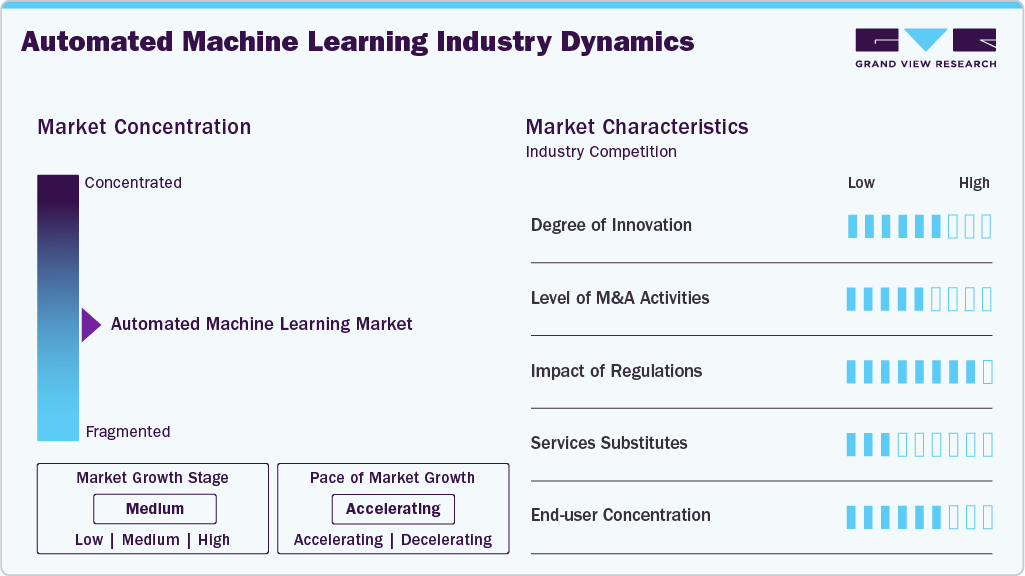
The Automated Machine Learning Market is moderately concentrated, characterized by the presence of leading cloud service providers, AI platform developers, and specialized AutoML solution vendors competing on automation capabilities, model accuracy, scalability, ease of deployment, and integration with enterprise data ecosystems. Key market participants include Amazon Web Services, Inc., Google LLC, Microsoft, DataRobot, Inc., H2O.ai, Databricks, Oracle, Alibaba Cloud, Akkio Inc., and Clarifai, Inc.
 To learn more about this report, Download Free Sample Report
 These companies are increasingly investing in automated model development, no-code and low-code AI platforms, cloud-native machine learning services, MLOps capabilities, and generative AI integration to strengthen their competitive positioning. Strategic partnerships, platform enhancements, product innovation, acquisitions, and continuous advancements in automated feature engineering, model optimization, and AI governance capabilities are further intensifying competition across the market.
Analyst Perspective
The Automated Machine Learning (AutoML) Market is emerging as a key component of enterprise AI strategies, driven by the growing demand for rapid AI deployment, increasing data volumes, and the need to democratize machine learning across organizations. AutoML technologies automate tasks such as data preparation, feature engineering, algorithm selection, hyperparameter tuning, and model deployment, enabling faster and more efficient machine learning adoption. Advancements in artificial intelligence, cloud computing, no-code/low-code platforms, and MLOps frameworks are further accelerating market growth. Growing use of AutoML for predictive analytics, fraud detection, demand forecasting, predictive maintenance, and operational optimization is helping organizations improve decision-making and reduce development timelines. Increasing investments in cloud-based AI platforms, generative AI technologies, and digital transformation initiatives are expected to support long-term market expansion.
Offering Insights
Based on offering, the services segment led the market with the largest revenue share of 50.9% in 2025. Automated Machine Learning services aim to simplify and automate various stages of the machine learning workflow, making it more accessible to users without extensive expertise in data science and machine learning. These services automate the process of building machine learning models, including various tasks such as, data preprocessing, feature engineering, algorithm selection, and hyperparameter tuning, allowing users to focus on the problem they want to solve rather than the intricacies of model development. Major cloud providers such as, Google Cloud, Amazon Web Services, and Microsoft Azure offer fully managed AutoML services on their cloud platforms, providing a user-friendly interface and handling the underlying infrastructure. There are also open-source AutoML libraries such as, Auto-Sklearn, AutoKeras, and Auto-PyTorch that automate machine learning tasks for specific frameworks. Some AutoML services aim to automate the entire machine learning lifecycle, from data ingestion and preparation to model deployment and monitoring, significantly reducing the time and effort required. Additionally, there are vertical-specific solutions tailored to industries or use cases such as, healthcare, manufacturing, or computer vision, leveraging domain knowledge and pre-trained models.
The solution segment is expected to register the fastest CAGR over the forecast period. AutoML solutions are designed to automate the tasks involved in developing and deploying machine learning models. This makes it easier for organizations to leverage the power of machine learning without requiring significant expertise in data science or machine learning. AutoML solutions are becoming an increasingly important tool for organizations looking to leverage the power of machine learning to gain insights from their data and make better decisions. By automating many tedious and time-consuming tasks involved in model development and deployment, AutoML platforms can help organizations accelerate their digital transformation and unlock new opportunities for growth and innovation.
Enterprise Size Insights
Based on enterprise size, the large enterprises segment led the market with the largest revenue share of 69.7% in 2025. Large businesses are increasingly adopting cloud-based automated machine learning platforms and services. The scalable and cost-effective infrastructure of cloud platforms facilitates the training and deployment of machine learning models. Services such as, Amazon Web Services (AWS), Google Cloud AI Platform, and Microsoft Azure Machine Learning provide pre-built models, distributed training capabilities, and infrastructure management, enabling large enterprises to utilize automated machine learning without substantial infrastructure investments.
The SMEs segment is expected to register a significant CAGR over the forecast period. The adoption of machine learning is rapidly growing among small and medium-sized enterprises (SMEs). With often limited resources, SMEs may need extra expertise to analyze large data sets. Machine learning platforms and technologies can automate data analysis processes, allowing SMEs to gain valuable insights from their data with minimal manual effort. This automated data analysis helps SMEs better understand customer behavior, improve inventory management, optimize marketing strategies, and make data-driven decisions.
Deployment Insights
Based on deployment, the cloud segment led the market with the largest revenue share of 53.2% in 2025. Cloud-based AutoML solutions have gained significant traction in recent years, offering businesses and organizations a convenient and scalable way to leverage automated machine learning capabilities. These solutions, such as Google Cloud AutoML, Amazon SageMaker Autopilot, and Azure AutoML, provide user-friendly interfaces and abstraction layers that simplify the process of building and deploying machine learning models, enabling users with limited machine learning expertise to leverage advanced AutoML capabilities. Moreover, cloud platforms offer virtually unlimited computing resources that can be dynamically scaled up or down based on demand, ensuring optimal performance and cost-effectiveness for AutoML workloads.
The on-premises segment is expected to register a significant CAGR over the forecast period. On-premises based AutoML solutions offer organizations the ability to leverage automated machine learning capabilities within their own infrastructure and data centers. One of the primary advantages of on-premises AutoML is the ability to keep sensitive data within the organization’s controlled environment, which is particularly important for industries dealing with sensitive information, such as healthcare, finance, and government, where data privacy and compliance regulations are stringent. In addition, on-premises AutoML solutions provide organizations with greater control and customization options, allowing them to tailor the platform to their specific needs, integrate it with existing systems and workflows, and ensure compatibility with their infrastructure and security protocols.
Application Insights
Based on application, the data processing segment led the market with the largest revenue share of 29.9% in 2025. Automated machine learning can be utilized to automate various aspects of data processing, such as data cleaning, normalization, and transformation. The automated machine learning marketstreamline the process of identifying and correcting data errors, including detecting missing values, fixing data formatting issues, and removing outliers that could impact the accuracy of machine learning models. AutoML employs techniques such as, standardization and normalization automatically. It can also transform data into more suitable formats, minimizing the risk of errors and inconsistencies. In addition, AutoML can integrate data from multiple sources, a typically time-consuming and complex task, through techniques such as, data merging and joining. By automating these tasks, AutoML significantly reduces the time and effort needed for manual data processing, enhancing the quality and accuracy of the resulting data.
Feature engineering segment is expected to register the fastest CAGR over the forecasted period. Feature engineering is a crucial step in automated machine learning (AutoML) pipelines, as it significantly impacts the performance of the resulting models. AutoML tools and libraries such as, FeatureTools, Dask-ML, and TSFRESH can automatically generate new features from raw data by applying various techniques such as, feature synthesis, feature extraction, and feature construction, reducing the manual effort required for feature engineering. For datasets consisting of data from multiple related tables or sources, AutoML tools can automatically join and combine data from these sources to generate meaningful features that capture relationships across different entities.
Vertical Insights
Based on vertical, the BFSI segment led the market with the largest revenue share of 22.2% in 2025. In recent years, artificial intelligence (AI) and machine learning technologies have been increasingly adopted in the banking, financial services, and insurance (BFSI) industry to boost operational efficiency and enhance consumer experience. As data becomes more prominent, the demand for machine learning applications in the BFSI sector continues to grow. Automated machine learning can deliver accurate and swift results using vast amounts of data, affordable processing power, and cost-effective storage. Additionally, machine learning (ML)-powered solutions enable financial firms to enhance productivity by automating repetitive tasks through intelligent process automation.
 To learn more about this report, Download Free Sample Report
 IT & telecommunications segment is expected to register a significant CAGR over the forecast period due to its high demand for intelligent automation, network optimization, and customer analytics. Increasing data complexity from IoT devices, 5G infrastructure, and cloud platforms requires scalable AI models that AutoML can rapidly generate and deploy. Telecom operators are leveraging AutoML for predictive maintenance, churn prediction, and service personalization to enhance operational efficiency and user experience. Additionally, the integration of AutoML into DevOps and data engineering workflows accelerates AI adoption, reduces model development time, and minimizes the need for specialized data science expertise across IT ecosystems.
Regional Insights
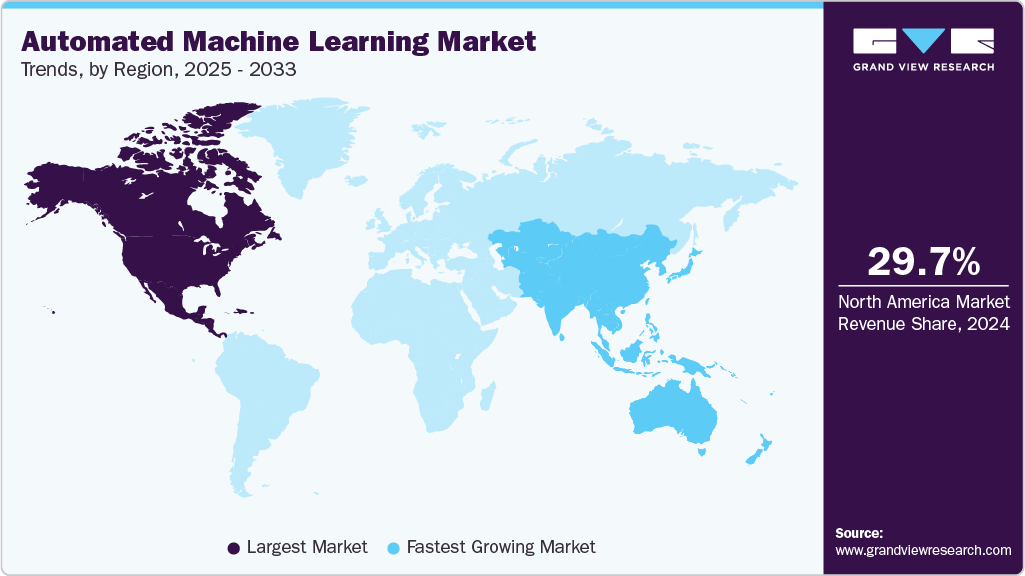
North America dominated the Automated Machine Learning Market with the largest revenue share of 28.6% in 2025. This region has been a major contributor to the development and growth of the Automated Machine Learning market. The U.S. is one of the most developed countries in the region. AutoML is a rapidly growing market in the U.S., with several key players offering solutions that range from fully automated platforms to ones that assist data scientists in building machine learning models. The market is being driven by the need for faster and more efficient ways to build and deploy machine learning models, as well as the increasing demand for artificial intelligence solutions in various industries. In recent years, there has been a significant increase in the adoption of AutoML solutions in the U.S., especially in industries such as healthcare, finance, and retail. Healthcare providers are using AutoML to analyze medical images and identify patterns in patient data, while financial institutions are using it to detect fraudulent transactions and assess credit risk. Retailers are using AutoML to personalize recommendations and improve customer engagement.
 To learn more about this report, Download Free Sample Report
 U.S. Automated Machine Learning Market Trends
The Automated Machine Learning Market in the U.S. held the largest share in the North America region in 2025. The U.S. is at the forefront of automated machine learning research and development, with major tech companies, academic institutions, and businesses actively investing in and adopting AutoML solutions. Major U.S. tech giants such as, Microsoft, Google, and Amazon are investing heavily in developing AutoML solutions and offering cloud-based AutoML services. Microsoft Azure offers Azure AutoML, which automates the end-to-end machine learning process, including data preprocessing, model selection, hyperparameter tuning, and model deployment, making AutoML accessible to users without extensive machine learning expertise. Google Cloud provides the AutoML suite of tools, which includes pre-trained models for various tasks such as, image recognition, text classification, and structured data analysis, aiming to democratize machine learning by simplifying the model development process. Amazon Web Services (AWS) offers Amazon SageMaker Autopilot, an AutoML solution that automates data preprocessing, model tuning, and deployment, allowing businesses to quickly build and deploy machine learning models without extensive coding.
Europe Automated Machine Learning Market Trends
The automated machine learning market in Europe is expected to grow significantly over the forecast period. Various academic institutions, research organizations, and companies are actively contributing to its development and adoption. Moreover, Europe has several leading academic institutions conducting research on AutoML techniques and methodologies. For instance, the University of Leiden in the Netherlands offers courses on AutoML, covering topics such as, hyperparameter optimization, meta-learning, and transfer learning. Additionally, the University of Freiburg in Germany has a dedicated research group focused on AutoML and meta-learning. These academic efforts contribute to advancing the theoretical foundations and practical applications of AutoML.
Asia Pacific Automated Machine Learning Market Trends
The automated machine learning industry in the Asia Pacific region is anticipated to be at the fastest CAGR over the forecast period. Various government initiatives are propelling the demand for Automated Machine Learnings in Asia Pacific. Fiber optic networks are playing a crucial role in supporting smart city solutions, Internet of Things (IoT) devices, and other digital innovations as part of various government initiatives. Asia Pacific region has emerged as a leading market due to its abundance of vendors developing robust and innovative machine learning solutions. With the Banking, Financial Services, and Insurance (BFSI) industry in the region expected to see significant growth in deploying security services, major companies are targeting this area to expand their operations. Moreover, Asian countries are at the forefront of advanced technologies and trends such as autonomous driving, artificial intelligence, e-health, and fintech. The region's digitalization landscape is diverse, with varying levels of readiness for capitalization, digital transformation, and regulatory capacities across different countries.
Key Automated Machine Learning Company Insights
Some key companies in the automated machine learning market are Akamai Technologies and Amazon Web Services, Inc.
-
Akamai Technologies leads the automated machine learning market with its extensive global CDN infrastructure, enabling ultra-fast, secure, and reliable video delivery. Its advanced media compression, adaptive bitrate streaming, and real-time analytics optimize viewer experience. Akamai Technologies’ scalability and partnerships with major OTT platforms strengthen its leadership in global content distribution.
-
Amazon Web Services, Inc. dominates through its powerful cloud-based video processing and streaming solutions. Its scalable infrastructure supports live and on-demand content processing, encoding, and delivery globally. AI-driven analytics, automation, and integration across Amazon Web Services, Inc. enables cost-efficient, high-quality video workflows, making it a preferred choice for broadcasters and OTT providers.
Key Automated Machine Learning Companies:
The following key companies have been profiled for this study on the automated machine learning market.
-
Amazon Web Services, Inc.
-
Google LLC
-
Microsoft
-
DataRobot, Inc.
-
H2O.ai.
-
Databricks
-
Oracle
-
Alibaba Cloud
-
Akkio Inc.
-
Clarifai, Inc.
Competitive Benchmarking
Category
Operating Strategies
Competitive Edge
Weakness
Established Players: Amazon Web Services, Inc.; Google LLC; Microsoft; Oracle; Alibaba Cloud
- Focus on expanding AutoML capabilities through cloud-native machine learning platforms, AI development environments, no-code/low-code tools, MLOps integration, and scalable data analytics solutions.
- Emphasize strategic partnerships, ecosystem expansion, platform integration, global cloud infrastructure investments, and continuous innovation in artificial intelligence and machine learning technologies to strengthen market leadership.
- Strong global presence, extensive enterprise customer bases, scalable cloud infrastructure, broad AI and analytics portfolios, strong R&D capabilities, integrated data ecosystems, and established positions across cloud computing, enterprise software, and machine learning markets.
- High operational and infrastructure costs, complexity associated with integrating AutoML solutions across diverse enterprise environments, regulatory and data governance challenges, dependence on large enterprise customers, and increasing competition from specialized AI platform providers.
Emerging Players: DataRobot, Inc.; H2O.ai.; Databricks; Akkio Inc.; Clarifai, Inc.
- Focus on specialized AutoML platforms, automated model development, no-code/low-code machine learning solutions, AI lifecycle management, model optimization, and industry-specific AI applications.
- Invest in product innovation, strategic collaborations, customer-centric platform enhancements, and expansion into emerging AI use cases to accelerate market penetration and adoption.
- Strong expertise in machine learning automation, agile innovation capabilities, advanced AutoML technologies, faster product development cycles, specialized AI solutions, user-friendly platforms, and the ability to address evolving enterprise AI requirements with flexible and scalable offering
- Limited global reach compared to large cloud providers, smaller customer bases, resource constraints, lower brand recognition in certain regions, dependence on specific AI and analytics segments, and challenges in scaling operations and competing with larger technology companies on infrastructure, ecosystem breadth, and R&D investments.
Recent Developments
-
In June 2025, Nordic Semiconductor, low-power wireless communication solutions provider, acquired Neuton.AI Inc., a provider of AutoML tools. This strengthens Nordic Semiconducto’s edge in deploying tiny, efficient AutoML models on resource-constrained devices (edge/IoT). The deal complements Nordic Semiconducto’s earlier acquisition of Atlazo, a semiconductor company and positions them to better support embedded ML use cases.
-
In February 2025, IBM Corporation acquired DataStax, a company specializing in AI and data management solutions. This acquisition is expected to enhance IBM Corporation’s watsonx product lineup, enabling faster adoption of generative AI and helping businesses extract meaningful insights from extensive unstructured datasets.
-
In May 2024, leveraging over two decades of collaboration, IBM Corporation and Adobe are providing clients with the expertise and technology to fully utilize Generative AI in marketing, content creation, and brand management. This is accomplished through a distinctive partnership that encompasses both technology solutions and consulting services, fostering collaborative innovation across hybrid cloud infrastructure, data utilization, applications, and a diverse Generative AI strategy.
Automated Machine Learning Market Report Scope
Report Attribute
Details
Market size in 2025
USD 4.7 billion
Estimated market size in 2026
USD 6.2 billion
Projected market size by 2033
USD 61.2 billion
Growth rate
CAGR of 38.6% from 2026 to 2033
Base year for estimation
2025
Historical data
2021 - 2024
Forecast period
2026 - 2033
Quantitative units
Revenue in USD billion/billion and CAGR from 2026 to 2033
Report coverage
Revenue forecast, company ranking, competitive landscape, growth factors, and trends
Segments covered
Offering, enterprise size, deployment, application, vertical, and region
Regional scope
North America; Europe; Asia Pacific; Latin America; MEA
Country scope
U.S.; Canada; Mexico; Germany; UK; France; China; India; Japan; Australia; South Korea; Brazil; UAE; South Africa; KSA
Key companies profiled
Amazon Web Services, Inc.; Google LLC; Microsoft; DataRobot, Inc.; H2O.ai.; Databricks; Oracle; Alibaba Cloud; Akkio Inc.; Clarifai, Inc.
Customization scope
Free report customization (equivalent up to 8 analysts' working days) with purchase. Addition or alteration to country, regional & segment scope.
Pricing and purchase options
Avail customized purchase options to meet your exact research needs. Explore purchase options
Global Automated Machine Learning Market Report Segmentation
This report forecasts revenue growth at global, regional, and country levels and provides an analysis of the latest industry trends in each of the sub-segments from 2021 to 2033. For this study, Grand View Research has segmented global automated machine learning market report based on offering, enterprise size, deployment, application, vertical, and region.
-
Offering Outlook (Revenue, USD Billion, 2021 - 2033)
-
Solution
-
Services
-
-
Deployment Outlook (Revenue, USD Billion, 2021 - 2033)
-
On-Premises
-
Cloud
-
-
Enterprise Size Outlook (Revenue, USD Billion, 2021 - 2033)
-
Large Enterprises
-
SMEs
-
-
Application Outlook (Revenue, USD Billion, 2021 - 2033)
-
Data Processing
-
Feature Engineering
-
Model Selection
-
Hyperparameter Optimization Tuning
-
Model Ensembling
-
Others
-
-
Vertical Outlook (Revenue, USD Billion, 2021 - 2033)
-
BFSI
-
Retail & E-Commerce
-
Healthcare
-
Government & Defense
-
Manufacturing
-
Media & Entertainment
-
Automotive & Transportation
-
IT & Telecommunications
-
Others
-
-
Regional Outlook (Revenue, USD Billion, 2021 - 2033)
-
North America
-
U.S.
-
Canada
-
Mexico
-
-
Europe
-
Germany
-
UK
-
France
-
-
Asia Pacific
-
China
-
Japan
-
India
-
South Korea
-
Australia
-
-
Latin America
-
Brazil
-
-
Middle East and Africa (MEA)
-
UAE
-
KSA
-
South Africa
-
-
Research Methodology
The automated machine learning market figures in this report are based on a proven research process that combines executive interviews with secondary research from proprietary databases, company filings, and recognized regulatory and institutional sources. Market size is built through value-chain sizing - reconciling supply-side and demand-side estimates - and triangulated with bottom-up and top-down approaches. Every estimate passes multiple levels of expert validation before publication, with each automated machine learning segment quantified using the revenue-capture definitions in the table below.
Segment Definition
Segment - Offering
Revenue capture definition
Solution
Revenue in this segment is generated through the development, licensing, deployment, and subscription-based delivery of Automated Machine Learning (AutoML) software platforms and solutions. These offerings include automated data preparation tools, feature engineering solutions, model selection and optimization platforms, hyperparameter tuning tools, no-code and low-code machine learning platforms, model deployment and monitoring solutions, MLOps platforms, and cloud-based AutoML services.
Services
Revenue in this segment is generated through consulting, implementation, integration, training, support, maintenance, and managed services associated with Automated Machine Learning (AutoML) solutions. These services help organizations design AI strategies, deploy and customize AutoML platforms, integrate machine learning workflows with existing IT infrastructure, optimize model performance, establish MLOps frameworks, and ensure effective governance and compliance.
Segment - Enterprise Size
Revenue capture definition
SMEs
This segment comprises small and medium-sized enterprises that leverage Automated Machine Learning (AutoML) solutions to accelerate AI adoption, improve operational efficiency, and gain data-driven insights without requiring extensive in-house data science expertise. SMEs utilize AutoML platforms for applications such as customer analytics, sales forecasting, fraud detection, demand planning, marketing optimization, risk assessment, and business intelligence
Large Enterprises
This segment comprises large organizations that utilize Automated Machine Learning (AutoML) solutions to scale artificial intelligence initiatives, accelerate model development, and enhance data-driven decision-making across multiple business functions. Large enterprises deploy AutoML platforms for applications such as predictive analytics, customer intelligence, fraud detection, risk management, supply chain optimization, predictive maintenance, and operational forecasting.
Segment - Deployment
Revenue capture definition
Cloud
Revenue in this segment is generated through subscription-based and usage-based delivery of Automated Machine Learning (AutoML) solutions via cloud infrastructure. These offerings include cloud-hosted AutoML platforms, machine learning development environments, automated model training and deployment services, MLOps solutions, data management tools, and AI-as-a-Service (AIaaS) capabilities
On-premises
Revenue in this segment is generated through the licensing, deployment, and maintenance of Automated Machine Learning (AutoML) solutions installed and operated within an organization's own IT infrastructure. These offerings include on-premises AutoML platforms, machine learning development tools, model training and deployment environments, data management systems, and MLOps solutions hosted in private data centers
Segment - Application
Revenue capture definition
Data Processing
Revenue in this segment is generated through Automated Machine Learning (AutoML) solutions that automate data preparation, cleansing, transformation, integration, and feature engineering processes required for machine learning model development. These solutions help organizations manage large volumes of structured and unstructured data, improve data quality, identify relevant variables, and streamline workflows for analytics and AI applications
Feature Engineering
Revenue in this segment is generated through solutions that automate the identification, creation, selection, and optimization of features used in machine learning models. These solutions leverage advanced algorithms to transform raw data into meaningful input variables, improve data representation, eliminate irrelevant features, and enhance model performance. Automated feature engineering reduces the time and expertise required for manual feature development while improving prediction accuracy and model efficiency
Model Selection
Revenue in this segment is generated through solutions that automate the evaluation, comparison, and selection of the most suitable machine learning algorithms for specific datasets and business objectives. These solutions test multiple models, assess their performance using predefined metrics, and identify the optimal algorithm based on accuracy, efficiency, scalability, and interpretability requirements.
Hyperparameter Optimization Tuning
Revenue in this segment is generated through Automated Machine Learning (AutoML) solutions that automate the process of identifying and optimizing hyperparameters to improve machine learning model performance. These solutions utilize techniques such as grid search, random search, Bayesian optimization, evolutionary algorithms, and other optimization methods to determine the most effective parameter configurations
Model Ensembling
The segment generates revenue from AutoML platforms that combine multiple machine learning models using advanced ensemble techniques to improve predictive accuracy, enhance model robustness, and deliver more reliable outcomes across a wide range of datasets and business applications.
Others
The segment generates revenue from AutoML solutions that provide additional capabilities beyond core functions such as data processing, feature engineering, model selection, hyperparameter optimization. These capabilities may include automated model deployment, model monitoring, explainable AI (XAI), data visualization, workflow automation, AI governance, performance tracking, and MLOps integration.
Segment - Vertical
Revenue capture definition
BFSI
The segment generates revenue from the adoption of Automated Machine Learning (AutoML) solutions by banking, financial services, and insurance organizations to automate data analysis, improve decision-making, and enhance operational efficiency. AutoML platforms are utilized for applications such as fraud detection, credit risk assessment, customer segmentation, loan underwriting, claims processing, anti-money laundering (AML), regulatory compliance, and personalized financial services.
Retail & E commerce
The segment generates revenue from the adoption of Automated Machine Learning (AutoML) solutions by retail and e-commerce organizations to enhance customer experiences, optimize operations, and improve business performance. AutoML platforms are utilized for applications such as customer segmentation, personalized recommendations, demand forecasting, inventory optimization, dynamic pricing, churn prediction, sales forecasting, and marketing campaign optimization.
Healthcare
The segment generates revenue from the adoption of Automated Machine Learning (AutoML) solutions by healthcare providers, hospitals, pharmaceutical companies, research institutions, and healthcare technology organizations to improve clinical and operational decision-making. AutoML platforms are utilized for applications such as disease prediction, patient risk assessment, medical imaging analysis, treatment optimization, drug discovery, resource planning, and healthcare analytics.
Government & Defense
Revenue is generated in this segment through the adoption of Automated Machine Learning (AutoML) solutions by government agencies, defense organizations, public sector institutions, and intelligence departments to enhance data-driven decision-making and operational efficiency. AutoML platforms are utilized for applications such as predictive analytics, risk assessment, resource allocation, threat analysis, fraud detection, public service optimization, and mission planning
Manufacturing
Revenue is generated in this segment through the adoption of Automated Machine Learning (AutoML) solutions by manufacturing companies to optimize production processes, improve operational efficiency, and enhance decision-making across industrial operations. AutoML platforms are utilized for applications such as predictive maintenance, quality control, demand forecasting, supply chain optimization, inventory management, process automation, and equipment performance monitoring
Media & Entertainment
Revenue is generated in this segment through the adoption of Automated Machine Learning (AutoML) solutions by media companies, broadcasters, streaming platforms, gaming firms, and digital content providers to enhance content delivery, audience engagement, and business performance. AutoML platforms are utilized for applications such as content recommendation, audience analytics, customer segmentation, advertising optimization, demand forecasting, content performance analysis, churn prediction, and personalized user experiences.
Automotive & transportation
Revenue is generated in this segment through the adoption of Automated Machine Learning (AutoML) solutions by automotive manufacturers, transportation providers, logistics companies, and mobility service operators to improve operational efficiency, safety, and decision-making. AutoML platforms are utilized for applications such as predictive maintenance, route optimization, demand forecasting, fleet management, supply chain analytics, quality control, and vehicle performance monitoring
IT & Telecommunications
Revenue is generated in this segment through the adoption of Automated Machine Learning (AutoML) solutions by IT service providers, telecommunications operators, cloud service providers, and technology companies to optimize network performance, enhance service delivery, and improve operational efficiency. AutoML platforms are utilized for applications such as network analytics, predictive maintenance, customer churn prediction, capacity planning, service quality monitoring, anomaly detection, demand forecasting, and resource optimization.
Others
Revenue is generated in this segment through the adoption of Automated Machine Learning (AutoML) solutions across various industries, including education, energy & utilities, agriculture, logistics, real estate, travel & hospitality, and professional services.
Estimation Model
Layer Name
Key Question
Description
Addressable Enterprise User Base Layer
Which organizations utilize Automated Machine Learning solutions?
Identify the global addressable base of organizations adopting machine learning and artificial intelligence technologies across industries including BFSI, healthcare, retail & e-commerce, manufacturing, IT & telecommunications, government, education, energy & utilities, transportation & logistics, and other enterprise sectors. Consider organizations seeking to accelerate AI adoption, improve analytics capabilities, automate model development, and enhance data-driven decision-making.
AutoML Adoption & Deployment Layer
Which business functions and applications deploy AutoML technologies?
Apply AutoML adoption rates across key applications based on the deployment of automated data preparation, feature engineering, model selection, hyperparameter optimization, model monitoring, and MLOps capabilities. Consider use cases such as predictive analytics, fraud detection, customer segmentation, demand forecasting, predictive maintenance, risk assessment, recommendation systems, and business intelligence across functional departments.
Solution Consumption Layer
How extensively are AutoML solutions utilized?
Estimate AutoML solution consumption based on the number of platform subscriptions, cloud-based AutoML deployments, enterprise AI licenses, no-code/low-code AI tools, model development projects, and automated analytics workloads deployed per organization. Consider usage intensity across data science teams, business analysts, citizen developers, enterprise applications, and cloud environments.
Revenue Generation Layer
How much revenue is generated?
Calculate market revenue by multiplying the volume of AutoML software platforms, cloud-based AI services, enterprise subscriptions, professional services, consulting engagements, training services, and MLOps solutions deployed across organizations by their respective average selling prices (ASPs), subscription fees, licensing costs, implementation charges, and recurring revenue streams.
Delivered Customizations
This report has been delivered with the following In-depth customizations
CLIENT REQUEST
CUSTOMIZATION DELIVERED
VALUE ADDS
End-Use Demand & Application Analysis
Assessed AutoML adoption trends across key application areas, including predictive analytics, customer segmentation, fraud detection, demand forecasting, predictive maintenance, recommendation systems, risk assessment, business intelligence, and operational optimization.
Evaluated technology adoption patterns, customer requirements, investment priorities, and growth drivers across BFSI, healthcare, retail, manufacturing, telecommunications, government, and other enterprise sectors.
Provides actionable insights into AutoML adoption drivers, application-specific demand patterns, high-growth use cases, and emerging AI automation trends, supporting market-entry, expansion, and commercialization strategies.
Technology Innovation & Growth Opportunity Assessment
Conducted an in-depth evaluation of emerging technologies shaping the Automated Machine Learning (AutoML) market, including automated feature engineering, automated model selection, hyperparameter tuning, no-code/low-code AI development platforms, MLOps frameworks, generative AI integration, cloud-based machine learning services, and automated model governance solutions. Assessed their impact on market development, identified high-growth opportunity areas, uncovered whitespace opportunities across industries, and evaluated evolving use cases driving the adoption of AutoML technologies.
Supports strategic growth planning by identifying attractive investment areas, prioritizing technology development opportunities, evaluating future revenue streams, and understanding the structural trends shaping the long-term evolution of the Automated Machine Learning Market.
Frequently Asked Questions About This Report
Services leads the offering segment in 2025 with market share of 50.9%, while solution is the fastest growing segment in the market.
Large Enterprises leads the segment in 2025 with market share of 69.7%, While SMEs is the fastest growing in the market
Cloud leads the segment in 2025 with market share of 53.2%, While On-premises is the fastest growing in the market
BFSI leads the segment in 2025 with market share of 22.2% & is the fastest growing in the market.
Some key players operating in the automated machine learning market include Amazon Web Services, Inc., Google LLC, Microsoft, DataRobot, Inc., H2O.ai., Databricks, Oracle, Alibaba Cloud, Akkio Inc., and Clarifai, Inc.
North America dominated the automated machine learning market with a share of 28.6% in 2025. This is attributable to rising healthcare awareness coupled with cloud-based technologies acceptance and constant research and development initiatives.
Key factors that are driving the market growth include the AutoML’s capability to identify discrepancies, errors, and other issues within the data, and present the U.S. er with choices, suggestions, as well as suggest outliers. Once the expert is presented with all this information, they can seamlessly curate multiple models, saving them time and effort.
The global automated machine learning market is expected to grow at a CAGR of 38.6% from 2026 to 2033, reaching USD 61.2 billion by 2033.
The global automated machine learning market size was valued at USD 4.7 billion in 2025 and is estimated at USD 6.2 billion in 2026.
About the Author(s)
Next Generation Technologies Research Team
Technology · Next Generation TechnologiesThis report was authored by the next generation technologies research team at Grand View Research - comprising two research analysts, one senior research analyst, and one industry expert - with specialized expertise in the next generation technologies segment of the technology industry. All findings are based on proprietary technology databases, executive interviews, and regulatory analysis, subject to internal peer review prior to publication.
Last Updated:
Speak to Analyst

Customize this report to your needs - add regions, segments, or data points, with 20% free customization.
Or view our licence options:


ISO 9001:2015 & 27001:2022 Certified
We are GDPR and CCPA compliant! Your transaction & personal information is safe and secure. For more details, please read our privacy policy.


