
- Home
- »
- Plastics, Polymers & Resins
- »
-
Automated Packaging Solutions Market Report, 2026-2033GVR Report cover

Automated Packaging Solutions Market (2026 - 2033)
Size, Share & Trends Analysis Report By Type (Packaging Robots, Secondary Automated Packaging Solutions), By Application (Food & Beverage, Healthcare, Personal Care & Cosmetics), By Region, And Segment Forecasts
Market Size, 2025
$80.6BMarket Estimate, 2026
$86.1BMarket Forecast, 2033
$140.8BCAGR, 2026–2033
7.3%Automated Packaging Solutions Market Summary
The global automated packaging solutions market size was valued at USD 80.6 billion in 2025 and is projected to grow from USD 86.1 billion in 2026 to USD 140.8 billion by 2033, at a CAGR of 7.3% from 2026 to 2033. Asia Pacific dominated the market, accounting for a revenue share of 33.5% in 2025. The market is driven by the growing demand for faster, more efficient, and cost-effective packaging processes across industries.
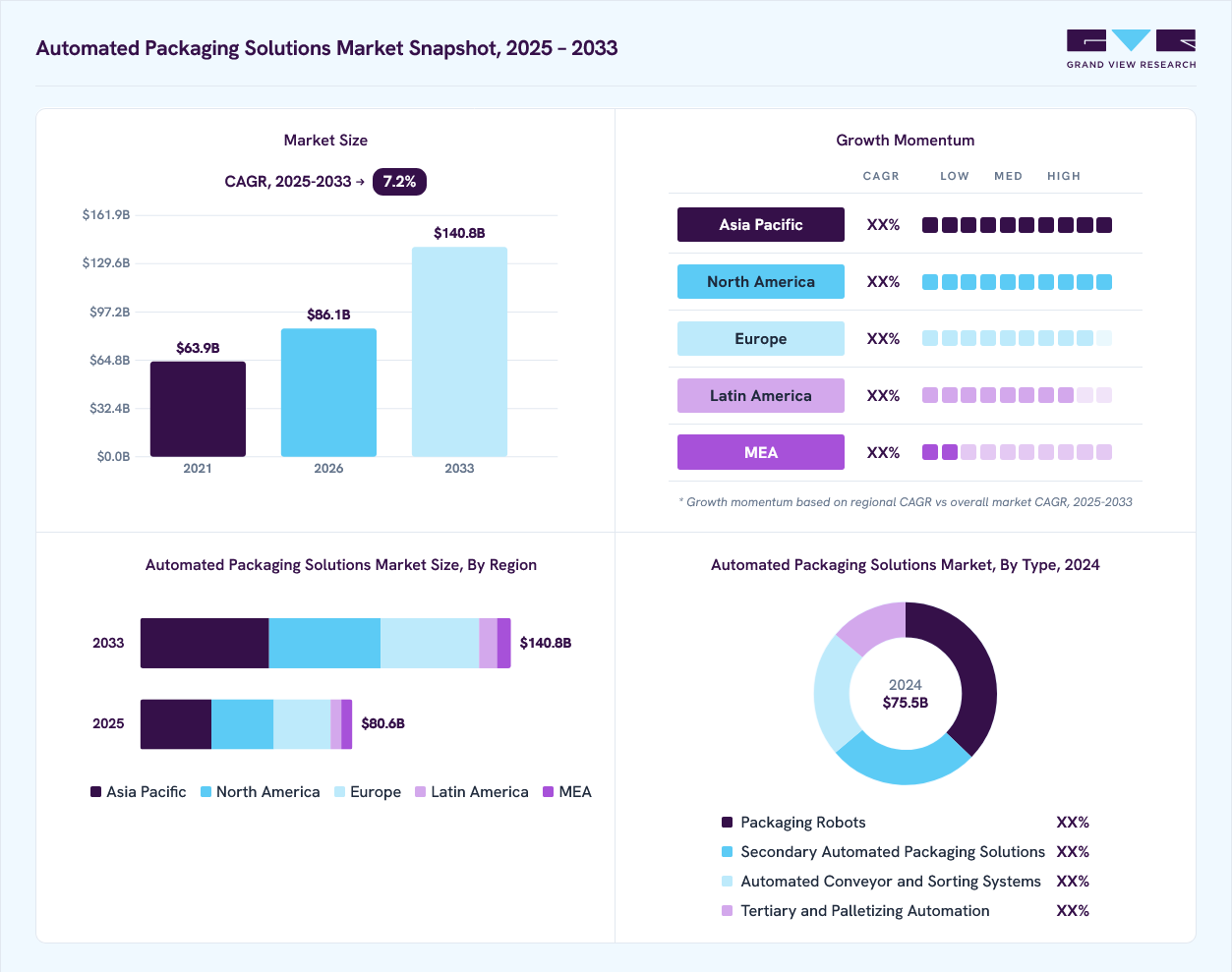 Source: Grand View Research, IR Documents, Primary Interviews, Paid DatabasesTo learn more about this report,
 Download Free Sample Report
 Key Market Trends & Insights
- By type: Packaging robots segment led the market with the largest revenue share of 37.3% in 2025.
- By application: Food & beverage segment led the market with the largest revenue share of 34.0% in 2025.
Regional Highlights
- Largest regional market: Asia Pacific (33.5% revenue share, 2025)
- By country: China held the largest market share in 2025.
Market Size & Forecast
- Market size in 2025: USD 80.6 Billion
- Estimated market size in 2026: USD 86.1 Billion
- Projected market size by 2033: USD 140.8 Billion
- CAGR (2026-2033): 7.3%
Three ways to get this report
Buy it, customize it, or ask a question.Ask an Analyst
Analyst response in 1 business day
- AccessReport author, directly
- Reply timeWithin 1 working day
- No sales callDirect answer only
- FormatEmail reply
- CostFree, no cost
Get the Full Report
What the study covers
- FormatsPDF · Excel · Dashboard
- Timeline2026–2033 annual, 2025 base
- Coverage20+ countries, 5 regions
- Companies10+ key players profiled
Customize the Report
20% free customization
- IncludeCountries, segments, points
- TailorTo your product definition
- ExtendDeeper competitor detail
- OrA fully bespoke study
- Turnaround5–10 working days
In addition, the rise of e-commerce, labor shortages, and increasing focus on sustainability and precision drive automation adoption. Automated packaging systems reduce manual labor dependency, minimize human errors, and enhance speed and consistency in packaging operations. Industries such as food & beverages, pharmaceuticals, and consumer goods are increasingly integrating robotics and smart sensors into packaging lines to meet large-scale production targets while maintaining quality. For instance, Nestlé and Unilever have adopted automated packaging lines that enable faster changeovers and continuous operation, significantly improving throughput and reducing downtime.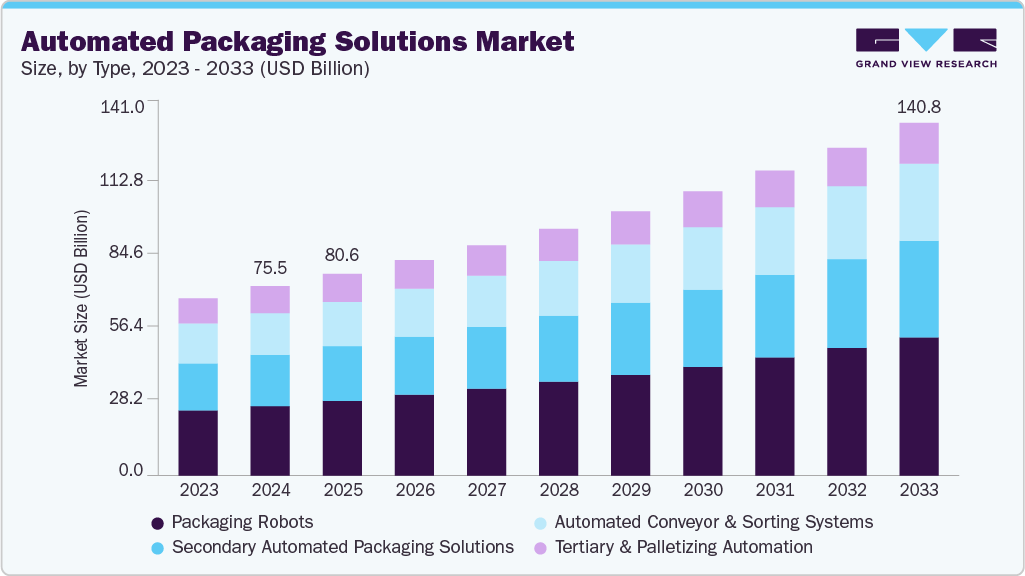 To learn more about this report, Download Free Sample Report
 The rising adoption of Industry 4.0 and smart manufacturing technologies is also propelling the market growth. The integration of AI, IoT, and machine learning into packaging automation systems enables predictive maintenance, real-time data monitoring, and adaptive control of packaging lines. These advancements enhance machine performance, reduce operational costs, and provide valuable insights into process optimization. For instance, companies such as Siemens and Rockwell Automation are developing intelligent packaging solutions equipped with IoT-based analytics platforms, allowing manufacturers to improve traceability and streamline production management.
The increasing focus on sustainability and waste reduction is also accelerating the growth of packaging automation. Automated systems optimize material usage by ensuring precise cutting, sealing, and labeling, reducing wastage of films, paper, and plastics. Moreover, automation enables easy adaptation to eco-friendly packaging materials such as recyclable or biodegradable films, which often require high precision during processing. For example, Tetra Pak has implemented automated technologies that allow efficient use of sustainable carton materials while maintaining packaging integrity, helping companies meet environmental regulations and corporate sustainability goals.
Moreover, the growing e-commerce and retail sectors are fueling the need for automated packaging systems to handle diverse product sizes, higher order volumes, and rapid fulfillment requirements. Automation solutions such as robotic pick-and-place systems, automated cartoning, and labeling machines improve order accuracy and packaging speed. Major logistics companies such as Amazon and DHL are investing heavily in automated packaging technologies to improve supply chain efficiency and customer satisfaction. This shift toward high-speed, flexible, and intelligent packaging lines is expected to continue driving market expansion globally, especially in Asia Pacific and North America, where e-commerce penetration is rapidly increasing.
Market Dynamics
The automated packaging solutions market is witnessing steady growth, driven by rising demand for higher operational efficiency, reduced labor dependency, and increased packaging speed across industries such as food & beverages, pharmaceuticals, e-commerce, and consumer goods. The adoption of robotics, AI, and smart automation technologies is improving packaging accuracy, productivity, and cost efficiency. While high initial investment and system integration challenges may limit adoption among smaller businesses, growing e-commerce activities, sustainability initiatives, and advancements in Industry 4.0 technologies continue to create strong growth opportunities for the market.
One of the primary drivers of the automated packaging solutions market is the increasing need for operational efficiency and labor cost optimization across manufacturing, logistics, and distribution facilities. Companies are under constant pressure to improve production output, reduce packaging errors, and maintain consistent product quality while managing rising labor costs and workforce shortages. Automated packaging systems enable faster packaging processes, minimize human intervention, and enhance overall equipment effectiveness, allowing businesses to achieve higher productivity and lower operating expenses.
The growing adoption of automation is particularly evident in industries such as food & beverages, pharmaceuticals, consumer goods, and e-commerce, where high-volume packaging operations require speed, precision, and reliability. Advanced technologies such as robotics, machine vision, and intelligent control systems help streamline packaging workflows, reduce downtime, and improve supply chain efficiency. As organizations increasingly focus on maximizing profitability and maintaining competitiveness, investments in automated packaging solutions continue to accelerate, supporting sustained market growth.
A significant restraint for the automated packaging solutions market is the high upfront capital investment required for purchasing, installing, and integrating automated packaging equipment into existing production lines. The costs associated with robotics, software, control systems, and employee training can be substantial, making adoption challenging for small and medium-sized enterprises with limited budgets. Furthermore, integrating advanced automation technologies with legacy manufacturing systems often involves technical complexities, operational disruptions, and ongoing maintenance requirements, which can delay implementation and reduce the pace of market adoption.
A significant opportunity for the automated packaging solutions market lies in the rapid growth of e-commerce and the increasing adoption of smart manufacturing practices. Rising online retail activities are driving demand for faster, more accurate, and scalable packaging operations to support high order volumes and quick delivery expectations. At the same time, the integration of Industry 4.0 technologies, including IoT, artificial intelligence, and real-time monitoring systems, is enabling more intelligent and connected packaging processes. These trends are encouraging businesses to invest in advanced automated packaging solutions that enhance efficiency, flexibility, and supply chain performance, creating substantial growth opportunities for market participants.
Market Concentration & Characteristics
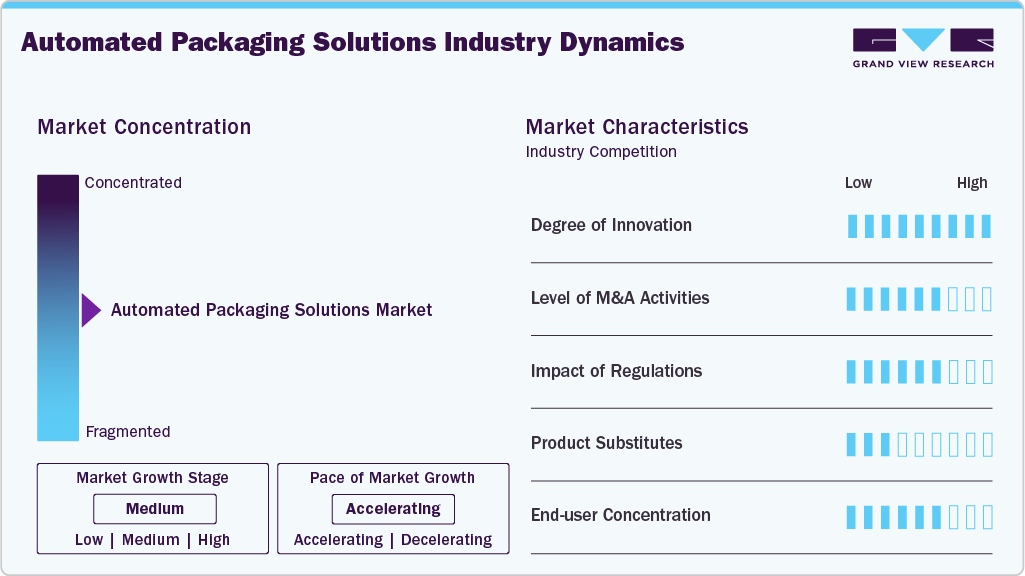
The automated packaging solutions industry is characterized by a high level of technological innovation and integration. It combines advanced robotics, artificial intelligence (AI), machine vision, and IoT technologies to enhance packaging efficiency, precision, and customization. The industry is dynamic, with continuous product advancements such as collaborative robots (cobots), smart sensors, and automated inspection systems that enable real-time quality control. This innovation-driven environment encourages manufacturers to invest in R&D to stay competitive and meet the growing demand for flexibility and speed in packaging lines.
Another key characteristic is its capital-intensive nature, as the development and installation of automated packaging systems require substantial initial investment in machinery, software, and skilled workforce. However, the long-term benefits-such as reduced labor costs, lower material waste, and higher productivity-justify the investment. The industry also sees a growing presence of modular and scalable systems that allow businesses to upgrade existing packaging lines without full replacements, making automation more accessible to medium and small enterprises.
 To learn more about this report, Download Free Sample Report
 The industry is also highly diversified, serving a wide range of end-use sectors including food & beverages, pharmaceuticals, consumer goods, Personal Care & Cosmetics, and e-commerce. Each sector has distinct packaging requirements, ranging from sterile and tamper-proof pharmaceutical packaging to high-speed flexible food packaging. This diversity drives continuous innovation in machine design and customization, with manufacturers developing sector-specific automation solutions to cater to varying packaging formats, product types, and compliance standards.
Analyst Perspective
The automated packaging solutions market is positioned for strong growth, driven by increasing demand for higher operational efficiency, reduced labor dependency, and enhanced packaging accuracy across industries such as food & beverage, healthcare, personal care & cosmetics, and electronics. The rapid expansion of e-commerce and omnichannel retail is accelerating investments in automated packaging technologies that enable faster order fulfillment, improved throughput, and streamlined warehouse operations. The market is also benefiting from the adoption of advanced technologies, including robotics, artificial intelligence, machine vision, and Industry 4.0-enabled systems, which help manufacturers optimize productivity and reduce operational costs. Going forward, companies that can deliver flexible, scalable, and intelligent automation solutions while supporting sustainability goals and evolving packaging requirements will be well positioned to capture growth opportunities in both mature and emerging markets.
Type Insights
Based on type, the packaging robots segment led the market with the largest revenue share of 37.3% in 2025. Packaging robots are automated machines designed to handle repetitive packaging tasks such as filling, sealing, labeling, and packing products. These robots improve efficiency and reduce human error by handling tasks that are repetitive, labor-intensive, or require precision. For instance, collaborative robots (cobots) in e-commerce warehouses are increasingly used to pick and pack items of varying shapes and sizes. Advances in AI and machine vision have made robots more adaptable to product variability, while growing e-commerce and online retail demand require flexible, scalable, and automated packaging solutions.
Secondary packaging automation refers to systems that automate the processes of grouping primary packaged products into cartons, trays, or cases. This includes cartoning machines, shrink-wrapping machines, and automated case packers. The key drivers for secondary packaging automation include the need to increase operational efficiency, reduce labor dependency, and meet stringent quality standards. Market demand for faster turnaround times, customization, and multi-pack formats also promote adoption. Moreover, increasing global trade and e-commerce have heightened the requirement for robust secondary packaging solutions to ensure product protection during shipping and handling.
Application Insights
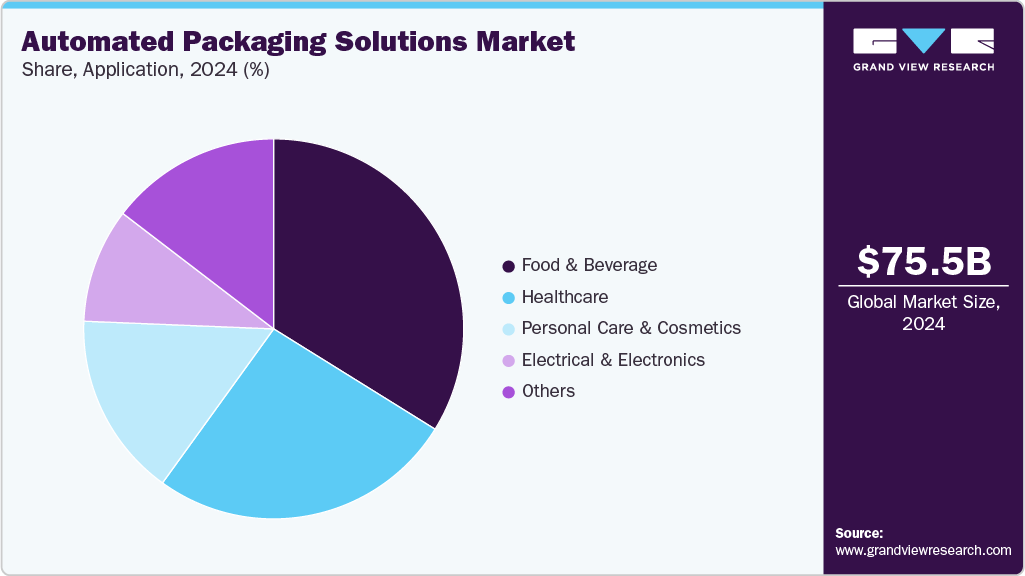
Based on application, the food & beverage segment led the market with the largest revenue share of 34.0% in 2025. The segment is the largest and fastest-growing application in packaging automation. It includes automated packaging for processed foods, dairy products, beverages, snacks, confectionery, and frozen foods. Solutions range from high-speed filling and sealing machines to fully automated end-of-line packaging systems, such as palletizers, labeling machines, and robotic pick-and-place systems. The segment benefits from diverse product formats, including bottles, pouches, cartons, and trays, requiring flexible automation solutions. Rising consumer demand for convenience foods, increasing adoption of e-commerce for grocery delivery, and stricter hygiene and food safety regulations are key drivers.
 To learn more about this report, Download Free Sample Report
 The healthcare segment is projected to grow at the fastest CAGR of 7.8% during the forecast period. Healthcare packaging automation covers pharmaceuticals, medical devices, and diagnostics. Automation solutions include blister packing machines, vial filling and capping systems, syringe packaging, and labeling machines. Companies provide automated solutions that ensure high precision, sterility, and compliance with regulatory standards such as FDA and EU GMP. Automation reduces the risk of contamination, ensures dosage accuracy, and accelerates production lines for lifesaving drugs and medical devices.
Region Insights
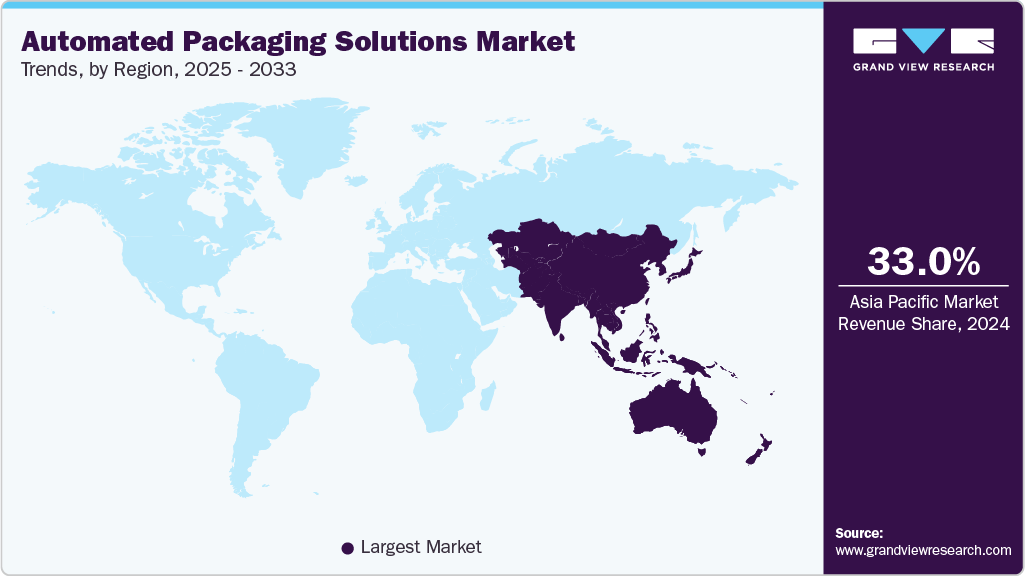
Asia Pacific dominated the automated packaging solutions market with the largest revenue share of 33.5% in 2025. The automated packaging solutions market in China held the largest share in the Asia Pacific region in 2025. This positive outlook is due to rapid industrialization, urbanization, and rising disposable incomes. Countries such as China, Japan, and India are witnessing strong growth in food & beverage, healthcare, and personal care industries, which are major adopters of automation. For example, China has seen widespread deployment of high-speed filling and carton packaging systems in its booming beverage sector, while India’s dairy and snack segments increasingly rely on automated solutions for hygiene and efficiency.
 To learn more about this report, Download Free Sample Report
 In addition, the region is experiencing growth in e-commerce and organized retail, which demands flexible and high-speed packaging systems. The region’s cost-competitive manufacturing environment also attracts multinational packaging automation companies to set up operations and R&D centers. Local manufacturers are adopting robotic pick-and-place systems, automated labeling, and secondary packaging lines to increase productivity and reduce labor dependency. Government initiatives in countries such as China, such as “Made in China 2025,” promote smart manufacturing and automation adoption, further driving the demand for packaging automation solutions.
North America Automated Packaging Solutions Market Trends
North America, led by the U.S., is a mature market for packaging automation, driven by advanced manufacturing practices and strong demand from food & beverage, pharmaceuticals, and consumer goods. Companies in the region adopt cutting-edge automation technologies such as robotic palletizing, vision-guided inspection systems, and automated carton forming to improve efficiency and reduce operational costs. For instance, beverage giants such as Coca-Cola and PepsiCo utilize end-of-line robotic solutions in the U.S. to enhance throughput while maintaining quality standards.
The region’s focus on Industry 4.0 and smart manufacturing also supports the integration of IoT, AI, and data analytics in packaging operations, improving traceability, predictive maintenance, and operational efficiency. Regulatory compliance requirements in the U.S. for food safety (FDA) and pharmaceuticals (cGMP) encourage automation adoption to minimize errors and ensure consistent product quality. The mature infrastructure and skilled workforce make North America a key market for advanced packaging automation solutions.
Europe Automated Packaging Solutions Market Trends
Europe is a highly developed market for packaging automation, driven by strong demand from food & beverage, healthcare, and personal care sectors, as well as stringent environmental and safety regulations. Germany, France, and Netherlands are notable leaders in automation adoption, with companies relying on fully integrated systems for filling, labeling, case packing, and palletizing.
European demand is also shaped by sustainability initiatives, such as reducing packaging waste and adopting recyclable materials, which require precise automated handling. The presence of a large number of multinational packaging equipment manufacturers and a focus on Industry 4.0 adoption further strengthens the market. Countries such as Germany emphasize robotics, collaborative automation, and energy-efficient solutions, positioning Europe as a hub for innovation and high-value packaging automation technologies.
Key Automated Packaging Solutions Company Insights
The competitive environment of the global automated packaging solutions market is moderately consolidated, with a mix of large multinational corporations and specialized regional players driving innovation and technology adoption. Key players compete on the basis of advanced robotics, intelligent conveyor systems, and integrated automation solutions tailored for diverse industries like food & beverage, healthcare, and personal care.
The market is characterized by continuous investments in R&D, strategic partnerships, and mergers & acquisitions to expand product portfolios and geographic reach. Additionally, emerging players are leveraging niche solutions, software integration, and Industry 4.0-enabled automation to capture specific end-use segments, intensifying competitive pressure while fostering rapid technological advancements across the sector.
Key Automated Packaging Solutions Companies:
The following key companies have been profiled for this study on the automated packaging solutions market.
-
Syntegon Technology GmbH
-
Crown Packaging Corp.
-
Smurfit Westrock
-
Rockwell Automation
-
Mpac Group plc
-
Sealed Air
-
Siemens AG
-
Ranpack
-
ABB Ltd
-
Schneider Packaging Equipment
-
Emerson Electric Co.
-
Multivac Group
-
ULMA Packaging
Competitive Benchmarking
Category
Operating Strategies
Competitive Edge
Weakness
Established Players (Siemens AG, ABB Ltd, Rockwell Automation, Emerson Electric Co., Sealed Air, Syntegon Technology GmbH, Multivac Group, and Smurfit Westrock)
- Focus on integrated automation ecosystems combining robotics, software, machine vision, and smart packaging technologies to deliver end-to-end solutions.
- Expand through strategic acquisitions, global service networks, and continuous investment in Industry 4.0, AI-driven analytics, and digital manufacturing platforms.
- Strong global presence, extensive customer relationships, and diversified product portfolios enable large-scale project execution across multiple industries.
- Significant R&D capabilities, established brand reputation, and comprehensive after-sales support create high customer retention and entry barriers for competitors.
- Large organizational structures can reduce operational agility and slow the commercialization of emerging technologies.
- High operating costs and dependence on mature industrial markets may limit flexibility in addressing niche or rapidly evolving customer requirements.
Emerging Players (Mpac Group plc, Ranpak, ULMA Packaging, Schneider Packaging Equipment, and Crown Packaging Corp.)
- Concentrate on specialized packaging automation segments, customized solutions, and targeted industry applications to differentiate from larger competitors.
- Pursue growth through innovation, strategic partnerships, regional expansion, and the development of sustainable and cost-efficient automation technologies.
- Greater flexibility and faster decision-making enable rapid adaptation to changing customer demands and market trends.
- Strong specialization in niche applications allows the delivery of highly customized solutions and competitive pricing structures.
- Limited financial resources and smaller service networks can restrict large-scale expansion and global market penetration.
- Lower brand recognition and narrower product portfolios may reduce competitiveness in large multinational contracts and integrated automation projects.
Recent Developments
-
In October 2025, Cobalt Systems launched a new range of end-of-line packaging automation solutions, CoForm case erectors, CoSeal case sealers, and CoWrap pallet wrappers, offering semi-automatic and fully automatic models with modular designs. These systems integrate with Cobalt’s print-and-apply technology for coordinated case forming, sealing, labeling, and pallet wrapping, enhancing throughput, reliability, and operator ergonomics.
-
In October 2025, CMC Packaging Automation partnered with Tokyo-based Correns to expand its presence in Japan, promoting automated and sustainable packaging solutions like the CartonWrap system. The partnership leverages Correns’ local network and expertise to support optimized packaging, with joint offerings showcased at Japan Pack 2025.
-
In January 2024, Stora Enso partnered with Polish packaging machinery specialist Radpak to strengthen its Automated Packaging Solutions business in Northern and Central Europe, leveraging Radpak’s expertise to offer advanced automated solutions that enhance efficiency and responsiveness for customers.
Automated Packaging Solutions Market Report Scope
Report Attribute
Details
Market size in 2025
USD 80.6 billion
Estimated market size in 2026
USD 86.1 billion
Projected market size by 2033
USD 140.8 billion
Growth rate
CAGR of 7.3% from 2026 to 2033
Base year for estimation
2025
Historical data
2021 - 2024
Forecast period
2026 - 2033
Quantitative units
Revenue in USD million/billion and CAGR from 2026 to 2033
Report coverage
Revenue forecast, company ranking, competitive landscape, growth factors, and trends
Segments covered
Type, application, region
Regional scope
North America; Europe; Asia Pacific; Latin America; MEA
Country scope
U.S.; Canada; Mexico; Germany; UK; France; Italy; Spain; China; Japan; India; South Korea; Australia; Brazil; Argentina; Saudi Arabia; South Africa; UAE
Key companies profiled
Syntegon Technology GmbH; Crown Packaging Corp.; Smurfit Westrock; Rockwell Automation; Mpac Group plc; Sealed Air; Siemens AG; Ranpack; ABB Ltd; Schneider Packaging Equipment; Emerson Electric Co.; Multivac Group; ULMA Packaging
Customization scope
Free report customization (equivalent up to 8 analysts' working days) with purchase. Addition or alteration to country, regional & segment scope.
Pricing and purchase options
Avail customized purchase options to meet your exact research needs. Explore purchase options
Global Automated Packaging Solutions Market Report Segmentation
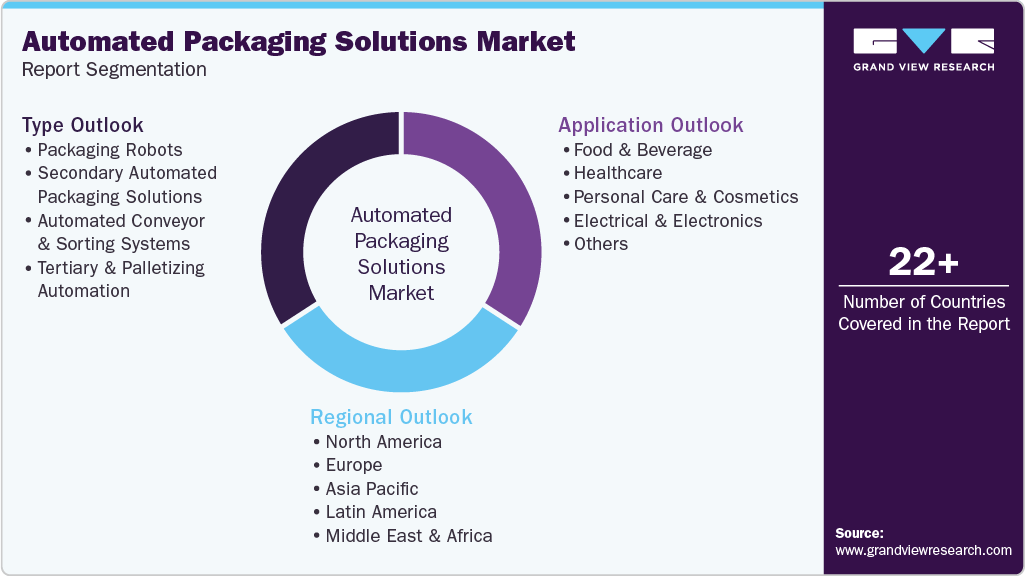
This report forecasts revenue growth at a global level and provides an analysis of the latest industry trends in each of the sub-segments from 2021 to 2033. For this study, Grand View Research has segmented the global automated packaging solutions market report based on type, application, and region:
 To learn more about this report, Download Free Sample Report
 -
Type Outlook (Revenue, USD Million, 2021 - 2033)
-
Packaging Robots
-
Secondary Automated Packaging Solutions
-
Automated Conveyor & Sorting Systems
-
Tertiary & Palletizing Automation
-
-
Application Outlook (Revenue, USD Million, 2021 - 2033)
-
Food & Beverage
-
Healthcare
-
Personal Care & Cosmetics
-
Electrical & Electronics
-
Others
-
-
Region Outlook (Revenue, USD Million, 2021 - 2033)
-
North America
-
U.S.
-
Canada
-
Mexico
-
-
Europe
-
Germany
-
France
-
UK
-
Italy
-
Spain
-
-
Asia Pacific
-
China
-
India
-
Japan
-
Australia
-
South Korea
-
-
Latin America
-
Brazil
-
Argentina
-
-
Middle East & Africa
-
South Africa
-
Saudi Arabia
-
UAE
-
-
Research Methodology
The automated packaging solutions market figures in this report are based on a proven research process that combines executive interviews with secondary research from proprietary databases, company filings, and recognized regulatory and institutional sources. Market size is built through value-chain sizing - reconciling supply-side and demand-side estimates - and triangulated with bottom-up and top-down approaches. Every estimate passes multiple levels of expert validation before publication, with each automated packaging solutions segment quantified using the revenue-capture definitions in the table below.
Segment Definition
Segment - Type
Revenue capture definition
Packaging Robots
Revenue generated from the sale of robotic systems used for automated packaging operations, including picking, placing, packing, case handling, and product manipulation. This segment includes articulated robots, collaborative robots (cobots), delta robots, and robotic arms deployed across manufacturing and packaging lines.
Secondary Automated Packaging Solutions
Revenue generated from the sale of automated equipment used for secondary packaging processes such as cartoning, case packing, wrapping, labeling, and bundling. This segment includes machinery designed to group, protect, and prepare primary packaged products for storage and distribution.
Automated Conveyor and Sorting Systems
Revenue generated from the sale of automated conveyor, material handling, and sorting solutions used to transport, route, and organize products throughout packaging and distribution facilities. This segment includes conveyor belts, automated sorters, accumulation systems, and integrated material flow technologies.
Tertiary and Palletizing Automation
Revenue generated from the sale of automated palletizing, depalletizing, stretch wrapping, and load stabilization systems used for tertiary packaging and logistics operations. This segment includes robotic palletizers, automated guided systems, and end-of-line packaging automation solutions designed for warehouse and transportation efficiency.
Segment – Application
Revenue capture definition
Food & Beverage
Revenue generated from automated packaging solutions deployed in food and beverage manufacturing facilities for packaging, labeling, sorting, case packing, and palletizing applications. This segment includes solutions used for packaged foods, beverages, dairy products, bakery items, frozen foods, and other consumer products.
Healthcare
Revenue generated from automated packaging solutions used in pharmaceutical, medical device, biotechnology, and healthcare product packaging operations. This segment includes equipment designed to ensure packaging accuracy, product safety, traceability, and regulatory compliance.
Personal Care & Cosmetics
Revenue generated from automated packaging solutions utilized in the packaging of cosmetics, skincare, haircare, fragrance, and personal hygiene products. This segment includes systems used for filling, labeling, cartoning, wrapping, and end-of-line packaging processes.
Electrical & Electronics
Revenue generated from automated packaging solutions used for electronic components, consumer electronics, electrical equipment, and semiconductor products. This segment includes packaging systems designed to improve handling precision, product protection, and operational efficiency.
Others
Revenue generated from automated packaging solutions used across additional industries such as chemicals, industrial goods, household products, automotive components, and logistics. This segment includes specialized packaging automation systems tailored to unique industry requirements and packaging formats.
Estimation Model
Layer Name
Key Question
Description
Industrial Packaging Demand Layer
What forms the demand base?
Identify packaging volumes generated across major end-use industries including food & beverage, healthcare, personal care & cosmetics, electrical & electronics, logistics, and industrial manufacturing. This layer establishes the total addressable packaging demand requiring automation to improve throughput, accuracy, safety, and operational efficiency.
Automation Adoption Layer
Where are automated packaging solutions utilized?
Estimate the penetration of automated packaging technologies across manufacturing facilities, distribution centers, warehouses, and fulfillment hubs. Assess adoption levels of packaging robots, automated conveyors, sorting systems, secondary packaging equipment, and palletizing automation across developed and emerging markets.
Packaging Operations Intensity Layer
How much packaging volume is automated?
Analyze packaging throughput, production capacity utilization, labor replacement rates, order fulfillment requirements, and end-of-line automation intensity across industries. Automation intensity is influenced by production scale, product complexity, regulatory requirements, e-commerce growth, labor availability, and operational efficiency targets.
Revenue Layer
How is market revenue generated?
Market revenue is quantified through the sale, installation, integration, and servicing of automated packaging equipment, including packaging robots, secondary packaging systems, conveyor and sorting solutions, and palletizing automation. Revenue is generated from equipment sales, software platforms, maintenance services, upgrades, and recurring aftermarket support across manufacturing and logistics operations.
Delivered Customizations
This report has been delivered with the following In-depth customizations
Client Request
Customization Delivered
Value Adds
Regional Segmentation Analysis
Delivered a detailed assessment of the Automated Packaging Solutions Market across North America, Europe, Asia Pacific, Central & South America, and the Middle East & Africa, including market size, growth trends, automation adoption rates, regulatory influences, and industry-specific demand patterns.
Enabled identification of high-growth regions, investment hotspots, expansion opportunities, and region-specific market entry strategies.
Cross-Segmentation Analysis
Provided analysis of the Automated Packaging Solutions Market by Type and Application, evaluating demand for Packaging Robots, Secondary Automated Packaging Solutions, Automated Conveyor and Sorting Systems, and Tertiary and Palletizing Automation across Food & Beverage, Healthcare, Personal Care & Cosmetics, Electrical & Electronics, and other industries.
Helped stakeholders identify high-growth segment combinations, uncover emerging demand pockets, and optimize market positioning strategies.
Competitive Benchmarking
Conducted benchmarking of key market players based on product offerings, technology capabilities, geographic presence, recent developments, and market positioning within the Automated Packaging Solutions Market.
Supported competitive intelligence, strategic planning, differentiation strategies, and partnership evaluation.
Frequently Asked Questions About This Report
The packaging robots segment led the automated packaging solutions market with a 37.3% revenue share in 2025.
The food & beverage segment led the automated packaging solutions market with a 34.0% revenue share in 2025.
Asia Pacific dominated the automated packaging solutions market with a 33.5% revenue share in 2025.
Key players in the automated packaging solutions market include Syntegon Technology GmbH; Crown Packaging Corp.; Smurfit Westrock; Rockwell Automation; Mpac Group plc; Sealed Air; Siemens AG; Ranpack; ABB Ltd; Schneider Packaging Equipment; Emerson Electric Co.; Multivac Group; ULMA Packaging.
Key factors driving the automated packaging solutions market include rising demand for operational efficiency, growing labor shortages, expanding e-commerce activities, and increasing adoption of robotics and smart manufacturing technologies.
The global automated packaging solutions market size was valued at USD 80.6 billion in 2025 and is estimated at USD 86.1 billion for 2026.
The global automated packaging solutions market is expected to grow at a CAGR of 7.3% from 2026 to 2033, reaching USD 140.8 billion by 2033.
About the Author(s)
Plastics, Polymers & Resins Research Team
Bulk Chemicals · Plastics, Polymers & ResinsThis report was authored by the plastics, polymers & resins research team at Grand View Research - comprising two research analysts, one senior research analyst, and one industry expert - with specialized expertise in the plastics, polymers & resins segment of the bulk chemicals industry. All findings are based on proprietary bulk chemicals databases, executive interviews, and regulatory analysis, subject to internal peer review prior to publication.
Last Updated:
Speak to Analyst

Customize this report to your needs - add regions, segments, or data points, with 20% free customization.
Or view our licence options:


ISO 9001:2015 & 27001:2022 Certified
We are GDPR and CCPA compliant! Your transaction & personal information is safe and secure. For more details, please read our privacy policy.


