
- Home
- »
- Automotive & Transportation
- »
-
Automotive Cybersecurity Market Size Report, 2026-2033GVR Report cover

Automotive Cybersecurity Market (2026 - 2033) Size, Share & Trends Analysis Report By Security Type (Endpoint, Application, Wireless Network), By Vehicle Type (Passenger, Commercial, Electric), By Service, By Application, By Region, And Segment Forecasts
Market Size, 2025
$7.7BMarket Estimate, 2026
$8.8BMarket Forecast, 2033
$24.8BCAGR, 2026–2033
15.9%Automotive Cybersecurity Market Summary
The global automotive cybersecurity market size was valued at USD 7.7 billion in 2025 and is projected to grow from USD 8.8 billion in 2026 to USD 24.8 billion by 2033, at a CAGR of 15.9% from 2026 to 2033. The market in Asia Pacific dominated with a revenue share of 35.8% in 2025. Due to the rapid integration of advanced connectivity features such as V2X (vehicle-to-everything), telematics, over-the-air (OTA) updates, and infotainment systems. These technologies expand the attack surface, making vehicles more vulnerable to cyber threats.
 Source: Grand View Research, IR Documents, Primary Interviews, Paid DatabasesTo learn more about this report,
 Download Free Sample Report
 Key Market Trends & Insights
- By security type: Wireless network led the market and held the largest revenue share of 43.0% in 2025.
- By vehicle type: The passenger car segment held the dominant position in the market and accounted for the largest revenue share in 2025.
- By application: The infotainment segment is expected to grow at the fastest CAGR from 2026 to 2033.
Regional Highlights
- Largest regional market: Asia Pacific (35.8% revenue share, 2025)
- By country: China held the largest market share in 2025.
Market Size & Forecast
- Market size in 2025: USD 7.7 Billion
- Estimated market size in 2026: USD 8.8 Billion
- Projected market size by 2033: USD 24.8 Billion
- CAGR (2026-2033): 15.9%
Three ways to get this report
Buy it, customize it, or ask a question.Ask an Analyst
Analyst response in 1 business day
- AccessReport author, directly
- Reply timeWithin 1 working day
- No sales callDirect answer only
- FormatEmail reply
- CostFree, no cost
Get the Full Report
What the study covers
- FormatsPDF · Excel · Dashboard
- Timeline2026–2033 annual, 2025 base
- Coverage20+ countries, 5 regions
- Companies10+ key players profiled
Customize the Report
20% free customization
- IncludeCountries, segments, points
- TailorTo your product definition
- ExtendDeeper competitor detail
- OrA fully bespoke study
- Turnaround5–10 working days
The accelerating adoption of electric vehicles (EVs) and autonomous driving technologies is also contributing to the growth in the automotive cybersecurity industry. EVs and autonomous vehicles depend heavily on complex electronic control units (ECUs), sensors, and AI-driven decision-making systems, all of which require secure architectures. The transition toward software-defined vehicles (SDVs) further amplifies cybersecurity needs, as software updates and digital services become central to vehicle functionality. For instance, in March 2026, Google unveiled a new open platform, Android Automotive OS for Software Defined Vehicles (SDVs), aimed at standardizing vehicle software architecture and simplifying integration for automakers. The platform is expected to be released through the Android Open Source Project, introducing a unified software layer designed to reduce system complexity and enable OEMs to seamlessly incorporate modules from multiple suppliers. The Qualcomm is adopting the platform, alongside Renault, which plans to deploy it in its upcoming Trafic E-Tech electric commercial van scheduled for production later this year. To learn more about this report, Download Free Sample Report
 Stringent regulatory mandates and industry standards are also significantly propelling market expansion. Regulations such as UNECE WP.29 (R155/R156) and ISO/SAE 21434 require automakers to implement comprehensive cybersecurity management systems and ensure continuous monitoring and risk mitigation. Compliance with these standards is no longer optional in many markets, particularly in Europe and parts of Asia Pacific, pushing manufacturers to invest in advanced cybersecurity solutions and services to meet homologation requirements.
The increasing frequency and sophistication of cyberattacks targeting automotive systems is another major driver. High-profile incidents involving remote vehicle hacking, ransomware attacks on automotive supply chains, and data breaches have heightened awareness across the ecosystem. This has led to a proactive approach toward cybersecurity, with stakeholders prioritizing intrusion detection systems (IDS), secure gateways, encryption protocols, and threat intelligence platforms to safeguard both vehicle integrity and user data. According to the 2026 Global Automotive and Smart Mobility Cybersecurity Report by Upstream Security, which provides a cloud-based data management platform, highlights that ransomware accounted for 44% of all incidents, more than double its share in 2024, underscoring the growing prominence of financially driven cyberattacks in the sector.
Market Dynamics
The increasing adoption of connected vehicles, software-defined vehicles (SDVs), telematics, and over-the-air (OTA) update systems is expanding the attack surface of modern automobiles, thereby driving strong demand for automotive cybersecurity solutions. As vehicles become more software-driven and interconnect with cloud platforms, mobile apps, and external infrastructure, the risk of cyberattacks, data breaches, and remote exploitation continues to rise, compelling OEMs to integrate advanced cybersecurity frameworks across the vehicle lifecycle.
For instance, in 2025, according to Upstream Security Ltd., the automotive ecosystem witnessed a 39% year-over-year increase in global cyber incidents, marking an all-time high, driven largely by rising attacks on telematics providers, dealership management systems, and Tier-1 suppliers. Additionally, reports highlighted a surge in API-based attacks and ransomware incidents targeting connected vehicle ecosystems, further exposing vulnerabilities across the automotive supply chain. Subsequently, the rapid expansion of connected mobility ecosystems, combined with increasing cyber threats and regulatory enforcement, is expected to remain a key driver, accelerating the growth of the automotive cybersecurity market.
Fragmented supply chains and a lack of standardization are significantly restraining the growth of the automotive cybersecurity market. The automotive ecosystem is highly dispersed, involving OEMs, multiple tiers of suppliers, semiconductor manufacturers, and software vendors, each operating with different cybersecurity frameworks, tools, and development standards. This lack of alignment creates inconsistent security coverage across vehicle architectures, leading to potential vulnerabilities in connected systems such as ECUs, telematics, infotainment, and cloud interfaces. As a result, OEMs face higher integration complexity, increased compliance burden, and rising development costs, which slow down the large-scale deployment of unified cybersecurity solutions.
For instance, in 2025, regulatory discussions around UNECE WP.29 and ISO/SAE 21434 compliance highlighted that while regions such as Europe, Japan, and South Korea are advancing mandatory cybersecurity regulations for vehicles, many other markets continue to operate under non-uniform or voluntary frameworks. This uneven adoption across geographies and suppliers creates fragmentation in cybersecurity maturity levels across the global automotive supply chain. Consequently, OEMs are required to implement multiple overlapping security controls to meet different regional and supplier requirements, delaying product standardization and hindering the scalability of automotive cybersecurity solutions.
The automotive cybersecurity market is expected to witness significant growth opportunities driven by the rapid expansion of connected vehicles, electric vehicles (EVs), autonomous driving, and software-defined vehicle (SDV) architectures. As modern vehicles become highly software-dependent and interconnected through technologies such as V2X communication, over-the-air (OTA) updates, telematics, and cloud platforms, the attack surface is expanding significantly. This is creating strong demand for advanced cybersecurity solutions such as intrusion detection systems, secure gateways, endpoint protection, and AI-based threat monitoring. Moreover, increasing regulatory pressure through frameworks like UNECE WP.29 and ISO/SAE 21434 is further pushing OEMs to integrate cybersecurity across the entire vehicle lifecycle.
For instance, the shift toward software-defined and autonomous vehicles is a major long-term opportunity, as these vehicles require continuous connectivity and real-time data exchange, making robust cybersecurity a core requirement rather than an optional feature. According to recent market insights, the expansion of EVs and autonomous driving technologies is directly contributing to cybersecurity demand, as these vehicles rely heavily on complex electronic control units and cloud-connected ecosystems that must be secured against evolving cyber threats.
Market Concentration & Characteristics
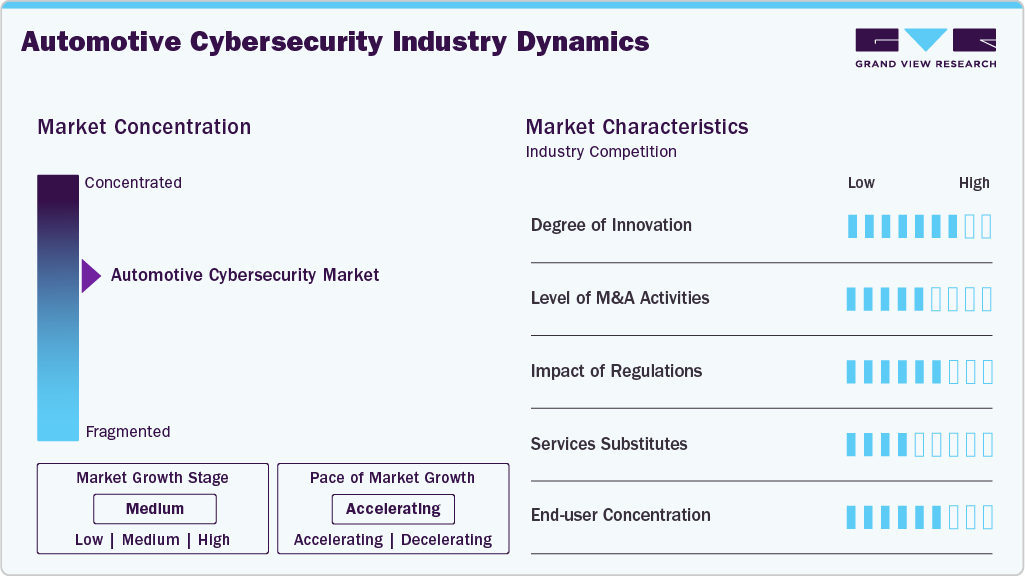
The automotive cybersecurity market is moderately concentrated, with a mix of established automotive suppliers, global cybersecurity companies, and specialized vehicle security startups competing across the ecosystem. Large players such as Bosch, Continental, Harman, Aptiv, and PlaxidityX hold notable market positions due to their strong OEM partnerships, integrated cybersecurity platforms, and expertise in embedded vehicle systems. However, the market also remains partially fragmented because of the presence of niche vendors offering specialized solutions for intrusion detection systems (IDS/IDPS), secure over-the-air (OTA) updates, V2X communication security, cloud-based vehicle protection, and ECU security.
 To learn more about this report, Download Free Sample Report
 In terms of characteristics, the market demonstrates a high degree of innovation, driven by the rapid adoption of connected vehicles, autonomous driving technologies, and advanced cryptographic solutions. The industry is also witnessing moderate-to-high M&A activity, as major automotive and cybersecurity firms acquire niche technology providers to strengthen cybersecurity portfolios and expand vehicle security capabilities. Regulatory impact is significant, with standards such as UNECE WP.29, UNECE R155/R156, and ISO/SAE 21434 compelling automakers and suppliers to integrate cybersecurity throughout the vehicle lifecycle. Service substitutes remain relatively limited, as cybersecurity solutions are becoming mandatory components of connected vehicle architectures rather than optional add-ons. Additionally, the market exhibits high end-user concentration, as demand is primarily concentrated among automotive OEMs and Tier-1 suppliers that directly procure cybersecurity solutions for connected and autonomous vehicle platforms.
Security Type Insights
The wireless network segment dominated the market and accounted for a revenue share of 43.0% in 2025 due to the rapid expansion of in-vehicle and external connectivity technologies. Modern vehicles increasingly rely on wireless interfaces such as Wi-Fi, Bluetooth, cellular (4G/5G), and V2X (vehicle-to-everything) communication for infotainment, navigation, remote diagnostics, and connected services. Each of these interfaces represents a potential entry point for cyber threats, driving the need for advanced wireless security solutions such as secure communication protocols, encryption layers, and intrusion detection systems specifically designed for wireless environments.
The application segment is anticipated to grow at the highest CAGR during the forecast period as vehicles become increasingly software-driven and reliant on complex applications for core and auxiliary functions. Modern vehicles integrate a wide range of applications, including infotainment systems, navigation platforms, advanced driver-assistance systems (ADAS), and telematics software. These applications process sensitive data and control critical vehicle functions, making them prime targets for cyberattacks.
Vehicle Type Insights
The passenger car segment dominated the market and accounted for the largest revenue share in 2025, driven by the rapid proliferation of connected car technologies in personal vehicles. Modern passenger cars are increasingly equipped with features such as infotainment systems, smartphone integration, telematics, and cloud-based services, all of which rely on continuous data exchange. This high level of connectivity significantly expands the attack surface, prompting automakers to integrate robust cybersecurity solutions to protect user data, communication networks, and vehicle control systems.
The electric vehicle segment is expected to grow at a significant CAGR during the forecast period due to its inherently software-centric and highly connected architecture. Unlike traditional internal combustion engine vehicles, EVs rely extensively on electronic control systems, battery management software, and cloud-connected platforms for performance optimization and energy efficiency. This deep integration of software and connectivity significantly expands the cyberattack surface, prompting automakers to embed advanced cybersecurity measures across vehicle systems, thereby driving demand for specialized security solutions in the EV segment.
Service Insights
The in-vehicle services segment dominated the market and accounted for the largest revenue share in 2025 due to the rapid expansion of digital services embedded within vehicles. Modern vehicles now offer a wide range of in-vehicle services, including infotainment, navigation, remote diagnostics, voice assistants, and personalized user experiences. These services rely heavily on continuous data exchange and software integration, making them highly susceptible to cyber threats.
The external cloud services segment is expected to grow at a significant CAGR during the forecast period due to the expansion of connected car ecosystems and backend platforms. Automakers are leveraging cloud services to enable functionalities such as remote vehicle monitoring, predictive maintenance, fleet management, and software updates. These backend systems serve as centralized hubs for vehicle operations, making them attractive targets for cyberattacks.
Application Insights
The infotainment segment dominated the market and accounted for the largest revenue share in 2025, owing to the widespread adoption of smartphone integration technologies such as Apple CarPlay, Android Auto, and in-vehicle app stores. These integrations enable seamless connectivity between personal devices and vehicle systems, but they also introduce potential vulnerabilities through third-party applications and external interfaces. Ensuring secure data exchange, app sandboxing, and controlled access to vehicle functions is critical, leading to increased demand for application-layer security and secure interface protocols within infotainment systems.
 To learn more about this report, Download Free Sample Report
 The powertrain segment is expected to grow at a significant CAGR over the forecast period due to the rising adoption of electric and hybrid powertrains, which rely heavily on advanced software for battery management, motor control, and energy optimization. These systems require real-time communication between multiple components, such as inverters, battery management systems (BMS), and thermal controls. Any cyber compromise in these applications can directly impact vehicle performance or safety.
Regional Insights
North America automotive cybersecurity market held a significant share in the global market in 2025, driven by the strong presence of advanced automotive and technology ecosystems, particularly the deep integration of cybersecurity into vehicle engineering processes. Automakers in this region are early adopters of secure-by-design development frameworks, embedding cybersecurity into vehicle architecture from the initial design phase.
U.S. Automotive Cybersecurity Market Trends
The automotive cybersecurity market in the U.S. is expected to grow significantly at a CAGR of 15.2% from 2026 to 2033, due to increasing federal involvement and cybersecurity policy development specific to transportation systems. Agencies are actively working on guidelines for vehicle cybersecurity resilience, which is encouraging automakers to align with national security priorities.
Europe Automotive Cybersecurity Market Trends
The automotive cybersecurity market in Europe is anticipated to register considerable growth from 2026 to 2033 due to regulatory enforcement and standardization across the automotive industry. The region has established itself as a benchmark for compliance-driven cybersecurity adoption, where strict homologation requirements are accelerating implementation across OEMs.
The UK automotive cybersecurity market is expected to grow rapidly in the coming years due to its focus on building secure connected and autonomous vehicle (CAV) ecosystems through public-private collaboration. Government-backed innovation programs and testbeds for smart mobility are encouraging the development of cybersecurity solutions tailored to real-world deployment scenarios.
The automotive cybersecurity market in Germany held a substantial market share in 2025 due to its strong manufacturing base and leadership in premium and high-performance vehicles, where cybersecurity is critical to maintaining brand integrity and engineering excellence. German automakers are heavily investing in securing complex vehicle architectures, particularly in high-end models that incorporate advanced digital features.
Asia Pacific Automotive Cybersecurity Market Trends
The automotive cybersecurity market in Asia Pacific dominated the global industry with the largest revenue share of 35.8% in 2025, due to large-scale vehicle production and increasing digital transformation across emerging economies. The region’s expanding middle-class population is driving demand for connected vehicles, prompting automakers to integrate cybersecurity into mass-market models.
 To learn more about this report, Download Free Sample Report
 Japan automotive cybersecurity market is expected to grow rapidly in the coming years, driven by its emphasis on precision engineering and the integration of cybersecurity into high-reliability automotive systems. Japanese automakers are focusing on ensuring the robustness and fault tolerance of vehicle systems, particularly in hybrid and advanced mobility solutions.
The automotive cybersecurity market in China held a substantial market share in 2025, due to the government’s strong push for data sovereignty and control over vehicle-generated data. Regulatory frameworks in China emphasize local data storage, monitoring, and cybersecurity compliance, compelling automakers to adopt domestically aligned security solutions.
Key Automotive Cybersecurity Companies Insights
Key players operating in the automotive cybersecurity industry are PlaxidityX, ETAS, Robert Bosch GmbH, Continental AG, AUTOCRYPT Co., Ltd., and DENSO Corporation. The companies are focusing on various strategic initiatives, including new product development, partnerships & collaborations, and agreements to gain a competitive advantage over their rivals. The following are some instances of such initiatives.
-
In December 2025, AUTOCRYPT Co., Ltd. announced the launch of its next-generation Public Key Infrastructure (PKI) solution designed to support post-quantum cryptography for automotive applications. The new offering incorporates ML-DSA, a quantum-resistant digital signature algorithm, positioning the company among the early movers in commercializing PQC-enabled PKI tailored for automotive OEMs. The solution is engineered to support real-world certificate issuance under this emerging framework, enabling enhanced security for connected vehicle ecosystems and future-proofing cryptographic infrastructures against evolving quantum threats.
-
In June 2025, ETAS and ThunderSoft announced a strategic collaboration to introduce a newly developed multi-domain middleware solution tailored for high-performance computing (HPC) SoC-based vehicle architectures. The joint solution features a co-developed Vehicle Hardware Abstraction Layer (VHAL) gateway, designed to enable seamless, high-speed bidirectional communication between safety-critical systems and in-vehicle infotainment (IVI) platforms, delivering ultra-low latency and high bandwidth performance. Optimized for hypervisor-based environments, the platform is engineered to meet stringent functional safety and automotive cybersecurity requirements, supporting the evolution of software-defined vehicles.
-
In March 2025, PlaxidityX entered into a strategic collaboration with Deloitte to deliver a comprehensive Vehicle Security Operations Center (VSOC) solution aimed at strengthening protection against increasingly sophisticated automotive cyber threats. The joint offering combines advanced threat detection, continuous monitoring, and incident response capabilities to address the expanding attack surface in connected and software-defined vehicles, enabling automakers and mobility providers to enhance real-time cybersecurity resilience across their fleets.
Key Automotive Cybersecurity Companies:
The following key companies have been profiled for this study on the automotive cybersecurity market.
- Aptiv PLC
- AUTOCRYPT Co., Ltd.
- Broadcom Inc.
- C2A Security
- Continental AG
- Denso Corporation
- ETAS
- Harman International
- Honeywell International, Inc.
- Karamba Security
- NXP Semiconductors N.V.
- PlaxidityX
- Robert Bosch GmbH
- Trillium Secure
- Vector Informatik GmbH
Competitive Benchmarking
Operating Strategies
Competitive Edge
Weakness
Mature Players: Robert Bosch GmbH; Continental AG; Denso Corporation; Aptiv PLC; Honeywell International, Inc.; NXP Semiconductors N.V.; Broadcom Inc.; Vector Informatik GmbH; ETAS; Harman International
- Embedding cryptographic features directly into ECUs and system-on-chip architectures to secure vehicle hardware.
- Bundling cybersecurity software with broad automotive architecture services, tying compliance testing tools directly to the vehicle development process.
- Acquiring or backing high-performing software units to absorb specialized cybersecurity engineering talent.
- Entrenched multi-decade partnerships with major global Automotive OEMs, guaranteeing their security protocols are built into vehicle assemblies.
- The financial muscle to build extensive Type Approval and UN R155 compliance auditing capabilities, providing a "one-stop regulatory shop" for car manufacturers.
- Ability to align software-level firewalls with extreme physical constraints, temperature requirements, and long-life cycles of automotive hardware.
- Their sheer corporate scale can slow down the deployment of real-time patches to combat newly discovered over-the-air zero-day exploits.
- Integrating modern, cloud-native DevSecOps software with older "on-premise" embedded ECU code legacy architectures can introduce system friction.
- Cybersecurity represents only a single segment of their massive, diversified hardware portfolios, sometimes leading to slower algorithmic innovation compared to specialized pure plays.
Emerging Players: PlaxidityX (formerly Argus Cyber Security); C2A Security; Karamba Security; AUTOCRYPT Co., Ltd.; Trillium Secure
- Focusing on "shifting left" by offering automated TARA software that scans code vulnerabilities from the design phase to the connected car.
- Deploying hyper-focused V-SOC software to monitor live fleet telemetry and instantly identify CAN/Ethernet network anomalies.
- Designing lightweight, hardware-agnostic software agents that easily overlay onto any third-party Tier-1 microcontroller without requiring a total system overhaul.
- Ability to rapidly iterate on threat intelligence models and ship out security updates against zero-day mobility threats faster than traditional hardware-bound vendors.
- Dedicated exclusively to mobility cybersecurity, allowing them to lead technical breakthroughs in complex areas.
- Offering highly intuitive, cloud-native user interfaces that allow automotive software engineers to manage and visualize risk profiles.
- Rely heavily on Tier-1 hardware suppliers to integrate their software code onto the production line.
- Restructured or smaller balance sheets mean they lack the global, 24/7 on-the-ground engineering support scale demanded by multi-brand multinational automotive syndicates.
- OEMs frequently look to pare down their supplier base, leaving point-product security firms vulnerable to being sidelined by full-suite platform offerings from larger industrial titans.
Automotive Cybersecurity Market Report Scope
Report Attribute
Details
Market size in 2025
USD 7.7 billion
Estimated market size in 2026
USD 8.8 billion
Projected market size by 2033
USD 24.8 billion
Growth rate
CAGR of 15.9% from 2026 to 2033
Actual data
2021 - 2025
Forecast period
2026 - 2033
Quantitative units
Revenue in USD million/billion and CAGR from 2026 to 2033
Report coverage
Revenue forecast, company share, competitive landscape, growth factors, and trends
Segments covered
Security type, vehicle type, service, application, region
Regional scope
North America; Europe; Asia Pacific; Latin America; MEA
Country scope
U.S.; Canada; Mexico; UK; Germany; France; China; India; Japan; Australia; South Korea; Brazil; UAE; Saudi Arabia; South Africa
Key companies profiled
Aptiv PLC; PlaxidityX; Broadcom Inc.; C2A Security; Continental AG; Denso Corporation; ETAS; Harman International; Honeywell International, Inc.; Karamba Security; NXP Semiconductors N.V.; Robert Bosch GmbH; AUTOCRYPT Co., Ltd.; Trillium Secure; Vector Informatik GmbH
Customization scope
Free report customization (equivalent to 8 analysts working days) with purchase. Addition or alteration to country, regional & segment scope.
Pricing and purchase options
Avail customized purchase options to meet your exact research needs. Explore purchase options
Global Automotive Cybersecurity Market Report Segmentation
This report forecasts revenue growth at the global, regional, and country levels and provides an analysis of the latest industry trends in each of the sub-segments from 2021 to 2033. For this study, Grand View Research has segmented the global automotive cybersecurity market report based on security type, vehicle type, service, application, and region:
-
Security Type Outlook (Revenue, USD Billion, 2021 - 2033)
-
Endpoint
-
Application
-
Wireless Network
-
-
Vehicle Type Outlook (Revenue, USD Billion, 2021 - 2033)
-
Passenger Car
-
Commercial Vehicle
-
Electric Vehicle
-
-
Service Outlook (Revenue, USD Billion, 2021 - 2033)
-
In-vehicle Services
-
External Cloud Services
-
-
Application Outlook (Revenue, USD Billion, 2021 - 2033)
-
ADAS & Safety System
-
Infotainment
-
Body Electronics
-
Powertrain
-
Telematics
-
-
Regional Outlook (Revenue, USD Billion, 2021 - 2033)
-
North America
-
U.S.
-
Canada
-
Mexico
-
-
Europe
-
UK
-
Germany
-
France
-
-
Asia Pacific
-
China
-
India
-
Japan
-
South Korea
-
Australia
-
-
Latin America
-
Brazil
-
-
Middle East & Africa
-
UAE
-
Saudi Arabia
-
South Africa
-
-
Delivered Customizations
This report has been delivered with the following In-depth customizations
Client Request
Customization Delivered
Value Adds
Automotive cybersecurity market landscape assessment for a connected vehicle technology provider
- Analysis of regulatory landscape (UNECE WP.29, ISO/SAE 21434) across key regions (North America, Europe, APAC)
- Evaluation of cybersecurity architecture across connected, autonomous, and software-defined vehicles
- Supported market entry and expansion strategy for connected vehicle security solutions
- Identified high-growth regions and regulatory-driven adoption hotspots
Competitive benchmarking of automotive cybersecurity vendors for an OEM cybersecurity strategy team
- Comparative assessment of leading vendors across product offerings, threat detection capabilities, and deployment models
- Analysis of partnerships between OEMs and cybersecurity providers
- Identified competitive positioning gaps and differentiation opportunities
- Supported vendor selection and partnership strategy for OEM cybersecurity stack
Connected vehicle threat intelligence and risk assessment for an automotive software provider
- Assessment of emerging cyber threats, including V2X attacks, OTA update vulnerabilities, ECU hijacking, and infotainment system breaches
- Evaluation of incident trends and attack vectors in connected and electric vehicles
- Highlighted critical vulnerability areas across vehicle architectures
- Supported development of advanced intrusion detection and real-time threat monitoring solutions
Frequently Asked Questions About This Report
The global automotive cybersecurity market size was estimated at USD 7.7 billion in 2025 and is expected to reach USD 8.8 billion in 2026.
Asia Pacific dominated the global market with the largest revenue share of 35.8% in 2025.
Key players include Aptiv PLC, PlaxidityX, Broadcom Inc., C2A Security, Continental AG, Denso Corporation, ETAS, Harman International, Honeywell International, Inc., Karamba Security, NXP Semiconductors N.V., Robert Bosch GmbH, AUTOCRYPT Co., Ltd., Trillium Secure, Vector Informatik GmbH
Key factors that are driving the market growth include the rapid integration of advanced connectivity features such as V2X (vehicle-to-everything), telematics, over-the-air (OTA) updates, and infotainment systems. These technologies expand the attack surface, making vehicles more vulnerable to cyber threats.
The wireless network segment led with a 43.0% revenue share in 2025, while application is the fastest-growing segment.
The passenger car held the largest revenue share in 2025.
The infotainment held the largest share in 2025.
The global automotive cybersecurity market is expected to grow at a compound annual growth rate of 15.9% from 2026 to 2033 to reach USD 24.8 billion by 2033.
About the Author(s)
Automotive & Transportation Research Team
Technology · Automotive & TransportationThis report was authored by the automotive & transportation research team at Grand View Research - comprising two research analysts, one senior research analyst, and one industry expert - with specialized expertise in the automotive & transportation segment of the technology industry. All findings are based on proprietary technology databases, executive interviews, and regulatory analysis, subject to internal peer review prior to publication.
Last Updated:
Speak to Analyst

Customize this report to your needs - add regions, segments, or data points, with 20% free customization.
Or view our licence options:


ISO 9001:2015 & 27001:2022 Certified
We are GDPR and CCPA compliant! Your transaction & personal information is safe and secure. For more details, please read our privacy policy.


