
- Home
- »
- Next Generation Technologies
- »
-
Automotive Internet of Things Market Size Report, 2026-2033GVR Report cover

Automotive Internet Of Things Market (2026 - 2033)
Size, Share & Trends Analysis Report By Component (Hardware, Software, Services), By System (Embedded, Tethered, Integrated), By Application, By Region, And Segment Forecasts
Market Size, 2025
$205.5BMarket Estimate, 2026
$229.8BMarket Forecast, 2030
$554.3BCAGR, 2026–2030
13.4%Automotive Internet of Things Market Summary
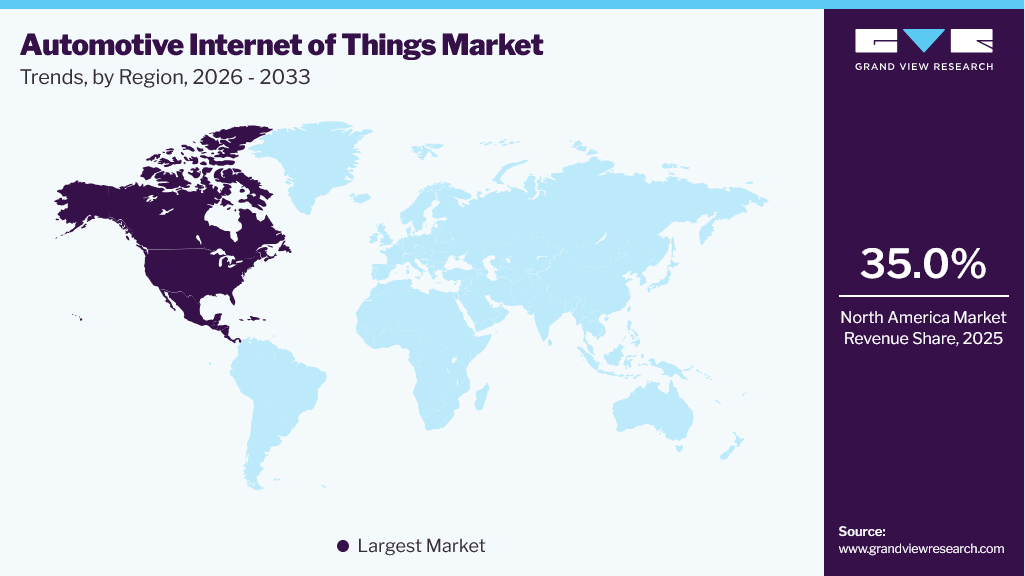
The global automotive Internet of Things market was valued at USD 205.5 billion in 2025 and is projected to grow from USD 229.8 billion in 2026 to USD 554.3 billion in 2033, at a CAGR of 13.4% from 2026 to 2033. North America dominated the market, accounting for a revenue share of 35.0% in 2025. The growing need for connected cars to enhance user comfort and convenience is a significant factor driving growth in the automotive IoT (Internet of Things) market.
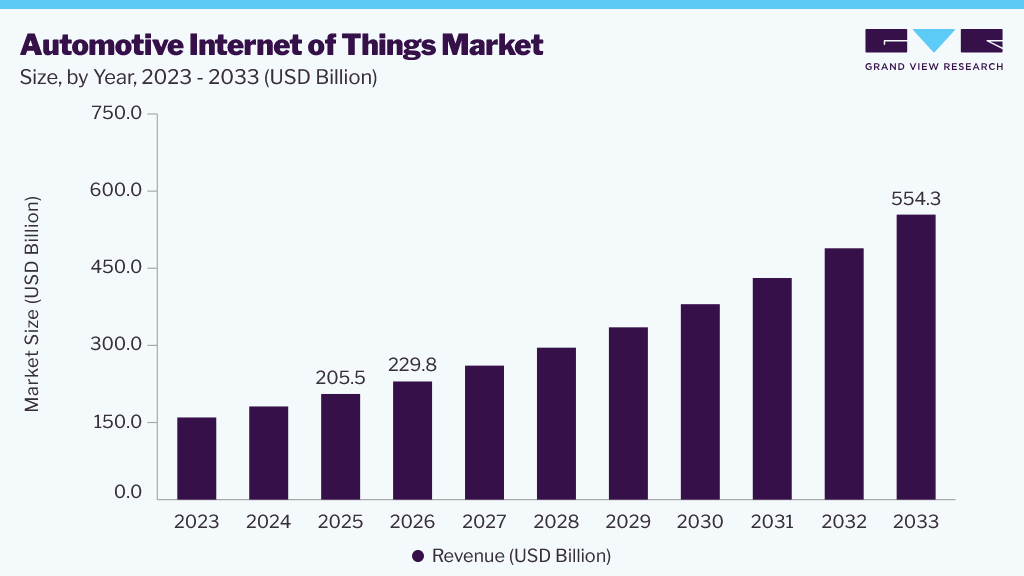 Source: Grand View Research, IR Documents, Primary Interviews, Paid DatabasesTo learn more about this report,
 Download Free Sample Report
Key Market Trends & Insights
- By component: The hardware segment held the largest market share of over 55.0% in 2025.
- By system: The embedded system held the largest market share in 2025.
- By application: The telematics segment held the largest market share in 2025.
Regional Highlights
- Largest regional market: North America (35.0% revenue share, 2025)
- Fastest-growing regional market: Europe (highest CAGR, 2026-2033)
Market Size & Forecast
- Market size in 2025: USD 205.5 Billion
- Estimated market size in 2026: USD 229.8 Billion
- Projected market size by 2033: USD 554.3 Billion
- CAGR (2026-2033): 13.4%
Three ways to get this report
Buy it, customize it, or ask a question.Ask an Analyst
Analyst response in 1 business day
- AccessReport author, directly
- Reply timeWithin 1 working day
- No sales callDirect answer only
- FormatEmail reply
- CostFree, no cost
Get the Full Report
What the study covers
- FormatsPDF · Excel · Dashboard
- Timeline2026–2030 annual, 2025 base
- Coverage20+ countries, 5 regions
- Companies10+ key players profiled
Customize the Report
20% free customization
- IncludeCountries, segments, points
- TailorTo your product definition
- ExtendDeeper competitor detail
- OrA fully bespoke study
- Turnaround5–10 working days
As consumers increasingly seek enhanced in-vehicle experiences, ranging from infotainment systems to real-time vehicle diagnostics, automakers are integrating Internet of Things (IoT) solutions to meet these expectations. The incorporation of IoT in vehicles also leads to improved safety features and more efficient vehicle management, attracting a broader consumer base and stimulating market growth.
Additionally, advancements in wireless communication technologies are further driving the automotive IoT market. The deployment of 5G networks ensures high-speed data transmission, low latency, and better connectivity, all of which are essential for the seamless operation of connected vehicles. This facilitates real-time data exchange between vehicles and infrastructure, enhancing the driving experience and supporting the development of autonomous driving technologies. These developments not only boost market growth but also create opportunities for innovation in vehicle-to-everything (V2X) communication.
Government initiatives and regulations aimed at promoting vehicle safety and emissions standards are also contributing to the growth of the automotive IoT market. Legislation that mandates the incorporation of advanced safety features, such as emergency call systems (eCall), along with stringent emission monitoring, is compelling manufacturers to adopt IoT technologies. These regulations underscore the importance of technology in addressing safety and environmental concerns, ultimately driving market expansion as both manufacturers and consumers prioritize sustainable, safe driving experiences.
Moreover, the global rise in smart city projects is driving demand for automotive IoT solutions. As urban areas strive to enhance mobility and reduce traffic congestion, integrating IoT into transportation is essential. Smart city initiatives support the development of intelligent transportation systems (ITS) that leverage IoT for traffic management, smart parking, and connected public transit. This aligns with broader goals of sustainability and efficient urban planning, contributing to the growth of the automotive IoT market.
Furthermore, the growing consumer focus on vehicle health monitoring and predictive maintenance is expected to drive additional growth in the automotive IoT market. With IoT-enabled devices, vehicle owners can receive real-time updates on their vehicle's condition and maintenance needs, helping them avoid costly repairs and downtime. The trend toward predictive maintenance is fueled by a desire for longevity and efficiency in vehicle usage, encouraging the adoption of IoT technologies in the automotive sector. The convenience and potential cost savings of these technologies make them increasingly attractive to consumers, thereby promoting market growth in the coming years.
Analyst Perspective
The automotive Internet of Things market is moving beyond basic vehicle connectivity toward a more integrated digital mobility ecosystem. Connected vehicles are increasingly being used to support real-time diagnostics, predictive maintenance, fleet management, and enhanced in-car experiences. As automakers compete on software capabilities and user experience, IoT integration is becoming a key differentiator rather than an optional feature. Companies with strong connectivity infrastructure, data analytics expertise, and partnerships across automotive and technology sectors are likely to strengthen their market position. The growing adoption of electric and autonomous vehicles is also accelerating demand for connected systems that can improve vehicle performance and operational efficiency. Over time, the market is expected to favor platforms that can securely manage large volumes of vehicle data while enabling seamless communication between vehicles, users, and broader smart transportation networks.
Component Insights
By component, the hardware segment dominated the market, accounting for around 55.0% of revenue in 2025, driven by the increasing integration of advanced sensors, connectivity modules, and computing devices in vehicles. These components are essential for enabling real-time data collection, processing, and communication, which are crucial for applications such as ADAS, autonomous driving, and vehicle-to-everything (V2X) communication. Additionally, the rising demand for electric vehicles (EVs) and connected car technologies further drives the need for advanced hardware solutions, thereby driving the segment growth.
The services segment is expected to record the highest CAGR from 2026 to 2033. The segment is experiencing significant growth due to the increasing demand for data-driven insights and connectivity solutions. Companies are offering advanced analytics, telematics, and remote diagnostics services that enhance vehicle performance and safety. The rise of connected car ecosystems and the need for continuous software updates and cybersecurity measures are driving this expansion. For instance, in March 2025, Telenor IoT established a dedicated global automotive business unit to expand its range of connectivity and digital services for automakers. The initiative was launched to support growing demand for over-the-air updates, connected vehicle services, and software-defined vehicle capabilities, reinforcing the importance of service-based offerings within the automotive IoT ecosystem. As a result, automakers and service providers are collaborating to deliver comprehensive IoT-enabled services that are expected to support the segment's expansion.
Application Insights
Based on application, the telematics segment accounted for the highest market share in 2025. Segment growth is driven by increasing demand for connected car services and fleet management solutions. Telematics systems provide real-time data on vehicle location, diagnostics, driver behavior, and fuel efficiency, enhancing operational efficiency and safety. Additionally, the integration of telematics with insurance models, such as usage-based insurance (UBI), is driving its adoption. For instance, in April 2025, Geotab introduced new AI-powered telematics capabilities within its connected vehicle platform to help fleet operators improve vehicle utilization, safety monitoring, and predictive maintenance. The enhancement strengthens the role of advanced telematics solutions in enabling data-driven fleet management and connected mobility services.
The infotainment segment is anticipated to expand at the highest CAGR from 2026 to 2033. The growth of the infotainment segment can be attributed to the increasing consumer demand for enhanced in-car experiences. Modern drivers seek advanced features such as real-time navigation, streaming services, and seamless smartphone integration, all facilitated by IoT technology. Automakers are increasingly implementing sophisticated infotainment systems to differentiate their offerings and meet customer expectations. This trend is further accelerated by advancements in connectivity and the proliferation of smart devices, driving continuous innovation and adoption in the infotainment segment.
System Insights
Based on the system, the embedded segment held the highest revenue share in 2025 due to the increasing integration of smart technologies into vehicles. These systems, which include microcontrollers, sensors, and real-time operating systems, are essential for enabling advanced features such as autonomous driving, vehicle-to-everything (V2X) communication, and predictive maintenance. The demand for enhanced safety, efficiency, and connectivity in modern vehicles is driving the adoption of embedded systems. For instance, in March 2025, Infineon Technologies announced the launch of a new automotive microcontroller family, the AURIX, based on the RISC-V architecture. The new embedded microcontrollers are designed to support software-defined vehicles and a wide range of connected automotive applications, enabling enhanced real-time processing, functional safety, cybersecurity, and software portability.
The integrated segment is estimated to register the highest growth rate from 2026 to 2033. The growth is attributed to the increasing demand for comprehensive solutions that seamlessly combine hardware, software, and connectivity. These systems enable efficient communication between various vehicle components, enhancing functionalities such as advanced driver assistance systems (ADAS), infotainment, and predictive maintenance. As automakers and consumers prioritize safety, convenience, and overall driving experience, the adoption of integrated IoT systems is rapidly expanding.
Regional Insights
The North America automotive IoT market accounted for the highest revenue share, over 35.0%, in 2025. The North American automotive IoT market is driven by significant technological advancements and investments in smart transportation infrastructure, promoting the widespread adoption of connected vehicle technologies. For instance, in March 2025, HARMAN introduced Ready Aware, a new Vehicle-to-Network (V2N) solution that delivers near real-time contextual information to connected vehicles. The platform uses cloud connectivity, machine learning, and vehicle network communications to provide hazard alerts and enhanced situational awareness, strengthening the adoption of IoT-enabled connected vehicle services across North America.
 To learn more about this report, Download Free Sample Report
U.S. Automotive Internet of Things Market Trends
The automotive Internet of Things market in the U.S. is anticipated to grow at a notable CAGR from 2026 to 2033. In the U.S., the growth of the automotive IoT market is fueled by extensive R&D initiatives, a robust tech ecosystem, and government regulations focused on enhancing vehicle safety and emissions control.
Europe Automotive Internet of Things Market Trends
The growth of the automotive Internet of Things market in Europe is driven by stringent regulations that promote vehicle safety and emissions standards, coupled with increasing investment in autonomous driving technologies. For instance, in January 2025, Samsara expanded its strategic collaboration with Stellantis through an integration with Mobilisights, Stellantis' Data-as-a-Service platform. The collaboration enables businesses across Europe to access real-time telematics data from millions of connected vehicles without requiring additional hardware, supporting smarter fleet management, predictive maintenance, and connected vehicle services.
The UK automotive IoT market is projected to grow at a notable CAGR from 2026 to 2033. In the UK, growth is driven by a strong emphasis on electric vehicle adoption, supported by government incentives and the development of charging infrastructure.
The automotive IoT market in Germany is expected to grow significantly from 2026 to 2033. Germany's growth is fueled by robust automotive manufacturing capabilities, a focus on Industry 4.0 initiatives, and leadership in developing advanced automotive technologies, including connected vehicles and smart manufacturing solutions.
Key Automotive Internet of Things Company Insights
The automotive Internet of Things industry features a range of global, regional, and local players, making it a competitive market. The world’s leading companies are using partnerships, collaborations, acquisitions, mergers, and agreements as strategies to withstand the intense competition and increase their market share.
Key Automotive Internet of Things Companies
The following key companies have been profiled for this study on the automotive Internet of Things market:
-
NXP Semiconductors N.V.
-
HARMAN International Industries, Inc.
-
Robert Bosch GmbH
-
Thales S.A.
-
IBM Corporation
-
Texas Instruments Incorporated
-
Microsoft Corporation
-
Intel Corporation
-
Verizon Communications Inc.
-
QUALCOMM Incorporated
Recent Developments
-
In January 2026, Qualcomm announced expanded adoption of its Snapdragon Digital Chassis solutions along with new AI-powered connected vehicle capabilities. The technologies integrate automotive 5G connectivity, edge AI, digital cockpit systems, and software-defined vehicle architectures to support real-time data exchange, intelligent in-vehicle experiences, and enhanced vehicle connectivity, further advancing the automotive IoT market.
-
In September 2025, Telenor IoT launched IoT Drive, a dedicated connectivity platform developed for software-defined and connected vehicles. The solution provides automakers with global IoT connectivity, infotainment integration, and regulatory compliance support, helping to simplify connected-vehicle ecosystem management and accelerate automotive IoT adoption.
-
In June 2025, QNX and Vector Informatik signed a memorandum of understanding to develop a foundational software platform for software-defined vehicles. The platform combines QNX’s safety-certified operating system with Vector’s middleware technologies to support connected-vehicle development, over-the-air updates, and the deployment of IoT-enabled automotive applications.
Automotive Internet of Things Market Report Scope
Report Attribute
Details
Market size in 2025
USD 205.5 billion
Estimated market size in 2026
USD 229.8 billion
Projected market size by 2033
USD 554.3 billion
Growth rate
CAGR of 13.4% from 2026 to 2033
Base year for estimation
2025
Actual data
2021 – 2024
Forecast period
2026 – 2033
Quantitative units
Revenue in USD billion, and CAGR from 2026 to 2033
Report coverage
Revenue forecast, company ranking, competitive landscape, growth factors, and trends
Segments covered
Component, system, application, region
Regional Scope
North America; Europe; Asia Pacific; Latin America; Middle East & Africa
Country Scope
U.S.; Canada; Mexico; Germany; UK; France; Italy; China; Japan; India; Australia; South Korea; Brazil; UAE; Saudi Arabia; South Africa
Key companies profiled
NXP Semiconductors N.V.; HARMAN International Industries, Inc.; Robert Bosch GmbH; Thales S.A.; IBM Corporation; Texas Instruments Incorporated; Microsoft Corporation; Intel Corporation; Verizon Communications Inc.; QUALCOMM Incorporated
Customization scope
Free report customization (equivalent up to 8 analysts working days) with purchase. Addition or alteration to country, regional & segment scope.
Pricing and purchase options
Avail of customized purchase options to meet your exact research needs. Explore purchase options
Global Automotive Internet of Things Market Report Segmentation
This report forecasts revenue growth at global, regional, and country levels and provides an analysis of the latest industry trends and opportunities in each of the sub-segments from 2021 to 2033. For the purpose of this study, Grand View Research has segmented the global automotive Internet of Things market report based on component, system, application, and region:
-
Component Outlook (Revenue, USD Million, 2021 - 2033)
-
Hardware
-
Software
-
Services
-
-
System Outlook (Revenue, USD Million, 2021 - 2033)
-
Embedded
-
Tethered
-
Integrated
-
-
Application Outlook (Revenue, USD Million, 2021 - 2033)
-
Navigation
-
Telematics
-
Infotainment
-
-
Regional Outlook (Revenue, USD Million, 2021 - 2033)
-
North America
-
U.S.
-
Canada
-
Mexico
-
-
Europe
-
Germany
-
UK
-
France
-
Italy
-
-
Asia Pacific
-
Japan
-
China
-
India
-
Australia
-
South Korea
-
-
Latin America
-
Brazil
-
-
Middle East and Africa (MEA)
-
UAE
-
Saudi Arabia
-
South Africa
-
-
Frequently Asked Questions About This Report
The global automotive internet of things market size was estimated at USD 205.5 billion in 2025 and is expected to reach USD 229.8 billion in 2026.
The global automotive internet of things market is expected to grow at a compound annual growth rate of 13.4% from 2026 to 2033 to reach USD 554.3 billion by 2033.
Component dominated the automotive internet of things market with a share of 55.0% in 2025, while services is the fastest-growing segment.
Some key players operating in the automotive IoT market include NXP Semiconductors N.V., HARMAN International Industries, Inc., Robert Bosch GmbH, Thales S.A., IBM Corporation, Texas Instruments Incorporated, Microsoft Corporation, Intel Corporation, Verizon Communications Inc., QUALCOMM Incorporated.
North America dominated with a 35.0% revenue share in 2025.
About the Author(s)
Next Generation Technologies Research Team
Technology · Next Generation TechnologiesThis report was authored by the next generation technologies research team at Grand View Research - comprising two research analysts, one senior research analyst, and one industry expert - with specialized expertise in the next generation technologies segment of the technology industry. All findings are based on proprietary technology databases, executive interviews, and regulatory analysis, subject to internal peer review prior to publication.
Last Updated:
Speak to Analyst

Customize this report to your needs - add regions, segments, or data points, with 20% free customization.
Or view our licence options:


ISO 9001:2015 & 27001:2022 Certified
We are GDPR and CCPA compliant! Your transaction & personal information is safe and secure. For more details, please read our privacy policy.


