
- Home
- »
- Automotive & Transportation
- »
-
Automotive Leaf Spring Market Size & Share Report, 2033GVR Report cover

Automotive Leaf Spring Market (2026 - 2033)
Size, Share & Trends Analysis By Type (Semi-elliptic, Parabolic, Elliptic) By Material (Steel, Composite), By Vehicle Type (Light Commercial Vehicles, Passenger Cars), By Sales Channel (OEMs, Aftermarket), By Region, And Segment Forecasts
Market Size, 2025
$11.1BMarket Estimate, 2026
$11.8BMarket Forecast, 2033
$20.0BCAGR, 2026–2033
7.8%Automotive Leaf Spring Market Summary
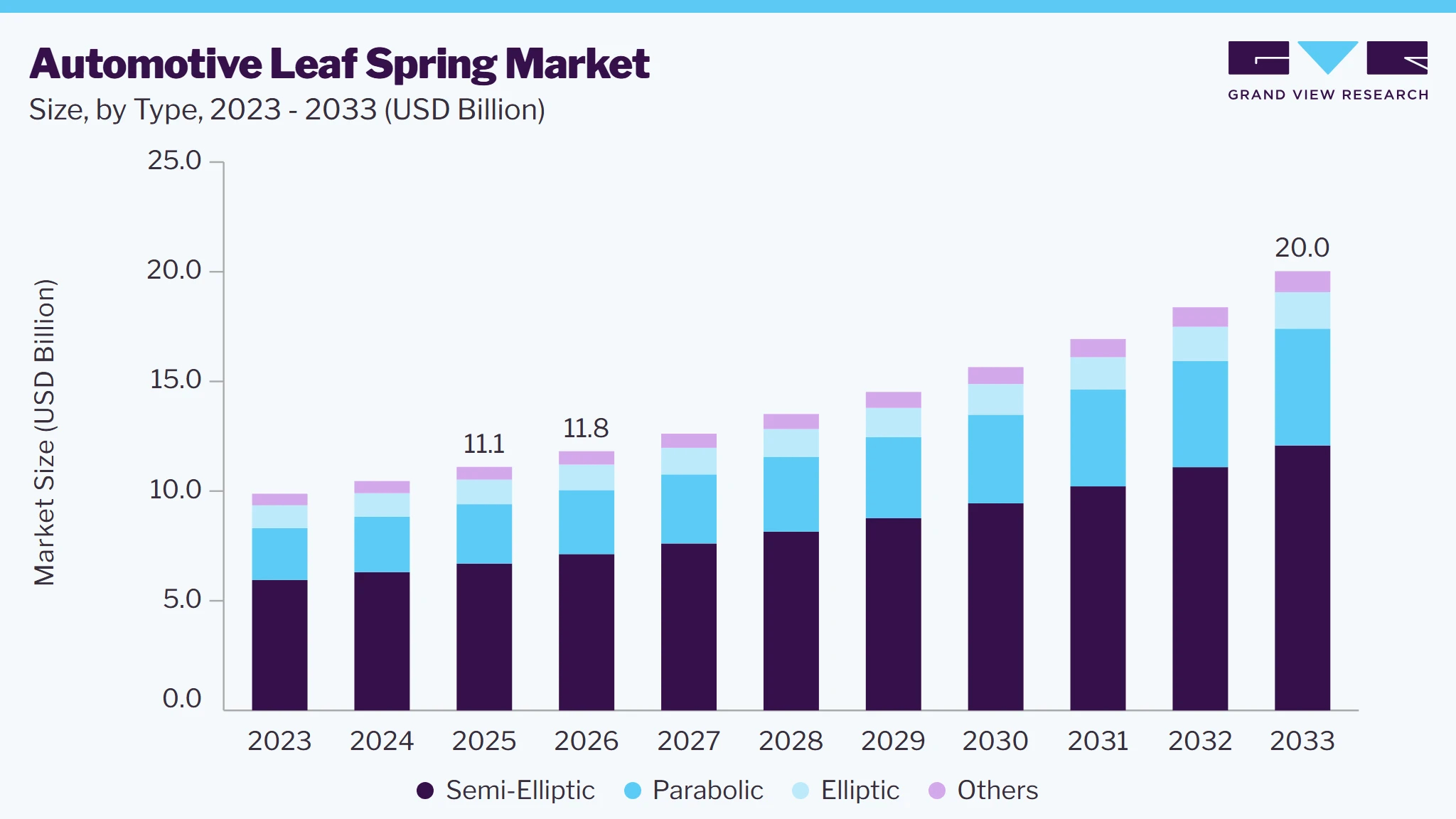
The global automotive leaf spring market size was valued at USD 11.1 billion in 2025 and is projected to grow from USD 11.8 billion in 2026 to USD 20.0 billion by 2033, growing at a CAGR of 7.8% from 2026 to 2033. Asia pacific market dominated, with a revenue share of 44.6% in 2025. The increasing demand for durable, lightweight, and cost-effective suspension systems across commercial vehicles is accelerating the growth of the automotive leaf spring market.
 Source: Grand View Research, IR Documents, Primary Interviews, Paid DatabasesTo learn more about this report,
 Download Free Sample Report
Key Market Trends & Insights
- By type: Semi-elliptic segment accounted for the largest revenue share of 60.3% in 2025.
- By material, Steel segment led the market and accounted for 74.2% of the global revenue in 2025.
- By vehicle type: Medium & heavy commercial vehicles (MHCVs) segment led the market and accounted for the global revenue in 2025.
- By sales channel: OEMs segment accounted for the largest market revenue share in 2025.
Regional Highlights
- Largest regional market: Asia pacific (44.6% revenue share, 2025)
- By country: China held the largest market share in 2025.
Market Size & Forecast
- Market size in 2025: USD 11.1 Billion
- Estimated market size in 2026: USD11.8 Billion
- Projected market size by 2033: USD 20.0 Billion
- CAGR (2026-2033): 7.8%
Prism AI by Grand View Research Free to tryAsk a question about the automotive leaf spring marketTry asking✓Every figure cited from GVR research Prefer the report? Download free sample →
Automakers are increasingly prioritizing vehicle weight reduction to improve fuel efficiency, reduce energy consumption, and enhance overall vehicle performance. This trend is creating opportunities for advanced leaf spring designs and lightweight materials, particularly fiber-reinforced composite springs that can reduce weight compared with conventional steel constructions. Lightweight suspension components are also becoming increasingly relevant for electric vehicles because reducing vehicle mass can help offset the additional weight of battery systems and support vehicle range and efficiency. As OEMs continue to balance durability, payload requirements, and vehicle efficiency, lightweight leaf spring solutions are gaining greater strategic importance.The increasing adoption of composite leaf springs is a technology trend in the market. Manufacturers are increasingly developing composite leaf springs to reduce suspension weight while maintaining the required strength and fatigue performance. Glass-fiber-reinforced polymer and other composite materials can provide substantial weight reductions compared with conventional steel leaf springs, supporting vehicle light weighting objectives. Advanced simulation, material characterization, and component testing are also being used to optimize composite spring structures before production deployment.
 To learn more about this report, Download Free Sample Report
The increasing focus on suspension, safety and performance is driving the regulation in the market. Vehicle regulations and inspection requirements continue to emphasize the structural integrity and secure installation of suspension components, including leaf springs. For example, U.S. federal requirements prohibit cracked, broken, missing, or displaced leaf springs on commercial vehicles, while vehicle inspection frameworks in other markets similarly assess suspension condition. UNECE WP.29 also establishes a broader framework for vehicle safety and environmental performance requirements covering vehicles, systems, and parts.
The higher development and manufacturing cost of composite leaf springs can restrict their adoption compared with established steel alternatives. Composite solutions require specialized materials, manufacturing processes, simulation, testing, and quality-control procedures, increasing the investment required for large-scale production. Cost, durability, and packaging considerations can also limit the suitability of composite leaf springs for certain vehicle applications. These economic and engineering considerations can encourage vehicle manufacturers to retain conventional steel leaf springs where affordability and proven production capabilities remain key purchasing priorities.
Market Dynamics
The automotive leaf spring market is primarily supported by demand for durable suspension systems across commercial and utility vehicles. Increasing vehicle load requirements, focus on suspension durability, and the need for improved ride and handling performance are encouraging manufacturers to develop more efficient leaf spring designs. At the same time, vehicle lightweighting is increasing the focus on high-strength materials, parabolic designs, and optimized spring structures. Improvements in manufacturing processes, material treatment, and product engineering are further supporting product development. Overall, the market is moving toward lighter, stronger, and more application-specific suspension solutions.
The increasing use of commercial vehicles for freight, construction, logistics, and passenger transportation is driving demand for reliable suspension systems. Trucks and buses frequently operate under heavy loads and across varied road conditions, creating a need for suspension components that can withstand repeated loading and maintain vehicle stability. Leaf springs are widely used in these applications because they can support substantial loads while providing a relatively simple and durable suspension structure. As commercial vehicle utilization increases, manufacturers and fleet operators require suspension components that can deliver longer service life and consistent performance.
Automotive leaf springs address this requirement by providing load support, axle positioning, and suspension functionality in commercial vehicles. Manufacturers are developing different spring configurations based on vehicle weight, load requirements, operating conditions, and desired ride characteristics. Improvements in spring geometry, heat treatment, material strength, and manufacturing accuracy are helping increase durability while maintaining the required suspension performance. The ongoing need for dependable suspension systems in commercial vehicles drives demand for automotive leaf springs and contributes to market growth.
The relatively high weight of conventional steel leaf springs can act as a restraint as vehicle manufacturers increasingly focus on overall vehicle weight reduction. Traditional suspension systems may require multiple steel leaves to meet the required load-carrying capacity and durability, thereby increasing the weight of the suspension assembly. Higher vehicle weight can affect fuel efficiency and, in electric vehicles, can influence energy consumption and driving range. This creates pressure on manufacturers to reduce component weight without compromising strength, durability, and load capacity.
The impact of this restraint is particularly relevant in commercial vehicle applications where suspension components must balance high load capacity with lightweighting requirements. Developing lighter leaf springs may require advanced materials, optimized designs, additional testing, and more sophisticated manufacturing processes, thereby increasing development and production costs. These factors can slow the replacement of conventional products with newer lightweight solutions, particularly in price-sensitive applications and regions. As a result, manufacturers must continuously improve material efficiency and product design to address weight-related limitations.
The increasing focus on vehicle lightweighting is creating opportunities for advanced leaf spring designs that can deliver the required suspension performance with lower weight. Parabolic and tapered designs can reduce unnecessary material while maintaining the strength and flexibility required for suspension applications. Improvements in steel grades, material processing, spring geometry, heat treatment, and engineering technologies are further enabling manufacturers to develop lighter and more efficient products. These developments are particularly relevant as vehicle manufacturers seek to improve overall vehicle efficiency without reducing load-carrying capability.
The opportunity is expected to be strongest in commercial vehicle applications where suspension weight, durability, and load capacity are major considerations. Suppliers with capabilities in advanced spring design, lightweight materials, engineering, and large-scale manufacturing are well positioned to capture this demand. The opportunity also extends across OEM and aftermarket channels as vehicle manufacturers and fleet operators increasingly seek durable replacement and original-equipment suspension components. The growing demand for improved vehicle efficiency is expected to encourage investment in lightweight, higher-performance leaf spring technologies.
Market Concentration & Characteristics
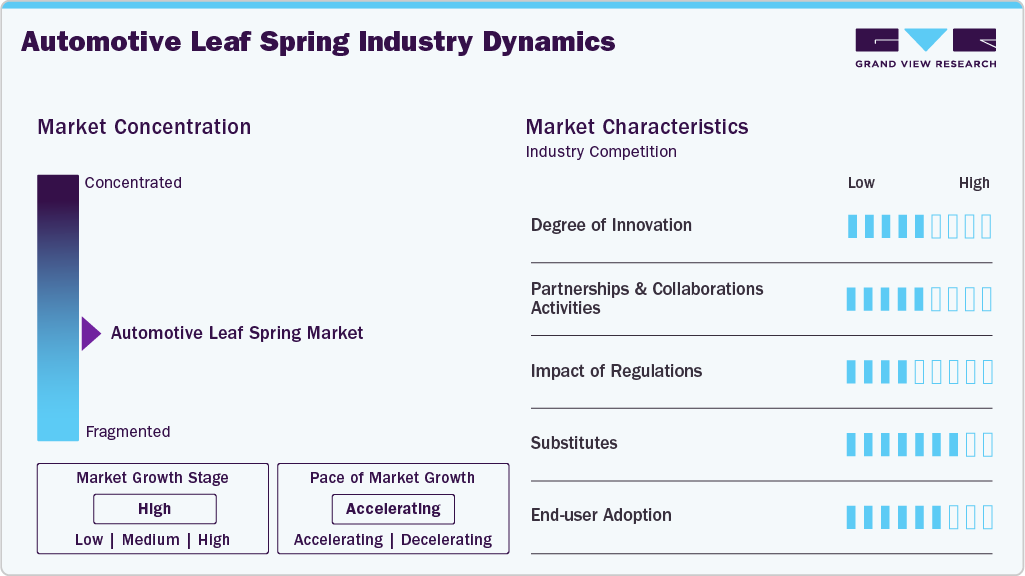
The automotive leaf spring market is moderately fragmented, with competition distributed among established global suspension manufacturers, regional spring producers, and aftermarket suppliers. While larger manufacturers benefit from established OEM relationships, broader product portfolios, manufacturing scale, and engineering capabilities, numerous smaller and regional suppliers also serve specific vehicle applications and replacement markets. The availability of conventional multi-leaf, parabolic, tapered, and specialized spring designs further allows suppliers to compete across different price points and application requirements. The presence of multiple suppliers serving commercial vehicle and aftermarket applications supports a fragmented competitive structure rather than allowing a small number of companies to dominate the market.
 To learn more about this report, Download Free Sample Report
The fragmented structure also reflects differences in regional demand, vehicle specifications, and customer requirements. Suppliers compete through product durability, load-carrying capability, weight reduction, customization, manufacturing efficiency, and distribution reach, while OEM customers generally require suppliers to meet specific technical and quality requirements. At the same time, the shift toward parabolic and lightweight leaf springs is creating opportunities for suppliers with stronger engineering and product development capabilities, thereby increasing competition beyond basic price considerations. This combination of established suppliers and a broad base of regional manufacturers is expected to maintain a moderately fragmented market structure, with competition remaining particularly strong in commercial vehicle and aftermarket applications.
Analyst Perspective
The automotive leaf spring market continues to benefit from demand for durable and cost-effective suspension systems, particularly across commercial vehicle applications. Increasing emphasis on vehicle weight reduction, load-carrying capability, durability, and suspension performance is encouraging product development. Parabolic, tapered, and lightweight designs are gaining importance as manufacturers seek improved performance with lower component weight. Future investment is expected to focus on advanced materials, optimized spring designs, manufacturing efficiency, and product testing. Competitive positioning is increasingly influenced by the ability to provide customized, lightweight, durable, and cost-efficient suspension solutions.
Type Insights
Based on type, the semi-elliptic segment accounted for 60.3%, the largest share of global revenue in 2025. Semi-elliptic leaf springs continue to hold a strong position in commercial vehicle suspension systems because of their established design and dependable load-bearing characteristics. Their relatively simple construction supports cost-efficient manufacturing and makes them suitable for vehicles operating under high-load and demanding road conditions. The design is widely associated with conventional suspension architectures used in trucks, buses, and other commercial vehicles, and is supported by established manufacturing capabilities and replacement networks. The continued preference for proven suspension configurations among fleet operators and vehicle manufacturers is expected to sustain demand for semi-elliptic springs.
The parabolic segment is projected to grow at the fastest CAGR over the forecast period. Parabolic leaf springs are gaining greater attention as vehicle manufacturers seek improved ride quality and lower suspension weight. Their tapered construction can reduce unnecessary material and inter-leaf friction while maintaining the load-carrying characteristics required for commercial vehicle applications. Suppliers are increasingly offering parabolic designs with optimized geometry and advanced manufacturing processes to meet requirements for durability, comfort, and vehicle efficiency. The segment is therefore positioned for increased adoption as commercial vehicle platforms place greater emphasis on lightweight, performance-oriented suspension systems.
Material Insights
Based on material, the steel segment accounted for 74.2%, the largest share of global revenue in 2025. The steel segment is experiencing growth due to its high strength, established processing infrastructure, and suitability for repeated heavy-load applications. Manufacturers use specialized spring-steel grades and controlled heat-treatment and peening processes to achieve the required fatigue resistance and durability. The extensive supplier base and familiarity of OEMs and maintenance networks with steel suspension components continue to support its commercial relevance.
The composite segment is projected to grow at the fastest CAGR over the forecast period. Composite leaf springs are emerging as a lightweight alternative to conventional steel components, particularly as automakers seek to reduce vehicle mass without compromising suspension performance. Composite construction can offer a favorable strength-to-weight ratio and reduce the overall weight of the suspension assembly, supporting efficiency objectives across commercial vehicle platforms. The technology is also relevant to electrified commercial vehicles, where manufacturers must manage additional vehicle mass associated with battery systems. The increasing focus on lightweight suspension architecture is creating opportunities for composite materials in applications where higher initial component costs can be justified by weight and performance benefits.
Vehicle Type Insights
Based on vehicle type, the medium & heavy commercial vehicles (MHCVs) segment led the market and accounted for the global revenue in 2025, as these vehicles routinely operate with substantial payloads and experience high mechanical loads. Trucks, buses, and other heavy-duty commercial vehicles require suspension systems that maintain stability and durability over long operating cycles and varying road conditions. Manufacturers offer specialized conventional and parabolic spring configurations according to axle loads, vehicle architecture, and operating requirements. Continued freight movement, construction activity, and fleet utilization are expected to maintain the significance of leaf springs within the MHCV segment.
The light commercial vehicles (LCVs) segment is projected to grow at the fastest CAGR over the forecast period The light commercial vehicles (LCVs) segment is gaining traction due to increasing demand for leaf springs as urban distribution, delivery, and small-scale freight transportation expand across emerging and developed markets. These vehicles require suspension systems that balance payload capacity, durability, ride comfort, and operating cost within relatively compact vehicle platforms. Leaf spring manufacturers are supplying dedicated solutions for LCV models, including conventional and parabolic configurations designed around specific vehicle load requirements. The expansion of delivery-oriented commercial fleets is consequently creating a broader base of applications for LCV leaf spring systems.
Sales Channel Insights
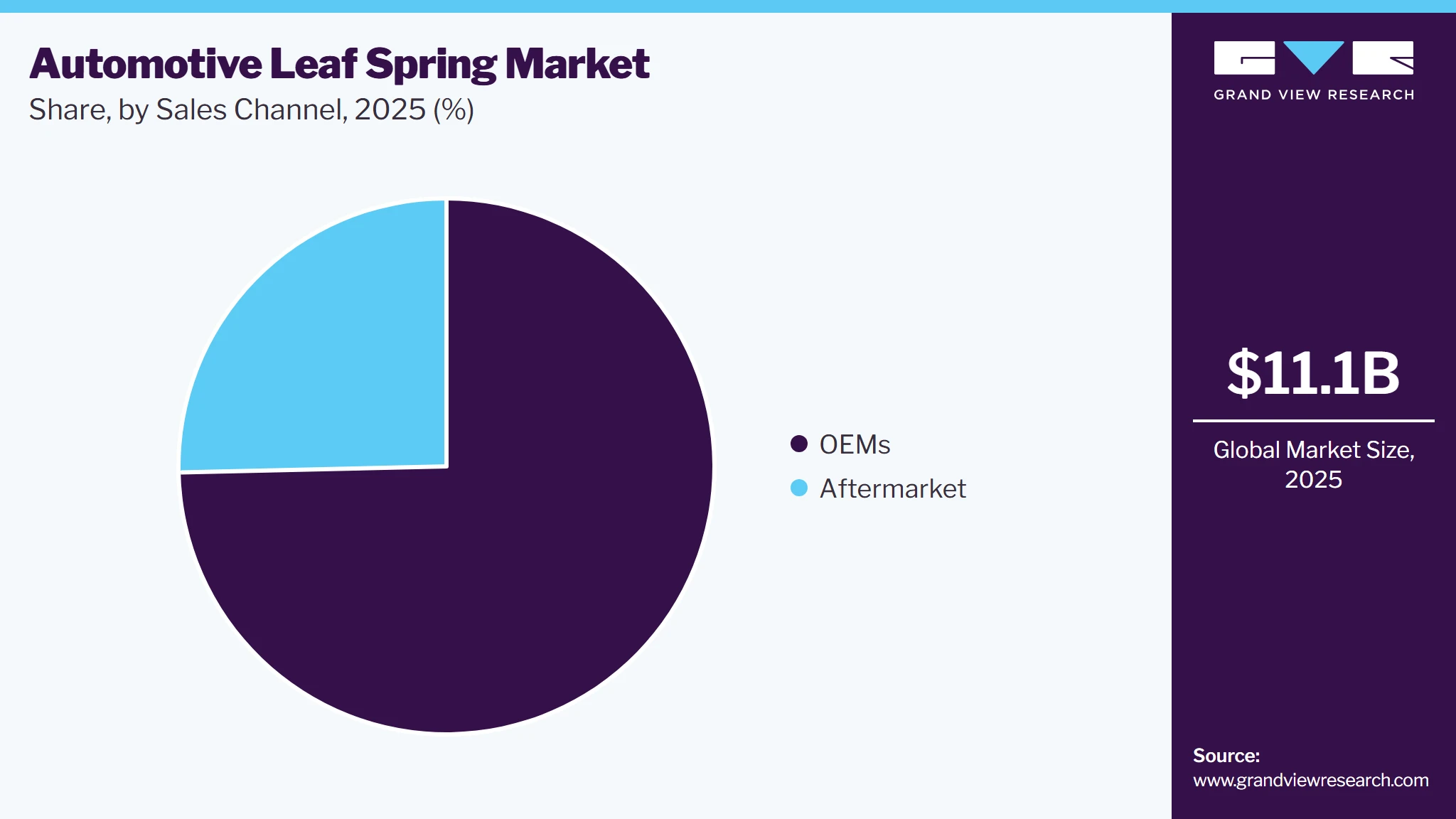
Based on sales channel, OEMs accounted for the largest share of global revenue in 2025, as these components are integrated into vehicles during the original manufacturing process. Suppliers work closely with vehicle manufacturers to develop springs to meet defined load ratings, dimensions, durability requirements, and vehicle performance targets. Established suppliers demonstrate their ability to serve multiple commercial vehicle manufacturers and provide application-specific suspension solutions, supporting long-term OEM relationships. Increasing commercial vehicle production and the integration of application-specific suspension designs are expected to sustain OEM demand for leaf springs.
 To learn more about this report, Download Free Sample Report
Aftermarket is projected to grow at the fastest CAGR over the forecast period. The aftermarket offers a recurring revenue opportunity because leaf springs require replacement after prolonged operation, fatigue, damage, or heavy-duty use. Suppliers serve this channel through distributors, workshops, fleet operators, and replacement-parts networks, with products often manufactured to OEM-equivalent specifications. For example, aftermarket suppliers maintain extensive portfolios covering conventional and parabolic springs for multiple commercial vehicle models. The large installed base of commercial vehicles and continued fleet utilization support steady replacement demand through the aftermarket channel.
Regional Insights
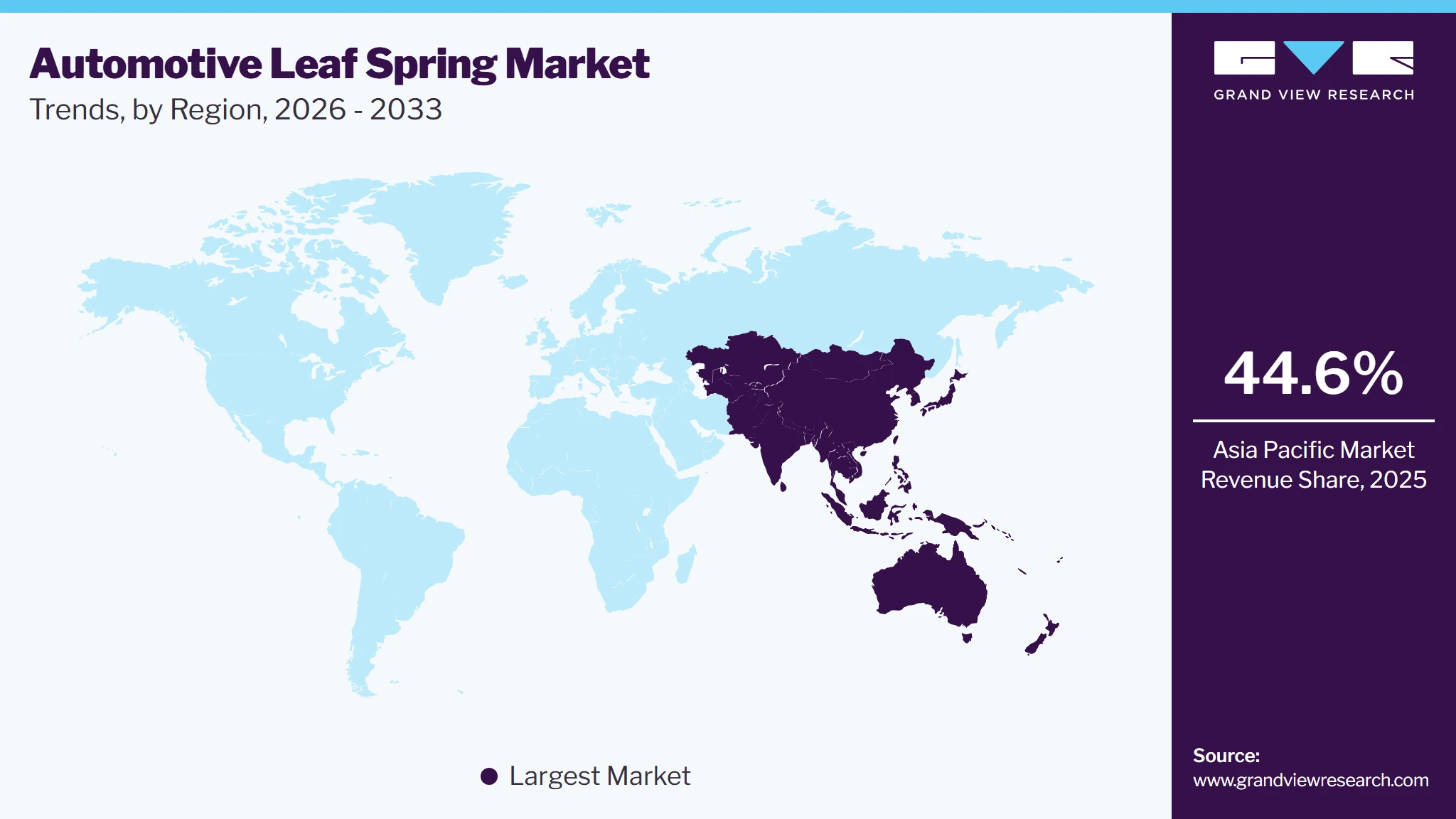
The Asia Pacific automotive leaf spring market led and accounted for 44.6% of the global revenue in 2025 and is expected to register the fastest growth from 2026 to 2033. The Asia Pacific automotive leaf spring market is experiencing rapid growth, fueled by large vehicle production base, extensive commercial vehicle usage, and expanding transportation infrastructure. For instance, in December 2025, China alone produced approximately 34.5 million motor vehicles, while commercial vehicle production reached more than 4.2 million units, providing a substantial potential OEM application base for suspension components. The presence of established spring manufacturers across countries such as China and Japan further strengthens the region's manufacturing and supply capabilities.
 To learn more about this report, Download Free Sample Report
China Automotive Leaf Spring Market Trends
China held a dominant share in the Asia Pacific automotive leaf spring market. China is a major market for automotive leaf springs, supported by its large-scale automotive manufacturing industry and substantial commercial vehicle production. For instance, in December 2025, China produced approximately 4.26 million commercial vehicles, representing a 12% year-on-year increase, while total automobile production reached 34.53 million units. The country's large commercial vehicle manufacturing base provides considerable demand potential for leaf springs across OEM and replacement applications.
Japan automotive leaf spring market is expected to grow at a significant CAGR over the forecast period. Japan is expanding its automotive leaf spring market, supported by its mature automotive manufacturing sector and specialized spring component suppliers. Japan manufacturers produce leaf springs for trucks, trailers, and special-purpose vehicles, while also maintaining export capabilities across international markets. The country's emphasis on manufacturing quality, durability, and precision engineering supports continued demand for high-performance suspension components.
North America Automotive Leaf Spring Market Trends
North America automotive leaf spring market is expected to grow at a significant CAGR over the forecast period, supported by the region’s substantial commercial vehicle base and strong presence of trucks, trailers, and other load-carrying vehicles. The widespread use of leaf spring systems across heavy-duty applications creates demand from both vehicle manufacturers and replacement-part suppliers. The region also has established suspension component manufacturers serving original-equipment and aftermarket requirements, strengthening the overall supply ecosystem.
The U.S. automotive leaf spring market held the largest market share in 2025, driven by extensive utilization of medium- and heavy-duty trucks, trailers, and light-duty commercial vehicles. Domestic manufacturers supply leaf springs across heavy, medium, and light-duty applications, with products available for both OE and aftermarket specifications. The country's large commercial vehicle fleet and established replacement-parts network provide a broad customer base for leaf spring suppliers.
Europe Automotive Leaf Spring Market Trends
The Europe Automotive Leaf Spring market led the global market and accounted for 44.6% of the global revenue in 2025 and is expected to register the fastest growth from 2026 to 2033. Europe is witnessing steady growth in the adoption of automotive leaf springs, particularly across commercial vehicle and heavy-duty transportation applications. The regional supplier landscape includes established manufacturers offering conventional and parabolic spring solutions for commercial vehicles, reflecting continued demand for durable and application-specific suspension components. Increasing attention toward vehicle weight reduction is also encouraging suppliers to develop suspension components with improved weight and performance characteristics.
The U.K. is gaining momentum in the automotive leaf spring market, supported by demand from commercial vehicles, trailers, and replacement applications, with suppliers serving both original-equipment and aftermarket customers. Local spring manufacturers provide products for commercial vehicle applications and maintain capabilities in leaf spring and parabolic spring production. The country's established commercial vehicle manufacturing and maintenance ecosystem creates continued opportunities for suspension component suppliers.
The Germany held a substantial share in the Europe automotive leaf spring market., due to its strong automotive manufacturing base and extensive commercial vehicle industry. Domestic suppliers manufacture leaf and parabolic springs for commercial vehicles, while the country's broader automotive supply chain supports engineering and production capabilities for suspension components. Germany's focus on advanced vehicle engineering and lightweight technologies is also creating opportunities for suppliers offering optimized suspension solutions.
Key Automotive Leaf Spring Company Insights
Key players operating in the automotive leaf spring market include NHK SPRING Co.,Ltd., Rassini., Hendrickson USA, L.L.C., JAMNA AUTO INDUSTRIES LIMITED., Olgun Çelik., SOGeFI Group, Standen’s, MITSUBISHI STEEL MFG. CO., LTD., Akar Tools Ltd, TOYO SPRINGS LTD. Key players in the automotive leaf spring are heavily investing in lightweight suspension technologies, advanced steel and composite materials, product customization, manufacturing automation, durability enhancement, and strategic partnerships to improve suspension performance, reduce vehicle weight, strengthen OEM relationships, and expand their presence across commercial vehicle and aftermarket applications.
-
NHK Spring Co., Ltd. is a general spring manufacturer. The company focuses on manufacturing products through its technology, sales, management systems, and product quality. It provides products and technologies across various industries and situations. The company provides leaf springs for suspension systems, including tapered and mono leaf springs for commercial vehicles. Its leaf springs are designed to provide high strength, light weight, stable traveling under heavy loads, and high reliability.
-
Rassini. is a global company specializing in the innovative design and manufacture of automotive parts, with a focus on safety, comfort, and quality. Its engineering solutions serve urban, family, all-terrain, sports, luxury, and commercial vehicles, as well as electric mobility and internal combustion engines. The company’s suspension portfolio includes springs, hybrid springs, and parabolic and multi-leaf springs.
Key Automotive Leaf Spring Companies:
The following key companies have been profiled for this study on the automotive leaf spring market.
-
NHK SPRING Co., Ltd.
-
Rassini.
-
Hendrickson USA, L.L.C.
-
JAMNA AUTO INDUSTRIES LIMITED.
-
Olgun Çelik.
-
SOGeFI Group
-
Standen’s
-
MITSUBISHI STEEL MFG. CO., LTD.
-
Akar Tools Ltd
-
TOYO SPRINGS LTD
Competitive Benchmarking
Operating Strategies
Competitive Edge
Weaknesses
Mature Players: NHK SPRING Co., Ltd., Rassini, Hendrickson USA, L.L.C., JAMNA AUTO INDUSTRIES LIMITED, Olgun Çelik
- Mature players in the automotive leaf spring are focus on long-term OEM contracts, expand sales across vehicle applications, and strengthen market position. Investment in advanced spring designs and manufacturing technologies helps improve durability, reduce weight, enhance vehicle performance, and meet changing OEM requirements.
- Mature players gain a competitive advantage through strong brand recognition and OEM relationships help build trust and win long-term contracts, while broad portfolios and manufacturing capabilities support different vehicle requirements and large-volume production. Engineering expertise and leaf spring experience help deliver durable, application-specific solutions.
- These companies face challenges related to larger operating structures can reduce flexibility because complex decision-making and higher operating costs can slow customization and response times. Continuous investment in lightweight materials and advanced manufacturing is required to meet OEM performance requirements while controlling costs and maintaining competitive pricing.
Emerging Players: Standen's, TOYO SPRINGS LTD
- Emerging players in the automotive leaf spring are focus on specialized products and customer-specific solutions helps meet niche vehicle requirements and build repeat business. Product development, quality improvements, and technical partnerships help strengthen capabilities, improve product performance, and expand customer reach.
- Emerging players gain market traction by specializing in leaf springs that meet specific vehicle needs, while customer-focused production helps build repeat business. Partnerships and long industry experience help improve quality, build trust, and reach more customers.
- Emerging players face limitations due to limited geographic reach and smaller operations can make it harder to serve large global customers and handle high-volume orders. Lower scale can also restrict investment in new products, equipment, and production capacity.
Recent Developments
-
In July 2026, Jamna Auto Industries Limited. acquired Owen Springs Ltd., a UK-based manufacturer of leaf springs, parabolic springs, and related automotive products, to strengthen its presence in the UK and expand access to new customers and business opportunities.
-
In June 2025, Hendrickson USA, L.L.C., introduced an updated STEERTEK NXT steer axle for selected Blue Bird school buses, reducing weight by an additional 25 pounds to improve vehicle efficiency and payload flexibility. The axle supports SOFTEK and AIRTEK suspension systems and offers easier servicing and reduced maintenance needs.
Automotive Leaf Spring Market Report Scope
Report Attribute
Details
Market size in 2025
USD 11.1 billion
Market size value in 2026
USD 11.8 billion
Revenue forecast in 2033
USD 20.0 billion
Growth Rate
CAGR of 7.8% from 2026 to 2033
Base year for estimation
2025
Historical data
2021 - 2024
Forecast period
2026 - 2033
Quantitative units
Revenue in USD billion and CAGR from 2026 to 2033
Report coverage
Revenue forecast, company ranking, competitive landscape, growth factors, and trends
Segments covered
Type, material, vehicle type, sales channel, region
Regional scope
North America; Europe; Asia Pacific; Latin America; MEA
Country scope
U.S.; Canada; Mexico; Germany; U.K.; France; China; Japan; India; South Korea; Australia; Brazil; Kingdom of Saudi Arabia (KSA); UAE; South Africa
Key companies profiled
NHK SPRING Co.,Ltd., Rassini., Hendrickson USA, L.L.C., JAMNA AUTO INDUSTRIES LIMITED., Olgun Çelik., SOGeFI Group, Standen’s, MITSUBISHI STEEL MFG. CO., LTD., Akar Tools Ltd, TOYO SPRINGS LTD.
Customization scope
Free report customization (equivalent up to 8 analysts working days) with purchase. Addition or alteration to country, regional & segment scope.
Pricing and purchase options
Avail customized purchase options to meet your exact research needs. Explore purchase options
Global Automotive Leaf Spring Market Report Segmentation
The report forecasts revenue growth at global, regional, and country levels and provides an analysis of the latest industry trends in each of the sub-segments from 2021 to 2033. For the purpose of this study, Grand View Research has segmented the global automotive leaf spring market based on type, material, vehicle type, sales channel, and region:
-
Type Outlook (Revenue, USD Billion, 2021 - 2033)
-
Semi-Elliptic
-
Parabolic
-
Elliptic
-
Others
-
-
Material Outlook (Revenue, USD Billion, 2021 - 2033)
-
Steel
-
Composite
-
-
Vehicle Type Outlook (Revenue, USD Billion, 2021 - 2033)
-
Medium & Heavy Commercial Vehicles (MHCVs)
-
Light Commercial Vehicles (LCVs)
-
Passenger Cars
-
-
Sales Channel Outlook (Revenue, USD Billion, 2021 - 2033)
-
OEMs
-
Aftermarket
-
-
Regional Outlook (Revenue, USD Billion, 2021 - 2033)
- North America
-
U.S.
-
Canada
-
Mexico
-
- Europe
-
Germany
-
U.K.
-
France
-
- Asia Pacific
-
China
-
India
-
Japan
-
South Korea
-
Australia
-
-
Latin America
-
Brazil
-
- Middle East & Africa (MEA)
-
UAE
-
Kingdom of Saudi Arabia (KSA)
-
South Africa
-
- North America
Research Methodology
The automotive leaf spring market figures in this report are based on a proven research process that combines executive interviews with secondary research from proprietary databases, company filings, and recognized regulatory and institutional sources. Market size is built through value-chain sizing-reconciling supply-side and demand-side estimates-and triangulated with bottom-up and top-down approaches. Every estimate passes multiple levels of expert validation before publication, with each automotive leaf spring segment quantified using the revenue-capture definitions in the table below.
Segment Definition
Segment - Type
Revenue capture definition
Semi-Elliptic
The segment revenue is generated from the sale of semi-elliptic leaf springs and related spring assemblies supplied for vehicle suspension systems, including products sold for original-equipment and replacement applications.
Parabolic
The segment revenue is generated from the sale of parabolic and tapered leaf springs and related suspension assemblies supplied for vehicle applications requiring optimized weight, strength, durability, and suspension performance.
Elliptic
The segment revenue is generated from the sale of elliptic leaf springs and associated suspension assemblies supplied for vehicle suspension applications where this spring configuration is used.
Others
The segment revenue is generated from the sale of other leaf spring configurations, including specialized, customized, progressive, mono-leaf, multi-stage, and application-specific designs that do not fall under semi-elliptic, parabolic, or elliptic categories.
Segment - Material
Revenue capture definition
Steel
The segment revenue is generated from the sale of leaf springs manufactured using steel and high-strength spring steel materials, including individual springs and complete suspension assemblies supplied to OEM and aftermarket customers.
Composite
The segment revenue is generated from the sale of leaf springs manufactured using composite materials, including fiber-reinforced materials, for lightweight suspension applications.
Segment - Vehicle Type
Revenue capture definition
Medium & Heavy Commercial Vehicles (MHCVs)
The segment revenue is generated from leaf springs and suspension assemblies supplied for medium- and heavy-duty trucks, buses, trailers, and other heavy commercial vehicles.
Light Commercial Vehicles (LCVs)
The segment revenue is generated from leaf springs and suspension assemblies supplied for light trucks, vans, pickups, and other light commercial vehicles using leaf spring suspension systems.
Passenger Cars
The segment revenue is generated from leaf springs supplied for passenger cars and utility vehicles equipped with leaf spring suspension systems.
Segment - Sales Channel
Revenue capture definition
OEMs
The segment revenue is generated from leaf springs and complete suspension assemblies supplied directly or indirectly to vehicle manufacturers for installation in newly manufactured vehicles.
Aftermarket
The segment revenue is generated from replacement leaf springs, spring assemblies, and related suspension products sold through distributors, retailers, workshops, service centers, and other replacement-part channels.
Estimation Model
Layer Name
Key Question
Description
Vehicle Production & Application Base
How many vehicles require leaf spring suspension?
The estimation begins by identifying the vehicle production and application base relevant to leaf spring systems. The analysis primarily considers LCVs, MHCVs, trucks, buses, and other vehicles that use leaf spring suspension. Vehicle production volumes and suspension configurations establish the potential demand base for automotive leaf springs.
Leaf Spring Installation Volume
How many leaf springs are required per vehicle?
This layer converts the relevant vehicle base into estimated leaf spring installation volumes. The calculation considers the number of leaf springs or spring assemblies required for different vehicle configurations. Replacement requirements are also considered when estimating aftermarket demand.
Average Revenue per Leaf Spring
What revenue is generated per spring or assembly?
This layer applies average selling values to estimated leaf spring volumes. Revenue varies according to spring type, material, vehicle application, design complexity, load capacity, and sales channel. OEM and aftermarket products may also have different pricing structures because of differences in specifications, volumes, and distribution channels.
Market Revenue Validation
Does the estimated revenue reflect the actual market structure?
The layer validates the estimated market revenue against supplier capabilities, production capacity, product portfolios, vehicle applications, and regional presence. The analysis checks whether the estimated revenue is consistent across type, material, vehicle type, and sales channel. This step helps ensure that the final automotive leaf spring market estimate reflects the underlying industry structure.
Delivered Customization
We have successfully delivered the following deep-dive customizations:
Client Request
Customization Delivered
Value Adds
Regional Automotive Leaf Spring Market Opportunity Assessment
Country/region-wise market sizing and forecasts
Analysis of demand, adoption trends, and regulatory landscape
Identification of high-growth regions and investment hotspots
Identified region-specific growth opportunities
Supported expansion and go-to-market strategy
Enabled informed regional investment decisions
Cross-Segmentation Analysis for the Automotive Leaf Spring Market
Criss-cross market analysis by type, material vehicle type, sales channel
Demand and adoption assessment across key segments
Segment attractiveness and growth potential benchmarking
Identified high-potential market segments
Supported targeted material positioning and marketing strategy
Improved customer and segment prioritization
Competitive Benchmarking and Strategic Positioning in the Automotive Leaf Spring Market
Benchmarking of key competitors across materials, pricing, partnerships, and innovation
Comparative assessment of market share, capabilities, and strategies
Analysis of competitive strengths, gaps, and differentiation areas
Identified competitive white spaces and growth gaps
Supported strategic positioning and differentiation
Enabled data-driven competitive strategy development
Frequently Asked Questions About This Report
The global automotive leaf spring market size was estimated at USD 11.1 billion in 2025 and is estimated at USD 11.8 billion in 2026.
The global automotive leaf spring market is expected to grow at a CAGR of 7.8% from 2026 to 2033, reaching USD 20.0 billion by 2033.
Asia pacific market dominated, with a revenue share of 44.6% in 2025.
The increasing demand for durable, lightweight, and cost-effective suspension systems across commercial vehicles is accelerating the growth of the automotive leaf spring market.
Key players include NHK SPRING Co.,Ltd., Rassini., Hendrickson USA, L.L.C., JAMNA AUTO INDUSTRIES LIMITED., Olgun Çelik., SOGeFI Group, Standen’s, MITSUBISHI STEEL MFG. CO., LTD., Akar Tools Ltd, TOYO SPRINGS LTD.
OEMs accounted for the largest share of global revenue in 2025, while aftermarket is the fastest-growing segment.
The semi-elliptic segment accounted for 60.3%, the largest share of global revenue in 2025, while parabolic segment is the fastest-growing type.
The steel segment accounted for 74.2%, the largest share of global revenue in 2025, while composite segment is the fastest-growing material.
Medium & heavy commercial vehicles (MHCVs) segment led the market and accounted for the global revenue in 2025, while light commercial vehicles (LCVs) is the fastest-growing segment.
About the Author(s)
Automotive & Transportation Research Team
Technology · Automotive & TransportationThis report was authored by the automotive & transportation research team at Grand View Research - comprising two research analysts, one senior research analyst, and one industry expert - with specialized expertise in the automotive & transportation segment of the technology industry. All findings are based on proprietary technology databases, executive interviews, and regulatory analysis, subject to internal peer review prior to publication.
Last Updated:
Speak to Analyst

Customize this report to your needs - add regions, segments, or data points, with 20% free customization.
Or view our licence options:


ISO 9001:2015 & 27001:2022 Certified
We are GDPR and CCPA compliant! Your transaction & personal information is safe and secure. For more details, please read our privacy policy.


