
- Home
- »
- Next Generation Technologies
- »
-
Autonomous Crop Management Market Size Report, 2030GVR Report cover

Autonomous Crop Management Market (2022 - 2030) Size, Share & Trends Analysis Report By Solution, By Deployment, By Application (Crop Tracking & Management, Weather Tracking & Forecasting), By Region, And Segment Forecasts
Report Overview
The global autonomous crop management market size was valued at USD 1.45 billion in 2021 and is expected to expand at a compound annual growth rate (CAGR) of 16.2% from 2022 to 2030. The farmers' increased awareness regarding the benefits such as improved crop planning and tracking, minimizing labor costs, and weather forecasting is boosting the industry’s growth. The growth is also attributed to the increasing implementation of cloud computing for real-time crop data management and the growing global population resulting in rising food demand.
 Source: Grand View Research, IR Documents, Primary Interviews, Paid DatabasesTo learn more about this report,
 Download Free Sample Report
 The software allows the farmers to implement environment-friendly farming practices, which in turn will reduce the use of water, fertilizers, and pesticides ensuring food safety. Further, modern agricultural practices would replace ineffective conventional agricultural methods, which would help the agriculture sector address sustainability issues. This change is anticipated to favorably impact the growth of the autonomous crop management industry over the forecast period.
Over the forecast period, it is anticipated that farmers' increased focus on crop output, productivity, and farm efficiency will boost growth. Technology advancements like cloud computing and the Internet of Things (IoT) are expected to encourage the use of big data, AI, and robots in agriculture. The use of big data analysis in autonomous crop management is important for supplying farmers with predictive insights, restructuring business processes, and making operational decisions in real time to enhance agricultural productivity.
According to the United Nations Food and Agriculture Organization (FAO), by 2050, 70% of world food production is anticipated to increase across the globe. To meet the growing food demand, precision farming is the solution adopted in majorly populated countries such as India and China. Artificial intelligence and machine learning have become more widespread, enabling real-time access to data that simplifies data management tasks like planning, buying, harvesting, feeding, marketing, and inventory control. Real-time data collected from farming operations aid in analysis and decision-making.
The COVID-19 pandemic adversely affected the market, with several manufacturing units across India, China, Japan, the U.S., and European countries temporarily shutting down. The outbreak has severely disrupted the agriculture industry. Crop management systems play a significant role in addressing difficulties in agricultural output. Many businesses are using innovative strategies to provide more practical tools and meet the rising need for food. However, crop management software tools and remote sensing could lead to higher adoption post-COVID-19. Companies have already started focusing more on wireless platforms to enable real-time decision-making for crop health monitoring, irrigation scheduling, harvesting management, and field mapping.
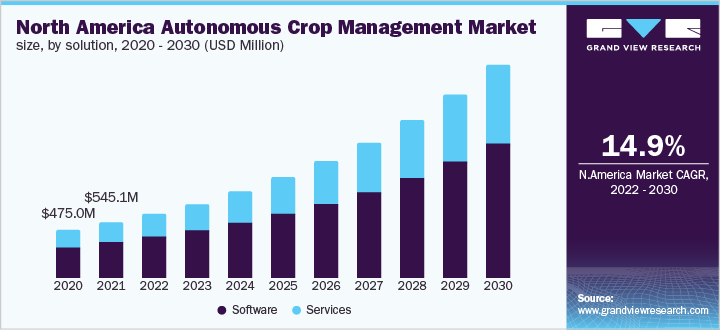
North America held the largest industry share in 2021, owing to the presence of significant vendors, high adoption of advanced technologies to boost agriculture yield, and growing demand for crop management solutions. Also, the high income and purchasing power of farmers in developed countries like the U.S. and Canada play a significant factor in adopting crop management solutions. Digital farming involves high investments, which is considered a drawback for farmers, especially in emerging countries such as India, China, and Brazil. The capital investment in adopting smart agriculture is relatively high but it also provides a notable return on investment by boosting crop productivity and enhancing resilience.
Solution Insights
The software segment accounted for the largest revenue share of 64.7% in 2021 and is expected to remain dominant over the forecast period. The service segment is bifurcated based on professional and managed services. Professional services are categorized into system integration & consulting and maintenance & support. The crop management software improves planning and tracking, saves on input and labor costs, and complies with regulatory requirements.
The use of management software enables farmers to employ the most effective, environmentally friendly farming techniques. This adoption allows farmers to produce safe food with less water, fertilizer, and pesticides. Predictive analytics software guides farmers about crop rotation, soil management, harvesting times, and optimal planting times.
Deployment Insights
The on-premises segment accounted for the largest market share of 54.6% in 2021. Cloud-based autonomous crop management segment is anticipated to grow with the highest CAGR during the forecast period. Cloud computing focuses on storage devices, shared networks, and servers, due to which the high costs of maintaining software and hardware infrastructure are eliminated. Using cloud computing for agriculture to monitor crop inputs and output can help to create climate change.
Also, most companies are adopting partnership strategies to enhance cloud-based applications. For instance, in 2020, Trimble and Ecobot, a software provider that offers cloud-based services to expedite environmental regulatory reporting, partnered. To enable quick, sub-meter accurate wetland delineation, the company's GNSS was integrated with Ecobot's Natural Resources Platform through this agreement.
Application Insights
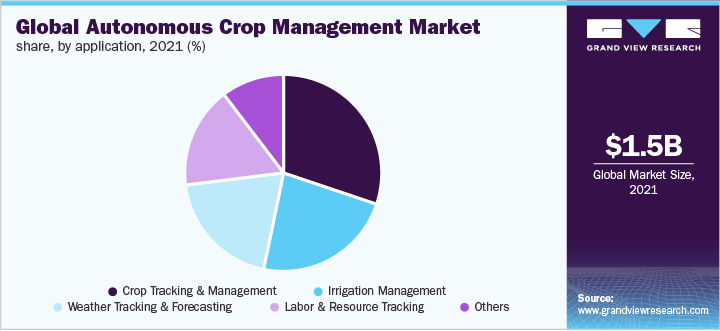
Crop tracking and management accounted for the largest revenue share of 30.4% in 2021 and is expected to continue its dominance over the forecast period. This is further attributed to the rising demand for crop growth monitoring and waste reduction by the timely provision of necessary water and minerals. The application of agriculture type includes crop tracking and management, weather tracking & forecasting, irrigation management, labor and resource tracking, and others.
The weather tracking and forecasting segment is estimated to grow with the highest CAGR from 2022 to 2030. Weather monitoring can help cut costs, prevent over or underwatering, and produce higher crop yields. Predicting the weather helps deter pests and other crop diseases from spreading and helps in crop-destroying problems. The market has grown due to the development of advanced data analytics services and machine learning techniques, improving weather forecasts' dependability and accuracy.
 To learn more about this report, Download Free Sample Report
 Increasing environmental consciousness among consumers and growing water scarcity have urged the need to modify agricultural management techniques that conserve natural resources, including soil, air, and water boosting the market growth. Furthermore, the irrigation management segment is anticipated to grow considerably in the upcoming years.
Regional Insights
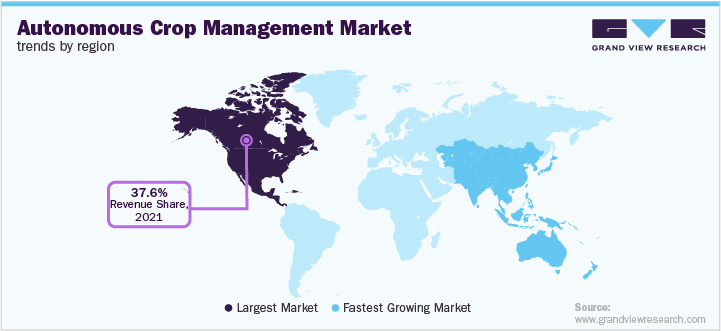
North America accounted for the largest revenue share of 37.6% in 2021 and is expected to continue its supremacy in the coming years. Major tech companies offering crop management solutions are located in North America. Also, the region is considered to be an early adopter of technologies. Increasing government initiatives for adopting modern agriculture technologies coupled with the developed infrastructure are the major factors responsible for the market growth. For instance, a partnership of agricultural associations called the North America Climate Smart Agriculture Alliance (NACSAA) was established to educate and equip farmers for sustainable agricultural productivity.
Additionally, the U.S. and UAE Agriculture Innovation Mission for Climate (AIM4C) program calls on participating nations and corporations to make significant investments in "climate-smart" agriculture over the following five years. The USD 4 billion programs will fund public and private agricultural research facilities and make them more accessible to farmers to stimulate new scientific discoveries.
 To learn more about this report, Download Free Sample Report
 Over the years, the U.S. has been leading in deploying precision technology to farming techniques. According to the Economic Research Service published report, by the U.S. Department of Agriculture (USDA), farms with the largest acreage are more likely to adopt smart agriculture technologies and software. An increase in the average farm size and a shortage of farm laborers are the factors influencing farmers to adopt farming software, which gives them data-driven insights for improving crop yields.
Asia Pacific is expected to witness significant growth during the projected period and is expected to witness the highest CAGR from 2022 to 2030. Smart farming in the region is in the stage of adoption, where an increase in government initiatives and rising awareness among cultivators are the significant factors responsible for the growth. For instance, Japan's agriculture ministry has been funding the advancement of precision agriculture. Each nation's farmers' groups and community-based organizations are focused on advancing sustainable agriculture.
Key Companies & Market Share Insights
To broaden their product offering, the companies utilize a variety of inorganic growth tactics, such as partnerships, regular mergers, and acquisitions. For instance, CropX, a top provider of soil and agricultural analytics, purchased CropMetrics to expand in the American market. The goal of this acquisition was to expand CropMetrics' product offerings throughout significant U.S. areas by utilizing their extensive dealer network, service model, user-friendly platform, and Variable Rate Irrigation System. Some prominent players in the global autonomous crop management market include:
-
Croptracker
-
Crop
-
Software Solutions Integrated (SSI)
-
Agrivi
-
Granular
-
Trimble
-
Farm ERP
-
Conservis
-
Raven Industries
-
Topcon Corporation
-
Proagrica
-
Cropin
-
CropX
-
Microsoft Corporation (Farm Beats)
-
IBM (Regenerative Agriculture)
Autonomous Crop Management Market Report Scope
Report Attribute
Details
Market size value in 2022
USD 1.68 billion
Revenue forecast in 2030
USD 5.58 billion
Growth Rate
CAGR of 16.2% from 2022 to 2030
Base year for estimation
2021
Historical data
2017 - 2020
Forecast period
2022 - 2030
Quantitative units
Revenue in USD Million and CAGR from 2022 to 2030
Report Coverage
Revenue forecast, company ranking, competitive landscape, growth factors, and trends
Segments Covered
Solution, deployment, application, region
Regional scope
North America; Europe; Asia Pacific; South America; Middle East & Africa
Country scope
U.S.; Canada; Mexico; U.K.; Germany; France; China; India; Japan; Brazil
Key companies profiled
Croptracker; Cropio; EasyFarm; Software Solutions Integrated (SSI); Agrivi; Granular; Trimble; Raven Industries Inc.
Customization scope
Free report customization (equivalent up to 8 analysts working days) with purchase. Addition or alteration to country, regional & segment scope.
Pricing and purchase options
Avail customized purchase options to meet your exact research needs. Explore purchase options
Global Autonomous Crop Management Market Segmentation
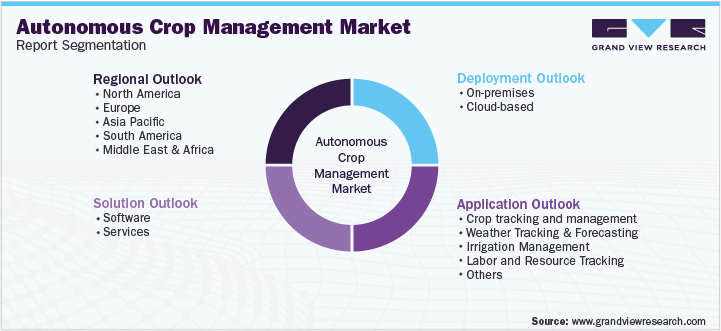
This report forecasts revenue growth at global, regional, and country levels and provides an analysis of the latest industry trends and opportunities in each of the sub-segments from 2017 to 2030. For this study, Grand View Research has segmented the global autonomous crop management market report based on solution, deployment, application, and region:
 To learn more about this report, Download Free Sample Report
 -
Solution Outlook (Revenue, USD Million, 2017 - 2030)
-
Software
-
Services
-
Professional Services
-
System integration & consulting
-
Maintenance & support
-
-
Managed Services
-
-
-
Deployment Outlook (Revenue, USD Million, 2017 - 2030)
-
On-premises
-
Cloud-based
-
-
Application Outlook (Revenue, USD Million, 2017 - 2030)
-
Crop tracking and management
-
Weather Tracking & Forecasting
-
Irrigation Management
-
Labor and Resource Tracking
-
Others
-
-
Regional Outlook (Revenue, USD Million, 2017 - 2030)
-
North America
-
U.S.
-
Canada
-
Mexico
-
-
Europe
-
Germany
-
U.K.
-
France
-
-
Asia Pacific
-
China
-
India
-
Japan
-
-
South America
-
Brazil
-
-
Middle East & Africa
-
Frequently Asked Questions About This Report
The global autonomous crop management market size was estimated at USD 1.45 billion in 2021 and is expected to reach USD 1.68 billion in 2022.
The global autonomous crop management market is expected to grow at a compound annual growth rate of 16.2% from 2022 to 2030 to reach USD 5.58 billion by 2030.
North America held the largest share of 37.6% in the year 2021, owing to the presence of significant vendors, high adoption of advanced technologies to boost agriculture yield, and growing demand for crop management solutions. Also, the high income and purchasing power of farmers in developed countries like the U.S. and Canada play a significant factor in adopting crop management solutions.
Some key players operating in the autonomous crop management market include Topcon Corporation (Japan); Proagrica (Germany); Cropin (India); Microsoft Corporation (Farm Beats) (U.S.); IBM (Regenerative Agriculture) (U.S.); Trimble, Inc. (U.S.); Raven Industries Inc. (U.S.), Croptracker (Canada); Agrivi (U.K.); Granular (U.S.); Conservis (U.S);
Key factors that are driving the autonomous crop management market growth include the farmers' increased awareness regarding the benefits such as improved crop planning and tracking, minimizing labor costs, and weather forecasting. The growth of the market for autonomous crop management is also attributed to the increasing implementation of cloud computing for real-time crop data management and growing global population resulting to rise in food demand.
About the Author(s)
Next Generation Technologies Research Team
Technology · Next Generation TechnologiesThis report was authored by the next generation technologies research team at Grand View Research - comprising two research analysts, one senior research analyst, and one industry expert - with specialized expertise in the next generation technologies segment of the technology industry. All findings are based on proprietary technology databases, executive interviews, and regulatory analysis, subject to internal peer review prior to publication.
Last Updated:
Speak to Analyst -

Customize this report to your needs - add regions, segments, or data points, with 20% free customization.
Or view our licence options:


ISO 9001:2015 & 27001:2022 Certified
We are GDPR and CCPA compliant! Your transaction & personal information is safe and secure. For more details, please read our privacy policy.


