
- Home
- »
- Medical Devices
- »
-
Baby Tech Market Size, Growth Report, 2026-2033GVR Report cover

Baby Tech Market (2026 - 2033)
Size, Share & Trends Analysis Report By Product Type (Smart Monitoring Devices, Smart Feeding & Nutrition), By Application, By Distribution Channel (Online Retail, Specialty Stores), And Regional Segment Forecasts
Market Size, 2025
$3.4BMarket Estimate, 2026
$3.8BMarket Forecast, 2033
$7.9BCAGR, 2026–2033
11.2%Baby Tech Market Summary
The global baby tech market size was valued at USD 3.4 billion in 2025 and is projected to grow from USD 3.8 billion in 2026 to USD 7.9 billion by 2033, at a CAGR of 11.20% from 2026 to 2033. North America dominated the global market, accounting for the largest revenue share of 36.0% in 2025. The market growth is primarily driven by rising parental awareness of infant safety and health monitoring, increasing adoption of smart home ecosystems, and the growing number of dual-income households seeking convenient childcare solutions.
Key Market Trends & Insights
- By product: Smart monitoring devices segment led the market with the largest revenue share in 2025.
- By application: Safety & security segment led the market with the largest revenue share in 2025.
- By distribution channel: Online retail segment led the market with the largest revenue share in 2025.
Regional Highlights
- Largest regional market: North America (36.0% revenue share, 2025)
- Fastest-growing regional market: Asia Pacific (highest CAGR, 2026-2033)
- By country: The U.S. baby tech industry is a major contributor to the global market.
Market Size & Forecast
- Market size in 2025: USD 3.4 Billion
- Estimated market size in 2026: USD 3.8 Billion
- Projected market size by 2033: USD 7.9 Billion
- CAGR (2026-2033): 11.20%
Three ways to get this report
Buy it, customize it, or ask a question.Ask an Analyst
Analyst response in 1 business day
- AccessReport author, directly
- Reply timeWithin 1 working day
- No sales callDirect answer only
- FormatEmail reply
- CostFree, no cost
Get the Full Report
What the study covers
- FormatsPDF · Excel · Dashboard
- Timeline2026–2033 annual, 2025 base
- Coverage20+ countries, 5 regions
- Companies10+ key players profiled
Customize the Report
20% free customization
- IncludeCountries, segments, points
- TailorTo your product definition
- ExtendDeeper competitor detail
- OrA fully bespoke study
- Turnaround5–10 working days
Demand for AI-enabled baby monitors, wearable health trackers, and connected nursery devices is accelerating as parents seek real-time insights and remote access via platforms like Amazon Alexa and Google Home. The rising demand for infant safety and health monitoring is a key growth driver for the baby tech industry, as parents seek real-time insights into their child’s well-being. Smart monitors, wearable trackers, and connected health devices enable continuous tracking of vital signs, sleep patterns, and movement, helping detect potential risks early. This growing emphasis on proactive, data-driven parenting is accelerating the adoption of advanced baby tech solutions.
 Source: Grand View Research, IR Documents, Primary Interviews, Paid DatabasesTo learn more about this report,
 Download Free Sample Report
 For instance, in April 2026, the New York Post reported that a growing wave of connected baby wearables and smart monitoring devices-such as breathing trackers and sleep-monitoring apparel-are integrated with smartphone apps to deliver real-time infant health data and alerts. These IoT-enabled solutions reflect how baby care is becoming part of broader, data-driven, connected home ecosystems, where parents rely on continuous monitoring and app-based insights. This trend highlights how the expansion of smart, connected environments is directly driving the adoption of advanced baby tech products.
 To learn more about this report, Download Free Sample Report
  To learn more about this report, Download Free Sample Report
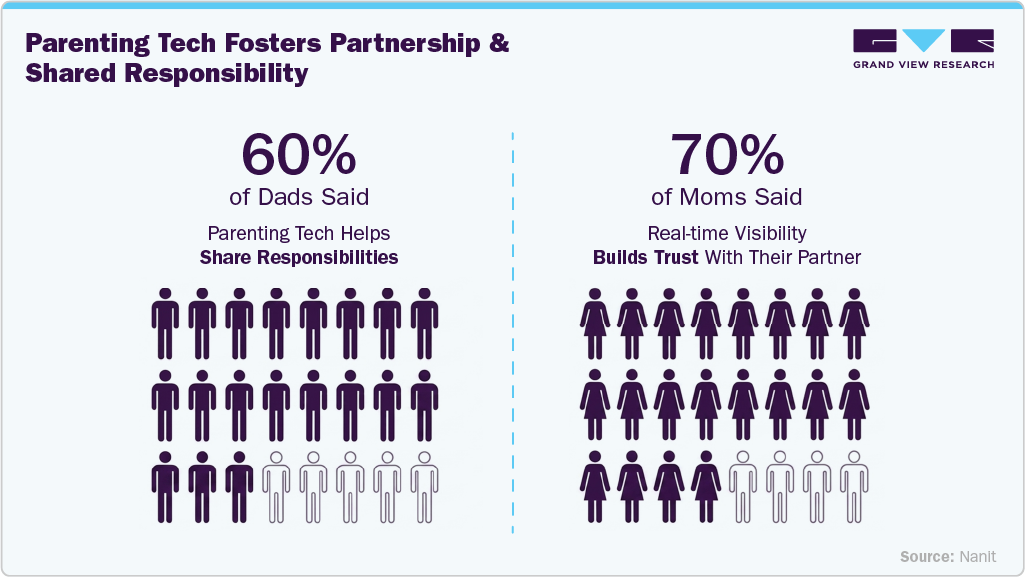
 The increasing number of working parents and nuclear families is a key driver of the baby tech market, as caregivers seek efficient solutions to manage childcare alongside professional responsibilities. With limited support systems, parents are turning to smart monitors, automated cribs, and app-based tracking tools to ensure continuous supervision and safety. These technologies provide remote access, real-time alerts, and convenience, reducing the need for in-person caregiving. As a result, demand for connected and time-saving baby tech solutions continues to grow.
Mothers with Children under 3 Years Old (2024 vs 2025)
Characteristic
2024 Total
2024 (2 yrs)
2024 (1 yr)
2024 (<1 yr)
2025 Total
2025 (2 yrs)
2025 (1 yr)
2025 (<1 yr)
Civilian noninstitutional population
8,063
2,632
2,904
2,526
8,067
2,572
2,879
2,615
Civilian labor force
5,275
1,831
1,879
1,565
5,241
1,714
1,907
1,620
Participation rate (%)
65.4
69.6
64.7
61.9
65
66.6
66.2
61.9
Employed
5,067
1,765
1,802
1,500
5,019
1,646
1,823
1,550
Full-time workers
3,822
1,347
1,371
1,104
3,830
1,298
1,359
1,173
Part-time workers
1,245
418
431
396
1,189
348
464
377
Employment-population ratio (%)
62.8
67.1
62
59.4
62.2
64
63.3
59.3
Unemployed
208
66
77
65
221
68
84
70
Unemployment rate (%)
3.9
3.6
4.1
4.1
4.2
4
4.4
4.3
Source: Bureau of Labor Statistics
Advancements in AI, IoT, and sensor technologies are a major driver of the baby tech market, enabling smarter and more responsive childcare solutions. Modern devices can track breathing, sleep patterns, movement, and environmental conditions in real time, providing actionable insights through connected apps. AI-powered analytics further enhance functionality by offering predictive alerts and personalized recommendations for infant care. These innovations are transforming traditional baby products into intelligent, data-driven systems, accelerating market growth.
Brand
Key Product / Category
Nanit
AI-powered baby monitor & sleep tracking
Owlet Baby Care
Wearable baby health monitor (oxygen, heart rate)
CuboAi
AI safety baby monitor with rollover alerts
Miku
Contact-free breathing & sleep monitor
Motorola Nursery
Smart video baby monitors & nursery tech
VTech
Audio/video baby monitoring systems
LeapFrog
HD smart baby monitors with learning features
Eufy
Privacy-focused smart baby monitors
Infant Optics
Non-WiFi secure baby monitoring devices
Hatch
Smart sleep devices & nursery ecosystem
Source: Company Websites
Market Concentration & Characteristics
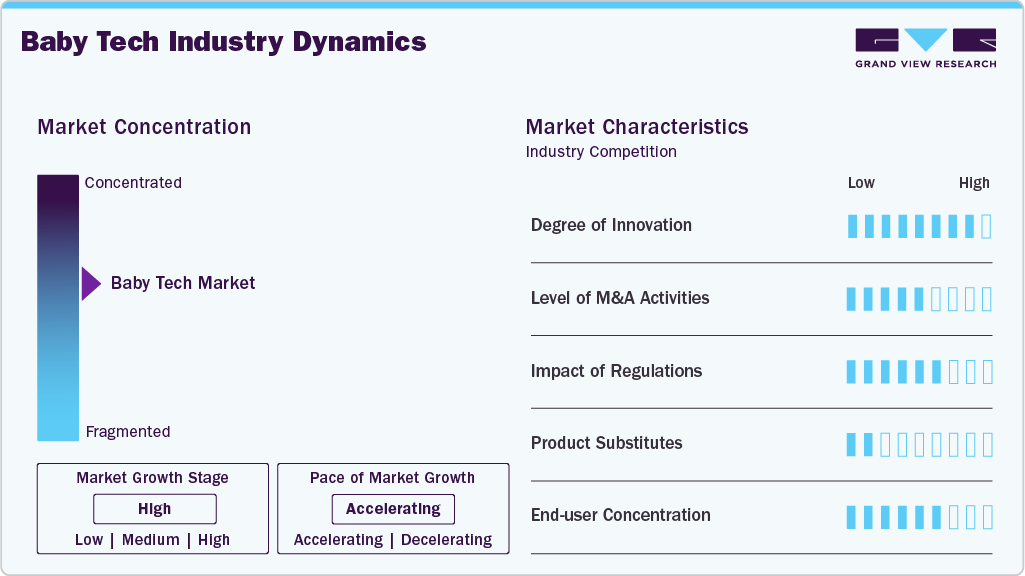
The degree of innovation in the baby tech market is high, driven by rapid advancements in AI, IoT, and sensor technologies that are transforming traditional childcare products into smart, connected solutions. Companies are introducing features such as real-time health monitoring, predictive sleep analytics, and automated response systems, enhancing both safety and convenience. Continuous integration with mobile apps and smart home ecosystems further accelerates product evolution. As a result, innovation remains a key competitive factor, with frequent product upgrades and new launches shaping the market. For instance, in January 2026, Ahmi, an AI-powered early learning device at CES that integrates HD monitoring, sleep tools, and age-based learning programs into a single platform designed to evolve with children from birth to six years. The product, launched with a presale model, highlights how innovation in the baby tech market is moving toward multi-functional, AI-driven ecosystems that combine monitoring, development, and personalized care. This reflects a broader shift from standalone devices to integrated, smart childcare solutions, significantly advancing the market’s innovation landscape.
"Parents are drowning in expensive devices that do one thing at a time and none of them help kids learn or build independence," said Dhruv Chadha, founder and CEO of Ahmi. "We built Ahmi to bring structure, calm and confidence to families. This is intentional tech that helps children develop independence and a healthy relationship with technology from the start."
The level of merger and acquisition activity in the baby tech industry is moderate to high, driven by companies seeking to expand technological capabilities and product portfolios. Larger firms are acquiring startups specializing in AI, wearables, and connected health solutions to strengthen their position in smart childcare. These strategic deals also help companies enter new geographic markets and accelerate innovation. As competition intensifies, M&A activity is expected to remain a key growth and consolidation strategy in the baby tech industry.
 To learn more about this report, Download Free Sample Report
 Regulations play a crucial role in shaping the market by enforcing strict standards for product safety, data privacy, and reliability, especially for devices that monitor infant health. Compliance with safety certifications and digital data protection rules increases development time and costs but ensures higher product quality and consumer trust. Regulatory requirements also push companies to adopt secure connectivity, accurate sensors, and safer materials. As a result, regulations act as both a barrier to entry and a driver of innovation in the market.
End-use concentration in the baby tech market is relatively high, as demand is primarily driven by households with infants and toddlers, particularly among urban, tech-savvy parents. A significant share of adoption comes from nuclear families and dual-income households seeking convenient and reliable childcare solutions. While hospitals and childcare centers contribute to usage, the market remains largely consumer-driven (B2C). This concentrated end-user base enables targeted product development but also limits diversification across broader segments.
Product Type Insights
Smart monitoring devices dominated the baby tech industry in 2025 and is expected to be the fastest-growing segment in the forecast period, driven by increasing parental focus on real-time infant safety and health tracking. These devices, such as video monitors, breathing trackers, and wearable sensors, offer continuous monitoring of sleep patterns, movement, and vital signs, making them essential for modern parenting. Their integration with mobile apps and smart home systems further enhances convenience and remote access, strengthening their widespread adoption. As a result, smart monitoring solutions remain the largest and most established segment.
Application Insights
The safety & security segment dominated the baby tech market in 2025, as parents prioritized real-time monitoring and risk prevention for infants. Products such as smart baby monitors, breathing trackers, and alert systems are widely adopted to ensure continuous supervision and early detection of potential hazards. The critical nature of infant safety and rising parental awareness have made this the largest application segment.
Health & wellness monitoring is expected to be the fastest-growing segment during the forecast period, driven by increasing demand for data-driven parenting and preventive healthcare. Devices that track vital signs, sleep patterns, and developmental metrics are gaining traction as parents seek deeper insights into infant health. The integration of AI, wearables, and IoT-based health ecosystems is further accelerating growth in this segment.
Distribution Channel Insights
The online retail (e-commerce) segment dominated the baby tech industry in 2025, due to its convenience, wide product availability, and competitive pricing, making it the preferred purchasing channel for modern parents. Platforms such as Amazon, Walmart, and Flipkart offer a broad range of smart baby monitors, wearables, and feeding devices, along with detailed product comparisons, user reviews, and fast delivery options. The ability to access global brands, frequent discounts, and easy return policies further enhances consumer confidence.
 To learn more about this report, Download Free Sample Report
 The Direct-to-Consumer (DTC) channel is expected to grow at a rapid CAGR during the forecast period, driven by rising brand preference for direct customer engagement and higher profit margins. Companies are leveraging their own websites and digital platforms to offer personalized product recommendations, subscription models, and exclusive product launches, enhancing customer loyalty.
Regional Insights
The baby tech market in North America held the largest revenue share of 36.00% in 2025, driven by high consumer awareness, strong purchasing power, and early adoption of connected parenting solutions. Parents are using AI-enabled monitors, wearable devices, and mobile apps to track infant health, sleep, and safety in real time. A key trend is the rise of integrated ecosystems, where baby tech products connect seamlessly with smartphones and smart home systems, enhancing convenience and control. In addition, demand for premium, data-driven solutions is growing, while concerns around data privacy, accuracy, and responsible usage continue to shape product innovation and adoption patterns.
 To learn more about this report, Download Free Sample Report
 U.S. Baby Tech Market Trends
The U.S. baby tech industry is characterized by strong demand for connected, data-driven parenting solutions, supported by high digital adoption and tech-savvy consumers. Parents are increasingly using AI-enabled baby monitors, wearable health trackers, and mobile apps to monitor infant sleep, breathing, and overall well-being in real time. A key trend is the shift toward premium, feature-rich devices integrated with smart home ecosystems, offering enhanced convenience and personalization. At the same time, growing awareness around data privacy, device accuracy, and regulatory standards is influencing product development and purchasing decisions.
Europe Baby Tech Market Trends
The Europe baby tech industry is witnessing steady growth, supported by rising awareness of infant safety, increasing digital adoption, and strong regulatory standards. Parents across the region are gradually adopting smart monitors, wearable devices, and app-based tracking tools, with demand particularly strong in Western Europe. A key trend is the preference for privacy-focused and clinically reliable products, reflecting stricter data protection norms and cautious consumer behavior. In addition, there is growing interest in eco-friendly, high-quality, and premium baby tech solutions, aligning with broader sustainability trends in the region.
The UK baby tech market is growing steadily, driven by high smartphone penetration and increasing adoption of connected parenting solutions. Parents are increasingly using smart baby monitors, wearable trackers, and app-based platforms to monitor infant sleep, safety, and health in real time. A key trend is the demand for privacy-compliant, high-quality devices, driven by data protection regulations and consumer awareness. In addition, there is growing interest in premium, user-friendly products that integrate seamlessly with smart home ecosystems.
The baby tech market in France is experiencing gradual growth, supported by increasing awareness of infant health monitoring and rising digital adoption among parents. Consumers are interested in smart baby monitors, connected wearables, and app-based tracking solutions, particularly in urban areas. A key trend is the preference for high-quality, safety-certified, and privacy-focused products, reflecting strong regulatory standards and cautious buying behavior. In addition, demand for premium and design-oriented baby tech solutions is increasing, aligning with the country’s emphasis on quality and lifestyle products.
Asia Pacific Baby Tech Market Trends
The Asia Pacific baby tech industry is witnessing rapid growth, driven by rising urbanization, increasing disposable incomes, and expanding digital connectivity across emerging economies. Parents are adopting smart baby monitors, wearable devices, and mobile-based tracking solutions, particularly in countries like China, India, and Japan. A key trend is the growing demand for affordable yet feature-rich products, supported by strong e-commerce penetration and local manufacturing. In addition, the market is benefiting from a large birth population and increasing awareness of infant health and safety, accelerating overall adoption.
The China baby tech market is expanding rapidly, driven by growing middle-class income, high smartphone penetration, and strong demand for smart parenting solutions. Urban parents are adopting AI-enabled baby monitors, wearable health trackers, and app-based platforms to manage infant care more efficiently. A key trend is the rising preference for locally manufactured, cost-effective, and feature-rich devices, supported by a robust e-commerce ecosystem. In addition, increasing awareness of infant health, safety, and early development is accelerating the adoption of connected baby tech products.
Latin America Baby Tech Market Trends
The Latin America baby tech industry is witnessing gradual growth, supported by rising internet penetration, an expanding middle-class population, and increasing awareness of infant safety. Adoption of smart baby monitors and app-based tracking solutions is growing, particularly in urban centers across countries such as Brazil and Mexico. A key trend is the demand for affordable and easy-to-use devices, as price sensitivity remains a major factor. In addition, the expansion of e-commerce platforms is improving product accessibility and driving market penetration across the region.
MEA Baby Tech Market Trends
The Middle East and Africa baby tech industry is at a developing stage, with growth supported by rising urbanization, improving internet connectivity, and increasing awareness of infant safety. Adoption of smart baby monitors and app-based tracking solutions is gradually increasing, particularly in urban centers within the Gulf Cooperation Council countries and South Africa. A key trend is the preference for cost-effective and easy-to-use devices, as affordability remains a major consideration. In addition, the expansion of online retail channels is enhancing product accessibility and supporting market growth across the region.
Key Baby Tech Company Insights
The baby tech market is highly fragmented, with competition spread across multiple players offering smart monitors, wearables, and connected nursery solutions, leaving no single company with a dominant share. Market share is primarily driven by innovation, product reliability, and ecosystem integration, with larger players leveraging distribution scale. In comparison, smaller players compete through specialized features, AI-enabled capabilities, and direct-to-consumer strategies.
Key Baby Tech Companies:
The following key companies have been profiled for this study on the baby tech market.
- Nanit
- Owlet Baby Care
- CuboAi
- Miku
- Motorola Nursery
- VTech
- LeapFrog
- Eufy
- Infant Optics
- Hatch
Recent Developments
-
In April 2026, Nanit announced the launch of the Nanit Lab Sleep Index-the first state-by-state ranking of infant sleep quality across the United States. The index is built on anonymized, real-world data collected from more than 100,000 Nanit users, drawn from its broader customer base, offering unique insights into the sleep patterns of infants aged 0-8 months nationwide.
-
In October 2025, Owlet, Inc. announced that its Dream Sock, a wearable smart baby monitor designed for infants aged 0-18 months (2.5-13.6 kg), has received approval from the Central Drugs Standard Control Organization for distribution. The device tracks key vitals such as oxygen levels and pulse rate in real time, along with sleep trends, delivering clinically validated insights for infant monitoring.
Baby Tech Market Report Scope
Report Attribute
Details
Market size in 2025
USD 3.4 billion
Estimated Market size in 2026
USD 3.8 billion
Projected Market size by 2033
USD 7.9 billion
Growth rate
CAGR of 11.20% from 2026 to 2033
Base year for estimation
2025
Historical data
2021 - 2024
Forecast period
2026 - 2033
Quantitative units
Revenue in USD million/billion and CAGR from 2026 to 2033
Report coverage
Revenue forecast, company ranking, competitive landscape, growth factors, and trends
Segments covered
Product type, application, distribution channel, and region
Regional scope
North America; Europe; Asia Pacific; Latin America; MEA
Country scope
U.S.; Canada; Mexico; Germany; UK; France; Norway; Denmark; Sweden; Spain; China; Japan; India; South Korea; Australia; Brazil; KSA; UAE; South Africa
Key companies profiled
Nanit; Owlet Baby Care; CuboAi; Miku; Motorola Nursery; Vtech; LeapFrog; Eufy; Infant Optics; Hatch
Customization scope
Free report customization (equivalent up to 8 analysts working days) with purchase. Addition or alteration to country, regional & segment scope.
Pricing and purchase options
Avail customized purchase options to meet your exact research needs. Explore purchase options
Global Baby Tech Market Report Segmentation
This report forecasts revenue growth at the global, regional, and country levels and provides an analysis of the latest industry trends in each of the sub-segments from 2021 to 2033. For this study, Grand View Research has segmented the global baby tech market report based on product type, application, distribution channel, and region:
 To learn more about this report, Download Free Sample Report
 -
Product Type Outlook (Revenue, USD Million, 2021 - 2033)
-
Smart Monitoring Devices
-
AI Baby Monitors
-
Wearable Health Trackers
-
-
Smart Feeding & Nutrition
-
Wi-Fi Bottle Warmers & Sterilizers
-
Smart Breast Pumps
-
-
Smart Nursery & Sleep Tech
-
Smart Bassinets/Cribs
-
Connected Sleep Aids
-
-
Activity & Development
-
Smart Swings & Bouncers
-
Screen-Free Educational Tech
-
-
-
Application Outlook (Revenue, USD Million; 2021 - 2033)
-
Safety & Security
-
Health & Wellness Monitoring
-
Entertainment & Learning
-
Parenting Convenience
-
-
Distribution Channel Outlook (Revenue, USD Million; 2021 - 2033)
-
Online Retail (E-commerce)
-
Specialty Stores
-
Direct-to-Consumer (DTC)
-
-
Regional Outlook (Revenue, USD Million, 2021 - 2033)
-
North America
-
U.S.
-
Canada
-
Mexico
-
-
Europe
-
Germany
-
UK
-
France
-
Italy
-
Spain
-
Sweden
-
Denmark
-
Norway
-
-
Asia Pacific
-
Japan
-
China
-
India
-
Australia
-
South Korea
-
Thailand
-
-
Latin America
-
Brazil
-
Argentina
-
-
Middle East & Africa
-
South Africa
-
Saudi Arabia
-
UAE
-
Kuwait
-
-
Frequently Asked Questions About This Report
The global baby tech market size was valued at USD 3.4 billion in 2025 and is estimated at USD 3.8 billion for 2026.
North America dominated the baby tech market with a share of 36.0% in 2025. This is attributable to the high consumer awareness, strong purchasing power, and early adoption of connected parenting solutions.
Key players include Nanit; Owlet Baby Care; CuboAi; Miku; Motorola Nursery; Vtech; LeapFrog; Eufy; Infant Optics; Hatch.
Smart monitoring devices segment held the largest revenue share in 2025, and is the fastest-growing product type.
The safety & security segment held the largest revenue share in 2025, while health & wellness monitoring is the fastest-growing application.
Online retail (e-commerce) segment dominated the market and accounted for the largest share in 2025.
Key factors that are driving the baby tech market growth include rising parental awareness of infant safety and health monitoring, increasing adoption of smart home ecosystems, and the growing number of dual-income households seeking convenient childcare solutions.
The global baby tech market is expected to grow at a CAGR of 11.2% from 2026 to 2033, reaching USD 7.9 billion by 2033.
About the Author(s)
Medical Devices Research Team
Healthcare · Medical DevicesThis report was authored by the medical devices research team at Grand View Research - comprising two research analysts, one senior research analyst, and one industry expert - with specialized expertise in the medical devices segment of the healthcare industry. All findings are based on proprietary healthcare databases, executive interviews, and regulatory analysis, subject to internal peer review prior to publication.
Last Updated:
Speak to Analyst

Customize this report to your needs - add regions, segments, or data points, with 20% free customization.
Or view our licence options:


ISO 9001:2015 & 27001:2022 Certified
We are GDPR and CCPA compliant! Your transaction & personal information is safe and secure. For more details, please read our privacy policy.


