
- Home
- »
- Consumer F&B
- »
-
Barley Tea Market Size, Share & Trends Report, 2026-2033GVR Report cover

Barley Tea Market (2026 - 2033)
Size, Share & Trends Analysis Report By Flavor (Original, Flavored), By Form (Instant, Ready-to-Drink), By Distribution Channel (Offline, Online), By Region (North America, Europe, Asia Pacific, Latin America, MEA), And Segment Forecasts
Market Size, 2025
$1.2BMarket Estimate, 2026
$1.3BMarket Forecast, 2033
$1.7BCAGR, 2026–2033
3.9%Barley Tea Market Size & Trends
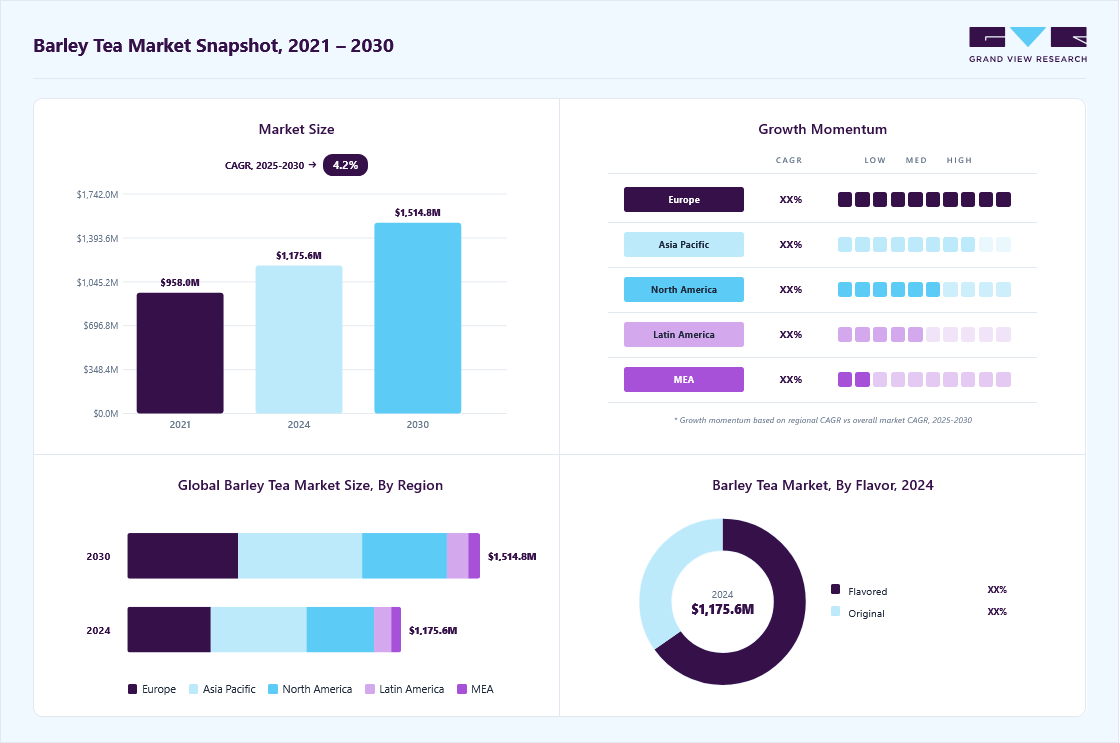
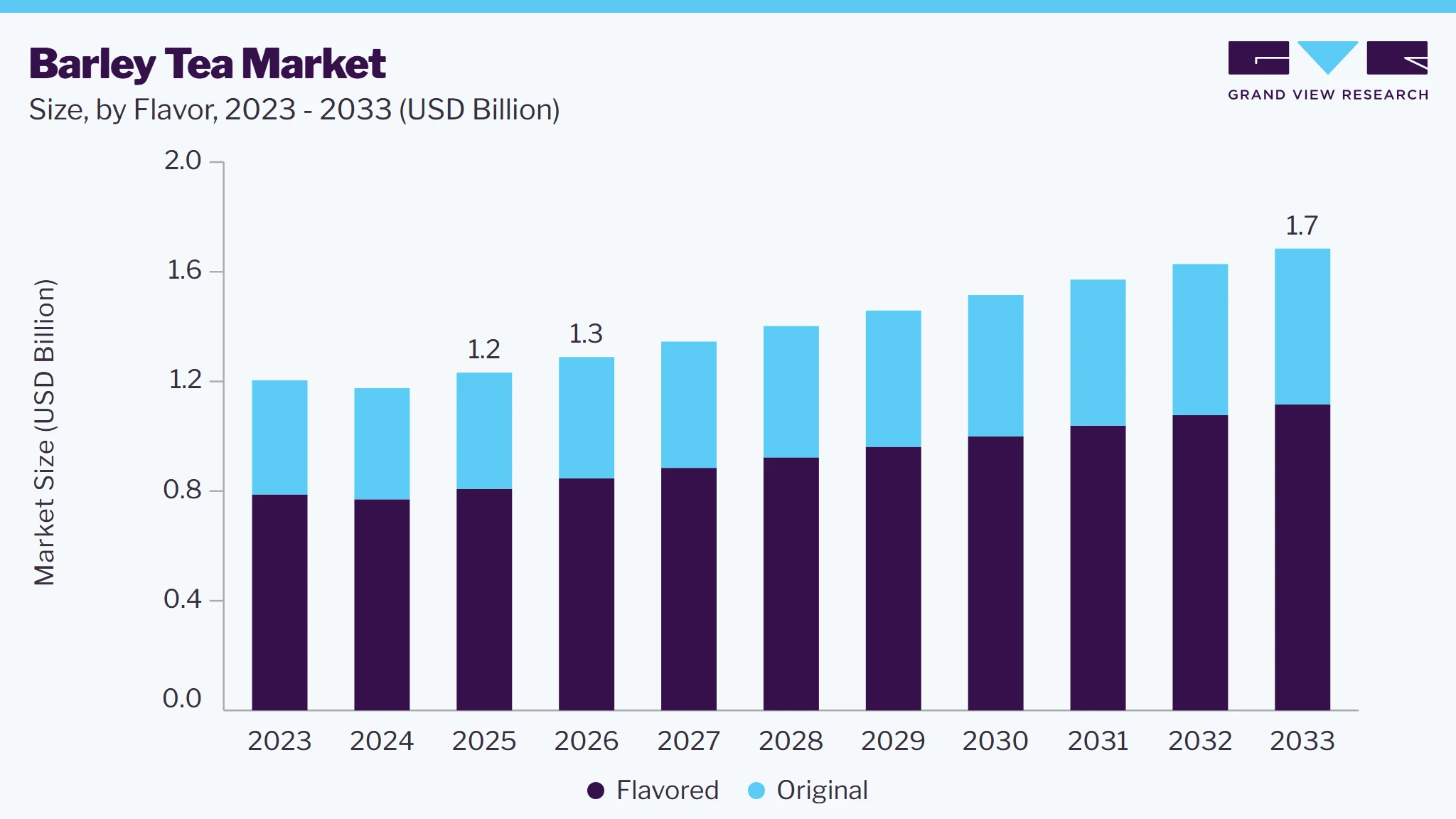
The global barley tea market size was valued at USD 1.2 billion in 2025 and is projected to grow from USD 1.3 billion in 2026 to USD 1.7 billion by 2033, at a CAGR of 3.9% from 2026 to 2033. Asia Pacific dominated the barley tea market with the largest revenue share of 35.0% in 2025. Barley tea, also known as mugicha in Japan and boricha in Korea, is a caffeine-free beverage made from roasted barley grains.
 Source: Grand View Research, IR Documents, Primary Interviews, Paid DatabasesTo learn more about this report,
 Download Free Sample Report
 Key Market Trends & Insights
- By flavor: Flavored segment held the largest market share of 65.6% in 2025.
- By form: Ready-to-drink (RTD) segment held the largest market share of 69.8% in 2025.
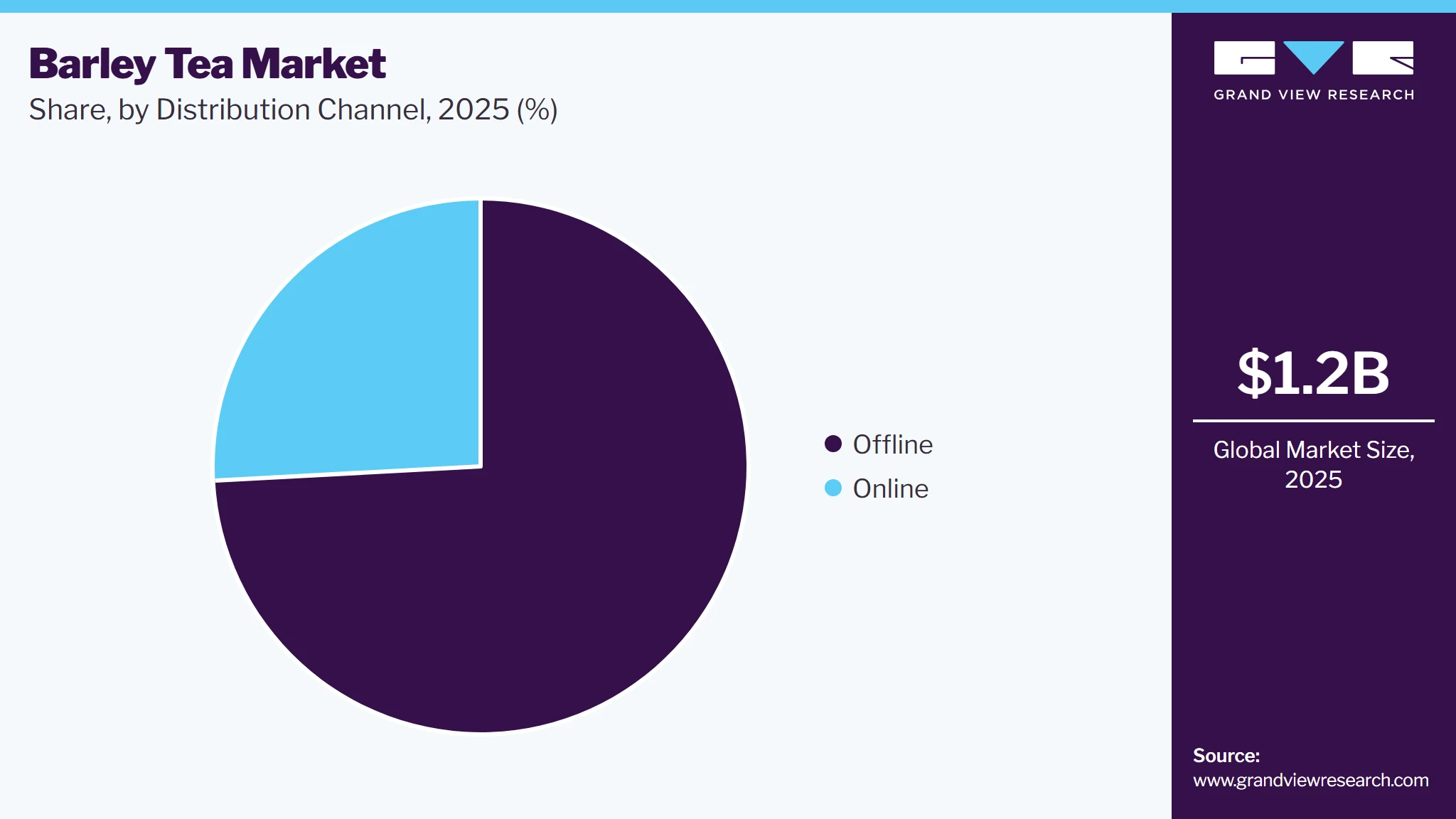
- By distribution channel: Offline channels segment held the largest market share of 74.1% in 2025.
Regional Highlights
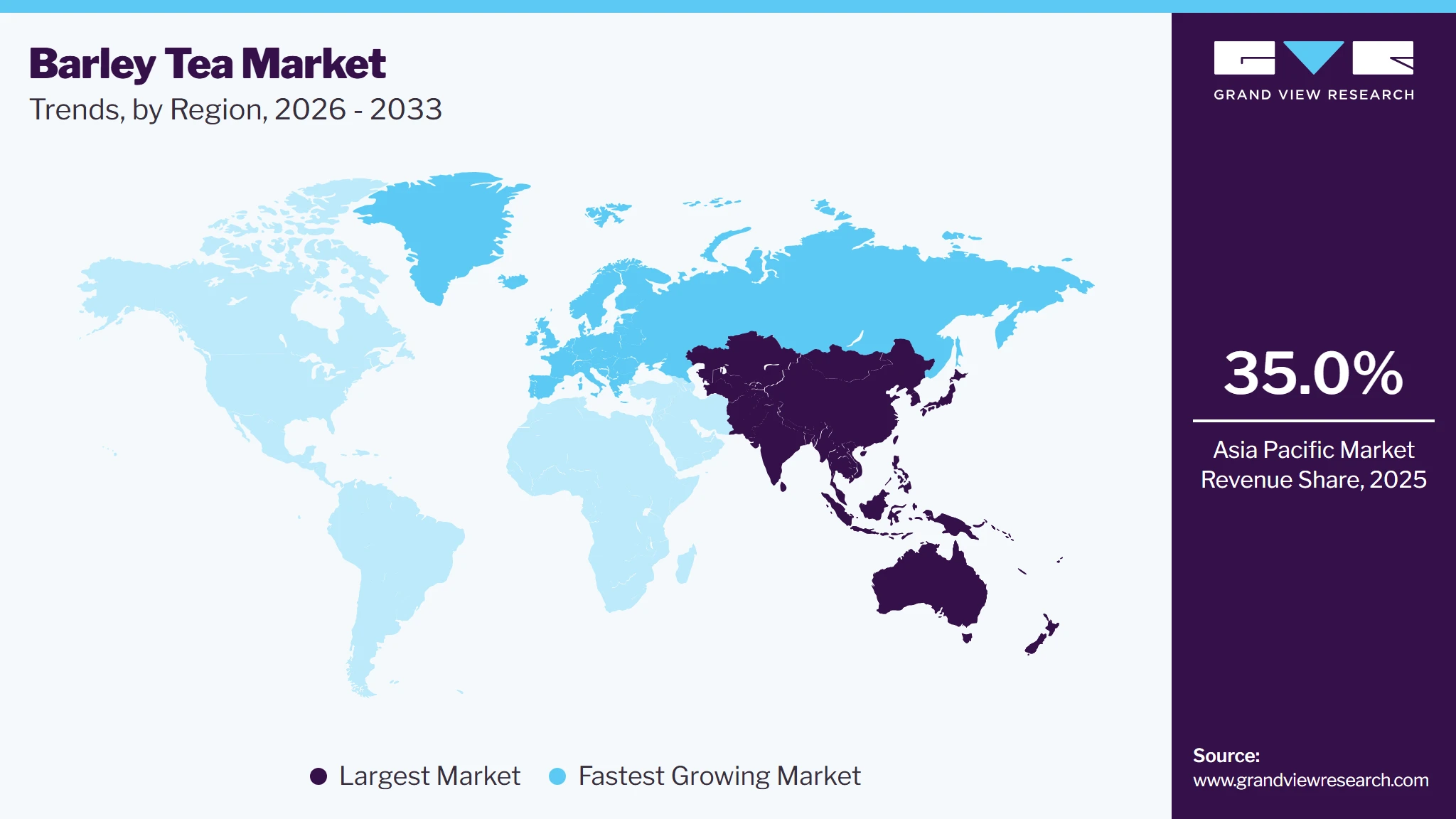
- Largest regional market: Asia Pacific (35.0% revenue share, 2025)
- Fastest-growing regional market: Europe (highest CAGR, 2026-2033)
Market Size & Forecast
- Market size in 2025: USD 1.2 Billion
- Estimated market size in 2026: USD 1.3 Billion
- Projected market size by 2033: USD 1.7 Billion
- CAGR (2026-2033): 3.9%
Three ways to get this report
Buy it, customize it, or ask a question.Ask an Analyst
Analyst response in 1 business day
- AccessReport author, directly
- Reply timeWithin 1 working day
- No sales callDirect answer only
- FormatEmail reply
- CostFree, no cost
Get the Full Report
What the study covers
- FormatsPDF · Excel · Dashboard
- Timeline2026–2033 annual, 2025 base
- Coverage20+ countries, 5 regions
- Companies10+ key players profiled
Customize the Report
20% free customization
- IncludeCountries, segments, points
- TailorTo your product definition
- ExtendDeeper competitor detail
- OrA fully bespoke study
- Turnaround5–10 working days
It's celebrated for its unique flavor and potential health benefits, making it a popular choice among consumers looking for healthy beverage options. The barley tea industry, primarily concentrated in Asia but expanding globally, is experiencing notable growth due to increasing health consciousness, cultural influences, and innovations in product offerings. Barley tea is caffeine-free and rich in antioxidants, which appeal to health-conscious consumers. It's known for aiding digestion, promoting relaxation, and potentially helping to manage blood sugar levels. The trend towards specialty beverages such as craft beers and artisanal drinks has paved the way for herbal tea blends to be recognized as a premium and healthy beverage option. The growing interest in Asian culture and cuisine has spurred demand for traditional nutty-flavored detox drinks in Western markets.There is a growing trend towards sustainable and eco-friendly packaging to appeal to environmentally conscious consumers. Barley tea is increasingly marketed as a functional beverage with health benefits, aligning with the wellness trend in the food and beverage industry. Companies are introducing barley tea in various convenient packaging options, such as ready-to-drink bottles, tea bags, and instant powders.
 To learn more about this report, Download Free Sample Report
 Manufacturers are developing RTD barley tea in convenient, portable packaging to cater to on-the-go consumers. They are introducing unique flavors and blends to attract different consumer segments. There is significant potential for barley tea to expand into new markets, particularly in Western countries where it is not yet widely consumed. Barley tea holds cultural significance in Asian countries and is an integral part of traditional diets. As a caffeine-free, antioxidant-rich beverage, barley tea fits well into the health and wellness segment.
The market is set for sustained growth, driven by innovations in product formulations, campaigns and collaboration activities, strategic marketing efforts, and expanding distribution networks. Manufacturers and stakeholders in this sector have significant opportunities to capitalize on changing consumer trends and strengthen their positions in the global market.
Market Dynamics
The barley tea market is experiencing steady growth due to increasing consumer preference for natural, caffeine-free beverages and rising awareness of health and wellness. Barley tea, traditionally consumed in several Asian countries, is valued for its roasted flavor, refreshing taste, and perceived health benefits, including hydration support and digestive wellness. Growing concerns regarding excessive sugar consumption and caffeine intake are encouraging consumers to shift toward healthier beverage alternatives. In addition, the expansion of ready-to-drink (RTD) tea products, growing popularity of functional beverages, and increasing global interest in traditional Asian food and beverage products are contributing to the market's growth.
The growing consumer shift toward healthier beverage choices is a major driver of the barley tea market. Increasing awareness of the potential health impacts associated with excessive consumption of sugary soft drinks and high-caffeine beverages has encouraged consumers to seek natural and low-calorie alternatives. Barley tea offers a caffeine-free option that can be consumed throughout the day by a wide range of age groups.
Furthermore, rising health consciousness and growing interest in preventive wellness are supporting demand for beverages perceived as natural and beneficial for hydration and digestive health. Consumers are increasingly incorporating herbal and grain-based teas into their daily routines as part of broader healthy lifestyle practices. The growing popularity of clean-label beverages, coupled with increasing demand for plant-based and minimally processed products, is further driving market expansion.
Limited awareness and relatively low market penetration outside traditional consumption regions remain significant restraints for the barley tea market. While barley tea enjoys strong popularity in several Asian countries, many consumers in North America, Europe, Central and South America, and parts of the Middle East and Africa remain unfamiliar with the product and its benefits.
In addition, the beverage faces strong competition from established tea varieties, coffee, flavored water, herbal infusions, energy drinks, and functional beverages. Differences in taste preferences across regions may also affect adoption rates, as the roasted and grain-like flavor profile of barley tea may require consumer education and trial. Furthermore, fluctuations in barley production and agricultural commodity prices can impact raw material availability and manufacturing costs, creating challenges for market participants.
The expanding functional beverage industry presents substantial opportunities for the barley tea market. Consumers are increasingly seeking beverages that provide health benefits beyond basic hydration, encouraging manufacturers to introduce value-added barley tea products enriched with vitamins, antioxidants, botanicals, probiotics, and other functional ingredients. These innovations can help position barley tea within the growing wellness beverage category.
The rapid growth of ready-to-drink (RTD) beverages is creating additional opportunities for market expansion. Busy lifestyles and increasing demand for convenient beverage options are encouraging consumers to purchase packaged barley tea products that offer portability and ease of consumption. Furthermore, rising interest in Asian food culture, premium beverage experiences, and natural ingredients is supporting the introduction of flavored, organic, and specialty barley tea products. The expansion of e-commerce platforms, specialty beverage retailers, and international distribution networks is expected to further enhance market accessibility and support long-term growth in the barley tea market.
Analyst Perspective
The barley tea market is benefiting from growing consumer interest in natural, functional, and caffeine-free beverages. Traditionally popular across East Asian countries, barley tea is increasingly gaining recognition in international markets due to its perceived digestive benefits, antioxidant properties, refreshing taste profile, and suitability as a healthy alternative to sugary soft drinks and caffeinated beverages. Rising awareness of wellness-focused lifestyles and clean-label consumption trends continues to support market expansion. The market's most sustainable competitive advantage will belong to companies that successfully position barley tea as both a traditional wellness beverage and a modern functional drink. While established players benefit from strong distribution networks and consumer familiarity in core markets, future growth is expected to be driven by innovation in ready-to-drink formats, premium ingredients, flavor diversification, and sustainable packaging solutions. As consumers increasingly seek hydration products with natural ingredients and lower sugar content, manufacturers capable of combining authenticity, convenience, and health-focused value propositions will be best positioned to capture long-term growth opportunities in the global barley tea market.
Flavor Insights
By flavor, the flavored segment led the market with the largest revenue share of 65.6% in 2025. Modern consumers often seek variety in their beverage choices. Flavored segment offers a wide range of options, from fruity flavors to herbal infusions, catering to diverse taste preferences. Flavored versions can enhance the natural taste of barley tea, making it more appealing to those who may find the original flavor too subtle or bland. There is a rising demand for naturally flavored and organic beverages, which flavored barley tea can cater to by using natural flavorings and organic ingredients. Flavored segment appeals to a broader demographic, including younger consumers and those new to barley tea who may be more accustomed to flavored beverages.
The original barley tea segment is expected to grow at the fastest CAGR of 4.1% from 2024 to 2030. In countries like Japan and Korea, where barley tea (mugicha and boricha, respectively) is a staple, the original, unflavored version is deeply rooted in daily life and traditional practices. Consumers seeking health benefits often prefer the original version due to its simplicity and lack of additives or artificial flavors. With increasing awareness about the health benefits of natural and unprocessed foods, consumers are more likely to choose the original version. Original segment is being marketed as a functional beverage with health benefits, which appeals to the growing health and wellness consumer base.
Form Insights
By form, the ready-to-drink (RTD) segment led the market with the largest revenue share of 69.8% in 2025. RTD barley tea offers the ultimate convenience as it is pre-brewed and ready for immediate consumption. This appeals to busy consumers who want a quick and easy beverage option without any preparation. Available in bottles, cans, and tetra packs, RTD barley tea can be easily carried and consumed on the go, making it ideal for busy lifestyles and outdoor activities. Manufacturers are introducing a variety of flavors to cater to diverse consumer tastes, including options like lemon, honey, and herbal infusions. This variety helps attract and retain a wider audience.
The instant segment is expected to grow at the fastest CAGR of 5.3% from 2024 to 2030. The portability of instant tea packets makes it easy for consumers to enjoy barley tea anywhere, whether at work, while traveling, or during outdoor activities. The availability of single-serve packets caters to individual consumption needs, reducing waste and ensuring freshness. Many instant barley tea products emphasize natural and minimal ingredients, aligning with the trend towards clean eating and transparency in food labeling. Manufacturers are continually innovating with new flavors and formulations, making instant barley tea more appealing to a broader audience.
Distribution Channel Insights
By distribution channel, the sales through offline channels led the market with the largest revenue share of 74.1% in 2025. Companies producing barley tea have established partnerships with major retail chains such as supermarkets, hypermarkets, and convenience stores. These collaborations ensure that barley tea is widely available to a broad consumer base. Through these partnerships, barley tea brands can penetrate markets more effectively and establish a strong presence in both urban and rural areas. This widespread availability helps in maintaining a majority market share. Offline channels like supermarkets and convenience stores offer consumers the ease of picking up barley tea during their regular shopping trips. This convenience encourages repeat purchases.
 To learn more about this report, Download Free Sample Report
 The online segment is expected to grow at the fastest CAGR of 5.2% from 2024 to 2030. Online shopping offers unparalleled convenience, allowing consumers to purchase barley tea from the comfort of their homes at any time. Brands can leverage digital marketing tools to target specific demographics, increasing the effectiveness of advertising campaigns. Platforms like Instagram, Facebook, and Twitter are used to promote barley tea products, engage with customers, and drive traffic to online stores. Moreover, online reviews and ratings help potential buyers make informed decisions based on the experiences of other consumers.
Regional Insights
North America dominated the barley tea market with a revenue share of 24.79% in the market. The popularity of barley tea in Asian cultures is influencing North American consumers, especially in metropolitan areas with diverse populations and a growing interest in Asian cuisine and wellness practices. Brands are emphasizing sustainable sourcing of barley and environmentally friendly packaging to appeal to eco-conscious consumers. Health professionals, nutritionists, and wellness influencers are advocating for barley tea as a healthy alternative to sugary and caffeinated drinks, further boosting its popularity.
U.S. Barley Tea Market Trends
The barley tea market in the U.S. held the largest share in the North America region in 2025. The U.S. market is experiencing robust growth, fueled by increasing consumer awareness of its health benefits, the rise of wellness trends, and a growing preference for natural and healthy beverages. The preference for clean-label products is rising, and barley tea, made from roasted barley grains without additives, fits this trend perfectly.
Europe Barley Tea Market Trends
The barley tea market in Europe is expected to grow at the fastest CAGR of 4.8% from 2024 to 2030. European consumers are increasingly prioritizing health and wellness, driving demand for functional beverages like barley tea, known for its health benefits such as being caffeine-free, aiding digestion, and providing antioxidants. European consumers are increasingly interested in authentic and traditional Asian beverages, including barley tea, as part of their culinary exploration. Moreover, there is a growing emphasis on sustainable packaging solutions, such as recyclable and biodegradable materials, in response to consumer demand for environmentally friendly products.
Asia Pacific Barley Tea Market Trends
Asia Pacific dominated the barley tea market with the largest revenue share of 35.0% in 2025. Barley tea has deep cultural roots in several Asia Pacific countries, including Japan, South Korea, and China. It is widely consumed as a traditional beverage, enjoyed for its refreshing taste and health benefits. The beverage’s traditional status and widespread consumption are bolstering its market presence in both established and emerging markets within the region. The urbanization trend is driving the demand for convenient and premium beverages in metropolitan areas, contributing to the market growth. Brands are investing in educational campaigns to raise awareness about the benefits of barley tea and its traditional significance. These campaigns are effective in attracting new consumers.
 To learn more about this report, Download Free Sample Report
 Key Barley Tea Company Insights
The market is characterized by dynamic competitive dynamics shaped by a combination of factors including product innovation, regional production capabilities, and evolving consumer preferences. Leading manufacturers invest in R&D and technological advancements to provide cost-effective and quality products. Market players are entering into joint ventures, partnerships, mergers, agreements, and acquisitions to strengthen their market position and expand their geographical reach. Key manufacturers in the global market utilize their expansive distribution networks and robust brand recognition to sustain a substantial market presence. They prioritize quality, innovation, and regional preferences, thereby reinforcing their leadership in international markets that embrace barley tea.
Key Barley Tea Companies
The following key companies have been profiled for this study on the barley tea market.
-
Ito En
-
Suntory Beverage & Food
-
Kirin Holdings
-
Otsuka Pharmaceutical
-
Jinjja Barley Tea
-
Haitai
-
The Republic of Tea
-
Lotte
-
New Mexico Tea Company
-
The Canadian Barley Tea Company
Competitive Benchmarking
Category
Operating Strategies
Competitive Edge
Weakness
Established Players (Ito En, Suntory Beverage & Food, Kirin Holdings, Otsuka Pharmaceutical, Haitai, Lotte)
- Expand ready-to-drink and packaged barley tea portfolios through product innovation, premium offerings, and wider distribution across retail, convenience stores, and e-commerce channels
- Invest in brand development, sustainable sourcing, and functional beverage formulations that align with growing consumer demand for healthier, caffeine-free drinks
- Strong brand recognition, extensive distribution networks, and significant manufacturing capabilities across domestic and international markets
- Large-scale operations enable product consistency, cost efficiencies, and rapid commercialization of new beverage formats
- Dependence on mature beverage markets can limit growth opportunities in developed regions
- Exposure to changing consumer preferences and increasing competition from functional beverages, herbal teas, and plant-based drinks
Emerging Players (Jinjja Barley Tea, The Republic of Tea, New Mexico Tea Company, The Canadian Barley Tea Company)
- Focus on premium, organic, specialty, and wellness-oriented barley tea products targeting health-conscious consumers
- Leverage direct-to-consumer sales, digital marketing, and niche retail partnerships to expand brand visibility and customer engagement
- Greater flexibility in introducing innovative flavors, premium ingredients, and artisanal product positioning
- Strong differentiation through authenticity, clean-label claims, and targeted wellness-focused branding
- Limited production scale and geographic reach compared to multinational beverage companies
- Lower marketing resources and distribution capabilities may restrict mass-market penetration and international expansion
Recent Developments
-
In April 2023, Shiga Prefecture, renowned for being home to Japan's largest lake, Lake Biwa, has just unveiled a new release of Omi barley tea. This region is blessed with abundant sunlight and mineral-rich soil, which contributes to the exceptional quality of its barley. The barley is carefully roasted using hot air, resulting in a delightfully rich and aromatic tea that captures the essence of its pristine environment
-
In April 2022, the Canadian Barley Tea Company is proud to announce the launch of its new product, mo'mugi, now available on both Amazon.com and Amazon.ca. Sourced and crafted locally in British Columbia, mo'mugi is made from the highest quality organic Canadian barley. mo'mugi offers a wealth of benefits as a 100% natural beverage. Composed entirely of premium organic barley, it contains no caffeine, sugar, carbs, or calories, making it an ideal choice for health-conscious consumers
Barley Tea Market Report Scope
Report Attribute
Details
Market size in 2025
USD 1.2 billion
Estimated market size in 2026
USD 1.3 billion
Projected market size by 2033
USD 1.7 billion
Growth rate
CAGR of 3.9% from 2026 to 2033
Base year for estimation
2025
Historical data
2021 - 2024
Forecast period
2026 - 2033
Quantitative units
Revenue in USD million/billion and CAGR from 2026 to 2033
Report coverage
Revenue forecast, company ranking, competitive landscape, growth factors, and trends
Segments covered
Flavor, form, distribution channel, region
Regional scope
North America; Europe; Asia Pacific; Central & South America; Middle East & Africa
Country scope
U.S.; Canada; Mexico; Germany; UK; France; Italy; Spain; China; Japan; India; South Korea; Australia & New Zealand; Brazil; South Africa
Key companies profiled
Ito En; Suntory Beverage & Food; Kirin Holdings; Otsuka Pharmaceutical; Jinjja Barley Tea; Haitai; The Republic of Tea; Lotte; New Mexico Tea Company; and The Canadian Barley Tea Company.
Customization scope
Free report customization (equivalent up to 8 analysts' working days) with purchase. Addition or alteration to country, regional & segment scope.
Pricing and purchase options
Avail customized purchase options to meet your exact research needs. Explore purchase options
Global Barley Tea Market Report Segmentation
This report forecasts revenue growth at the global, regional, and country levels and provides an analysis of the latest industry trends and opportunities in each of the sub-segments from 2021 to 2033. For this study, Grand View Research has segmented the global barley tea market report based on flavor, form, distribution channel, and region:
-
Flavor Outlook (Revenue, USD Million, 2021 - 2033)
-
Original
-
Flavored
-
-
Form Outlook (Revenue, USD Million, 2021 - 2033)
-
Instant
-
Ready-to-drink
-
-
Distribution Channel Outlook (Revenue, USD Million, 2021 - 2033)
-
Offline
-
Online
-
-
Regional Outlook (Revenue, USD Million, 2021 - 2033)
-
North America
-
U.S.
-
Canada
-
Mexico
-
-
Europe
-
UK
-
France
-
Germany
-
Spain
-
Italy
-
-
Asia Pacific
-
China
-
Japan
-
India
-
Australia & New Zealand
-
South Korea
-
-
Central & South America
-
Brazil
-
-
Middle East & Africa
-
South Africa
-
-
Research Methodology
The barley tea market figures in this report are based on a proven research process that combines executive interviews with secondary research from proprietary databases, company filings, and recognized regulatory and institutional sources. Market size is built through value-chain sizing - reconciling supply-side and demand-side estimates - and triangulated with bottom-up and top-down approaches. Every estimate passes multiple levels of expert validation before publication, with each barley tea segment quantified using the revenue-capture definitions in the table below.
Segment Definition
Segment - Flavor
Revenue capture definition
Flavored
This segment includes the sales of barley tea infused with added flavors such as fruit, herbs, or spices.
Original
This segment includes the sales of traditional barley tea without added flavors or taste enhancers.
Estimation Model
Tea & Beverage Consumer Layer
Market Access Layer
Barley Tea Adoption Layer
Monetisation Layer
Who consumes tea and health-oriented beverages?
Who can access barley tea products?
Who actively purchases barley tea?
How much revenue is generated?
Identify consumers of tea, herbal infusions, and functional beverages across target markets. Analyze beverage consumption habits, health awareness, cultural tea-drinking traditions, and demand for caffeine-free alternatives to define the potential consumer pool for barley tea products.
Apply region-specific availability through supermarkets, convenience stores, specialty tea retailers, health food stores, foodservice establishments, and e-commerce platforms to the eligible consumer base. Consider the influence of distribution networks and product visibility in estimating the addressable barley tea market.
Apply barley tea penetration rates and consumer preferences for caffeine-free beverages, digestive wellness drinks, traditional teas, and natural hydration solutions. Factor in demand from health-conscious consumers, aging populations, wellness-focused individuals, and consumers seeking alternatives to sugary beverages to convert the addressable market into active buyers.
Multiply active barley tea consumers by average annual consumption frequency and spending per consumer. Add revenue contributions from retail stores, specialty tea shops, cafés, restaurants, online channels, ready-to-drink products, and premium tea offerings to estimate total market revenue.
Delivered Customizations
This report has been delivered with the following In-depth customizations
Client Request
Customization Delivered
Value Adds
Consumer Beverage Trends & Product Preference Analysis
Conducted a focused analysis of barley tea consumption across traditional roasted barley tea, ready-to-drink (RTD) beverages, flavored barley tea, organic variants, and functional tea products, covering changing beverage preferences, caffeine-free consumption trends, and demand for natural wellness beverages.
Helps stakeholders identify high-growth product categories, evaluate evolving consumer preferences, and assess commercialization opportunities in the expanding healthy beverage market.
Health, Wellness & Functional Beverage Trends
Evaluated adoption trends for low-calorie, caffeine-free, antioxidant-rich, organic, clean-label, and digestive-health-oriented barley tea products, including consumer purchasing behavior, hydration trends, weight management awareness, and demand for natural plant-based beverages.
Provides insights into emerging health and wellness trends, unmet consumer needs, and commercially attractive product segments to support product innovation, portfolio diversification, and brand positioning strategies.
Retail Expansion, RTD Innovation & Market Opportunity Assessment
Assessed demand across supermarkets, hypermarkets, convenience stores, specialty tea shops, cafés, restaurants, vending channels, and e-commerce platforms, along with trends in ready-to-drink packaging, premium formulations, sustainable packaging, and regional flavor customization.
Supports investment and expansion strategies by identifying high-potential distribution channels, evaluating consumer acceptance of innovative barley tea products, and strengthening long-term growth opportunities in the global functional and wellness beverage industry.
Frequently Asked Questions About This Report
The global barley tea market size was estimated at USD 1.2 billion in 2025 and is expected to reach USD 1.3 billion in 2026.
The global barley tea market is expected to grow at a compounded growth rate of 3.9% from 2026 to 2033 to reach USD 1.7 billion by 2033.
By flavor, the flavored segment led the market with the largest revenue share of 65.6% in 2025.
Some key players operating in the barley tea market include Ito En; Suntory Beverage & Food; Kirin Holdings; Otsuka Pharmaceutical; Jinjja Barley Tea; Haitai; The Republic of Tea; Lotte; New Mexico Tea Company; and The Canadian Barley Tea Company.
By form, the ready-to-drink (RTD) segment led the market with the largest revenue share of 69.8% in 2025.
By distribution channel, the sales through offline channels led the market with the largest revenue share of 74.1% in 2025.
Asia Pacific dominated the barley tea market with the largest revenue share of 35.0% in 2025.
Europe is the fastest-growing region in the barley tea market.
The barley tea market is experiencing steady growth due to increasing consumer preference for natural, caffeine-free beverages and rising awareness of health and wellness.
About the Author(s)
Consumer F&B Research Team
Consumer Goods · Consumer F&BThis report was authored by the consumer f&b research team at Grand View Research - comprising two research analysts, one senior research analyst, and one industry expert - with specialized expertise in the consumer f&b segment of the consumer goods industry. All findings are based on proprietary consumer goods databases, executive interviews, and regulatory analysis, subject to internal peer review prior to publication.
Last Updated:
Speak to Analyst

Customize this report to your needs - add regions, segments, or data points, with 20% free customization.
Or view our licence options:


ISO 9001:2015 & 27001:2022 Certified
We are GDPR and CCPA compliant! Your transaction & personal information is safe and secure. For more details, please read our privacy policy.


