
- Home
- »
- Advanced Interior Materials
- »
-
Battery Recycling Equipment Market, Industry Report, 2033GVR Report cover
![Battery Recycling Equipment Market Size, Share & Trends Report]()
Battery Recycling Equipment Market (2026 - 2033) Size, Share & Trends Analysis Report By Equipment (Mechanical Processing Equipment, Pyrometallurgical Equipment, Hydrometallurgical Equipment), By Source, By Battery Type, By Region, And Segment Forecasts
- Report ID: GVR-4-68040-877-7
- Number of Report Pages: 150
- Format: PDF
- Historical Range: 2021 - 2024
- Forecast Period: 2026 - 2033
- Industry: Advanced Materials
- Report Summary
- Table of Contents
- Segmentation
- Methodology
- Download FREE Sample
-
 Download Sample Report
Battery Recycling Equipment Market Summary
The global battery recycling equipment market size was estimated at USD 1,413.6 million in 2025 and is projected to reach USD 3,261.2 million by 2033, growing at a CAGR of 11.1% from 2026 to 2033. The battery recycling equipment industry is primarily driven by the rapid growth in battery consumption, especially from electric vehicles and consumer electronics.
Key Market Trends & Insights
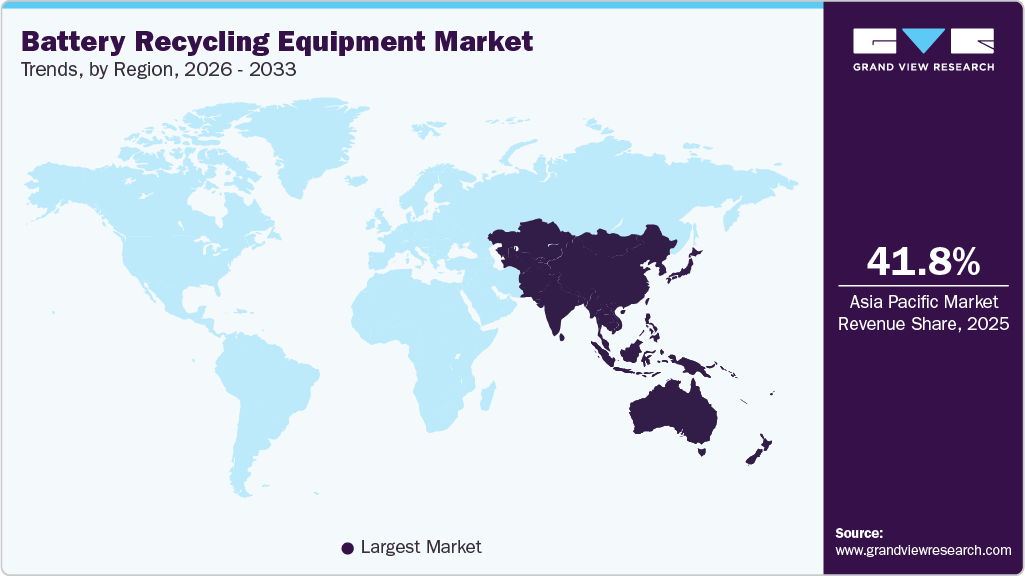
- Asia Pacific dominated the global battery recycling equipment market with the largest revenue share of 41.8% in 2025.
- Based on equipment, the hydrometallurgical equipment segment is expected to register at the fastest CAGR of 14.9% from 2026 to 2033.
- Based on source, the manufacturing scrap segment led the market with the largest revenue share of 59.3% in 2025.
- Based on battery type, the lithium-ion batteries segment led the market with the largest revenue share of 46.4% in 2025.
Market Size & Forecast
- 2025 Market Size: USD 1,413.6 Million
- 2033 Projected Market Size: USD 3,261.2 Million
- CAGR (2026-2033): 11.1%
- Asia Pacific: Largest market share in 2025
As the volume of end-of-life batteries increases, there is a rising need for efficient recycling infrastructure and advanced equipment to recover valuable materials such as lithium, cobalt, and nickel. Another key factor supporting market growth is the tightening of environmental regulations and sustainability goals across industries. Governments and regulatory bodies are emphasizing proper battery disposal and resource recovery to reduce environmental hazards and dependence on raw material mining. This has encouraged manufacturers and recycling companies to adopt advanced equipment such as hydrometallurgical and pyrometallurgical systems, improving recycling efficiency and compliance with evolving environmental standards.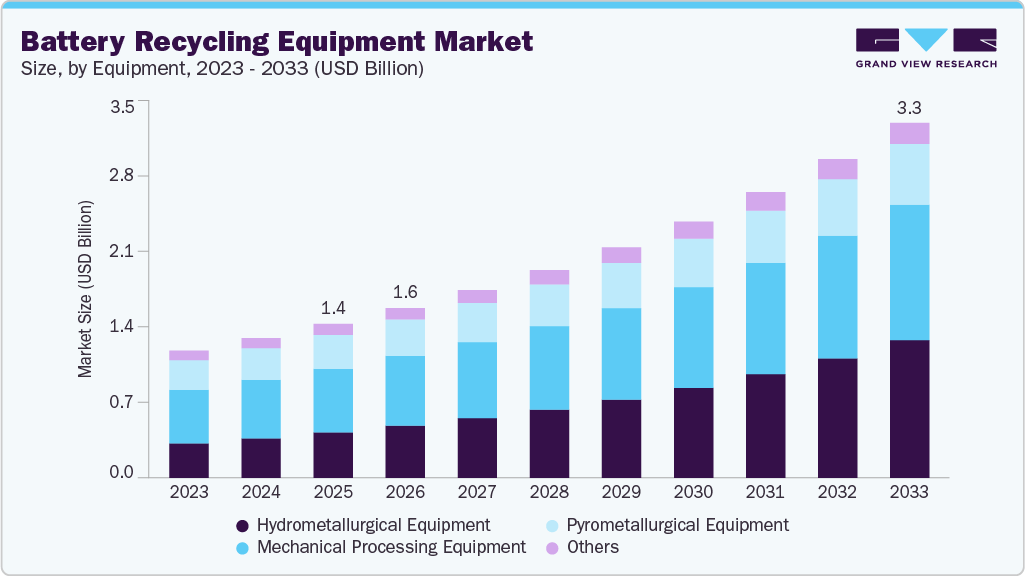
According to the International Energy Agency, electric car sales surpassed 17 million globally in 2024, marking an increase of over 25%, with an additional 3.5 million units sold during the year, exceeding the total sales recorded in 2020. This rapid growth in electric mobility is significantly increasing battery production and usage, which in turn is expected to generate a substantial volume of end-of-life batteries, thereby driving strong demand for advanced battery recycling equipment to support efficient material recovery and sustainable resource management.
Market Concentration & Characteristics
The battery recycling equipment industry is fragmented, with a mix of global technology providers and regional equipment manufacturers competing across different stages of the recycling value chain. While a few established players hold strong positions in advanced processing technologies such as hydrometallurgical and pyrometallurgical systems, a large number of smaller and specialized firms operate in mechanical equipment segments like shredders and separators.
Innovation in the battery recycling equipment industry is focused on improving recovery efficiency and lowering environmental impact through advanced processing technologies and automation. Companies are increasingly adopting hydrometallurgical methods, AI-based sorting, and closed-loop systems to enhance material recovery from lithium-ion batteries. There is also a growing shift toward direct recycling approaches that minimize energy use and preserve material value. For instance, in December 2025, BMW Group and Encory introduced a direct recycling solution that enables recovery and reuse of battery materials without extensive chemical processing, supporting more sustainable production cycles.
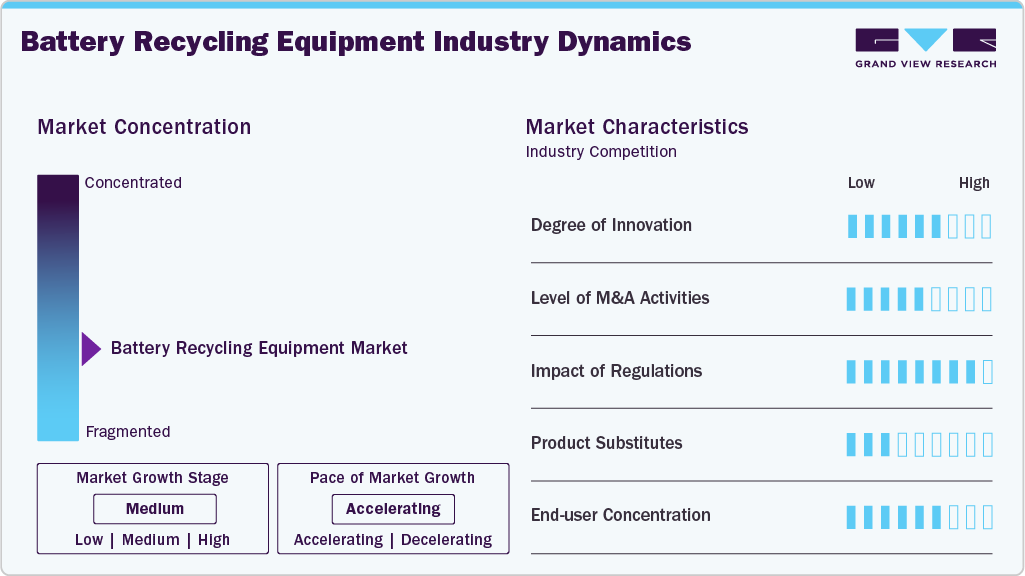
Regulatory frameworks continue to play a critical role in shaping the market, especially with stricter policies around battery disposal, recycling efficiency, and emissions control. Governments are increasingly mandating extended producer responsibility (EPR) and setting minimum recycling efficiency targets, particularly for lithium-ion batteries. These regulations are accelerating the adoption of advanced and environmentally sustainable recycling equipment, encouraging a shift from conventional pyrometallurgical methods to cleaner hydrometallurgical and direct recycling technologies.
End-user concentration remains relatively high, with demand largely driven by automotive OEMs, battery manufacturers, and large recycling firms. The automotive sector dominates due to the surge in electric vehicle adoption and the resulting increase in end-of-life battery volumes. However, the market is gradually diversifying as consumer electronics and industrial energy storage sectors expand, although major investments and long-term contracts are still concentrated among a limited number of large-scale players.
Drivers, Opportunities & Restraints
The battery recycling equipment industry is mainly driven by the sharp rise in battery usage across electric vehicles, consumer electronics, and energy storage systems. The growing volume of end-of-life batteries has increased the need for efficient recycling infrastructure to recover valuable materials like lithium, cobalt, and nickel. In addition, stricter environmental regulations and sustainability goals are pushing industries to adopt advanced recycling equipment and processes.
Significant opportunities are emerging from the rapid expansion of the electric vehicle ecosystem and the shift toward a circular economy. Increasing investments in lithium-ion battery recycling and the development of direct recycling technologies are creating demand for next-generation equipment. Moreover, rising focus on recycling manufacturing scrap and improving material recovery efficiency is opening new avenues for equipment manufacturers and technology providers.
Despite strong growth potential, the market faces challenges such as high capital investment required for advanced recycling systems and the complexity of handling different battery chemistries. Limited standardization in battery design and evolving recycling technologies can also create operational difficulties. In addition, in some regions, inadequate collection and recycling infrastructure continues to hinder market growth.
Equipment Insights
The mechanical processing equipment segment led the market with the largest revenue share of 41.4% in 2025, as it forms the first and most essential stage of battery recycling. Equipment such as shredders, crushers, and separators are widely used to dismantle batteries and generate black mass for further processing. Its widespread adoption is driven by the need for safe handling of diverse battery chemistries, high processing volumes, and relatively lower operational complexity compared to chemical-based systems.
The hydrometallurgical equipment segment is anticipated to grow at the fastest CAGR during the forecast period, supported by its ability to recover high-purity metals such as lithium, cobalt, and nickel with greater efficiency. This process is gaining traction due to its lower environmental impact and higher material recovery rates compared to traditional methods. Increasing focus on sustainability and the rising demand for critical battery materials are accelerating the adoption of hydrometallurgical technologies across recycling facilities.
Battery Type Insights
The Lithium-ion batteries segment led the market with the largest revenue share of 46.4% in 2025 and is projected to grow at the fastest CAGR during the forecast period, driven by their widespread use in electric vehicles, consumer electronics, and energy storage systems. The rapid growth in EV adoption has significantly increased the volume of lithium-ion battery waste, creating strong demand for advanced recycling equipment. In addition, the high value of recoverable materials such as lithium, cobalt, and nickel is encouraging investments in efficient recycling technologies.
The nickel-cadmium batteries segment is expected to grow at a significant CAGR of 5.6% during the forecast period. The segment is driven by their continued use in industrial applications and backup power systems. Increasing regulatory pressure to safely dispose of cadmium, a hazardous material, is driving the need for proper recycling infrastructure. Consequently, specialized recycling equipment for handling and processing these batteries is gaining traction, particularly in regions with strict environmental compliance requirements.
Source Insights
The manufacturing scrap segment accounted for the largest market revenue share in 2025, as battery production facilities generate a consistent volume of waste during cell manufacturing and assembly processes. This scrap is relatively clean and uniform, making it easier and more cost-effective to recycle using mechanical and hydrometallurgical equipment. Increasing battery production capacity, especially for electric vehicles, is further contributing to steady demand for recycling systems focused on processing manufacturing waste.
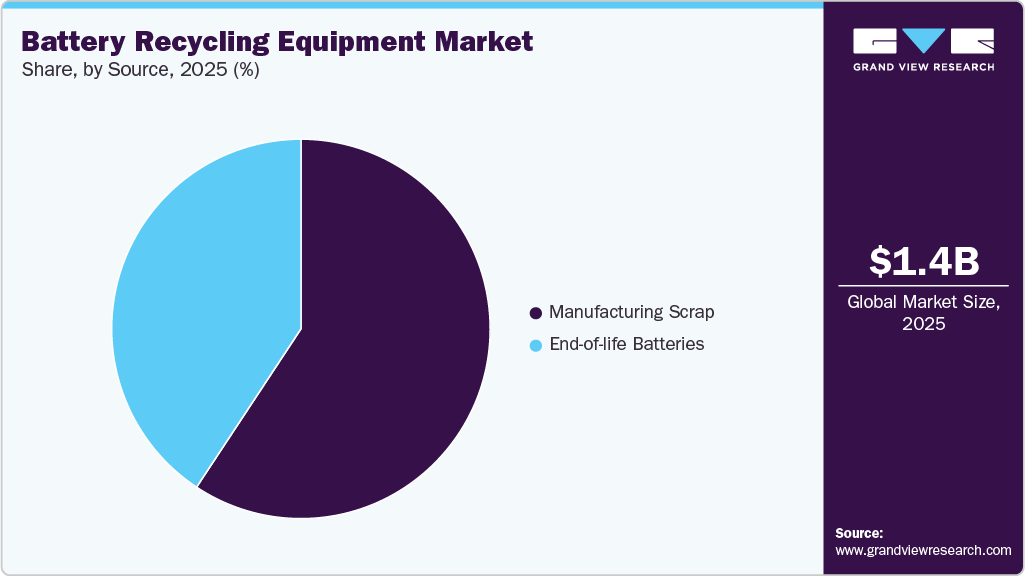
The end-of-life batteries segment is anticipated to grow at the fastest CAGR of 14.5% during the forecast period, driven by the rising number of batteries reaching the end of their usable life across automotive, electronics, and energy storage applications. The surge in electric vehicle adoption is expected to significantly increase battery waste volumes in the coming years. This is creating strong demand for advanced recycling equipment capable of handling complex and mixed battery chemistries while ensuring efficient material recovery.
Regional Insights
The battery recycling equipment market in North America is witnessing steady growth driven by increasing adoption of electric vehicles and rising emphasis on domestic battery material recovery. Strong regulatory support and investments in sustainable technologies are encouraging the deployment of advanced recycling systems. The region is also seeing increased collaboration between recyclers and manufacturers to build localized recycling capabilities.
U.S. Battery Recycling Equipment Market Trends
The battery recycling equipment market in the U.S. accounted for the largest market revenue share in North America in 2025, driven by strong policy support, increasing electric vehicle adoption, and a growing focus on domestic supply chains for critical materials. The country is actively investing in advanced recycling technologies to reduce dependence on imported raw materials and strengthen circular economy practices. For instance, in March 2026, the U.S. Department of Energy’s Office of Critical Minerals and Energy Innovation announced a funding opportunity of up to USD 500 million to support the expansion of critical mineral processing, battery manufacturing, and recycling capabilities, which is expected to accelerate the deployment of advanced recycling equipment.
The Canada battery recycling equipment market is steadily expanding its presence, supported by increasing investments in clean energy and sustainable resource management. The country is focusing on building an integrated battery value chain, from raw material extraction to recycling, which is creating demand for efficient recycling technologies. Growing emphasis on environmental compliance and the development of recycling infrastructure is further contributing to market growth.
Europe Battery Recycling Equipment Market Trends
The battery recycling equipment market in Europe is growing significantly due to stringent environmental regulations and circular economy initiatives. The region has a strong focus on reducing dependency on raw material imports, which is driving demand for efficient recycling technologies. Increasing investments in next-generation recycling facilities and innovation in low-emission processes are further supporting market expansion.
The Germany battery recycling equipment market is a key market, supported by strong industrial capabilities and a well-established engineering base, along with a sustained focus on sustainable energy solutions. The country is increasing investments in battery production, particularly through gigafactory developments, alongside circular economy initiatives aimed at improving resource efficiency and reducing dependency on raw material imports. These factors are driving demand for advanced recycling technologies, especially hydrometallurgical systems and automation solutions, as manufacturers and recyclers seek to enhance recovery rates, ensure regulatory compliance, and support the growing electric vehicle ecosystem.
The battery recycling equipment market in UK is witnessing steady growth, driven by increasing electrification and strong regulatory focus on sustainability. The country is prioritizing the development of domestic battery supply chains and recycling infrastructure to support energy transition goals. Rising investments in battery technologies and waste management systems are creating opportunities for the adoption of advanced recycling equipment.
Asia Pacific Battery Recycling Equipment Market Trends
Asia Pacific dominated the global battery recycling equipment market with the largest revenue share of 41.8% in 2025 and is projected to grow at the fastest CAGR during the forecast period, due to the presence of large-scale battery production and a rapidly expanding electric mobility ecosystem. The region benefits from strong manufacturing capabilities, high volumes of end-of-life batteries, and increasing investments in recycling infrastructure. Moreover, the presence of established supply chains and a growing focus on resource recovery has strengthened demand for advanced recycling equipment.
The battery recycling equipment market in China accounted for the largest market revenue share in the Asia Pacific in 2025, supported by its large-scale battery manufacturing base and a well-established electric vehicle ecosystem. The country continues to invest in next-generation battery technologies and recycling capabilities to strengthen its position across the value chain, from production to material recovery. In addition, strong government support, stringent recycling regulations, and the presence of integrated players are driving the adoption of advanced recycling systems.
The India battery recycling equipment market is emerging as a growing market, driven by increasing adoption of electric mobility and government focus on sustainable waste management. The country is gradually building its battery recycling ecosystem through policy support and investments in local infrastructure. Rising battery consumption across automotive and energy storage sectors is expected to create strong demand for efficient recycling technologies in the coming years.
Latin America Battery Recycling Equipment Market Trends
The battery recycling equipment market in Latin America is gradually emerging, supported by growing awareness of environmental sustainability and improving waste management practices. Expanding industrial activities and increasing battery usage are creating demand for basic recycling infrastructure. The market is still developing, with opportunities for technology adoption and capacity expansion.
The Brazil battery recycling equipment market held a significant market share in Latin America in 2025, supported by growing industrial activity and increasing adoption of batteries across automotive and energy storage applications. The country is gradually strengthening its waste management and recycling ecosystem, creating demand for efficient processing technologies. Rising focus on resource recovery and environmental compliance is further encouraging investments in battery recycling infrastructure and equipment.
Middle East & Africa Battery Recycling Equipment Market Trends
The battery recycling equipment market in the Middle East & Africa is at an early stage of growth, with rising focus on environmental regulations and sustainable waste handling practices. Increasing adoption of batteries across industrial and energy storage applications is driving the need for recycling solutions. Gradual investments in infrastructure and awareness initiatives are expected to support market development over the coming years.
The Saudi Arabia battery recycling equipment market is gradually emerging, supported by its focus on economic diversification and sustainable industrial development. The country is increasing investments in clean energy, electric mobility, and waste management infrastructure, which is driving the need for efficient battery recycling solutions. Growing emphasis on resource efficiency and environmental regulations is expected to further support the adoption of advanced recycling equipment in the coming years.
Key Battery Recycling Equipment Company Insights
Some of the key players operating in the market include ANDRITZ, Hosokawa Micron Group, and EKATO HOLDING GmbH.
-
ANDRITZ delivers equipment and complete process solutions for battery recycling, mainly focused on the pre-treatment stage to extract black mass from used batteries. Its offerings include systems for discharging, shredding, drying, and material separation, designed to handle lithium-ion batteries safely and efficiently. The company integrates mechanical and thermal processing with automation to improve recovery rates and ensure consistent output across recycling operations.
-
EKATO HOLDING GmbH supplies process equipment used in battery recycling, with a focus on hydrometallurgical processing and material handling. Its portfolio includes high-performance mixers, reactors, and vacuum drying systems designed to treat black mass, remove electrolytes, and prepare materials for metal recovery. The company’s vacuum-drying technology enables efficient solvent removal and improves process consistency. EKATO also provides engineered solutions that combine mixing and drying technologies to enhance overall recycling efficiency.
Key Battery Recycling Equipment Companies:
The following key companies have been profiled for this study on the battery recycling equipment market.
- ANDRITZ
- Hosokawa Micron Group
- EKATO HOLDING GmbH
- Mettherm
- SSI Shredding Systems, Inc
- Eldan Recycling A/S
- Grand Energy Manufacturing Co., Ltd.
- Miracle Automation Engineering Co., Ltd.
- Genox Recycling Tech Co., Ltd.
- Henan Recycle
- Gongyi City Xiangrui Machinery Manufacturing Co., Ltd.
- Gomine Environmental Protection Technology Co., Ltd
- Metso
- BHS-Sonthofen GmbH
Recent Developments
-
In February 2025, ANDRITZ partnered with Duesenfeld to strengthen lithium-ion battery recycling solutions by combining engineering capabilities with advanced recycling processes. The collaboration enables the development of complete recycling plants, including key systems for discharging, drying, and material recovery. It focuses on improving black mass output while lowering emissions. The partnership supports more efficient and sustainable battery recycling operations.
-
In February 2026, Aqua Metals and American Battery Factory announced plans to collaborate on strengthening the battery supply chain through recycling and material recovery. The proposal includes developing a lithium-ion recycling facility near ABF’s manufacturing site in Arizona. The facility would process production scrap into battery-grade lithium materials for reuse. This initiative is aimed at improving domestic supply and reducing dependence on external sources.
Battery Recycling Equipment Market Report Scope
Report Attribute
Details
Market size value in 2026
USD 1,560 million
Revenue forecast in 2033
USD 3,261.2 million
Growth rate
CAGR of 11.1% from 2026 to 2033
Base year for estimation
2025
Historical data
2021 - 2024
Forecast period
2026 - 2033
Quantitative units
Revenue in USD million/billion, and CAGR from 2026 to 2033
Report coverage
Revenue forecast, company market position analysis, competitive landscape, growth factors, and trends
Segments covered
Equipment, source, battery type, region
Regional scope
North America; Europe; Asia Pacific; Latin America; Middle East & Africa
Country Scope
U.S.; Canada; Mexico; Spain; France; Germany; Italy; UK; China; India; Japan; Australia; South Korea; Brazil; Argentina; Saudi Arabia; UAE; South Africa
Key companies profiled
ANDRITZ; Hosokawa Micron Group; EKATO HOLDING GmbH; Mettherm; SSI Shredding Systems, Inc; Eldan Recycling A/S; Grand Energy Manufacturing Co., Ltd.; Miracle Automation Engineering Co., Ltd.; Shred-Tech Corporation; Genox Recycling Tech Co., Ltd.; Henan Recycle; Gongyi City Xiangrui Machinery Manufacturing Co., Ltd.; Gomine Environmental Protection Technology Co., Ltd.; Metso, BHS-Sonthofen GmbH.
Customization scope
Free report customization (equivalent up to 8 analysts working days) with purchase. Addition or alteration to country, regional & segment scope.
Pricing and purchase options
Avail customized purchase options to meet your exact research needs. Explore purchase options
Global Battery Recycling Equipment Market Report Segmentation
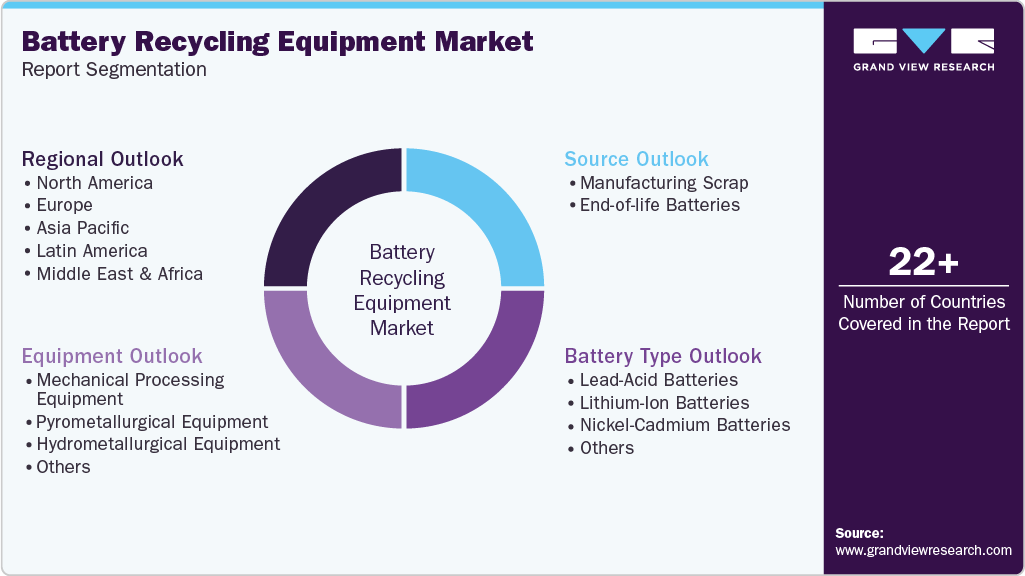
This report forecasts revenue growth at global, regional & country levels, and provides an analysis on the latest trends and opportunities in each of the sub-segments from 2021 to 2033. For this study, Grand View Research has segmented the global battery recycling equipment market report based on the equipment, source, battery type, and region:
-
Equipment Outlook (Revenue, USD Million, 2021 - 2033)
-
Mechanical Processing Equipment
-
Shredders
-
Separators
-
Crushers
-
-
Pyrometallurgical Equipment
-
Hydrometallurgical Equipment
-
Others
-
-
Source Outlook (Revenue, USD Million, 2021 - 2033)
-
Manufacturing Scrap
-
End-of-life Batteries
-
-
Battery Type Outlook (Revenue, USD Million, 2021 - 2033)
-
Lead-Acid Batteries
-
Lithium-Ion Batteries
-
Nickel-Cadmium Batteries
-
Others
-
-
Regional Outlook (Revenue, USD Million, 2021 - 2033)
-
North America
-
U.S.
-
Canada
-
Mexico
-
-
Europe
-
Spain
-
Germany
-
Italy
-
France
-
UK
-
-
Asia Pacific
-
China
-
India
-
Japan
-
Australia
-
South Korea
-
-
Latin America
-
Brazil
-
Argentina
-
-
Middle East & Africa
-
Saudi Arabia
-
UAE
-
South Africa
-
-
Frequently Asked Questions About This Report
b. The global battery recycling equipment market size was estimated at USD 1,413.6 million in 2025 and is expected to reach USD 1,560 million in 2026.
b. The global battery recycling equipment market is expected to grow at a compound annual growth rate of 11.1% from 2026 to 2033 to reach USD 3,261.2 million by 2033.
b. Asia Pacific held the leading position in the battery recycling equipment market in 2025 and accounted for 41.8% share, supported by large scale battery production and a rapidly expanding electric mobility ecosystem. The region benefits from strong manufacturing capabilities, high volumes of end-of-life batteries, and increasing investments in recycling infrastructure.
b. Some of the key players operating in the battery recycling equipment market include ANDRITZ; Hosokawa Micron Group; EKATO HOLDING GmbH; Mettherm; SSI Shredding Systems, Inc; Eldan Recycling A/S; Grand Energy Manufacturing Co., Ltd.; Miracle Automation Engineering Co., Ltd.; Shred-Tech Corporation; Genox Recycling Tech Co., Ltd.; Henan Recycle; Gongyi City Xiangrui Machinery Manufacturing Co., Ltd.; Gomine Environmental Protection Technology Co., Ltd.; Metso, BHS-Sonthofen GmbH.
b. The battery recycling equipment market is driven by the rapid increase in battery usage, particularly from electric vehicles and energy storage systems, leading to higher volumes of recyclable battery waste. Additionally, stringent environmental regulations and the growing need to recover critical materials like lithium, cobalt, and nickel are accelerating the adoption of advanced recycling technologies.


Share this report with your colleague or friend.
Need a Tailored Report?
Customize this report to your needs — add regions, segments, or data points, with 20% free customization.


ISO 9001:2015 & 27001:2022 Certified
We are GDPR and CCPA compliant! Your transaction & personal information is safe and secure. For more details, please read our privacy policy.
Trusted market insights - try a free sample
See how our reports are structured and why industry leaders rely on Grand View Research. Get a free sample or ask us to tailor this report to your needs.













