
- Home
- »
- Advanced Interior Materials
- »
-
Beryllium Market Size, Share And Trends Report, 2026-2033GVR Report cover

Beryllium Market (2026 - 2033)
Size, Share & Trends Analysis Report By Application (Industrial Components, Aerospace & Defense, Automotive Electronics, Telecommunications Infrastructure, Consumer Electronics), By Region, And Segment Forecasts
Market Size, 2025
$231.5MMarket Estimate, 2026
$244.3MMarket Forecast, 2033
$338.9MCAGR, 2026–2033
6.8%Beryllium Market Summary
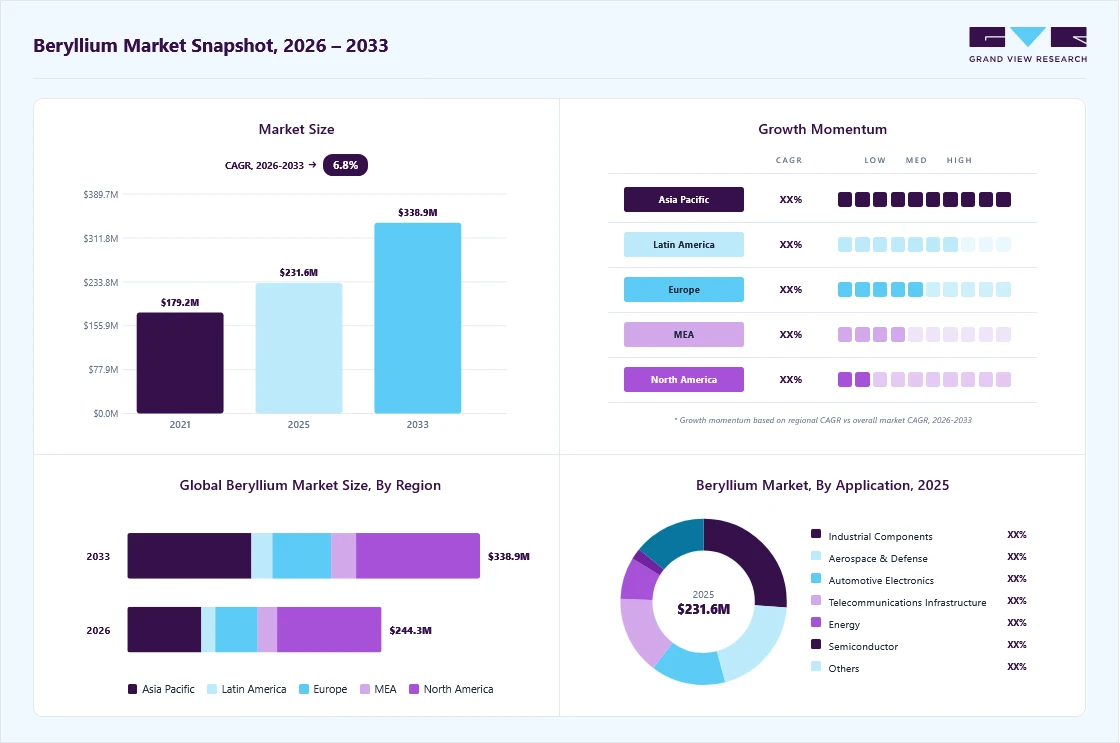
The global beryllium market size was valued at USD 231.5 million in 2025 and is projected to grow from USD 244.3 million in 2026 to USD 338.9 million by 2033, at a CAGR of 6.8% from 2026 to 2033. The market in North America dominated with a revenue share of 41.0% in 2025. The increasing demand for high-performance materials in aerospace and defense applications stands as a major growth driver for the beryllium market.
 Source: Grand View Research, IR Documents, Primary Interviews, Paid DatabasesTo learn more about this report,
 Download Free Sample Report
 Key Market Trends & Insights
- By application: Industrial components segment held the largest market share of 23.2% in 2025.
Regional Highlights
- Largest regional market: North America (41.0% revenue share, 2025)
- By country: The U.S. held the largest market share in 2025
Market Size & Forecast
- Market size in 2025: USD 231.5 Million
- Estimated market size in 2026: USD 244.3 Million
- Projected market size by 2033: USD 338.9 Million
- CAGR (2026-2033): 6.8%
Three ways to get this report
Buy it, customize it, or ask a question.Ask an Analyst
Analyst response in 1 business day
- AccessReport author, directly
- Reply timeWithin 1 working day
- No sales callDirect answer only
- FormatEmail reply
- CostFree, no cost
Get the Full Report
What the study covers
- FormatsPDF · Excel · Dashboard
- Timeline2026–2033 annual, 2025 base
- Coverage20+ countries, 5 regions
- Companies10+ key players profiled
Customize the Report
20% free customization
- IncludeCountries, segments, points
- TailorTo your product definition
- ExtendDeeper competitor detail
- OrA fully bespoke study
- Turnaround5–10 working days
Beryllium’s remarkable stiffness, combined with low density, makes it an ideal component in structural parts of aircraft, satellites, and missiles. As global aerospace activity expands with both commercial airline production and defense modernization programs, more beryllium components are required for structural panels, actuators, and precision instruments. This trend draws further strength from the push for fuel efficiency and lightweight design, since beryllium helps reduce overall weight while maintaining mechanical integrity.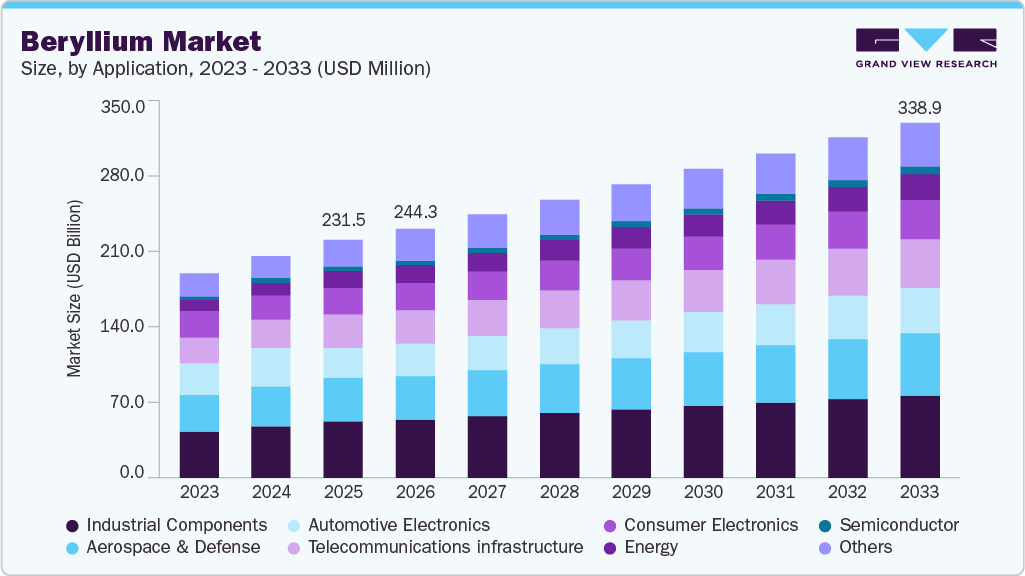 To learn more about this report, Download Free Sample Report
 The electronics and telecommunications sectors contribute significantly to the beryllium market growth by using beryllium copper alloys in connectors, switches, and other critical components. These alloys deliver excellent electrical conductivity and thermal performance, ensuring reliability in high-frequency and high-speed data applications. As 5G infrastructure deployment accelerates worldwide, demand for advanced interconnects and RF modules increases. Beryllium is vital in meeting stringent performance requirements, particularly where miniaturization and heat dissipation are priorities.
Medical technologies also stimulate demand for beryllium and its alloys, particularly in imaging equipment and precision surgical instruments. Beryllium’s unique properties enable sharper imaging in X-ray systems and other diagnostic devices. Hospitals and clinics expanding their advanced care capabilities drive the procurement of beryllium-containing equipment. Furthermore, growth in minimally invasive procedures spurs the use of specialized tools where material performance directly impacts procedural success and patient outcomes.
The energy sector is another area where beryllium demand is on the rise. In nuclear reactors, beryllium serves as a neutron moderator and reflector, improving the efficiency and safety of fission processes. With investments in both new and refurbished nuclear facilities, the need for reliable moderators grows. At the same time, renewable energy technologies such as wind turbines and solar trackers depend on highly durable electrical contacts and components, where beryllium alloys offer long-term stability and resistance to fatigue under cyclic load.
Ongoing advancements in manufacturing processes and recycling capabilities further support the beryllium market expansion. Improved powder metallurgy and additive manufacturing techniques reduce production costs and enable more complex component designs. Recycling initiatives recover beryllium from obsolete parts, easing supply constraints and making the material more attractive to price-sensitive industries. Collectively, these technological improvements fortify market resilience by broadening the range of applications while reducing environmental and economic barriers to adoption.
Drivers, Opportunities & Restraints
The industry is primarily driven by its exceptional material properties that support critical performance requirements across advanced industries. High stiffness to weight ratio, thermal stability, and excellent electrical conductivity make beryllium indispensable in aerospace, defense, electronics, and nuclear applications. Rising investments in aircraft production, satellite deployment, advanced electronics, and nuclear energy infrastructure continue to strengthen demand. The growing focus on miniaturization, precision engineering, and high-reliability components further reinforces the role of beryllium in next-generation technologies.
Significant opportunities exist as emerging technologies broaden the application base of beryllium and its alloys. Expansion of 5G networks, electric vehicles, renewable energy systems, and advanced medical imaging creates new demand for high-performance connectors, sensors, and structural components. Progress in manufacturing methods, such as additive manufacturing and improved alloy development, enables more efficient use of beryllium, opening opportunities in complex and customized components. Recycling and secondary recovery initiatives also present long-term opportunities by improving supply sustainability and cost efficiency.
Despite these positives, the industry faces notable restraints related to health, safety, and regulatory challenges. Exposure risks during mining and processing require strict controls, increasing compliance costs for producers and limiting the entry of new players. Supply concentration and limited global production capacity can lead to price volatility, affecting downstream industries.
Application Insights
The industrial components segment held the revenue share of 23.2% in 2025. It represents a core application area within the beryllium market, driven by the metal’s exceptional combination of high stiffness, low density, thermal stability, and resistance to wear. These properties make beryllium and beryllium-containing alloys highly suitable for precision industrial components such as springs, connectors, diaphragms, bushings, and non-sparking tools used in demanding environments.
The semiconductors segment represents a high-value application within the beryllium market, driven by the material’s exceptional thermal conductivity, stiffness, and dimensional stability under extreme operating conditions. In semiconductor manufacturing, beryllium and beryllium-containing alloys are widely used in critical components such as wafer handling tools, vacuum chamber parts, beam windows, and precision alignment fixtures. These components must maintain tight tolerances during high-temperature processing and plasma-based fabrication steps, where conventional metals tend to deform or lose performance.
Regional Insights
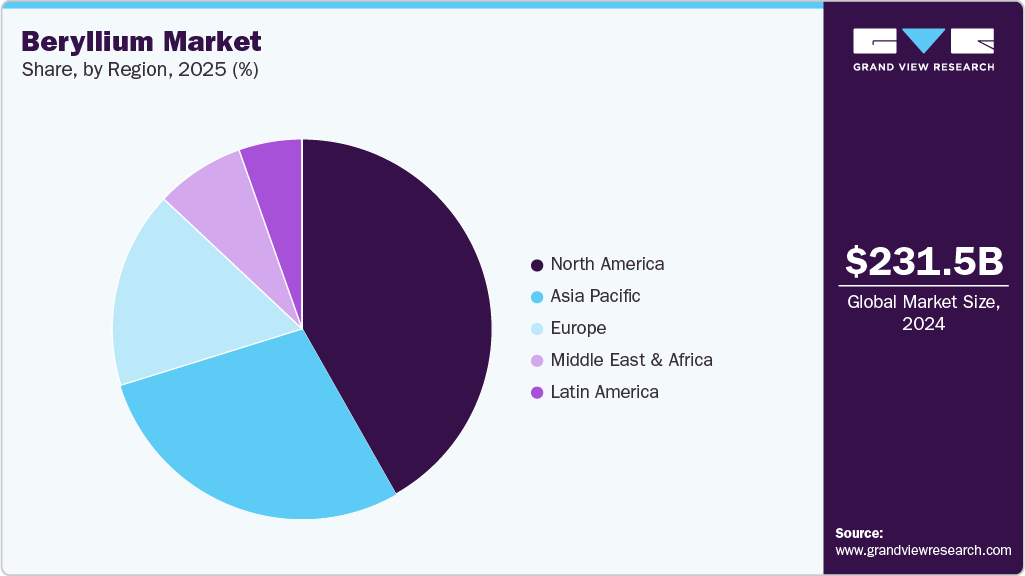
North America beryllium marketheld over 41% revenue share of the global beryllium industry, primarily driven by robust demand from the aerospace, defense, and telecommunications sectors. Beryllium's unique properties, including its exceptional stiffness-to-weight ratio, thermal stability, and transparency to X-rays, make it a critical material for high-performance applications. For instance, in aerospace and defense, beryllium is indispensable for satellite components, inertial guidance systems, and fighter jet optics, as seen in its use by major contractors like Lockheed Martin and Raytheon Technologies.
U.S. Beryllium Market Trends
The beryllium market in the U.S. is fundamentally driven by its status as a strategic and critical material for national security and advanced technology. The Department of Defense (DoD) and associated contractors are primary consumers, relying on beryllium's unparalleled properties for mission-critical systems. For example, beryllium is essential in the targeting and surveillance pods of F-35 fighter jets, the mirror assemblies in advanced missile defense satellites like those in the Space-Based Infrared System (SBIRS), and the guidance systems of precision munitions.
 To learn more about this report, Download Free Sample Report
 Asia Pacific Beryllium Market Trends
The beryllium market in Asia Pacific is experiencing significant growth driven by the twin engines of rapid industrialization and massive investments in electronics manufacturing and telecommunications infrastructure. As the global hub for consumer electronics and semiconductor production, countries like China, Japan, South Korea, and Taiwan generate enormous demand for beryllium-copper alloys. These alloys are critical for manufacturing high-reliability connectors, switches, and miniaturized components in smartphones, laptops, and automotive electronics. A prime example is the proliferation of 5G networks across the region, led by Chinese tech giants like Huawei and ZTE, which requires beryllium-copper for base station components and connectors that ensure signal integrity and thermal management in high-density urban environments.
Europe Beryllium Market Trends
The beryllium market in Europe is primarily driven by the region's world-leading aerospace, nuclear research, and high-performance automotive sectors, underpinned by stringent regulatory standards for safety and reliability. The aerospace industry, with giants like Airbus, Safran, and Rolls-Royce, is a major consumer, utilizing beryllium-aluminum alloys (e.g., AlBeMet) for critical, weight-sensitive structural components in satellites and aircraft, such as the Eurofighter Typhoon's avionics enclosures.
Latin America Beryllium Market Trends
The beryllium market in Latin America is nascent and fundamentally constrained, with limited direct consumption and growth drivers centered almost exclusively on its role as a critical mineral exporter, primarily from Brazil. The region possesses one of the world's largest non-US reserves of bertrandite ore in the state of Minas Gerais, making Brazil a strategic global supplier of raw beryllium hydroxide to the processing facilities in the U.S.
Key Beryllium Companies Insights
Key players operating in the beryllium market are undertaking various initiatives to strengthen their presence and increase the reach of their products and services. Strategies such as expansion activities and partnerships are key in propelling the market growth. Some of the key players operating in the market include American Elements, American Beryllia Inc. among others.
-
American Beryllia Inc., a subsidiary of Materion Corporation, is a preeminent, fully integrated global leader in the manufacturing and supply of advanced beryllium oxide (BeO) ceramic materials and components. Founded with deep roots in defense and aerospace, the company has evolved into a critical supplier for the most demanding high-reliability applications where exceptional thermal management is paramount.
-
American Elements is a globally recognized manufacturer and supplier of engineered and advanced materials, operating as a vast catalog-based corporation with a product portfolio exceeding 15,000 items. Founded in 1997 and headquartered in Los Angeles, California, the company operates more as a diversified materials science conglomerate than a beryllium specialist. Its business model is built on vertical integration, controlling processes from ore sourcing through advanced material production, and a vast global supply chain network.
Key Beryllium Companies:
The following are the leading companies in the beryllium market. These companies collectively hold the largest market share and dictate industry trends.
- American Beryllia Inc
- American Elements
- Aviva Metals
- Belmont Metals Inc
- Charter Dura-Bar, Inc.
- China Beryllium Copper Alloy Co Ltd
- IBC Advanced Alloys Corp
- Materion Corporation
- NGK Metals Corporation
- Ulba Metallurgical Plant
Recent Developments
- In January 2024, Materion Corporation expanded its manufacturing capabilities for proprietary AlBeCast aluminum-beryllium products at its flagship facility in Elmore, Ohio. The expansion specifically enhanced the company's investment casting capacity to meet growing demand from aerospace, defense, and precision industrial equipment industries, leveraging Materion's position as the world's only mine-to-mill integrated beryllium producer.
Beryllium Market Report Scope
Report Attribute
Details
Market definition
The market represents total consumption of beryllium in various applications.
Market size in 2025
USD 231.5 million
Estimated market size in 2026
USD 244.3 million
Projected market size by 2033
USD 338.9 million
Growth rate
CAGR of 6.8% from 2026 to 2033
Base year for estimation
2025
Historical data
2021 - 2024
Forecast period
2026 - 2033
Quantitative units
Volume in kilotons, revenue in USD million/billion, and CAGR from 2026 to 2033
Report coverage
Revenue and volume forecast, company ranking, competitive landscape, flit factors, and trends
Segments covered
Application, region
Regional scope
North America; Europe; Asia Pacific; Latin America; Middle East & Africa
Country scope
U.S.; Canada; Mexico; Germany; UK; Russia; Turkey; China; India; Japan; South Korea; Australia; Brazil; Saudi Arabia
Key companies profiled
Materion Corporation, Ulba Metallurgical Plant, IBC Advanced Alloys Corp, NGK Metals Corporation, American Beryllia Inc, Belmont Metals Inc, American Elements, China Beryllium Copper Alloy Co Ltd, Aviva Metals, Charter Dura Bar, Inc.
Customization scope
Free report customization (equivalent to up to 8 analysts working days) with purchase. Addition or alteration to country, regional & segment scope.
Pricing and purchase options
Avail customized purchase options to meet your exact research needs. Explore purchase options
Global Beryllium Market Report Segmentation
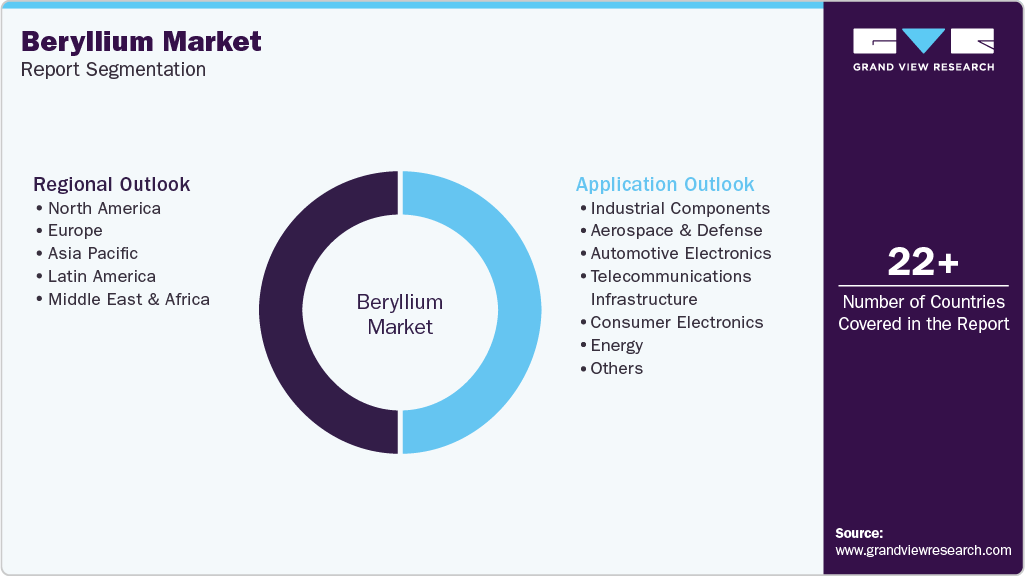
This report forecasts revenue and volume growth at global, regional, and country levels and provides an analysis of the latest industry trends in each of the sub-segments from 2021 to 2033. For this study, Grand View Research has segmented the global beryllium market report on the basis of application, and region.
 To learn more about this report, Download Free Sample Report
 -
Application Outlook (Volume, Kilotons; Revenue, USD Million, 2021 - 2033)
-
Industrial Components
-
Aerospace & Defense
-
Automotive Electronics
-
Telecommunications Infrastructure
-
Consumer Electronics
-
Energy
-
Semiconductor
-
Others
-
-
Regional Outlook (Volume, Kil0tons; Revenue, USD Million, 2021-2033)
-
North America
-
U.S.
-
Canada
-
Mexico
-
-
Europe
-
Germany
-
UK
-
Russia
-
Turkey
-
-
Asia Pacific
-
China
-
India
-
Japan
-
South Korea
-
Australia
-
-
Latin America
-
Brazil
-
-
Middle East & Africa
-
Saudi Arabia
-
-
Frequently Asked Questions About This Report
The key factors that are driving the beryllium market include growing demand from aerospace and defense applications, increasing use of beryllium copper alloys in electronics and telecommunications.
North America dominated with a 41.0% revenue share in 2025.
The global beryllium market size was valued at USD 231.5 million in 2025 and is estimated at USD 244.3 million for 2026.
The global beryllium market is expected to grow at a CAGR of 6.8% from 2026 to 2033, reaching USD 338.9 million.
Key players include Materion Corporation, Ulba Metallurgical Plant, IBC Advanced Alloys Corp, NGK Metals Corporation, American Beryllia Inc, Belmont Metals Inc, American Elements, China Beryllium Copper Alloy Co Ltd, Aviva Metals, Charter Dura Bar, among others
The industrial components segment led with a 23.2% revenue share in 2025.
About the Author(s)
Advanced Interior Materials Research Team
Advanced Materials · Advanced Interior MaterialsThis report was authored by the advanced interior materials research team at Grand View Research - comprising two research analysts, one senior research analyst, and one industry expert - with specialized expertise in the advanced interior materials segment of the advanced materials industry. All findings are based on proprietary advanced materials databases, executive interviews, and regulatory analysis, subject to internal peer review prior to publication.
Last Updated:
Speak to Analyst

Customize this report to your needs - add regions, segments, or data points, with 20% free customization.
Or view our licence options:


ISO 9001:2015 & 27001:2022 Certified
We are GDPR and CCPA compliant! Your transaction & personal information is safe and secure. For more details, please read our privacy policy.


