
- Home
- »
- Power Generation & Storage
- »
-
Bio-based Battery Market Size & Share Report, 2026-2033GVR Report cover
![Bio-based Battery Market (2026 - 2033)Report]()
Bio-based Battery Market (2026 - 2033)
Size, Share & Trends Analysis Report By Type (Enzymatic Batteries, Microbial Fuel Cells, Bio-carbon / Organic Batteries), By Application (Medical Devices, Consumer Electronics, Smart Packaging), By Region, And Segment Forecasts
Market Size, 2025
$106.3MMarket Estimate, 2026
$114.4MMarket Forecast, 2033
$182.4MCAGR, 2026–2033
6.9%Bio-based Battery Market Summary
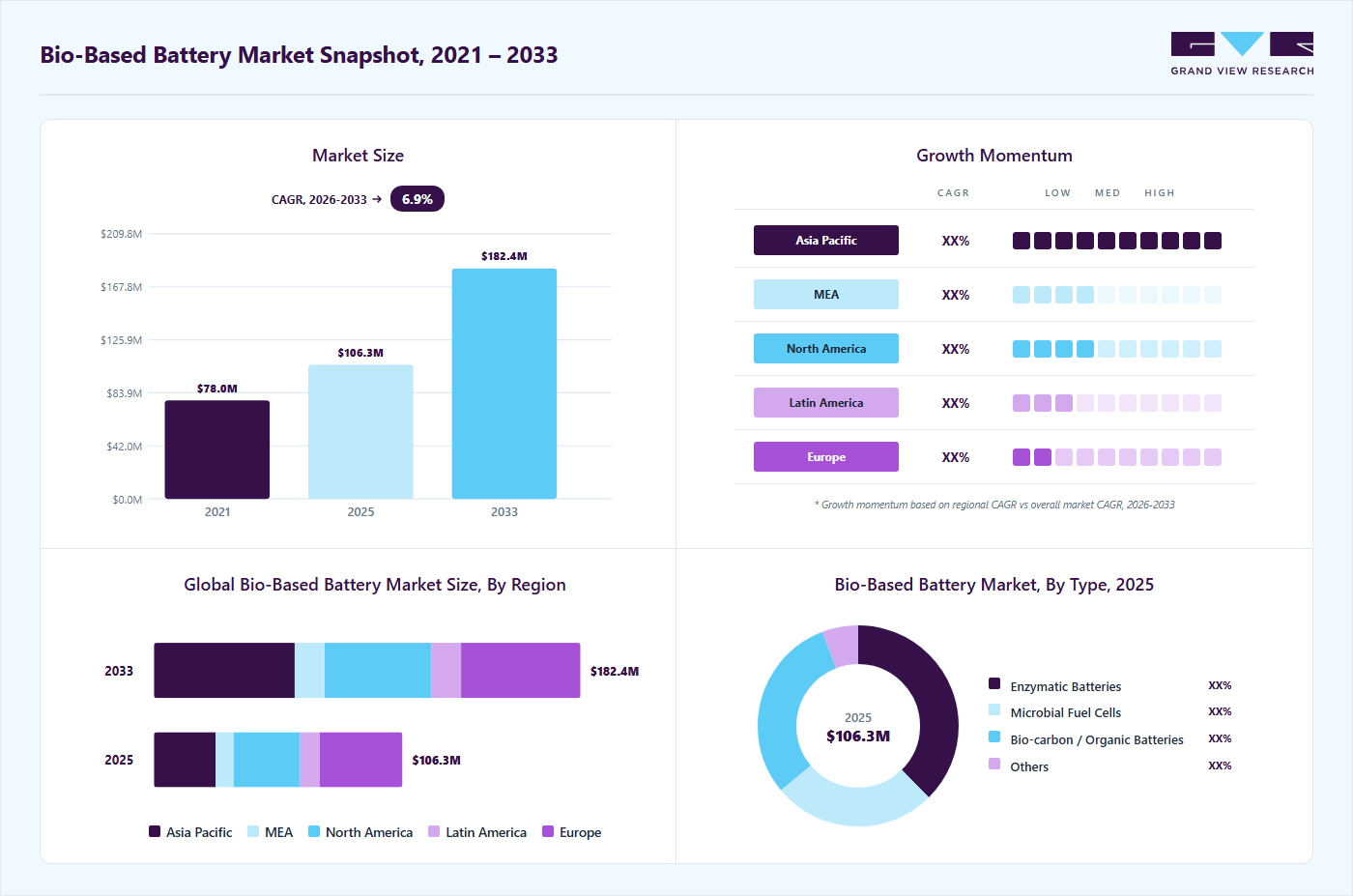
The global bio-based battery market size was valued at USD 106.3 million in 2025 and is projected to grow from USD 114.4 million in 2026 to USD 182.4 million by 2033, at a CAGR of 6.9% from 2026 to 2033. The market in Europe dominated with a revenue share of 33.3% in 2025. Market expansion is largely driven by the growing global focus on sustainable energy storage technologies and the need to reduce the environmental impact of conventional battery chemistries.
Key Market Trends & Insights
- By type: Enzymatic batteries segment led the market with the largest revenue share of 37.5% in 2025.
- By application: Medical devices segment led the market with the largest revenue share of 35.3% in 2025.
Regional Highlights
- Largest regional market: Europe (33.3% revenue share, 2025)
- Fastest-growing regional market: Asia Pacific (highest CAGR, 2026-2033)
- By country: The U.S. held the largest market share in 2025.
Market Size & Forecast
- Market size in 2025: USD 106.3 Million
- Estimated market size in 2026: USD 114.4 Million
- Projected market size by 2033: USD 182.4 Million
- CAGR (2026-2033): 6.9%
Three ways to get this report
Buy it, customize it, or ask a question.Get the Full Report
What the study covers
- FormatsPDF · Excel · Dashboard
- Timeline2026–2033 annual, 2025 base
- Coverage20+ countries, 5 regions
- Companies10+ key players profiled
Customize the Report
20% free customization
- IncludeCountries, segments, points
- TailorTo your product definition
- ExtendDeeper competitor detail
- OrA fully bespoke study
- Turnaround5–10 working days
Ask Prism AI
A cited answer in seconds
- Corpus30K studies, 1.2M points
- ScopeAll markets, not just this
- CitationTraced to report & table
- HonestySays "not covered" if so
- SpeedSeconds, not days
Bio-based batteries developed using organic materials, enzymes, and microbial processes provide a low-toxicity and biodegradable alternative that supports circular economic objectives and long-term climate goals. Continuous advancements in material science and biotechnology are improving energy efficiency, durability, and commercial feasibility, while growing regulatory support and research funding are accelerating innovation across the industry.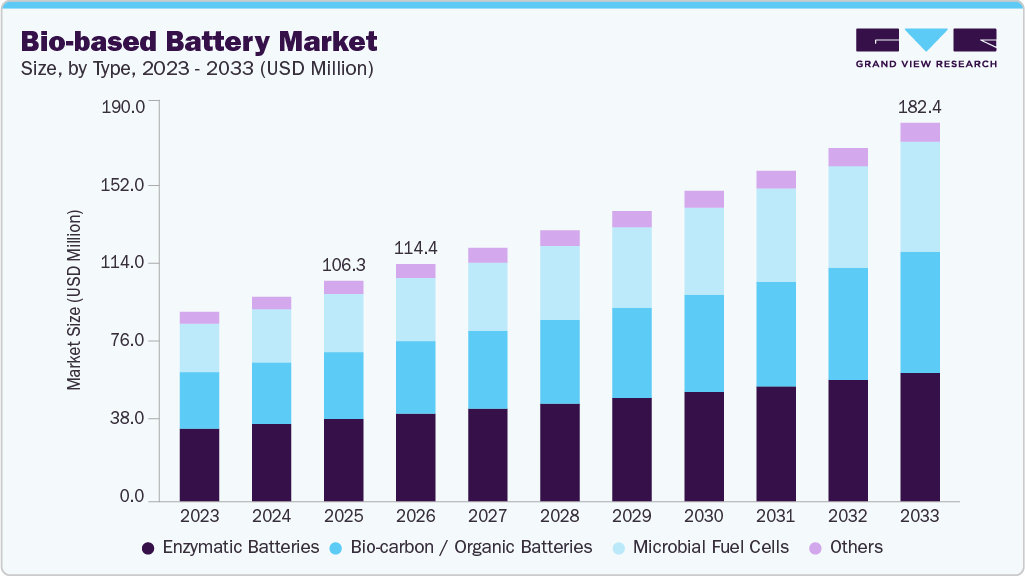
The bio-based battery industry is witnessing steady momentum as governments, research institutions, and private organizations intensify efforts toward developing greener energy solutions. Increasing investments in next-generation battery technologies, along with strategic partnerships and pilot-scale projects, are fostering technological maturity and facilitating gradual commercialization. In addition, rising awareness regarding electronic waste management and sustainable product design is encouraging manufacturers to explore bio-based alternatives. Although the market remains in an early stage compared to traditional battery technologies, ongoing breakthroughs and expanding research pipelines are expected to strengthen competitiveness, positioning bio-based batteries as a promising component of the future sustainable energy landscape.
Drivers, Opportunities & Restraints
The global bio-based battery industry is driven by the growing emphasis on sustainable energy storage solutions and the need to minimize the environmental impact of conventional battery technologies. Rising concerns over hazardous electronic waste, strict environmental regulations, and growing awareness of biodegradable materials are encouraging the adoption of bio-based alternatives.
Continuous advancements in biotechnology and organic material science are improving battery efficiency, safety, and commercial feasibility, while supportive government initiatives and expanding investments in green technologies are further strengthening market growth. Significant opportunities are emerging as industries prioritize environmentally responsible power solutions to meet climate commitments and corporate sustainability goals. Increasing research collaborations, pilot projects, and innovation in next-generation materials are creating pathways for improved performance and scalability, positioning bio-based batteries as a promising component of the future energy storage ecosystem.
However, the market faces restraints, including limited large-scale commercialization, a relatively lower energy density compared to traditional batteries, and high research and production costs. Manufacturing complexities, supply chain limitations for biomaterials, and the absence of standardized regulatory frameworks may also hinder widespread adoption. Overcoming these challenges through continued technological advancements, cost optimization, and supportive policy structures will be essential to unlocking the long-term potential of the bio-based battery industry.
Type Insights
The enzymatic batteries segment led the market with the largest revenue share of 37.53% in 2025, dominating the type landscape of the global bio-based battery industry. This leadership is primarily attributed to their high energy efficiency, biocompatibility, and ability to generate electricity through enzyme-catalyzed reactions using renewable biological substrates. Enzymatic batteries are increasingly being adopted in medical devices, wearable electronics, and low-power applications due to their environmentally friendly composition and reduced reliance on toxic materials. In addition, ongoing advancements in enzyme stability and electrode design are enhancing performance and extending operational lifespan, further strengthening segment growth.
The microbial fuel cells (MFCs) segment is projected to register at the fastest CAGR of 8.2% during the forecast period, supported by rising interest in sustainable energy generation and wastewater-based power solutions. Microbial fuel cells utilize microorganisms to convert organic matter directly into electricity, making them highly attractive for integrated waste management and energy recovery systems.
Application Insights
The medical devices segment led the market with the largest revenue share of 35.28% in 2025. The growing demand for safe, lightweight, and biocompatible power sources for implantable and wearable medical technologies primarily drives this dominance. Bio-based batteries are increasingly utilized in devices such as glucose monitors, pacemakers, biosensors, and drug delivery systems due to their ability to operate efficiently with minimal environmental impact. Furthermore, the rising prevalence of chronic diseases and the expanding adoption of remote patient monitoring solutions are accelerating the need for reliable micro-energy sources, strengthening segment growth.
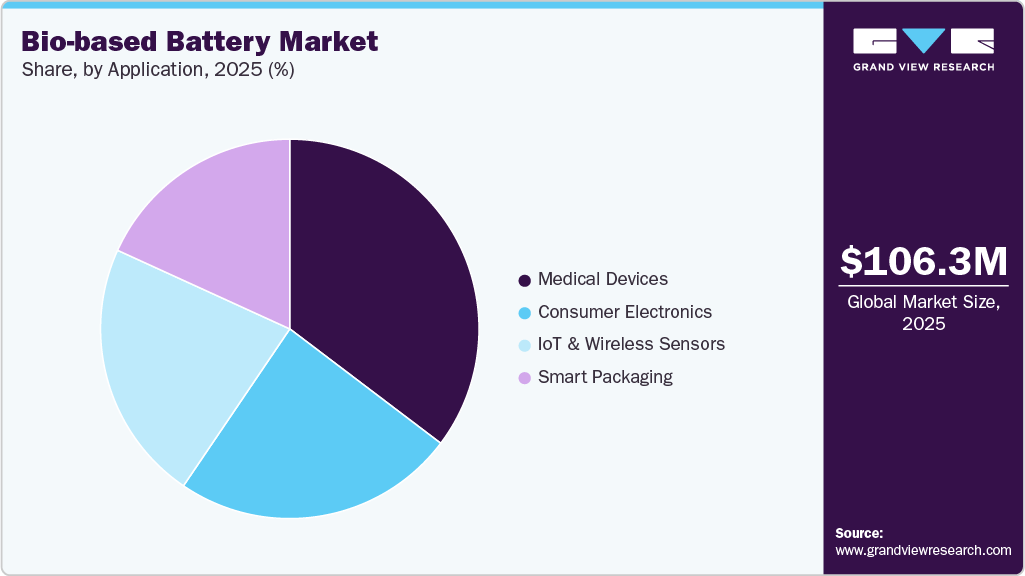
The smart packaging segment is projected to register at the fastest CAGR of 8.2% during the forecast period, supported by the increasing integration of intelligent tracking and sensing technologies in packaging solutions. Bio-based batteries provide an eco-friendly power option for smart labels, freshness indicators, and temperature-monitoring systems, helping companies improve supply chain visibility while reducing environmental footprint.
Regional Insights
The bio-based battery market in North America held the significant share in 2025, primarily driven by early technology adoption, strong innovation ecosystems, and growing awareness regarding environmentally friendly energy storage solutions. Corporate sustainability initiatives and stricter environmental regulations are encouraging manufacturers to shift toward biodegradable battery materials. Strategic partnerships between technology developers, academic institutions, and private investors are further accelerating commercialization, positioning the region as an important contributor to global market expansion.
U.S. Bio-based Battery Market Trends
The bio-based battery market in the U.S. accounted for the largest market revenue share in North America in 2025, supported by advanced research infrastructure and rising investments in next-generation energy storage technologies. Universities, technology firms, and startups are actively developing enzyme-based and microbial battery solutions to meet the growing demand for sustainable power sources. Increasing applications in healthcare devices, wearable technologies, and environmental sensors are driving market growth. Furthermore, government support for clean technology innovation and the presence of strong venture capital funding are expected to reinforce the country’s position as a key innovation hub throughout the forecast period.
Europe Bio-based Battery Market Trends
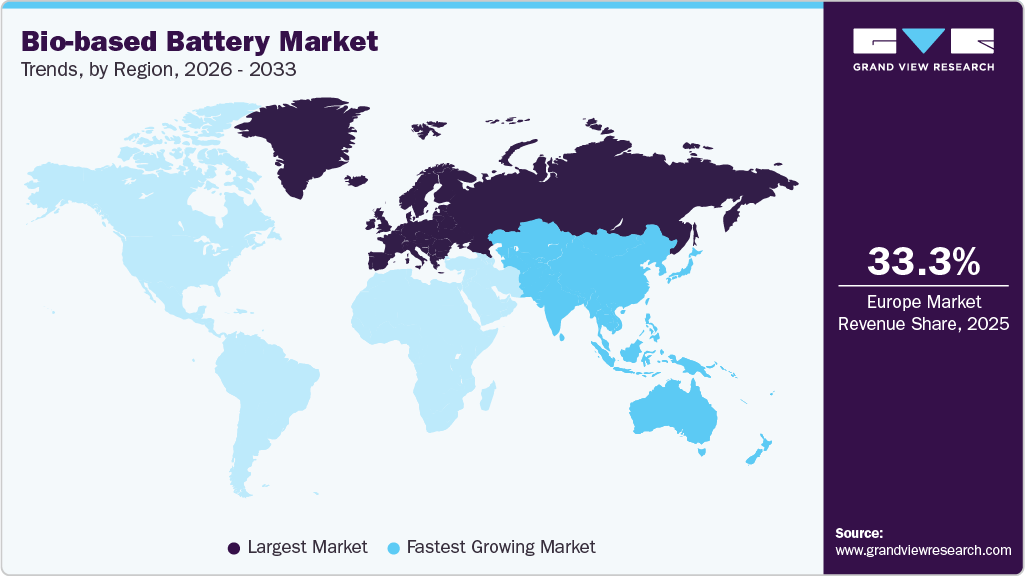
Europe dominated the global bio-based battery market with the largest revenue share of 33.27% in 2025, driven by strong regulatory support for sustainable technologies, ambitious carbon neutrality goals, and increasing investments in green energy storage solutions. The region’s emphasis on reducing reliance on conventional batteries and promoting biodegradable alternatives has accelerated research and commercialization of bio-based batteries. In addition, funding programs from the European Union, coupled with collaborations between research institutions and battery manufacturers, are fostering technological advancements. Growing adoption across medical devices, smart packaging, and consumer electronics further strengthens Europe’s leadership in the global market.
Asia Pacific Bio-based Battery Market Trends
The bio-based battery market in the Asia Pacific is projected to register at the fastest CAGR of 10.7% during the forecast period, supported by rapid industrialization, expanding electronics manufacturing, and increasing focus on sustainable technologies. Countries such as China, Japan, and South Korea are investing heavily in advanced battery research to reduce environmental impact while meeting rising energy demands. Growing healthcare infrastructure and the increasing adoption of smart packaging solutions are further fueling regional demand.
Government initiatives promoting green manufacturing, coupled with rising investments in research and development, are enhancing technological capabilities across the region. As environmental regulations become more stringent and consumer awareness of sustainable products increases, the Asia Pacific is expected to emerge as a high-growth market for bio-based batteries.
Latin America Bio-based Battery Market Trends
The bio-based battery market in Latin America is gradually expanding, driven by improving environmental awareness and the growing need for sustainable energy alternatives. Countries such as Brazil and Mexico are witnessing increased research activities and pilot projects focused on biodegradable battery technologies. Although the market is still in its early stages, supportive policy developments and international collaborations are expected to create new opportunities for adoption across healthcare and packaging applications.
Middle East & Africa Bio-based Battery Market Trends
The bio-based battery market in the Middle East & Africa (MEA) is experiencing steady development, supported by rising interest in clean technologies and sustainable infrastructure. Governments and private stakeholders are beginning to explore eco-friendly energy storage solutions to support smart city initiatives and reduce environmental impact. While limited technological infrastructure currently poses challenges, increasing foreign investments, research partnerships, and innovation-driven projects are expected to encourage gradual market growth across the region.
Key Bio-based Battery Company Insights
Some of the key players operating in the global bio-based battery industry include BeFC, Bioo, Bactery AB, Stora Enso, Northvolt, Panasonic Holdings Corporation, Samsung SDI, Sony Group Corporation, EnOcean GmbH, and Varta AG. These companies focus on the research, development, and commercialization of sustainable battery technologies, including enzymatic batteries, microbial fuel cells, and other biodegradable energy storage solutions. Their activities include advancing bio-compatible materials, improving energy efficiency, and integrating eco-friendly power sources into applications such as medical devices, smart packaging, wearable electronics, and environmental sensors, thereby driving technological innovation and supporting market growth across multiple regions.
Key Bio-based Battery Companies:
The following key companies have been profiled for this study on the bio-based battery market.
- BeFC
- Bioo
- Bactery AB
- Stora Enso
- Northvolt
- Panasonic Holdings Corporation
- Samsung SDI
- Sony Group Corporation
- EnOcean GmbH
- Varta AG
Recent Developments
-
In February 2025, China's CATL launched its Naxtra sodium-ion battery brand, achieving an energy density of 175 Wh/kg and supporting 15-minute fast charging. These batteries demonstrated exceptional cold-weather performance, retaining over 90% capacity at -40°C. Mass production commenced in December 2025, with integration into electric vehicles planned for 2026.
-
In September 2025, Italian energy company Eni, in partnership with Seri Industrial, initiated a project to produce stationary lithium-iron-phosphate batteries at Eni's Brindisi site. This initiative aims to manufacture over 8 GWh of batteries annually, targeting more than 10% of the European stationary battery market.
Bio-based Battery Market Report Scope
Report Attribute
Details
Market size in 2025
USD 106.3 million
Estimated market size in 2026
USD 114.4 million
Projected market size by 2033
USD 182.4 million
Growth rate
CAGR of 6.9% from 2026 to 2033
Base year for estimation
2025
Historical data
2021 - 2024
Forecast period
2026 - 2033
Quantitative units
Revenue in USD million/billion, and CAGR from 2026 to 2033
Report coverage
Revenue forecast, competitive landscape, growth factors, and trends
Segments covered
Type, application, region
Regional scope
North America; Europe; Asia Pacific; Latin America; Middle East & Africa
Country scope
U.S.; Canada; Mexico; Germany; UK; France; Italy; Spain; Norway; China; India; Japan; South Korea; Australia; Brazil; Argentina; Saudi Arabia; UAE; South Africa
Key companies profiled
BeFC; Bioo; Bactery AB; Stora Enso; Northvolt; Panasonic Holdings Corporation; Samsung SDI; Sony Group Corporation; EnOcean GmbH; Varta AG
Customization scope
Free report customization (equivalent up to 8 analysts working days) with purchase. Addition or alteration to country, regional & segment scope.
Pricing and purchase options
Avail customized purchase options to meet your exact research needs. Explore purchase options
Global Bio-based Battery Market Report Segmentation
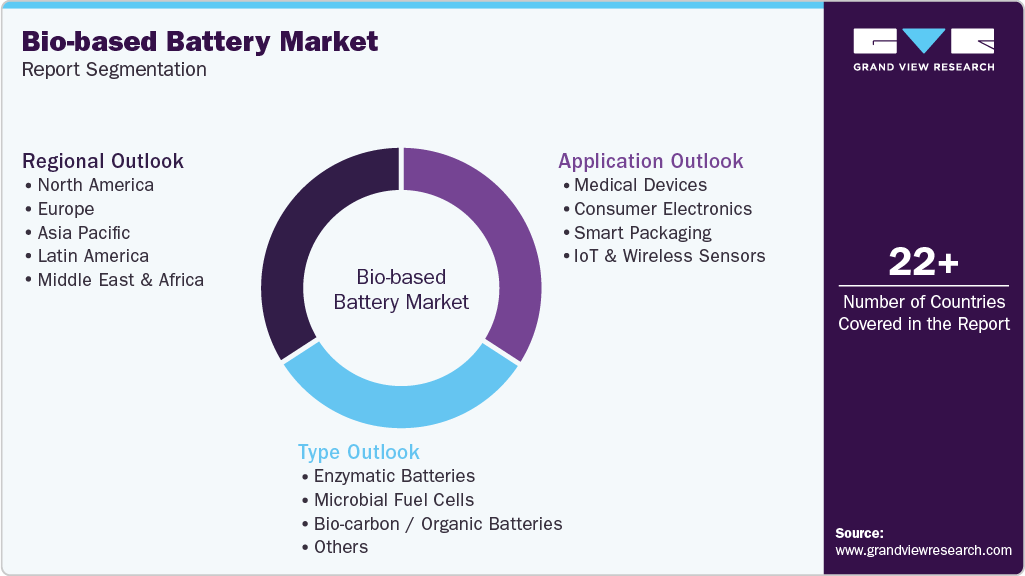
This report forecasts revenue growth at global, regional, and country levels and provides an analysis of the latest industry trends in each of the sub-segments from 2021 to 2033. For this study, Grand View Research has segmented the global bio-based battery market report based on the type, application, and region:
-
Type Outlook (Revenue, USD Million, 2021 - 2033)
-
Enzymatic Batteries
-
Microbial Fuel Cells
-
Bio-carbon / Organic Batteries
-
Others
-
-
Application Outlook (Revenue, USD Million, 2021 - 2033)
-
Medical Devices
-
Consumer Electronics
-
Smart Packaging
-
IoT & Wireless Sensors
-
-
Regional Outlook (Revenue, USD Million, 2021 - 2033)
-
North America
-
U.S.
-
Canada
-
Mexico
-
-
Europe
-
Germany
-
UK
-
France
-
Italy
-
Spain
-
Norway
-
-
Asia Pacific
-
China
-
India
-
Japan
-
South Korea
-
Australia
-
-
Latin America
-
Brazil
-
Argentina
-
-
Middle East & Africa
-
Saudi Arabia
-
UAE
-
South Africa
-
-
Frequently Asked Questions About This Report
Europe dominated with a revenue share of 33.3% in 2025.
Asia Pacific is the fastest-growing region over the forecast period.
Medical devices held the largest share of 35.3% in 2025, while smart packaging segment is fastest-growing
Enzymatic Batteries held the largest revenue share of more than 37.5% in 2025.
The global bio-based battery market size was estimated at USD 106.3 million in 2025 and is expected to reach USD 114.4 million in 2026.
The global bio-based battery market is expected to grow at a compound annual growth rate of 6.9% from 2026 to 2033 to reach USD 182.4 million by 2033.
Some of the key players operating in the global bio-based battery market include BeFC, Bioo, Bactery AB, Stora Enso, Northvolt, Panasonic Holdings Corporation, Samsung SDI, Sony Group Corporation, EnOcean GmbH, and Varta AG, among others.
The key factors driving the growth of the bio-based battery market include the rising demand for sustainable and biodegradable energy storage solutions, increasing environmental concerns associated with conventional battery waste, and growing adoption of eco-friendly materials across industries.
About the Author(s)
Power Generation & Storage Research Team
Energy & Power · Power Generation & StorageThis report was authored by the power generation & storage research team at Grand View Research - comprising two research analysts, one senior research analyst, and one industry expert - with specialized expertise in the power generation & storage segment of the energy & power industry. All findings are based on proprietary energy & power databases, executive interviews, and regulatory analysis, subject to internal peer review prior to publication.
Last Updated:
Speak to Analyst


Customize this report to your needs - add regions, segments, or data points, with 20% free customization.
Or view our licence options:


ISO 9001:2015 & 27001:2022 Certified
We are GDPR and CCPA compliant! Your transaction & personal information is safe and secure. For more details, please read our privacy policy.


