
- Home
- »
- Advanced Interior Materials
- »
-
Bio-based Flooring Materials Market Size Report, 2026-2033GVR Report cover
![Bio-based Flooring Materials Market (2026 - 2033)Report]()
Bio-based Flooring Materials Market (2026 - 2033)
Size, Share & Trends Analysis Report By Material (Bamboo, Linoleum, Cork, Bio-based Polymer Flooring), By Product (Planks, Tiles, Sheets/Rolls), By End-use (Commercial, Industrial), By Region, And Segment Forecasts
Market Size, 2025
$3.2BMarket Estimate, 2026
$3.3BMarket Forecast, 2033
$5.2BCAGR, 2026–2033
6.4%Bio-based Flooring Materials Market Summary
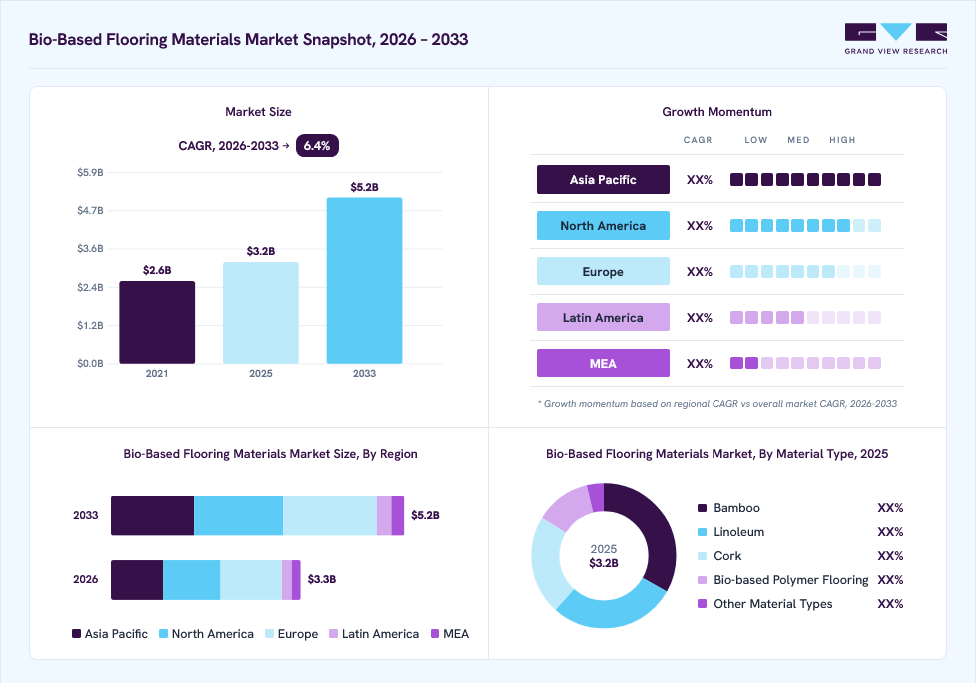
The global bio-based flooring materials market size was valued at USD 3.2 billion in 2025 and is projected to grow from USD 3.3 billion in 2026 to USD 5.2 billion by 2033, at a CAGR of 6.4% from 2026 to 2033. Europe dominated the market, accounting for the largest revenue share of 32.4% in 2025. The global market for bio-based flooring materials is gaining traction as construction stakeholders increasingly seek flooring solutions that reduce dependence on fossil-based raw materials while supporting healthier and more sustainable interiors.
Key Market Trends & Insights
- By material: The bamboo segment held the largest revenue share of 33.2% in 2025.
- By end-use: The residential segment dominated the market with a revenue share of 45.6% in 2025.
- By product: The planks segment held the largest revenue share of 52.0% in 2025.
Regional Highlights
- Largest regional market: Europe (32.4% revenue share, 2025)
- Fastest-growing regional market: Asia Pacific (highest CAGR, 2026-2033)
- By country: Germany held the largest market share in 2025.
Market Size & Forecast
- Market Size in 2025: USD 3.2 Billion
- Estimated market size in 2026: USD 3.3 Billion
- Projected Market Size by 2033: USD 5.2 Billion
- CAGR (2026-2033): 6.4%
Bio-based flooring includes materials derived in part or in whole from renewable biological resources, such as cork, bamboo, natural linoleum, wood, natural fibers, bio-based polymers, agricultural residues, and other plant-derived materials. Growing awareness of embodied carbon, indoor air quality, resource efficiency, and circular construction is encouraging architects, developers, and consumers to consider renewable flooring alternatives.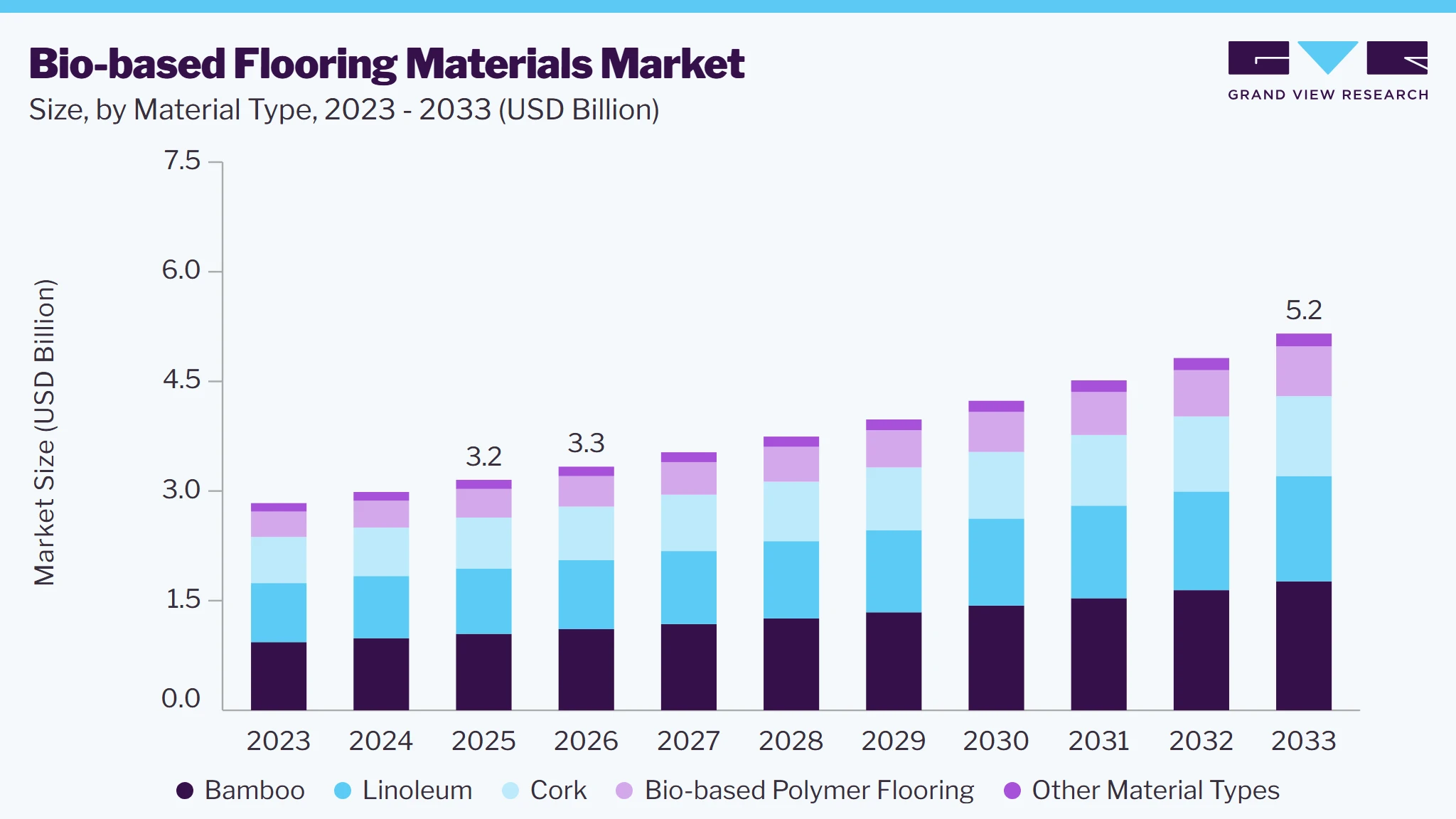
Demand is also being supported by the expansion of green buildings and sustainability-focused construction practices. Building owners increasingly use environmentally preferable materials to improve building sustainability credentials, comply with corporate environmental objectives, and respond to consumer demand for healthier living spaces. Bio-based flooring can contribute to these objectives through renewable raw materials, reduced reliance on conventional plastics, and opportunities for lower-emission formulations.
Technological development is broadening the range of bio-based flooring solutions beyond traditional bamboo, cork, wood, and linoleum. Manufacturers are developing bio-based polymers, natural-fiber composites, agricultural-waste formulations, bio-resins, and hybrid flooring structures designed to improve durability, dimensional stability, moisture resistance, and installation performance. Research is increasingly focused on multifunctional bio-based materials, advanced composites, environmental performance, and scalable manufacturing. These developments are helping address historical limitations related to cost, performance consistency, moisture sensitivity, and consumer awareness while creating opportunities for next-generation renewable flooring products.
Market Dynamics
The bio-based flooring materials industry is influenced by the shift toward low-carbon construction, increasing preference for renewable and healthier interior materials, technological advancements in bio-derived polymers and natural-fiber composites, and the expansion of green-building practices. At the same time, higher manufacturing costs, inconsistent availability of renewable feedstocks, performance concerns, and limited consumer familiarity with certain bio-based flooring technologies can restrict adoption. Increasing use of agricultural residues, bio-based binders, locally sourced materials, and advanced surface technologies is creating new opportunities for manufacturers to improve both sustainability and performance.
The increasing emphasis on sustainable construction is a major driver of the bio-based flooring materials industry. Developers, architects, and building owners are increasingly evaluating flooring materials based on renewable content, emissions, responsible sourcing, durability, and end-of-life characteristics rather than focusing solely on initial cost. Bio-based materials such as cork, bamboo, natural linoleum, and sustainably sourced wood offer established renewable alternatives, while natural-fiber composites and bio-based polymers are expanding the technology base.
Consumer preferences are reinforcing this transition. Increasing awareness of indoor air quality, chemical exposure, plastic pollution, and environmental degradation is encouraging households and businesses to consider low-emission and renewable flooring products. Natural materials can also provide aesthetic differentiation through wood-like textures, natural patterns, tactile surfaces, and organic finishes. In emerging markets, urbanization and growing interest in environmentally responsible housing are creating additional opportunities, particularly where green-building certifications and sustainable construction initiatives are becoming more prominent.
Higher production costs remain a significant restraint for bio-based flooring materials. Renewable feedstocks, specialized processing, certified raw materials, bio-based binders, and sustainable manufacturing processes can increase costs compared with conventional mass-produced flooring. Certain materials can also face challenges related to moisture resistance, dimensional stability, abrasion performance, fire performance, and long-term durability depending on formulation and application. Supply-chain variability for agricultural residues, natural fibers, cork, bamboo, and other biological resources can further affect manufacturing consistency and pricing.
The utilization of agricultural and forestry residues presents a major opportunity for the market. Materials such as rice husk, wheat straw, bagasse, wood residues, jute, hemp, and coir can be incorporated into flooring boards, composite structures, underlays, and other flooring components. This approach can reduce dependence on virgin resources while creating additional value from waste streams and supporting circular-economy models. Bio-based construction research is increasingly moving toward advanced composites and multifunctional materials, creating opportunities for flooring manufacturers to develop products that combine renewable content with enhanced mechanical and functional performance.
Market Concentration & Characteristics
The bio-based flooring materials industry is characterized by a mix of established flooring manufacturers, natural-material specialists, engineered wood producers, and emerging bio-material companies. The market remains relatively fragmented because bio-based flooring encompasses several distinct technologies and raw material categories, including cork, bamboo, natural linoleum, engineered wood, natural fiber composites, and bio-based polymers. Established companies benefit from manufacturing scale, distribution networks, certifications, and established relationships with architects and developers, while smaller companies compete through specialized materials, innovative formulations, circular sourcing, and customized sustainable flooring solutions.
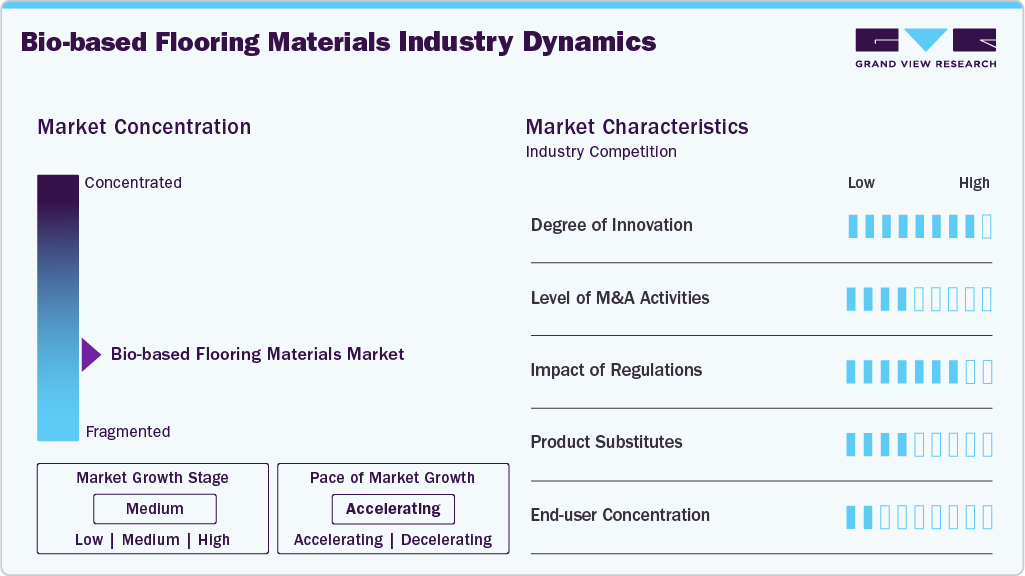
The threat of substitutes is moderate because conventional flooring products such as vinyl, PVC-based resilient flooring, laminate, ceramic tiles, synthetic carpets, rubber flooring, and conventional engineered flooring offer strong availability, established installation systems, competitive pricing, and familiar performance characteristics. Bio-based flooring must therefore compete not only with environmental credentials but also on durability, maintenance requirements, aesthetics, installation convenience, and total cost of ownership.
industry
Material Insights
The bamboo segment held the largest revenue share of 33.2% in 2025, supported by bamboo’s rapid renewability, durability, strength, and natural aesthetic appeal. Its availability across major producing regions and suitability for engineered and solid flooring formats further supports adoption. Growing preference for renewable building materials and sustainable interior solutions is encouraging residential and commercial buyers to consider bamboo flooring as an alternative to conventional wood-based products.
The bio-based polymer flooring segment is expected to grow at a CAGR of 7.3% over the forecast period, as manufacturers increasingly develop flooring materials using renewable biological feedstocks as alternatives to petroleum-based polymers. Advances in bio-based resins and polymer formulations are improving durability, flexibility, moisture resistance, and design versatility. Increasing demand for lower-carbon and renewable-content flooring, particularly in commercial and sustainable construction projects, is expected to support the segment’s expansion.
Product Insights
The planks segment held the largest revenue share of 52.0% in 2025, driven by their widespread use across residential and commercial flooring applications. Plank formats offer installation flexibility, a familiar appearance, and compatibility with materials such as bamboo, cork, engineered wood, and bio-based composite flooring. Their availability in different dimensions, surface finishes, and installation systems further supports consumer and professional preference.
The tiles segment is expected to grow at a CAGR of 7.0% over the forecast period, as modular flooring solutions gain popularity for their installation flexibility, easy replacement, and suitability for diverse interior applications. Bio-based tiles made from cork, linoleum, natural fibers, and other renewable materials are increasingly being developed with improved durability and design options. Growing demand for sustainable commercial interiors and flexible renovation solutions is expected to create further opportunities for bio-based flooring tiles.
End-use Insights
The residential segment held the largest revenue market share of 45.6% in 2025, due to increasing consumer awareness of sustainable living and demand for natural and renewable interior materials. Bio-based flooring products offer aesthetic appeal, material variety, and opportunities for lower-emission interiors, making them attractive for new homes as well as renovation projects. Growing interest in healthier indoor environments and environmentally responsible home construction is further supporting adoption.
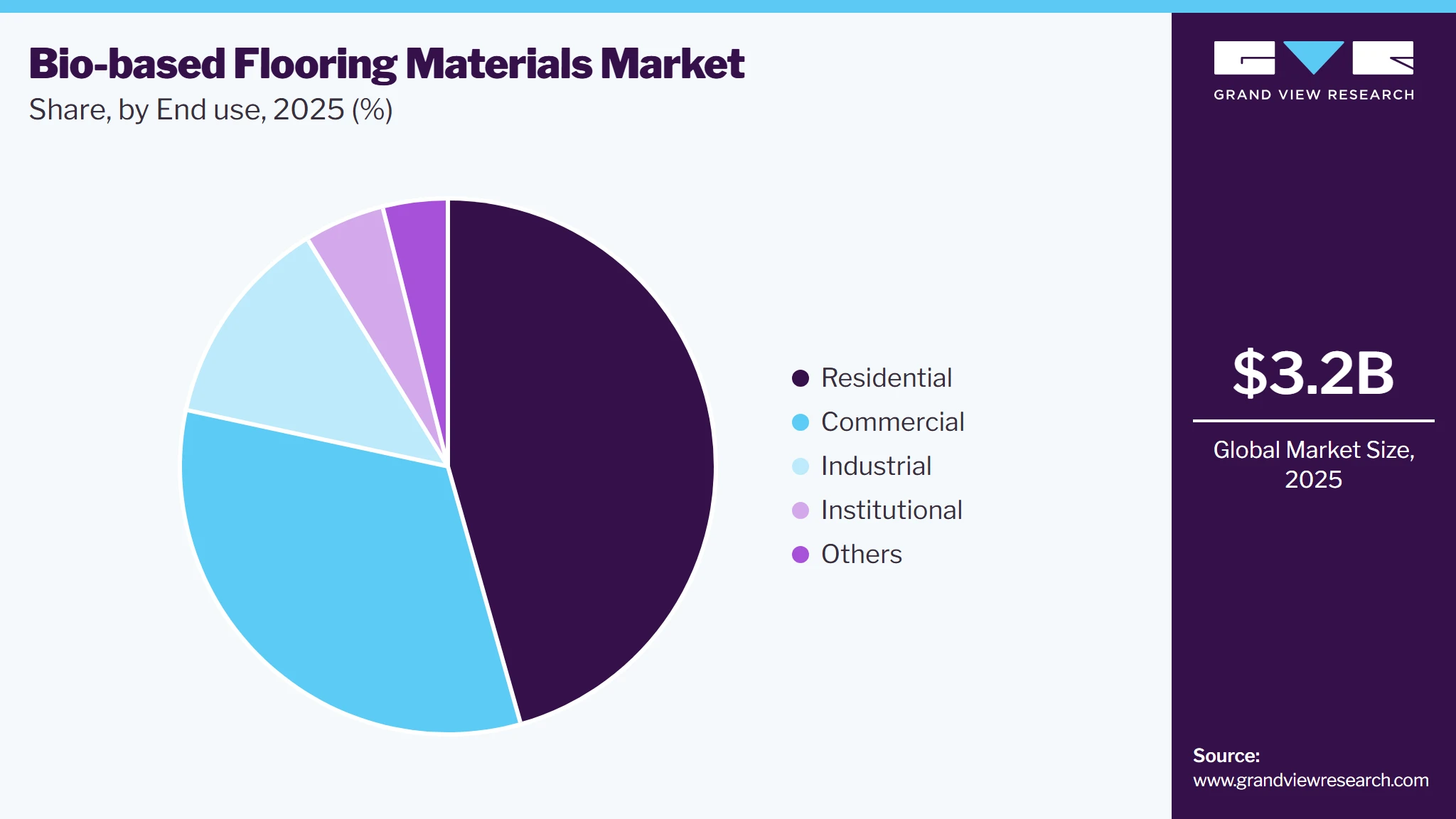
The commercial segment is expected to grow at a CAGR of 7.0% over the forecast period, as offices, hospitality facilities, retail spaces, healthcare buildings, and other commercial properties increasingly incorporate sustainable flooring into interior design and green-building strategies. Demand for durable, visually appealing, low-emission, and renewable-content flooring is encouraging the specification of bio-based products. Sustainability certifications and corporate environmental commitments are also supporting greater adoption in commercial projects.
Regional Insights
Europe bio-based flooring materials industry dominated the global market and accounted for the largest revenue share of 32.4% in 2025. The large share is attributed to strong environmental policies, established circular-economy practices, sustainability-conscious consumers, and widespread green-building activity. Natural linoleum, cork, engineered wood, bamboo, and bio-based resilient flooring are increasingly integrated into sustainable interior specifications. European manufacturers are also investing in renewable feedstocks, bio-based polymers, low-emission formulations, product transparency, and circular manufacturing. The region's emphasis on lifecycle performance and environmental product information supports continued innovation in bio-based flooring.

Germany Bio-based Flooring Materials Market Trends
Germany bio-based flooring materials industry represents an important European market because of its strong environmental awareness, sustainable construction practices, and advanced manufacturing capabilities. Demand for renewable and low-emission interior products is supported by environmentally conscious consumers, architects, and building developers. Flooring manufacturers are focusing on responsibly sourced wood, natural fibers, bio-based binders, low-emission products, and recyclable or recoverable flooring systems.
Asia Pacific Bio-based Flooring Materials Market Trends
Asia Pacific bio-based flooring materials industry is expected to grow at the fastest CAGR over the forecast period, due to rapid urbanization, expanding construction activity, rising environmental awareness, and growing adoption of sustainable building practices. The region has strong access to renewable resources, including bamboo, agricultural residues, wood fibers, jute, coir, and other natural materials. Manufacturers are increasingly exploring locally available feedstocks to produce sustainable flooring and composite materials.
China bio-based flooring materials market is an important market due to its large construction industry, extensive manufacturing ecosystem, and availability of renewable agricultural and forestry resources. Bamboo, wood-based materials, agricultural residues, and bio-derived composites provide opportunities for domestic production of sustainable flooring products. Manufacturers are increasingly investing in improved processing, engineered materials, surface treatments, and environmentally preferable binders.
North America Bio-based Flooring Materials Market Trends
North America bio-based flooring materials market is characterized by strong consumer awareness of sustainable products, green-building practices, and indoor environmental quality. Bio-based flooring is increasingly considered in residential remodeling, commercial interiors, healthcare facilities, hospitality projects, and institutional buildings. Cork, bamboo, natural linoleum, engineered wood, and bio-based resilient flooring are among the major product categories. Demand is also supported by architects and building owners seeking materials with renewable content, responsible sourcing, low emissions, and improved lifecycle characteristics.
The U.S. bio-based flooring materials market benefits from established demand for sustainable interiors and strong awareness of green-building standards and indoor air quality. Natural flooring categories such as cork, bamboo, wood, and linoleum have an established presence, while bio-based polymers and natural-fiber composites are creating additional product opportunities. Healthcare, education, corporate offices, hospitality, and environmentally conscious residential projects are important application areas.
Central and South America Bio-based Flooring Materials Market Trends
Central and South America bio-based flooring materials market offers growth opportunities due to expanding construction activity, abundant agricultural and forestry resources, and increasing interest in sustainable building materials. Bamboo, wood, natural fibers, agricultural residues, and other locally available biological resources can support regional production of bio-based flooring. Residential construction and hospitality developments are particularly relevant application areas, while sustainable tourism and environmentally responsible commercial projects can create additional demand.
Middle East & Africa Bio-based Flooring Materials Market Trends
The Middle East & Africa bio-based flooring materials market is developing gradually as green-building initiatives, sustainable urban development, and environmentally responsible construction are becoming more important. Demand is concentrated in premium residential developments, hospitality projects, commercial buildings, and institutional construction where sustainability and design differentiation are valued. The region has opportunities to incorporate agricultural residues, natural fibers, wood-based materials, and bio-derived polymers into flooring products.
Key Bio-based Flooring Materials Company Insights
Some of the key players operating in the market include Forbo Holding AG and Tarkett S.A.
-
Forbo Holding AG is a Switzerland-based industrial group with a major presence in flooring through Forbo Flooring Systems. Its portfolio includes sustainable flooring solutions, particularly Marmoleum natural linoleum, which is made largely from renewable and natural raw materials such as linseed oil, wood flour, resin, and jute.
-
Tarkett S.A. is a global flooring manufacturer offering solutions for residential, commercial, and institutional applications. The company has a strong position in bio-based linoleum flooring, with its Tarkett Lino products using renewable ingredients such as linseed oil, pine rosin, wood and cork flour, and jute, alongside initiatives focused on recycling and circular flooring.
Mohawk Industries, Inc. and Kährs Group are some of the emerging market participants in the bio-based flooring materials industry.
-
Mohawk Industries, Inc. is a global flooring manufacturer offering a broad portfolio of hard and soft surface flooring for residential and commercial applications. Its portfolio spans wood, laminate, luxury vinyl, carpet, ceramic tile, and other flooring categories, with sustainability integrated into product development and material selection.
-
Kährs Group is a Swedish flooring manufacturer and distributor specializing in premium flooring for residential and commercial applications. Founded in 1857, the company offers wood, vinyl, and vinyl-free flooring and emphasizes sustainable innovation, durability, and responsible material use across its product portfolio.
Key Bio-based Flooring Materials Companies:
The following key companies have been profiled for this study on the bio-based flooring materials market.
-
Forbo Holding AG
-
Tarkett S.A.
-
Gerflor Group
-
Amorim Cork, S.A.
-
Interface, Inc.
-
Moso International B.V.
-
Kährs Group
-
Mohawk Industries, Inc.
-
Lamiwood
-
Wicanders
Competitive Benchmarking
Category
Operating Strategies
Competitive Edge
Weakness
Established Players: Forbo Holding AG, Tarkett S.A., Gerflor Group, Amorim Cork, S.A., Interface, Inc., Moso International B.V.
- Invest in expanding bio-based flooring portfolios across linoleum, cork, bamboo, natural fibers, and bio-based resilient flooring.
- Develop low-emission, durable, and renewable-content flooring products to meet green-building and sustainability requirements.
- Strengthen manufacturing and distribution networks through partnerships with architects, developers, contractors, and sustainable-material suppliers.
- Strong brand recognition and established flooring distribution networks support broad market access.
- Extensive expertise in natural flooring materials, product development, and sustainable flooring technologies provides differentiation.
- Established certifications, sustainability credentials, and relationships with commercial and institutional customers support product specification and adoption.
- Higher production costs for renewable raw materials, specialized formulations, and sustainable manufacturing processes can affect price competitiveness.
- Dependence on consistent availability and quality of natural and bio-based feedstocks can create supply-chain challenges.
- Some bio-based flooring products face performance limitations related to moisture, durability, and application-specific requirements.
Emerging Players: Kährs Group, Mohawk Industries, Inc., Lamiwood, Wicanders
- Develop innovative flooring products using renewable materials, engineered wood, cork, bamboo, and other bio-based inputs.
- Expand through partnerships with sustainable-material suppliers, distributors, architects, and construction companies to increase market penetration.
- Prioritize improvements in durability, design flexibility, renewable content, recyclability, and manufacturing efficiency.
- Strong specialization in natural, engineered, and sustainable flooring products provides differentiation.
- Product innovation and use of renewable materials enable these companies to address growing demand for environmentally preferable flooring.
- Flexible product development and sustainability-focused positioning can support penetration into premium residential and commercial applications.
- Relatively smaller scale and geographic reach compared with the largest global flooring manufacturers.
- Dependence on renewable raw-material availability, supplier networks, and market acceptance can influence expansion.
- Challenges remain around production costs, material consistency, performance optimization, and price competitiveness against conventional flooring materials.
Recent Developments
-
In January 2026, Tarkett introduced what it describes as the world’s first carbon-negative linoleum flooring, using renewable ingredients such as linseed oil, cork, pine resin, wood, and jute.
-
In January 2025, Interface introduced a carbon-negative rubber flooring prototype incorporating recycled and bio-based materials and expanded its portfolio of carbon-negative flooring solutions.
Bio-based Flooring Materials Market Report Scope
Report Attribute
Details
Market size in 2025
USD 3.2 billion
Estimated Market size in 2026
USD 3.3 billion
Projected market size by 2033
USD 5.2 billion
Growth rate
CAGR of 6.4% from 2026 to 2033
Base year for estimation
2025
Actual estimates/Historical data
2021 - 2024
Forecast period
2026 - 2033
Quantitative units
Revenue in USD billion and CAGR from 2026 to 2033
Report coverage
Revenue forecast, company ranking, competitive landscape, growth factors, and trends
Segments covered
Material, product, end-use, region
Regional scope
North America; Europe; Asia Pacific; Central & South America; Middle East & Africa
Country scope
U.S.; Canada; Mexico; Germany; UK; France; Italy; Spain; China; Japan; India; South Korea; Brazil; Saudi Arabia
Key companies profiled
Forbo Holding AG; Tarkett S.A.; Gerflor Group; Amorim Cork, S.A.; Interface, Inc.; Moso International B.V.; Kährs Group; Mohawk Industries, Inc.; Lamiwood; Wicanders
Customization scope
Free report customization (equivalent up to 8 analysts working days) with purchase. Addition or alteration to country, regional & segment scope.
Pricing and purchase options
Avail customized purchase options to meet your exact research needs. Explore purchase options
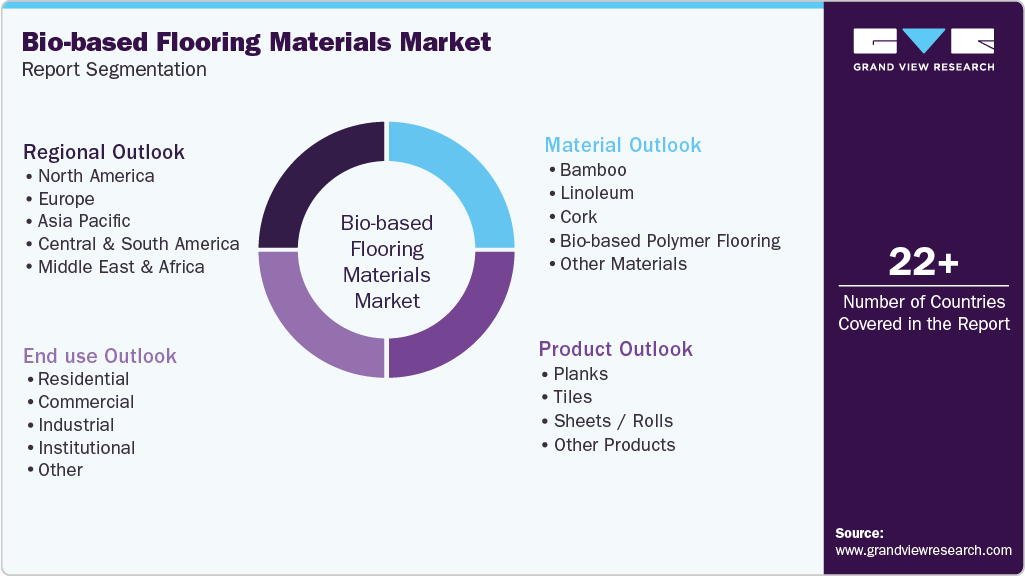
Global Bio-based Flooring Materials Market Report Segmentation
This report forecasts revenue growth at global, regional & country levels and provides an analysis on the industry trends in each of the sub-segments from 2021 to 2033. For this study, Grand View Research has segmented the bio-based flooring materials market report based on material, product, end use, and region:
-
Material Outlook (Revenue, USD Billion, 2021 - 2033)
-
Bamboo
-
Linoleum
-
Cork
-
Bio-based Polymer Flooring
-
Other Materials
-
-
Product Outlook (Revenue, USD Billion, 2021 - 2033)
-
Planks
-
Tiles
-
Sheets / Rolls
-
Other Products
-
-
End-use Outlook (Revenue, USD Billion, 2021 - 2033)
-
Residential
-
Commercial
-
Industrial
-
Institutional
-
Other End-uses
-
-
Regional Outlook (Revenue, USD Billion, 2021 - 2033)
-
North America
-
U.S.
-
Canada
-
Mexico
-
-
Europe
-
UK
-
Germany
-
France
-
Italy
-
Spain
-
-
Asia Pacific
-
China
-
Japan
-
India
-
South Korea
-
-
Central and South America
-
Brazil
-
-
Middle East and Africa
-
Saudi Arabia
-
-
Research Methodology
The bio-based flooring materials market figures in this report are based on a proven research process that combines executive interviews with secondary research from proprietary databases, company filings, and recognized regulatory and institutional sources. Market size is built through value-chain sizing-reconciling supply-side and demand-side estimates-and triangulated with bottom-up and top-down approaches. Every estimate passes multiple levels of expert validation before publication, with each bio-based flooring materials segment quantified using the revenue-capture definitions in the table below.
Segment Definition
Segment - Material
Revenue Capture Definition
Bamboo
Revenue generated from the sale of bamboo-based flooring products manufactured using bamboo as the primary renewable raw material, including engineered bamboo flooring, solid bamboo flooring, and related formats.
Linoleum
Revenue generated from the sale of linoleum flooring manufactured using bio-based materials such as linseed oil, natural resins, wood flour, cork dust, and other renewable components.
Cork
Revenue generated from the sale of cork-based flooring products manufactured using cork as the primary material, including cork tiles, planks, and other cork flooring formats.
Bio-based Polymer Flooring
Revenue generated from the sale of flooring products manufactured using polymers derived wholly or partially from renewable biological feedstocks, including bio-based resins and plant-derived polymer materials.
Other Materials
Revenue generated from the sale of bio-based flooring products manufactured using other renewable materials, including natural fibers, agricultural residues, bio-based composites, wood-based materials, and other plant-derived resources.
Segment - Product
Revenue Capture Definition
Planks
Revenue generated from the sale of bio-based flooring products manufactured and supplied in plank formats, including interlocking, engineered, and other plank-based flooring systems.
Tiles
Revenue generated from the sale of bio-based flooring products manufactured and supplied as individual tiles, including modular tiles made from cork, linoleum, bamboo, bio-based polymers, and other renewable materials.
Sheets / Rolls
Revenue generated from the sale of bio-based flooring products supplied in continuous sheet or roll formats, including linoleum, bio-based resilient flooring, and other flexible renewable flooring materials.
Other Products
Revenue generated from the sale of bio-based flooring products supplied in formats other than planks, tiles, or sheets/rolls, including specialty flooring systems and customized formats.
Segment - End Use
Revenue Capture Definition
Residential
Revenue generated from the sale of bio-based flooring products used in residential properties, including houses, apartments, condominiums, and other private living spaces.
Commercial
Revenue generated from the sale of bio-based flooring products used in commercial buildings and spaces, including offices, retail stores, hotels, restaurants, and other commercial establishments.
Industrial
Revenue generated from the sale of bio-based flooring products used in industrial facilities, including manufacturing plants, warehouses, processing facilities, and other industrial environments.
Institutional
Revenue generated from the sale of bio-based flooring products used in institutional facilities, including schools, universities, hospitals, healthcare facilities, government buildings, and other public or institutional establishments.
Other End Uses
Revenue generated from the sale of bio-based flooring products used in other applications not classified under residential, commercial, industrial, or institutional end uses, including specialized facilities and recreational spaces.
Estimation Model
Layer Name
Key Question
Description
Parent Market Analysis
What is the overall size and growth outlook of the global flooring, sustainable flooring, bio-based materials, and green building materials markets?
The estimation begins by evaluating the broader flooring, sustainable flooring, bio-based materials, and green building materials markets. Construction activity, flooring demand, renewable raw material availability, and sustainability investments are analyzed to establish the addressable market for bio-based flooring materials.
Bio-Based Flooring Product Penetration Analysis
What proportion of the overall flooring and sustainable flooring market is represented by bio-based flooring materials?
This layer estimates bio-based flooring penetration across bamboo, linoleum, cork, bio-based polymers, and other renewable materials. Adoption is further assessed across planks, tiles, sheets/rolls, and other product formats.
Regional & End-use Demand Assessment
Which regions and end-use sectors contribute the highest demand for bio-based flooring materials?
Demand is assessed across major regions based on construction activity, green-building adoption, sustainability regulations, renewable material availability, and consumer awareness. Analysis covers residential, commercial, industrial, institutional, and other end uses.
Company Revenue Validation & Market Forecasting
How is the final market size validated and forecast?
Estimates are validated using company revenues, production capacities, product portfolios, manufacturing facilities, sustainability certifications, investments, product launches, and capacity expansions. Bottom-up and top-down approaches are triangulated to develop reliable market estimates and forecasts.
Delivered Customizations
This report has been delivered with the following In-depth customizations
Client Request
Customization Delivered
Value Adds
Renewable Raw Material & Sustainability Assessment
Analyze the availability and use of bamboo, cork, natural fibers, agricultural residues, wood-based materials, and bio-based polymers, including sourcing, processing, and sustainability characteristics.
Helps identify feedstock opportunities, raw-material constraints, and sustainability trends influencing market scalability.
Technology & Competitive Landscape Assessment
Evaluate product portfolios, manufacturing technologies, bio-based material innovations, certifications, sustainability initiatives, and capacity expansions of key market participants.
Supports competitive benchmarking and identification of technology and product differentiation opportunities.
Regional Demand Assessment
Assess bio-based flooring adoption across Asia Pacific, North America, Europe, Latin America, and Middle East & Africa, based on construction activity and green-building trends.
Helps identify high-potential regions and regional growth opportunities.
About the Author(s)
Advanced Interior Materials Research Team
Advanced Materials · Advanced Interior MaterialsThis report was authored by the advanced interior materials research team at Grand View Research - comprising two research analysts, one senior research analyst, and one industry expert - with specialized expertise in the advanced interior materials segment of the advanced materials industry. All findings are based on proprietary advanced materials databases, executive interviews, and regulatory analysis, subject to internal peer review prior to publication.
Last Updated:
Speak to Analyst


Customize this report to your needs — add regions, segments, or data points, with 20% free customization.
Or view our licence options:


ISO 9001:2015 & 27001:2022 Certified
We are GDPR and CCPA compliant! Your transaction & personal information is safe and secure. For more details, please read our privacy policy.


