
- Home
- »
- Renewable Chemicals
- »
-
Bioadhesives Market Size, Share & Trends Report 2026-2033GVR Report cover

Bioadhesives Market (2026 - 2033)
Size, Share & Trends Analysis Report By Source (Plant-based, Animal-based), By End Use (Packaging & Paper, Construction, Personal Care & Cosmetics), By Region, And Segment Forecasts
Market Size, 2025
$5.6BMarket Estimate, 2026
$6.1BMarket Forecast, 2033
$11.2BCAGR, 2026–2033
9.1%Bioadhesives Market Summary
The global bioadhesives market size was estimated at USD 5.6 billion in 2025 and is projected to grow from USD 6.1 billion in 2026 to USD 11.2 billion by 2033, growing at a CAGR of 9.1% from 2026 to 2033. North America dominated the market, accounting for a revenue share of 30.0% in 2025. This growth is attributed to the improvements in bioadhesive formulations and their enhanced performance. In addition, there has been an increase in the formation of innovative bioadhesives with improved characteristics.
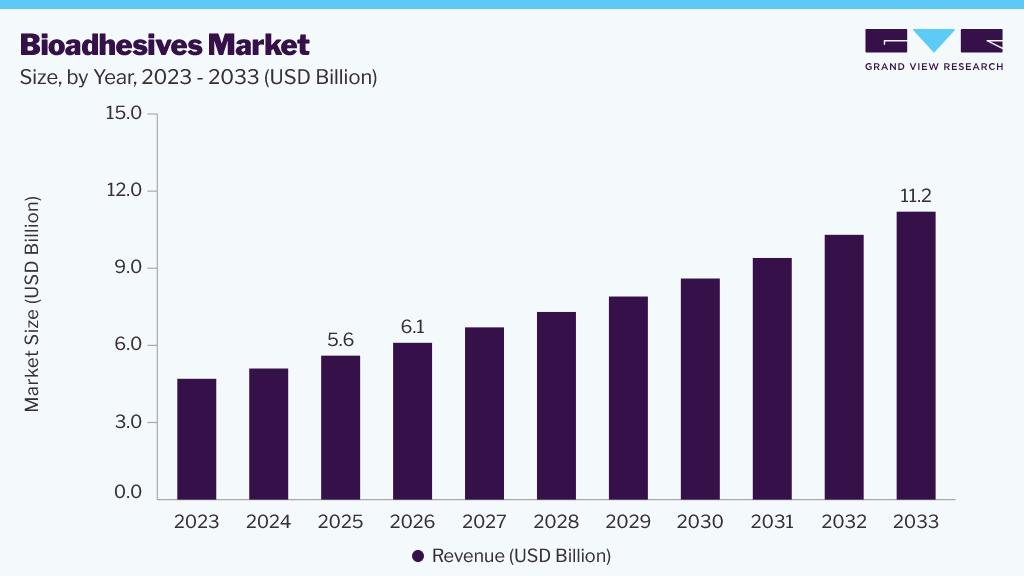 Source: Grand View Research, IR Documents, Primary Interviews, Paid DatabasesTo learn more about this report,
 Download Free Sample Report
Key Market Trends & Insights
- By source: The plant-based bioadhesives segment held the largest market share of over 66.0% in 2025.
- By end use: The paper & packaging segment held the largest market share of around 35.0% in 2025.
Regional Highlights
- Largest regional market: North America (30.0% revenue share, 2025)
- Fastest-growing regional market: Asia Pacific (highest CAGR, 2026-2033)
Market Size & Forecast
- Market size in 2025: USD 5.6 Billion
- Estimated market size in 2026: USD 6.1 Billion
- Projected market size by 2033: USD 11.2 Billion
- CAGR (2026-2033): 9.1%
Three ways to get this report
Buy it, customize it, or ask a question.Ask an Analyst
Analyst response in 1 business day
- AccessReport author, directly
- Reply timeWithin 1 working day
- No sales callDirect answer only
- FormatEmail reply
- CostFree, no cost
Get the Full Report
What the study covers
- FormatsPDF · Excel · Dashboard
- Timeline2026–2033 annual, 2025 base
- Coverage20+ countries, 5 regions
- Companies10+ key players profiled
Customize the Report
20% free customization
- IncludeCountries, segments, points
- TailorTo your product definition
- ExtendDeeper competitor detail
- OrA fully bespoke study
- Turnaround5–10 working days
Bioadhesives comprise naturally derived adhesive materials produced from renewable feedstock such as starch, cellulose, soy protein, and gelatin. These materials are increasingly being adopted as alternatives to conventional petroleum-based adhesives owing to their renewable origin and lower environmental impact. Continuous material innovation has further expanded their applicability across industrial and healthcare sectors.
Rising consumer preference for bio-based products and growing awareness of the environmental and health concerns associated with conventional synthetic adhesives are supporting market growth. Regulatory initiatives promoting sustainable manufacturing practices and the use of renewable raw materials have further encouraged manufacturers to expand their bio-based product portfolios through innovation and research and development.
The expansion of end-use industries, increasing investments in research and development, and growing demand for bioadhesives in biomedical applications are further contributing to market growth. Bioadhesives are widely used in wound care, surgical procedures, transdermal drug delivery systems, and wearable medical devices due to their ability to bond biological tissues. For instance, in March 2024, TELA Bio announced the U.S. commercial launch of the LIQUIFIX FIX8 Laparoscopic and LIQUIFIX Precision Open Hernia Mesh Fixation Devices. These adhesive-based devices enable mesh fixation without penetrating the tissue with sutures, staples, or tacks, providing an alternative approach for hernia repair. This development reflects the continued introduction of advanced adhesive technologies for medical applications.
The availability of renewable agricultural feedstocks, including starch, soy protein, cellulose, and gelatin, continues to support the production of bio-based adhesives by providing a reliable raw material base for manufacturers. Combined with ongoing product innovation and expanding application areas, these factors are supporting the long-term development of the global bioadhesives market.
Analyst Perspective
The bioadhesives market is transitioning from a niche sustainable alternative to a commercially viable adhesive solution across multiple industries. While sustainability remains a key adoption driver, future market growth will increasingly depend on the ability of manufacturers to enhance adhesive performance, durability, and cost competitiveness relative to conventional synthetic adhesives. Healthcare is expected to remain a high-value application area, supported by continued innovation in surgical sealants, wound care products, and drug delivery technologies. At the same time, the packaging, paper, and woodworking industries are expected to drive stable demand as companies pursue the adoption of renewable materials and regulatory compliance. Continued investment in formulation development, process optimization, and scalable production capabilities will be critical for expanding commercial adoption and strengthening the long-term growth outlook of the bioadhesives market.
Source Insights
By source, plant-based bioadhesives dominated the market, accounting for over 66.0% of revenue in 2025. The segment is widely adopted owing to the increasing demand for renewable and low-emission adhesive solutions across healthcare and industrial applications. Growing emphasis on sustainable materials and regulatory support for bio-based products has further accelerated the adoption of plant-based bioadhesives. For instance, in October 2024, UPM Biomedicals launched FibGel, an injectable hydrogel developed from wood-derived nanocellulose for wound healing, tissue repair, regenerative medicine, and medical device applications. The launch highlights continued innovation in plant-derived biomaterials for medical use. Plant-based bioadhesives are commonly formulated using renewable raw materials such as starch, lignin, natural rubber, and soy protein, offering a sustainable alternative to conventional petroleum-based adhesives.
The animal-based segment is expected to grow at the fastest CAGR over the forecast period. Animal-derived bioadhesives are used in applications such as wound care, tissue engineering, and surgical procedures because of their biocompatibility and strong adhesion to biological tissues. Continued research on naturally derived biomaterials is supporting product development for specialized medical applications. However, their adoption in certain industries may be limited by ethical, religious, and regulatory considerations, encouraging manufacturers to evaluate alternative bio-based materials for broader commercial use.
End Use Insights
By end-use, paper & packaging led the market, accounting for the largest revenue share of around 35.0% in 2025. Driven by the increasing use of sustainable adhesive solutions in cartons, corrugated boxes, paper bags, labels, flexible packaging, envelopes, laminates, disposable packaging products, and specialty paper applications. For instance, in September 2024, Henkel launched Technomelt Supra 079 Eco Cool, a bio-based hot melt adhesive containing 49% bio-based raw materials for trays, folding cartons, and wrap-around packaging. The adhesive is designed for paper packaging applications and supports lower application temperatures, helping reduce energy consumption during packaging operations. The continued development of bio-based packaging adhesives is supporting broader adoption across paper and packaging applications.
The construction segment is expected to witness significant growth over the forecast period. Bioadhesives are increasingly used in the production of engineered wood products, including particleboard, fiberboard, plywood, furniture, doors, and interior building components. Their strong bonding performance, durability, improved water resistance, and lower reliance on petrochemical-based ingredients support their adoption in construction applications. Growing emphasis on sustainable building materials and environmentally responsible construction practices is further encouraging the use of bio-based adhesive technologies across the construction industry.
Regional Insights
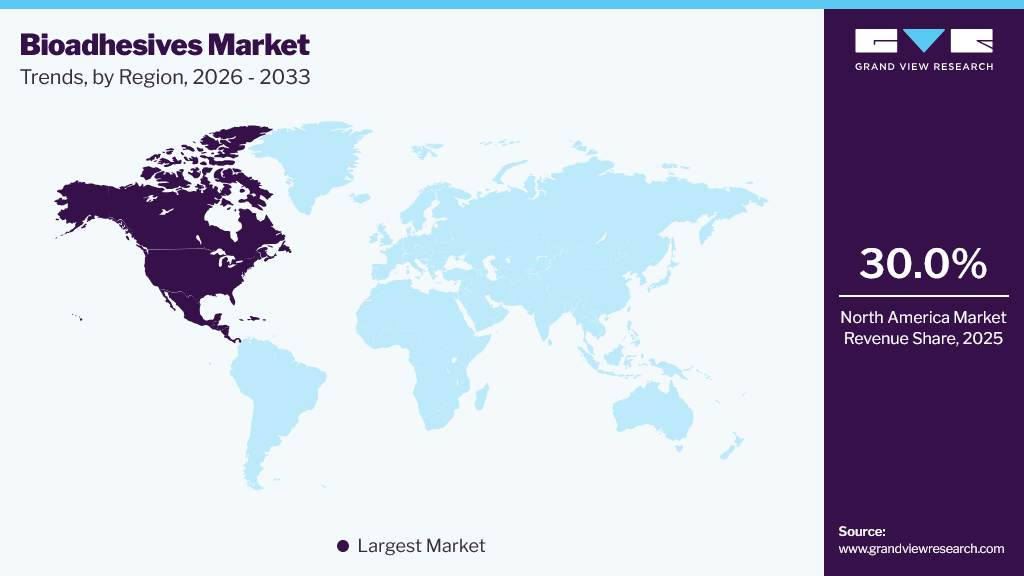
The North America bioadhesives market dominated the global market and accounted for the largest market share of approximately 30.0% in 2025. This growth is attributed to the growing demand in different application segments, especially packaging & paper, and construction. The ever-increasing demand for packaging and healthcare applications drives this market. Growing regulatory pressure to reduce volatile organic compounds (VOC) and reliance on petroleum-based chemicals are encouraging manufacturers to adopt bio-based adhesive technology. Moreover, the growing demand for eco-friendly products among consumers and increased usage of renewable resources are driving the demand for bio-adhesives.
 To learn more about this report, Download Free Sample Report
U.S. Bioadhesives Market Trends
The bioadhesives market dominated the U.S. market, owing to initiatives by significant companies and rising demand across various sectors. Companies are investing in research and development to create bioadhesive products that meet the increasing demand for sustainable solutions. In addition, Advancements in biotechnology enable enhancements in high-performance bioadhesives, which provide durability and adhesion properties. For instance, in July 2025, TISSIUM announced the U.S. commercial launch of COAPTIUM Connect, a programmable polymer-based bioadhesive platform for sutureless nerve repair. The product eliminates the need for microsutures and is based on the company's proprietary biomorphic polymer technology. The healthcare segment also contributes to market expansion by using bioadhesives in medical devices.
Europe Bioadhesives Market Trends
The Europe bioadhesives market growth is driven by strict environmental regulations, sustainability efforts, and the increasing demand for bio-based products in industries such as packaging, paper & wood, healthcare, and consumer goods. The region's focus on reducing carbon emissions and dependence on fossil-fuel-derived chemicals is encouraging companies to adopt adhesive products. In addition, the rising consumer trend towards eco-friendly products and the adoption of circular economy approaches in Europe are further supporting demand for bioadhesives in the region.
Furthermore, the UK bioadhesives market is expanding significantly, driven by rising consciousness among people and regulatory frameworks aimed at reducing carbon footprints. The substantial growth in building activity also fuels the demand in industries such as plastic, painting, and coasting sectors, which will propel the bioadhesives market even higher. The government’s emphasis on sustainability and circular economy prompts industries to implement bio-based adhesives over traditional synthetic alternatives.
The bioadhesives market in Germany is expected to witness substantial growth, owing to the manufacturing of bio-succinic acid, which helped fuel the development of bioadhesives: a rapid industrial base and a commitment to sustainability. Environmental regulations and government initiative programs aid the bioadhesives market by promoting the use of renewable resources for sustainability. In addition, Germany’s focus on enhancement and innovation with its well-established research infrastructure is leading the development of advanced bioadhesive solutions.
Asia Pacific Bioadhesives Market Trends
The Asia Pacific bioadhesives market is expected to witness substantial growth over the forecast period, driven by increasing construction activity, expanding packaging production, and growing demand for sustainable materials across manufacturing industries. In addition,
China is expected to expand in the Bioadhesives industry owing to increasing environmental awareness, regulatory initiatives promoting bio-based materials, and rising demand from packaging, construction, and healthcare industries. Rapid growth of the e-commerce sector is further increasing demand for sustainable paper-based packaging, supporting the adoption of bioadhesive technologies across the country.
Key Bioadhesives Company Insights
Companies operating in the bioadhesives market are focusing on product innovation, strategic collaborations, acquisitions, and portfolio expansion to strengthen their market position. Manufacturers are investing in the development of high-performance bio-based adhesive technologies to address growing demand from healthcare, packaging, construction, woodworking, and consumer goods industries. In addition, continuous research and development activities are enabling companies to improve product performance while expanding the use of renewable raw materials across commercial applications.
Key Bioadhesives Companies
The following key companies have been profiled for this study on the bioadhesives market:
-
Henkel AG & Co. KGaA
-
DuPont de Nemours, Inc.
-
Arkema S.A.
-
Ashland Inc.
-
Beardow Adams Limited
-
Paramelt B.V.
-
Jowat SE
-
Ingredion Incorporated
-
EcoSynthetix Inc.
-
Tate & Lyle PLC
Recent Developments
-
In January 2026, BioBond Adhesives launched BioAdhere SUP250, a plant-based industrial bioadhesive designed for mobility and defense applications. The adhesive provides metal-to-metal, glass-to-glass, and metal-to-glass bonding while offering low VOC emissions, no added microplastics, PFAS-free formulation, and USDA BioPreferred certification.
-
In July 2025, BioBond Adhesives launched BioMelt SPKG500 and BioMelt SPKG250, two plant-based hot melt bioadhesives developed for packaging applications. The products are formulated using renewable raw materials and are designed to provide competitive performance while eliminating added microplastics commonly found in conventional adhesive systems.
-
In September 2024, the adhesive solutions business of Arkema launched Kizen LIME, a new range of packaging adhesives formulated with a minimum of 80% renewable ingredients, including bio-based and bio-circular materials. The product was developed in collaboration with Dow and Nordson for recyclable paper and cardboard packaging and provides high adhesion performance, low-temperature application, and energy savings.
Bioadhesives Market Report Scope
Report Attribute
Details
Market size in 2025
USD 5.6 billion
Estimated Market size in 2026
USD 6.1 billion
Projected Market size by 2033
USD 11.2 billion
Growth rate
CAGR of 9.1% from 2026 to 2033
Base year for estimation
2025
Actual data
2021 – 2024
Forecast period
2026 – 2033
Quantitative units
Revenue in USD Billion, and CAGR from 2026 to 2033
Report coverage
Revenue forecast, company ranking, competitive landscape, growth factors, and trends
Segments covered
Source, end use, region
Regional Scope
North America; Europe; Asia Pacific; Latin America; Middle East & Africa
Country scope
U.S.; Canada; Mexico; UK; Germany; France; Italy; Spain; Denmark; Sweden; Norway; China; India; Japan; Australia & New Zealand; Thailand; South Korea; Brazil; Argentina; South Africa; UAE; Saudi Arabia; Kuwait
Key companies profiled
Henkel AG & Co. KGaA; DuPont de Nemours, Inc.; Arkema S.A.; Ashland Inc.; Beardow Adams Limited; Paramelt B.V.; Jowat SE; Ingredion Incorporated; EcoSynthetix Inc.; Tate & Lyle PLC.
Customization scope
Free report customization (equivalent up to 8 analysts working days) with purchase. Addition or alteration to country, regional & segment scope.
Pricing and purchase options
Avail of customized purchase options to meet your exact research needs. Explore purchase options
Global Bioadhesives Market Report Segmentation
This report forecasts revenue growth at the global, regional, and country levels and provides an analysis of the latest industry trends and opportunities in each sub segment from 2021 to 2033. For this study, Grand View Research has segmented global bioadhesives market report on the basis of source, end use, and region.
-
Source Outlook (Revenue, USD Billion, 2021 - 2033)
-
Plant-based
-
Animal-based
-
-
End Use Outlook (Revenue, USD Billion, 2021 - 2033)
-
Paper & Packaging
-
Construction
-
Woodworking
-
Personal Care & Cosmetics
-
Medical
-
Others
-
-
Regional Outlook (Revenue, USD Billion, 2021 - 2033)
-
North America
-
U.S.
-
Canada
-
Mexico
-
-
Europe
-
Germany
-
UK
-
France
-
Italy
-
Spain
-
Denmark
-
Sweden
-
Norway
-
-
Asia Pacific
-
China
-
Japan
-
India
-
South Korea
-
Australia
-
Thailand
-
-
Latin America
-
Brazil
-
Argentina
-
-
Middle East and Africa (MEA)
-
Saudi Arabia
-
UAE
-
South Africa
-
Kuwait
-
-
Frequently Asked Questions About This Report
The global bioadhesives market size was estimated at USD 5.6 billion in 2025 and is expected to reach USD 6.1 billion in 2026.
The global bioadhesives market is expected to grow at a compound annual growth rate of 9.1% from 2026 to 2033 to reach USD 11.2 billion by 2033.
Plant-based bioadhesives dominated the bioadhesives market with a share of 66.0% in 2025, while animal-based is the fastest-growing segment.
Some key players operating in the bioadhesives market include Henkel AG & Co. KGaA; DuPont de Nemours, Inc.; Arkema S.A.; Ashland Inc.; Beardow Adams Limited; Paramelt B.V.; Jowat SE; Ingredion Incorporated; EcoSynthetix Inc.; Tate & Lyle PLC.
North America dominated with a 30.0% revenue share in 2025.
About the Author(s)
Renewable Chemicals Research Team
Specialty & Chemicals · Renewable ChemicalsThis report was authored by the renewable chemicals research team at Grand View Research - comprising two research analysts, one senior research analyst, and one industry expert - with specialized expertise in the renewable chemicals segment of the specialty & chemicals industry. All findings are based on proprietary specialty & chemicals databases, executive interviews, and regulatory analysis, subject to internal peer review prior to publication.
Last Updated:
Speak to Analyst

Customize this report to your needs - add regions, segments, or data points, with 20% free customization.
Or view our licence options:


ISO 9001:2015 & 27001:2022 Certified
We are GDPR and CCPA compliant! Your transaction & personal information is safe and secure. For more details, please read our privacy policy.


