
- Home
- »
- Plastics, Polymers & Resins
- »
-
Biodegradable Cut Flower Packaging Market Report, 2033GVR Report cover
![Biodegradable Cut Flower Packaging Market (2026 - 2033)Report]()
Biodegradable Cut Flower Packaging Market (2026 - 2033)
Size, Share & Trends Analysis Report By Material (Paper & Paperboard, Biodegradable Plastics, Compostable Coatings & Inserts, Jute), By Product (Sleeves, Wrapping Sheets), By Region, And Segment Forecasts
Market Size, 2025
$3.1BMarket Estimate, 2026
$3.3BMarket Forecast, 2033
$5.4BCAGR, 2026–2033
7.3%Biodegradable Cut Flower Packaging Market Summary
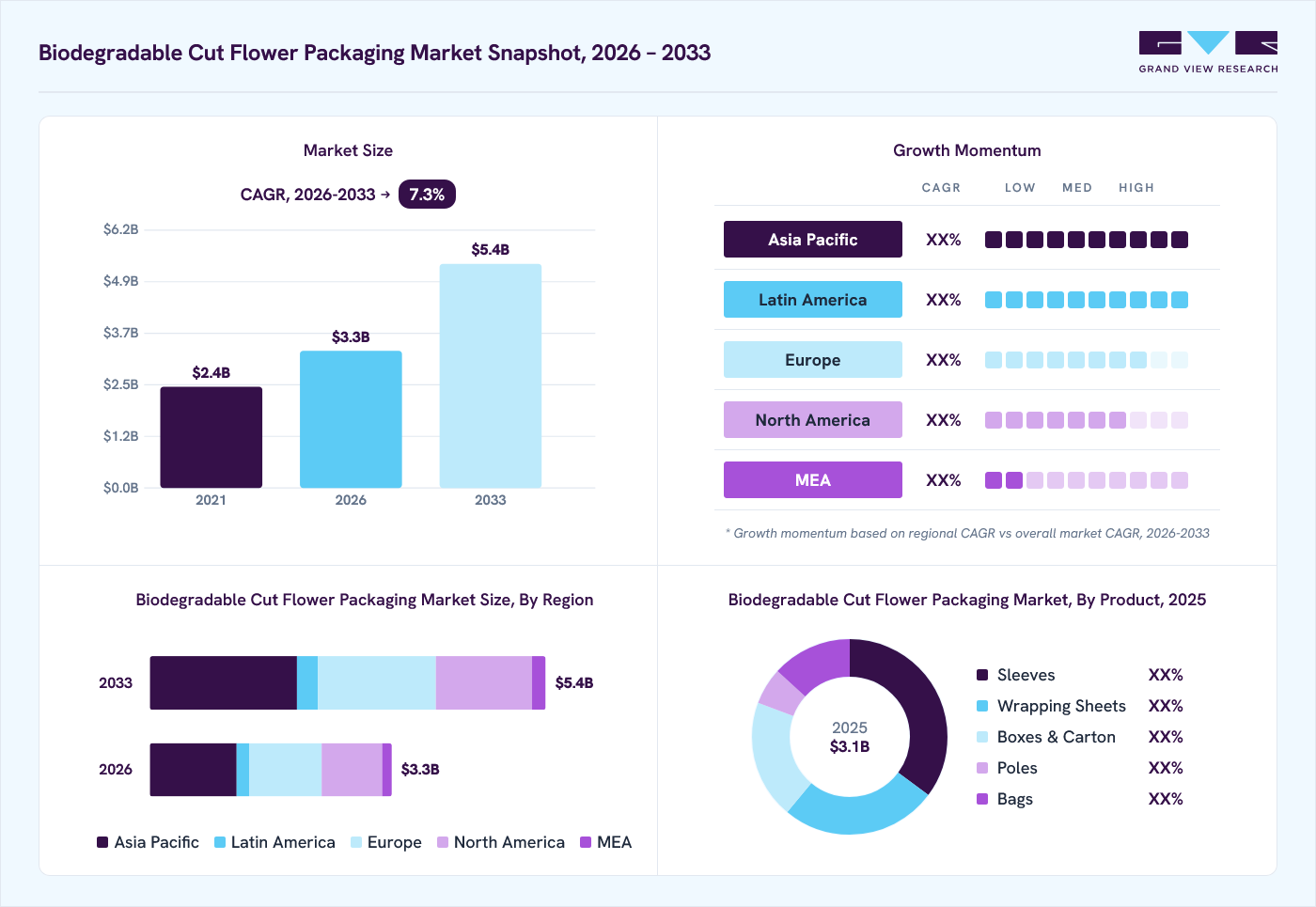
The global biodegradable cut flower packaging market size was valued at USD 3.1 billion in 2025 and is projected to grow from USD 3.3 billion in 2026 to USD 5.4 billion by 2033, at a CAGR of 7.3% from 2026 to 2033. Asia Pacific dominated the market, accounting for a revenue share of 35.7% in 2025. The market is driven by increasing consumer demand for sustainable and eco-friendly packaging solutions that reduce plastic waste.
Key Market Trends & Insights
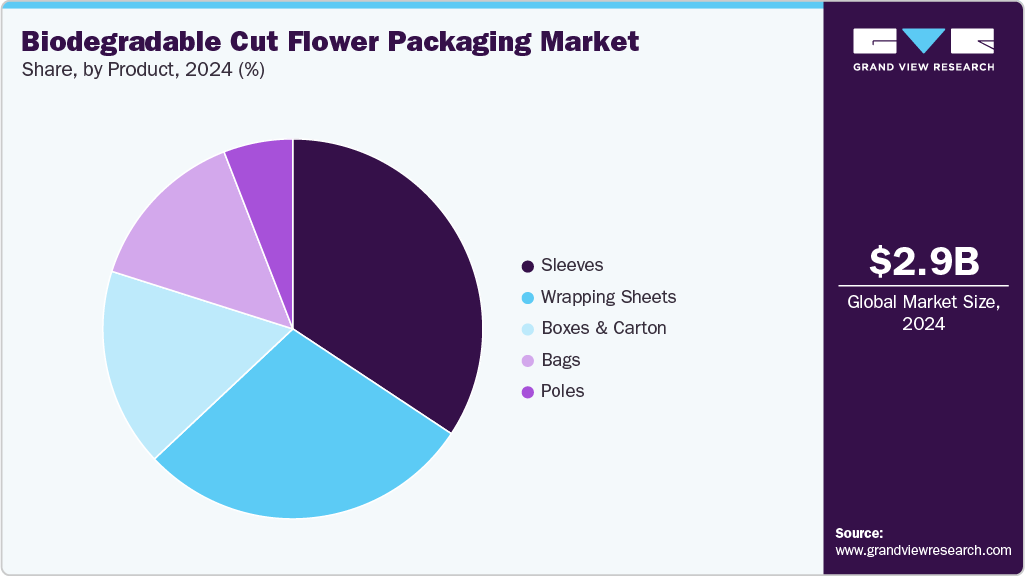
- By product: Sleeves segment led the market with the largest revenue share of 35.1% in 2025.
- By material: Paper & paperboard segment led the market with the largest revenue share of 51.8% in 2025.
Regional Highlights
- Largest regional market: Asia Pacific (35.7% revenue share, 2025)
- By country: The China held the largest market share in 2025
Market Size & Forecast
- Market size in 2025: USD 3.1 Billion
- Estimated market size in 2026: USD 3.3 Billion
- Projected market size by 2033: USD 5.4 Billion
- CAGR (2026-2033): 7.3%
Three ways to get this report
Buy it, customize it, or ask a question.Get the Full Report
What the study covers
- FormatsPDF · Excel · Dashboard
- Timeline2026–2033 annual, 2025 base
- Coverage20+ countries, 5 regions
- Companies10+ key players profiled
Customize the Report
20% free customization
- IncludeCountries, segments, points
- TailorTo your product definition
- ExtendDeeper competitor detail
- OrA fully bespoke study
- Turnaround5–10 working days
Ask Prism AI
A cited answer in seconds
- Corpus30K studies, 1.2M points
- ScopeAll markets, not just this
- CitationTraced to report & table
- HonestySays "not covered" if so
- SpeedSeconds, not days
In addition, government regulations promoting biodegradable materials in packaging further accelerate market growth. Flowers play a vital role in celebrations such as weddings, birthdays, anniversaries, and corporate gatherings, creating consistent demand for attractive and protective biodegradable packaging. The thriving event management and wedding industries, especially in the Asia Pacific and North America, have intensified this need. For example, India’s wedding sector, recognized as the world’s second-largest, hosts nearly 10 million weddings annually, generating an estimated USD 130 billion and ranking among the country’s top industries. This vast market fuels large-scale demand for sustainably packaged cut flowers. Similarly, florists and retailers across Western countries are increasingly opting for biodegradable sleeves, wraps, and boxes that enhance visual presentation while preserving freshness and minimizing environmental impact.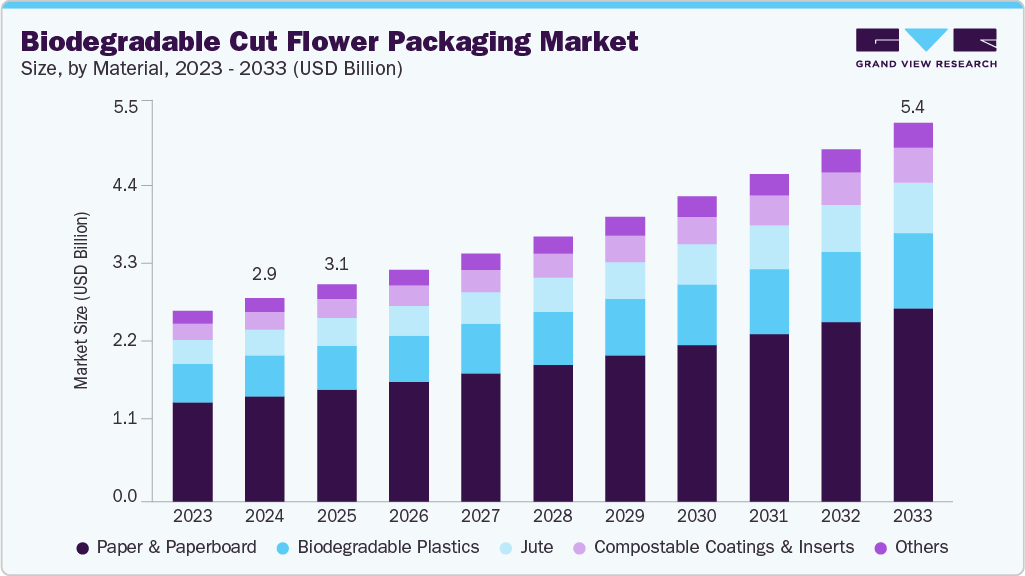
The surge in online flower delivery services has become a major growth catalyst for the biodegradable cut flower packaging industry. Leading e-commerce florists, such as 1-800-Flowers, Interflora, and Bloom & Wild, are turning to eco-friendly, temperature-resilient packaging solutions that ensure flowers reach customers in pristine condition. Modern biodegradable packaging incorporates moisture-retentive films, breathable coatings, and protective inserts made from compostable materials to prevent damage during transit. The convenience of doorstep delivery, coupled with optimized logistics and last-mile efficiency, has further increased the circulation of sustainably packaged flowers worldwide, driving the adoption of lightweight, recyclable, and biodegradable packaging alternatives.
Sustainability remains a cornerstone trend shaping the biodegradable cut flower packaging industry. Rising consumer awareness and stringent government regulations aimed at reducing plastic waste have encouraged producers to shift toward compostable, recyclable, and plant-based materials. Paper-based wraps, starch-derived bioplastics, and biodegradable cellophane made from renewable wood pulp are increasingly replacing conventional plastics. European suppliers, for instance, are aligning with the EU’s circular economy objectives by developing fully compostable floral wraps and sleeves. These initiatives not only ensure compliance with environmental directives but also enhance the brand reputation of florists and retailers catering to environmentally conscious consumers.
Continuous innovation in biodegradable packaging materials and technologies is further strengthening market growth. Manufacturers are developing advanced materials with improved breathability, humidity regulation, and ethylene absorption properties to prolong the freshness of flowers during shipment and storage. Technologies such as modified atmosphere packaging (MAP), anti-fog biodegradable films, and moisture-control components are being integrated into eco-friendly formats. For example, leading Dutch exporters are adopting biodegradable corrugated boxes with built-in hydration systems to maintain bloom vitality during international transport. Such advancements enable suppliers to minimize waste, maintain product integrity, and meet the global demand for sustainable floral packaging solutions.
Market Dynamics
The biodegradable cut flower packaging market is witnessing steady growth, driven by increasing environmental awareness, regulatory restrictions on plastic packaging, and rising demand for sustainable solutions in the floriculture industry. Flower growers, wholesalers, and retailers are increasingly adopting biodegradable materials to meet consumer preferences for eco-friendly products and support sustainability goals. The growth of online flower delivery services and premium floral gifting is further boosting demand. However, higher costs and performance limitations of some biodegradable materials compared to conventional plastics may pose challenges. Despite these constraints, ongoing material innovations are expected to support future market growth.
The primary driver of the biodegradable cut flower packaging market is the growing demand for sustainable and environmentally responsible packaging across the floriculture value chain. Increasing consumer awareness regarding plastic waste, environmental pollution, and carbon emissions has encouraged flower growers, wholesalers, retailers, and e-commerce platforms to adopt biodegradable packaging alternatives. Consumers are increasingly favoring floral products packaged in recyclable, compostable, and biodegradable materials, prompting businesses to align their packaging strategies with sustainability objectives and evolving purchasing preferences.Governments and regulatory bodies worldwide are implementing stricter regulations on single-use plastics, further accelerating the transition toward biodegradable packaging solutions. Retailers and floral brands are responding by incorporating paper-based wraps, compostable films, molded fiber trays, and other eco-friendly materials to reduce environmental impact and enhance brand reputation. As sustainability becomes a key competitive differentiator in the floral industry, the adoption of biodegradable cut flower packaging is expected to increase significantly, supporting long-term market growth.
A significant restraint for the biodegradable cut flower packaging market is the higher cost of biodegradable materials compared to traditional plastic-based packaging. Materials such as compostable films, molded fiber, and bio-based polymers often involve higher production and procurement expenses, increasing overall packaging costs for flower growers, distributors, and retailers. This cost disparity can limit adoption, particularly among small and medium-sized businesses operating with tight profit margins. Furthermore, fluctuations in raw material availability and the need for specialized manufacturing processes further contribute to pricing challenges, slowing the widespread transition to biodegradable packaging solutions.
A significant opportunity for the biodegradable cut flower packaging market lies in the rapid growth of e-commerce flower sales and online floral delivery services. As consumers increasingly purchase flowers through digital platforms, packaging has become essential for ensuring product protection, freshness, and visual appeal during transit. This trend is creating strong demand for biodegradable packaging solutions that combine sustainability with functionality. Floral retailers and delivery companies are investing in eco-friendly packaging to meet consumer expectations, strengthen brand image, and comply with environmental regulations, creating substantial growth opportunities for manufacturers of biodegradable cut flower packaging materials.Market Concentration & Characteristics
The industry is primarily driven by a shift toward environmentally responsible packaging solutions. Manufacturers focus on developing biodegradable, compostable, and recyclable materials such as kraft paper, jute, cornstarch-based films, and cellulose wraps. This approach addresses the global movement against single-use plastics and aligns with circular economy principles. Certifications such as FSC (Forest Stewardship Council), EN 13432, and ASTM D6400 are increasingly adopted to assure end users of material sustainability and biodegradability.
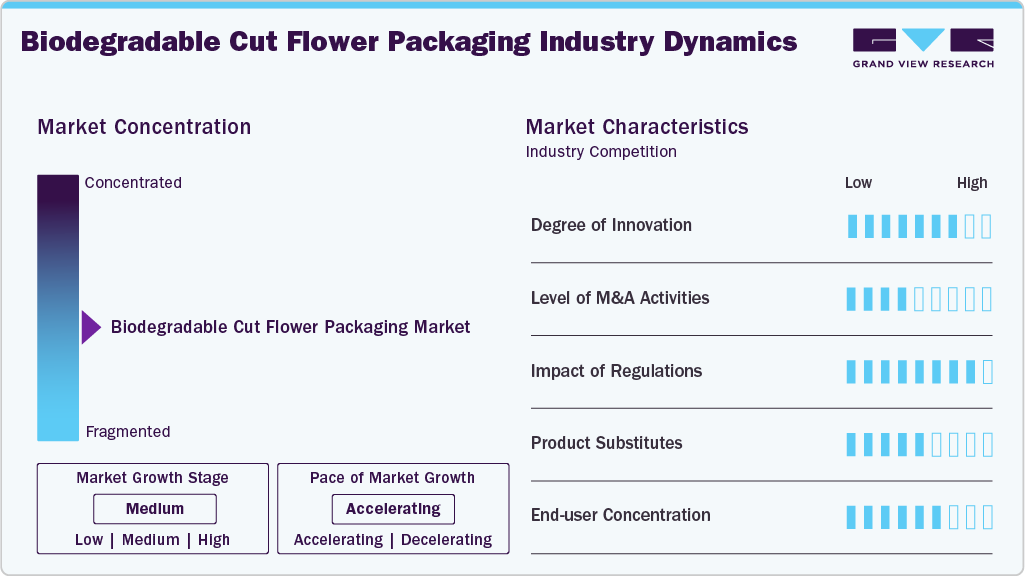
Continuous R&D investment defines the competitive nature of this industry. Companies are exploring bio-based polymers, water-soluble coatings, and plant-fiber composites to improve packaging performance and environmental impact. Technologies such as modified atmosphere packaging (MAP) and anti-fog biodegradable films are gaining traction to extend the shelf life of flowers. Collaboration among material scientists, floriculturists, and packaging manufacturers is central to ongoing innovation.
Analyst Perspective
The biodegradable cut flower packaging market is expected to witness steady growth, driven by increasing environmental awareness, regulatory restrictions on plastic packaging, and rising demand for sustainable solutions across the floriculture industry. Growers, wholesalers, retailers, and e-commerce flower delivery companies are increasingly adopting biodegradable materials to meet sustainability goals and evolving consumer preferences. The expansion of online flower sales and premium floral gifting is further boosting demand for eco-friendly packaging that offers both protection and visual appeal. Companies focusing on innovative, cost-effective, and high-performance biodegradable packaging solutions are expected to gain a competitive advantage in the years ahead.
Material Insights
Based on material, the paper & paperboard segment led the market with the largest revenue share of 51.8% in 2025. Paper and paperboard are among the most widely used materials in this industry due to their eco-friendliness, biodegradability, and ease of customization. They are commonly used in wrapping papers, corrugated boxes, and decorative sleeves that provide aesthetic appeal and sufficient protection during transportation. Kraft paper and coated paperboard are preferred for their strength and printability, allowing florists and retailers to add branding, color, and patterns. Government regulations promoting paper-based alternatives, such as the EU Single-Use Plastics Directive, have further boosted adoption.
The compostable coatings & inserts segment is expected to grow at the fastest CAGR of 8.0% during the forecast period. The compostable coatings and inserts segment in the biodegradable cut flower packaging industry is emerging as a crucial material category, combining functionality with environmental responsibility. Compostable coatings, derived from bio-based polymers such as polylactic acid (PLA), starch blends, or cellulose, are applied to paper and fiber-based packaging to enhance moisture resistance, durability, and barrier performance without compromising biodegradability.
Product Insights
Based on product, the sleeves segment led the market with the largest revenue share of 35.1% in 2025, primarily due to its convenience, functionality, and visual appeal. Biodegradable flower sleeves, typically made from kraft paper, PLA-coated paper, or compostable biofilms derived from cornstarch and cellulose, are designed to protect stems and petals from damage while maintaining adequate ventilation and moisture balance. Their lightweight and flexible structure makes them ideal for retail display, transportation, and gifting purposes. Florists and retailers prefer sleeves for their ability to combine aesthetic presentation with sustainability, often customizing them with printed branding or water-based inks to enhance shelf appeal.
The boxes & carton segment is projected to grow at the fastest CAGR of 7.9% during the forecast period. This segment is gaining significant traction as a durable and eco-friendly solution for the storage, transport, and presentation of floral products. Made from recyclable and compostable materials such as corrugated kraft paper, molded pulp, and plant-based coatings, these packaging formats offer superior structural strength and protection against mechanical damage, temperature fluctuations, and moisture during long-distance shipping. Biodegradable boxes and cartons are especially favored by flower exporters, online delivery platforms, and event organizers who require bulk packaging that maintains flower freshness and minimizes waste.
Regional Insights
The biodegradable cut flower packaging market in North America growth is supported by strong sustainability commitments, well-established e-commerce flower delivery networks, and advanced packaging technologies. The U.S. and Canada are witnessing rapid adoption of compostable, recyclable, and paper-based packaging due to growing consumer preference for environmentally responsible products. In addition, major retailers such as Whole Foods and Trader Joe’s have replaced conventional plastic floral packaging with kraft paper and biofilm-based alternatives to meet eco-conscious consumer expectations. This trend is reinforced by federal and state-level initiatives promoting waste reduction, such as bans on single-use plastics in states like California and New York.
U.S. Biodegradable Cut Flower Packaging Market Trends
The biodegradable cut flower packaging market in the U.S. accounted for the largest market revenue share in North America in 2024, due to its advanced retail infrastructure, consumer sustainability awareness, and high volume of online flower transactions. The country’s floral market, supported by major e-commerce players such as 1-800-Flowers, FTD, and Teleflora, has increasingly transitioned toward biodegradable and compostable packaging solutions to meet environmental regulations and consumer expectations.
Asia Pacific Biodegradable Cut Flower Packaging Market Trends
Asia Pacific dominated the biodegradable cut flower packaging market with the largest revenue share of 35.7% in 2025. This positive outlook is due to its expanding floriculture industry, rising environmental awareness, and growing consumer inclination toward sustainable lifestyle products. Countries such as India, China, Japan, and South Korea have witnessed a surge in demand for eco-friendly packaging materials across retail and event-based floral markets. The region’s rapidly growing wedding and event management industries, particularly in India and Southeast Asia, create bulk demand for biodegradable sleeves, wraps, and boxes.
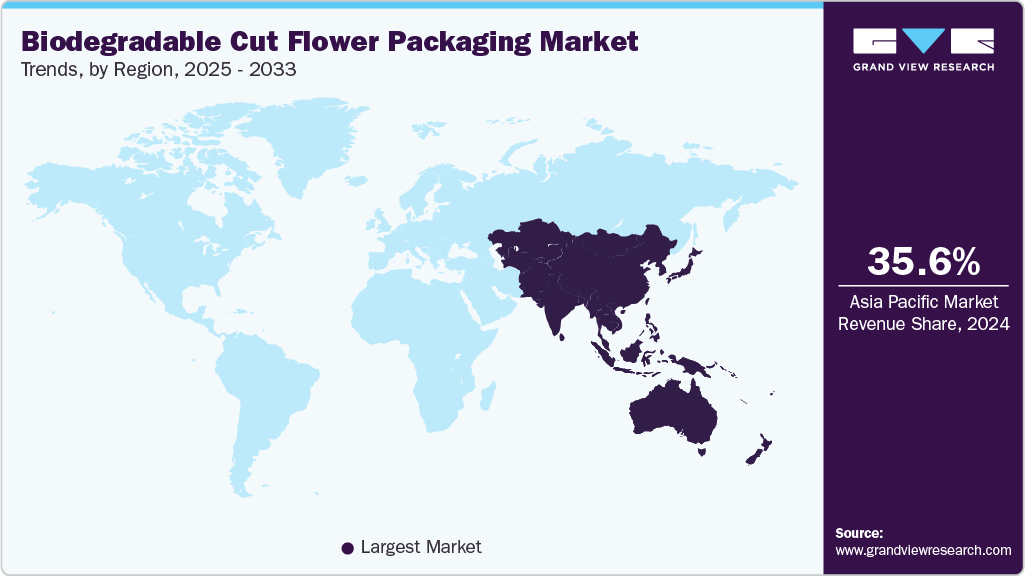
The biodegradable cut flower packaging market in China held the largest share in the Asia Pacific region in 2025. Government initiatives such as the “Green Packaging Standard” and broader circular economy policies have encouraged manufacturers to develop biodegradable films and recyclable paper-based materials tailored for floral applications. The rapid expansion of e-commerce flower delivery platforms such as FlowerPlus and Roseonly has also driven demand for visually appealing, durable, and eco-friendly packaging designs. Supported by its large-scale manufacturing capacity and cost-efficient production base, China has emerged as both a key producer and a global influencer in advancing biodegradable cut flower packaging solutions.
Europe Biodegradable Cut Flower Packaging Market Trends
The biodegradable cut flower packaging market in Europe stands at the forefront, driven by stringent environmental policies, high consumer awareness, and a mature floriculture trade network. The region’s strong regulatory framework, such as the EU Packaging and Packaging Waste Regulation (PPWR) and the European Green Deal, mandates the use of recyclable and compostable materials, compelling manufacturers to innovate in biodegradable solutions. Countries such as the Netherlands, Germany, and UK are major centers of flower production, trade, and export, and they have increasingly integrated biodegradable packaging materials into their supply chains.
Key Biodegradable Cut Flower Packaging Company Insights
The competitive environment of the biodegradable cut flower packaging industry is characterized by a mix of global packaging giants and specialized eco-friendly manufacturers focusing on sustainable innovation and material development. Companies such as DS Smith, Smurfit Kappa, Stora Enso, and Mondi are leading the market by offering recyclable and compostable paper-based sleeves, boxes, and wraps that cater to both retail and export floral packaging needs.
Emerging players and niche firms, including A·ROO Company, Smart Packaging Solutions, Packman Packaging, and Nature-Pack, are differentiating themselves through customization, design aesthetics, and the use of advanced biodegradable films and coatings. Strategic collaborations between packaging producers and floriculture businesses, such as partnerships for developing moisture-resistant and temperature-controlled compostable materials, are becoming increasingly common. The market is moderately fragmented, with competition centered around innovation, sustainability certifications, cost efficiency, and branding capabilities.
Key Biodegradable Cut Flower Packaging Companies:
The following key companies have been profiled for this study on the biodegradable cut flower packaging market.
- Smurfit Westrock
- Stora Enso
- DS Smith
- Mondi
- PakFactory
- Tycoon Packaging
- A·ROO Company
- Smart Packaging Solutions
- Nature-Pack
- Packman Packaging
- Flamingo Holland Inc.
- GleePackaging
Competitive Benchmarking
Category
Operating Strategies
Competitive Edge
Weakness
Established Players (Smurfit Westrock, Stora Enso, DS Smith, Mondi, Flamingo Holland Inc.)
- Invest in large-scale manufacturing and vertically integrated supply chains to ensure cost efficiency and consistent supply.
- Expand sustainable product portfolios through continuous R&D in biodegradable, compostable, and fiber-based packaging materials.
- Strong global distribution networks and long-standing relationships with flower growers, wholesalers, and retailers.
- Significant financial resources and technical expertise enabling innovation, regulatory compliance, and large-volume production.
- Lower flexibility in addressing highly customized or niche customer requirements.
- Higher operational and administrative costs due to complex organizational structures and extensive manufacturing networks.
Emerging Players (PakFactory, Tycoon Packaging, A·ROO Company, Smart Packaging Solutions, Nature-Pack, Packman Packagin, GleePackaging)
- Focus on customized biodegradable flower packaging solutions tailored to specific customer and regional needs.
- Leverage agile product development and strategic partnerships to accelerate market penetration.
- Faster response to changing market trends and customer preferences through flexible operations.
- Strong specialization in niche sustainable packaging applications and customized product offerings.
- Limited production capacity and financial resources compared to established global competitors.
- Lower brand visibility and restricted distribution networks, limiting access to large-scale contracts and international markets.
Recent Developments
-
In November 2025, Koen Pack Americas launched its Ecologic line, a sustainable floral packaging range made from grass paper and post-consumer recycled plastics, aiming to reduce environmental impact while maintaining quality and visual appeal. This initiative reinforces Koen Pack’s commitment to sustainability, innovation, and reliable supply across the floral industry.
-
In October 2025, DS Smith partnered with Queen Flowers to create a recyclable fibre-based bouquet box made from corrugated cardboard. Designed for easy assembly and material efficiency, it maintains flower freshness, reduces transport weight, and is fully recyclable, supporting both branding and sustainability goals.
Biodegradable Cut Flower Packaging Market Report Scope
Report Attribute
Details
Market size in 2025
USD 3.1 billion
Estimated market size in 2026
USD 3.3 billion
Projected market size by 2033
USD 5.4 billion
Growth rate
CAGR of 7.3% from 2026 to 2033
Base year for estimation
2025
Historical data
2021 - 2024
Forecast period
2026 - 2033
Quantitative units
Revenue in USD million/billion and CAGR from 2026 to 2033
Report coverage
Revenue forecast, company ranking, competitive landscape, growth factors, and trends
Segments covered
Product, material, region
Regional scope
North America; Europe; Asia Pacific; Latin America; MEA
Country scope
U.S.; Canada; Mexico; Germany; UK; France; Italy; Spain; China; Japan; India; South Korea; Australia; Brazil; Argentina; Saudi Arabia; South Africa; UAE
Key companies profiled
Smurfit Westrock; Stora Enso; DS Smith; Mondi; PakFactory; Tycoon Packaging; A·ROO Company; Smart Packaging Solutions; Nature-Pack; Packman Packaging; Flamingo Holland Inc.; GleePackaging
Customization scope
Free report customization (equivalent up to 8 analysts' working days) with purchase. Addition or alteration to country, regional & segment scope.
Pricing and purchase options
Avail customized purchase options to meet your exact research needs. Explore purchase options
Global Biodegradable Cut Flower Packaging Market Report Segmentation
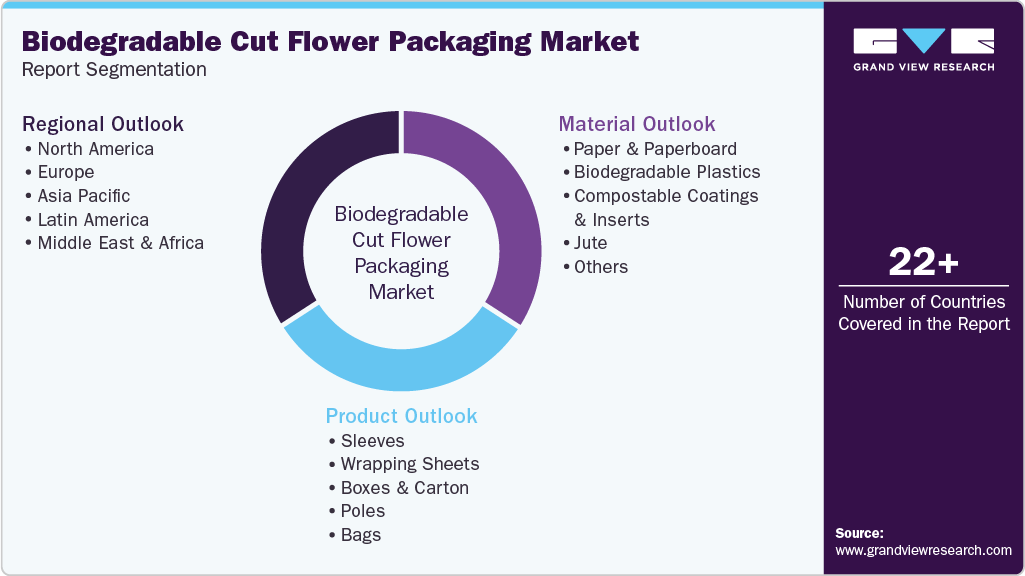
This report forecasts revenue growth at a global level and provides an analysis of the latest industry trends in each of the sub-segments from 2021 to 2033. For this study, Grand View Research has segmented the global biodegradable cut flower packaging market report based on material, product, and region:
-
Material Outlook (Revenue, USD Million, 2021 - 2033)
-
Paper & Paperboard
-
Biodegradable Plastics
-
Compostable Coatings & Inserts
-
Jute
-
Others
-
-
Product Outlook (Revenue, USD Million, 2021 - 2033)
-
Sleeves
-
Wrapping Sheets
-
Boxes & Carton
-
Poles
-
Bags
-
-
Region Outlook (Revenue, USD Million, 2021 - 2033)
-
North America
-
U.S.
-
Canada
-
Mexico
-
-
Europe
-
Germany
-
France
-
UK
-
Italy
-
Spain
-
-
Asia Pacific
-
China
-
India
-
Japan
-
Australia
-
South Korea
-
-
Latin America
-
Brazil
-
Argentina
-
-
Middle East & Africa
-
South Africa
-
Saudi Arabia
-
UAE
-
-
Research Methodology
The biodegradable cut flower packaging market figures in this report are based on a proven research process that combines executive interviews with secondary research from proprietary databases, company filings, and recognized regulatory and institutional sources. Market size is built through value-chain sizing - reconciling supply-side and demand-side estimates - and triangulated with bottom-up and top-down approaches. Every estimate passes multiple levels of expert validation before publication, with each biodegradable cut flower packaging segment quantified using the revenue-capture definitions in the table below.
Segment Definition
Segment - Product
Revenue capture definition
Sleeves
Revenue generated from the sale of biodegradable flower sleeves used to protect, bundle, and present cut flowers during storage, transportation, and retail display. This segment includes paper-based, compostable film, and bio-based sleeves designed to enhance product visibility while reducing environmental impact.
Wrapping Sheets
Revenue generated from the sale of biodegradable wrapping sheets used for floral bouquet packaging and decorative presentation. This segment includes kraft paper, tissue paper, compostable wraps, and other sustainable sheet materials that provide protection, aesthetics, and eco-friendly disposal.
Boxes & Cartons
Revenue generated from the sale of biodegradable boxes and cartons used for packaging, shipping, and retail distribution of cut flowers. This segment includes corrugated paperboard cartons, molded fiber boxes, and compostable containers designed to protect flowers during handling and transit.
Poles
Revenue generated from the sale of biodegradable support poles and stems used to stabilize, protect, and maintain the structure of cut flowers during transportation and display. This segment includes bamboo, jute-based, paper-based, and other eco-friendly support solutions.
Bags
Revenue generated from the sale of biodegradable bags used for carrying, storing, and transporting cut flowers. This segment includes compostable plastic bags, paper bags, and other sustainable packaging formats designed to minimize environmental impact while maintaining product integrity.
Segment - Material
Revenue capture definition
Paper & Paperboard
Revenue generated from the sale of cut flower packaging manufactured using paper and paperboard materials. This segment includes sleeves, wrapping sheets, cartons, and other packaging formats that offer recyclability, biodegradability, and strong consumer acceptance.
Biodegradable Plastics
Revenue generated from the sale of cut flower packaging produced from biodegradable plastic materials such as PLA, PHA, and starch-based polymers. This segment includes flexible and rigid packaging solutions designed to decompose under specific environmental conditions.
Compostable Coatings & Inserts
Revenue generated from the sale of compostable coatings, liners, inserts, and protective components used in biodegradable flower packaging. This segment includes moisture-resistant coatings and cushioning inserts that enhance packaging performance while maintaining compostability.
Jute
Revenue generated from the sale of cut flower packaging products manufactured using jute fibers. This segment includes wraps, ties, bags, decorative coverings, and support materials that offer biodegradability, durability, and a natural aesthetic appearance.
Others
Revenue generated from the sale of biodegradable cut flower packaging made from alternative sustainable materials, including bamboo fiber, molded pulp, agricultural residues, wood-based materials, and other emerging eco-friendly substrates used in floral packaging applications.
Estimation Model
Layer Name
Key Question
Description
Cut Flower Production & Consumption Layer
What forms the demand base?
Identify global production and consumption volumes of cut flowers across major flower-producing and consuming countries. Assess demand from florists, supermarkets, online flower retailers, event organizers, and wholesale flower distributors. This layer establishes the total addressable demand for packaging solutions required throughout the floral supply chain.
Packaging Adoption Layer
Where is biodegradable packaging utilized?
Estimate the penetration of biodegradable packaging across flower cultivation, post-harvest handling, transportation, retail display, and e-commerce delivery. Assess adoption levels of sustainable packaging among growers, wholesalers, retailers, and floral delivery service providers across developed and emerging markets.
Packaging Consumption Intensity Layer
How much packaging is consumed?
Analyze average packaging usage per unit volume of cut flowers, considering sleeves, wrapping sheets, boxes & cartons, poles, and bags. Packaging intensity is influenced by flower type, transportation distance, export requirements, retail presentation standards, sustainability initiatives, and product protection needs.
Revenue Layer
How is market revenue generated?
Market revenue is quantified through the sale of biodegradable cut flower packaging products manufactured from paper & paperboard, biodegradable plastics, compostable coatings & inserts, jute, and other sustainable materials. Revenue is generated from recurring demand across flower growers, exporters, wholesalers, retailers, supermarkets, and e-commerce floral delivery platforms seeking environmentally responsible packaging solutions.
Delivered Customizations
This report has been delivered with the following In-depth customizations
Client Request
Customization Delivered
Value Adds
Regional Segmentation Analysis
Detailed assessment of the biodegradable cut flower packaging market across North America, Europe, Asia Pacific, Central & South America, and Middle East & Africa, including demand analysis for biodegradable flower packaging products such as sleeves, wrapping sheets, boxes & cartons, poles, and bags, along with regional sustainability regulations, consumer preferences, and market growth trends.
Enables identification of high-growth regions, supports regional expansion strategies, and provides insights into product demand variations across key markets.
Cross-Segmentation Analysis
Comprehensive evaluation of market opportunities across key segment intersections, including Product, Material, and Region. Analysis covers demand trends for sleeves, wrapping sheets, boxes & cartons, poles, and bags manufactured using paper & paperboard, biodegradable plastics, compostable coatings & inserts, jute, and other sustainable materials.
Helps identify the most lucrative product-material combinations, optimize product development strategies, and target high-growth application areas effectively.
Competitive Benchmarking
Benchmarking of major biodegradable cut flower packaging manufacturers based on product portfolio breadth across sleeves, wrapping sheets, boxes & cartons, poles, and bags, material innovation capabilities, sustainability certifications, regional presence, and strategic initiatives.
Provides insights into competitive positioning, identifies best practices, and supports strategic differentiation and market share expansion efforts.
Frequently Asked Questions About This Report
The sleeves segment led the biodegradable cut flower packaging market with a 35.1% revenue share in 2025.
The paper & paperboard segment led the biodegradable cut flower packaging market with a 51.8% revenue share in 2025.
Boxes & carton is the fastest-growing product segment in the biodegradable cut flower packaging market with a CAGR of 7.9% over the forecast period.
Key players in the biodegradable cut flower packaging market include Smurfit Westrock; Stora Enso; DS Smith; Mondi; PakFactory; Tycoon Packaging; A·ROO Company; Smart Packaging Solutions; Nature-Pack; Packman Packaging; Flamingo Holland Inc.; GleePackaging.
The global biodegradable cut flower packaging market size was valued at USD 3.1 billion in 2025 and is estimated at USD 3.3 billion for 2026.
The global biodegradable cut flower packaging market is expected to grow at a CAGR of 7.3% from 2026 to 2033, reaching USD 5.4 billion by 2033.
Key factors driving the biodegradable cut flower packaging market include growing environmental awareness, increasing restrictions on plastic packaging, rising demand for sustainable floral packaging, expansion of e-commerce flower deliveries, and continuous innovation in biodegradable and compostable packaging materials.
Asia Pacific dominated the biodegradable cut flower packaging market with a 35.7% revenue share in 2025.
Asia Pacific is the fastest-growing region in the biodegradable cut flower packaging market with a CAGR of 7.8% over the forecast period.
About the Author(s)
Plastics, Polymers & Resins Research Team
Bulk Chemicals · Plastics, Polymers & ResinsThis report was authored by the plastics, polymers & resins research team at Grand View Research - comprising two research analysts, one senior research analyst, and one industry expert - with specialized expertise in the plastics, polymers & resins segment of the bulk chemicals industry. All findings are based on proprietary bulk chemicals databases, executive interviews, and regulatory analysis, subject to internal peer review prior to publication.
Last Updated:
Speak to Analyst


Customize this report to your needs - add regions, segments, or data points, with 20% free customization.
Or view our licence options:


ISO 9001:2015 & 27001:2022 Certified
We are GDPR and CCPA compliant! Your transaction & personal information is safe and secure. For more details, please read our privacy policy.


