
- Home
- »
- Plastics, Polymers & Resins
- »
-
Biodegradable Packaging Market Size Report, 2026-2033GVR Report cover

Biodegradable Packaging Market (2026 - 2033)
Size, Share & Trends Analysis Report By Material (Paper & Paperboard, Bio-plastic, Bagasse), By Product Format (Bottles & Jars, Boxes & Cartons, Cans), By End Use, By Region, And Segment Forecasts
Market Size, 2025
$531.1BMarket Estimate, 2026
$566.7BMarket Forecast, 2033
$876.1BCAGR, 2026–2033
6.4%Biodegradable Packaging Market Summary
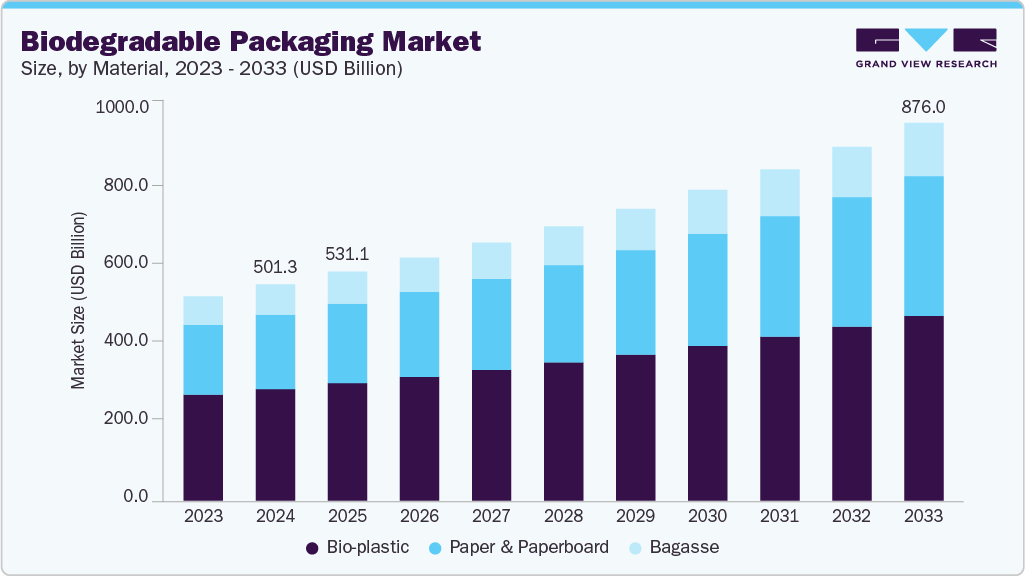
The global biodegradable packaging market size was valued at USD 531.1 billion in 2025 and is projected to grow from USD 566.7 billion in 2026 to USD 876.1 billion by 2033, at a CAGR of 6.4% from 2026 to 2033. North America dominated the market, accounting for a revenue share of 34.0% in 2025. The industry is driven by rising environmental concerns and stringent regulations promoting sustainable alternatives to conventional plastics.
 Source: Grand View Research, IR Documents, Primary Interviews, Paid DatabasesTo learn more about this report,
 Download Free Sample Report
 Key Market Trends & Insights
- By material: The bioplastic segment held the largest market share of around 50.0% in 2025.
- By product format: The pouches and bags segment held the largest market share of around 26.0% in 2025.
- By end use: The food & beverages segment held the largest market share of around 40.0% in 2025.
Regional Highlights
- Largest regional market: North America (34.0% revenue share, 2025)
- Fastest-growing regional market: Asia Pacific (highest CAGR, 2026-2033)
Market Size & Forecast
- Market size in 2025: USD 531.1 Billion
- Estimated market size in 2026: USD 566.7 Billion
- Projected market size by 2033: USD 876.1 Billion
- CAGR (2026-2033): 6.4%
Three ways to get this report
Buy it, customize it, or ask a question.Ask an Analyst
Analyst response in 1 business day
- AccessReport author, directly
- Reply timeWithin 1 working day
- No sales callDirect answer only
- FormatEmail reply
- CostFree, no cost
Get the Full Report
What the study covers
- FormatsPDF · Excel · Dashboard
- Timeline2026–2033 annual, 2025 base
- Coverage20+ countries, 5 regions
- Companies10+ key players profiled
Customize the Report
20% free customization
- IncludeCountries, segments, points
- TailorTo your product definition
- ExtendDeeper competitor detail
- OrA fully bespoke study
- Turnaround5–10 working days
Growing consumer demand for eco-friendly packaging in food, beverages, and e-commerce further fuels market growth. Governments across regions are implementing stringent regulations against single-use plastics, forcing industries to adopt sustainable alternatives. For instance, in July 2025, Huhtamaki launched its new compostable ice cream cups, stating that the cups are both home and industrial-compostable and recyclable, delivering a new sustainable packaging solution for the ice cream industry. The launch is expected to support sustainable packaging solutions as businesses respond to consumer demand and regulatory changes related to single-use plastics.
Consumer awareness and preference for eco-friendly packaging are reshaping purchase behaviors. Millennials and Gen Z, in particular, are willing to pay a premium for sustainable products, creating market pressure on brands to adapt. For example, multinational players like Unilever and Nestlé have announced sustainability targets that include expanding biodegradable packaging options. This shift in demand makes biodegradable packaging a strategic differentiator for companies seeking to enhance brand loyalty and appeal to eco-conscious customers.
The rapid expansion of food delivery services, quick-service restaurants (QSRs), and e-commerce platforms is fueling the demand for biodegradable packaging. Single-use items such as trays, cutlery, cups, and delivery boxes have been among the biggest contributors to plastic pollution, making biodegradable alternatives highly attractive. For instance, companies such as Zomato and Swiggy in India, and Uber Eats globally, are exploring biodegradable and compostable food containers to align with both consumer expectations and government norms. In e-commerce, giants like Amazon have started introducing biodegradable mailers, reflecting how packaging innovation is becoming integral to supply chain sustainability.
Advances in materials science are making biodegradable packaging more cost-effective, durable, and versatile, thereby expanding its applications. Innovations in biopolymers such as PLA (Polylactic Acid) and PHA (Polyhydroxyalkanoates) allow for packaging that mimics the functionality of plastics but decomposes naturally. At the same time, global brands are pledging to achieve 100% sustainable packaging targets within the next decade. For instance, PepsiCo is testing compostable snack packaging to meet its PepsiCo Positive (pep+) goal of making all packaging recyclable, compostable, biodegradable, or reusable by 2025. These initiatives not only create new growth opportunities but also set industry benchmarks, encouraging smaller players to adopt biodegradable packaging solutions.
Market Concentration & Characteristics
The industry is strongly shaped by environmental regulations and government policies. Bans on single-use plastics, extended producer responsibility (EPR) schemes, and strict waste management directives create a compliance-driven ecosystem. This regulatory dependency makes the industry sensitive to policy shifts but also ensures a steady demand for sustainable alternatives.
The industry is experiencing robust growth; however, cost remains a critical factor. Biodegradable alternatives are typically more expensive than conventional plastic packaging, which limits adoption in price-sensitive markets. However, falling raw material costs, economies of scale, and rising consumer willingness to pay for eco-friendly options are gradually offsetting this challenge, positioning the market for long-term expansion.
Analyst Perspective
The biodegradable packaging market is transitioning from a sustainability-focused segment toward broader commercial adoption, supported by regulatory restrictions on conventional plastics, growing brand commitments to sustainable packaging, and increasing consumer preference for environmentally responsible products. Material innovation across molded fiber, bagasse, seaweed-based materials, and biodegradable biopolymers is expanding the range of packaging formats available to food & beverage, personal care, e-commerce, and healthcare applications. Companies that can provide certified biodegradable or compostable packaging with reliable performance and competitive economics are expected to gain an advantage as sustainability requirements increasingly become integrated into packaging regulations, procurement decisions, and corporate strategies.
Material Insights
The bioplastic segment held the largest market share of around 50.0% in 2025. Bioplastics are derived from renewable biomass sources such as cornstarch, sugarcane, and cellulose and are increasingly used in food packaging, grocery bags, disposable cutlery, cups, trays, and films. For instance, in September 2025, Advanced Materials LLC launched a biodegradable plastic, designed to improve the environmental performance of conventional plastics while maintaining mechanical properties and compatibility with existing injection molding and extrusion processes. The bio-plastic segment is primarily driven by environmental regulations limiting fossil-based plastics and the growing adoption of circular economy principles in packaging.
The paper & paperboard segment is expected to register the fastest CAGR over the forecast period. Paper and paperboard are the most widely used materials in biodegradable packaging due to their renewability, recyclability, and compostable nature. They are commonly used for packaging food, beverages, consumer goods, and pharmaceuticals. Examples include kraft paper bags, paper cups, cartons, and corrugated boxes. The material’s lightweight nature, versatility in printing, and ability to maintain product integrity make it a preferred choice for brands seeking eco-friendly packaging solutions.
Product Format Insights
The pouches and bags segment held the largest market share of around 26.0% in 2025. These packaging formats are designed to replace conventional polyethylene or polypropylene bags and pouches used for groceries, snacks, and small consumer goods. For instance, in June 2026, Mother Dairy launched a degradable milk pouch for its Cow Milk variant across the Delhi, offering an alternative to conventional plastic milk pouches. In addition, the primary drivers include regulations on single-use plastics, rising consumer demand for sustainable alternatives, and brands’ efforts to improve environmental performance.
The films & wraps segment is expected to register the fastest CAGR over the forecast period. Biodegradable films and wraps are mainly applied in food packaging to preserve freshness while reducing environmental impact. They include cling films, shrink wraps, and stretch films made from PLA, cellulose, or other biopolymers. For instance, fresh produce and bakery items are increasingly wrapped in biodegradable films to reduce plastic waste. Rising awareness of plastic pollution, coupled with advancements in biodegradable polymer technology that maintain strength and barrier properties, fuels market growth.
End Use Insights
The food & beverages segment recorded the largest market share, over 40.0%, in 2025 and is projected to grow at the fastest CAGR during the forecast period. This positive outlook is driven by the growing demand for sustainable solutions across food service, QSRs (quick-service restaurants), and packaged foods. Biodegradable films, trays, and pouches made from PLA (polylactic acid), starch blends, and bagasse are replacing traditional plastics in takeaway boxes, water bottles, and snack packaging. Brands such as Coca-Cola and Nestlé are investing in biodegradable bottles and compostable flexible packaging to meet consumer expectations and regulatory norms.
The personal care & cosmetics segment is expected to register the fastest CAGR over the forecast period, owing to the growing momentum as premium brands adopt eco-conscious packaging to align with sustainability goals. Products such as shampoos, lotions, and makeup now come in biodegradable tubes, jars, and refill packs made from paper, molded fiber, and biopolymers. Companies such as L’Oréal and Unilever are actively piloting compostable pouches and biodegradable bioplastic bottles to reduce their plastic footprint.
Regional Insights
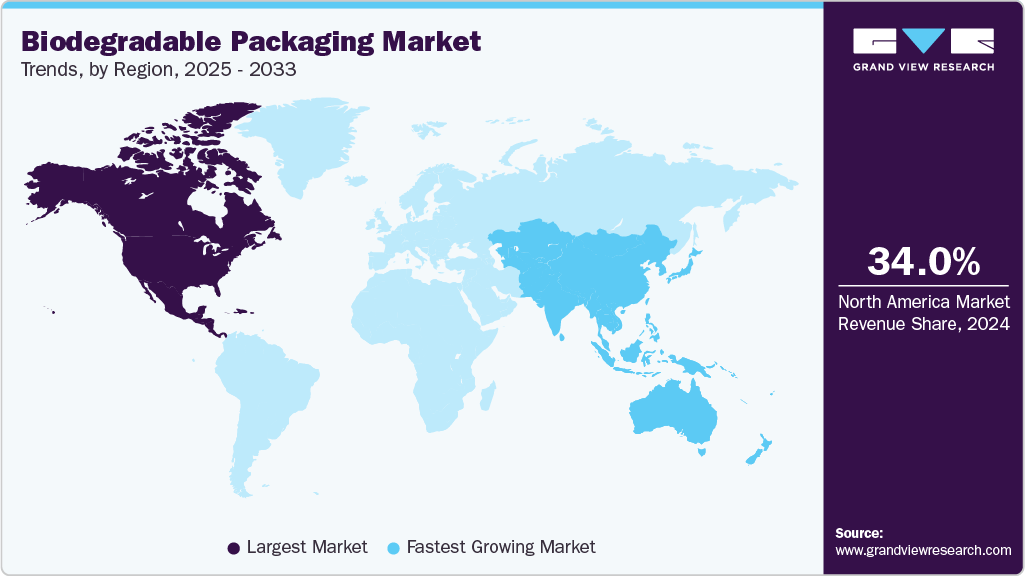
The biodegradable packaging industry in North America dominated the global market, accounting for approximately 34.0% of global revenue in 2025. This positive outlook is due to strong regulatory frameworks and consumer demand for sustainable products. The U.S. and Canada have introduced various laws to reduce plastic waste, such as bans on single-use plastic bags and straws in states such as California and New York. This regulatory landscape has encouraged businesses to adopt biodegradable alternatives in retail, foodservice, and personal care packaging. Major food chains such as McDonald’s and Starbucks in North America are experimenting with compostable packaging, which directly boosts demand.
 To learn more about this report, Download Free Sample Report
 U.S. Biodegradable Packaging Market Trends
The biodegradable packaging industry in the U.S. is driven by a combination of strong consumer demand, state-level regulations, and innovation leadership. The rise of eco-conscious consumers has also pressured major retailers and foodservice providers to adopt sustainable packaging solutions. The country also serves as a hub for innovation and commercialization of biodegradable packaging technologies. U.S.-based companies such as NatureWorks (producer of Ingeo PLA biopolymer) and Elevate Packaging are leading the global supply of biodegradable packaging materials and finished products.
Asia Pacific Biodegradable Packaging Market Trends
The biodegradable packaging industry in Asia Pacific market is expected to register the fastest growth during the forecast period, owing to its large consumer base, rapid urbanization, and government pushes for sustainable alternatives to single-use plastics. Countries such as China, India, and Japan are enforcing stringent bans on non-biodegradable plastics, which is encouraging industries to adopt biodegradable solutions in foodservice, e-commerce, and retail packaging. Additionally, the fast-growing food delivery and online grocery sectors in the Asia Pacific create a huge demand for eco-friendly packaging, as seen with companies such as Zomato and Swiggy in India increasingly shifting to biodegradable alternatives.
Europe Biodegradable Packaging Market Trends
The biodegradable packaging industry in Europe is driven by its strong circular economy initiatives and ambitious sustainability targets set by the European Union. The EU’s Single-Use Plastics Directive (SUPD), which restricts items such as cutlery, plates, and straws, has accelerated the transition to biodegradable and compostable packaging. Countries such as Germany, France, and the Netherlands are frontrunners in adopting biodegradable packaging for foodservice, retail, and e-commerce. Europe’s advanced recycling and composting infrastructure further supports the efficient use of biodegradable packaging. Global players such as BASF SE and Novamont, headquartered in Europe, are leading innovations in biodegradable polymers such as Ecovio and Mater-Bi, which are being used across packaging formats like films, trays, and carrier bags.
Inclination among brands to embrace sustainable packaging solutions also contributes to the industry growth. For instance, in May 2025, Starbucks EMEA announced its latest partnership with Transcend Packaging, Qwarzo, and Metsä Board and introduced a newly designed home-compostable hot cup and lid. The design for this cup was done in Wales, and the technology was delivered in Italy. The phased rollout was set for these cups across select European markets, including Italy, France, Germany, Sweden, Austria, Switzerland, Portugal, Hungary, and Spain.
Key Biodegradable Packaging Company Insights
Key players operating in the biodegradable packaging industry are undertaking various initiatives to strengthen their presence and increase the reach of their products and services. Strategies such as expansion activities and partnerships are key in propelling the market growth.
Established players such as Amcor plc, Smurfit Westrock, Tetra Pak, DS Smith, and Mondi leverage economies of scale, R&D investments, and strategic partnerships to strengthen their market position, while niche players and startups differentiate through specialized product lines, compostable technologies, or region-specific offerings. Intense rivalry is further fueled by rising sustainability commitments from end user industries, leading to continuous product development, mergers and acquisitions, and collaborations across the value chain to gain a competitive advantage.
Key Biodegradable Packaging Companies:
The following key companies have been profiled for this study on the biodegradable packaging market:
-
TIPA LTD
-
NOTPLA LIMITED
-
Greenhope
-
Elevate Packaging
-
CarePac
-
EcoPackables
-
Amcor plc
-
Mondi
-
Novamont S.p.A.
-
BASF
Recent Developments
-
In August 2026, Pepper Lunch, one of the prominent experiential fast-casual concepts with presence across more than 500 locations in several countries, launched EcoTeppan. Its new takeaway packaging experience comprises fully compostable container, dish made from bagasse, and more.
-
In March 2026, Notpla and Kwalitaria launched plastic-free and seaweed-coated food trays across 160 restaurants in the Netherlands. The home-compostable packaging is designed for fries and snacks, providing a sustainable alternative to conventional plastic-lined cardboard trays.
-
In October 2025, Notpla partnered with Delaware North and Wembley Stadium to introduce seaweed-based, naturally biodegradable food packaging across live music events, with more than 350,000 packaging items deployed during the rollout.
-
In October 2024, Accredo Packaging, with Fresh-Lock closures, launched the first 100% bio-based resin pouch with a zipper at PACK EXPO International 2024. Made from Braskem’s sugarcane-derived polyethylene, the mono-material pouch is recyclable, has a negative carbon footprint, and matches traditional PE in durability and flexibility. Produced with 100% wind energy, it features a resealable Fresh-Lock Renewables zipper, offering a sustainable solution for food, personal care, and healthcare packaging.
-
In January 2024, Sealed Air introduced its first biobased, industrial compostable protein packaging tray at IPPE 2024. The CRYOVAC tray, made from USDA-certified wood cellulose resin with 54% biobased content, matches EPS trays in performance and durability. Certified compostable and biodegradable by BPI and TÜV Austria, it breaks down without toxic residue, supporting company’s sustainability goals to reduce packaging waste and increase renewable content.
Biodegradable Packaging Market Report Scope
Report Attribute
Details
Market size in 2025
USD 531.1 billion
Estimated market size in 2026
USD 566.7 billion
Projected market size by 2033
USD 876.1 billion
Growth rate
CAGR of 6.4% from 2026 to 2033
Base year for estimation
2025
Historical data
2021 - 2025
Forecast period
2026 - 2033
Quantitative units
Revenue in USD billion and CAGR from 2026 to 2033
Report coverage
Revenue forecast, company ranking, competitive landscape, growth factors, and trends
Segments covered
Material, product format, end use,
and region
Regional Scope
North America; Europe; Asia Pacific; Latin America; Middle East & Africa
Country Scope
U.S.; Canada; Mexico; UK; Germany; France; Italy; Spain; China; Japan; India; Australia; South Korea; Brazil; Argentina; South Africa; Saudi Arabia; UAE
Key companies profiled
TIPA LTD; NOTPLA LIMITED; Greenhope; Elevate Packaging; CarePac; EcoPackables; Amcor plc; Mondi; Novamont S.p.A; BASF
Customization scope
Free report customization (equivalent to 8 analyst working days) with purchase. Addition or alteration to country, regional & segment scope.
Pricing and purchase options
Avail of customized purchase options to meet your exact research needs. Explore purchase options
Global Biodegradable Packaging Market Report Segmentation
This report forecasts revenue growth at the global, regional, and country levels and provides an analysis of the latest industry trends and opportunities across each sub-segment from 2021 to 2033. For this study, Grand View Research has segmented the global biodegradable packaging market report based on material, product format, end use,
and region:
-
Material Outlook (Revenue, USD Billion, 2021 - 2033)
-
Paper & Paperboard
-
Bio-plastic
-
Bagasse
-
-
Product Format Outlook (Revenue, USD Billion, 2021 - 2033)
-
Bottles & Jars
-
Boxes & Cartons
-
Cans
-
Trays & Clamshells
-
Cups & Bowls
-
Pouches & Bags
-
Films & Wraps
-
Labels & Tapes
-
Others
-
-
End Use Outlook (Revenue, USD Billion, 2021 - 2033)
-
Food & Beverages
-
Personal Care & Cosmetics
-
Pharmaceuticals
-
Homecare
-
Others
-
-
Regional Outlook (Revenue, USD Billion, 2021 - 2033)
-
North America
-
U.S.
-
Canada
-
Mexico
-
-
Europe
-
UK
-
Germany
-
France
-
Italy
-
Spain
-
-
Asia Pacific
-
China
-
Japan
-
India
-
Australia
-
South Korea
-
-
Latin America
-
Brazil
-
Argentina
-
-
Middle East and Africa (MEA)
-
South Africa
-
Saudi Arabia
-
UAE
-
-
Frequently Asked Questions About This Report
The global biodegradable packaging market size was valued at USD 531.1 billion in 2025 and is estimated at USD 566.7 billion for 2026.
The global biodegradable packaging market is expected to grow at a CAGR of 6.4% from 2026 to 2033, reaching USD 876.1 billion.
North America dominated with an approximately 34.0% revenue share in 2025.
Which material segment accounted for the largest share of the global biodegradable packaging market?The bioplastic segment held the largest market share of around 50.0% in 2025.
Key players in the market include TIPA LTD, NOTPLA LIMITED, Greenhope, Elevate Packaging, CarePac, EcoPackables, Amcor plc, Mondi, Novamont S.p.A, BASF, and others.
About the Author(s)
Plastics, Polymers & Resins Research Team
Bulk Chemicals · Plastics, Polymers & ResinsThis report was authored by the plastics, polymers & resins research team at Grand View Research - comprising two research analysts, one senior research analyst, and one industry expert - with specialized expertise in the plastics, polymers & resins segment of the bulk chemicals industry. All findings are based on proprietary bulk chemicals databases, executive interviews, and regulatory analysis, subject to internal peer review prior to publication.
Last Updated:
Speak to Analyst

Customize this report to your needs - add regions, segments, or data points, with 20% free customization.
Or view our licence options:


ISO 9001:2015 & 27001:2022 Certified
We are GDPR and CCPA compliant! Your transaction & personal information is safe and secure. For more details, please read our privacy policy.


