
- Home
- »
- Advanced Interior Materials
- »
-
Blast-Resistant Construction Materials Market Report, 2033GVR Report cover

Blast-Resistant Construction Materials Market (2026 - 2033)
Size, Share & Trends Analysis Report By Material Type (Concrete, Steel, Fiber-Reinforced Composites, Glass, Other Materials), By End Use (Government & Defense), By Application, By Region, And Segment Forecasts
Market Size, 2025
$7.7BMarket Estimate, 2026
$8.3BMarket Forecast, 2033
$14.4BCAGR, 2026–2033
8.1%Blast-Resistant Construction Materials Market Summary
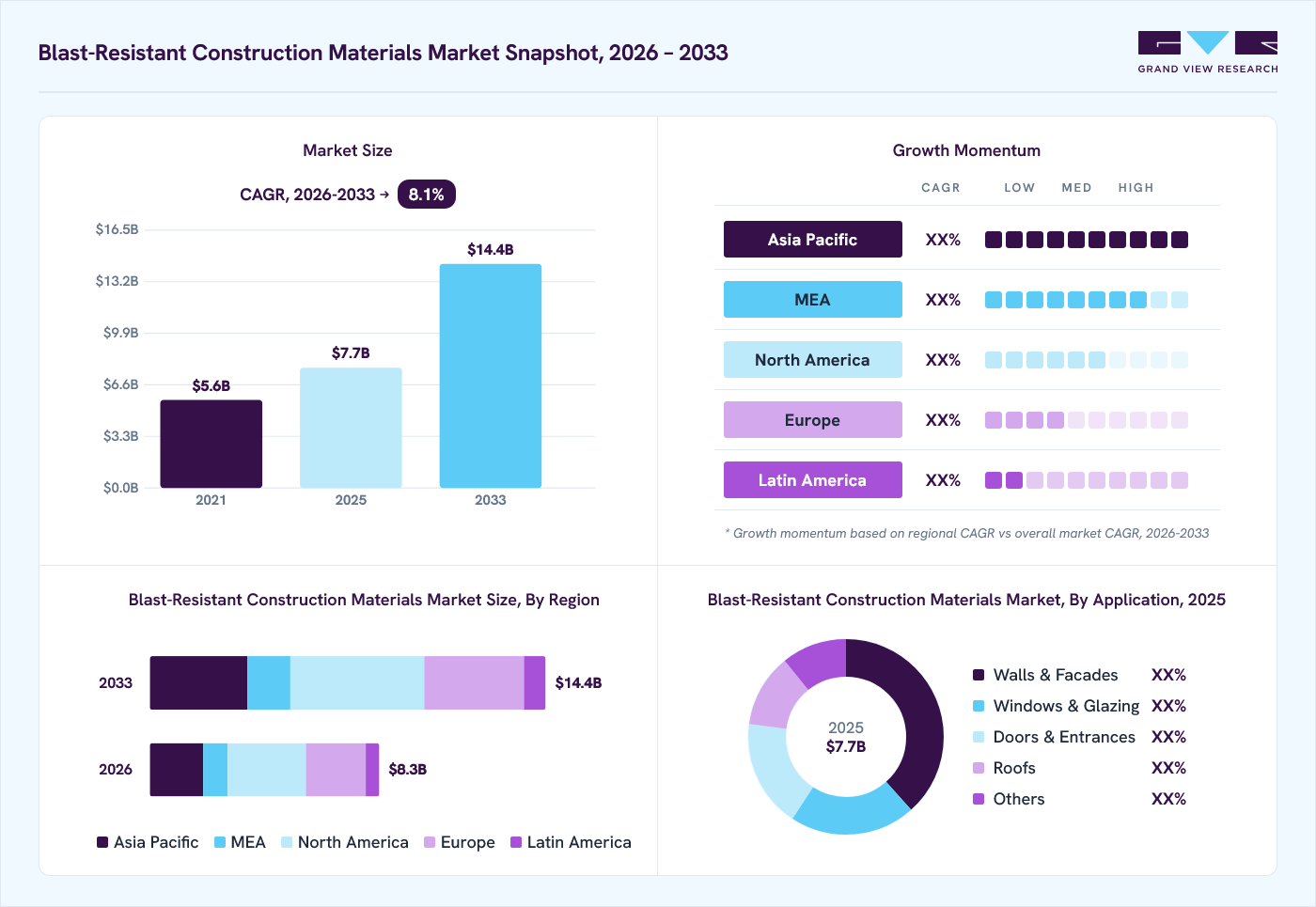
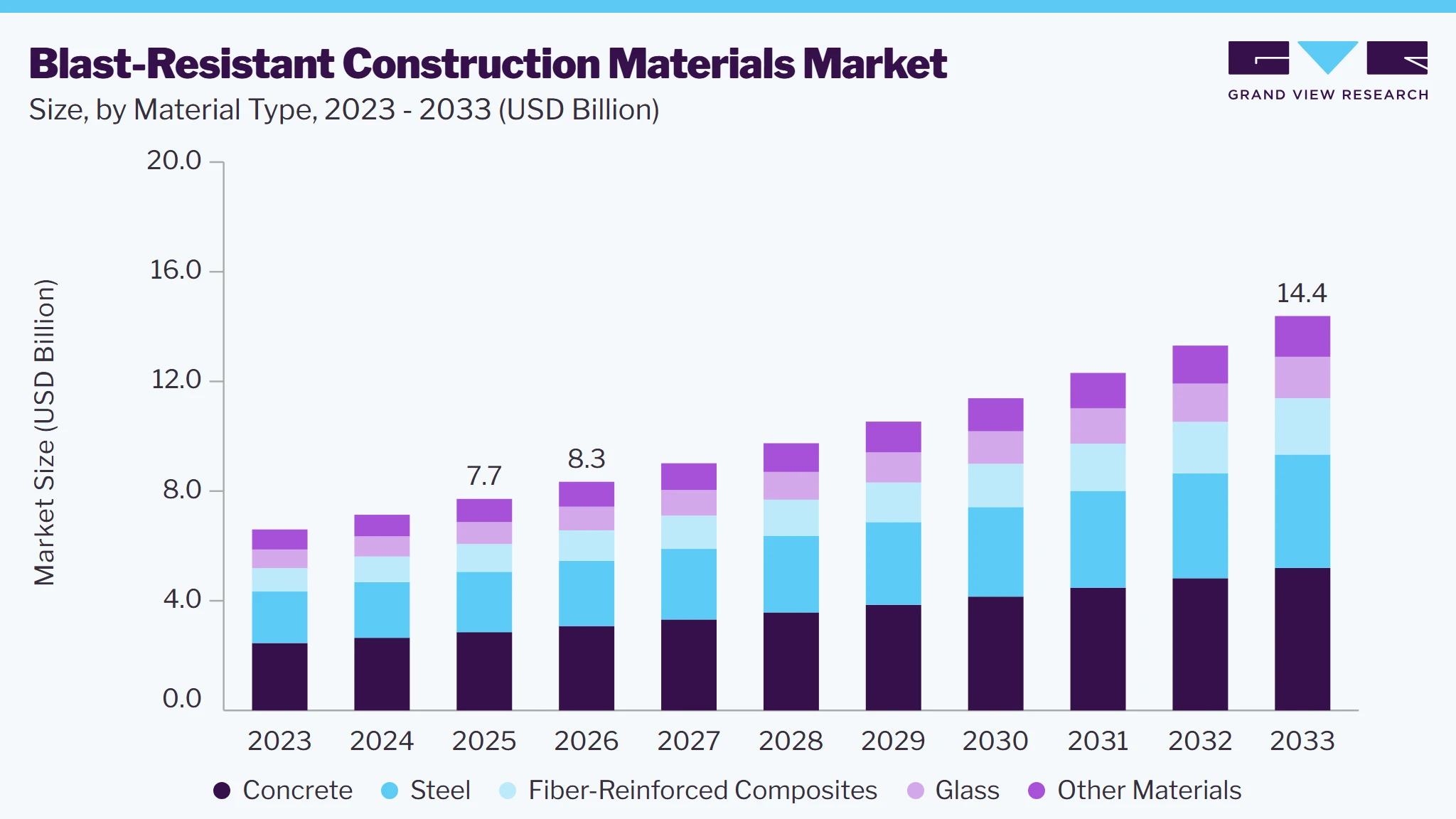
The global blast-resistant construction materials market size was valued at USD 7.7 billion in 2025 and is projected to grow from USD 8.3 billion in 2026 to USD 14.4 billion by 2033, at a CAGR of 8.1% from 2026 to 2033. The market in North America dominated with a revenue share of 34.1% in 2025. Demand for blast resistant construction materials is driven by investments in defense infrastructure, government buildings, critical industrial facilities, and high-security commercial developments. Military installations, embassies, command centers, and sensitive government facilities require protective construction systems to mitigate risks from accidental explosions and deliberate attacks.
 Source: Grand View Research, IR Documents, Primary Interviews, Paid DatabasesTo learn more about this report,
 Download Free Sample Report
Key Market Trends & Insights
- By material type: Concrete segment held the largest market share of 37.0% in 2025.
- By end use: Government & defense segment held the largest market share of 34.5% in 2025.
- By application: Walls & facades segment held the largest market share of 38.4% in 2025.
Regional Highlights
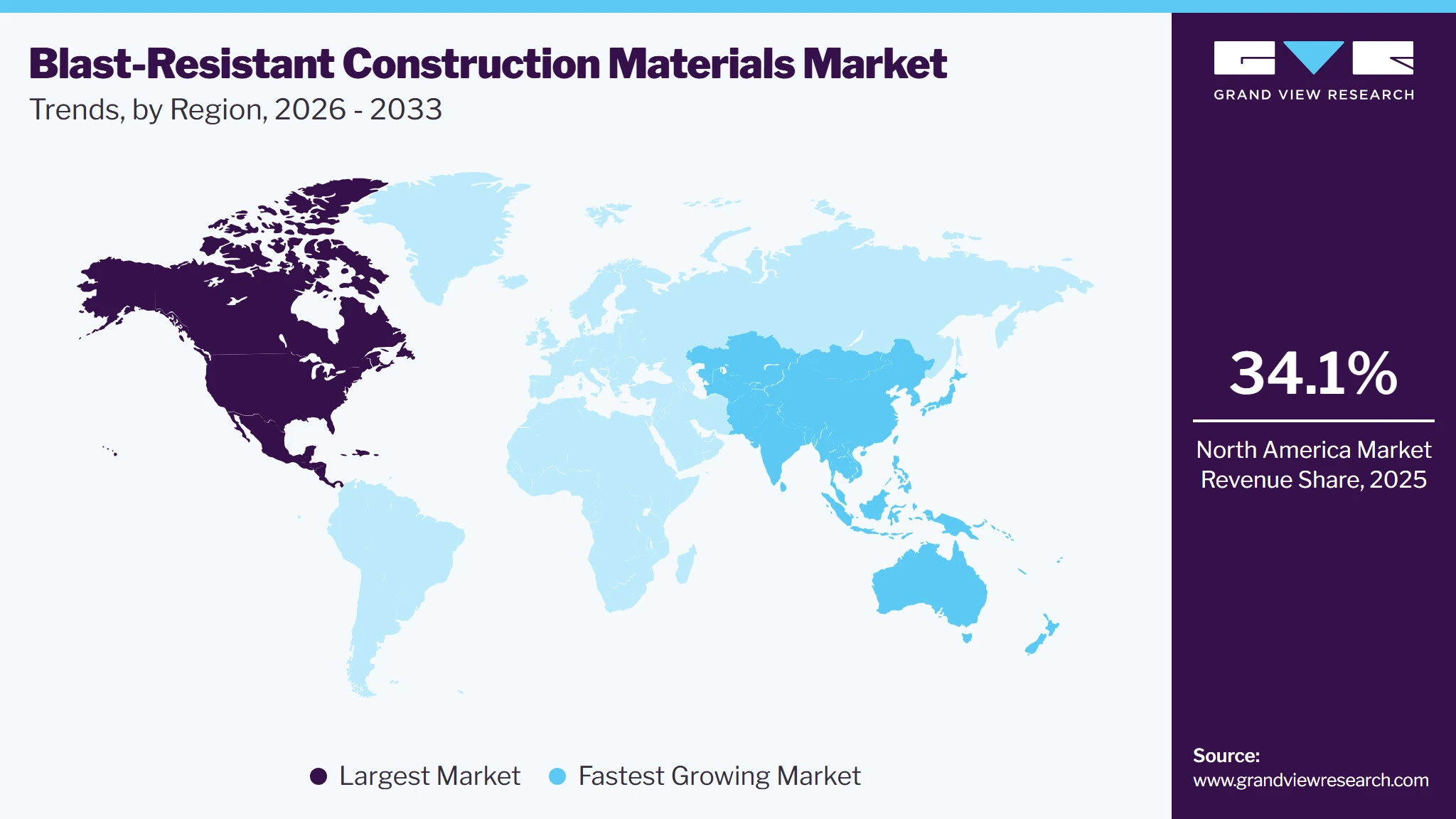
- Largest regional market: North America (34.1% revenue share, 2025)
- Fastest-growing regional market: Asia Pacific (highest CAGR, 2026-2033)
- By country: The U.S. held the largest market share in 2025
Market Size & Forecast
- Market size in 2025: USD 7.7 Billion
- Estimated market size in 2026: USD 8.3 Billion
- Projected market size by 2033: USD 14.4 Billion
- CAGR (2026-2033): 8.1%
GVR research-powered AIAsk Prism AI about the Blast-Resistant construction materials marketGet cited answers from GVR research on market growth, segments, regulations and forecasts.Start with✓ Source-linked answers ✓ Market-specific context ✓ Traceable figuresExplore Prism AI ↗The industrial sector represents another important source of demand, particularly across oil and gas facilities, petrochemical plants, chemical processing units, and energy infrastructure where explosive hazards may arise from industrial operations. These facilities require materials and structural designs capable of limiting damage to equipment, reducing the risk of structural failure, and protecting personnel. Increasing attention to operational continuity and the protection of high-value industrial assets supports demand for specialized blast-resistant construction solutions.
 To learn more about this report, Download Free Sample Report
Advancements in high-performance concrete, fiber-reinforced materials, energy-absorbing composites, and blast-resistant glazing are expanding the range of solutions available to construction companies and engineering providers. The integration of blast protection into building design is also creating opportunities for manufacturers supplying specialized materials and engineered structural systems. In addition, retrofitting existing buildings with protective glazing, reinforced structural components, and blast-resistant cladding is supporting demand from facility owners seeking to improve protection without undertaking complete reconstruction.
Market Dynamics
The blast-resistant construction materials market is influenced by security-related construction investments, industrial safety requirements, advances in protective materials, and the modernization of existing infrastructure. Demand depends on the level of blast protection required, the nature of the facility, applicable design standards, and project budgets. While growing emphasis on structural resilience supports the adoption of specialized materials, high costs and complex engineering requirements can constrain implementation. Retrofitting existing structures and developing advanced protective systems present opportunities for manufacturers and engineering providers.
Increasing investments in defense infrastructure and high-security facilities are supporting demand for blast resistant construction materials. Military installations, ammunition storage facilities, government buildings, diplomatic establishments, and defense research centers require protective structural systems to mitigate damage from explosive events. These projects incorporate reinforced concrete, high-strength steel, blast-resistant doors, protective glazing, and specialized wall systems to improve structural integrity and occupant safety. The need to protect strategic assets and maintain operational readiness encourages the use of materials engineered to withstand high-pressure loading and impact forces.
The modernization of existing security infrastructure further supports market growth by creating demand for advanced protective components and structural upgrades. Government agencies, defense contractors, and infrastructure developers increasingly incorporate blast mitigation into facility planning to address identified security risks. This supports demand for materials that combine blast resistance with durability, constructability, and long-term performance. The integration of reinforced structures, protective building envelopes, and energy-absorbing components also creates opportunities for suppliers offering specialized materials and engineered solutions.
Blast-resistant construction materials often involve higher procurement, installation, testing, and engineering costs than conventional construction materials. Specialized concrete formulations, high-strength steel assemblies, fiber-reinforced composites, and blast-resistant glazing require appropriate design specifications and quality controls. In addition, structural assessments, performance validation, and specialized installation practices can increase project timelines and overall expenditure. These cost considerations may limit adoption in projects with restricted budgets or lower perceived exposure to blast-related risks.
Retrofitting existing buildings and industrial facilities presents opportunities for manufacturers of blast resistant construction materials. Government offices, commercial buildings, energy facilities, and industrial plants can incorporate protective glazing, fiber-reinforced polymer strengthening, reinforced structural components, and blast-resistant cladding to improve protection without complete reconstruction. Targeted upgrades can help facility owners address vulnerable structural elements while managing capital expenditure and minimizing operational disruption. Suppliers offering retrofit-compatible products, tested protective systems, and technical engineering support can benefit from demand for infrastructure modernization.
Market Concentration & Characteristics
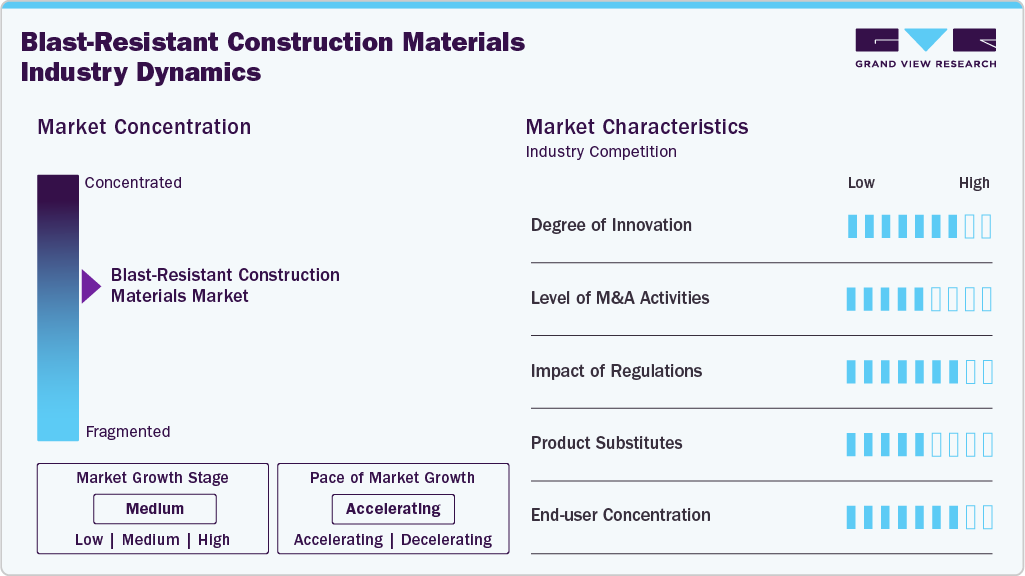
The blast-resistant construction materials market includes a combination of established construction-material manufacturers, advanced-material suppliers, specialty glazing producers, steel manufacturers, and engineering companies that provide blast-mitigation solutions. Competitive positioning depends on material performance, product certification and testing, engineering expertise, project references, manufacturing capabilities, and the ability to meet facility-specific protection requirements. While large materials companies benefit from established production networks and broad product portfolios, specialized suppliers compete through proprietary materials, engineered systems, and technical support.
 To learn more about this report, Download Free Sample Report
Substitutes for specialized blast-resistant construction materials include conventional reinforced concrete, standard structural steel, ordinary glazing, and traditional wall or cladding systems that may provide limited protection under certain blast conditions. Alternative protection approaches include increasing structural thickness, modifying building layouts, introducing standoff distances, installing protective barriers, and incorporating sacrificial structural components. However, these alternatives may not provide equivalent performance under severe blast loading and must be assessed against project-specific safety requirements.
Analyst Perspective
The blast resistant construction materials market is expected to benefit from increasing investments in defense infrastructure, critical facility protection, and industrial safety. Demand is likely to be supported by the adoption of high-performance concrete, specialized steel, fiber-reinforced composites, and blast-resistant glazing across government, defense, industrial, and critical infrastructure projects. Retrofitting existing facilities presents additional opportunities as asset owners seek to strengthen vulnerable structures without complete reconstruction. Manufacturers offering tested material solutions, application-specific engineering support, and cost-effective protective systems are likely to strengthen their competitive positioning.
Material Type Insights
The concrete segment held the highest revenue share of 37.0% in 2025, driven by its widespread use in protective structures, defense facilities, and critical industrial buildings. Reinforced and high-strength concrete provide substantial compressive strength, structural mass, and resistance to blast-induced loading. Its versatility allows engineers to incorporate specialized reinforcement and structural configurations to improve energy absorption and limit structural damage. Established construction practices and broad material availability further support its adoption across large-scale protective infrastructure projects.
The fiber-reinforced composites segment is expected to grow at a CAGR of 9.2% over the forecast period, as demand increases for lightweight, high-strength materials that enhance blast protection without adding excessive structural weight. Fiber-reinforced polymer systems can improve impact resistance, strengthen existing structural components, and help control fragmentation under blast loading. Their application in retrofitting concrete structures and reinforcing vulnerable building elements creates additional opportunities across defense, industrial, and commercial facilities. Continued material development and demand for efficient structural reinforcement are expected to support segment growth.
End Use Insights
The government & defense segment held the highest revenue share of 34.5% in 2025, supported by investments in military installations, secure government buildings, defense research facilities, and other security-sensitive infrastructure. These facilities require specialized construction materials to mitigate explosion-related risks and protect personnel, equipment, and strategic assets. Reinforced concrete, blast-resistant doors, protective glazing, and specialized wall systems are incorporated according to facility-specific security requirements. Ongoing infrastructure modernization and the need to strengthen protection at sensitive sites continue to support demand from this end-use segment.
The critical infrastructure segment is expected to grow at a CAGR of 9.0% over the forecast period, as governments and infrastructure operators place greater emphasis on protecting essential facilities against physical threats and operational disruptions. Power plants, energy installations, transportation facilities, utilities, and communication infrastructure may require blast-resistant materials to reduce structural vulnerability and safeguard essential operations. Investments in infrastructure resilience and upgrades to existing facilities create opportunities for reinforced structural systems, protective enclosures, and blast-resistant building components.
Application Insights
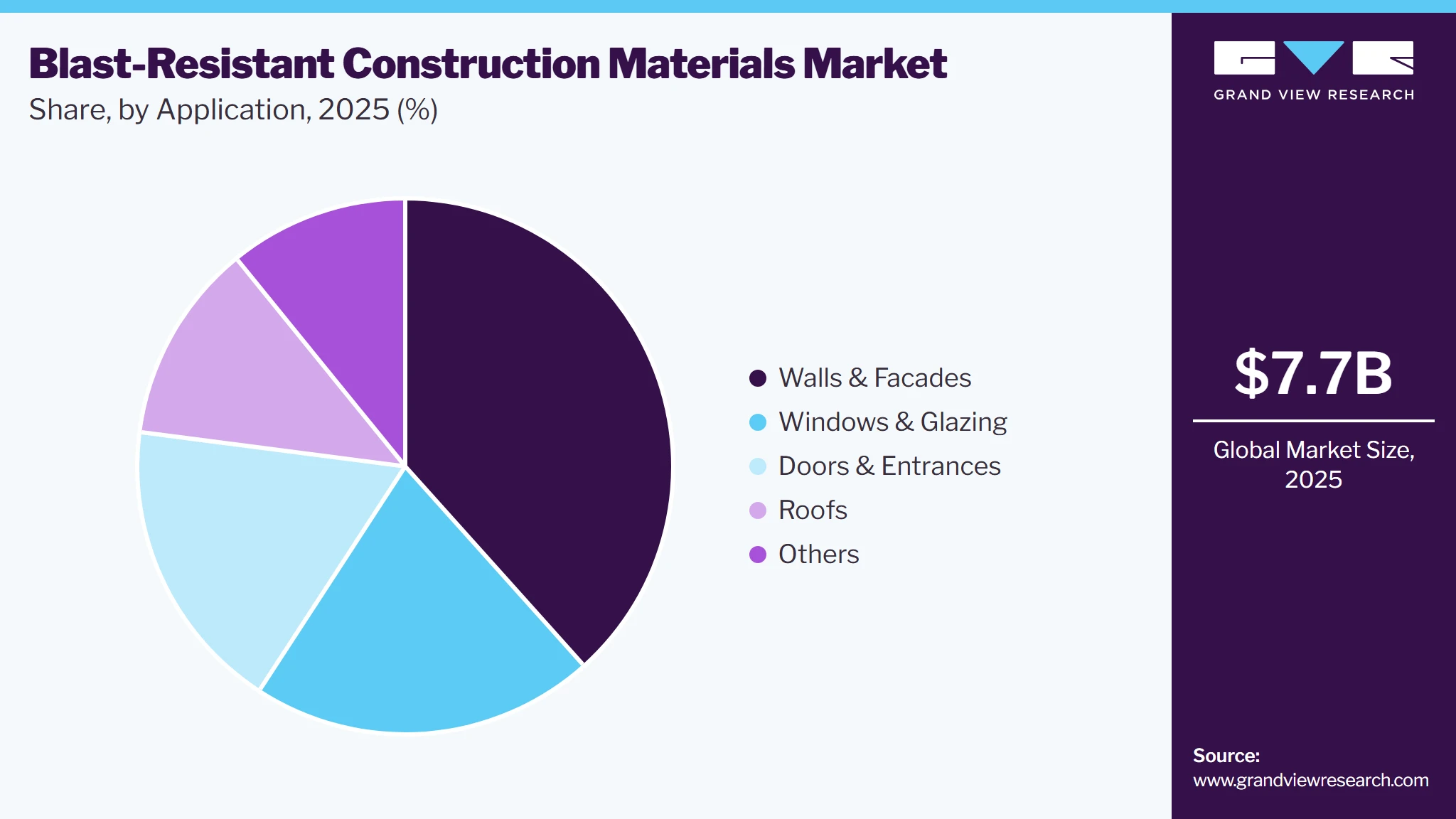
The walls & facades segment held the highest revenue market share of 38.4% in 2025, due to the importance of external and internal structural barriers in blast protection. Reinforced walls, protective cladding, and specialized facade systems help resist blast pressure, limit debris generation, and reduce damage to building interiors. These components are widely relevant to defense facilities, government buildings, industrial plants, and other structures requiring enhanced protection. Their integration into primary structural design and building-envelope systems supports demand across new construction and selected infrastructure upgrades.
 To learn more about this report, Download Free Sample Report
The windows & glazing segment is expected to grow at a CAGR of 8.6% over the forecast period, as building owners increasingly seek to reduce injuries and damage associated with glass breakage during blast events. Blast-resistant laminated glass, reinforced framing systems, and specialized glazing assemblies are designed to withstand pressure loads and limit hazardous fragmentation. Demand is supported by applications in government buildings, embassies, commercial facilities, and critical infrastructure where windows represent vulnerable points in the building envelope.
Regional Insights
North America dominated the global blast-resistant construction materials market and accounted for the largest revenue share of 34.1% in 2025, because of its defense infrastructure, established industrial base, and demand for security-sensitive facilities. Military installations, government buildings, energy infrastructure, petrochemical plants, and critical industrial assets create applications for reinforced concrete, structural steel, blast-resistant glazing, and protective building-envelope systems. The region's engineering and construction sectors also support the use of specialized design methods and performance-tested materials. Renovation projects provide opportunities to strengthen existing facilities without replacing entire structures.
 To learn more about this report, Download Free Sample Report
U.S. Blast-Resistant Construction Materials Market Trends
The United States benefits from demand associated with military installations, federal facilities, critical infrastructure, industrial plants, and high-security commercial buildings. Blast-resistant construction materials are relevant to projects requiring protection against explosive incidents, industrial accidents, and deliberate attacks. Reinforced structural systems, blast-resistant doors and windows, protective glazing, and specialized wall assemblies are used according to the risk profile and operational requirements of individual facilities. Industrial applications in oil and gas, petrochemicals, and energy infrastructure provide additional demand opportunities.
Asia Pacific Blast-Resistant Construction Materials Market Trends
Asia Pacific is supported by investments in defense infrastructure, government facilities, industrial development, and critical infrastructure protection. The region's expanding construction activity creates potential demand for protective materials in selected high-security and high-risk projects. Industrial facilities in the oil and gas, petrochemical, and energy sectors also represent relevant applications because of the need to mitigate explosion-related risks. Demand varies considerably across countries according to defense expenditure, industrial structure, security requirements, and the maturity of engineering capabilities.
China's large construction and industrial base provides potential demand for blast-resistant materials across defense facilities, government infrastructure, energy installations, and selected industrial projects. The country's steel, cement, glass, and advanced-material manufacturing capabilities support the supply of several material categories used in protective construction. Industrial applications may include petrochemical facilities, chemical processing plants, and other installations where explosion hazards require specialized structural protection. Adoption is influenced by project specifications, engineering requirements, and the need to maintain the operational integrity of critical assets.
Europe Blast-Resistant Construction Materials Market Trends
Europe's market is influenced by investment in defense facilities, critical infrastructure, industrial safety, and the protection of sensitive government and commercial assets. Blast-resistant materials may be specified for military installations, energy facilities, chemical plants, transportation infrastructure, and selected high-security buildings. The region's established construction-material industry supports the availability of reinforced concrete, structural steel, glazing, and engineered composite solutions. Demand also depends on the requirements of individual projects and the integration of protective design into broader building-safety strategies.
Germany's industrial and engineering capabilities support demand for specialized construction materials used in industrial facilities, critical infrastructure, and security-sensitive buildings. Chemical processing, manufacturing, energy installations, and other industrial environments may require blast-mitigation measures where explosion hazards are identified. Reinforced concrete, structural steel, protective cladding, and engineered glazing can form part of facility-specific protection systems. The country's established construction and materials industries provide a base for developing and supplying technically demanding building components.
Central and South America Blast-Resistant Construction Materials Market Trends
Central and South America present opportunities for blast-resistant construction materials in selected industrial, energy, mining, and security-sensitive infrastructure projects. Oil and gas facilities, petrochemical installations, mining operations, and chemical processing sites may require protective structural systems to mitigate explosion-related risks. Demand is influenced by industrial investment, facility operating conditions, project financing, and the availability of specialized engineering services. Conventional construction materials may be incorporated into blast-resistant designs through reinforcement, specialized detailing, and the addition of protective components.
Middle East & Africa Blast-Resistant Construction Materials Market Trends
The Middle East and Africa offer potential demand for blast-resistant construction materials across oil and gas facilities, petrochemical plants, defense installations, government buildings, and other critical infrastructure. The concentration of energy-related assets in parts of the Middle East creates applications for materials and structural systems designed to mitigate explosion risks and protect essential equipment. New industrial developments and facility modernization may require reinforced structures, blast-resistant enclosures, specialized glazing, and protective building components. In Africa, demand is more selective and depends on industrial development, infrastructure investment, security requirements, and project financing.
Key Blast-Resistant Construction Company Insights
Some of the key players operating in the market include ASSA ABLOY and Armortex
-
ASSA ABLOY is a global access solutions manufacturer offering specialized security doors and entrance systems, including blast-resistant doors designed for applications requiring enhanced protection in government, defense, and industrial facilities.
-
Armortex manufactures bullet-resistant, blast-resistant, and other security glazing and building protection products. Its portfolio includes specialized doors, windows, and composite systems for high-security commercial, government, and industrial applications.
Roots Group and Shelter & Bunker are some of the emerging market participants in the blast resistant construction materials market.
-
Roots Group provides specialized security solutions, including blast-resistant doors and associated assemblies designed for facilities requiring protection against explosion-related hazards. Its products serve security-sensitive industrial and infrastructure applications.
-
Shelter & Bunker specializes in protective construction products, including blast-resistant doors and reinforced door systems for bunkers, defense facilities, and other installations requiring enhanced structural protection.
Key Blast-Resistant Construction Companies
The following key companies have been profiled for this study on the blast-resistant construction market:
-
ASSA ABLOY
-
Armortex
-
Deansteel Manufacturing
-
Kawneer
-
Vetrotech Saint-Gobain
-
Chandra Lakshmi Safety Glass
-
Shelter & Bunker
-
Roots Group
-
Ecotone Systems
-
Blastotech
Competitive Benchmarking
Category
Operating Strategies
Competitive Edge
Weakness
Established Players (ASSA ABLOY, Armortex, Deansteel Manufacturing, Vetrotech Saint-Gobain, Chandra Lakshmi Safety Glass)
- Expand blast-resistant product portfolios across doors, glazing, windows, and protective building-envelope systems for defense, government, industrial, and critical infrastructure projects.
- Invest in product engineering, material performance, and testing to address varying blast-pressure ratings and project-specific safety requirements.
- Strengthen relationships with architects, engineering consultants, contractors, and government procurement agencies to secure specifications in large-scale construction projects.
- Established manufacturing capabilities and specialized product portfolios support supply to security-sensitive construction projects.
- Technical expertise in blast-resistant doors, laminated safety glass, and engineered protective systems enables solutions tailored to different threat levels and building requirements.
- Established customer relationships, project experience, and technical support capabilities can strengthen credibility in specification-driven procurement.
- Specialized blast-resistant products can involve high development, testing, certification, and installation costs.
- Product performance must be validated against project-specific blast conditions, which can increase engineering complexity and extend procurement cycles.
- Dependence on defense spending, industrial capital expenditure, and large construction projects can expose demand to budget fluctuations and project delays.
Emerging / Specialized Players (Kawneer, Shelter & Bunker, Roots Group, Ecotone Systems, Blastotech)
- Target specialized applications through blast-mitigating curtain walls, protective glazing assemblies, reinforced doors, and customized blast-resistant enclosures.
- Develop application-specific solutions for petrochemical facilities, power plants, military installations, and other high-risk industrial environments.
- Pursue project partnerships and specialized procurement opportunities by offering customized configurations, pressure-rated systems, and installation support.
- Focused product offerings enable customization for specific blast-protection requirements and building configurations.
- Specialization in particular components, such as protective doors, glazing, and industrial enclosures, supports targeted positioning in niche applications.
- Project-specific engineering and tailored product configurations can help address requirements that standard building components cannot meet.
- More specialized product portfolios may limit participation in projects requiring integrated protection across multiple building components.
- Dependence on specialized projects and procurement opportunities can result in uneven order flows and longer sales cycles.
- Competition with larger suppliers, project-specific testing requirements, and the need to demonstrate verified blast performance can create barriers to market expansion.
Recent Developments
-
In June 2025, Vetrotech announced a new VETROGARD high-security glass brochure covering solutions for physical attack, ballistic threats, and blast impact. It includes product specifications, testing methods, certification information, and applications across facades, partitions, and doors, supporting the specification of blast-resistant glazing systems.
-
In October 2025, Shelter & Bunker announced the production of heavy-duty blast-resistant steel doors made from 30 mm solid steel. The company highlighted reinforced frames, heavy-duty hinges, and a triple-arm locking system for shelters, technical rooms, and other protective facilities.
Blast-Resistant Construction Market Report Scope
Report Attribute
Details
Market size in 2025
USD 7.7 billion
Estimated market size in 2026
USD 8.3 billion
Projected market size by 2033
USD 14.4 billion
Growth rate
CAGR of 8.1% from 2026 to 2033
Base year for estimation
2025
Actual estimates/Historical data
2021 2024
Forecast period
2026 2033
Quantitative units
Revenue in USD million/billion and CAGR from 2026 to 2033
Report coverage
Revenue forecast, company ranking, competitive landscape, growth factors, and trends
Segments covered
Material type, application, end use, and region
Regional scope
North America; Europe; Asia Pacific; Central & South America; Middle East & Africa
Country scope
U.S.; Canada; Mexico; Germany; UK; France; Italy; Spain; China; Japan; India; South Korea; Brazil; Saudi Arabia
Key companies profiled
ASSA ABLOY, Armortex, Deansteel Manufacturing, Kawneer, Vetrotech Saint-Gobain, Chandra Lakshmi Safety Glass, Shelter & Bunker, Roots Group, Ecotone Systems, Blastotech
Customization scope
Free report customization (equivalent up to 8 analysts working days) with purchase. Addition or alteration to country, regional & segment scope.
Pricing and purchase options
Avail customized purchase options to meet your exact research needs. Explore purchase options
Global Blast-Resistant Construction Materials Market Report Segmentation
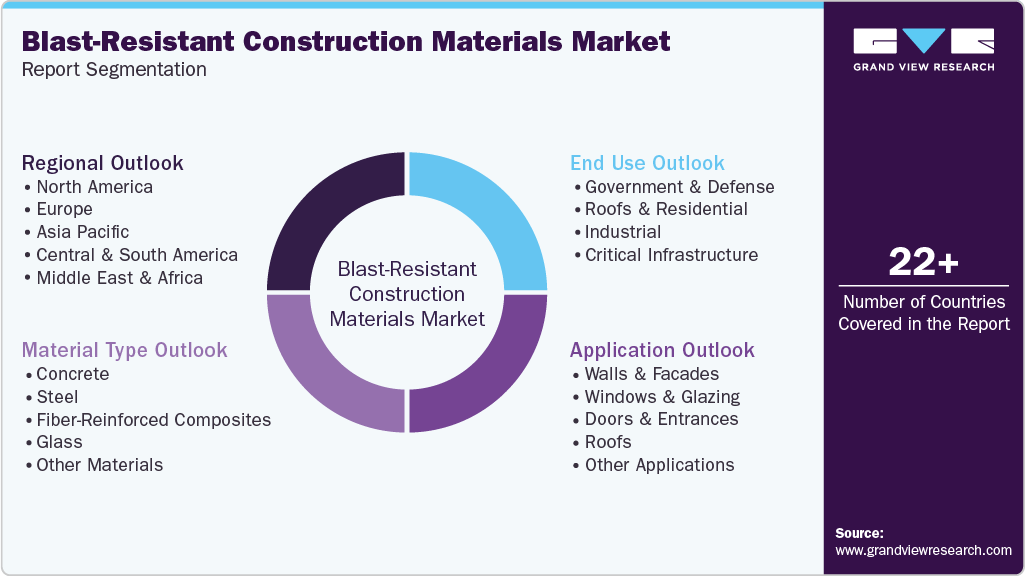
This report forecasts revenue growth at regional & country levels and provides an analysis on the industry trends in each of the sub-segments from 2021 to 2033. For this study, Grand View Research has segmented the blast-resistant construction materials market on the basis of material type, application, end use, and region:
 To learn more about this report, Download Free Sample Report
-
Material Type Outlook (Revenue, USD Million, 2021 - 2033)
-
Concrete
-
Steel
-
Fiber-Reinforced Composites
-
Glass
-
Other Materials
-
-
End Use Outlook (Revenue, USD Million, 2021 - 2033)
-
Government & Defense
-
Roofs & Residential
-
Industrial
-
Critical Infrastructure
-
-
Application Outlook (Revenue, USD Million, 2021 - 2033)
-
Walls & Facades
-
Windows & Glazing
-
Doors & Entrances
-
Roofs
-
Other Applications
-
-
Regional Outlook (Revenue, USD Million, 2021 - 2033)
-
North America
-
U.S.
-
Canada
-
Mexico
-
-
Europe
-
UK
-
Germany
-
France
-
Italy
-
Spain
-
-
Asia Pacific
-
China
-
Japan
-
India
-
South Korea
-
-
Central and South America
-
Brazil
-
-
Middle East and Africa
-
Saudi Arabia
-
-
Research Methodology
The blast-resistant construction materials market figures in this report are based on a proven research process that combines executive interviews with secondary research from proprietary databases, company filings, and recognized regulatory and institutional sources. Market size is built through value-chain sizing - reconciling supply-side and demand-side estimates - and triangulated with bottom-up and top-down approaches. Every estimate passes multiple levels of expert validation before publication, with each blast-resistant construction materials segment quantified using the revenue-capture definitions in the table below.
Segment Definition
Material Type
Revenue Capture Definition
Concrete
Revenue generated from blast-resistant concrete materials, including reinforced concrete, high-strength concrete, and specialized concrete formulations designed to withstand blast pressure, absorb impact energy, and reduce structural damage.
Steel
Revenue generated from blast-resistant steel materials, including high-strength structural steel, reinforced steel components, and specialized steel products designed to improve structural integrity and resistance to blast-induced loads.
Fiber-Reinforced Composites
Revenue generated from fiber-reinforced composite materials, including fiber-reinforced polymer (FRP) systems and composite panels incorporating glass, carbon, or other reinforcing fibers to enhance impact resistance, energy absorption, and structural reinforcement.
Glass
Revenue generated from blast-resistant glass products, including laminated glass, strengthened glazing, and specialized protective glazing systems designed to resist blast pressure, reduce fragmentation, and improve building-envelope protection.
Other Materials
Revenue generated from other blast-resistant construction materials, including protective coatings, advanced polymers, specialized masonry, energy-absorbing materials, and other materials designed to improve blast protection in buildings and infrastructure.
End Use
Revenue Capture Definition
Government & Defense
Revenue generated from blast-resistant construction materials supplied for government and defense facilities, including military installations, embassies, command centers, defense research facilities, and other security-sensitive government buildings requiring protection against explosion-related hazards.
Roofs & Residential
Revenue generated from blast-resistant construction materials used in commercial and residential buildings, including offices, hotels, retail facilities, residential developments, and other buildings requiring enhanced structural protection and occupant safety.
Industrial
Revenue generated from blast-resistant construction materials used in industrial facilities, including oil and gas plants, petrochemical facilities, chemical processing units, manufacturing plants, and other industrial establishments requiring protection against accidental explosions and blast-related structural damage.
Critical Infrastructure
Revenue generated from blast-resistant construction materials used in critical infrastructure facilities, including power plants, transportation facilities, utilities, communication infrastructure, and other essential installations requiring enhanced protection against blast events and operational disruptions.
Application
Revenue Capture Definition
Windows & Glazing
Revenue generated from blast-resistant window and glazing systems, including protective glass, laminated glazing, reinforced window assemblies, and associated materials designed to resist blast pressure and minimize glass fragmentation.
Walls & Facades
Revenue generated from blast-resistant wall and facade materials, including reinforced wall systems, protective cladding, composite panels, and facade components designed to withstand blast loading and limit structural damage and debris generation.
Doors & Entrances
Revenue generated from blast-resistant door and entrance materials, including reinforced steel doors, protective door assemblies, specialized frames, and associated components designed to withstand blast loads and secure building access points.
Roofs
Revenue generated from blast-resistant roofing materials and structural components designed to improve resistance to blast-induced pressure, reduce the risk of roof failure, and support structural protection in buildings and industrial facilities.
Other Applications
Revenue generated from blast-resistant construction materials used in applications other than walls and facades, windows and glazing, doors and entrances, and roofs, including structural columns, floor systems, internal partitions, protective barriers, and specialized enclosures.
Estimation Model
Layer Name
Key Question
Description
Parent Market Analysis
What is the overall size and growth outlook of the global construction materials market?
The estimation begins with the broader construction materials market, analyzing construction activity, infrastructure investments, defense spending, industrial development, and commercial construction to establish the addressable market for blast-resistant construction materials.
Blast-Resistant Materials Penetration Analysis
What proportion of the overall construction materials market is represented by blast-resistant construction materials?
This layer estimates the penetration of blast-resistant concrete, steel, fiber-reinforced composites, glass, and other specialized materials based on blast-protection requirements, material performance, structural design specifications, and adoption across security-sensitive construction projects.
Regional & Application Demand Assessment
Which regions and applications contribute the highest demand for blast-resistant construction materials?
Demand is assessed across major regions based on defense infrastructure investments, critical infrastructure development, industrial safety requirements, and security-sensitive construction. Application-level demand is evaluated across walls and facades, windows and glazing, doors and entrances, roofs, and other structural applications, with further assessment across government and defense, commercial and residential, industrial, and critical infrastructure end uses.
Company Revenue Validation & Market Forecasting
How is the final market size validated and forecast?
Market estimates are validated using company revenues, product portfolios, manufacturing capabilities, blast-resistant material offerings, project awards, facility upgrades, partnerships, and secondary research. Bottom-up and top-down approaches are triangulated to develop market estimates and forecasts, accounting for material-specific demand, application adoption, regional trends, and end-use requirements.
Delivered Customizations
This report has been delivered with the following In-depth customizations
Client Request
Customization Delivered
Value Adds
Material Performance & Competitive Benchmarking
Comparative assessment of blast-resistant concrete, steel, fiber-reinforced composites, glass, and other protective materials based on blast-load resistance, energy absorption, structural integrity, fragmentation control, durability, and suitability across different threat levels.
Enables stakeholders to compare material performance, identify competitive advantages, evaluate material selection opportunities, and align product portfolios with the protection requirements of security-sensitive construction projects.
Application-Specific Blast Protection Assessment
Detailed assessment of blast-resistant material requirements across walls and facades, windows and glazing, doors and entrances, and roofs. The analysis considers pressure resistance, debris mitigation, structural reinforcement, building-envelope protection, and integration with existing construction systems across defense, commercial, and industrial facilities.
Helps companies identify high-potential applications, prioritize product development, evaluate demand across building components, and develop solutions aligned with project-specific blast-protection requirements.
Retrofitting & Critical Infrastructure Protection
Assessment of demand for blast-resistant upgrades across existing government buildings, defense facilities, industrial plants, and critical infrastructure. Coverage includes structural strengthening, protective glazing replacement, reinforced cladding, fiber-reinforced polymer retrofits, and modular protection systems designed to improve resilience while limiting reconstruction requirements.
Supports the identification of retrofit-driven revenue opportunities, enables suppliers to target infrastructure modernization projects, and helps companies develop cost-effective protective solutions that address operational continuity, installation constraints, and long-term structural resilience.
Frequently Asked Questions About This Report
The global blast-resistant construction materials market size was valued at USD 7.7 billion in 2025 and is estimated at USD 8.3 billion for 2026.
The global blast-resistant construction materials market is expected to grow at a CAGR of 8.1% from 2026 to 2033, reaching USD 14.4 billion by 2033.
The walls & facades segment accounted for the highest revenue share of 38.4% in 2025, due to the extensive use of reinforced walls and protective facade systems in blast-resistant buildings to withstand pressure loads and minimize structural damage.
Key factors driving the blast-resistant construction materials market include rising defense and security infrastructure investments, increasing demand for protection of critical infrastructure and industrial facilities, stringent building safety requirements, and growing adoption of advanced materials for blast mitigation and structural reinforcement.
Some key players in the blast-resistant construction materials market include ASSA ABLOY, Armortex, Deansteel Manufacturing, Kawneer, Vetrotech Saint-Gobain, Chandra Lakshmi Safety Glass, Shelter & Bunker, Roots Group, Blastotech, and Ecotone Systems.
The critical infrastructure segment is the fastest-growing end use in the blast-resistant construction materials market.
The windows & glazing segment is the fastest growing application in the blast-resistant construction materials market.
The concrete segment accounted for the largest revenue share of 37.0% in 2025, due to its high compressive strength, structural durability, and widespread use in blast-resistant buildings and critical infrastructure.
North America held the highest revenue market share of 34.1% in 2025, due to substantial defense spending, stringent security requirements, and significant investments in protecting critical infrastructure and government facilities from blast-related threats.
About the Author(s)
Advanced Interior Materials Research Team
Advanced Materials · Advanced Interior MaterialsThis report was authored by the advanced interior materials research team at Grand View Research - comprising two research analysts, one senior research analyst, and one industry expert - with specialized expertise in the advanced interior materials segment of the advanced materials industry. All findings are based on proprietary advanced materials databases, executive interviews, and regulatory analysis, subject to internal peer review prior to publication.
Last Updated:
Speak to Analyst

Customize this report to your needs - add regions, segments, or data points, with 20% free customization.
Or view our licence options:


ISO 9001:2015 & 27001:2022 Certified
We are GDPR and CCPA compliant! Your transaction & personal information is safe and secure. For more details, please read our privacy policy.


