
- Home
- »
- Advanced Interior Materials
- »
-
High Strength Steel Market Size & Share Report, 2026-2033GVR Report cover

High Strength Steel Market (2026 - 2033) Size, Share & Trends Analysis Report By Type (High Strength Low Alloy, Transformation Induced Plasticity), By Application (Automotive, Construction, Mining Machinery, Aviation & Marine), By Region, And Segment Forecasts
Market Size, 2025
$40.7BMarket Estimate, 2026
$42.9BMarket Forecast, 2033
$78.4BCAGR, 2026–2033
7.0%High Strength Steel Market Summary
The global high strength steel market size was valued at USD 40.7 billion in 2025 and is projected to grow from USD 42.9 billion in 2026 to USD 78.4 billion by 2033, at a CAGR of 9.0% from 2026 to 2033.Asia Pacific dominated the high strength steel market with the largest market revenue share of over 48.0% in 2025.High-strength steel is a type of steel engineered to deliver significantly higher tensile and yield strength than conventional steel, enabling lighter and more durable structures and components.
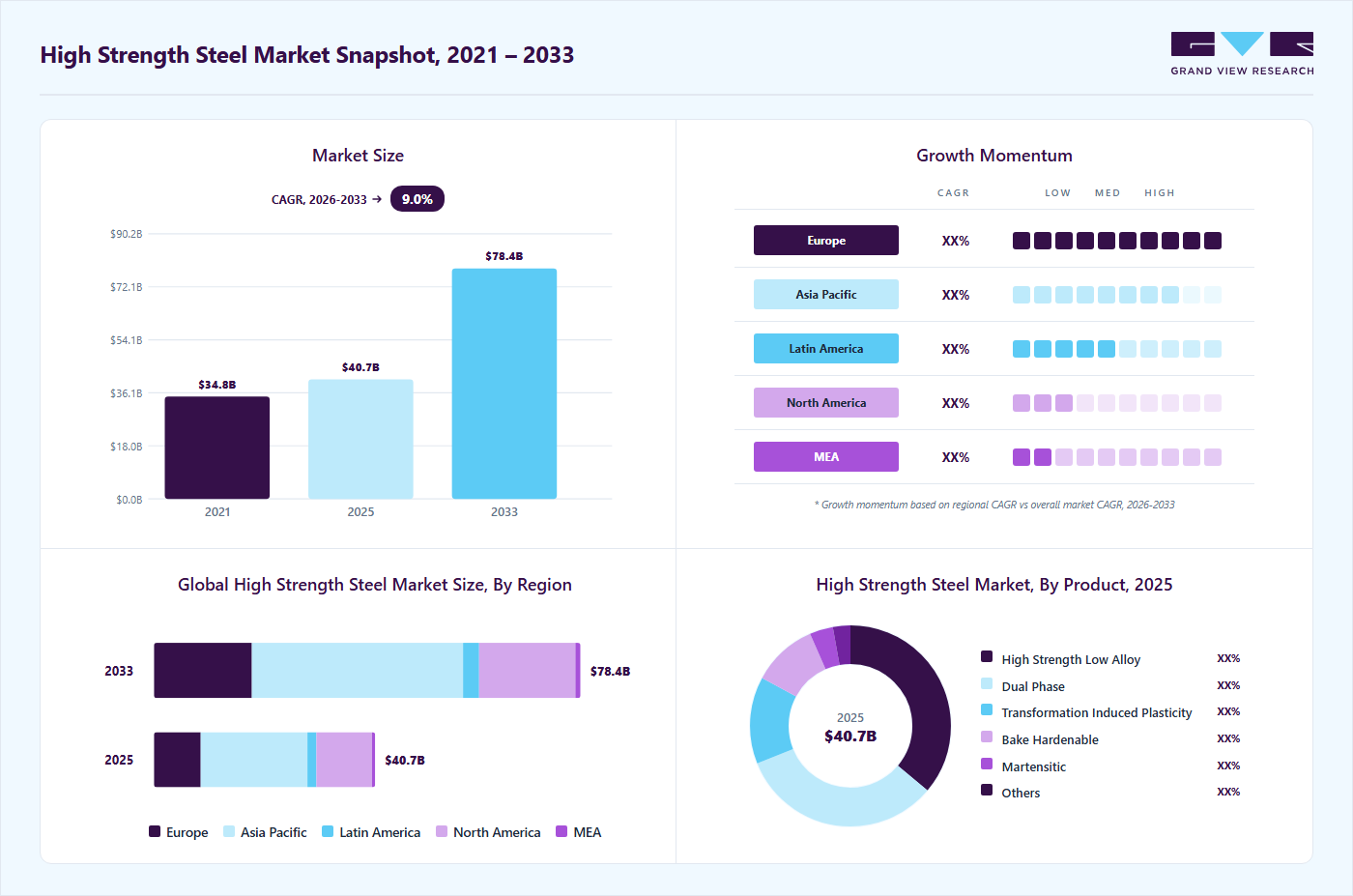 Source: Grand View Research, IR Documents, Primary Interviews, Paid DatabasesTo learn more about this report,
 Download Free Sample Report
 Key Market Trends & Insights
- By type: High strength low alloy segment segment dominated the market, with a revenue share of 36.5% in 2025.
- By application: Automotive segment held the largest market share of 81.1% in 2025.
Regional Highlights
- Largest regional market: Asia Pacific (48.0% revenue share, 2025)
- Fastest-growing regional market: Europe (highest CAGR, 2026-2033)
Market Size & Forecast
- Market size in 2025: USD 40.7 Billion
- Estimated market size in 2026: USD 42.9 Billion
- Projected market size by 2033: USD 78.4 Billion
- CAGR (2026-2033): 9.0%
Three ways to get this report
Buy it, customize it, or ask a question.Ask an Analyst
Analyst response in 1 business day
- AccessReport author, directly
- Reply timeWithin 1 working day
- No sales callDirect answer only
- FormatEmail reply
- CostFree, no cost
Get the Full Report
What the study covers
- FormatsPDF · Excel · Dashboard
- Timeline2026–2033 annual, 2025 base
- Coverage20+ countries, 5 regions
- Companies10+ key players profiled
Customize the Report
20% free customization
- IncludeCountries, segments, points
- TailorTo your product definition
- ExtendDeeper competitor detail
- OrA fully bespoke study
- Turnaround5–10 working days
The market is on a robust growth trajectory, driven by a convergence of regulatory, industrial, and technological factors. The material's unique ability to offer superior strength while enabling significant weight reduction has made it indispensable across multiple sectors. The primary catalysts for this expansion can be categorized into five key areas: automotive lightweighting, infrastructure development, advancements in manufacturing, sustainability initiatives, and the expansion of the electric vehicle market.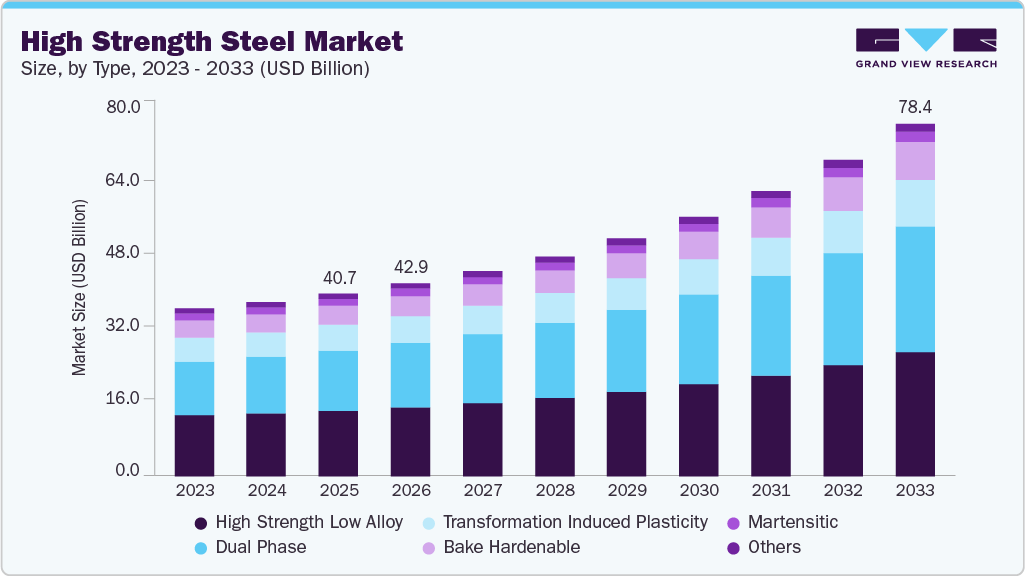 To learn more about this report, Download Free Sample Report
 The most significant growth driver for the high strength steel market is the automotive industry’s strong focus on lightweighting to comply with stringent global fuel efficiency and emissions regulations. Automakers are increasingly adopting high strength steel due to its high strength-to-weight ratio, enabling thinner and lighter vehicle components without compromising structural integrity. This directly improves fuel economy, reduces CO₂ emissions, and enhances crashworthiness through superior energy absorption and passenger protection.
Beyond automotive, rising demand from construction and infrastructure is accelerating market growth, as high strength steel offers superior load-bearing capacity and durability for bridges, high-rise buildings, and industrial structures. It supports longer spans, improved structural efficiency, and better seismic resistance, making it ideal for large-scale infrastructure development and renewal projects globally.
Technological advancements in steel manufacturing, including hot stamping and improved metallurgical processes, are further boosting adoption by enabling the production of complex, ultra-high-strength components with enhanced ductility and formability. Additionally, the growing emphasis on sustainability is supporting market expansion, as steel is fully recyclable and helps reduce material consumption.
Moreover, the rapid proliferation of electric vehicles is creating a powerful new wave of demand for high strength steel. In 2025, global EV sales reached approximately 20.7 million units, marking a 20% increase from the previous year and underscoring the market's strong momentum despite regional policy shifts. In electric vehicles, weight reduction is paramount because a lighter vehicle directly extends the driving range of a battery, a critical factor for consumer adoption.
Drivers, Opportunities & Restraints
High strength steel market growth is primarily driven by rising demand from the automotive industry for lightweight yet crash-resistant materials to meet stringent fuel efficiency and emission regulations. Automakers are increasingly adopting high strength steel in body structures, chassis, and safety components as it provides an optimal balance of strength, formability, and cost compared to alternatives like aluminum and composites. In addition, growing investments in infrastructure development, bridges, high-rise buildings, and industrial construction are accelerating demand, as high strength steel enables reduced material usage while maintaining structural integrity.
The market presents strong opportunities through the expanding electric vehicle sector, where reducing vehicle weight is critical for improving battery performance and driving range. Increasing deployment of renewable energy infrastructure such as wind turbines, transmission towers, and heavy-duty power equipment is further creating demand for specialized high strength steel grades with enhanced fatigue resistance and durability. Moreover, continuous advancements in metallurgical processes and alloying technologies are enabling manufacturers to develop advanced high strength steels with better ductility, weldability, and corrosion resistance, widening adoption across aerospace, shipbuilding, railways, and heavy machinery applications.
However, the market faces restraints due to the high production and processing costs associated with advanced high strength steel grades, which can limit adoption in price-sensitive industries. Complex manufacturing requirements, including specialized forming, welding, and heat-treatment processes, create challenges for end users lacking advanced fabrication capabilities.
Type Insights
High strength low alloy (HSLA) steel is witnessing strong growth within the high strength steel market due to its superior balance of strength, ductility, and weldability compared to conventional carbon steels. Industries such as automotive and transportation are increasingly adopting HSLA steels to achieve vehicle lightweighting without compromising structural integrity, directly supporting compliance with stringent fuel efficiency and emission regulations.
Dual phase (DP) steel is experiencing strong growth in the high strength steel market primarily due to its excellent combination of high tensile strength and superior formability, making it highly suitable for complex-shaped automotive components. The automotive industry is a key driver, as manufacturers increasingly use DP steels in structural and safety-critical parts such as door beams, pillars, crash boxes, and reinforcements to enhance crash performance while reducing vehicle weight. This demand is directly supported by stringent fuel efficiency standards and emission reduction targets, pushing automakers toward lightweight materials without compromising passenger safety.
Application Insights
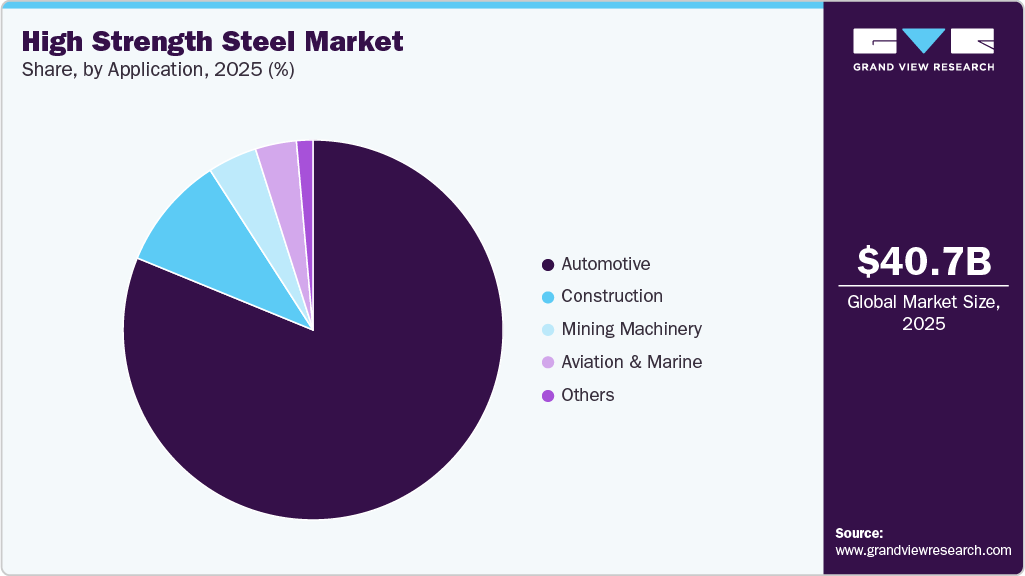
Automotive segment dominated with a revenue share of 81.1% in 2025.The increasing focus on lightweighting to improve fuel efficiency and reduce vehicle emissions is anticipated to proliferate the automotive segment. Automakers are widely adopting high strength steel in body-in-white structures, chassis systems, and safety-critical components to reduce overall vehicle weight while maintaining high crash resistance and structural stability.
 To learn more about this report, Download Free Sample Report
 The construction segment is anticipated to register the fastest CAGR over the forecast period due to increasing infrastructure development and rising demand for durable, high load-bearing materials. Governments across emerging and developed economies are investing heavily in bridges, highways, metro rail networks, airports, and commercial buildings, which is accelerating the consumption of high strength steel for structural frameworks and reinforcement applications.
Regional Insights
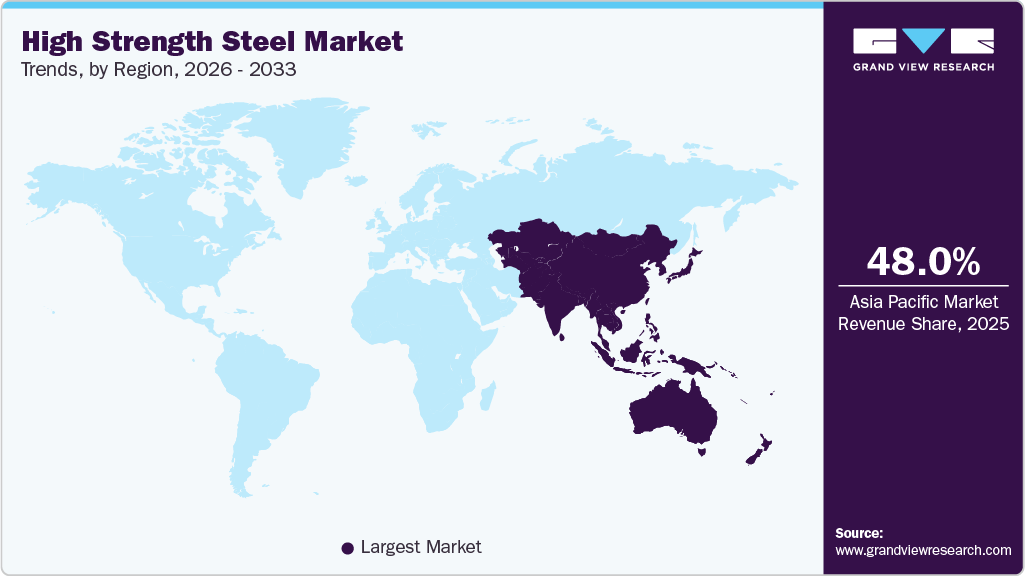
Asia Pacific accounted for the largest market revenue share of over 48.0% in 2025. Rapid urbanization and large-scale infrastructure projects across emerging economies in the region are fuelling demand. Governments are investing trillions into "smart cities" and resilient transportation networks that require materials with superior yield strength and earthquake resistance. In India, the National Infrastructure Pipeline is a key catalyst, driving the use of HSS in high-rise buildings and long-span bridges to reduce the overall weight of structures while maintaining durability. A notable example is the use of high-strength hollow sections in major Asian stadium projects and high-speed rail networks, such as the Shinkansen in Japan, where the material's high strength-to-weight ratio allows for more efficient, aerodynamic, and durable designs.
 To learn more about this report, Download Free Sample Report
 North America High Strength Steel Market Trends
In North America, the market is undergoing a significant expansion, primarily fueled by federal infrastructure legislation and the revitalization of domestic manufacturing. Legislative pillars like the Infrastructure Investment and Jobs Act (IIJA) and the Inflation Reduction Act (IRA) have earmarked billions for the modernization of the U.S. power grid, bridges, and transportation networks. These projects require materials with exceptional load-bearing capacity and durability to withstand extreme weather and seismic activity. For instance, more than 40% of U.S. bridges are currently classified as needing repair or replacement; as a result, domestic producers like Cleveland-Cliffs and Nucor are seeing a surge in demand for HSS plates and structural beams that allow for longer spans and reduced material weight in massive civil engineering projects.
In the U.S., the growth is currently dictated by a mix of federal industrial policy and the unique demands of the domestic energy transition. The use of High-Performance Steel (HPS 70W) has become standard for new bridge spans in states like Pennsylvania and New York, as it offers superior atmospheric corrosion resistance and allows for thinner, lighter girders that reduce overall construction costs and long-term maintenance.
Europe High Strength Steel Market Trends
In Europe, the market is characterized by the convergence of decarbonization mandates and the rapid expansion of offshore renewable energy. Under the European Green Deal and the "Fit for 55" legislative package, European industries are facing escalating carbon prices, which has spurred a massive shift toward "Green Steel" production. High-strength steel is at the heart of this transition because its high performance allows for material savings, directly lowering the overall carbon footprint of end products. For example, major steelmakers such as SSAB and ArcelorMittal are partnering with automotive giants like Volvo and Mercedes-Benz to supply fossil-free, high-strength steels.
Latin America High Strength Steel Market Trends
In Latin America, the market is driven by the region's expanding mining infrastructure and its role as a global hub for heavy vehicle manufacturing. Latin America is a top producer of critical minerals like lithium and copper; the extraction of these materials requires specialized "yellow goods", such as high-capacity dump trucks and crushing equipment, that utilize wear-resistant HSS to endure abrasive environments. For example, in Chile and Peru, the demand for high-strength plates for mining machinery is a significant market pillar. Furthermore, the region's automotive sector, particularly in Brazil and Mexico, is shifting toward AHSS to meet global export standards.
Key High Strength Steel Company Insights
Some of the key players operating in the market include ArcelorMittal, JSW Steel, and others
-
ArcelorMittal is a Luxembourg-based multinational steel and mining company ranked among the largest global steel producers, with integrated operations spanning steelmaking, mining, and value-added product facilities across Europe, the Americas, and beyond. It produces a wide spectrum of steel products, including flat and long steels for automotive, construction, and industrial applications, and focuses on innovation toward efficient, stronger steels with lower carbon emissions.
-
JSW Steel is a leading integrated steel manufacturer in India with a global presence in over 100 countries and a diversified product mix that serves construction, automotive, infrastructure, and engineering sectors. Known for its large-scale production facilities such as the Vijayanagar works, the company produces flat and long steel products, coated and value-added steels and has been an early mover in manufacturing advanced high strength steel products for automotive and infrastructure applications.
Key High Strength Steel Companies:
The following key companies have been profiled for this study on the high strength steel market.
- ArcelorMittal
- JSW
- NIPPON STEEL CORPORATION
- Nucor Corporation
- POSCO
- SAIL
- SSAB
- Tata Steel
- ThyssenKrupp AG
- voestalpine AG
Recent Development
-
In July 2025, ArcelorMittal Nippon Steel India (AMNS India) advanced its USD 7.2 billion expansion at the Hazira plant in Gujarat by progressing toward commissioning a new continuous galvanising line (CGL) capable of producing Advanced High-Strength Steel (AHSS) up to 1180 MPa for automotive applications, making it the first in India to achieve this strength level and supporting national self-reliance goals.
High Strength Steel Market Report Scope
Report Attribute
Details
Market definition
Market size represents the total annual revenue generated from sale of high strength steel used for different applications.
Market size in 2025
40.7 Billion
Estimated market size in 2026
USD 42.9 billion
Projected market size by 2033
USD 78.4 billion
Growth rate
CAGR of 9.0% from 2026 to 2033
Base year for estimation
2025
Historical data
2021 - 2024
Forecast period
2026 - 2033
Quantitative units
Revenue in USD billion/million, volume in kilotons, and CAGR from 2026 to 2033
Report coverage
Revenue & volume forecast, competitive landscape, growth factors, and trends
Segments covered
Type, application, region
Regional scope
North America; Europe; Asia Pacific; Latin America; Middle East & Africa
Country scope
U.S.; Canada; Mexico; Germany; Italy; France; Russia; China; India; Japan; Brazil; Saudi Arabia; UAE
Key companies profiled
ArcelorMittal; Tata Steel; voestalpine AG; POSCO; SSAB; ThyssenKrupp AG; Nucor Corporation; SAIL; NIPPON STEEL CORPORATION; JSW
Customization scope
Free report customization (equivalent up to 8 analysts working days) with purchase. Addition or alteration to country, regional & segment scope.
Pricing and purchase options
Avail customized purchase options to meet your exact research needs. Explore purchase options
Global High Strength Steel Market Report Segmentation
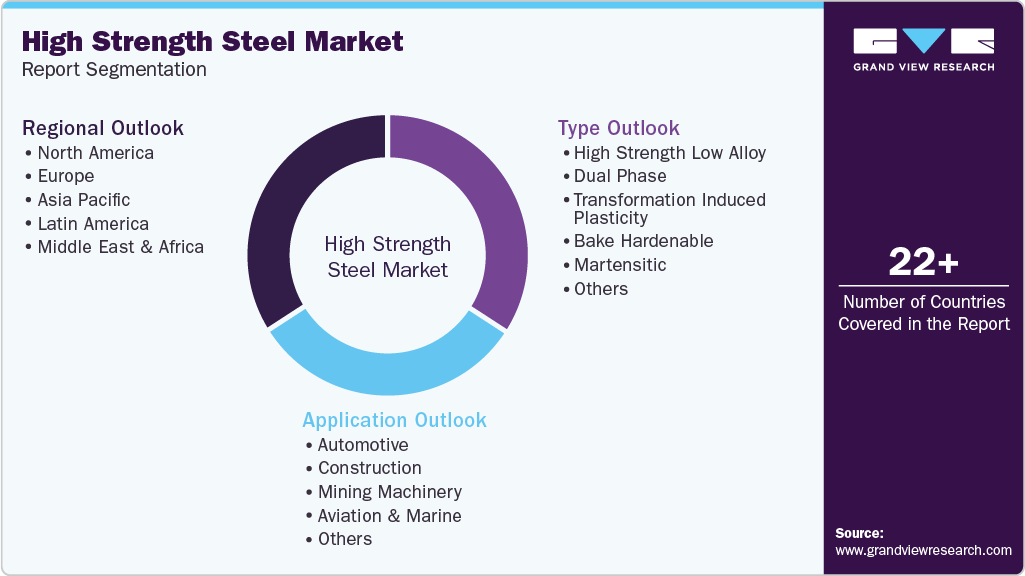
This report forecasts revenue and volume growth at global, regional, and country levels and provides an analysis of the latest industry trends in each of the sub-segments from 2021 to 2033. For this study, Grand View Research has segmented the global high strength steel market report on the basis of type, application, and region:
 To learn more about this report, Download Free Sample Report
 -
Type Outlook (Volume, Kilotons; Revenue, USD Million, 2021 - 2033)
-
High Strength Low Alloy
-
Dual Phase
-
Transformation Induced Plasticity
-
Bake Hardenable
-
Martensitic
-
Others
-
-
Application Outlook (Volume, Kilotons; Revenue, USD Million, 2021 - 2033)
-
Automotive
-
Construction
-
Mining Machinery
-
Aviation & Marine
-
Others
-
-
Regional Outlook (Volume, Kilotons; Revenue, USD Million, 2021 - 2033)
-
North America
-
U.S.
-
Canada
-
Mexico
-
-
Europe
-
Germany
-
Italy
-
France
-
Russia
-
-
Asia Pacific
-
China
-
India
-
Japan
-
-
Latin America
-
Brazil
-
-
Middle East & Africa
-
Saudi Arabia
-
UAE
-
-
Frequently Asked Questions About This Report
The global high strength steel market is expected to grow at a compound annual growth rate of 9.0% from 2026 to 2033 to reach USD 78.4 billion by 2033.
High strength low alloy segment segment dominated the market, with a revenue share of 36.5% in 2025.
The key factor driving the growth of the global high strength steel market is the rising demand for lightweight, high-performance materials in automotive and construction applications to improve fuel efficiency, reduce emissions, and enhance structural strength.
The global high strength steel market size was estimated at USD 40.67 billion in 2025 and is expected to reach USD 42.95 billion in 2026.
Some of the key players of the global high strength steel market are ArcelorMittal; Tata Steel; voestalpine AG; POSCO; SSAB; ThyssenKrupp AG; Nucor Corporation; SAIL; NIPPON STEEL CORPORATION; JSW, and others.
Asia Pacific dominated the high strength steel market with the largest market revenue share of over 48.0% in 2025.
Europe is the fastest-growing region over the forecast period.
Automotive segment held the largest market share of 81.1% in 2025
About the Author(s)
Advanced Interior Materials Research Team
Advanced Materials · Advanced Interior MaterialsThis report was authored by the advanced interior materials research team at Grand View Research - comprising two research analysts, one senior research analyst, and one industry expert - with specialized expertise in the advanced interior materials segment of the advanced materials industry. All findings are based on proprietary advanced materials databases, executive interviews, and regulatory analysis, subject to internal peer review prior to publication.
Last Updated:
Speak to Analyst

Customize this report to your needs - add regions, segments, or data points, with 20% free customization.
Or view our licence options:


ISO 9001:2015 & 27001:2022 Certified
We are GDPR and CCPA compliant! Your transaction & personal information is safe and secure. For more details, please read our privacy policy.


