
- Home
- »
- Next Generation Technologies
- »
-
Blockchain Technology Market Size Report, 2026-2033GVR Report cover
![Blockchain Technology Market (2026 - 2033)Report]()
Blockchain Technology Market (2026 - 2033)
Size, Share & Trends Analysis Report By Type (Public Cloud, Private Cloud), By Offering (Platform, Services), By Component, By Application (Application & Solution, Middleware), By Enterprise Size, By End-use, By Region, And Segment Forecasts
- Report Summary
- Table of Contents
- Segmentation
- Methodology
- Download FREE Sample
-
 Download Sample Report
- Buy Now
Market Size, 2025
$57.7BMarket Estimate, 2026
$108.3BMarket Forecast, 2033
$9,055.5BCAGR, 2026–2033
88.2%Blockchain Technology Market Summary
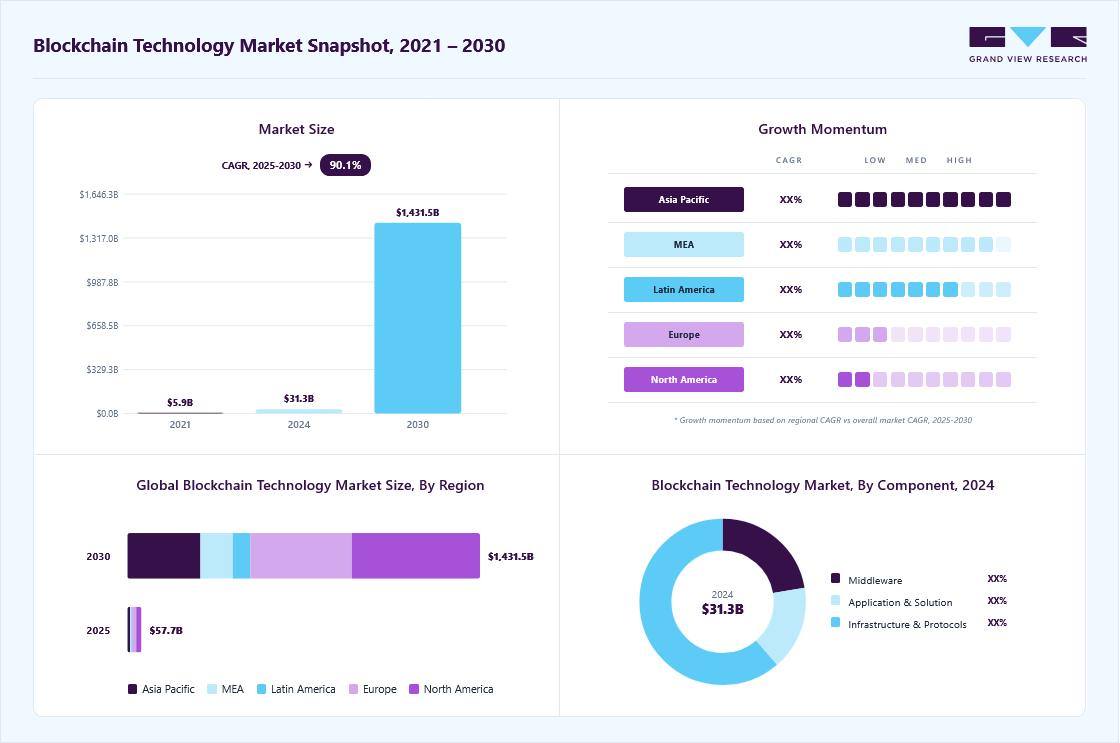
The global blockchain technology market size was valued at USD 57.7 billion in 2025 and is projected to grow from USD 108.3 billion in 2026 to USD 9,055.5 billion by 2033, growing at a CAGR of 88.2% from 2026 to 2033. The market in North America dominated with a revenue share of 37.2% in 2025. The escalating demand for secure and transparent transactions across many industries is driving the market growth.
Key Market Trends & Insights
- Based on type: The public cloud segment led the market with the largest revenue share of 61.8% in 2025.
- Based on component: The infrastructure & protocols segment led the market with the largest revenue share of 61.1% in 2025.
- Based on offering: The platform segment led the market with the largest revenue share of64.7% in 2025.
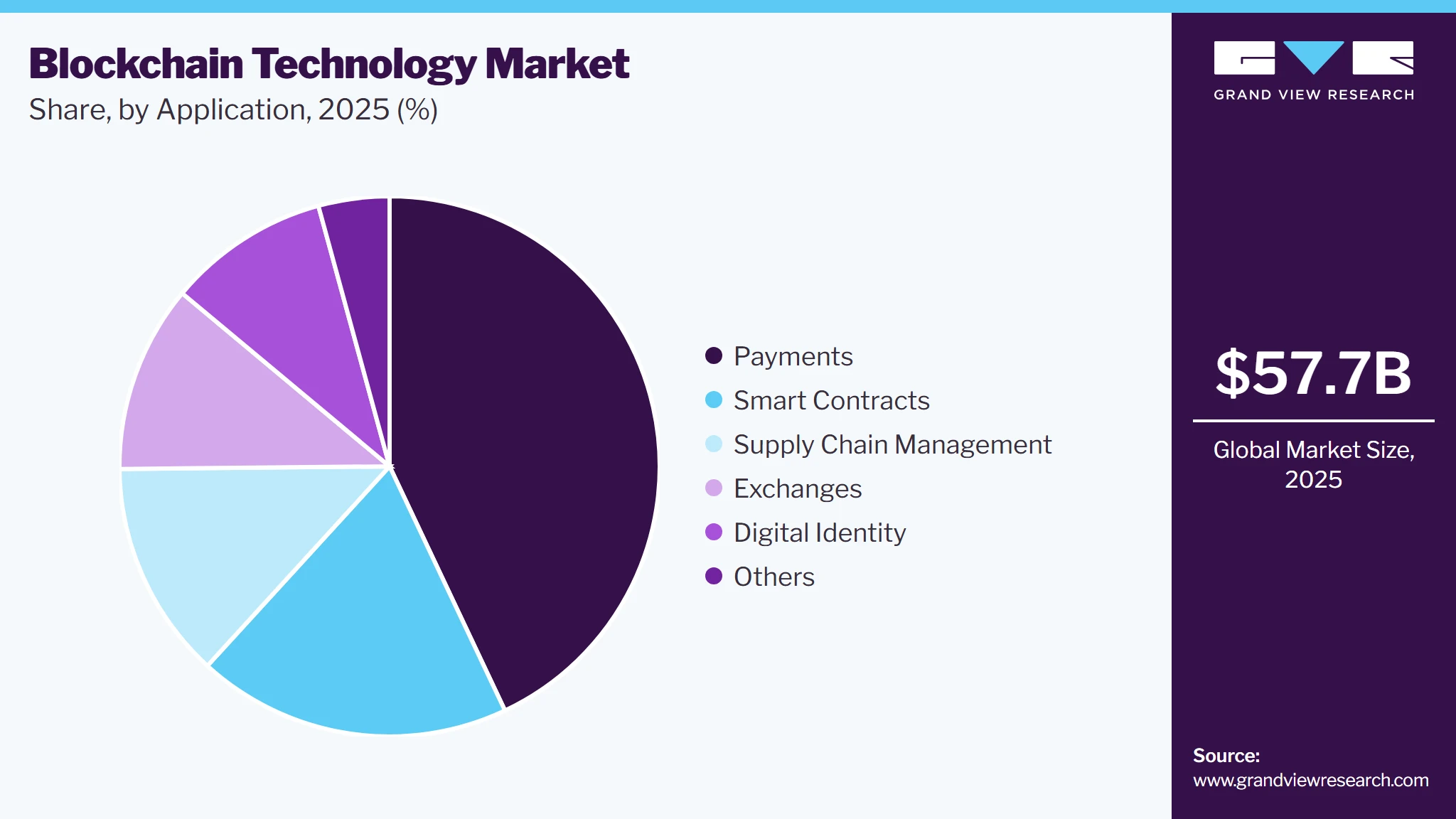
- Based on application: The payments segment led the market with the largest revenue share of 43.0% in 2025.
- Based on enterprise size: The large enterprises segment led the market with the largest revenue share of 67.1% in 2025.
- Based on end use: The financial services segment led the market with the largest revenue share of 28.1% in 2025.
Regional Highlights
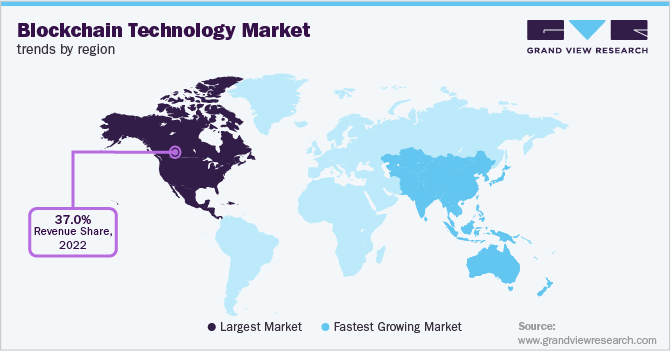
- Largest regional market: North America (37.2% revenue share, 2025)
- Fastest-growing regional market: Asia Pacific (highest CAGR, 2026-2033)
- By country: The U.S held the largest market share in 2025.
Market Size & Forecast
- Market size in 2025: USD 57.7 Billion
- Estimated market size in 2026: USD 108.3 Billion
- Projected market size by 2033: USD 9055.5 Billion
- CAGR (2026-2033): 88.2%
Blockchain's decentralized and immutable ledger system ensures the integrity and transparency of transactions, making it especially appealing to sectors such as finance, healthcare, and supply chain management. Businesses across these domains are increasingly integrating blockchain solutions to enhance security and transparency in their operations.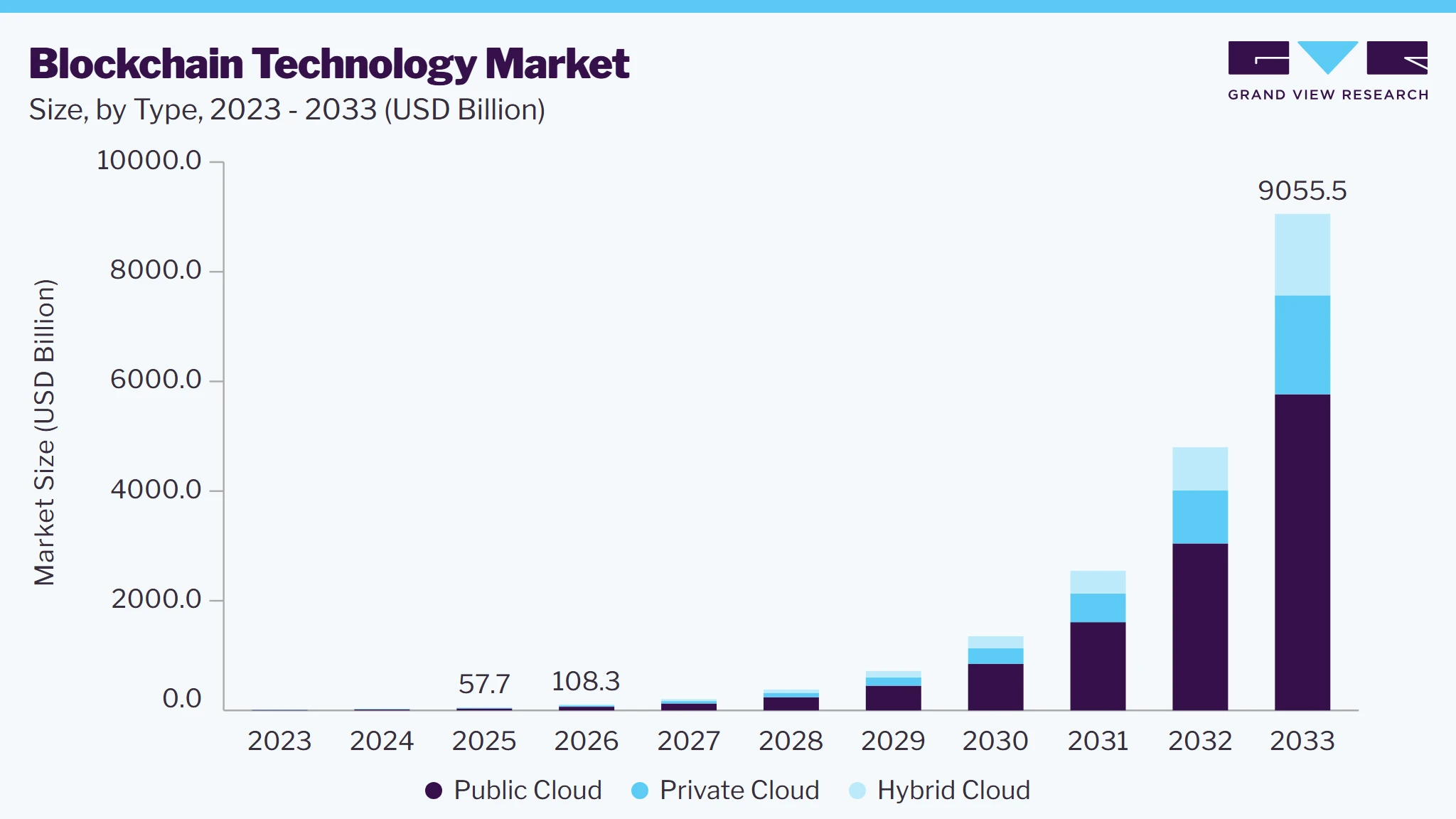
The adoption of blockchain technology for optimizing supply chain processes is witnessing a surge. The ability to trace and verify the origin and journey of products in real time curbs fraud and significantly improves traceability and overall supply chain efficiency. Consequently, an increasing number of enterprises are leveraging blockchain's potential to transform their supply chain management, driving the technology's growth. Moreover, the surging interest in cryptocurrencies and digital assets is another driver responsible for the growth.
Since blockchain serves as the underlying technology for most cryptocurrencies, the rising popularity of digital currencies like Bitcoin and Ethereum has inevitably directed considerable attention to the technology itself. Many organizations are now exploring how blockchain can be used to create and manage digital assets, including Central Bank Digital Currencies (CBDCs), further propelling the market's expansion. Furthermore, the escalating need for secure and efficient cross-border payments and remittances propels blockchain's adoption. Traditional international payment systems often involve multiple intermediaries, resulting in delays and exorbitant costs. In stark contrast, blockchain-based solutions offer faster, cost-effective, and transparent cross-border transactions, driving their adoption in the finance and remittance sectors.
Governments and regulatory bodies worldwide also recognize blockchain technology's transformative potential. They are actively introducing supportive policies and regulations that encourage its widespread adoption. This regulatory clarity not only attracts substantial investments but also fosters the development of innovative blockchain solutions across industries. In addition, the increasing engagement of major corporations and tech giants significantly influences the blockchain landscape.
One of the prominent restraints challenging the blockchain technology industry is the issue of scalability. As the adoption of blockchain technology grows across various industries, particularly in financial services and supply chain management, the networks are experiencing increased congestion, slower transaction speeds, and higher fees. This scalability challenge can hinder widespread adoption, especially when blockchain is expected to handle large volumes of transactions. To overcome this restraint, developers, and innovators in the blockchain space are actively working on scaling solutions. Layer 2 solutions, such as Ethereum 2.0, aim to improve scalability by processing transactions off the main blockchain, thus alleviating congestion and reducing fees.
Market Dynamics
The blockchain technology market is driven by increasing digital transformation across industries, rising demand for secure and transparent transaction systems, and growing adoption of decentralized applications. Enterprises are increasingly leveraging Blockchain Technology to enhance data integrity, improve traceability, and reduce reliance on intermediaries. Sectors such as finance, supply chain, healthcare, and government are integrating blockchain-based solutions to improve operational efficiency and strengthen trust in digital ecosystems. Technological advancements such as smart contracts, tokenization, interoperability protocols, and layer-2 scaling solutions are further expanding the scope of blockchain applications. However, challenges such as scalability limitations, regulatory uncertainty, and high energy consumption in certain consensus mechanisms continue to influence market development.
The rising need for secure, transparent, and tamper-proof transaction systems across industries. As digital transactions increase globally, organizations are seeking technologies that can reduce fraud, enhance auditability, and ensure data integrity. Blockchain enables decentralized record-keeping, where every transaction is cryptographically secured and stored across distributed networks, significantly reducing the risk of manipulation or single-point failure.
In the financial sector, blockchain is increasingly used for cross-border payments, trade finance, and settlement systems to improve speed and reduce transaction costs. Similarly, in supply chain management, blockchain enhances traceability by allowing stakeholders to track products from origin to end-user in real time. The increasing adoption of digital identity systems, smart contracts, and tokenized assets is further accelerating demand. As industries continue to digitize core processes, blockchain is becoming a foundational technology supporting trust-based digital ecosystems.
Despite strong growth potential, the blockchain technology market faces significant restraints, particularly related to regulatory uncertainty and technical limitations. Governments across different regions are still developing frameworks to govern blockchain applications, cryptocurrencies, and decentralized finance (DeFi). This lack of standardized regulation creates compliance challenges for enterprises and slows down large-scale adoption in certain sectors.
Scalability remains another critical challenge, as many blockchain networks struggle to process high transaction volumes efficiently without compromising speed or cost. Network congestion and high transaction fees in some public blockchains limit their suitability for enterprise-grade applications. Additionally, concerns related to energy consumption, especially in proof-of-work-based systems, have led to increased scrutiny and environmental criticism.
The blockchain technology market presents significant opportunities through expanding enterprise adoption, decentralized finance (DeFi), and interoperability advancements. Enterprises are increasingly exploring blockchain for use cases such as supply chain tracking, digital identity verification, asset tokenization, and secure data sharing. This growing enterprise integration is driving demand for scalable, permissioned blockchain networks tailored to business needs.
The rise of DeFi platforms is also creating new opportunities by enabling decentralized lending, borrowing, and trading without traditional financial intermediaries. In parallel, advancements in interoperability solutions are allowing different blockchain networks to communicate and exchange data seamlessly, addressing one of the key limitations of early blockchain systems.
Analyst Perspective
The blockchain technology market continues to benefit from increasing demand for secure, transparent, and tamper-proof digital transaction systems across industries such as finance, supply chain, and government. However, the rising adoption of centralized cloud platforms, along with evolving regulatory frameworks and scalability challenges, is shaping the pace and direction of long-term blockchain deployment. In response, market participants are focusing on scalable enterprise-grade solutions, interoperability protocols, and energy-efficient consensus mechanisms, including proof-of-stake-based architectures within Blockchain Technology ecosystems. Smart contract automation, tokenization platforms, and integration with emerging technologies such as AI and IoT are also gaining traction to enhance functionality and enterprise value.
Type Insights
Based on type, the public cloud segment led the market with the largest revenue share of 61.8% in 2025. Public cloud providers offer a scalable and cost-effective infrastructure for deploying blockchain solutions. This scalability is vital as blockchain networks grow and require additional resources to support increasing transaction volumes. Moreover, public cloud providers have invested significantly in security and compliance measures, which are crucial in blockchain applications, particularly in sectors like finance and healthcare, where data integrity is paramount.
The private cloud segment is anticipated to witness significant growth over the forecast period. Private cloud services include the provision of dedicated infrastructure and resources exclusively for organizations. The private cloud enables companies to reverse transactions at cost-effective transaction rates. This is driving the growth of the segment. Furthermore, the rise in the adoption of private cloud by large enterprises and small & medium enterprises is one of the major factors driving the segment growth.
Component Insights
Based on component, the infrastructure & protocols segment led the market with the largest revenue share of 61.1% in 2025. The increasing demand for blockchain standards and protocols such as Ethereum, Openchain, and Hyperledger is driving the segment growth. The users demand protocols as they enable them to share information reliably and securely across cryptocurrency networks. Thus, the benefits offered by infrastructure and protocols are contributing to the segment's growth.
The middleware segment is expected to witness significant growth over the forecast period. Middleware helps developers build applications more efficiently. A middleware tool is mainly used in the healthcare sector to automate the authentication of clinical data. Growing investments in the healthcare sector are expected to drive the segment growth. Middleware tools track the laboratory performance metrics, which is also one of the factors driving the growth of the segment.
Offering Insights
Based on offering, the platform segment led the market with the largest revenue share of 64.7% in 2025. The growth of the platform segment is driven by increasing demand for customizable and scalable blockchain infrastructure solutions across industries. Enterprises are leveraging these platforms to enhance operational efficiency, ensure data security, and streamline processes, especially in sectors like finance, supply chain, and healthcare.
The services segment is expected to witness significant growth over the forecast period. The segment's growth is driven by the increasing need for consulting, integration, and support services as businesses adopt blockchain solutions. Companies seek expert guidance to navigate blockchain implementation, ensure seamless integration with existing systems, and maintain ongoing operations. In addition, the rising demand for managed services is accelerating growth as organizations look to outsource blockchain management to focus on core business activities.
Application Insights
Based on application, the payments segment led the market with the largest revenue share of 43.0% in 2025. Blockchain technology improves payment system efficiency, minimizes operating costs, and offers transparency. These benefits provided by blockchain technology are increasing its use in payment solutions, thus driving the segment growth. Furthermore, blockchain reduces the need for a middleman in payment processing, which is also a major factor driving the segment growth.
The digital identity segment is anticipated to grow at the fastest CAGR over the forecast period. The segment is experiencing rapid growth due to its potential to address critical challenges in the digital age. As our lives become increasingly digitized, the need for secure and portable digital identities has become paramount. Blockchain technology offers a unique solution by providing a decentralized and tamper-proof ledger to verify and manage digital identities. This innovation has garnered significant interest, especially in sectors like finance, healthcare, and government, where identity verification is crucial.
Enterprise Size Insights
Based on enterprise size, the large enterprises segment led the market with the largest revenue share of 67.1% in 2025. Large enterprises operating in sectors such as insurance, financial services, healthcare, and supply chain are increasingly making efforts to digitalize their offerings, which is creating a demand for blockchain technology among them. Large enterprises such as BBVA, Intesa Sanpaolo, Barclays, and HSBC are using blockchain technology to streamline their KYC and fund processes. They have access to adequate capital and different assets to adopt new technologies introduced in the market.
The small & medium enterprise segment is anticipated to grow at the fastest CAGR over the forecast period. Small & medium enterprises face difficulties in scaling their tasks, such as financing, processing payments, and selecting ancillary services essential for global expansion. Blockchain technology helps them reduce issues in the areas of subsidizing and exchanging accounts. Furthermore, secure and safe information exchanges and smart contracts offered by blockchain technology help small & medium enterprises streamline supply chains. Furthermore, blockchain-based storage applications enable small businesses to store data safely and cost-effectively, which is driving the demand for blockchain among small businesses.
End-use Insights
Based on end use, the financial services segment led the market with the largest revenue share of 28.1% in 2025. Blockchain technology in BFSI is leveraged for managing financial transactions taking place in businesses. Blockchain technology provides secure and efficient transactions, and this is driving the demand for the technology in financial services. The technology is expected to be widely adopted in this vertical owing to factors such as rising cryptocurrencies, high compatibility with the industry ecosystem, rapid transactions, Initial Coin Offerings (ICOs), and reduced total cost of ownership.
The healthcare segment is anticipated to grow at the fastest CAGR over the forecast period. The growing number of regulations for protecting consumer data is increasing the adoption of blockchain technology in the healthcare market. Governments across the globe are implementing stringent regulations to protect consumer information owing to the growing incidents of data theft and breaches. For instance, the European Union data protection law, the General Data Protection Regulation (GDPR), became effective in May 2018. GDPR aims to safeguard EU citizens from privacy and data breaches. Such regulations are impelling companies across the globe to make investments in enhancing data security. Furthermore, the COVID-19 pandemic has increased the demand for digitalization across the healthcare sector, which thereby created the need for blockchain technology across the sector.
Regional Insights
North America dominated the blockchain technology market with the largest revenue share of 37.23% in 2025. The region boasts a robust ecosystem of tech startups, established corporations, and leading research institutions, creating a fertile ground for blockchain development. Silicon Valley, in particular, has been a hotspot for blockchain startups and venture capital investments. Moreover, North America is home to a diverse range of industries, from finance and healthcare to supply chain management and energy, all of which recognize the transformative potential of blockchain technology.
U.S. Blockchain Technology Market Trends
The blockchain technology market in the U.S. held the largest share in the North America region in 2025. It is driven by the country's advanced regulatory advancements and increasing government interest in leveraging blockchain for secure digital identity and supply chain traceability. In addition, the U.S. benefits from a highly mature tech ecosystem, with substantial venture capital investments and collaborations between blockchain startups and established financial institutions, fostering innovation and adoption at scale.
Asia Pacific Blockchain Technology Market Trends
APAC blockchain technology market is expected to grow at the fastest CAGR over the forecast period. The governments of countries such as China, Japan, and India are promoting the use of blockchain technology in recent days. They are promoting the use of blockchain owing to benefits such as high transparency and increased efficiency provided to multiple industries. In 2019, the South Korean government announced an investment of USD 880 million in blockchain development projects.
The blockchain technology market in Japan is driven by its tech-savvy population and leading position in digital innovation, which also fosters rapid adoption of blockchain in areas like gaming, digital assets, and intellectual property management. Moreover, collaborations between Japanese corporations and global blockchain firms further accelerate market growth.
The China blockchain technology market growth is fueled by strong government support, including its inclusion of blockchain as a key pillar in the national digital economy strategy and the development of the Blockchain-based Service Network (BSN) to promote widespread adoption. China's focus on blockchain for improving trade finance, cross-border payments, and supply chain transparency aligns with its goals for global trade leadership under initiatives like the Belt and Road Initiative.
Europe Blockchain Technology Market Trends
The blockchain technology market in Europe is expected to grow at a significant CAGR from 2025 to 2030. It is driven by the European Union's comprehensive regulatory framework, such as the Markets in Crypto-Assets (MiCA) regulation, which fosters transparency and trust in blockchain applications. Europe's commitment to sustainability has also encouraged the adoption of blockchain for energy trading and carbon credit tracking. In addition, cross-border collaboration between EU member states supports the development of blockchain-based solutions in trade, logistics, and public services, strengthening regional innovation.
The blockchain technology market in the UK is driven by its position as a global financial hub, with strong adoption of blockchain in fintech for applications like digital asset trading and decentralized finance (DeFi). The UK government's focus on fostering innovation, including regulatory sandboxes for blockchain startups, further accelerates development.
The Germany blockchain technology market held a substantial market share in 2024. The market's growth in Germany is driven by its industrial leadership, particularly the adoption of blockchain in manufacturing and Industry 4.0 applications to enhance supply chain transparency and automate processes. Germany's commitment to renewable energy has also spurred blockchain integration for energy trading and decentralized energy management systems.
Key Blockchain Technology Company Insights
Some of the key companies in the blockchain technology industry include IBM Corporation, Microsoft Corporation, The Linux Foundation, Blockchain Tech LTD, and others. Organizations are focusing on integrating advanced technologies into their offerings to maintain competitive advantages. Therefore, key players are taking several strategic initiatives, such as new product launches, mergers and acquisitions, and partnerships, among others.
-
Monax Labs is a key innovator in the global blockchain technology industry, specializing in blockchain-based smart contract solutions. The company offers a platform for building and deploying decentralized applications, focusing on improving legal and contractual processes and enabling secure, transparent business transactions across industries.
-
Chain is a blockchain technology company focused on building scalable blockchain infrastructure for enterprises. It offers solutions that enable secure, transparent asset transfers and smart contract automation, serving industries like finance, healthcare, and supply chain and helping businesses leverage blockchain for digital transformation.
Key Blockchain Technology Companies:
The following key companies have been profiled for this study on the blockchain technology market.
-
IBM Corporation
-
Microsoft Corporation
-
The Linux Foundation
-
Blockchain Tech LTD
-
Chain
-
Circle Internet Financial, LLC
-
Deloitte Touche Tohmatsu Limited
-
Digital Asset Holdings, LLC
-
Global Arena Holding, Inc. (GAHC)
-
Monax Labs
-
Ripple
Competitive Benchmarking
Category
Operating Strategies
Competitive Edge
Weakness
Established Players (IBM Corporation; Microsoft Corporation; The Linux Foundation; Deloitte Touche Tohmatsu Limited; Ripple)
Expand enterprise blockchain offerings across finance, supply chain, and government sectors through cloud-based platforms and consortium-led networks
Strengthen integration of blockchain with cloud, AI, and analytics ecosystems to enhance enterprise adoption
Invest in scalable infrastructure, interoperability protocols, and permissioned blockchain frameworks for enterprise-grade use cases
Strong global brand recognition and deep enterprise client relationships
Advanced technological capabilities in cloud computing, cybersecurity, and distributed ledger systems
High dependency on enterprise and government procurement cycles, leading to slower adoption timelines
Complex integration processes across legacy IT systems
High operational and R&D costs associated with large-scale blockchain infrastructure development
Emerging Players (Chain; Circle Internet Financial, LLC; Digital Asset Holdings, LLC; Monax Labs; Blockchain Tech LTD; Global Arena Holding, Inc. (GAHC))
Focus on niche blockchain applications such as payments infrastructure, tokenized assets, smart contracts, and decentralized finance (DeFi) solutions
Expand API-driven platforms and developer ecosystems to enable faster blockchain integration for businesses
High agility and faster innovation cycles compared to large incumbents
Strong specialization in specific blockchain use cases such as payments (e.g., stablecoins), smart contracts, and digital asset infrastructure
Limited global enterprise reach and weaker brand recognition compared to established technology giants
Dependence on regulatory clarity, especially in areas like stablecoins and digital asset issuance
Recent Developments
-
In January 2024, Chain updated its Chain Prime product. Chain Prime, originally launched as a B2C blockchain solution, has evolved into a comprehensive institutional trading platform catering to accredited investors and institutions. However, following a strategic shift, Chain Prime will discontinue its brokerage services and pivot to a "Trading-as-a-Service" platform, enabling clients to develop their crypto trading integrations while continuing to focus on enterprise-level software solutions in blockchain through products like Chain Cloud, Sequence, and Chain NFTs.
-
In December 2023, RYVYL, a blockchain ledger-based payments platform, partnered with R3, a distributed ledger technology company. Through this collaboration, the companies have launched ‘RYVYL Block,’ a blockchain-as-a-service platform. The platform aims to simplify the adoption of blockchain technology for businesses with high-volume processing environments.
-
In October 2023, DTCC, a global financial services industry leader, announced the acquisition of a digital asset infrastructure developer, Securrency Inc. With this acquisition, DTCC is expected to leverage Securrency Inc.’s technology to embed digital assets within its existing services and products, develop regulatory-compliant and new blockchain-based offerings, and explore new use cases within the industry.
-
In September 2023, LayerZero, a cross-chain messaging protocol, partnered with Google Cloud to elevate its infrastructure. This collaboration designates Google Cloud as the primary oracle provider for LayerZero, ensuring that all transactions transmitted across blockchains by LayerZero's dapps will undergo verification through Google Cloud.
Blockchain Technology Market Report Scope
Report Attribute
Details
Market size value in 2025
USD 57.7 billion
Market size value in 2026
USD 108.3 billion
Revenue forecast in 2033
USD 9,055.5 billion
Growth rate
CAGR of 88.2% from 2026 to 2033
Base year for estimation
2025
Historical data
2021 - 2024
Forecast period
2026 - 2033
Quantitative units
Revenue in USD million/billion and CAGR from 2026 to 2033
Report coverage
Revenue forecast, company ranking, competitive landscape, growth factors, and trends
Segments covered
Type, component, offering, application, enterprise size, end-use, region
Regional scope
North America; Europe; Asia Pacific; Latin America; MEA
Country scope
U.S.; Canada; Germany; U.K; France; China; India; Japan; South Korea; Australia; Brazil; Mexico; KSA; UAE; South Africa
Key companies profiled
IBM Corporation; Microsoft Corporation; The Linux Foundation; Blockchain Tech LTD; Chain; Circle Internet Financial, LLC; Deloitte Touche Tohmatsu Limited; Digital Asset Holdings, LLC; Global Arena Holding, Inc. (GAHC); Monax Labs; Ripple
Customization scope
Free report customization (equivalent up to 8 analysts' working days) with purchase. Addition or alteration to country, regional & segment scope.
Pricing and purchase options
Avail customized purchase options to meet your exact research needs. Explore purchase options
Global Blockchain Technology Market Report Segmentation
The report forecasts revenue growth at global, regional, and country levels and provides an analysis of the latest industry trends in each of the sub-segments from 2021 to 2033. For this study, Grand View Research has segmented the global blockchain technology market report based on type, component, offering, application, enterprise size, end-use, and region.
-
Type Outlook (Revenue, USD Million, 2021 - 2033)
-
Public Cloud
-
Private Cloud
-
Hybrid Cloud
-
-
Component Outlook (Revenue, USD Million, 2021 - 2033)
-
Application & Solution
-
Infrastructure & Protocols
-
Middleware
-
-
Offering Outlook (Revenue, USD Million, 2021 - 2033)
-
Platform
-
Services
-
-
Application Outlook (Revenue, USD Million, 2021 - 2033)
-
Digital Identity
-
Exchanges
-
Payments
-
Smart Contracts
-
Supply Chain Management
-
Others
-
-
Enterprise Size Outlook (Revenue, USD Million, 2021 - 2033)
-
Large Enterprises
-
Small & Medium Enterprises
-
-
End-use Outlook (Revenue, USD Million, 2021 - 2033)
-
Banking & Financial Services
-
Government
-
Healthcare
-
Media & Entertainment
-
Retail & eCommerce
-
Transportation & Logistics
-
Travel
-
Manufacturing
-
IT & Telecom
-
Real Estate & Construction
-
Energy & Utilities
-
Others
-
-
Regional Outlook (Revenue, USD Million, 2021 - 2033)
-
North America
-
U.S.
-
Canada
-
Mexico
-
-
Europe
-
UK
-
Germany
-
France
-
-
Asia Pacific
-
China
-
Japan
-
Australia
-
India
-
South Korea
-
-
Latin America
-
Brazil
-
-
Middle East & Africa
-
Kingdom of Saudi Arabia (KSA)
-
UAE
-
South Africa
-
-
Research Methodology
(a) Segment Definition
Segment – Type
Revenue capture definition
Public Cloud
In a public network, a service provider makes resources such as information, applications, and storage available to the public over the Internet. The services may be offered either for free or under a pay-per-use model.
Private Cloud
Unlike public networks, a private network delivers services only to a set of authorized individuals or an organization. A private network has a predefined set of restrictions that offers it high security.
Hybrid Cloud
A hybrid network comprises two or more communication standards in a network design. This network is primarily a mix of public and private networks.
Segment – Component Outlook
Revenue capture definition
Application & Solution
The application & solution segment includes self-executing smart contracts and third-party applications, which integrate with the blockchain network and enable business logic in the ecosystem.
Infrastructure & Protocols
Blockchain infrastructure & protocols allow users to develop the next generation of business applications. These also provide endpoint security, periodical vulnerability assessment, and logging and monitoring of public and private connections.
Middleware
Blockchain middleware is designed to bring together various elements and interrelated instances of blockchain data. It also encompasses software designed to integrate different blockchain implementations in a unified interface for ease of use.
Segment – Offering
Revenue capture definition
Platform
Blockchain platforms comprise the core technology and tools that enable the creation, deployment, and management of decentralized applications. This includes blockchain infrastructure, protocols, middleware, and application/solution layers that allow businesses to build, operate, and scale blockchain-based solutions securely and efficiently.
Services
Blockchain services include consulting, system integration, and support/maintenance offerings that help organizations implement, manage, and optimize blockchain solutions. These services ensure smooth deployment, interoperability with existing systems, and ongoing performance, security, and compliance of blockchain networks.
Segment – Application
Revenue capture definition
Digital Identity
Blockchain-based digital identity allows organizations or individuals to maintain more direct control over their confidential information. It is secure, immutable, and easy to access. It records each identity shared in a global network and maintains continuity in resigned data across the network.
Exchanges
Stock exchanges across the globe are now focusing on adopting blockchain technology in their business processes in order to decrease costs, improve efficiency, reduce risks, and strengthen security.
Payments
Blockchain technology in payment processing allows for secure, fast, and low-cost international payment processing. Blockchain-based payments use encrypted distributed ledgers that enable the real-time verification of transactions.
Smart Contracts
Smart contracts eliminate the need for human management and significantly reduce the risk of errors. Smart contracts are coded to exchange vital information, reflect what influences them, and stay updated with the most current information.
Supply Chain Management
Blockchain technology in supply chain management is used for executing supply chain transactions and product tracking. The real-time tracking of a product in a supply chain with the help of blockchain technology minimizes the overall cost of moving items in a supply chain.
Others
Other applications of blockchain technology include content storage management and digital voting. Developing economies are focusing on using digital voting with the use of blockchain technology to secure data and protect against potential attacks.
Segment – Enterprise Size
Revenue capture definition
Large Enterprises
A commercial company with an employee strength of 500 or more employees is termed as a large enterprise. Many large enterprises are expected to increasingly use blockchain technology in the near future owing to growing trends such as cloud computing, the Internet of Things (IoT), and big data.
Small & Medium Enterprises
These organizations are non-subsidiary, independent firms with an employee strength under 500 people. The use of blockchain is increasing among small & medium organizations on account of benefits such as security, speed, and reduced risk in terms of hacking and identity fraud.
Segment – End Use
Revenue capture definition
Banking & Financial Services
This segment includes banks and other financial institutions that use blockchain technology for tracking and verifying financial transactions. Advantages such as high efficiency, improved speed, and increased transparency offered by blockchain technology are accelerating its adoption in the financial services segment.
Government
The use of blockchain technology in government agencies helps improve processes related to record-keeping. The technology is used for applications such as verifying the digital identities of individuals, voting records, and benefits disbursements.
Healthcare
In the healthcare industry, blockchain helps ensure that care allowance is spent exclusively on healthcare activities. A blockchain-based system helps save the time spent on reconciliation after every transaction, thereby enabling improved Straight-Through Processing (STP).
Media & Entertainment
Blockchain finds applications in media & entertainment for supporting applications such as connectivity authentication, micro-transactions, smart contracts, and IoT devices.
Retail & ecommerce
Comprises retailers and online marketplaces utilizing blockchain for supply chain transparency, loyalty programs, secure payments, and counterfeit prevention.
Transportation & Logistics
Blockchain helps create real-time digital records or ledgers of data for use by cargo owners, transport officials, and others along global supply chains.
Travel
Includes airlines, travel agencies, and hospitality services implementing blockchain for ticketing, loyalty programs, booking management, and secure payment processing.
Manufacturing
This segment covers production and industrial firms applying blockchain for supply chain traceability, quality control, inventory management, and automation.
IT & Telecom
This segment covers IT service providers and telecom operators adopting blockchain for secure data exchange, network management, billing, and identity verification.
Real Estate & Construction
This segment covers real estate developers, property management, and construction companies using blockchain for land registry, property transactions, smart contracts, and project tracking.
Energy & Utilities
This segment covers power generation, renewable energy, and utility companies leveraging blockchain for energy trading, grid management, billing, and sustainability tracking.
Others
The other end uses of blockchain technology include automotive, agriculture, and education for secure data management, transparency, and operational efficiency.
(b) Estimation Model
01
02
03
04
Who could benefit from blockchain solutions?
Who can realistically adopt blockchain?
Who is actively investing in blockchain solutions?
How much revenue is generated?
Establish the total pool of organizations, industries, and use cases where blockchain can create value through transparency, security, automation, or decentralization.
Identify organizations that have the digital maturity, infrastructure, regulatory readiness, and business need to implement blockchain technologies.
Estimate active blockchain deployments by applying adoption rates, pilot-to-production conversion rates, and enterprise investment activity.
Convert blockchain adoption into market revenue through software licensing, platform subscriptions, professional services, integration, consulting, and managed services.
Delivered Customizations
This report has been delivered with the following In-depth customizations
Client Request
Customization Delivered
Value Adds
Blockchain Technology Market Overview
• Assessment of global demand for blockchain solutions across finance, supply chain, healthcare, and government applications.
• Analysis of key growth drivers such as digital transformation, demand for secure transactions, and increasing data transparency requirements.
• Identified high-growth application areas such as DeFi, digital identity, and supply chain traceability.
• Supported market sizing, segmentation, and opportunity assessment across enterprise and public-sector adoption.
Technology & Product Innovation Analysis
• Evaluation of smart contracts, decentralized applications (dApps), tokenization, and decentralized finance (DeFi) ecosystems.
• Assessment of scalability solutions, interoperability protocols, and advanced consensus mechanisms (e.g., proof-of-stake).
• Highlighted innovation-led growth opportunities in enterprise blockchain and Web3 ecosystems.
• Supported product development strategies focused on scalability, security, and interoperability.
Competitive Landscape Assessment
• Benchmarking of leading players including enterprise technology providers, blockchain platforms, and fintech innovators.
• Analysis of product offerings, ecosystem partnerships, and platform adoption strategies across key market participants.
• Strengthened competitive intelligence across enterprise and decentralized blockchain segments.
• Identified gaps in scalability, regulatory positioning, and ecosystem integration strategies.
Frequently Asked Questions About This Report
Some key players operating in the blockchain technology market include IBM Corporation; Microsoft Corporation; The Linux Foundation; Blockchain Tech LTD; Chain; Circle Internet Financial, LLC; Deloitte Touche Tohmatsu Limited; Digital Asset Holdings, LLC; Global Arena Holding, Inc. (GAHC); Monax Labs; Ripple.
Key factors that are driving the blockchain technology market growth include increasing merchants accepting cryptocurrency and growing interest in blockchain among financial institutions.
The global blockchain technology market size was estimated at USD 31.28 billion in 2024 and is expected to reach USD 57.72 billion in 2025.
The global blockchain technology market is expected to witness a compound annual growth rate of 90.1% from 2025 to 2030 to reach USD 1,431.54 billion by 2030.
North America dominated the blockchain technology market with a share of 37.41% in 2024. This is attributable to the faster adoption of innovative technologies in developed countries such as the U.S. and Canada.
About the Author(s)
Next Generation Technologies Research Team
Technology · Next Generation TechnologiesThis report was authored by the next generation technologies research team at Grand View Research - comprising two research analysts, one senior research analyst, and one industry expert - with specialized expertise in the next generation technologies segment of the technology industry. All findings are based on proprietary technology databases, executive interviews, and regulatory analysis, subject to internal peer review prior to publication.
Last Updated:
Speak to Analyst

Share this report with your colleague or friend.
Need a Tailored Report?
Customize this report to your needs — add regions, segments, or data points, with 20% free customization.


ISO 9001:2015 & 27001:2022 Certified
We are GDPR and CCPA compliant! Your transaction & personal information is safe and secure. For more details, please read our privacy policy.












