
- Home
- »
- Electronic & Electrical
- »
-
Body Dryer Market Size, Share & Trends Report, 2026-2033GVR Report cover
![Body Dryer Market (2026 - 2033)Report]()
Body Dryer Market (2026 - 2033)
Size, Share & Trends Analysis Report By Product (Wall-mounted, On-floor), By Application (Residential, Commercial), By Region (North America, Europe, Asia Pacific, Latin America, MEA), And Segment Forecasts
Market Size, 2025
$4.2MMarket Estimate, 2026
$4.4MMarket Forecast, 2033
$6.4MCAGR, 2026–2033
5.3%Body Dryer Market Summary
The global body dryer market size was valued at USD 4.2 million in 2025 and is projected to grow from USD 4.4 million in 2026 to USD 6.4 million by 2033, growing at a CAGR of 5.3% from 2026 to 2033. North America dominated the market, accounting for the largest global share of 36.3% in 2025. Increasing consumer demand for hygiene and convenience plays a significant role, as body dryers offer a touch-free drying experience that enhances personal cleanliness.

Key Market Trends & Insights
- By product: Wall-mounted segment held the largest revenue share of 73.0% in 2025.
- By application: Commercial channel segment held the largest share of 84.4% in 2025.
Regional Highlights
- Largest regional market: North America (36.3% revenue share, 2025)
- Fastest-growing regional market: Asia pacific (fastest CAGR, 2026-2033)
- By country: The U.S. held the largest share of North America in 2025.
Market Size & Forecast
- Market size in 2025: USD 4.2 Million
- Estimated market size in 2026: USD 4.4 Million
- Projected market size by 2033: USD 6.4 Million
- CAGR (2026-2033): 5.3%
In addition, rising disposable incomes and improved living standards are encouraging consumers to invest in luxury and spa-like home experiences. The growing geriatric population and increasing healthcare expenditure also contribute to market expansion, as body dryers provide a safer and more comfortable drying option for elderly and mobility-impaired individuals.Advancements in smart technology are significantly enhancing the functionality and appeal of body dryers. Features such as infrared sensors allow for touch-free operation, improving hygiene and adding convenience by automatically activating the dryer when a user is detected. Adjustable air velocity enables users to customize the drying experience to their preference, making the device more user-friendly and efficient. These technological improvements make body dryers more attractive to consumers, driving market growth.

Moreover, the trend towards eco-friendly designs is resonating with environmentally conscious consumers. Manufacturers are increasingly using recyclable materials in the production of body dryers, reducing the environmental impact. This shift towards sustainability appeals to a growing segment of consumers who prioritize eco-friendly products, further boosting the market expansion.
Market Dynamics
The body dryer market is witnessing steady growth driven by increasing consumer demand for touch-free personal hygiene solutions and rising adoption of premium smart bathroom appliances. Growing awareness of moisture-related skin conditions and the increasing elderly and mobility-impaired population, both of which require convenient drying alternatives, are supporting market expansion. Furthermore, the integration of features such as adjustable airflow, temperature control, energy-efficient heating systems, and antimicrobial components, along with the rising installation of luxury bathrooms in residential and hospitality settings, is expected to continue driving growth in the global body dryer market. The expanding availability of wall-mounted and floor-standing models through online retail channels is further driving market growth.
The increasing emphasis on aging-in-place residential design is emerging as a key driver for the body dryer market. Governments, healthcare providers, and homeowners are investing in accessible bathroom modifications that enable elderly individuals and people with physical limitations to live independently for longer periods. Body dryers are being incorporated into barrier-free bathrooms as they reduce the need for bending, towel handling, and caregiver assistance during post-shower routines. Their integration alongside walk-in tubs, grab bars, and curbless showers is expanding their application beyond luxury wellness products into essential accessibility solutions.
This trend is particularly evident in developed markets experiencing demographic aging, where home remodeling activities are increasing. Consequently, manufacturers are targeting rehabilitation centers, assisted living facilities, and universal design projects, creating new avenues for market penetration and accelerating adoption across residential healthcare-oriented environments.
A major restraint for the body dryer market is the difficulty and cost associated with integrating these systems into existing bathrooms. Many body dryers require dedicated floor space, electrical modifications, drainage considerations, or wall-mounting arrangements, making retrofitting challenging in apartments and older residential buildings. Consumers often prioritize lower-cost bathroom upgrades over specialized drying systems, particularly when renovation costs exceed the cost of the device. In addition, the lack of standardized installation specifications across manufacturers increases complexity for contractors and limits adoption among mainstream homeowners, thereby restricting the market largely to new construction projects and premium renovation segments.
The growing investment in wellness-oriented hospitality facilities presents a significant opportunity for body dryer manufacturers. Luxury hotels, premium spas, wellness resorts, and high-end fitness centers are increasingly incorporating advanced bathroom technologies to differentiate guest experiences and strengthen their premium positioning. Body dryers offer operators an opportunity to deliver a touch-free, towel-reducing drying solution while enhancing perceptions of hygiene and exclusivity. As wellness tourism and experiential hospitality continue to expand, commercial establishments are seeking smart bathroom fixtures that complement infrared saunas, hydrotherapy installations, and spa suites. This trend is opening a new revenue stream for manufacturers beyond residential applications and supporting higher-value institutional sales.
Analyst Perspective
The body dryer market is increasingly driven by smart bathroom technology, accessible home design, and premium wellness infrastructure. Manufacturers integrating body dryers with smart showers, heated floors, bidets, and connected controls can gain a competitive edge. Rising demand for personalized wellness and aging-in-place solutions is also boosting interest in customizable airflow and energy-efficient features. Seamless smart-home integration can strengthen customer loyalty, increase installation value, and support premium pricing.
Product Insights
Based on product, the wall-mounted segment led the market with the largest revenue share of 73.0% in 2025. These dryers are favored for their space-saving design and ease of installation, making them ideal for residential and commercial settings. Wall-mounted body dryers are typically installed in bathrooms and spas, providing a convenient and hygienic drying solution that eliminates the need for towels. Their popularity is driven by the growing awareness of hygiene and the increasing demand for luxury bathroom fixtures. Moreover, advancements in technology have led to the development of more efficient and aesthetically pleasing wall-mounted dryers, further boosting their adoption.
The on-floor segment is expected to grow at a CAGR of 5.6% over the forecast period. On-floor body dryers are designed to be placed on the floor, offering flexibility in terms of placement and usage. These dryers are particularly popular in settings where wall-mounted installations are not feasible, such as large public restrooms, gyms, and swimming pools. The growth of this segment is driven by the increasing demand for versatile and portable drying solutions that can be easily moved and positioned as needed. Moreover, on-floor body dryers often have advanced features such as adjustable airflow and temperature settings, enhancing user comfort and convenience.
Application Insights
Based on application, the commercial channel segment led the market with the largest revenue share of 84.4% in 2025, driven by the widespread adoption of body dryers in various commercial settings such as gyms, spas, hotels, and swimming pools. The main drivers of this dominance are the substantial customer traffic in these establishments and the increasing focus on delivering a clean and upscale experience to patrons. Commercial body dryers offer a convenient and efficient alternative to traditional towels, reducing the risk of cross-contamination and enhancing overall hygiene.
In addition, the cost savings associated with reduced laundry expenses and the environmental benefits of minimizing towel usage have further propelled the adoption of body dryers in commercial spaces. The integration of advanced features such as touchless operation, rapid drying times, and energy-efficient systems has also made these devices highly attractive to commercial users, who prioritize both customer satisfaction and operational efficiency.

On the other hand, the residential segment is projected to grow at the fastest rate over the forecast period. This growth is driven by the increasing awareness of personal hygiene and the rising demand for luxury home appliances. Homeowners are increasingly investing in smart home technologies and wellness products that enhance their living experience. Body dryers, with their ability to provide a spa-like experience at home, are becoming a popular addition to modern bathrooms. The convenience of touchless drying, coupled with the benefits of reduced towel usage and lower laundry costs, appeals to many consumers. Furthermore, product design and technology advancements have led to the development of compact and aesthetically pleasing body dryers that can easily be integrated into residential bathrooms. The availability of a wide range of models with customizable features, such as adjustable airflow and temperature settings, also drives the adoption of body dryers in the residential segment.
Regional Insights
North America dominated the body dryer market with the largest revenue share of 36.3% in 2025, driven by a combination of high consumer awareness and the widespread adoption of advanced personal care technologies. The region’s dominant position can be attributed to the strong presence of key market players, a well-established hospitality sector, and a growing trend towards smart home devices.

U.S. Body Dryer Market Trends
The body dryer market in the U.S. held the largest share in the North America region in 2025, owing to the growing emphasis on hygiene, increased consumer awareness of personal care products, and the rise of wellness trends that favor innovative drying solutions. The U.S. market benefits from robust distribution channels and a strong presence of key manufacturers, which further supports widespread adoption. Additionally, the trend toward luxury and convenience in personal care is expected to sustain continued growth in this segment.
Asia Pacific Body Dryer Market Insights & Trends
The Asia Pacific body dryer market is expected to grow at a fastest CAGR over the forecast period, driven by increasing consumer spending on health and hygiene and the rising adoption of luxury and convenience products. Countries such as China and India are witnessing significant economic growth, leading to higher disposable incomes and a greater willingness to invest in premium personal care products. The growing hospitality and wellness industries in the area and the growing presence of local producers are key drivers of the market expansion.
Europe Body Dryer Market Insights & Trends
Europe body dryer market is expected to grow steadily over the forecast period. Europe’s body dryer market is expected to grow steadily over the forecast period, supported by a high standard of living and a strong emphasis on personal hygiene. The regional growth is driven by the increasing adoption of smart home technologies and the rising demand for luxury bathroom fixtures. European consumers are increasingly seeking products that offer functionality and aesthetic appeal, leading to a growing preference for advanced body drying solutions. In addition, well-established healthcare and hospitality sectors in countries such as Germany, France, and the UK contribute to the steady demand for body dryers.
Key Body Dryer Company Insights
Some of the key companies in the body dryer market include Avant Innovations, Dolphy India Private Limited, Full Body Dryer LLC, Haystack Dryers, Kingkraft, and others.
-
Full Body Dryer LLC specializes in providing innovative body drying solutions that eliminate the need for traditional towels. Their products are designed to cater for both home and commercial use.
-
Haystack Dryers is renowned for its robust and efficient body dryers, primarily serving the leisure industry. Their products are designed to dry multiple individuals simultaneously, making them a staple in theme parks, water parks, and resorts.
Key Body Dryer Companies:
The following key companies have been profiled for this study on the body dryer market.
- Avant Innovations
- Dolphy India Private Limited
- Full Body Dryer LLC
- Haystack Dryers
- Kingkraft
- Orchids International
- Regal Care Shower Trays Ltd.
- Tornado Body Dryer, LLC
- Valiryo
- AKW Medi-Care Ltd.
Competitive Benchmarking
Category
Operating Strategies
Competitive Edge
Weakness
Established Players (Dolphy India Private Limited; Full Body Dryer LLC; Haystack Dryers; Regal Care Shower Trays Ltd.; Valiryo; AKW Medi-Care Ltd.)
- Expand through product innovation, smart and energy-efficient body dryer technologies, partnerships with hospitality and healthcare facilities, omnichannel distribution, and customized solutions for residential and commercial applications.
- Strong industry expertise, established distribution channels, diverse product portfolios, and long-standing relationships with healthcare, hospitality, and accessibility sectors support customer retention and market presence.
- Dependence on consumer awareness and adoption rates, fluctuations in raw material and manufacturing costs, and competition from conventional drying solutions may limit profitability and market expansion.
Emerging Players (Avant Innovations; Kingkraft; Orchids International; Tornado Body Dryer, LLC)
- Focus on specialized and accessibility-oriented products, compact and user-friendly designs, digital marketing initiatives, and flexible offerings tailored to residential, elderly care, and assisted living applications.
- Agility in product development, targeted market positioning, and the ability to respond quickly to evolving consumer preferences and accessibility requirements enable differentiation and growth opportunities.
- Limited brand recognition, smaller production capacities, and reliance on regional markets or niche customer segments may restrict expansion and intensify competitive pressures from larger, established manufacturers.
Recent Developments
-
In January 2024, SUMSEI unveiled an innovative "Air Shower" body dryer at CES 2024. This pioneering home appliance, designed to enhance personal hygiene and wellness, was initially introduced in South Korea. Its success has led to a global expansion.
Body Dryer Market Report Scope
Report Attribute
Details
Market size value in 2025
USD 4.2 million
Market size value in 2026
USD 4.4 million
Revenue forecast in 2033
USD 6.4 million
Growth rate
CAGR of 5.3% from 2026 to 2033
Base year for estimation
2025
Historical data
2021 - 2024
Forecast period
2026 - 2033
Quantitative units
Revenue in USD million/billion, and CAGR from 2026 to 2033
Report coverage
Revenue forecast, company ranking, competitive landscape, growth factors, and trends
Segments covered
Product, application, region
Regional scope
North America; Europe; Asia Pacific; Latin America; MEA
Country scope
U.S.; Canada; Mexico; Germany; UK; France; Italy; Spain; China; Japan; India; Australia & New Zealand; South Korea; Brazil; South Africa
Key companies profiled
Avant Innovations, Dolphy India Private Limited, Full Body Dryer LLC, Haystack Dryers, Kingkraft, Orchids International, Regal Care Shower Trays Ltd., Tornado Body Dryer, LLC, Valiryo, AKW Medi-Care Ltd.
Customization scope
Free report customization (equivalent to up to 8 analysts' working days) with purchase. Addition or alteration to country, regional & segment scope.
Pricing and purchase options
Avail customized purchase options to meet your exact research needs. Explore purchase options
Global Body Dryer Market Report Segmentation
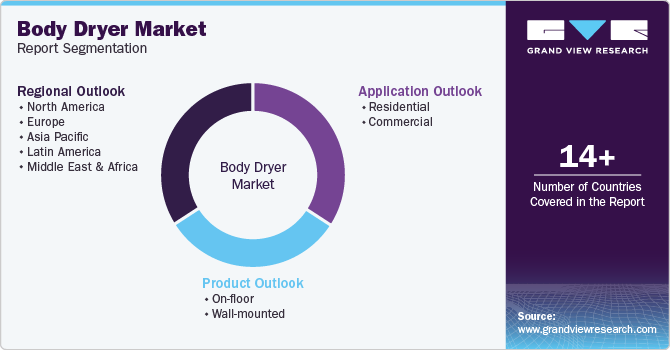
This report forecasts revenue growth at global, regional, and country levels and provides an analysis of the latest industry trends in each of the sub-segments from 2021 to 2033. For this study, Grand View Research has segmented the global Body Dryer market report based on product, application, and region.
-
Product Outlook (Revenue, USD Million, 2021 - 2033)
-
On-floor
-
Wall-mounted
-
-
Application Outlook (Revenue, USD Million, 2021 - 2033)
-
Residential
-
Commercial
-
-
Regional Outlook (Revenue, USD Million, 2021 - 2033)
-
North America
-
U.S.
-
Canada
-
Mexico
-
-
Europe
-
UK
-
Germany
-
France
-
Italy
-
Spain
-
-
Asia Pacific
-
China
-
India
-
Japan
-
Australia
-
South Korea
-
-
Latin America
-
Brazil
-
-
Middle East and Africa (MEA)
-
South Africa
-
-
Research Methodology
The body dryer market figures in this report are based on a proven research process that combines executive interviews with secondary research from proprietary databases, company filings, and recognized regulatory and institutional sources. Market size is built through value-chain sizing - reconciling supply-side and demand-side estimates - and triangulated with bottom-up and top-down approaches. Every estimate passes multiple levels of expert validation before publication, with each body dryer segment quantified using the revenue-capture definitions in the table below.
Segment Definition
Segment - Product
Revenue capture definition
On Floor
Revenue is generated from body dryer units designed for floor placement, where users stand directly on or above the device to receive full-body airflow for hands-free drying after bathing or swimming. The segment includes freestanding systems installed on bathroom floors and wellness facility changing areas.
Wall-Mounted
As the largest product segment, revenue is generated from body dryer units fixed to walls, delivering directed airflow for hands-free whole-body drying after bathing or swimming. The segment includes permanently mounted systems used in residential bathrooms, spas, fitness centers, and other wet-area environments.
Estimation Model
The Four-Layer Estimation Model
Each layer progressively narrows the population pool and applies a conversion rate to arrive at addressable revenue.
Bathroom Appliance User Base Layer
Wellness & Home Upgrade Spending Layer
Adoption & Daily Usage Layer
Revenue Generation Layer
Who has the potential to use body dryers?
Who can afford body dryers?
Who actively purchases and uses body dryers?
How much revenue is generated?
Identify households, elderly users, mobility-impaired individuals, luxury homeowners, and hospitality establishments seeking hands-free post-shower drying solutions.
Segment affluent households, aging populations, premium bathroom renovators, and hotels investing in comfort-oriented and accessibility-enhancing fixtures.
Focus on consumers prioritizing hygiene, reduced towel dependency, convenience, and assisted bathing experiences for seniors and physically challenged users.
Estimate revenue from residential installations, hospitality projects, replacement demand, premium smart features, and accessibility-focused bathroom upgrades.
Delivered Customizations
This report has been delivered with the following In-depth customizations
Client Request
Customization Delivered
Value Adds
Technology Innovation, Smart Features & Product Performance Assessment for Body Dryers
Conducted an assessment of technological advancements in body dryers, including temperature control systems, adjustable airflow settings, energy-efficient motors, touchless operation, and smart connectivity features. Evaluated product performance parameters, noise levels, drying efficiency, and innovations aimed at enhancing user comfort and accessibility.
Helped identify opportunities for product differentiation and premiumization. Supported innovation strategies and enabled benchmarking of emerging technologies across residential and commercial applications.
Regulatory Standards, Safety Compliance & Certification Analysis for Body Dryers
Conducted an evaluation of safety standards, electrical regulations, energy efficiency requirements, and product certifications applicable across major regional markets. Assessed compliance requirements related to waterproofing, electrical safety, accessibility standards, and environmental regulations influencing product design and commercialization.
Helped identify regulatory risks and compliance requirements across key geographies. Supported product development and market expansion strategies while enabling alignment with evolving safety and sustainability standards.
End-user Application & Accessibility Solutions Assessment for Body Dryers
Conducted an analysis of body dryer adoption across residential, hospitality, healthcare, senior living, and rehabilitation facilities. Evaluated the role of body dryers in improving convenience, hygiene, and accessibility for elderly individuals, people with disabilities, and patients with limited mobility. Assessed application-specific requirements and usage patterns across end-user segments.
Helped identify high-growth application areas and underserved customer segments. Supported targeted product positioning and enabled the development of solutions catering to accessibility and assisted-living requirements.
Frequently Asked Questions About This Report
The global body dryer market size was valued at USD 4.2 million in 2025 and is estimated at USD 4.4 million for 2026.
The global body dryer market is expected to grow at a CAGR of 5.3% from 2026 to 2033, reaching USD 6.4 million by 2033.
Some key players operating in the global body dryer market include Avant Innovations, Dolphy India Private Limited, Full Body Dryer LLC, Haystack Dryers, Kingkraft, Orchids International, Regal Care Shower Trays Ltd., Tornado Body Dryer, LLC, Valiryo, and AKW Medi-Care Ltd.
North America dominated with a 36.3% revenue share in 2025.
Asia Pacific is the fastest-growing region over the forecast period.
The wall-mounted segment led with a 73.0% revenue share in 2025, while the on floor is the fastest-growing segment.
U.S. dominated the North America market with a 45.7% revenue share in 2025.
Key factors include rising awareness regarding personal hygiene, consumer willingness to spend more on convenience products, rising demand for body dryers from the commercial sector, and people with impaired physical mobility and the elderly.
The residential body dryer accounted for the largest market share of 84.4% in 2025, while the commercial body dryer is the fastest-growing segment.
About the Author(s)
Electronic & Electrical Research Team
Consumer Goods · Electronic & ElectricalThis report was authored by the electronic & electrical research team at Grand View Research - comprising two research analysts, one senior research analyst, and one industry expert - with specialized expertise in the electronic & electrical segment of the consumer goods industry. All findings are based on proprietary consumer goods databases, executive interviews, and regulatory analysis, subject to internal peer review prior to publication.
Last Updated:
Speak to Analyst


Customize this report to your needs — add regions, segments, or data points, with 20% free customization.
Or view our licence options:


ISO 9001:2015 & 27001:2022 Certified
We are GDPR and CCPA compliant! Your transaction & personal information is safe and secure. For more details, please read our privacy policy.


