
- Home
- »
- Advanced Interior Materials
- »
-
Bonded Abrasives Market Size & Share Report, 2026-2033GVR Report cover

Bonded Abrasives Market (2026 - 2033)
Size, Share & Trends Analysis Report By Product Type (Grinding Wheels, Cutting Wheels, Polishing Wheels), By End Use (Automotive, Aerospace, Metalworking), By Region (North America, Europe, Asia Pacific), And Segment Forecasts
Market Size, 2025
$17.7BMarket Estimate, 2026
$18.5BMarket Forecast, 2033
$25.0BCAGR, 2026–2033
4.4%Bonded Abrasives Market Size & Trends
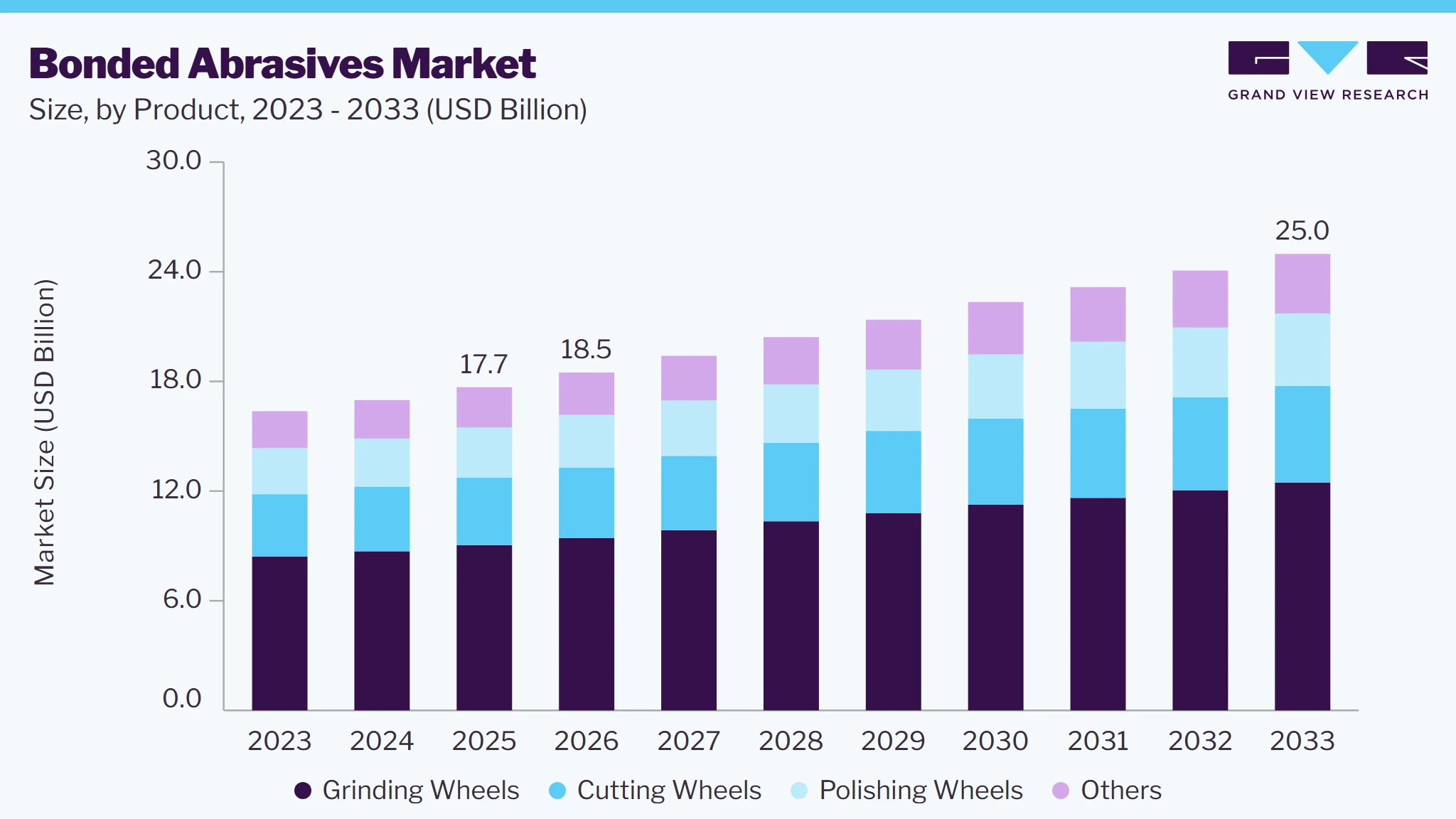
The global bonded abrasives market size was valued at USD 17.7 billion in 2025 and is projected to grow from USD 18.5 billion in 2026 to USD 25.0 billion by 2033, at a CAGR of 4.4% from 2026 to 2033. The market in Asia Pacific dominated with a revenue share of 54.5% in 2025. The growing demand from the metal fabrication and automotive industries is a significant driver of the global bonded abrasives industry.
 Source: Grand View Research, IR Documents, Primary Interviews, Paid DatabasesTo learn more about this report,
 Download Free Sample Report
 Key Market Trends & Insights
- By product type: Grinding wheels segment held the largest market share of 51.1% in 2025.
- By end use: Automotive segment held the largest market share of 40.8% in 2025.
Regional Highlights
- Largest regional market: Asia Pacific (54.5% revenue share, 2025)
- By country: China held the largest market share in 2025.
Market Size & Forecast
- Market size in 2025: USD 17.7 Billion
- Estimated market size in 2026: USD 18.5 Billion
- Projected market size by 2033: USD 25.0 Billion
- CAGR (2026-2033): 4.4%
Three ways to get this report
Buy it, customize it, or ask a question.Ask an Analyst
A direct answer, usually in 1 working day
- AccessReport author, directly
- Reply timeWithin 1 working day
- No sales callDirect answer only
- FormatEmail reply
- CostFree, no cost
Get the Full Report
What the study covers
- FormatsPDF · Excel · Dashboard
- Timeline2026–2033 annual, 2025 base
- Coverage20+ countries, 5 regions
- Companies10+ key players profiled
Customize the Report
20% free customization
- IncludeCountries, segments, points
- TailorTo your product definition
- ExtendDeeper competitor detail
- OrA fully bespoke study
- Turnaround5–10 working days
In the metal fabrication sector, bonded abrasives are widely used for cutting, grinding, and polishing applications, which are essential for manufacturing and maintenance operations. Similarly, in the automotive industry, the increasing production of vehicles and the rising demand for precision components have propelled the need for efficient abrasive solutions. The expansion of these industries, particularly in emerging economies, is further fueling market growth. The rising demand for bonded abrasives in the construction and aerospace sectors also contributes to market growth. In construction, bonded abrasives are essential for surface preparation, polishing, and material shaping, driven by increasing infrastructure projects worldwide. Meanwhile, in the aerospace industry, the stringent quality standards for aircraft components necessitate high-precision grinding and finishing, boosting the demand for advanced bonded abrasive solutions.Additionally, the development of eco-friendly and high-performance abrasives is playing a crucial role in market expansion. With growing environmental concerns and strict regulations on hazardous waste disposal, manufacturers are focusing on producing sustainable abrasives that offer high efficiency while reducing environmental impact. The shift towards ceramic and super abrasives, such as cubic boron nitride (CBN) and diamond abrasives, is gaining traction due to their superior durability and cutting capabilities, further driving market demand.
 To learn more about this report, Download Free Sample Report
 Another key driver is the advancement in manufacturing technologies and increasing automation in industrial processes. The integration of bonded abrasives in automated machinery enhances operational efficiency and precision in grinding and finishing applications. The adoption of computer numerical control machines and robotics in manufacturing processes has increased the use of high-performance bonded abrasives, improving productivity and reducing labor dependency.
Market Dynamics
The market is experiencing stable growth driven by expanding manufacturing activities, increasing metal fabrication operations, and rising demand for precision grinding and finishing across automotive, aerospace, construction, machinery, and electronics industries. The growing emphasis on product quality, dimensional accuracy, and surface finishing has significantly increased the adoption of bonded abrasive products such as grinding wheels, cutting wheels, mounted points, and honing stones. Furthermore, industrial automation, rapid infrastructure development, and rising investments in advanced manufacturing technologies are supporting market expansion across both developed and emerging economies.
The expansion of metalworking, automotive production, and industrial machinery manufacturing is a key factor driving demand for bonded abrasives globally. Bonded abrasive products are extensively used for grinding, cutting, deburring, polishing, and finishing metal components during various stages of production. The increasing production of passenger vehicles, electric vehicles, industrial equipment, and fabricated metal products has created substantial demand for high-performance abrasive solutions that improve productivity and machining efficiency.
Manufacturers are increasingly focusing on precision engineering and tighter dimensional tolerances, further accelerating the use of advanced bonded abrasive products. The growing adoption of automation and CNC machining systems in manufacturing facilities also supports the demand for specialized grinding and finishing tools, contributing to long-term market growth.
Fluctuations in the prices of key raw materials, including aluminum oxide, silicon carbide, zirconia alumina, diamonds, resins, and vitrified bonding materials, pose a significant challenge to the bonded abrasives market. Supply chain disruptions, energy cost fluctuations, and changes in mining and processing activities can impact production costs and profit margins for manufacturers. Moreover, increasing environmental regulations related to abrasive manufacturing processes and waste management add compliance costs for producers. These factors can affect pricing strategies and limit market growth, particularly for small and medium-sized manufacturers operating in highly competitive markets.
The increasing demand for precision machining and high-performance materials across aerospace, electronics, medical devices, and electric vehicle industries presents substantial growth opportunities for the bonded abrasives market. Manufacturers are developing advanced bonded abrasive products with improved grain structures, enhanced durability, and superior cutting performance to meet evolving industrial requirements. The growing use of hard-to-machine materials such as titanium alloys, composites, ceramics, and high-strength steels is creating demand for specialized grinding and finishing solutions. The continued advancement of Industry 4.0, smart manufacturing, and automated production systems is expected to further increase the adoption of technologically advanced bonded abrasives, supporting market growth throughout the forecast period.
Market Concentration & Characteristics
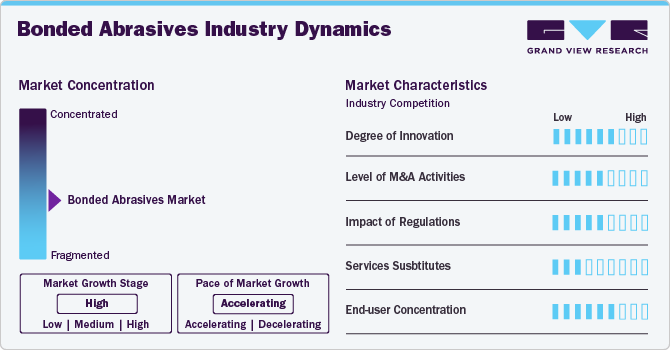
The global bonded abrasives market is characterized by a moderate to high level of market concentration, with a few dominant players such as 3M, Saint-Gobain, and Tyrolit holding significant shares. The degree of innovation in this market is relatively high, driven by advancements in material science, automation, and precision engineering. Manufacturers are focusing on the development of super abrasives like cubic boron nitride (CBN) and diamond abrasives to enhance cutting efficiency and durability. Furthermore, mergers, acquisitions, and strategic collaborations are prevalent, as companies seek to expand their geographic footprint and technological capabilities. Such activities are particularly evident in sectors like automotive, aerospace, and metal fabrication, where advanced bonded abrasives play a critical role in manufacturing and finishing processes.
 To learn more about this report, Download Free Sample Report
 Regulatory frameworks significantly influence the bonded abrasives industry, with stringent environmental and worker safety regulations shaping production methods. Regulations from agencies like OSHA (Occupational Safety and Health Administration) and REACH (Registration, Evaluation, Authorization, and Restriction of Chemicals) in the EU drive manufacturers toward safer, eco-friendly abrasives with reduced silica content and lower emissions. The market faces limited service substitutes, as bonded abrasives are essential in precision grinding and cutting applications; however, competition exists from coated abrasives and non-woven abrasives in certain finishing processes. End user concentration is notably high in industries like metalworking, construction, and electronics, with demand patterns aligning with trends in industrial automation and infrastructure development.
Analyst Perspective
The bonded abrasives market is set for steady growth as industries continue to focus on improving product quality, manufacturing efficiency, and precision in production processes. Demand from sectors such as automotive, metalworking, aerospace, and industrial manufacturing will remain the key growth driver. While challenges such as raw material price fluctuations may persist, the increasing use of advanced manufacturing technologies and the need for reliable grinding, cutting, and finishing solutions are expected to create long-term opportunities for market participants.
Product Type Insights
Based on product type, the grinding wheels segment led the market with the largest revenue share of 51.1% in 2025, driven by increasing demand across various industries such as automotive, aerospace, metal fabrication, and construction. A key driver for this segment is the rising adoption of precision grinding in manufacturing to achieve high-performance surface finishing and tight tolerances. As industries shift toward automation and Industry 4.0, the demand for high-efficiency, durable grinding wheels has surged. Additionally, advancements in super abrasives, such as diamond and cubic boron nitride (CBN) grinding wheels, have enhanced cutting speed, longevity, and performance, making them indispensable in high-precision applications.
The polishing wheels segment is expected to significantly at CAGR of 4.7% over the forecast period, driven by increasing demand across industries such as automotive, aerospace, metal fabrication, and electronics. One of the primary drivers is the growing emphasis on precision finishing and surface quality, particularly in the manufacturing sector, where high-performance abrasives are essential for achieving smooth, defect-free surfaces. Additionally, the rise in automation and advanced machining technologies has fueled the adoption of bonded polishing wheels, as they enhance efficiency, consistency, and cost-effectiveness in industrial applications.
End Use Insights
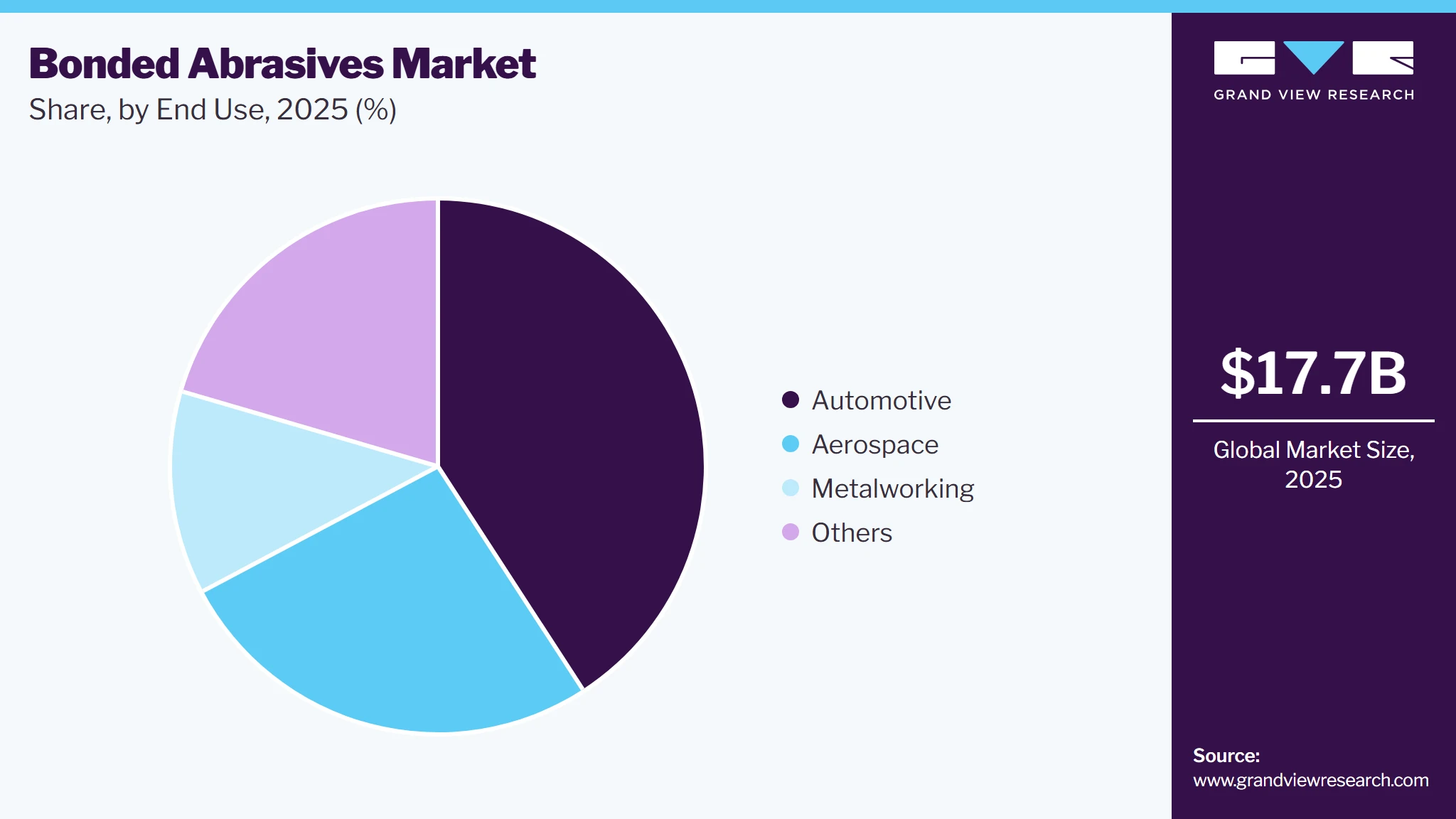
Based on end use, the automotive segment led the market with the largest revenue share of 40.8% in 2025, owing to the increasing demand for precision machining and high-performance finishing applications. The growth of the automotive industry, particularly in emerging economies, has led to a surge in vehicle production, directly influencing the demand for bonded abrasives in grinding, cutting, and surface finishing processes. The rising adoption of electric vehicles (EVs) has further accelerated the need for advanced abrasives capable of machining lightweight materials such as aluminum and composites, which are extensively used in EV manufacturing to improve efficiency and performance. Additionally, the shift toward automated manufacturing processes and Industry 4.0 integration has driven the need for high-precision bonded abrasives that ensure consistent quality and efficiency in automotive component production.
 To learn more about this report, Download Free Sample Report
 Aerospace segment is expected to grow at the fastest CAGR of 4.3% over the forecast period, driven by the increasing demand for precision-engineered components and advanced manufacturing processes. The aerospace industry requires high-performance materials such as titanium alloys, composites, and superalloys, which necessitate the use of bonded abrasives for grinding, cutting, and finishing operations. The rising production of commercial and defense aircraft, driven by growing air travel demand and military modernization programs, has led to higher consumption of bonded abrasives in component fabrication and maintenance, repair, and overhaul (MRO) activities.
Regional Insights
The North America bonded abrasives industry’s growth is driven by technological advancements in precision manufacturing and automation. The strong presence of the aerospace and defense industries fuels demand for bonded abrasives in turbine blade machining, aircraft maintenance, and composite material processing. The rising adoption of additive manufacturing (3D printing) and advanced CNC grinding machines has further increased the need for high-performance abrasives. Additionally, the growth of the automotive sector, particularly in the production of electric and autonomous vehicles, is stimulating demand for precision grinding and finishing solutions. The construction industry's focus on sustainable and energy-efficient buildings has driven the adoption of bonded abrasives in cutting and polishing concrete, glass, and ceramics.
U.S. Bonded Abrasives Market Trends
The U.S. bonded abrasives industry is influenced by high investments in industrial automation and digital manufacturing. The country's well-established aerospace and defense sector relies heavily on bonded abrasives for engine component fabrication, turbine finishing, and structural integrity maintenance. The expansion of the EV market, backed by policies like the Inflation Reduction Act (IRA) and the CHIPS Act, has led to increased demand for abrasives in battery cell manufacturing, lightweight material processing, and semiconductor production. The robust construction industry, with large-scale infrastructure projects and urban redevelopment, is another major growth driver.
Asia Pacific Bonded Abrasives Market Trends
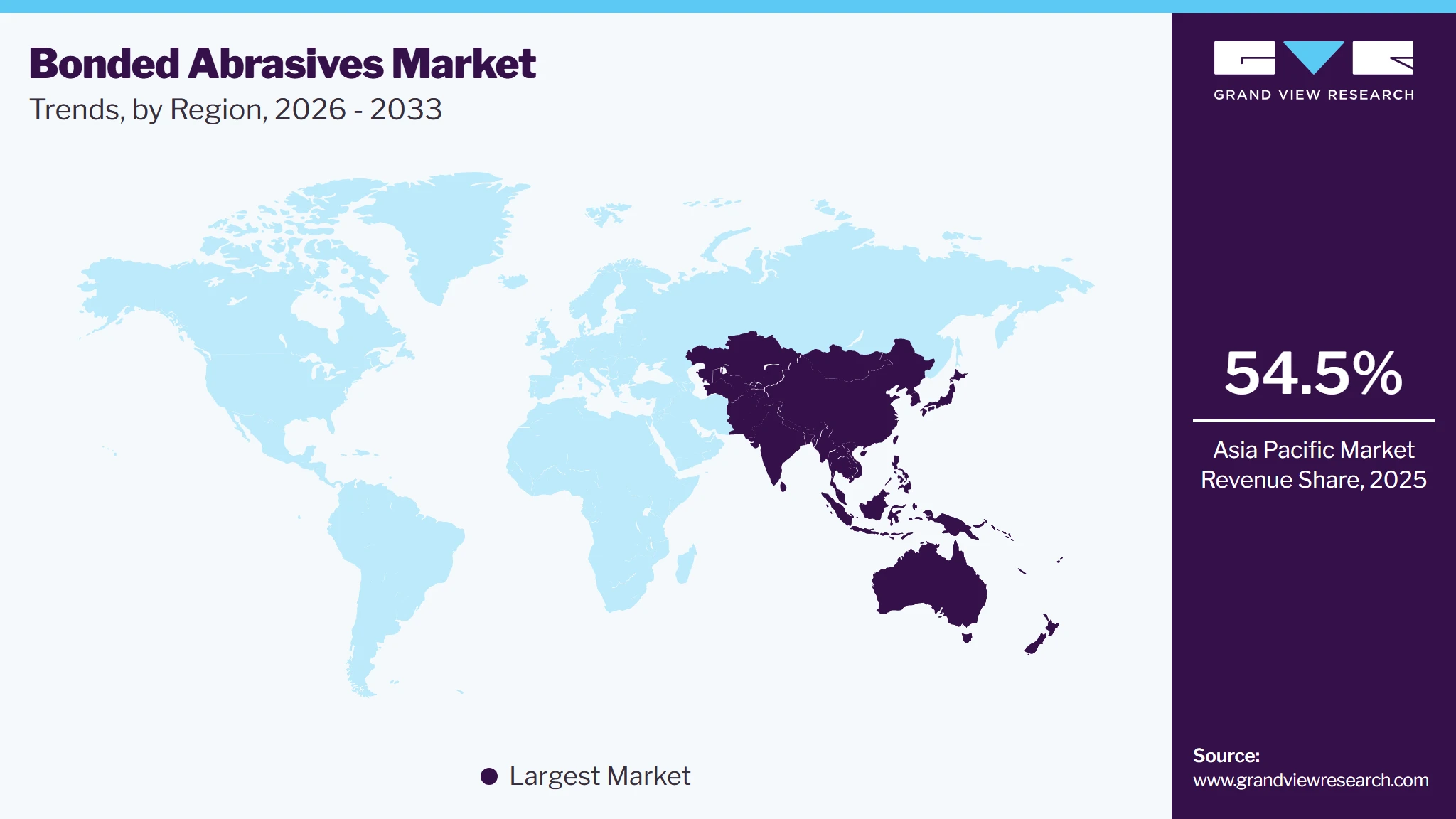
Asia Pacific dominated the bonded abrasives market with the largest revenue share of 54.5% in 2025, driven by rapid industrialization and infrastructure development, particularly in emerging economies such as India, China, and Southeast Asia. The growth of the automotive and electronics industries in the region has increased the demand for high-precision bonded abrasives for metalworking, polishing, and grinding applications. Government initiatives such as "Make in India" and "Made in China 2025" are further fueling investments in manufacturing, thereby boosting market expansion. The rising adoption of automation and smart manufacturing in key sectors, including aerospace and shipbuilding, has driven the need for high-performance bonded abrasives
 To learn more about this report, Download Free Sample Report
 The bonded abrasives market in China held the largest share in the Asia Pacific region in 2025. China is the largest consumer and producer of bonded abrasives, driven by expanding manufacturing, construction, and metal fabrication industries. The country's dominant position in steel production has significantly increased demand for bonded abrasives in grinding and cutting operations. The automotive industry, supported by the shift towards electric vehicles (EVs), requires precision abrasives for battery production, lightweight material processing, and advanced coating applications. Additionally, the aerospace and shipbuilding sectors are witnessing robust growth, necessitating high-performance bonded abrasives for precision machining. Government policies such as “Made in China 2025” promote domestic manufacturing and technological self-sufficiency, fostering investments in high-quality abrasives and automation technologies.
Europe Bonded Abrasives Market Trends
The Europe bonded abrasives industry is shaped by strong industrial and environmental regulations, driving the shift toward sustainable and advanced abrasives. The region's automotive industry, especially in Germany, France, and Italy, remains a key driver, with a strong focus on lightweight materials, electric vehicles, and precision engineering. The aerospace and defense sector, supported by companies like Airbus and Rolls-Royce, demands high-precision bonded abrasives for engine components and composite material machining. The construction industry’s emphasis on energy-efficient and green buildings has increased demand for abrasives in glass processing, concrete cutting, and tile finishing.
Germany bonded abrasives market is projected to grow during the forecast period. Germany, as a leading industrial powerhouse, drives the market growth through its advanced manufacturing, automotive, and aerospace sectors. The presence of global automakers like Volkswagen, BMW, and Mercedes-Benz has created a steady demand for bonded abrasives in precision grinding, polishing, and surface finishing. The machinery and metalworking industry, integral to Germany’s economy, further contributes to market expansion. The country’s aerospace industry, led by Airbus and other key players, requires bonded abrasives for turbine blade manufacturing and composite machining. Additionally, Germany's leadership in medical technology has increased demand for abrasives in the fabrication of high-precision surgical instruments and prosthetics.
Central & South America Bonded Abrasives Market Trends
The Central & South America bonded abrasives industry is driven by expanding automotive and metal fabrication industries, particularly in Brazil, Mexico, and Argentina. The growth of construction and infrastructure development, supported by government investments in urbanization and renewable energy projects, is significantly boosting demand. The rising adoption of automation in manufacturing is also increasing the need for high-precision abrasives. The oil and gas sector, particularly in Brazil and Venezuela, requires bonded abrasives for pipeline maintenance and metal surface preparation. Additionally, rising foreign direct investment (FDI) in industrial manufacturing is further strengthening the regional market.
Middle East & Africa Bonded Abrasives Market Trends
The Middle East & Africa bonded abrasives industry is driven by construction mega-projects, such as Saudi Arabia’s NEOM and the UAE’s smart cities initiatives. The oil and gas industry, a major economic driver in the region, heavily relies on bonded abrasives for pipeline maintenance and drilling operations. Growing manufacturing activities in Egypt, South Africa, and Turkey are further fueling demand. Additionally, the rising adoption of automation and industrial machinery is increasing the need for precision abrasives in metalworking applications. The infrastructure boom in African economies is also boosting demand for bonded abrasives in construction-related applications.
Key Bonded Abrasives Company Insights
Some of the key players operating in the bonded abrasives market include NIPPON RESIBON CORPORATION and Carborundum Universal Limited
-
NIPPON RESIBON CORPORATION is a leading manufacturer of bonded abrasives, recognized for its high-performance grinding and cutting solutions. The company focuses on innovation to develop products that enhance productivity and efficiency across various industrial applications. Its product portfolio includes cutting wheels, grinding wheels, flap discs, and flexible grinding wheels designed for metal fabrication, construction, and automotive industries.
-
Carborundum Universal Limited (CUMI), part of the Murugappa Group, is a global leader in the bonded abrasives market, offering a comprehensive range of abrasive solutions for industrial applications. The company's product offerings include vitrified and resin-bonded grinding wheels, coated abrasives, and cutting tools designed for metalworking, construction, and automotive sectors. CUMI emphasizes technological advancements to enhance product performance, ensuring precision and efficiency in grinding and finishing operations.
Buffalo Abrasives, Abrasives Manhattan are some of the emerging participants in the bonded abrasives market.
-
Buffalo Abrasives specializes in the development and manufacturing of bonded abrasive products for industrial grinding applications. The company offers a diverse range of vitrified and resin-bonded grinding wheels tailored for industries such as aerospace, automotive, and tool manufacturing.
-
Abrasives Manhattan is a well-established player in the bonded abrasives industry, known for delivering high-precision abrasive solutions for a variety of industrial sectors. The company's product range includes grinding wheels, cutting discs, and polishing abrasives, catering to industries such as metalworking, construction, and machinery manufacturing.
Key Bonded Abrasives Companies
The following key companies have been profiled for this study on the bonded abrasives market.
-
Nippon Resibon Corporation
-
Carborundum Universal Limited
-
Buffalo Abrasives
-
Abrasives Manhattan
-
Marrose Abrasives
-
Grinding Techniques Ltd
-
SAK Abrasives Limited
-
Sia Abrasives Industries AG
-
Flexovit
-
Saint-Gobain
Competitive Benchmarking
Category
Operating Strategies
Competitive Edge
Weakness
Established Players (Saint-Gobain, Flexovit, Sia Abrasives Industries AG, Carborundum Universal Limited, Nippon Resibon Corporation)
- Operate across multiple bonded abrasive product categories, including grinding, cutting, polishing, and precision finishing solutions.
- Focus on technological differentiation, premium product positioning, and expansion into high-value industrial applications.
- Leverage global manufacturing footprints and extensive distributor networks to strengthen market penetration.
- Broad product portfolios enable participation across diverse end-use industries.
- Strong technical expertise and innovation capabilities support premium pricing and customer retention.
- Well-established supply chains and distribution channels ensure consistent market coverage.
- Significant investments required for manufacturing upgrades, quality assurance, and product development.
- Vulnerable to fluctuations in industrial production cycles and raw material procurement costs.
- Managing global operations increases complexity in logistics and regulatory compliance.
Emerging & Regional Players (Buffalo Abrasives, Abrasives Manhattan, Marrose Abrasives, Grinding Techniques Ltd, SAK Abrasives Limited)
- Focus on application-driven solutions catering to regional manufacturing, fabrication, foundry, and maintenance sectors.
- Prioritize customer-centric product development, operational agility, and localized distribution strategies.
- Compete through specialized offerings and strong regional market presence.
- Close customer engagement enables rapid response to evolving industrial requirements.
- Flexible manufacturing and sales structures allow faster adaptation to market trends.
- Strong foothold in regional markets and niche application segments.
- Limited international visibility and smaller manufacturing capacities compared to major industry participants.
- Lower bargaining power in raw material sourcing and distribution negotiations.
- Dependence on regional industrial growth can create demand volatility during economic downturns.
Recent Developments
-
In July 2023, Saint-Gobain Abrasives introduced a new range of bonded abrasives specifically developed for the aerospace industry. These products are engineered to fulfil the demands of aerospace applications.
-
In May 2021, Blue Sea Capital made an investment in abrasive technology, a prominent supplier of super abrasive products catering to the dental, aerospace, medical, and industrial sectors, aiming to accelerate the company's market growth.
Bonded Abrasives Market Report Scope
Report Attribute
Details
Market definition
The market size refers to the annual sales value of bonded abrasive products used across end-use industries such as automotive, aerospace, metalworking, and others globally in a specific year.
Market size in 2025
USD 17.7 billion
Estimated market size in 2026
USD 18.5 billion
Projected market size by 2033
USD 25.0 billion
Growth rate
CAGR of 4.4% from 2026 to 2033
Base year for estimation
2025
Historical data
2021 - 2024
Forecast period
2026 - 2033
Quantitative units
Revenue in USD million and CAGR from 2026 to 2033
Report coverage
Revenue forecast, company ranking, competitive landscape, growth factors, and trends
Segments covered
Product type, end use, region
Regional scope
North America; Europe; Asia Pacific; Latin America; Middle East & Africa
Country scope
U.S.; Canada; Mexico; UK; Germany; France; Italy; Spain; China; India; Japan; South Korea
Key companies profiled
Abrasives Manhattan; Buffalo Abrasives; Carborundum Universal Limited; Flexovit; Grinding Techniques Ltd; Marrose Abrasives; Nippon Resibon Corporation; SAK Abrasives Limited; Saint-Gobain; Sia Abrasives Industries AG
Customization scope
Free report customization (equivalent up to 8 analysts' working days) with purchase addition or alteration to country, regional & segment scope.
Pricing and purchase options
Avail customized purchase options to meet your exact research needs. Explore purchase options
Global Bonded Abrasives Market Report Segmentation
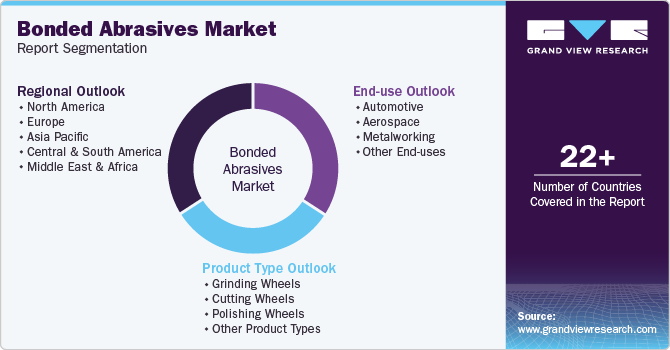
This report forecasts revenue growth at global, regional, and country levels and provides an analysis of the latest industry trends in each of the sub-segments from 2021 to 2033. For this study, Grand View Research has segmented the global bonded abrasives market report based on product type, end use, and region:
 To learn more about this report, Download Free Sample Report
 -
Product Type Outlook (Revenue, USD Million, 2021 - 2033)
-
Grinding Wheels
-
Cutting Wheels
-
Polishing Wheels
-
Other Product Types
-
-
End Use Outlook (Revenue, USD Million, 2021 - 2033)
-
Automotive
-
Aerospace
-
Metalworking
-
Other End Uses
-
-
Regional Outlook (Revenue, USD Million, 2021 - 2033)
-
North America
-
U.S.
-
Canada
-
Mexico
-
-
Europe
-
Germany
-
UK
-
France
-
Italy
-
Spain
-
-
Asia Pacific
-
China
-
Japan
-
India
-
South Korea
-
-
Central & South America
-
Middle East & Africa
-
Research Methodology
The bonded abrasives market figures in this report are based on a proven research process that combines executive interviews with secondary research from proprietary databases, company filings, and recognized regulatory and institutional sources. Market size is built through value-chain sizing - reconciling supply-side and demand-side estimates - and triangulated with bottom-up and top-down approaches. Every estimate passes multiple levels of expert validation before publication, with each bonded abrasives segment quantified using the revenue-capture definitions in the table below.
Segment Definition
Product Type
Revenue Capture Definition
Grinding Wheels
This segment includes bonded abrasive wheels used for precision grinding, surface finishing, sharpening, and material removal operations across metalworking, automotive, aerospace, and industrial manufacturing applications. Revenue is generated from the sale of vitrified, resinoid, rubber-bonded, and other grinding wheels utilized in production, maintenance, and repair activities.
Cutting Wheels
This segment comprises bonded abrasive wheels designed for cutting and slicing metals, alloys, composites, stone, and construction materials. Revenue is derived from the supply of cutting wheels used in fabrication shops, construction sites, foundries, automotive workshops, and industrial processing facilities.
Polishing Wheels
This segment includes bonded abrasive products used for polishing, deburring, smoothing, and surface enhancement applications. Revenue is generated from the sale of polishing wheels employed to improve surface finish, dimensional accuracy, and aesthetic appearance of components across various manufacturing industries.
Others
This segment covers other bonded abrasive products such as mounted points, honing stones, segments, sticks, and specialty abrasive tools. Revenue is generated from sales of these products for niche grinding, finishing, sharpening, and precision machining applications in industrial and commercial sectors.
End Use
Revenue Capture Definition
Automotive
Revenue in this segment is generated from the consumption of bonded abrasives used in vehicle manufacturing, engine component machining, transmission production, body finishing, maintenance, and repair operations. Applications include grinding, cutting, deburring, and polishing automotive components.
Aerospace
This segment includes bonded abrasives utilized in the machining and finishing of aircraft structures, turbine components, landing gear systems, and aerospace-grade materials. Revenue is derived from abrasive products used to achieve high precision, tight tolerances, and superior surface quality in aerospace manufacturing and maintenance activities.
Metalworking
Revenue is generated from bonded abrasives used in metal fabrication, foundries, steel processing, tool manufacturing, welding operations, and general industrial machining. The segment represents the largest consumption of bonded abrasive products for grinding, cutting, shaping, and finishing metal parts and components.
Others
This segment covers bonded abrasive consumption across construction, machinery manufacturing, electronics, medical devices, shipbuilding, energy, and other industrial applications. Revenue is generated from the use of bonded abrasives for material processing, maintenance, repair, and specialized finishing requirements.
Estimation Model
Layer Name
Key Question
Description
Industrial Manufacturing Demand Base Layer
What forms the demand base?
Identify demand for bonded abrasives generated from key end-use industries, including metalworking, automotive, aerospace, machinery manufacturing, construction, electronics, and maintenance & repair operations. Assess grinding, cutting, polishing, deburring, sharpening, and finishing requirements across industrial production processes. This layer establishes the total addressable demand for bonded abrasives globally.
Bonded Abrasives Production & Supply Layer
Where are bonded abrasives manufactured and supplied?
Evaluate the production and supply of bonded abrasives by analyzing manufacturing capacities, product portfolios, distribution networks, and the regional presence of key suppliers. Assess the availability of raw materials such as aluminum oxide, silicon carbide, zirconia alumina, diamond abrasives, and bonding agents, along with supply chain dynamics across major producing regions.
Application Adoption & Consumption Layer
Where are bonded abrasives utilized?
Analyze the adoption of bonded abrasives across grinding, cutting, polishing, and finishing applications within end-use industries. Evaluate usage patterns based on manufacturing output, machining requirements, precision finishing needs, maintenance activities, and industrial automation trends. Consumption levels vary according to material types and process requirements across industries and regions.
Revenue Layer
How is market revenue generated?
Market revenue is quantified through the sale of bonded abrasive products, including grinding wheels, cutting wheels, polishing wheels, mounted points, honing stones, and specialty abrasive tools. Revenue generation is influenced by product pricing, technological advancements, replacement demand, manufacturing activity, industrial investments, and end-user consumption across automotive, aerospace, metalworking, and other industrial sectors. The market size is estimated based on the annual sales value of bonded abrasive products consumed globally.
Delivered Customizations
This report has been delivered with the following In-depth customizations
Client Request
Customization Delivered
Value Adds
Regional Growth Hotspot Analysis
Identified and ranked high-growth countries and industrial clusters based on bonded abrasives consumption, manufacturing activity, automotive production, metalworking output, aerospace investments, and industrial expansion trends. Included assessment of regional demand drivers, growth rates, and future market potential.
Enabled prioritization of attractive geographic markets, supported regional expansion strategies, and identified emerging demand centers for future investments.
Import-Export Analysis, Pricing & Cost Structure Analysis
Comprehensive evaluation of global trade flows, major exporting and importing countries, trade dependencies, and supply chain dynamics. Additionally, pricing trends and cost structures were analyzed considering raw material costs, manufacturing expenses, labor, energy consumption, logistics, distribution margins, and product specifications across key regions.
Supported sourcing decisions, pricing strategy development, cost optimization initiatives, and identification of trade-related opportunities and risks across global markets.
Demand Segmentation Analysis
Detailed assessment of demand across key product categories, including grinding wheels, cutting wheels, polishing wheels, and other bonded abrasive products. Evaluated consumption patterns across automotive, aerospace, metalworking, and other industrial end-use sectors, with regional demand analysis and industry-wise adoption trends.
Enabled identification of high-growth product segments and end-use industries, supporting market entry strategies, capacity planning, and investment decisions.
Frequently Asked Questions About This Report
Asia Pacific dominated the market with a revenue share of 54.5% in 2025.
The bonded abrasives market in China held the largest share in the Asia Pacific region in 2025.
The Middle East & Africa is anticipated to register the fastest CAGR of 6.6% over the forecast period.
Based on end use, the automotive segment led the market with the largest revenue share of 40.8% in 2025.
The key players operating in the bonded abrasives market are Abrasives Manhattan, Buffalo Abrasives, Carborundum Universal Limited, Flexovit, Grinding Techniques Ltd, Marrose Abrasives, Nippon Resibon Corporation, SAK Abrasives Limited, Saint-Gobain, and Sia Abrasives Industries AG, among others.
The key factor driving the growth of the global bonded abrasives market is the increasing demand for precision grinding, cutting, and finishing solutions across automotive, metalworking, aerospace, and industrial manufacturing sectors.
The global bonded abrasives market size was valued at USD 17.7 billion in 2025 and is estimated at USD 18.5 billion for 2026.
The global bonded abrasives market is expected to grow at a CAGR of 4.4% from 2026 to 2033, reaching USD 25.0 billion by 2033.
Based on product types, the grinding wheels segment led the market with the largest revenue share of 51.1% in 2025.
About the Author(s)
Advanced Interior Materials Research Team
Advanced Materials · Advanced Interior MaterialsThis report was authored by the advanced interior materials research team at Grand View Research - comprising two research analysts, one senior research analyst, and one industry expert - with specialized expertise in the advanced interior materials segment of the advanced materials industry. All findings are based on proprietary advanced materials databases, executive interviews, and regulatory analysis, subject to internal peer review prior to publication.
Last Updated:
Speak to Analyst

Customize this report to your needs - add regions, segments, or data points, with 20% free customization.
Or view our licence options:


ISO 9001:2015 & 27001:2022 Certified
We are GDPR and CCPA compliant! Your transaction & personal information is safe and secure. For more details, please read our privacy policy.


