
- Home
- »
- Automotive & Transportation
- »
-
Brake Friction Products Market Size Report, 2026-2035GVR Report cover

Brake Friction Products Market (2026 - 2035)
Size, Share & Trends Analysis Report By Product (Brake Pads, Brake Linings, Brake Shoes, Brake Blocks), By Actuation (Hydraulic, Pneumatic, Mechanical), Vehicle, By Sales Channel, By Region, And Segment Forecasts
Market Size, 2025
$17.1BMarket Estimate, 2026
$17.9BMarket Forecast, 2035
$27.3BCAGR, 2026–2035
4.8%Brake Friction Products Market Summary
The global brake friction products market size was valued at USD 17.1 billion in 2025 and is projected to grow from USD 17.9 billion in 2026 to USD 27.3 billion by 2035, at a CAGR of 4.8% from 2026 to 2035. North America dominated the market, accounting for the largest revenue share in 2025.The increasing global vehicle production and the growing demand for replacement brake components remain the primary drivers of the brake friction products industry.
Key Market Trends & Insights
- By product: The brake pads segment held the largest market share in 2025.
- By actuation: The hydraulic segment accounted for the largest market share in 2025.
- By vehicle: The passenger carssegment held the largest market share in 2025.
Regional Highlights
- Largest regional market: Asia Pacific (largest revenue share, 2025)
- Fastest-growing regional market: North America (highest CAGR, 2026-2035)
Market Size & Forecast
- Market size in 2025: USD 17.1 Billion
- Estimated market size in 2026: USD 17.9 Billion
- Projected market size by 2035: USD 27.3 Billion
- CAGR (2026-2035): 4.8%
Prism AI by Grand View Research Free to tryAsk a question about the brake friction products marketTry asking✓Every figure cited from GVR research Prefer the report? Download free sample →
Brake pads, linings, and shoes are wear components that require periodic replacement, generating strong aftermarket demand alongside OEM installations. At the same time, governments are implementing stricter vehicle safety and environmental regulations, encouraging manufacturers to develop high-performance friction materials that offer improved stopping power, lower noise, and reduced particulate emissions. The rising adoption of electric and hybrid vehicles is also leading to a surge in the demand for friction materials that are specifically engineered to perform efficiently under regenerative braking conditions.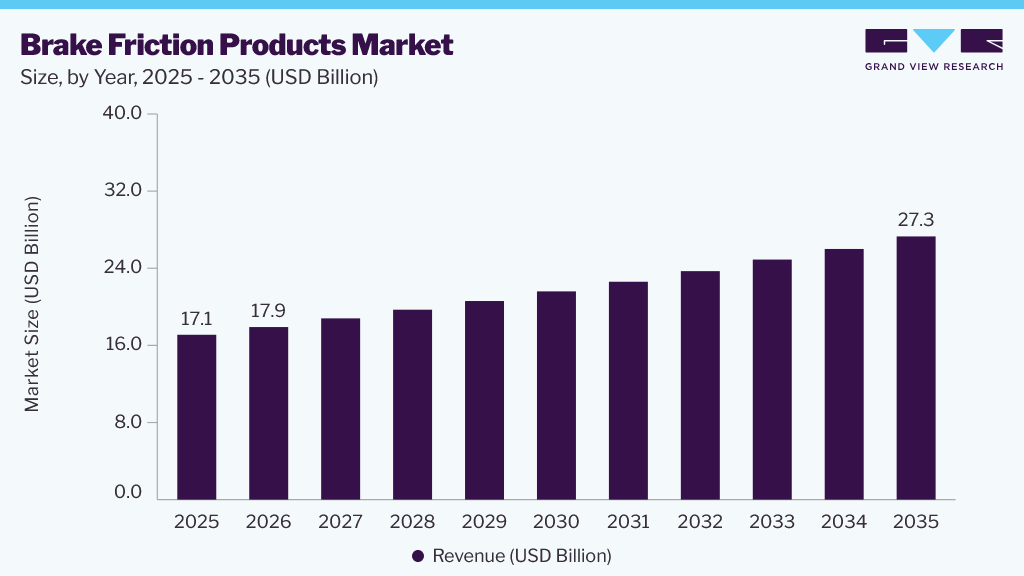 Source: Grand View Research, IR Documents, Primary Interviews, Paid DatabasesTo learn more about this report,
 Download Free Sample Report
Despite positive market fundamentals, manufacturers continue to face challenges associated with fluctuating raw material costs and increasingly stringent environmental regulations. Restrictions on copper and other hazardous substances in brake friction materials require continuous investment in research and development to identify sustainable alternatives that do not compromise braking performance. In addition, OEM qualification processes and compliance with international safety standards increase product development costs and commercialization timelines.
The market presents significant opportunities for the development of environmentally friendly brake technologies and intelligent braking systems. In February 2025, Textar, TMD Friction's premium brand, announced the expansion of its aftermarket portfolio with the addition of 157 new brake friction products, including 39 first-to-market applications, improving coverage for passenger cars, commercial vehicles, hybrid vehicles, and electric vehicles. This expansion reflects the increasing demand for advanced friction materials compatible with modern vehicle platforms.
Analyst Perspective
The brake friction products market is poised for steady growth, supported by rising global vehicle production, increasing demand for replacement brake components, and tightening vehicle safety and environmental regulations. The expansion of passenger and commercial vehicle fleets is encouraging OEMs and aftermarket suppliers to invest in advanced friction materials that enhance braking performance, reduce wear, and lower particulate emissions. This comes amidst raw material price volatility and stringent product certification requirements. Besides, the growing adoption of electric and hybrid vehicles is further reshaping product development, driving demand for low-noise, corrosion-resistant, and low-dust friction materials optimized for vehicles operating with regenerative braking systems. In parallel, evolving emission standards, including Euro 7, are accelerating the development of copper-free and environmentally sustainable friction formulations.
Product Insights
The brake pads segment accounted for the largest share of the global brake friction products market in 2025 and is expected to maintain its dominant position throughout the forecast period. Brake pads are the most widely used friction components in modern passenger cars, light commercial vehicles, and an increasing number of heavy-duty vehicles equipped with disc braking systems. Their ability to deliver consistent braking performance, superior heat dissipation, shorter stopping distances, and improved driving comfort has made them the preferred braking solution for vehicle manufacturers worldwide.
The continuous growth in global vehicle production, coupled with increasing consumer demand for enhanced safety and stricter braking performance standards, continues to support demand for advanced brake pad materials. Manufacturers are increasingly developing lightweight, copper-free, and low-noise brake pads that comply with evolving environmental regulations while maintaining high braking efficiency. The transition toward electric vehicles are also encouraging the development of new friction materials capable of performing efficiently alongside regenerative braking systems.
Supporting this trend, Brembo introduced its Greentell brake kit in April 2025, featuring advanced brake discs and pads engineered to significantly reduce particulate emissions while maintaining high braking performance. The product launch reflects the industry's increasing focus on environmentally sustainable friction materials that meet future Euro 7 emission requirements.
The disc brake product segment is expected to register the fastest CAGR during the forecast period. Disc brake systems continue to replace conventional drum brakes across passenger cars, SUVs, electric vehicles, and commercial vehicles because they provide superior braking efficiency, improved thermal management, better fade resistance, and enhanced vehicle safety. As global adoption of disc braking systems continues to expand, demand for high-performance disc brake friction materials is expected to increase substantially.
Actuation Insights
The hydraulic brake actuation segment accounted for the largest share of the global brake friction products market in 2025, supported by its widespread adoption across passenger cars, light commercial vehicles, and heavy-duty vehicles. Hydraulic systems offer proven reliability, consistent braking performance, cost effectiveness, and compatibility with established vehicle architectures, sustaining demand across both OEM and replacement markets. The continued expansion of global vehicle fleets and replacement demand for brake pads, discs, and other friction components further supports the segment’s leading position.
Though electrification is accelerating the development of alternative actuation technologies, hydraulic braking remains integral to most vehicles, including hybrids and electric vehicles, where it complements regenerative braking. In July 2025, ZF brought a comprehensive Brake-by-Wire portfolio to market, offering braking solutions that can be configured as purely electric, purely hydraulic, or combined systems. The portfolio supports the evolving requirements of software-defined, electrified, and automated vehicles, while providing greater flexibility in vehicle architecture and braking system integration.
The electric/electromechanical brake actuation segment is expected to register the fastest growth during the forecast period, driven by accelerating vehicle electrification, software-defined vehicle architectures, and increasing integration of advanced driver assistance and automated driving technologies. Electric and electromechanical actuation enables faster and more precise braking control, supports regenerative braking optimization, and offers greater flexibility in vehicle design compared with conventional hydraulic architectures.
Growing adoption of brake-by-wire systems is expected to create significant opportunities for advanced friction products designed for electronically controlled braking environments. In January 2025, ZF secured a major brake-by-wire technology contract with a global vehicle manufacturer covering nearly 5 million vehicles over the contract period. The system combines ZF’s Electro-Mechanical Brake (EMB) technology and Integrated Brake Control with traditional front calipers, creating a hybrid braking architecture that combines electromechanical and hydraulic braking. Such developments are aiding the commercialization of electromechanical brake actuation technology in passenger cars and light commercial vehicles and supporting the broader transition toward software-defined vehicle architectures.
Vehicle Insights
The passenger cars segment accounted for the largest share of the global brake friction products market in 2025. Passenger vehicles constitute the largest vehicle production category worldwide, generating substantial demand for brake pads, brake shoes, brake discs, and other friction materials across both OEM and replacement markets. Rising vehicle ownership, growing awareness of vehicle safety, and continuous advancements in braking technologies are supporting sustained demand in this segment.
Automotive manufacturers are increasingly integrating advanced driver assistance systems (ADAS), electronic stability control, automatic emergency braking, and regenerative braking technologies, driving demand for high-performance friction materials that deliver consistent braking performance under diverse operating conditions. The rapid adoption of electric and hybrid passenger vehicles is further creating opportunities for low-wear, low-noise, and lightweight brake friction technologies.
The light commercial vehicles (LCVs) segment is expected to register the fastest growth during the forecast period. The rapid expansion of e-commerce, urban logistics, last-mile delivery, and commercial transportation is increasing global demand for LCVs. These vehicles typically undergo frequent braking cycles and intensive utilization, creating strong demand for durable friction materials that can withstand higher operating loads, extend service intervals, and deliver reliable braking performance.
Sales Channel Insights
The Original Equipment Manufacturers (OEMs) segment held the largest share of the brake friction products market in 2025. Automotive manufacturers continue to source brake friction components directly from specialized suppliers to ensure compliance with stringent safety, durability, and performance standards. OEM brake systems undergo extensive validation and vehicle-specific testing, making factory-installed brake components the preferred choice for new vehicle production.
Increasing global automobile production, particularly in Asia Pacific, continues to drive OEM demand for advanced brake friction materials. Manufacturers are collaborating closely with braking technology suppliers to develop lightweight, low-emission, and high-performance braking systems that support electric vehicles, hybrid powertrains, and autonomous driving technologies.
The aftermarket segment is expected to register a notable growth rate throughout the forecast period. The steadily increasing global vehicle parc, rising average vehicle age, and regular replacement requirements for wear components continue to generate strong aftermarket demand. Brake pads and brake shoes require periodic replacement throughout a vehicle's service life, making brake friction materials one of the largest segments within the automotive replacement parts industry. Growing consumer preference for premium replacement products and expanding online distribution of automotive parts are expected to further strengthen the growth of aftermarket segment.
Regional Insights
The Asia Pacific brake friction products market accounted for the largest share of the global industry in 2025 and is expected to maintain its leadership throughout the forecast period. The region benefits from the world’s largest automotive manufacturing base, with China, Japan, India, South Korea, and Thailand producing substantial volumes of passenger cars, commercial vehicles, and two-wheelers. Strong vehicle production, expanding automotive component manufacturing, and rising demand for replacement brake components continue to support regional market growth.
Rapid urbanization, rising disposable incomes, increasing vehicle ownership, and expanding transportation infrastructure across emerging economies are strengthening both OEM and aftermarket demand. Asia Pacific has also emerged as a key manufacturing hub for global brake system suppliers, supported by well-established automotive supply chains, a skilled manufacturing base, and competitive production costs.
Regional innovation is further contributing to market development, with manufacturers investing in environmentally sustainable brake friction technologies. Nisshinbo Brake Inc., for instance, continues to develop copper-free friction materials designed to meet evolving global environmental regulations while maintaining high braking performance. Such investments highlight Asia Pacific’s growing role in the development and commercialization of advanced brake friction technologies.
North America Brake Friction Products Market Trends
The brake friction products market in North America is expected to witness the fastest CAGR during the forecast period. The growth is supported by rising production and adoption of SUVs, pickup trucks, electric vehicles, and commercial vehicles. Increasing demand for advanced braking systems, coupled with regulatory initiatives aimed at reducing non-exhaust particulate emissions, is encouraging manufacturers to develop high-performance and environmentally sustainable friction products. The growing adoption of premium ceramic brake materials is further contributing to product innovation across the region.
Increasing investments in electric mobility, the continued expansion of the automotive aftermarket, and rising consumer demand for premium braking performance are expected to strengthen market growth throughout North America. In addition, the region’s established automotive manufacturing ecosystem and strong replacement demand provide favorable conditions for the adoption of advanced brake friction technologies.
Key Brake Friction Products Company Insights
The global brake friction products market is highly competitive, with leading manufacturers focusing on advanced friction material technologies, lightweight brake components, and environmentally compliant formulations to meet evolving vehicle performance and emission standards. Companies are investing in the research and development to improve braking efficiency, durability, and noise reduction. Strategic initiatives such as product launches, partnerships with automotive OEMs, acquisitions, and expansion of aftermarket product portfolios continue to strengthen their competitive positions.
Key Brake Friction Products Companies
The following key companies have been profiled for this study on the brake friction products market:
-
Brembo N.V.
-
TMD Friction Holdings GmbH
-
Akebono Brake Industry Co., Ltd.
-
Nisshinbo Holdings Inc.
-
ZF Aftermarket
-
Tenneco Inc.
-
Bosch Mobility Aftermarket
-
Aisin Corporation
-
ITT Inc.
-
ADVICS Co., Ltd.
Recent Developments
-
In May 2026, Brembo announced that its Sensify intelligent braking system had entered serial production for a leading global vehicle manufacturer. The software-defined braking platform integrates advanced brake friction management with digital control technology, enabling next-generation driver assistance systems, supporting the development of future autonomous vehicles, and enhancing braking precision and safety.
-
In June 2026, Akebono Brake Corporation introduced six new premium brake pad part numbers across its EURO Ultra-Premium Ceramic and Severe Duty product lines. The expansion extends product coverage across European luxury vehicles, electric vehicles, heavy-duty trucks, and commercial vans, strengthening the company’s aftermarket brake friction product portfolio.
Brake Friction Products Market Report Scope
Report Attribute
Details
Market size in 2025
USD 17.1 billion
Estimated market size in 2026
USD 17.9 billion
Projected market size by 2035
USD 27.3 billion
Growth rate
CAGR of 4.8% from 2026 to 2035
Base year for estimation
2025
Actual data
2021 – 2024
Forecast period
2026 – 2035
Quantitative units
Revenue in USD billion and CAGR from 2026 to 2035
Report coverage
Revenue forecast, company ranking, competitive landscape, growth factors, and trends
Segments covered
Product, actuation, vehicle, sales channel, region
Regional scope
North America; Europe; Asia Pacific; Central & South America; Middle East & Africa
Country scope
U.S.; Canada; Mexico; UK; Germany; France; China; Japan; India; Australia; South Korea; Brazil; Argentina; South Africa; Saudi Arabia; UAE
Key companies profiled
Brembo N.V.; TMD Friction Holdings GmbH; Akebono Brake Industry Co., Ltd.; Nisshinbo Holdings Inc.; ZF Aftermarket; Tenneco Inc.; Bosch Mobility Aftermarket; Aisin Corporation; ITT Inc.; ADVICS Co., Ltd.
Customization scope
Free report customization (equivalent to 8 analyst working days) with purchase. Addition or alteration to country, regional & segment scope.
Pricing and purchase options
Avail of customized purchase options to meet your exact research needs. Explore purchase options
Global Brake Friction Products Market Report Segmentation
This report forecasts revenue growth at the global, regional, and country levels and provides an analysis of the latest industry trends and opportunities across each sub-segment from 2021 to 2035. For this study, Grand View Research has segmented the global brake friction products market report based on product, actuation, vehicle, sales channel, and region:
-
By Product Outlook (Revenue, USD Billion, 2021–2035)
-
Brake Pads
-
Brake Linings
-
Brake Shoes
-
Brake Blocks
-
Disc Brake Friction Materials
-
Drum Brake Friction Materials
-
-
By Actuation Outlook (Revenue, USD Billion, 2021–2035)
-
Hydraulic
-
Pneumatic
-
Mechanical
-
Electric/Electromechanical
-
-
By Vehicle Outlook (Revenue, USD Billion, 2021–2035)
-
Passenger Cars
-
Light Commercial Vehicles (LCVs)
-
Heavy Commercial Vehicles (HCVs)
-
Two-wheelers
-
Off-highway Vehicles
-
-
By Sales Channel Outlook (Revenue, USD Billion, 2021–2035)
-
Original Equipment Manufacturers (OEMs)
-
Aftermarket
-
-
Regional Outlook (Revenue, USD Billion, 2021 - 2035)
-
North America
-
U.S.
-
Canada
-
Mexico
-
-
Europe
-
UK
-
Germany
-
France
-
-
Asia Pacific
-
China
-
Japan
-
India
-
Australia
-
South Korea
-
-
Central & South America
-
Brazil
-
Argentina
-
-
Middle East and Africa (MEA)
-
South Africa
-
Saudi Arabia
-
UAE
-
-
Frequently Asked Questions About This Report
The global brake friction products market size was valued at USD 17.1 billion in 2025 and is estimated at USD 17.9 billion for 2026.
The global brake friction products market is expected to grow at a CAGR of 4.8% from 2026 to 2035, reaching USD 27.3 billion.
The brake pads segment accounted for the largest revenue share in 2025.
Asia Pacific dominated with the largest revenue share in 2025.
Key players in the market include Brembo N.V.; TMD Friction Holdings GmbH; Akebono Brake Industry Co., Ltd.; Nisshinbo Holdings Inc.; ZF Aftermarket; Tenneco Inc.; Bosch Mobility Aftermarket; Aisin Corporation; ITT Inc.; ADVICS Co., Ltd.
About the Author(s)
Automotive & Transportation Research Team
Technology · Automotive & TransportationThis report was authored by the automotive & transportation research team at Grand View Research - comprising two research analysts, one senior research analyst, and one industry expert - with specialized expertise in the automotive & transportation segment of the technology industry. All findings are based on proprietary technology databases, executive interviews, and regulatory analysis, subject to internal peer review prior to publication.
Last Updated:
Speak to Analyst

Customize this report to your needs - add regions, segments, or data points, with 20% free customization.
Or view our licence options:


ISO 9001:2015 & 27001:2022 Certified
We are GDPR and CCPA compliant! Your transaction & personal information is safe and secure. For more details, please read our privacy policy.


