
- Home
- »
- Nutraceuticals & Functional Foods
- »
-
Bran Market Size, Share, And Growth Report, 2026-2033GVR Report cover

Bran Market (2026 - 2033)
Size, Share & Trends Analysis Report By Source (Wheat, Rice, Corn, Barley), By Application (Food, Animal Feed, Health & Wellness), By Distribution Channel (B2B, B2C), By Region, And Segment Forecasts
Market Size, 2025
$88.9BMarket Estimate, 2026
$96.4BMarket Forecast, 2033
$170.7BCAGR, 2026–2033
8.5%Bran Market Summary
The global bran market size was valued at USD 88.9 billion in 2025 and is projected to grow from USD 96.4 billion in 2026 to USD 170.7 billion by 2033, growing at a CAGR of 8.5% from 2026 to 2033. Asia Pacific dominated the global market, accounting for the largest revenue share of 60.0% in 2025. Factors such as growing consumer inclination towards a healthy lifestyle and diet, coupled with a shift towards whole and natural foods, are major drivers of demand for bran.
Key Market Trends & Insights
- By source: The wheat bran segment dominated the market, with a revenue share of about 50.0% in 2025.
- By application: The food segment held the largest market share of over 55.0% in 2025.
- By distribution channel: The B2B segment held the largest revenue share of over 61.0% in 2025.
Regional Insights
- Largest regional market: Asia Pacific (60.0% revenue share, 2025)
- Fastest-growing regional market: Asia Pacific (highest CAGR, 2026-2033)
- By country: China held the largest market share in 2025.
Market Size & Forecast
- Market size in 2025: USD 88.9 billion
- Estimated market size in 2026: USD 96.4 billion
- Projected market size by 2033: USD 170.7 billion
- CAGR (2026-2033): 8.5%
Three ways to get this report
Buy it, customize it, or ask a question.Ask an Analyst
A direct answer, usually in 1 working day
- AccessReport author, directly
- Reply timeWithin 1 working day
- No sales callDirect answer only
- FormatEmail reply
- CostFree, no cost
Get the Full Report
What the study covers
- FormatsPDF · Excel · Dashboard
- Timeline2026–2033 annual, 2025 base
- Coverage20+ countries, 5 regions
- Companies10+ key players profiled
Customize the Report
20% free customization
- IncludeCountries, segments, points
- TailorTo your product definition
- ExtendDeeper competitor detail
- OrA fully bespoke study
- Turnaround5–10 working days
Bran is rich in antioxidants, minerals, dietary fiber, and vitamins, making it a key ingredient for promoting well-being and digestive health. Furthermore, growing consumer awareness of the importance of a high-fiber diet has prompted several companies to incorporate fiber-rich sources. Increasing concerns about the risks of lifestyle diseases, including diabetes, heart disease, and hypertension, linked to processed foods, have led to a rise in the consumption of various types of bran, including corn, rice, wheat, and barley. Additionally, the use of bran in cereal-based products can improve water absorption and reduce loaf volume in food applications such as bran flakes, pasta, noodles, and biscuits.Rising consumer interest in digestive health has increased demand for foods rich in dietary fiber and prebiotic fiber. The easy availability of prebiotic fiber and its incorporation into a wide range of products, including supplements, cereals, bread, and snacks, is driving demand for bran. For instance, in April 2025, Kellanova (formerly Kellogg’s) began manufacturing its All-Bran Fiber Plus, a ready-to-eat cereal, at its UK plant. Such developments highlight the growing demand for bran as a rich source of fiber in various food products.
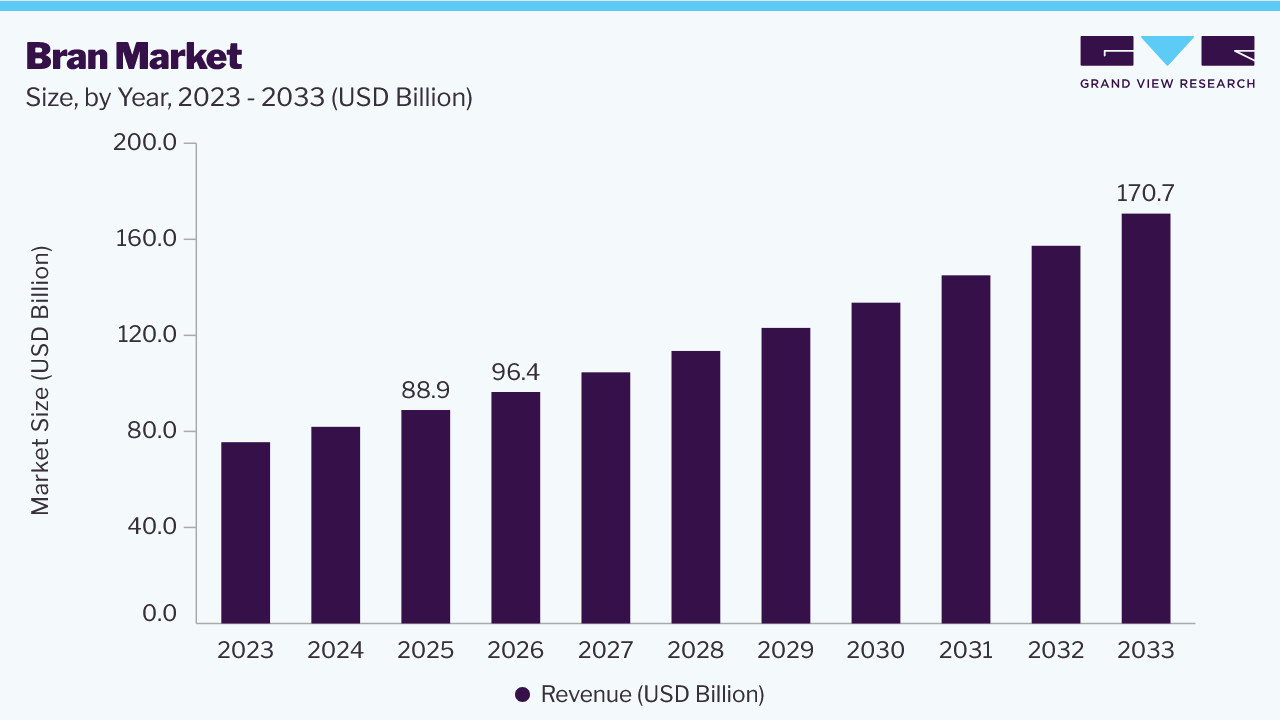 Source: Grand View Research, IR Documents, Primary Interviews, Paid DatabasesTo learn more about this report,
 Download Free Sample Report
 Rising cases of gluten intolerance and celiac disease are boosting the demand for bran derived from gluten-free grains. According to the U.S. National Institutes of Health (NIH), celiac disease affects approximately 1% of the U.S. population, and its incidence has been increasing over recent decades. As consumers increasingly seek gluten-free food alternatives, manufacturers are exploring alternative grain ingredients for bakery and functional food applications. For instance, researchers from the U.S. Department of Agriculture's Agricultural Research Service (USDA-ARS) reported that sorghum bran, a naturally gluten-free grain ingredient, can enhance the nutritional profile of gluten-free bread by increasing fiber and antioxidant content without compromising flavor, supporting its use in bakery formulations.
In addition, the rising demand for nutritious extruded snacks is driving demand for bran in the food and beverage industry. The use of bran in the production of extruded snacks benefits the products' nutrient composition by increasing levels of bioactive compounds, fiber, and protein.
Market Dynamics
The bran market is witnessing steady growth, driven by rising consumer demand for fiber-rich, functional food ingredients that support digestive health, weight management, and overall wellness. In addition, the growing popularity of clean-label and plant-based food products, along with innovation in fortified and functional foods, is further supporting market expansion.
The growing consumer focus on digestive health and balanced nutrition is a major driver of the bran market. Bran is a rich source of dietary fiber, vitamins, minerals, and bioactive compounds that support healthy digestion, bowel regularity, and overall gut health. Increasing awareness of the role of fiber in reducing the risk of constipation, obesity, cardiovascular diseases, and type 2 diabetes is encouraging consumers to incorporate fiber-rich foods into their daily diets.
The trend is particularly evident among health-conscious consumers, aging populations, and individuals seeking preventive healthcare solutions. In addition, rising demand for functional foods, breakfast cereals, bakery products, and nutritional supplements containing natural fiber ingredients supports bran consumption across developed and emerging markets. For instance, in March 2026, WK Kellogg launched its Fiber Hacks campaign, highlighting fiber-rich cereals such as All-Bran Original, Raisin Bran, Frosted Mini-Wheats, and Kashi GO to help consumers increase dietary fiber intake, reflecting the growing consumer demand for fiber-rich food products that support digestive wellness.
Fluctuating availability of cereal grains and sensory limitations associated with bran remain significant restraints for the bran market. Bran is primarily obtained during the milling of wheat, rice, oats, corn, and other cereals, making its supply dependent on agricultural production, weather conditions, and grain price fluctuations. Variability in raw material availability can impact production costs and supply chain stability for manufacturers.
The incorporation of bran into food products may affect texture, taste, color, and shelf life, creating formulation challenges for food manufacturers. High levels of bran can produce a denser texture and alter the sensory profile of bakery and snack products, potentially affecting consumer acceptance. Furthermore, manufacturers often incur additional processing and formulation costs to maintain product quality while achieving desired fiber content, which may limit broader adoption in certain applications.
The growing market for functional foods and clean-label nutrition is creating significant opportunities for the bran market. Consumers increasingly seek natural ingredients that deliver nutritional benefits beyond basic nutrition, driving demand for bran-enriched foods and beverages. Bran contains dietary fiber, antioxidants, phenolic compounds, and essential micronutrients, aligning with consumer preferences for minimally processed, health-promoting ingredients.
Advancements in food processing technologies are enabling manufacturers to improve the functionality, taste, and texture of bran-based ingredients, expanding their use across bakery products, cereals, snacks, dairy alternatives, and nutritional supplements. In March 2023, scientists from Sweden developed an upcycled wheat bran gel. This gel can be used to improve the texture of plant-based food. In addition, the rising popularity of plant-based diets and preventive healthcare is encouraging the development of innovative bran-fortified products targeting digestive health, weight management, and heart health. As consumers continue to prioritize natural, nutrient-dense food choices, the integration of bran into functional and clean-label product formulations is expected to create substantial growth opportunities over the forecast period.
Analyst Perspective
The artemisinin market is experiencing steady growth due to the persistent global burden of malaria and rising demand for artemisinin-based combination therapies (ACTs). Government initiatives and investments by global health organizations continue to support market expansion. Advances in semi-synthetic artemisinin production are improving supply stability and manufacturing efficiency. Despite challenges such as raw material dependency and regulatory requirements, ongoing malaria control and elimination programs are expected to drive sustained market growth, particularly in endemic regions.
Source Insights
By source, the wheat bran segment holds the largest share of approximately 50.0% in 2025, owing to rising applications of wheat bran in diverse applications. Changing dietary patterns, coupled with lifestyle changes, are driving demand for fiber-rich wheat bran products. In addition, advances in milling technology and machinery have also boosted the segment. For instance, Choyal Group, an India-based provider of flour-grinding tools, uses its patented technology to make flour accessible to companies that use its custom-ground-to-order tools. Furthermore, the widespread availability of wheat as a raw material and the increasing incorporation of wheat bran into bakery products, breakfast cereals, nutritional supplements, and animal feed applications are further supporting the segment's growth.
The rice bran segment showcased the fastest CAGR during the forecast period. Rice bran has a high caloric content, protein, vital fatty acids, and minerals in its nutritional profile. It contains sufficient nutrients to encourage animal growth, development, and overall health. Multiple research studies and initiatives on the use of rice bran in animal health are positively impacting the segment’s growth. For instance, a study by the University of Illinois at Urbana-Champaign showed that using stabilized rice bran in piglet diets can improve the growth-to-feed ratio and increase benefits without antibiotics. By source, the market is segmented into wheat, rice, corn, barley, and others.
Application Insights
The food application segment dominated the market in 2025, accounting for approximately 48.0% of overall revenue. The rising trend of incorporating fiber-rich grains into baked goods is expected to drive demand for bran. The use of bran in baked goods enables manufacturers to increase fiber content, thereby encouraging consumers to increase their fiber intake. By using bran, the bakery industry can offer products that support a healthy diet and address the needs of consumers concerned about fiber intake. For instance, in July 2025, Kellanova commenced production of its new Kellogg’s All-Bran Fibre Plus cereal at its expanded manufacturing facility in Wrexham, UK, reflecting growing investment in bran-based and high-fiber food products to meet rising consumer demand for digestive health and fiber-rich nutrition.
The functional food blend contains the lactic strain Plasma and dietary fiber derived from wheat bran. The breakfast cereals segment is expected to expand significantly during the forecast period, driven by growing awareness of their nutritional benefits, diverse flavors, and ease of use in meals. For instance, in January 2026, Kellogg’s announced the launch of its new cereal, Raisin Bran cereals. In addition, heavy marketing by companies operating in the industry is also creating awareness among consumers, thereby associating bran-based products with health and wellness.
Distribution Channel Insights
The B2B segment dominated the global industry in 2025, accounting for more than 61.0% of overall revenue. The growing demand for healthier food products has prompted manufacturers to seek bran to enhance the nutritional profiles of their products. In addition, the easy incorporation of bran in snacks, cereals, animal feed, and baked goods drives the demand for bran. Food manufacturers catering to specific dietary needs incorporate bran into their products to meet the needs of these consumer segments. Furthermore, the increasing demand for clean-label, fiber-enriched, and functional food products among health-conscious consumers is encouraging food manufacturers to incorporate bran into a wider range of product formulations, further supporting segment growth.
The B2C segment is expected to grow at a CAGR of approximately 8.5% over the forecast period. The B2C segment includes online channels, supermarkets, hypermarkets, specialty stores, and other convenience stores. The availability of a wide range of bran products from various brands and suppliers on the online channel has driven demand. Consumers can easily compare prices, access reviews, and select from a diverse range of bran options, including wheat bran and oat bran. This accessibility and variety offered by the online channel play a significant role in driving the demand for bran.
Regional Insights
The North America bran market is expected to grow at a steady pace from 2026 to 2033, primarily driven by strong market penetration in developed economies such as the U.S. and Canada. Consumers in these regions are willing to pay higher prices for products made with natural and organic ingredients. Moreover, corn bran is widely used as an ingredient in household applications, further driving market expansion. The increased use of corn bran across a variety of applications is a key driver of its market growth.
Europe Bran Market Trends
Europe is expected to witness steady growth driven by rising consumer awareness and demand for naturally sourced food products. The growing consumption of breakfast cereals and rising awareness towards sustainably sourced ingredients are the primary factors driving the demand for bran in the region. For instance, introducing new flavors, textures, and blends of breakfast cereals aims to attract consumers.
Asia Pacific Bran Market Trends
The Asia Pacific market held a dominant revenue share of approximately 60.0% in 2025, owing to the region’s large grain production capacity, coupled with favorable farming conditions for crops such as wheat, rice, and other grains. In addition, the growing population, coupled with changing dietary preferences, is influencing demand for bran derivatives in the region. The demand for rice bran oil in India has surged due to disruptions in oil storage and supply. In response to the rising urban demand, companies such as Emam, Adani Wilmar, and Cargill's India-based unit have launched their own rice bran oil brands. This demonstrates their recognition of market potential and their efforts to cater to evolving consumer preferences.
 To learn more about this report, Download Free Sample Report
 Furthermore, the China bran market held the largest revenue share in Asia Pacific owing to a large consumer base and rising demand for bran-based products. Favorable government initiatives, coupled with rising consumer demand for healthier oils, are driving demand for bran in the country. For instance, according to a 2025 study published in Elsevier, China remains the world's largest rice producer, accounting for approximately 27% of global rice production with an estimated output of 145.3 million metric tons, creating substantial availability of rice bran for use in food, edible oil, and nutraceutical applications.
Key Bran Company Insights
Competition among companies is expected to be intense in the global bran market, primarily due to the presence of numerous players. In response to changing consumer trends, several companies are expanding their product portfolios to gain a competitive advantage.
Key Bran Companies
The following key companies have been profiled for this study on the bran market:
-
Ardent Mills
-
Riceland Foods.
-
Wilmar International Ltd
-
ADM
-
Hindustan Animal Feeds
-
Astra Alliance
-
Siemer Milling Company
-
DIDION Inc.
-
Grain Millers Inc.
-
Grain Processing Corporation
Recent Developments
-
In July 2025, Ardent Mills entered into an agreement to acquire a specialty grain-cleaning facility, Stone Mill, to strengthen its portfolio of specialty grains and nutrition ingredients and expand its capabilities in value-added grain solutions. This acquisition is expected to enhance the company’s ability to meet the growing demand for fiber-rich, functional food ingredients across diverse food applications.
-
In May 2025, Ardent Mills launched Cocoa Replace, a wheat-based ingredient solution designed to partially replace cocoa powder in bakery and snack applications. The launch strengthens the company’s portfolio of value-added wheat-derived ingredients and supports manufacturers in addressing cocoa supply and cost challenges.
Bran Market Report Scope
Report Attribute
Details
Market size in 2025
USD 88.9 billion
Estimated Market size in 2026
USD 96.4 billion
Projected Market size by 2033
USD 170.7 billion
Growth rate
CAGR of 8.5% from 2026 to 2033
Base year for estimation
2025
Actual data
2021 - 2024
Forecast period
2026 - 2033
Quantitative units
Revenue in USD billion, and CAGR from 2026 to 2033
Report coverage
Revenue forecast, company ranking, competitive landscape, growth factors, and trends
Segments covered
Source, application, distribution channel, region
Regional Scope
North America; Europe; Asia Pacific; Central & South America; Middle East & Africa
Country scope
U.S.; Canada; Mexico; UK; Germany; France; Italy; Spain; China; India; Japan; Australia & New Zealand, South Korea; Brazil; Argentina, South Africa, UAE
Key companies profiled
Ardent Mills; Riceland Foods.; Wilmar International Ltd; ADM; Hindustan Animal Feeds; Astra Alliance; Siemer Milling Company; DIDION Inc.; Grain Millers Inc.; Grain Processing Corporation.
Customization scope
Free report customization (equivalent up to 8 analysts working days) with purchase. Addition or alteration to country, regional & segment scope.
Pricing and purchase options
Avail of customized purchase options to meet your exact research needs. Explore purchase options
Global Bran Market Report Segmentation
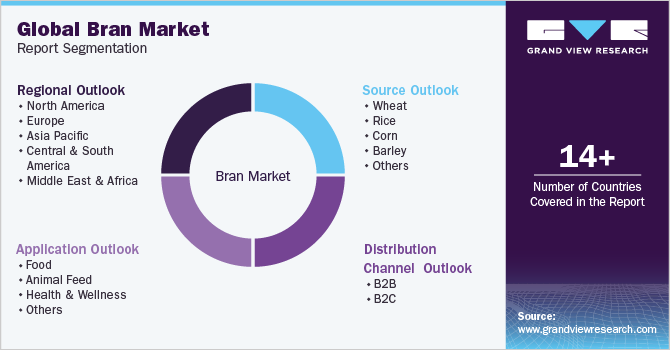
This report forecasts revenue growth at global, regional, and country levels and provides an analysis of the latest trends in each of the sub-segments from 2021 to 2033. For the purpose of this study, Grand View Research has segmented the global bran market report based on source, application, distribution channel, and region:
 To learn more about this report, Download Free Sample Report
 -
Source Outlook (Volume, Kilo Tons; Revenue, USD Billion; 2021 - 2033)
-
Wheat
-
Rice
-
Corn
-
Barley
-
Others
-
-
Application Outlook (Volume, Kilo Tons; Revenue, USD Billion; 2021 - 2033)
-
Food
-
Bakery goods
-
Breakfast cereals
-
Pasta & noodles
-
Oil
-
Others
-
-
Animal Feed
-
Health & Wellness
-
Others
-
-
Distribution Channel Outlook (Volume, Kilo Tons; Revenue, USD Billion; 2021 - 2033)
-
B2B
-
B2C
-
Online Sales
-
Hypermarkets/ Supermarkets
-
Specialty Stores
-
Others
-
-
-
Regional Outlook (Volume, Kilo Tons; Revenue, USD Billion; 2021 - 2033)
-
North America
-
U.S.
-
Canada
-
Mexico
-
-
Europe
-
Germany
-
France
-
UK
-
Italy
-
Spain
-
-
Asia Pacific
-
China
-
India
-
Japan
-
Australia & New Zealand
-
South Korea
-
-
Latin America
-
Brazil
-
Argentina
-
-
Middle East & Africa
-
South Africa
-
UAE
-
-
Frequently Asked Questions About This Report
The global bran market size was valued at USD 88.9 billion in 2025 and is projected to grow from USD 96.4 billion in 2026.
The global bran market is expected to grow at a CAGR of 8.5% from 2026 to 2033, reaching USD 170.7 billion.
Asia Pacific dominated with a revenue share of 60.0% in 2025.
Some of the key market players in the bran market are Ardent Mills,Riceland Foods, Inc , Wilmar International Limited , Archer Daniels Midland Company , Hindustan Animal Feeds, Astra Alliance, Siemer Milling Company, Didion Inc., Grain Millers Inc, and Grain Processing Corporation
Wheat bran segment dominated the container security market with a share of 50.0% in 2025, while rice bran is the fastest-growing segment.
About the Author(s)
Nutraceuticals & Functional Foods Research Team
Consumer Goods · Nutraceuticals & Functional FoodsThis report was authored by the nutraceuticals & functional foods research team at Grand View Research - comprising two research analysts, one senior research analyst, and one industry expert - with specialized expertise in the nutraceuticals & functional foods segment of the consumer goods industry. All findings are based on proprietary consumer goods databases, executive interviews, and regulatory analysis, subject to internal peer review prior to publication.
Last Updated:
Speak to Analyst

Customize this report to your needs - add regions, segments, or data points, with 20% free customization.
Or view our licence options:


ISO 9001:2015 & 27001:2022 Certified
We are GDPR and CCPA compliant! Your transaction & personal information is safe and secure. For more details, please read our privacy policy.


