
- Home
- »
- Medical Devices
- »
-
Breast Ultrasound Market Size, Share & Growth Report, 2033GVR Report cover

Breast Ultrasound Market (2026 - 2033)
Size, Share & Trends Analysis Report By Product (Conventional Breast Ultrasound (CBUS), Automated Breast Ultrasound (ABUS)), By End Use (Hospital, Diagnostics Imaging Laboratories), By Region, And Segment Forecasts
Market Size, 2025
$2.6BMarket Estimate, 2026
$3.0BMarket Forecast, 2033
$7.6BCAGR, 2026–2033
14.2%Breast Ultrasound Market Summary
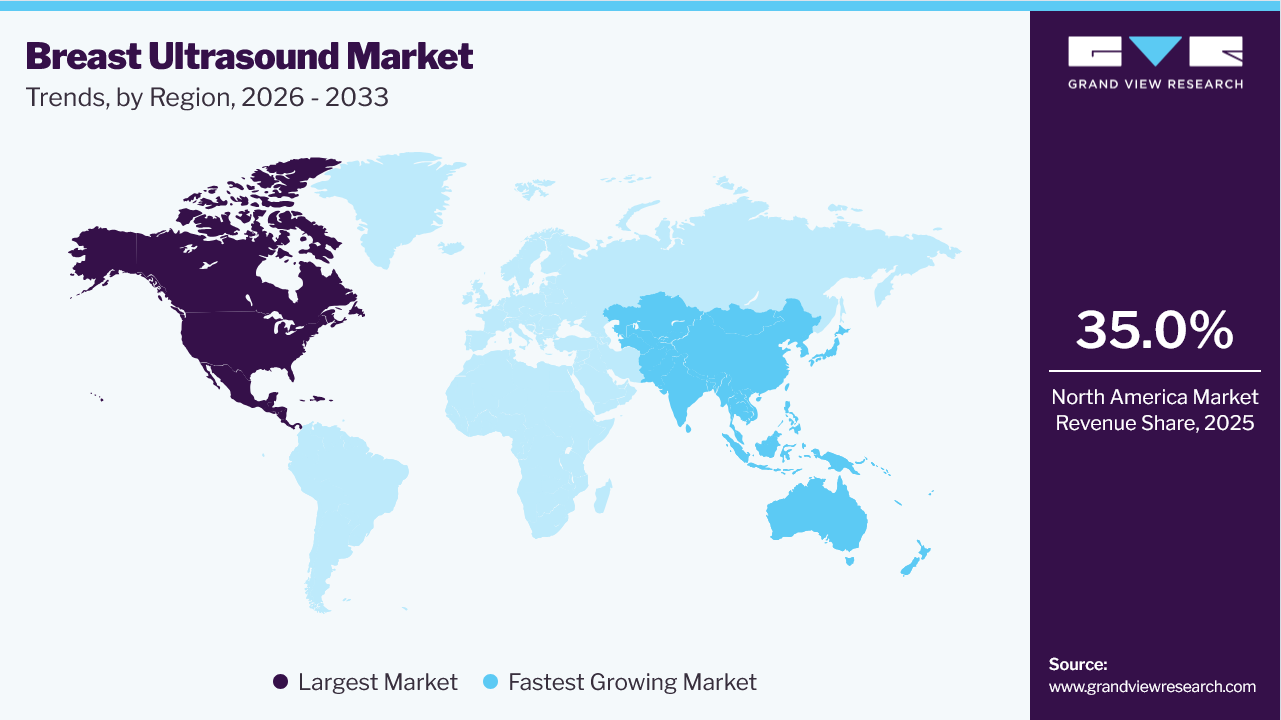
The global breast ultrasound market size was estimated at USD 2.6 billion in 2025 and is projected to grow from USD 3.0 billion in 2026 to USD 7.6 billion by 2033, growing at a CAGR of 14.2% from 2026 to 2033. North America dominated the market, accounting for a revenue share of 35.0% in 2025. The increasing incidence of breast cancer, rise in demand for breast ultrasound, technological advancements, and various awareness initiatives undertaken by the governments and non-profit organizations are among the factors driving the market growth.
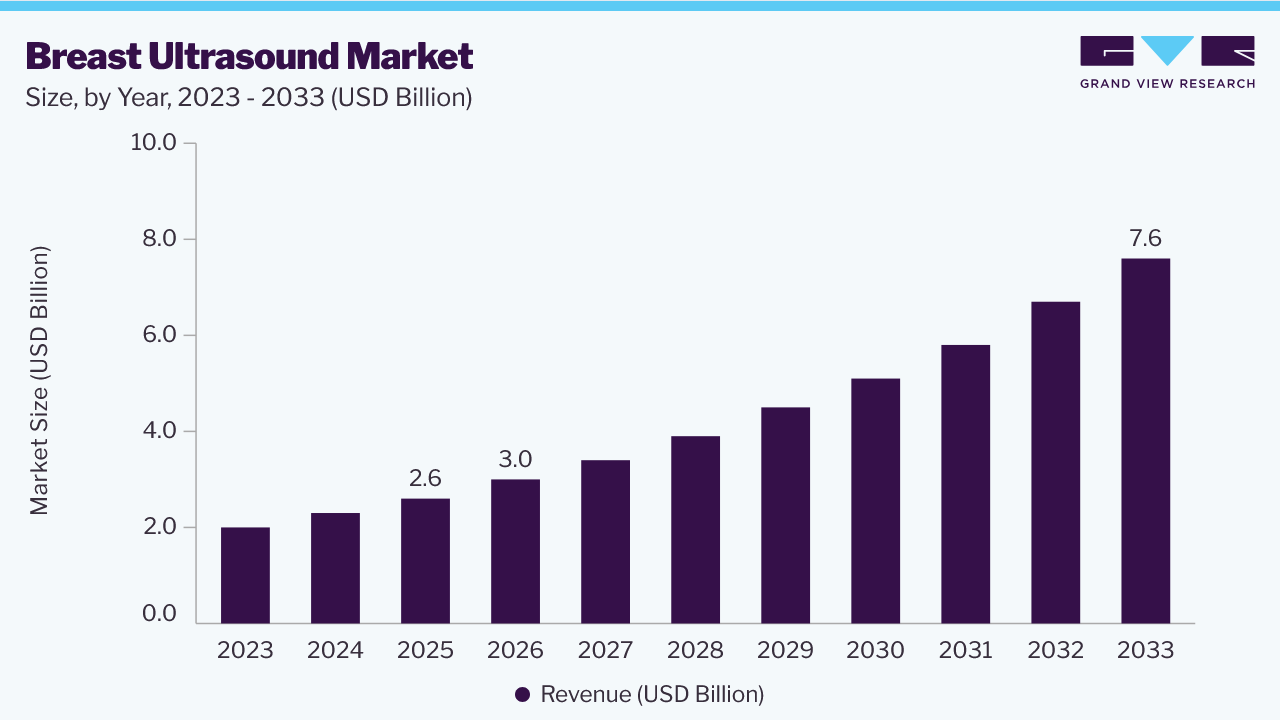 Source: Grand View Research, IR Documents, Primary Interviews, Paid DatabasesTo learn more about this report,
 Download Free Sample Report
Key Market Trends & Insights
- By product: The automated breast ultrasound (ABUS) segment dominated the market, with a revenue share of about 64.0% in 2025.
- By end use: The hospitals segment held the largest revenue share of over 48.0% in 2025.
Regional Highlights
- Largest regional market: North America (35.0% revenue share, 2025)
- Fastest-growing regional market: Asia Pacific (Highest CAGR, 2026-2033)
Market Size & Forecast
- Market size in 2025: USD 2.6 Billion
- Estimated market size in 2026: USD 3.0 Billion
- Projected market size by 2033: USD 7.6 Billion
- CAGR (2026-2033): 14.2%
Three ways to get this report
Buy it, customize it, or ask a question.Ask an Analyst
Analyst response in 1 business day
- AccessReport author, directly
- Reply timeWithin 1 working day
- No sales callDirect answer only
- FormatEmail reply
- CostFree, no cost
Get the Full Report
What the study covers
- FormatsPDF · Excel · Dashboard
- Timeline2026–2033 annual, 2025 base
- Coverage20+ countries, 5 regions
- Companies10+ key players profiled
Customize the Report
20% free customization
- IncludeCountries, segments, points
- TailorTo your product definition
- ExtendDeeper competitor detail
- OrA fully bespoke study
- Turnaround5–10 working days
According to an article published by NBC UNIVERSAL in April 2024, experts from the U.S. Preventive Services Task Force (USPSTF) recommended that people with breasts undergo an annual mammogram starting at age 40. The rising prevalence of breast cancer across the globe is anticipated to fuel product demand. Cancer is one of the leading causes of death globally, and breast cancer is the second most common cancer worldwide. In the case of women, breast cancer tops the list of most prevalent cancers.
Rise in sedentary lifestyle, obesity, and changes in eating habits are some of the major factors contributing to breast cancer. Moreover, rising alcohol consumption is also expected to increase the risk of disease. The risk increases by around 7% to 10% per unit of alcohol consumption per day. Such an increasing prevalence of the disease is expected to boost the demand for breast ultrasound shortly.
Due to the rising demand for the prevention and treatment of this disease, key companies and research organizations are launching technologically advanced products to strengthen their foothold in the breast ultrasound market. Furthermore, the American Cancer Society's Cancer Facts & Figures 2025 estimated that more than 316,950 new invasive breast cancer cases would be diagnosed among women in the U.S. in 2025, underscoring the continued need for advanced breast imaging technologies.
In addition, the growing prevalence of dense breast tissue among women and increasing awareness regarding supplemental screening are further driving market growth. Mammography often has reduced sensitivity in women with dense breast tissue, making breast ultrasound an important complementary imaging modality for early lesion detection. According to the U.S. FDA’s breast density notification rule, effective September 2024, mammography facilities are required to inform patients about breast density, increasing awareness regarding supplemental screening options such as breast ultrasound. This regulatory development is expected to support the adoption of breast ultrasound over the forecast period.
Analyst Perspective
The breast ultrasound market is expected to grow steadily, driven by rising breast cancer incidence, increasing awareness of early detection, and growing use of supplemental screening for dense breast tissue. Technological advancements in automated breast ultrasound systems (ABUS), 3D imaging, and AI-enabled image analysis are improving diagnostic accuracy and workflow efficiency. Personalized healthcare, evolving screening recommendations, favorable reimbursement policies, and rising healthcare investments are further supporting market expansion. Leading manufacturers are focusing on product innovation and portfolio expansion, while increasing adoption of AI-powered and automated imaging solutions is creating new growth opportunities.
Product Insights
The automated breast ultrasound (ABUS) segment dominated the market, accounting for approximately 64.0% in 2025, owing to its growing adoption in supplemental breast cancer screening, continuous technological advancements, favorable regulatory approvals, and user-friendly workflow features. Various advantages of automated breast ultrasound, including improved reproducibility, reduced operator dependency, and enhanced imaging consistency, are promoting device adoption and fueling market growth. In addition, growing awareness regarding dense breast tissue screening is supporting segment growth. Mammography has reduced sensitivity in individuals with dense breast tissue, increasing the need for supplemental screening modalities such as automated breast ultrasound. Ongoing advancements in breast imaging technologies and favorable regulatory support are expected to improve diagnostic accuracy and operational efficiency, thereby supporting continued growth in the breast ultrasound market.
The conventional breast ultrasound (CBUS) segment is expected to grow at the fastest CAGR over the forecast period due to its cost-effectiveness, widespread availability, and strong adoption across hospitals and diagnostic imaging centers for routine breast examinations. Conventional breast ultrasound is widely used for detecting tumors, cysts, and other breast abnormalities, particularly as a complementary imaging tool alongside mammography. Many healthcare providers continue to rely on conventional ultrasound systems due to their lower cost, operational flexibility, and ease of integration into existing diagnostic workflows, particularly in emerging markets. For instance, Canon Medical continues to strengthen its conventional ultrasound portfolio with advanced imaging systems such as the Aplio series, which support high-resolution breast imaging and improved diagnostic confidence. The continued use of conventional breast ultrasound for early detection and diagnostic evaluation is expected to support segment growth over the forecast period.
End Use Insights
The hospitals segment dominated the market, accounting for 48.0% of the market in 2025. Several hospitals are expanding their breast imaging and oncology capabilities by adopting advanced breast ultrasound systems to improve early detection and diagnostic accuracy. For instance, Moffitt Cancer Center expanded its breast imaging services to enhance early detection of breast cancer and improve access to advanced diagnostic technologies, supporting the growing use of breast ultrasound in hospital settings. The growing adoption of advanced breast ultrasound systems by hospitals, supported by increasing investments in diagnostic infrastructure and cancer care services, is expected to drive segment growth over the forecast period.
The diagnostics imaging laboratories segment is expected to grow at the fastest CAGR over the forecast period due to the increasing number of diagnostic centers, rising demand for imaging techniques, and high global prevalence of the disease. Strategic collaborations between imaging providers and technology companies are further enhancing diagnostic efficiency and supporting segment growth. For instance, in April 2026, GE HealthCare and RadNet's Deep Health expanded their collaboration to deploy AI-powered breast imaging solutions globally. The partnership combines GE HealthCare's mammography systems with DeepHealth's AI technologies to enhance breast cancer screening accuracy, optimize workflows, and improve patient outcomes across diagnostic imaging centers and radiology networks. The integration of AI-powered breast imaging solutions and the continued expansion of diagnostic imaging networks are expected to strengthen the role of imaging laboratories in breast cancer diagnosis, thereby supporting the fastest growth of this segment over the forecast period.
Regional Insights
The North America breast ultrasound industry accounted for the largest revenue share in the global market with a share of approximately 35.0% in 2025, owing to its well-established healthcare infrastructure, high screening awareness, and strong adoption of advanced diagnostic imaging technologies. The rising prevalence of breast cancer in the region, attributed to lifestyle-related risk factors such as smoking, obesity, and physical inactivity, along with supportive government initiatives and increasing healthcare expenditure, is driving market expansion. Expanding insurance coverage for breast ultrasound examinations, coupled with regulatory initiatives promoting breast density notification, is further accelerating the adoption of advanced breast imaging technologies across the region. For instance, in April 2026, Dense Breast-info highlighted that 38 states and Washington, D.C., had implemented expanded insurance laws for breast imaging, while new HRSA guidelines mandated no-cost coverage for supplemental imaging procedures, including ultrasound, for eligible individuals. These measures aim to reduce financial barriers and improve access to early breast cancer detection.
 To learn more about this report, Download Free Sample Report
U.S. Breast Ultrasound Market Trends
The breast ultrasound industry in the U.S. dominated North America with a share of around 78.0% in 2025 due to the presence of world-class medical facilities, renowned diagnostic centers, and the increasing prevalence of breast cancer, leading to rising demand for breast examinations. For instance, the American Cancer Society projected that around 310,720 cases of invasive breast cancer and approximately 56,500 cases of non-invasive breast cancer would be identified in the U.S. in 2024.
Europe Breast Ultrasound Market Trends
The breast ultrasound industry in Europe is anticipated to grow significantly in the coming years, owing to the presence of leading market players, supportive government initiatives, and increasing investments in healthcare infrastructure. Rising awareness regarding early breast cancer detection and the growing adoption of advanced diagnostic imaging technologies are further supporting market growth across the region. For instance, leading companies such as Hologic and Siemens Healthineers are expanding the adoption of advanced breast imaging solutions across European healthcare facilities to improve diagnostic accuracy and workflow efficiency. These developments are supporting the broader adoption of advanced breast imaging technologies, including breast ultrasound, across the region. Ongoing technological advancements, strong industry collaborations, and favorable healthcare initiatives are expected to improve access to breast imaging services and strengthen the adoption of breast ultrasound systems, supporting continued market growth in Europe.
Asia Pacific Breast Ultrasound Market Trends
The breast ultrasound industry in the Asia Pacific is expected to grow at the fastest CAGR over the forecast period, owing to rising awareness regarding breast cancer screening and early diagnosis, along with improving access to healthcare services across the region. Continuous product innovations and the integration of AI-enabled imaging solutions by leading manufacturers are enhancing diagnostic capabilities and accelerating the adoption of breast ultrasound systems. For instance, in November 2025, Samsung India launched the R20 ultrasound system powered by next-generation AI technologies. The platform incorporates Live BreastAssist, an AI-based tool that enables real-time breast lesion detection with BIRADS classification and reporting, enhancing diagnostic accuracy and workflow efficiency. Samsung stated that the R20 is designed to provide superior image quality across a wide range of applications, including breast imaging. The growing availability of technologically advanced ultrasound systems and increasing investments in breast cancer screening and diagnostic infrastructure are expected to drive the adoption of breast ultrasound technologies and support rapid growth in the Asia Pacific market.
Latin America Breast Ultrasound Market Trends
The breast ultrasound industry in Latin America is expected to witness steady growth over the forecast period, driven by rising awareness regarding early breast cancer detection, improving access to diagnostic imaging services, and increasing healthcare investments across the region. The growing prevalence of breast cancer, coupled with expanding government-led screening initiatives, is accelerating the demand for advanced breast imaging technologies. In addition, the adoption of technologically advanced ultrasound systems by hospitals and diagnostic imaging centers is improving diagnostic efficiency and supporting market growth. Ongoing improvements in healthcare infrastructure, along with increasing investments in cancer care and diagnostic services, are expected to strengthen the adoption of breast ultrasound systems and support continued market expansion in Latin America.
Middle East and Africa Breast Ultrasound Market Trends
The breast ultrasound industry in the Middle East and Africa is anticipated to grow significantly over the forecast period. Authorities in the region are taking various strategic initiatives to strengthen cancer detection and treatment. Organizations' adoption of advanced technologies contributes to market growth in the region. For instance, in July 2024, Qatar's Primary Health Care Corporation (PHCC) began implementing an AI-powered breast cancer detection solution, Lunit INSIGHT MMG, to improve early detection. The increasing deployment of AI-enabled diagnostic solutions and growing investments in cancer screening infrastructure are expected to improve early detection rates and support the adoption of advanced breast imaging technologies, thereby driving the growth of the Middle East and Africa breast ultrasound market over the forecast period.
Key Breast Ultrasound Company Insights
Some of the key companies in the breast ultrasound market include GE Healthcare, Koninklijke Philips N.V., Siemens Healthineers AG, Canon Inc., Telemed Medical Systems Srl, Hologic, Inc., FUKUDA DENSHI, SuperSonic Imagine, Lunit Inc., and Samsung Healthcare. Organizations are focusing on increasing their customer base to gain a competitive edge in the industry. Therefore, key players are taking several strategic initiatives, such as mergers and acquisitions, and partnerships with other major companies.
- GE HealthCare is a company that deals with medical technology, intelligent devices, and care solutions with an extensive range of products and services. The company offers mammography solutions under the imaging category of the product segment. In contrast, the ultrasound category includes systems such as the Voluson Women's Health Ultrasound for detecting early-stage cancer.
- Hologic, Inc. specializes in women's health products, such as breast health, sexual health, and gynecological health. The breast health segment includes a variety of devices in categories such as biopsy, diagnostics, screening, and others. The company provides various devices and software systems for diagnosing breast cancer and other abnormalities.
Key Breast Ultrasound Companies
The following key companies have been profiled for this study on the breast ultrasound market:
-
GE HealthCare.
-
Koninklijke Philips N.V.
-
Siemens Healthineers AG
-
Canon Inc.
-
Telemed Medical Systems Srl
-
Hologic, Inc.
-
FUKUDA DENSHI
-
SuperSonic Imagine
-
Lunit Inc.
-
SamsungHealthcare.com
Recent Developments
- In April 2026, Lunit announced that its AI-powered breast imaging ecosystem had expanded to more than 330 screening sites and supported approximately one million annual mammograms. The company also received FDA clearance for its next-generation 3D mammography AI solution, strengthening its position in breast cancer diagnostics.
- In March 2025, GE HealthCare launched the Invenia ABUS Premium, an AI-enabled automated breast ultrasound system designed to accelerate supplemental screening and improve cancer detection in women with dense breasts. The platform incorporates advanced workflow capabilities to enhance productivity and diagnostic confidence.
Breast Ultrasound Market Report Scope
Report Attribute
Details
Market size in 2025
USD 2.6 billion
Estimated Market size in 2026
USD 3.0 billion
Projected Market size by 2033
USD 7.6 billion
Growth rate
CAGR of 14.2% from 2026 to 2033
Base year for estimation
2025
Actual data
2021 – 2024
Forecast period
2026 – 2033
Quantitative units
Revenue in USD billion and CAGR from 2026 to 2033
Report coverage
Revenue forecast, company ranking, competitive landscape, growth factors, trends
Segments covered
Product, end use, region
Regional Scope
North America; Europe; Asia Pacific; Latin America; MEA
Country scope
U.S.; Canada; Mexico; UK; Germany; France; Italy; Spain; Denmark; Sweden; Norway; Japan; China; India; Australia; South Korea; Thailand; Brazil; Argentina; South Africa; Saudi Arabia; UAE; Kuwait
Key companies profiled
GE HealthCare; Koninklijke Philips N.V.; Siemens Healthineers AG; Canon Inc.; Telemed Medical Systems Srl; Hologic, Inc.; FUKUDA DENSHI; SuperSonic Imagine; Lunit Inc.; SamsungHealthcare.com.
Customization scope
Free report customization (equivalent to up to 8 analysts working days) with purchase. Addition or alteration to country, regional & segment scope.
Pricing and purchase options
Avail of customized purchase options to meet your exact research needs. Explore purchase options
Global Breast Ultrasound Market Report Segmentation
This report forecasts revenue growth at global, regional, and country levels and provides an analysis of the latest industry trends in each of the sub-segments from 2021 to 2033. For this study, Grand View Research has segmented the global breast ultrasound market report based on product, end use, and region:
-
Product Outlook (Revenue, USD Billion, 2021 - 2033)
-
Conventional Breast Ultrasound (CBUS)
-
Automated Breast Ultrasound (ABUS)
-
-
End Use Outlook (Revenue, USD Billion, 2021 - 2033)
-
Hospital
-
Diagnostics Imaging Laboratories
-
Others
-
-
Regional Outlook (Revenue, USD Billion, 2021 - 2033)
-
North America
-
U.S.
-
Canada
-
Mexico
-
-
Europe
-
UK
-
Germany
-
France
-
Italy
-
Spain
-
Denmark
-
Sweden
-
Norway
-
-
Asia Pacific
-
Japan
-
China
-
India
-
Australia
-
South Korea
-
Thailand
-
-
Latin America
-
Brazil
-
Argentina
-
-
Middle East and Africa (MEA)
-
South Africa
-
Saudi Arabia
-
UAE
-
Kuwait
-
-
Frequently Asked Questions About This Report
The global breast ultrasound market size was valued at USD 2.6 billion in 2025 and is estimated at USD 3.0 billion in 2026.
The global breast ultrasound market is expected to grow at a CAGR of 14.2% from 2026 to 2033, reaching USD 7.6 billion.
North America dominated with approximately 35.0% revenue share in 2025.
The automated breast ultrasound (ABUS) segment accounted for the largest revenue share of approximately 64.0% in 2025.
Key players in the market include GE HealthCare; Koninklijke Philips N.V.; Siemens Healthineers AG; Canon Inc.; Telemed Medical Systems Srl; Hologic, Inc.; FUKUDA DENSHI; SuperSonic Imagine; Lunit Inc.; SamsungHealthcare.com., and others.
About the Author(s)
Medical Devices Research Team
Healthcare · Medical DevicesThis report was authored by the medical devices research team at Grand View Research - comprising two research analysts, one senior research analyst, and one industry expert - with specialized expertise in the medical devices segment of the healthcare industry. All findings are based on proprietary healthcare databases, executive interviews, and regulatory analysis, subject to internal peer review prior to publication.
Last Updated:
Speak to Analyst

Customize this report to your needs - add regions, segments, or data points, with 20% free customization.
Or view our licence options:


ISO 9001:2015 & 27001:2022 Certified
We are GDPR and CCPA compliant! Your transaction & personal information is safe and secure. For more details, please read our privacy policy.


