
- Home
- »
- Automotive & Transportation
- »
-
Bus Seat Market Size, Share, Trends & Growth Report, 2033GVR Report cover
![Bus Seat Market (2026 - 2033)Report]()
Bus Seat Market (2026 - 2033)
Size, Share & Trends Analysis Report By Component (Frame, Upholstery), By Seat Type (Standard Passenger Seats, Reclining Seats), By Comfort Level, By Bus Type, By Region, And Segment Forecasts
Market Size, 2025
$15.4BMarket Estimate, 2026
$15.8BMarket Forecast, 2033
$23.2BCAGR, 2026–2033
5.7%Bus Seat Market Summary
The global bus seat market size was valued at USD 15.4 billion in 2025 and is projected to grow from USD 15.8 billion in 2026 to reach USD 23.2 billion by 2033, at a CAGR of 5.7% from 2026 to 2033. Asia Pacific dominated market, accounting for the largest revenue share of 46.3% in 2025. The increasing adoption of lightweight and ergonomic seating solutions is driving the growth of the bus seat market.

Key Market Trends & Insights
- By component: Frame segment led the market with a revenue share of 50.5% in 2025.
- By seat type: Standard passenger seats segment led the market and accounted for a share of 46.1% in 2025.
- By comfort level: Standard comfort segment led the market with a share of 52.6% in 2025.
- By bus types: City/transit bus segment held the largest market revenue share of 36.1% in 2025.
Regional Highlights
- Largest regional market: Asia Pacific (46.3% revenue share, 2025)
- Fastest-growing regional market: Middle East & Africa (highest CAGR, 2026-2033)
- By country: China held the largest market share of Asia pacific in 2025.
Market Size & Forecast
- Market size in 2025: USD 15.4 Billion
- Estimated market size in 2026: USD 15.8 Billion
- Projected market size by 2033: USD 23.2 Billion
- CAGR (2026-2033): 5.7%
The increasing integration of lightweight and smart seating technologies is emerging as a key trend in the bus seat market. Bus manufacturers are adopting lightweight materials and intelligent seating systems to improve vehicle efficiency while enhancing passenger comfort and convenience. The development of modular seat structures, advanced composite materials, occupancy sensors, and integrated USB charging features. These innovations reduce vehicle weight, improve fuel efficiency or electric bus range, simplify maintenance, and support better fleet management. As demand for connected, energy-efficient buses continues to grow, smart, lightweight bus seat solutions are accelerating market growth.
Governments and transportation authorities are strengthening occupant safety regulations to improve passenger protection during bus travel. These regulations require bus seats to meet higher standards for strength, crashworthiness, resistance to flammability, seat belt integration, and accessibility. Manufacturers are responding by developing compliant seating solutions that use advanced, lightweight, high-strength materials. As fleet operators replace older buses with regulation-compliant models, demand for advanced bus seating systems continues to grow, supporting market expansion.
The adoption of advanced bus seating systems is restrained by their higher costs compared with conventional seats. Lightweight materials, integrated safety features, and electronic functions increase manufacturing expenses for OEMs and fleet operators. As a result, limited budgets delay fleet modernization and slow the growth of the bus seat market.
Market Dynamics
The global bus seat market is witnessing steady growth, supported by rising investments in public transportation, increasing production of electric and intercity buses, and growing emphasis on passenger comfort and safety. Fleet modernization programs, stricter vehicle safety regulations, and demand for lightweight, durable, and ergonomic seating systems are accelerating product innovation. Manufacturers are integrating modular designs, sustainable materials, and smart seating features to improve operational efficiency and passenger experience. As urban mobility and long-distance transportation continue to expand globally, demand for advanced bus seating solutions is expected to strengthen.
Governments across developed and emerging economies are investing heavily in expanding public transportation infrastructure to reduce traffic congestion, lower emissions, and improve urban mobility. Large-scale procurement of city buses, electric buses, school buses, and intercity coaches is driving sustained demand for reliable, durable seating systems. Transit operators are increasingly replacing aging fleets with modern vehicles that comply with updated safety, accessibility, and passenger comfort standards. This transition is making seating quality an important purchasing criterion for both OEMs and fleet operators.
Bus seat manufacturers are responding by developing lightweight, modular, and ergonomically designed seating systems that improve passenger comfort while reducing vehicle weight and maintenance costs. Advanced materials, corrosion-resistant frames, and customizable seat configurations allow manufacturers to meet the diverse needs of city transit, coach, and school buses. These innovations help OEMs improve vehicle efficiency and passenger satisfaction while supporting long-term operational reliability. Consequently, continuous fleet modernization is accelerating demand across multiple seating categories and supporting overall market expansion.
The bus seat market is significantly affected by fluctuations in the prices of key raw materials such as steel, aluminum, polyurethane foam, plastics, textiles, and synthetic leather. These materials account for a substantial portion of manufacturing costs, and their prices are influenced by global supply chain disruptions, energy costs, inflation, and trade policies. Frequent cost variations make it difficult for seat manufacturers to maintain stable production expenses and long-term pricing agreements with bus OEMs. As a result, manufacturers often face pressure on profit margins while remaining competitive in price-sensitive procurement processes.
The impact is particularly pronounced in high-volume public transportation and school bus segments, where procurement decisions are largely driven by cost. Smaller manufacturers and regional suppliers are more vulnerable because they have limited purchasing power and less ability to absorb sudden increases in material costs. In developing regions, budget-constrained fleet operators may delay bus purchases or opt for lower-cost seating solutions, reducing demand for advanced seating systems. Consequently, raw material price volatility slows market expansion by limiting investment in product innovation and premium seating adoption.
The rapid expansion of electric buses and premium long-distance coaches is creating significant growth opportunities for advanced bus seating manufacturers. Electric buses increasingly emphasize lightweight components to maximize driving range, while premium coaches focus on passenger comfort, luxury, and enhanced travel experience. Growing tourism, intercity mobility, and government incentives for zero-emission transportation are encouraging fleet operators to invest in next-generation vehicles equipped with modern seating systems. These industry trends are expanding the demand for innovative seating technologies.
Manufacturers offer lightweight structures, sustainable materials, premium upholstery, reclining mechanisms, integrated USB charging, and modular seating designs are well positioned to benefit from this opportunity. Companies with strong OEM partnerships and customization capabilities can capture increasing demand from electric bus manufacturers and premium coach operators. The luxury coach, electric transit bus, and intercity bus segments are expected to generate significant revenue opportunities as operators prioritize passenger experience and operational efficiency. Continued investment in smart mobility solutions is expected to strengthen long-term market growth.
Market Concentration & Characteristics
The bus seat market is moderately fragmented due to the presence of numerous global and regional seating manufacturers offering standard passenger seats, premium coach seats, driver seats, and customized seating solutions for city buses, intercity buses, school buses, and coaches. Companies are focusing on expanding manufacturing capacity, developing lightweight and ergonomic seating systems, and investing in sustainable materials, modular designs, and advanced safety features. As bus production and fleet modernization accelerate worldwide, manufacturers continue to compete through product quality, customization capabilities, OEM partnerships, and cost-efficient manufacturing rather than market concentration.
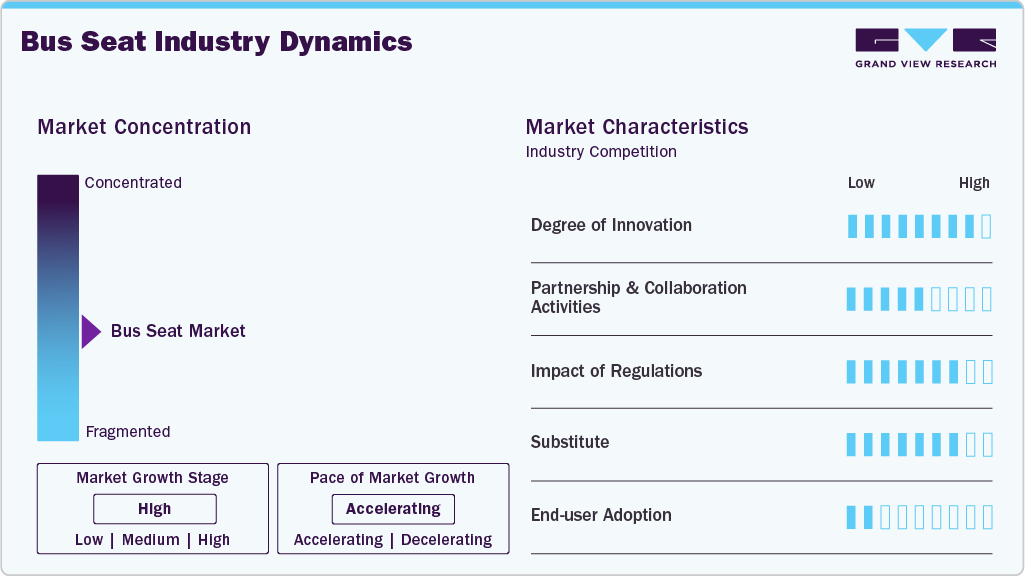
Moderate market concentration is further supported by the strong presence of established companies such as Lear Corp., Adient plc., RECARO Holding GmbH, GRAMMER AG, and Freedman Seating Company, which continue to strengthen their market positions through product innovation, strategic collaborations, and global OEM relationships. At the same time, companies including KAB Seating Ltd, Compin Fainsa, Irizar, KIEL SITZE, and Sedeo Connectors are expanding their presence by offering specialized seating solutions for transit buses, luxury coaches, school buses, and electric buses. Market participants primarily compete on seating comfort, ergonomic design, lightweight construction, durability, safety compliance, customization capabilities, after-sales support, and long-term supply agreements with bus manufacturers, thereby maintaining the moderately fragmented nature of the bus seat market.
Analyst Perspective
The bus seat market is witnessing a sustained growth as governments continue investing in public transportation modernization and electric mobility initiatives. Demand is increasingly shifting toward lightweight, ergonomic, and premium seating solutions that enhance passenger comfort while improving vehicle efficiency. Technology innovations including modular seat architectures, sustainable materials, and integrated passenger convenience features are strengthening product differentiation across OEM portfolios. Future investments are expected to focus on electric buses, luxury coaches, and smart seating solutions, while strategic partnerships between seating manufacturers and bus OEMs likely to intensify competition and accelerate product innovation.
Component Insights
The frame components segment accounted for 50.5% of the largest share of global revenue in 2025. The increasing adoption of lightweight bus structures is driving the growth of the segment. The rising production of electric and fuel-efficient buses encourages manufacturers to reduce vehicle weight to improve energy efficiency, extend battery range, and lower operating costs. This has increased the use of high-strength steel and aluminum seat frames that provide structural strength while minimizing vehicle mass. As a result, demand for lightweight frame solutions continues to reinforce the dominance of the frame segment in the market.
The upholstery component segment is projected to grow at the fastest CAGR over the forecast period. The growing use of sustainable and premium upholstery materials is driving the growth of the segment. Bus manufacturers and fleet operators are increasingly selecting recycled fabrics, bio-based materials, antimicrobial textiles, and easy-to-clean surfaces to improve passenger comfort and support sustainability initiatives. These advanced upholstery solutions enhance durability, simplify maintenance, and improve the overall passenger experience. Moreover, the growing adoption of sustainable and premium interior materials is accelerating growth in the upholstery segment.
Seat Type Insights
The standard passenger seats segment accounted for 46.1% of the largest share of global revenue in 2025. Governments are continuously investing in urban public transportation to improve mobility and reduce traffic congestion. Large-scale procurement of city and transit buses creates substantial demand for standard passenger seating, as every vehicle requires high-capacity, durable seating. Manufacturers are supplying standardized, cost-effective seating systems that meet safety regulations and withstand intensive daily usage. This sustained fleet expansion reinforces the dominance of standard passenger seats.
The luxury/premium coach seats type segment is projected to grow at the fastest CAGR over the forecast period. The expansion of premium coach services and long-distance tourism is creating strong demand for enhanced passenger comfort. Bus seat manufacturers are developing reclining seats with ergonomic cushioning, armrests, USB charging, and premium upholstery to differentiate modern coaches. These advanced seating solutions improve travel experience and help operators attract higher-value passengers. Moreover, premium coach seating is emerging as the fastest-growing seat type segment.
Comfort Level Insights
The standard comfort segment accounted for the largest share of global revenue in 2025. The increasing focus on cost-efficient fleet operations is driving the growth of the segment. Public transport operators require seating solutions that deliver durability, reliability, and low maintenance costs across high-frequency daily operations. Standard comfort seats provide an optimal balance between passenger convenience and operational efficiency while keeping procurement and lifecycle expenses under control. As a result, their widespread adoption across city and transit buses continues to support the dominance of the standard comfort segment.
The high comfort segment is expected to grow at a significant CAGR over the forecast period. The growing demand for enhanced passenger travel experience is driving the growth of the segment. Bus manufacturers are introducing high-comfort seats with advanced cushioning, ergonomic contours, lumbar support, and reclining features to improve comfort during long-distance journeys. These seating solutions reduce passenger fatigue while helping operators differentiate their premium and intercity bus services. Moreover, increasing investment in passenger-centric interiors is accelerating the growth of the high comfort segment.
Bus Type Insights
The city/transit bus segment accounted for the largest market revenue share in 2025. Rapid urbanization is encouraging governments to expand city bus networks and modernize public transportation infrastructure. The procurement of large transit bus fleets generates consistent demand for durable, space-efficient seating that can handle high passenger turnover. Bus seat manufacturers provide robust seating systems designed for safety, longevity, and low maintenance in intensive operating conditions. These factors continue to support the dominance of the city/transit bus segment.

The coach bus segment is projected to grow at the fastest CAGR over the forecast period, due to the increasing deployment of electric coaches and premium intercity buses is creating new opportunities for advanced seating manufacturers. Operators are seeking lightweight, luxury seating solutions that enhance passenger comfort while supporting vehicle efficiency and extended travel distances. Manufacturers are responding with modular, ergonomic, and premium seating systems tailored for modern coach applications. This ongoing transition is accelerating the growth of the coach bus segment.
Regional Insights
The Asia Pacific bus seat market led the global market and accounted for 46.3% of the global revenue in 2025 and is projected to grow at the fastest CAGR over the forecast period. The Asia Pacific bus seat market is driven by expanding urban public transportation networks are creating significant opportunities in the Asia Pacific bus seat market. Governments are investing in new bus fleets to meet growing urban mobility needs. This supports the growth of the bus seat market by increasing investment in new bus fleet procurement

Bus seat market in China held a dominant share in the Asia Pacific market. The increasing adoption of electric bus manufacturing is a technology trend in the China bus seat market. Manufacturers are developing lightweight seating systems to improve vehicle efficiency and passenger capacity. This trend is accelerating innovation in bus seating technologies.
Japan bus seat market is expected to grow at a significant CAGR over the forecast period. Strengthening universal design standards supports the Japan bus seat market. Bus manufacturers are developing seating systems that accommodate elderly and mobility-impaired passengers while meeting safety requirements. These regulations are encouraging the adoption of advanced bus seating solutions.
North America Bus Seat Market Trends
Bus seat market in North America held a significant share of the market in 2025. North America is replacing aging transit and school bus fleets to improve passenger safety and operational reliability. Fleet operators are investing in modern buses equipped with durable and ergonomic seating that enhances passenger comfort. This replacement cycle is increasing demand for advanced bus seats across the region.
U.S. Bus Seat Market Trends
Bus seat market in the U.S.held the largest market share in 2025. Stringent school bus safety standards are supporting the growth of the U.S. bus seat market. Regulatory requirements for occupant protection are encouraging manufacturers to develop compliant and durable seating systems. This is driving the adoption of advanced bus seats across new school bus fleets.
Europe Bus Seat Market Trends
The Europe Bus Seat market poised significant growth from 2026 to 2033. The growing demand for premium coach seating is a key trend in the Europe bus seat market. Bus operators are upgrading interiors with reclining seats and premium upholstery to improve passenger comfort. This trend is accelerating the growth of the market for high-quality bus seating solutions.
The UK bus seat market is driven by the increasing investment in accessible public transport is creating growth opportunities in the market. Bus operators are modernizing fleets with seating systems that improve accessibility, comfort, and convenience for all passengers. As a result, manufacturers are witnessing higher demand for accessible and ergonomically designed bus seats.
Bus seat market in Germany held a substantial share in the European market. The rising production of coaches and commercial buses is driving the growth of the bus seat market. OEMs are increasing vehicle manufacturing to meet domestic and export demand. This supports the adoption of durable and lightweight bus seating systems.
Middle East & Africa Bus Seat Market Trends
The MEA bus seat market is being driven by rising investments in public transportation infrastructure and fleet modernization across major urban centers. Growing adoption of electric and low-emission buses is increasing demand for lightweight, durable, and ergonomically designed seating solutions. In Africa, the expansion and electrification of minibus and urban transit fleets is further supporting demand for cost-effective and adaptable bus seating. Additionally, increasing passenger comfort expectations and the integration of premium features are encouraging manufacturers to develop safer, more comfortable, and technologically advanced bus seats.
Key Bus Seat Company Insights
Key players operating in the bus seat market include RECARO Holding GmbH, Lear Corp., Adient plc., Irizar, KAB Seating Ltd, Compin Fainsa, Sedeo Connectors, Freedman Seating Company., GRAMMER AG and KIEL SITZE. Key players in the bus seat market are expanding their portfolios with lightweight, ergonomic, and modular seating solutions while strengthening partnerships with bus OEMs and fleet operators. Companies are focusing on improving passenger comfort, enhancing safety compliance, integrating sustainable materials, and supporting the growing demand for city buses, intercity buses, coaches, school buses, and electric buses.
-
Lear Corp. is a global automotive technology company specializing in Seating and E-Systems for the world's leading automotive manufacturers. The company designs, engineers, manufactures, and supplies complete seating systems, seat components, and vehicle electrical distribution and connectivity solutions. Lear Corp. focuses on innovation, operational excellence, and sustainability to develop technologies that enhance vehicle comfort, safety, convenience, and connectivity.
-
Adient plc is a global manufacturer of automotive seating systems and components for passenger cars and commercial vehicles. The company designs, engineers, manufactures, and supplies complete seating solutions tailored to OEM requirements. It focuses on lightweight, modular, and sustainable seating technologies while emphasizing innovation, manufacturing efficiency, and product customization through close collaboration with automotive OEMs.
Key Bus Seat Companies
The following key companies have been profiled for this study on the bus seat market.
-
RECARO Holding GmbH
-
Lear Corp.
-
Adient plc.
-
Irizar
-
KAB Seating Ltd
-
Compin Fainsa
-
Sedeo Connectors
-
Freedman Seating Company.
-
GRAMMER AG
-
KIEL SITZE
Competitive Benchmarking
Operating Strategies
Competitive Edge
Weaknesses
Mature Players: Lear Corp., Adient plc., GRAMMER AG, Freedman Seating Company
Mature players in the bus seat market are focusing on strong OEM partnerships, global manufacturing footprint, continuous product innovation, broad commercial vehicle seating portfolio, investment in lightweight and ergonomic seating technologies.
Mature players gain a competitive advantage through extensive production capabilities, strong brand recognition, diversified customer base, advanced engineering expertise, global distribution network.
These companies often face challenges related to large organizations have higher operating and administrative costs due to their extensive global operations and standardized production processes. Their larger scale can also slow response times for highly customized or low-volume seating requirements.
Emerging Players: KAB Seating Ltd, Compin Fainsa, KIEL SITZE
Emerging players in the bus seat market are focusing on specialized bus seating solutions, regional market expansion, customized seating designs, and targeted partnerships with bus manufacturers.
Emerging players gain market traction through high product specialization, flexibility in customization, strong presence in selected regional and transit markets.
Emerging players face limitations due to limited manufacturing capacity and regional presence, which restrict their ability to serve large global OEMs and high-volume contracts. Their narrower product portfolios also reduce competitiveness across diverse bus seating applications.
Recent Developments
-
In May 2026, Irizar launched the second generation of its hydrogen-powered coach. The new model offers higher passenger capacity and a driving range of more than 1,000 km. It would begin operations with Alsa in Madrid after receiving type approval, supporting the adoption of zero-emission bus transportation.
-
In April 2025, Freedman Seating Company acquired by Lippert, a manufacturer and supplier of highly engineered components, to strengthen its vehicle product portfolio. The acquisition expanded Lippert's bus and commercial vehicle seating solutions. It also enhanced the company's presence in the transportation vehicle market.
Bus Seat Market Report Scope
Report Attribute
Details
Market size in 2025
USD 15.4 billion
Estimated Market size in 2026
USD 15.8 billion
Projected market size by 2033
USD 23.2 billion
Growth rate
CAGR of 5.7% from 2026 to 2033
Base year for estimation
2025
Historical data
2021 - 2024
Forecast period
2026 - 2033
Quantitative units
Revenue in USD billion, and CAGR from 2026 to 2033
Report coverage
Revenue forecast, company ranking, competitive landscape, growth factors, and trends
Segments covered
Component, seat type, comfort level, bus type, region
Regional scope
North America; Europe; Asia Pacific; Latin America; MEA
Country scope
U.S.; Canada; Mexico; Germany; UK; France; China; Japan; India; South Korea; Australia; Brazil; KSA; UAE; South Africa
Key companies profiled
RECARO Holding GmbH; Lear Corp.; Adient plc; Iriza; KAB Seating Ltd; Compin Fainsa; Sedeo Connectors; Freedman Seating Company.; GRAMMER AG; KIEL SITZE
Customization scope
Free report customization (equivalent up to 8 analysts working days) with purchase. Addition or alteration to country, regional & segment scope.
Pricing and purchase options
Avail customized purchase options to meet your exact research needs. Explore purchase options
Global Bus Seat Market Report Segmentation
The report forecasts revenue growth at global, regional, and country levels and provides an analysis of the latest industry trends in each of the sub-segments from 2021 to 2033. For this study, Grand View Research has segmented the global bus seat market report based on component, seat type, comfort level, bus type, and region:
-
Component Outlook (Revenue, USD Billion, 2021 - 2033)
-
Frame
-
Upholstery
-
Others
-
-
Seat Type Outlook (Revenue, USD Billion, 2021 - 2033)
-
Standard Passenger Seats
-
Reclining Seats
-
Luxury/Premium Coach Seats
-
Driver Seats
-
Integrated Child Seats
-
Others
-
-
Comfort Level Outlook (Revenue, USD Billion, 2021 - 2033)
-
Standard Comfort
-
Basic Utility Seats
-
High Comfort
-
-
Bus Type Outlook (Revenue, USD Billion, 2021 - 2033)
-
City/Transit Bus
-
Intercity Bus
-
Coach Bus
-
School Bus
-
Shuttle Bus
-
Others
-
-
Regional Outlook (Revenue, USD Billion, 2021 - 2033)
-
North America
-
U.S.
-
Canada
-
Mexico
-
-
Europe
-
Germany
-
UK
-
France
-
-
Asia Pacific
-
China
-
India
-
Japan
-
South Korea
-
Australia
-
-
Latin America
-
Brazil
-
-
Middle East & Africa (MEA)
-
UAE
-
Kingdom of Saudi Arabia (KSA)
-
South Africa
-
-
Research Methodology
The bus seat market figures in this report are based on a proven research process that combines executive interviews with secondary research from proprietary databases, company filings, and recognized regulatory and institutional sources. Market size is built through value-chain sizing-reconciling supply-side and demand-side estimates-and triangulated with bottom-up and top-down approaches. Every estimate passes multiple levels of expert validation before publication, with each bus seat segment quantified using the revenue-capture definitions in the table below.
Segment Definition
Segment - Component
Revenue capture definition
Frame
The segment revenue is generated from metal, aluminum, stainless steel, composite, and structural seat frame assemblies supplied to OEMs and aftermarket customers.
Upholstery
The segment revenue is generated from fabric, vinyl, leather, synthetic leather, foam cushioning, seat covers, and upholstery replacement materials.
Others
The segment revenue is generated from armrests, headrests, seat belts, grab handles, reclining mechanisms, seat accessories, mounting hardware, and integrated seat components.
Segment - Seat Type
Revenue capture definition
Standard Passenger Seats
The segment revenue is generated from fixed passenger seats installed in city buses, transit buses, and standard public transport vehicles.
Reclining Seats
The segment revenue is generated from adjustable reclining seats used in intercity buses, coaches, and long-distance transportation.
Luxury/Premium Coach Seats
The segment revenue is generated from premium seating systems featuring enhanced cushioning, armrests, footrests, USB charging, and luxury upholstery.
Driver Seats
The segment revenue is generated from ergonomic driver seating systems equipped with suspension mechanisms, adjustable positioning, lumbar support, and safety features.
Integrated Child Seats
The segment revenue is generated from child-integrated seating systems designed for school buses and specialized passenger transport applications.
Others
The segment revenue is generated from foldable seats, tip-up seats, wheelchair companion seats, modular seating systems, and customized specialty seats.
Segment - Comfort Level
Revenue capture definition
Standard Comfort
The segment revenue is generated from conventional passenger seating offering basic ergonomic support for routine public transportation.
Basic Utility Seats
The segment revenue is generated from economical seating solutions designed for high-capacity transit buses and commercial fleet operations.
High Comfort
The segment revenue is generated from premium ergonomic seating featuring enhanced cushioning, reclining mechanisms, lumbar support, and luxury materials.
Segment - Bus Type
Revenue capture definition
City/Transit Bus
The segment revenue is generated from seating supplied for urban public transit buses, municipal transportation fleets, and metro feeder buses.
Intercity Bus
The segment revenue is generated from seating installed in long-distance intercity buses, emphasizing passenger comfort and durability.
Coach Bus
The segment revenue is generated from premium seating systems designed for luxury coaches, tourism buses, and executive transportation fleets.
School Bus
The segment revenue is generated from safety-focused seating supplied for school transportation vehicles complying with student safety standards.
Shuttle Bus
The segment revenue is generated from seating installed in airport shuttles, hotel shuttles, employee transport vehicles, and institutional buses.
Others
The segment revenue is generated from seating supplied for mini buses, special-purpose buses, military buses, and customized commercial transport vehicles.
Estimation Model
Layer No.
Layer Name
Key Question
Description
01
Global Bus Production Assessment
How many buses are manufactured annually by region and bus type?
This layer estimates total annual bus production across city buses, coaches, school buses, electric buses, and shuttle buses. Production volumes are analyzed by region, manufacturer, and vehicle category to establish the primary addressable market for bus seats. Regional manufacturing trends and government procurement programs are incorporated into the assessment.
02
Seat Installation Mapping
How many seats are installed per bus configuration?
This layer determines average seat count based on vehicle type, seating layout, passenger capacity, and regulatory requirements. Different seating configurations for transit, coach, school, and shuttle buses are evaluated to estimate total seat demand. Replacement ratios for driver and passenger seats are also considered.
03
Product Mix & Pricing Analysis
What is the value of seats installed across different product categories?
This layer evaluates adoption of standard, reclining, premium, driver, and specialty seating systems along with average selling prices. Material selection, comfort level, customization, and technology integration are analyzed to determine revenue contribution by product category. OEM and aftermarket pricing variations are also incorporated.
04
Market Revenue Validation
What is the final market value after validating supply and demand?
This layer validates estimated revenues using manufacturer sales, OEM procurement data, supplier shipments, fleet replacement cycles, and regional demand trends. Market sizing is cross verified through company financial information, industry production statistics, and procurement activities. The validated estimates form the final Bus Seat Market revenue forecast.
Delivered Customizations
This report has been delivered with the following In-depth customizations
Client Request
Customization Delivered
Value Adds
Regional Bus Seat Market Opportunity Assessment
Country/region-wise market sizing and forecasts
Analysis of demand, adoption trends, and regulatory landscape
Identification of high-growth regions and investment hotspots
Identified region-specific growth opportunities
Supported expansion and go-to-market strategy
Enabled informed regional investment decisions
Cross-Segmentation Analysis for the Bus Seat Market
Criss-cross market analysis by component, seat type, comfort level, bus type
Demand and adoption assessment across key segments
Segment attractiveness and growth potential benchmarking
Identified high-potential market segments
Supported targeted component positioning and marketing strategy
Improved customer and segment prioritization
Competitive Benchmarking and Strategic Positioning in the Bus Seat Market
Benchmarking of key competitors across components, pricing, partnerships, and innovation
Comparative assessment of market share, capabilities, and strategies
Analysis of competitive strengths, gaps, and differentiation areas
Identified competitive white spaces and growth gaps
Supported strategic positioning and differentiation
Enabled data-driven competitive strategy development
Frequently Asked Questions About This Report
The global bus seat market size was valued at USD 15.4 billion in 2025 and is estimated at USD 15.8 billion in 2026.
Standard passenger seats segment led the market and accounted for 46.1% of the global revenue in 2025, while luxury/premium coach seats is projected to grow at the fastest CAGR over the forecast period
The global bus seat market is expected to grow at a compound annual growth rate of 5.7% from 2026 to 2033, reaching USD 23.2 billion by 2033.
Frame components segment led the market and accounted for 50.5% of the global revenue in 2025. The increasing adoption of lightweight bus structures is driving the growth of the segment
Asia Pacific market led the global market and accounted for 46.3% of the global revenue in 2025. The Asia Pacific bus seat market is driven by expanding urban public transportation networks are creating significant opportunities in the Asia Pacific bus seat market
The increasing adoption of lightweight and ergonomic seating solutions is driving the growth of the bus seat market
Some key players operating in the bus seat market include RECARO Holding GmbH, Lear Corp., Adient plc., Irizar, KAB Seating Ltd, Compin Fainsa, Sedeo Connectors, Freedman Seating Company., GRAMMER AG and KIEL SITZE
Standard comfort segment accounted for the largest share of global revenue in 2025, while high comfort is expected to grow at a significant CAGR over the forecast period.
City/transit bus segment accounted for the largest market revenue share in 2025, while coach bus segment is projected to grow at the fastest CAGR over the forecast period.
About the Author(s)
Automotive & Transportation Research Team
Technology · Automotive & TransportationThis report was authored by the automotive & transportation research team at Grand View Research - comprising two research analysts, one senior research analyst, and one industry expert - with specialized expertise in the automotive & transportation segment of the technology industry. All findings are based on proprietary technology databases, executive interviews, and regulatory analysis, subject to internal peer review prior to publication.
Last Updated:
Speak to Analyst


Customize this report to your needs — add regions, segments, or data points, with 20% free customization.
Or view our licence options:


ISO 9001:2015 & 27001:2022 Certified
We are GDPR and CCPA compliant! Your transaction & personal information is safe and secure. For more details, please read our privacy policy.


