
- Home
- »
- IT Services & Applications
- »
-
Business Process Management Market Report, 2026-2033GVR Report cover

Business Process Management Market (2026 - 2033)
Size, Share & Trends Analysis Report By Solution (Content & Document Management, Monitoring & Optimization), By Deployment (Cloud, On-premise), By Enterprise Size, By Application, By Region, And Segment Forecasts
Market Size, 2025
$16.0BMarket Estimate, 2026
$17.5BMarket Forecast, 2033
$34.7BCAGR, 2026–2033
10.3%Business Process Management Market Summary
The global business process management market size was valued at USD 16.0 billion in 2025 and is projected to grow from USD 17.5 billion in 2026 to USD 34.7 billion by 2033, at a CAGR of 10.3% from 2026 to 2033. North America dominated the market, accounting for a revenue share of 38.9% in 2025. This growth is driven by the growing demand for workflow automation, operational efficiency, and AI-driven process optimization across enterprises.
 Source: Grand View Research, IR Documents, Primary Interviews, Paid DatabasesTo learn more about this report,
 Download Free Sample Report
 Key Market Trends & Insights
- By solution: Process modelling segment dominated the market, with a revenue share of 26.9% in 2025
- By deployment: Cloud segment dominated the market, with a revenue share of 63.2% in 2025
- By enterprise size: Large enterprise segment dominated the market, with a revenue share of 72.3% in 2025
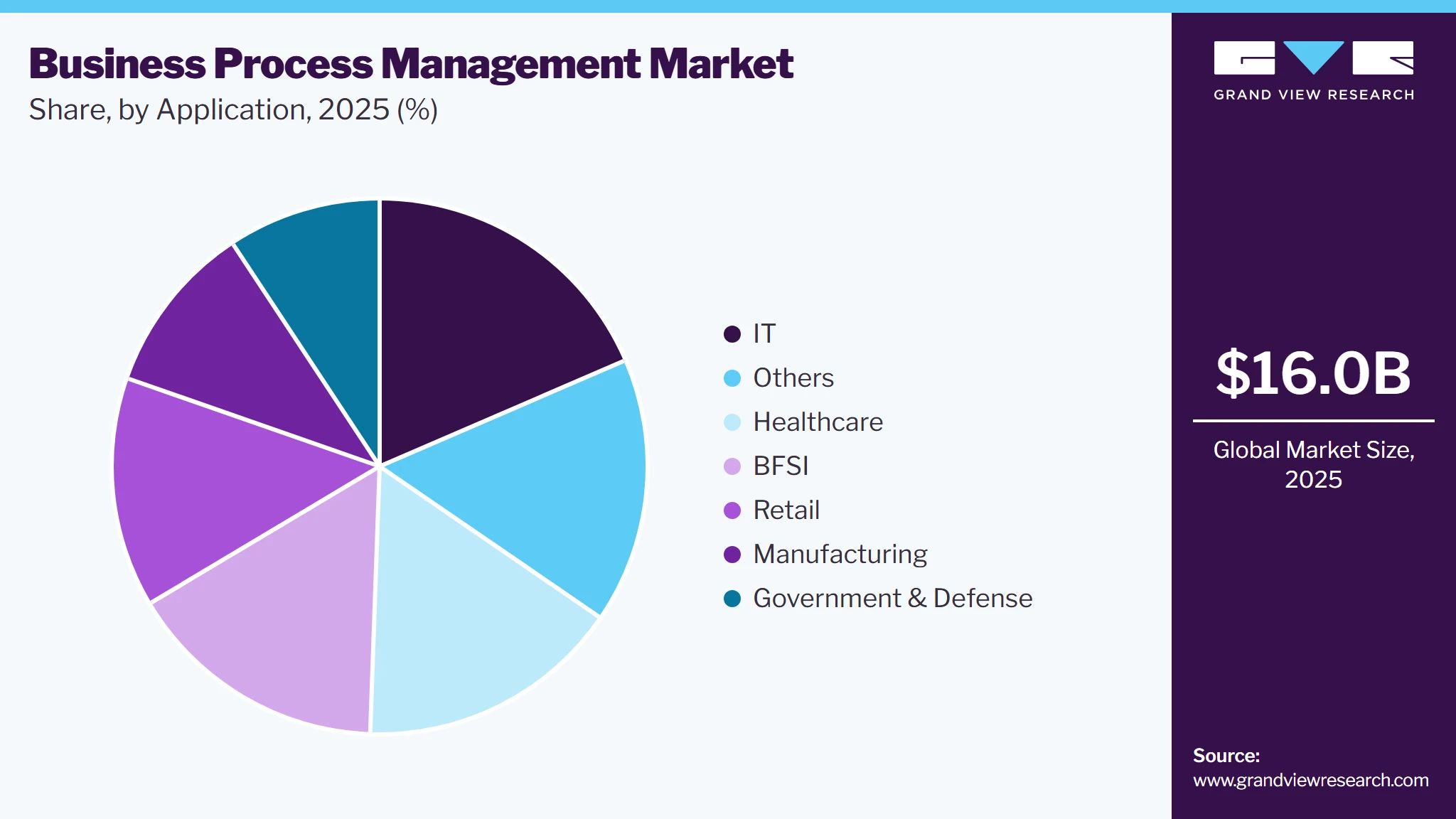
- By application: IT segment held the largest revenue share of 18.5% in 2025
Regional Highlights
- Largest regional market: North America (38.9% revenue share, 2025)
- Fastest-growing regional market: Asia Pacific (highest CAGR, 2026–2033)
- By country: The U.S. held the largest market share in 2025.
Market Size & Forecast
- Market size in 2025: USD 16.0 Billion
- Estimated market size in 2026: USD 17.5 Billion
- Projected market size by 2033: USD 34.7 Billion
- CAGR (2026-2033): 10.3%
Three ways to get this report
Buy it, customize it, or ask a question.Ask an Analyst
Analyst response in 1 business day
- AccessReport author, directly
- Reply timeWithin 1 working day
- No sales callDirect answer only
- FormatEmail reply
- CostFree, no cost
Get the Full Report
What the study covers
- FormatsPDF · Excel · Dashboard
- Timeline2026–2033 annual, 2025 base
- Coverage20+ countries, 5 regions
- Companies10+ key players profiled
Customize the Report
20% free customization
- IncludeCountries, segments, points
- TailorTo your product definition
- ExtendDeeper competitor detail
- OrA fully bespoke study
- Turnaround5–10 working days
The market is driven by technological advancements, organizational needs for efficiency, and the increasing complexity of business operations. Organizations are increasingly leveraging BPM solutions to streamline workflows, automate repetitive tasks, and integrate advanced technologies like artificial intelligence (AI), machine learning (ML), and robotic process automation (RPA) into their operations. These solutions enhance productivity, reduce costs, and provide actionable insights, making them indispensable in the modern business landscape. The 2024 State of the Automation Professional Report by UiPath, a U.S.-based software company, highlights the widespread adoption of AI among automation professionals. According to the report, 90% of professionals are either already using AI or planning to implement it within the next year. The primary driver for AI integration is to boost productivity, cited by 66% of respondents. Professionals are leveraging AI for tasks such as coding (67%), creating documentation (57%), and conducting testing (47%). To learn more about this report, Download Free Sample Report
 The increasing complexity of regulatory compliance requirements is also fueling the adoption of business process management (BPM) systems. Industries such as healthcare, finance, and manufacturing are subject to stringent regulations that require meticulous process tracking and documentation. BPM solutions help organizations maintain compliance by ensuring adherence to standardized workflows, generating audit trails, and reducing the risk of non-compliance penalties. This capability is particularly critical in sectors with high legal and regulatory oversight stakes.
In addition, the proliferation of cloud-based BPM solutions has made process management more accessible and scalable. Cloud platforms enable organizations of all sizes to implement BPM tools without significant upfront investments in infrastructure. They also facilitate remote collaboration, a feature that has gained prominence in the wake of widespread hybrid and remote work models. This accessibility has expanded the market reach of BPM solutions to include small and medium-sized enterprises (SMEs) alongside larger organizations.
Market Dynamics
The global business process management (BPM) market is experiencing significant growth as organizations increasingly prioritize digital transformation, workflow automation, operational agility, and AI-driven process orchestration across enterprise functions. Businesses are adopting BPM platforms to streamline complex workflows, improve process visibility, reduce operational inefficiencies, and enhance customer and employee experiences through intelligent automation. The integration of BPM solutions with cloud platforms, ERP systems, CRM applications, low-code development tools, robotic process automation (RPA), and generative AI technologies is enabling enterprises to automate end-to-end business operations with greater scalability and flexibility.
The increasing adoption of AI-powered workflow automation and hyperautomation strategies is a major driver of the global BPM market. Enterprises are increasingly deploying BPM platforms integrated with generative AI, intelligent document processing, process mining, and agentic automation capabilities to optimize end-to-end workflows, reduce manual intervention, and improve operational decision-making. Organizations are leveraging BPM solutions to automate finance, HR, customer service, procurement, and supply chain processes while enabling real-time orchestration across hybrid IT environments. The growing emphasis on autonomous enterprise operations and intelligent process governance is significantly expanding BPM adoption across large enterprises and SMEs. For instance, in May 2026, SAP introduced its Autonomous Enterprise platform integrating AI agents, workflow orchestration, and enterprise process automation to enhance business operations and improve enterprise-wide efficiency.
Complex integration with legacy enterprise systems and challenges associated with process standardization act as a significant restraint for the BPM market. Many organizations operate fragmented IT infrastructures comprising multiple legacy applications, databases, and departmental workflows, making BPM implementation technically complex and resource-intensive. Integrating BPM platforms with ERP, CRM, HRMS, and third-party applications often requires substantial customization, migration planning, and change management efforts. Additionally, variations in organizational workflows across geographies and business units can complicate process harmonization and automation initiatives. Small and medium-sized enterprises may also face budget limitations, skill shortages, and resistance to organizational change, which can delay BPM deployment and increase implementation costs.
The emergence of autonomous enterprises and agentic AI orchestration presents a major growth opportunity for the global BPM market. Organizations are increasingly moving beyond traditional task automation toward intelligent process ecosystems where AI agents, digital workers, APIs, and human workflows operate collaboratively. Advanced BPM platforms are evolving to support process mining, predictive analytics, real-time decision intelligence, and self-optimizing workflows that enable enterprises to improve agility and responsiveness. Growing investments in AI-native business operations, low-code automation platforms, and cloud-based orchestration solutions are expected to drive demand for next-generation BPM technologies. Furthermore, industries seeking to improve customer experience, operational resilience, and enterprise-wide governance are increasingly adopting intelligent BPM solutions capable of supporting scalable and adaptive process automation environments.
Analyst Perspective
The business process management (BPM) market sits at the intersection of accelerating enterprise digital transformation initiatives, increasing demand for operational agility, and the rapid adoption of AI-driven workflow automation technologies. Organizations are increasingly required to manage complex cross-functional workflows, optimize operational efficiency, improve customer experience, and ensure regulatory compliance across distributed business environments, driving strong demand for centralized BPM platforms capable of orchestrating, automating, monitoring, and optimizing enterprise processes across departments, applications, and geographies.
Solution Insights
Based on solution, the process modeling segment led the market with the largest revenue share of 26.9% in 2025, owing to the rising demand for improved customer experience. Businesses prioritize customer satisfaction as a strategic goal in a competitive global market. BPM solutions enable organizations to optimize processes such as customer onboarding, support services, and complaint resolution. By ensuring consistency and reducing process inefficiencies, BPM tools enhance service delivery and contribute to stronger customer loyalty.
The automation segment is expected to grow at a significant CAGR of 21.8% over the forecast period. The increasing adoption of low-code and no-code platforms makes automation more accessible to non-technical users. These platforms empower business users to design and deploy automated workflows without the need for extensive programming expertise, democratizing automation and driving adoption across organizations of all sizes.
Deployment Insights
Based on deployment, the cloud segment led the market with the largest revenue share of 63.2% in 2025 due to the rise of remote and hybrid work environments. Cloud BPM solutions allow employees and stakeholders to access processes and collaborate from anywhere, ensuring business continuity and productivity. The cloud’s centralized architecture supports real-time collaboration and process updates, fostering efficiency in geographically distributed teams and enabling better decision-making.
The on-premise segment is expected to grow significantly over the forecast period. Organizations with legacy systems that are deeply integrated into their operations also support the preference for on-premise BPM systems. In such cases, transitioning to cloud-based BPM solutions may be challenging or resource-intensive. On-premise solutions offer compatibility with existing infrastructure, allowing businesses to modernize their processes without disrupting operations or incurring significant migration costs.
Enterprise Size Insights
Based on enterprise size, the large enterprise segment led the market with the largest revenue share of 72.3% in 2025 due to the increasing demand for process standardization and optimization. Large enterprises often operate across multiple geographies and business units, resulting in diverse and complex workflows. BPM solutions help standardize these processes, ensuring consistency, reducing inefficiencies, and enabling organizations to achieve higher levels of operational excellence.
The SMEs segment is expected to grow significantly over the forecast period. The rise of low-code and no-code BPM platforms is making process management more accessible to SMEs. These platforms empower business users to design, implement, and modify workflows without extensive technical expertise, enabling SMEs to adapt quickly to changing market conditions and customer needs.
Application Insights
Based on application, IT segment led the market with the largest revenue share of 18.5% in 2025, owing to the growing adoption of DevOps and agile methodologies. As organizations strive to accelerate software development lifecycles and improve time-to-market, BPM tools enable IT teams to automate and standardize processes like code deployment, testing, and continuous integration/continuous deployment (CI/CD). These capabilities not only enhance operational speed but also improve the quality and reliability of IT outputs.
 To learn more about this report, Download Free Sample Report
 The healthcare segment is expected to grow significantly over the forecast period. The increasing adoption of electronic health records (EHRs) and digital health solutions drives BPM adoption in healthcare. BPM systems enable seamless integration of EHRs and other digital tools into existing workflows, ensuring efficient data sharing, improved care coordination, and real-time access to patient information. This integration enhances the overall quality of care and supports better clinical decision-making.
Regional Insights
North America dominated the global business process management market with the largest revenue share of 38.9% in 2025. Organizations in the region are leveraging BPM solutions to streamline workflows, automate repetitive tasks, and integrate advanced technologies like artificial intelligence (AI), machine learning (ML), and robotic process automation (RPA) into their operations. These solutions enhance productivity, reduce costs, and provide actionable insights, making them indispensable in the modern business landscape.
 To learn more about this report, Download Free Sample Report
 U.S. Business Process Management Industry Trends
The business process management market in the U.S. held the largest share in the North America region in 2025. The demand for enhanced collaboration and communication within organizations is augmenting the adoption of process modeling solutions. These tools act as a common language across departments, helping teams align their goals, understand dependencies, and work cohesively towards shared objectives. This is particularly important in geographically dispersed or hybrid work environments, where clear communication about processes is critical.
Europe Business Process Management Industry Trends
The business process management market in Europe is anticipated to register considerable growth from 2025 to 2033. Sustainability initiatives are an emerging driver in the Europe BPM market. Many organizations focus on optimizing their processes to reduce waste, improve energy efficiency, and support environmentally sustainable practices. BPM tools enable businesses to analyze and refine their operations to align with sustainability goals, contributing to their overall growth and competitiveness.
The UK business process management market is expected to grow rapidly in the coming years, driven by these platforms' scalability, flexibility, and cost-effectiveness. Small and medium-sized enterprises (SMEs) particularly benefit from cloud BPM solutions, eliminating the need for extensive IT infrastructure and providing real-time access to processes.
The business process management market in Germany held a substantial market share in 2024. Automotive, electronics, and machinery companies are using BPM tools to optimize complex supply chains, enhance production workflows, and integrate smart technologies such as IoT and robotics into their operations. BPM solutions play a critical role in enabling manufacturers to achieve precision, efficiency, and scalability in their processes.
Asia Pacific Business Process Management Industry Trends
The business process management industry in the Asia Pacific is anticipated to grow at the fastest CAGR from 2026 to 2033. The rapid pace of digital transformation across APAC is one of the primary drivers of BPM adoption. As businesses seek to modernize their operations and integrate emerging technologies such as artificial intelligence (AI), machine learning (ML), robotic process automation (RPA), and big data analytics, BPM solutions serve as an essential tool. These platforms help organizations automate routine tasks, optimize workflows, and enhance decision-making, enabling them to stay competitive in a fast-evolving digital landscape.
Japan business process management market is expected to grow rapidly in the coming years. Japan faces demographic challenges, including an aging population and a shrinking workforce. This has led to a growing demand for automation and process optimization to maintain productivity with fewer workers. BPM solutions help businesses automate repetitive tasks, reduce reliance on manual labor, and increase operational efficiency, which is crucial to address labor shortages. Adopting BPM tools allows businesses to do more with less while maintaining high output and service levels.
The business process management market in China held a substantial market share in 2024. As China’s businesses face increasing domestic and international competition, there is a strong emphasis on improving operational efficiency and reducing costs. BPM solutions are essential in automating routine processes, streamlining workflows, and improving resource management. By enhancing productivity and reducing the need for manual intervention, BPM platforms enable organizations to cut operational costs and optimize performance, which is crucial for staying competitive.
Key Business Process Management Company Insights
Key players in the business process management industry are SAP SE, Red Hat, Inc., Genpact, IBM Corporation, and Accenture. These companies focus on various strategic initiatives, including new product development, partnerships, collaborations, and agreements, to gain a competitive advantage over their rivals.
Key Business Process Management Companies
The following key companies have been profiled for this study on the business process management market.
-
Accenture
-
Appian
-
BP Logix, Inc.
-
Genpact
-
Infosys Limited
-
IBM Corporation
-
Kissflow Inc.
-
Nintex
-
Open Text Corporation
-
Pegasystems Inc.
-
Red Hat, Inc.
-
SAP SE
-
Software GmbH
-
TATA Consultancy Services Limited
Competitive Benchmarking
Operating Strategies
Competitive Edge
Weaknesses
Established Players (Accenture, IBM Corporation, SAP SE, Pegasystems Inc., Software GmbH)
- Established players in the BPM market focus on integrated workflow automation, enterprise orchestration, AI-driven process optimization, low-code application development, and intelligent business operations management.
- They offer end-to-end BPM suites covering process modeling, automation, integration, analytics, case management, and enterprise workflow governance across multiple industries.
- Established players benefit from strong global presence, extensive enterprise customer networks, and highly scalable cloud and hybrid BPM platforms. Their solutions provide advanced AI integration, process mining, API orchestration, real-time monitoring, and enterprise-grade security capabilities.
- Strong consulting ecosystems and deep integration with ERP, CRM, HRMS, and cloud infrastructure platforms further strengthen their market position.
- These platforms often involve high implementation costs, lengthy deployment cycles, and significant integration complexity across legacy enterprise systems.
- Large-scale customization requirements, process harmonization challenges, and dependence on specialized implementation expertise can increase total cost of ownership and slow deployment timelines.
Emerging Players (Appian, Nintex, Kissflow Inc.)
- Emerging players focus on cloud-native BPM platforms, low-code/no-code workflow automation, citizen developer enablement, and agile process orchestration solutions targeting mid-sized enterprises and digital-first organizations.
- Their strategy emphasizes rapid deployment, simplified workflow automation, SaaS delivery models, and user-friendly automation tools with minimal coding requirements.
- Emerging players offer greater deployment flexibility, lower upfront costs, faster implementation cycles, and intuitive user interfaces compared to traditional enterprise BPM systems.
- Their platforms support rapid workflow digitization, collaborative automation development, and scalable cloud-based operations, making them attractive for organizations seeking agile digital transformation initiatives.
- These vendors face limitations in large-scale enterprise penetration, global consulting support, and highly complex workflow orchestration capabilities compared to established providers.
- Limited ecosystem partnerships, smaller R&D budgets, and lower brand recognition may restrict adoption among large multinational enterprises with highly customized operational environments.
Recent Developments
-
In November 2024, Red Hat, Inc. announced the launch of Red Hat Enterprise Linux 9.5, the newest version of the enterprise Linux platform. This update helps organizations deploy applications and workloads faster and more reliably, enabling cost reductions and better management of workloads across hybrid cloud environments. It also assists in mitigating IT risks across a range of infrastructures, from data centers to public clouds and edge computing.
-
In September 2024, SAP SE completed the acquisition of WalkMe Ltd., a U.S.-based company specializing in digital adoption platforms. WalkMe’s technology facilitates workflow execution across business applications, enhancing user experience and promoting greater software adoption while supporting business transformation. As part of the acquisition, WalkMe’s AI capabilities will be integrated into SAP’s Copilot Joule, offering context-sensitive and proactive assistance throughout workflows, ultimately helping users boost productivity.
Business Process Management Market Report Scope
Report Attribute
Details
Market value in 2025
USD 16.0 billion
Estimated market size in 2026
USD 17.5 billion
Projected Market size by 2033
USD 34.7 billion
Growth rate
CAGR of 10.3% from 2026 to 2033
Base year for estimation
2025
Historical data
2021 - 2024
Forecast period
2026 - 2033
Quantitative units
Revenue in USD million/billion and CAGR from 2026 to 2033
Report coverage
Revenue forecast, company market share analysis, competitive landscape, growth factors, and trends
Segments covered
Solution, deployment, enterprise size, application, region
Regional scope
North America; Europe; Asia Pacific; Latin America; MEA
Country scope
U.S.; Canada; Mexico; Germany; UK; France; China; Japan; India; South Korea; Australia; Brazil; Saudi Arabia; South Africa; UAE
Key companies profiled
Accenture; Appian; BP Logix, Inc.; Genpact; Infosys Limited; IBM Corporation; Kissflow Inc.; Nintex; Open Text Corporation; Pegasystems Inc.; Red Hat, Inc.; SAP SE; Software GmbH; TATA Consultancy Services Limited
Customization scope
Free report customization (equivalent up to 8 analysts' working days) with purchase. Addition or alteration to country, regional & segment scope.
Pricing and purchase options
Avail customized purchase options to meet your exact research needs. Explore purchase options
Global Business Process Management Market Report Segmentation
This report forecasts revenue growth at global, regional, and country levels and provides an analysis of the latest industry trends in each of the sub-segments from 2021 to 2033. For this study, Grand View Research has segmented the global business process management market report based on solution, deployment, enterprise size, application, and region:
-
Solution Outlook (Revenue, USD Billion, 2021 - 2033)
-
Automation
-
Process Modeling
-
Content & Document Management
-
Monitoring & Optimization
-
Integration
-
Others
-
-
Deployment Outlook (Revenue, USD Billion, 2021 - 2033)
-
Cloud
-
On-premise
-
-
Enterprise Size Outlook (Revenue, USD Billion, 2021 - 2033)
-
SMEs
-
Large Enterprise
-
-
Application Outlook (Revenue, USD Billion, 2021 - 2033)
-
BFSI
-
IT
-
Retail
-
Manufacturing
-
Healthcare
-
Government & Defense
-
Others
-
-
Regional Outlook (Revenue, USD Billion, 2021 - 2033)
-
North America
-
U.S.
-
Canada
-
Mexico
-
-
Europe
-
UK
-
Germany
-
France
-
-
Asia Pacific
-
China
-
India
-
Japan
-
South Korea
-
Australia
-
-
Latin America
-
Brazil
-
-
Middle East & Africa
-
UAE
-
Saudi Arabia
-
South Africa
-
-
Research Methodology
The business process management market figures in this report are based on a proven research process that combines executive interviews with secondary research from proprietary databases, company filings, and recognized regulatory and institutional sources. Market size is built through value-chain sizing-reconciling supply-side and demand-side estimates-and triangulated with bottom-up and top-down approaches. Every estimate passes multiple levels of expert validation before publication, with each cryptocurrency payment apps segment quantified using the revenue-capture definitions in the table below.
Segment Definition
Segment – Solution
Revenue capture definition
Automation
The value is generated by BPM platforms that automate repetitive and rule-based business processes across departments such as finance, HR, procurement, customer service, and operations. Vendors monetize through SaaS subscriptions, enterprise licensing, workflow automation modules, robotic process automation (RPA) integration, AI-powered task orchestration, and intelligent process automation capabilities.
Process Modelling
Revenue is generated through BPM solutions that enable organizations to design, visualize, simulate, and optimize business workflows and process architectures. Vendors earn revenue through modeling software licenses, low-code/no-code workflow design tools, digital process mapping capabilities, and consulting or customization services for enterprise process transformation initiatives.
Content & Document Management
This segment captures revenue from BPM platforms offering document-centric workflow automation, enterprise content management, digital records management, document routing, approval workflows, and compliance tracking. Revenue streams include cloud subscriptions, storage-based pricing, workflow integration services, and advanced document intelligence features such as OCR and AI-powered content classification.
Monitoring & Optimization
Revenue is generated through BPM solutions that provide real-time process monitoring, analytics dashboards, KPI tracking, process mining, predictive analytics, and continuous workflow optimization. Vendors monetize through premium analytics modules, AI-driven optimization engines, operational intelligence tools, and process performance benchmarking services.
Integration
The integration segment captures revenue from BPM platforms that connect enterprise applications, databases, APIs, cloud systems, ERP, CRM, and third-party business tools to enable seamless workflow orchestration across hybrid IT environments. Revenue is generated through middleware services, API management capabilities, integration connectors, and enterprise automation frameworks.
Others
This segment includes revenue generated from ancillary BPM capabilities such as case management, compliance management, business rules management, workflow governance, collaboration tools, and industry-specific BPM applications tailored for specialized operational requirements.
Segment - Deployment
Revenue capture definition
On-premise
On-premise BPM software revenue is generated through perpetual licensing models or long-term enterprise contracts where organizations deploy workflow automation and process management systems within their own IT infrastructure. This deployment model is primarily adopted by enterprises requiring enhanced data control, regulatory compliance, operational customization, and internal governance over mission-critical business processes.
Cloud
The cloud segment captures revenue through SaaS-based BPM platforms hosted on vendor-managed cloud infrastructure. Revenue is driven by recurring subscription models, scalable workflow automation services, API integrations, AI-enabled process analytics, low-code development environments, and continuous platform updates. Cloud deployment is increasingly preferred due to flexibility, scalability, lower upfront investment, and faster implementation cycles.
Segment – Enterprise Size
Revenue capture definition
Large Enterprise
The large enterprise segment, with respect to the number of employees, typically comprises organizations employing more than 1,000 employees for multinational corporations.
Small & Medium Enterprises (SMEs)
The SMEs segment, with respect to the number of employees, generally includes organizations employing between 10 and 999 employees.
Segment – Application
Revenue capture definition
BFSI
Revenue is generated through BPM solutions that automate banking workflows, loan processing, claims management, compliance monitoring, fraud detection, customer onboarding, and financial transaction approvals. These platforms help financial institutions improve operational efficiency, regulatory compliance, and customer experience management.
IT
The IT segment generates revenue through BPM platforms used for IT service management, software development workflows, DevOps orchestration, incident management, change management, and enterprise application lifecycle automation. Organizations leverage BPM solutions to streamline IT operations and improve service delivery efficiency.
Retail
Revenue is generated from BPM solutions supporting inventory management, order processing, omnichannel operations, customer service workflows, supplier coordination, and retail process automation. Retailers adopt BPM platforms to improve customer engagement, operational visibility, and supply chain efficiency.
Manufacturing
The manufacturing segment captures revenue through BPM platforms that optimize production workflows, procurement operations, supply chain coordination, quality management, maintenance scheduling, and compliance monitoring. These solutions help manufacturers improve productivity, operational agility, and process standardization across facilities.
Healthcare
Revenue is generated through BPM solutions used for patient workflow management, claims processing, medical records automation, regulatory compliance, appointment scheduling, and healthcare operations management. Healthcare providers utilize BPM platforms to improve patient experience, administrative efficiency, and operational accuracy.
Government & Defense
This segment generates revenue through BPM platforms that support public administration workflows, citizen service automation, document processing, procurement management, regulatory approvals, and defense operations coordination. Governments adopt BPM solutions to improve transparency, efficiency, and digital governance capabilities.
Others
The others segment includes BPM revenue generated from industries such as telecom, education, transportation, logistics, energy, and media, where organizations deploy workflow automation and process orchestration platforms to improve operational efficiency and business agility.
Estimation Model
Layer Name
Key Questions
Description
Business Process Opportunity Layer
Who can benefit from BPM solutions?
Identify organizations across industries that manage high-volume, repetitive, rule-based, or multi-step operational workflows requiring process standardization, automation, and orchestration. These stakeholders require BPM platforms to streamline business operations, improve process visibility, reduce operational inefficiencies, enhance compliance management, and support enterprise-wide digital transformation initiatives.
Digital Transformation Readiness Layer
Who can access BPM solutions?
Evaluate organizations based on digital maturity, cloud adoption levels, enterprise application integration capability, workflow complexity, process governance frameworks, and IT modernization initiatives. Enterprises with established ERP, CRM, HRMS, and cloud infrastructure, along with growing investments in automation and AI-driven operations, represent the addressable market for BPM solution adoption.
Adoption & Utilization Layer
Who actively uses BPM solutions?
Analyze actual deployment of BPM platforms for workflow automation, process orchestration, case management, document processing, approval automation, customer onboarding, IT service management, and operational analytics. Active users include large enterprises, government organizations, BFSI institutions, healthcare providers, manufacturers, and SMEs leveraging BPM tools to improve agility, operational efficiency, customer experience, and regulatory compliance.
Monetization Layer
How much revenue is generated?
Assess revenue generation through SaaS subscriptions, enterprise licensing, workflow automation modules, AI-powered process orchestration capabilities, low-code/no-code development tools, and value-added services such as implementation, integration, consulting, training, and managed automation services. Include recurring revenue from cloud-based BPM platforms, premium analytics, process mining tools, API integrations, intelligent document processing, and long-term enterprise contracts supporting digital transformation and hyper automation initiatives.
Delivered Customizations
This report has been delivered with the following In-depth customizations
Client Request
Customization Delivered
Value Adds
AI-Driven Workflow Automation & Hyperautomation Trends
Conducted a structured analysis of BPM platform capabilities focused on AI-powered workflow automation, robotic process automation (RPA), intelligent document processing, process mining, low-code development, and enterprise-wide hyperautomation strategies across industries.
Helps stakeholders understand evolving enterprise automation requirements, identify high-demand intelligent workflow capabilities, and evaluate commercialization opportunities in AI-enabled process orchestration and autonomous business operations.
Process Mining & Operational Intelligence Adoption Trends
Conducted a comprehensive analysis of BPM solutions integrating process mining, real-time operational analytics, KPI monitoring, bottleneck identification, and predictive workflow optimization capabilities across enterprise environments.
Helps stakeholders identify emerging demand for data-driven process optimization, evaluate operational intelligence monetization opportunities, and assess enterprise investments in continuous process improvement initiatives.
Low-Code/No-Code BPM Platform Innovation Trends
Conducted an analysis of low-code and no-code BPM platforms enabling citizen developers, rapid workflow configuration, drag-and-drop automation, and decentralized business process management initiatives.
Helps stakeholders evaluate the growing demand for democratized automation tools, identify innovation-driven market opportunities, and assess enterprise adoption of agile workflow development environments.
Frequently Asked Questions About This Report
North America dominated with 38.9% revenue share in 2025.
Asia Pacific is the fastest-growing region over the forecast period.
The cloud segment led with a 63.2% revenue share in 2025, while the on-premise segment is the fastest-growing segment.
The IT segment led with a 18.5% revenue share in 2025, while the healthcare segment is the fastest-growing segment.
Some key players operating in the business process management market include Accenture; Appian; BP Logix, Inc.; Genpact; Infosys Limited; IBM Corporation; Kissflow Inc.; Nintex; Open Text Corporation; Pegasystems Inc.; Red Hat, Inc.; SAP SE; Software GmbH; TATA Consultancy Services Limited
Key factors driving market growth include the increasing deployment of BPM platforms integrated with generative AI, intelligent document processing, process mining, and agentic automation capabilities to optimize end-to-end workflows, reduce manual intervention, and improve operational decision-making.
The global business process management market is expected to grow at a compound annual growth rate of 10.3% from 2026 to 2033 to reach USD 34.7 billion by 2033.
Process modeling segment dominated the market, with a 26.9% revenue share in 2025, while the automation segment is the fastest-growing.
The global business process management market size was estimated at USD 16.0 billion in 2025 and is expected to reach USD 17.5 billion in 2026.
About the Author(s)
IT Services & Applications Research Team
Technology · IT Services & ApplicationsThis report was authored by the it services & applications research team at Grand View Research - comprising two research analysts, one senior research analyst, and one industry expert - with specialized expertise in the it services & applications segment of the technology industry. All findings are based on proprietary technology databases, executive interviews, and regulatory analysis, subject to internal peer review prior to publication.
Last Updated:
Speak to Analyst

Customize this report to your needs - add regions, segments, or data points, with 20% free customization.
Or view our licence options:


ISO 9001:2015 & 27001:2022 Certified
We are GDPR and CCPA compliant! Your transaction & personal information is safe and secure. For more details, please read our privacy policy.


