
- Home
- »
- Petrochemicals
- »
-
Butane Market Size, Share, Trends & Growth Report, 2033GVR Report cover

Butane Market (2026 - 2033)
Size, Share & Trends Analysis Report By Application (LPG, Petrochemicals, Refineries, Others) By Region (North America, Europe, Asia Pacific, Central & South America, Middle East & Africa), And Segment Forecasts
Market Size, 2025
$122.4BMarket Estimate, 2026
$127.3BMarket Forecast, 2033
$168.5BCAGR, 2026–2033
4.1%Butane Market Summary
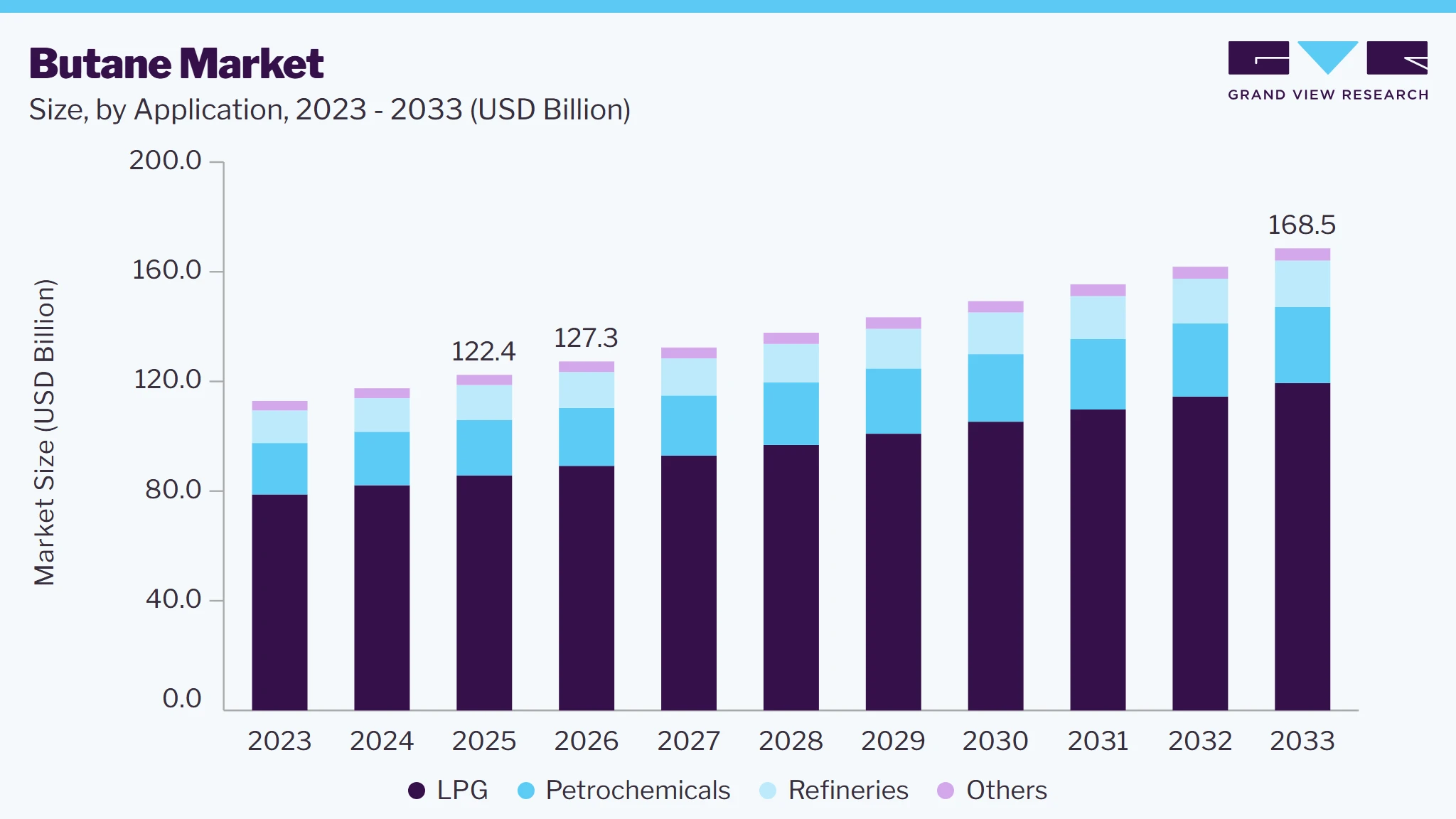
The global butane market size was valued at USD 122.4 billion in 2025 and is projected to grow from USD 127.3 billion in 2026 to USD 168.5 billion by 2033, at a CAGR of 4.1% from 2026 to 2033. Asia Pacific dominated the market, accounting for a revenue share of 37.1% in 2025. The growth is attributable to the increasing application of butane in the making of liquid petroleum gases (LPG).
 Source: Grand View Research, IR Documents, Primary Interviews, Paid DatabasesTo learn more about this report,
 Download Free Sample Report
Key Market Trends & Insights
- By application: Drug development segment held the largest market share of 55.4% in 2025.
Regional Highlights
- Largest regional market: Asia Pacific (37.1% revenue share, 2025)
- By country: China held the largest market share in 2025.
Market Size & Forecast
- Market size in 2025: USD 122.4 Billion
- Estimated market size in 2026: USD 127.3 Billion
- Projected market size by 2033: USD 168.5 Billion
- CAGR (2026-2033): 4.1%
Three ways to get this report
Buy it, customize it, or ask a question.Ask an Analyst
Analyst response in 1 business day
- AccessReport author, directly
- Reply timeWithin 1 working day
- No sales callDirect answer only
- FormatEmail reply
- CostFree, no cost
Get the Full Report
What the study covers
- FormatsPDF · Excel · Dashboard
- Timeline2026–2033 annual, 2025 base
- Coverage20+ countries, 5 regions
- Companies10+ key players profiled
Customize the Report
20% free customization
- IncludeCountries, segments, points
- TailorTo your product definition
- ExtendDeeper competitor detail
- OrA fully bespoke study
- Turnaround5–10 working days
Growing demand for LPG in numerous application such as residential cooking, fuel in automobile, industrial agriculture, and others, due to its properties like easy liquefiable and high flammability is likely to propel the market growth over the future years. Increasing adoption of LPG as a domestic fuel in emerging economies of Asia Pacific by the means of government subsidies is expected to remain a key driving factor for the growing demand for butane. It is also used for manufacturing various primary petrochemicals and the massive petrochemical capacity expansion in the Middle East. Auto gas is one of the fastest emerging alternative transportation fuels on account of its low carbon footprint compared to gasoline and diesel.
 To learn more about this report, Download Free Sample Report
Butane is used as a feedstock in petrochemical complexes for producing various petrochemicals such as ethylene, butadiene, which is a key raw material for the production of synthetic rubber, and maleic anhydride. The petrochemical industry represents the second biggest user after LPG. Ethylene which is considered one of the major petrochemical building blocks for manufacturing numerous vital petrochemicals is mainly produced via naphtha, however, some petrochemical complexes around the world, which are flexible on their feedstock slates, use butane to manufacture ethylene.
 To learn more about this report, Download Free Sample Report
Automotive liquefied petroleum gas, also known as auto gas, is used as a fuel in automobiles in many regions worldwide. Auto gas has high energy content and burns easily compared to other energy sources or fuels. Consumption of auto gas has been rapidly increasing over the last few years, majorly due to its environmental benefits. National governments of various countries have been promoting the use of auto gas through various initiatives. The growing use of butane in the production of automotive gas is likely to propel the market over the projected years.
The strike of COVID-19 further propelled the demand for butane owing to the rising consumption of LPG for cooking across the world. Global lockdown due to the growing risk of infection from COVID-19 compelled people to cook their food at home. This factor triggered the growth of the market across the globe.
Market Dynamics
The global butane market is driven by rising demand across residential, commercial, industrial, and petrochemical applications. Expanding consumption of liquefied petroleum gas (LPG) for cooking, heating, and clean energy solutions continues to drive market expansion, particularly in emerging economies where access to conventional natural gas infrastructure remains limited. In the petrochemical sector, butane serves as an essential feedstock to produce olefins, synthetic rubber, and specialty chemicals, reinforcing its strategic importance within the chemical value chain. Refinery operations also contribute significantly to demand through gasoline blending and fuel optimization processes aimed at meeting evolving fuel quality standards. However, market performance is influenced by fluctuations in crude oil and natural gas prices, geopolitical developments affecting hydrocarbon supply, and increasingly stringent environmental regulations governing fossil fuel consumption.
The increasing adoption of liquefied petroleum gas (LPG) as a cleaner and more efficient fuel source is a primary driver of the global butane market. As a key component of LPG, butane is extensively used for residential cooking, space heating, water heating, and commercial energy applications due to its high calorific value and ease of storage and transportation. Rapid urbanization, expanding access to modern energy infrastructure, and government initiatives promoting cleaner household fuels in developing economies have significantly strengthened LPG consumption. These factors continue to support stable demand for butane across both mature and emerging markets.
Industrial and commercial sectors are also contributing to sustained butane consumption as businesses seek reliable and cost-effective fuel alternatives for manufacturing processes, metal fabrication, ceramics, food processing, and hospitality applications. In addition, the expansion of LPG distribution infrastructure and storage facilities has improved product accessibility, while increasing investments in downstream energy networks are enhancing supply reliability. These developments collectively reinforce butane's position as a critical fuel within the global energy mix and create a strong foundation for long-term market growth.
The butane market remains highly susceptible to fluctuations in crude oil and natural gas prices, as butane is primarily produced during natural gas processing and crude oil refining. Variations in upstream production levels, geopolitical tensions, trade restrictions, supply chain disruptions, and changes in global energy demand can lead to significant price instability, affecting procurement costs for manufacturers and end users. Such volatility reduces pricing predictability, complicates long-term supply agreements, and places pressure on operating margins across the value chain. Increasing environmental regulations aimed at reducing dependence on fossil fuels and accelerating the transition toward renewable energy sources may limit investment in hydrocarbon-based infrastructure over time. These factors collectively create uncertainty for market participants, influence investment decisions, and may restrain the pace of expansion in the global butane market despite continued demand across key application sectors.
The growing transition toward lower-emission transportation fuels presents a significant opportunity for the butane market through increased adoption of autogas. As governments implement stricter vehicle emission standards and encourage alternatives to conventional gasoline and diesel, LPG-based automotive fuels are gaining wider acceptance due to their lower carbon emissions, reduced particulate matter, and competitive operating costs. Since butane is blended with propane to produce autogas, rising vehicle conversions and expanding fleets powered by LPG are expected to generate additional demand across both developed and emerging economies.
Investments in refueling infrastructure, supportive fiscal incentives, and policies promoting cleaner urban mobility are accelerating the penetration of autogas in commercial transportation, taxis, and public vehicle fleets. Many countries are prioritizing affordable transitional fuels while expanding long-term decarbonization strategies, positioning LPG as a practical solution for reducing transportation emissions. This evolving regulatory landscape, combined with advancements in fuel distribution networks and growing consumer awareness of fuel efficiency, is expected to create attractive growth opportunities for butane suppliers throughout the forecast period.
Application Insights
By application, LPG held a dominant position, contributing 70.0% of total revenue in 2025. Its high share is driven by its growing use of LPG in various applications such as residential & commercial, chemical & petrochemical, industrial, refinery, auto fuel, and others. The consumption of LPG for cooking has exponentially increased since the outbreak of COVID-19 owing to the rising dependability on home cooking on the account of the shutdown of restaurants.
Growing demand for auto fuel on the account of increasing use of cars and other automobiles for daily commutes is likely to influence the demand for butane over the forthcoming years. According to a report published by the World Economic Forum in 2022, near about 76.0% of residents use their own cars to commute between their homes and workplace in the U.S. In Germany, over 65.0% working-class population use their own cars to travel to their work. This factor is likely to accelerate the demand for butane over many years to come.
Growing consumption of petrochemicals is another factor contributing to the growth of the market globally. Petrochemicals are also found in various modern energy systems, wind turbine blades, solar panels, and thermal insulation for buildings, batteries, and electric vehicle parts. The rising utilization of petrochemicals in applications such as fertilizers, plastics, clothing, packaging, tires, detergent, medical equipment, and more, is anticipated to influence the growth of the market over the forecasted years.
Regional Insights
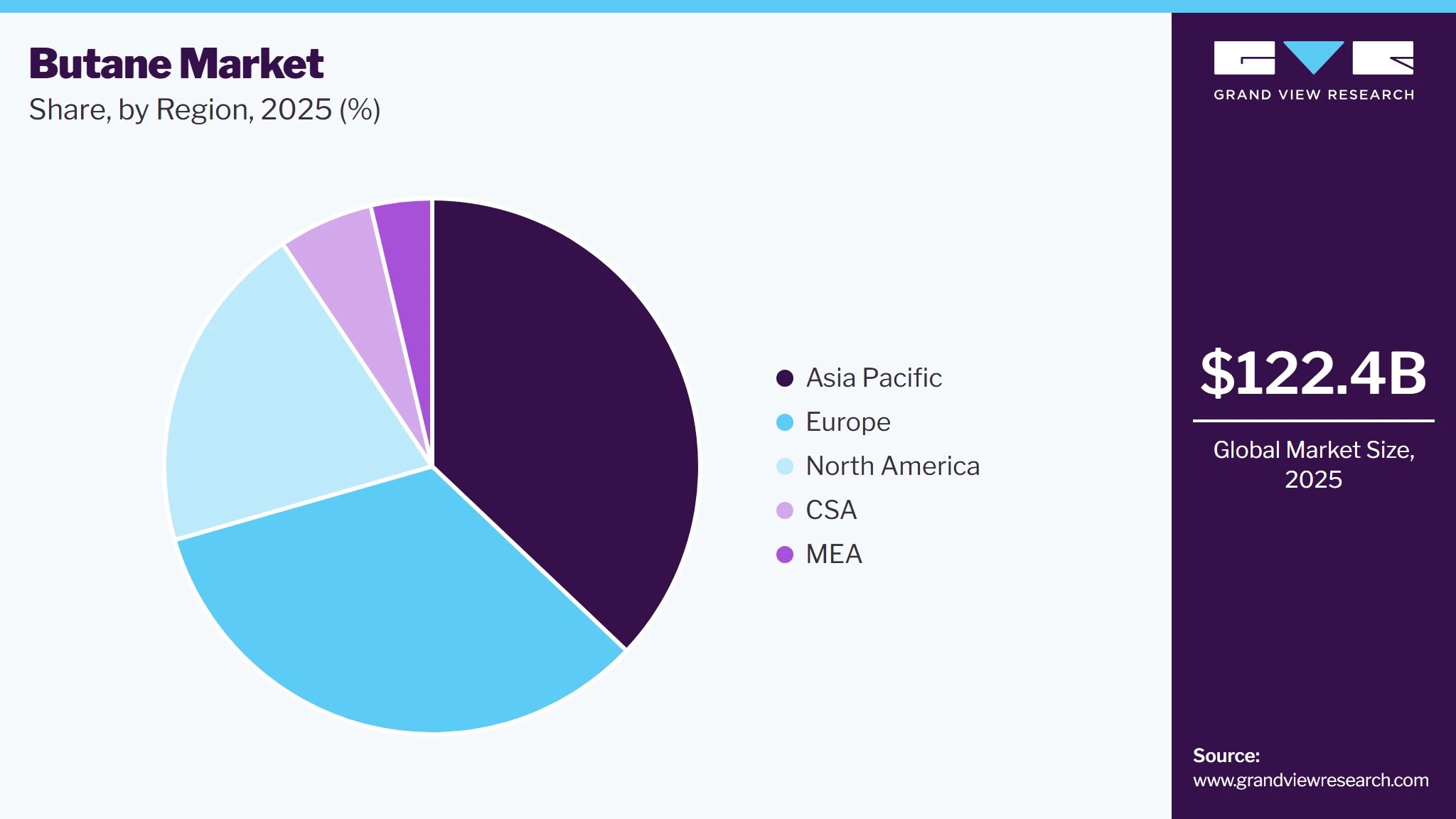
Asia Pacific dominated the butane market with the highest revenue share of 37.1% in 2025. Asia Pacific is among the high-prospect markets for chemical industry stakeholders. Rapid economic growth coupled with an increase in individual power consumption is encouraging growth in Asia Pacific. China dominated the Asia Pacific butane market in 2025. In addition to South Korea and Japan, flourishing countries like India, China, Indonesia, and others offer lucrative growth opportunities for the market.
 To learn more about this report, Download Free Sample Report
Europe presents lucrative growth opportunities owing to the rising production of liquid petroleum gas (LPG) in countries like Russia, Germany, the UK, and others. The rising consumption of LPG in residential and commercial for cooking and heating application is the key driver for the growing consumption of the product in Europe over the forthcoming years. Low carbon emission of butane in comparison with coal for energy generation is another contributing factor behind the growth of the market in Europe.
North America is anticipated to witness stable growth in demand for butane owing to rising production of crude and natural gas in the U.S. U.S. is among the key producers of petrochemicals, accounting for nearly 40.0% of the total global petrochemical production per year, according to the International Energy Agency (IEA). Growing petrochemical production is anticipated to accelerate the demand for butane over the foreseeable future in the U.S.
Key Companies & Market Share Insights
The global market is fragmented on the account of the presence of various players in the business operating globally. Emerging players and leaders in the country that include small manufacturers, traders, and players operating at country and regional levels capture a significant market share.
Key Butane Companies:
The following key companies have been profiled for this study on the butane market.
-
British Petroleum
-
Chevron Corporation
-
China National Petroleum Corporation (CNPC)
-
Valero Energy Corporation
-
Conocco Phillips Inc.
-
Devron Energy Corporation
-
Exxon Mobil Corporation
-
Proton Gases India Pvt. Ltd.
-
Perenco
-
Royal Dutch Shell plc
-
Linde AG
-
TotalEnergies
-
Praxair
Competitive Benchmarking
Category
Operating Strategies
Competitive Edge
Weakness
Established Players (BP plc (British Petroleum), Chevron Corporation, China National Petroleum Corporation (CNPC), Valero Energy Corporation, ConocoPhillips, ExxonMobil Corporation, Shell plc (formerly Royal Dutch Shell plc), TotalEnergies SE, Linde plc (formerly Linde AG), Praxair)
- Maintain vertically integrated operations spanning upstream production, refining, petrochemical manufacturing, and global distribution networks.
- Invest in refinery modernization, processing efficiency, and digital technologies to optimize production costs and asset utilization.
- Secure long-term supply agreements and strategic partnerships to ensure reliable feedstock availability and stable customer relationships.
- Expand portfolios through investments in cleaner fuels, low-carbon technologies, and infrastructure supporting evolving energy demand.
- Extensive global production, storage, and logistics infrastructure enables consistent product availability across multiple regions.
- Strong financial resources support large-scale capital investments, technological innovation, and capacity expansion projects.
- Well-established customer relationships and diversified end-market presence reduce dependence on a single application or geography.
- Integrated value chains provide greater control over feedstock sourcing, production efficiency, and pricing strategies.
- Large operational structures can reduce organizational flexibility and slow response to changing market conditions.
- Significant exposure to crude oil and natural gas price volatility impacts profitability and investment planning.
- High capital expenditure requirements for maintaining and upgrading refining and processing assets increase operational costs.
- Increasing regulatory scrutiny on fossil fuels may require substantial investments in emissions reduction and sustainability initiatives.
Emerging Players (Devron Energy Corporation, Perenco)
- Focus on regional production and niche markets where specialized supply and customer proximity provide competitive advantages.
- Strengthen market presence through strategic collaborations, joint ventures, and targeted acquisitions.
- Prioritize operational efficiency and cost optimization to remain competitive against larger integrated companies.
- Expand selectively into high-growth markets by leveraging flexible production and distribution capabilities.
- Greater operational agility allows quicker adaptation to regional demand shifts and customer requirements.
- Lean organizational structures facilitate faster decision-making and efficient resource allocation.
- Strong regional expertise enables customized solutions and closer customer engagement in specific markets.
- Ability to capitalize on underserved markets with focused investment strategies and localized distribution networks.
- Limited production capacity and geographic reach constrain scalability and market penetration.
- Greater dependence on third-party infrastructure and feedstock suppliers increases supply chain risks.
- Lower financial capacity may restrict investments in advanced technologies, capacity expansion, and research initiatives.
- Reduced brand recognition and global presence can make it challenging to compete for large, long-term commercial contracts.
Butane Market Report Scope
Report Attribute
Details
Market size in 2025
USD 122.4 billion
Estimated market size in 2026
USD 127.3 billion
Projected market size by 2033
USD 168.5 billion
Growth rate
CAGR of 4.1% from 2026 to 2033
Base year for estimation
2025
Historical data
2021 - 2024
Forecast period
2026 - 2033
Quantitative units
Revenue in USD billion/billion, Volume in Kilotons and CAGR from 2026 to 2033
Report coverage
Revenue forecast, company ranking, competitive landscape, growth factors, and trends
Segments covered
Application, region
Regional scope
North America; Europe; Asia Pacific; Central & South America; Middle East & Africa
Country scope
U.S.; Canada; Mexico; Germany; UK; Italy; Spain; Russia; China; India; Japan; South Korea; Thailand; Malaysia; Brazil; Argentina; Saudi Arabia; Iran
Key companies profiled
British Petroleum; Chevron Corporation; China National Petroleum Corporation (CNPC); Valero Energy Corporation; Conocco Phillips Inc.; Devron Energy Corporation; Exxon Mobil Corporation; Perenco; Royal Dutch Shell plc; Linde AG; TotalEnergies; Praxair
Customization scope
Free report customization (equivalent up to 8 analysts' working days) with purchase. Addition or alteration to country, regional & segment scope.
Pricing and purchase options
Avail customized purchase options to meet your exact research needs. Explore purchase options
Global Butane Market Segmentation
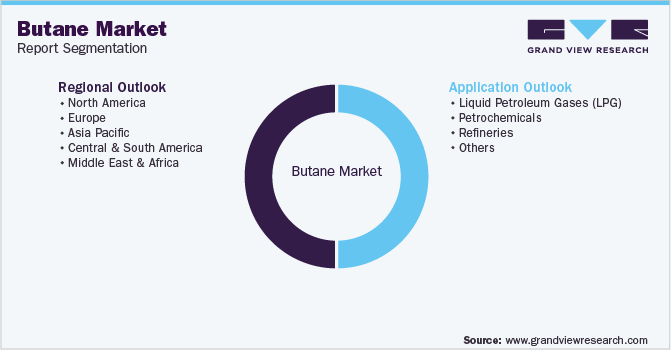
This report forecasts revenue growth at global, regional, and country levels and provides an analysis on the latest industry trends in each of the sub-segments from 2021 to 2033. For this study, Grand View Research has segmented the butane market report based on application, and region:
 To learn more about this report, Download Free Sample Report
-
Application Outlook (Volume, Million tons, Revenue, USD Million; 2021 - 2033)
-
Liquid Petroleum Gases (LPG)
-
Residential/Commercial
-
Chemical/Petrochemical
-
Industrial
-
Auto Fuel
-
Refinery
-
Others
-
-
Petrochemicals
-
Refineries
-
Others
-
-
Regional Outlook (Volume, Million tons, Revenue, USD Million; 2021 - 2033)
-
North America
-
U.S.
-
Canada
-
Mexico
-
-
Europe
-
Germany
-
UK
-
Italy
-
Spain
-
Russia
-
-
Asia Pacific
-
China
-
India
-
Japan
-
South Korea
-
Thailand
-
Malaysia
-
-
Central & South America
-
Brazil
-
Argentina
-
-
Middle East & Africa
-
Saudi Arabia
-
Iran
-
-
Research Methodology
The butane market figures in this report are based on a proven research process that combines executive interviews with secondary research from proprietary databases, company filings, and recognized regulatory and institutional sources. Market size is built through value-chain sizing - reconciling supply-side and demand-side estimates - and triangulated with bottom-up and top-down approaches. Every estimate passes multiple levels of expert validation before publication, with each butane segment quantified using the revenue-capture definitions in the table below.
Segment Definition
Segment - Application
Revenue capture definition
Liquid Petroleum Gases (LPG)
Income is generated from the supply of butane as a principal LPG component for residential cooking, space heating, commercial energy needs, industrial fuel, and automotive fuel blends across domestic and international markets.
Petrochemicals
Commercial gains arise from the utilization of butane as a feedstock for producing olefins, butadiene, maleic anhydride, synthetic rubber, and other chemical intermediates supporting downstream manufacturing operations.
Refineries
Value creation is derived from the use of butane in gasoline blending, vapor pressure adjustment, alkylation processes, and refinery fuel systems to optimize fuel quality and operational efficiency.
Other Applications
Economic contribution comes from the application of butane in aerosol propellants, refrigerants, lighter fuel, calibration gases, laboratory gases, and specialty industrial products serving diverse end-use industries.
Estimation Model
Layer Name
Key Question
Description
Raw Material & Production Layer
What forms the supply base?
Evaluate the global production landscape for butane by examining natural gas processing facilities and crude oil refineries that recover the product from hydrocarbon streams. The assessment covers feedstock availability, extraction and fractionation technologies, processing capacity, storage infrastructure, transportation networks, supplier integration, and key producing regions supporting consistent commercial availability.
Application Adoption Layer
Where is butane utilized?
Analyze deployment across major application areas including liquefied petroleum gas (LPG), petrochemical manufacturing, refinery operations, automotive fuel, aerosol propellants, refrigerants, and specialty industrial uses. Adoption is supported by increasing energy demand, expanding petrochemical production, fuel diversification initiatives, and broad utilization as a versatile hydrocarbon feedstock.
Consumption Intensity Layer
How much butane is utilized?
Assess utilization volumes by reviewing demand across residential, commercial, industrial, transportation, petrochemical, and refining sectors. The analysis considers fuel blending ratios, feedstock requirements, production throughput, seasonal consumption patterns, import-export dynamics, and regional energy demand to estimate overall market usage.
Revenue Layer
How is market revenue generated?
Market income is derived from the extraction, processing, storage, transportation, and sale of butane supplied to LPG distributors, petrochemical manufacturers, refineries, and industrial consumers. Commercial expansion is supported by energy consumption trends, refining activity, petrochemical capacity additions, supply chain optimization, strategic contracts, and investments in fuel distribution infrastructure.
Delivered Customizations
This report has been delivered with the following In-depth customizations
Client Request
Customization Delivered
Value Adds
Cross-segmentation
The assessment examines market performance across application segments, end-use industries, regional consumption patterns, production capacities, supply sources, pricing trends, and distribution networks for butane. It further evaluates demand across LPG, petrochemicals, refineries, automotive fuel, and specialty applications while analyzing competitive positioning, infrastructure development, and evolving consumption dynamics.
Enables stakeholders to identify high-growth application areas, compare regional consumption trends, evaluate production capabilities, understand sector-specific demand drivers, and develop targeted market expansion, supply planning, and investment strategies.
Trade Assessment
The report provides a comprehensive evaluation of historical and current trade activities for butane, including import-export volumes, leading producing and consuming countries, international supply routes, pricing movements, storage infrastructure, and transportation networks. It also analyzes regional production concentration, cross-border trade flows, and supply chain dynamics influencing product availability and market competitiveness.
Supports procurement optimization by identifying sourcing risks, improving supply chain resilience, uncovering export opportunities, strengthening supplier diversification, and enhancing visibility into global trade developments influencing the butane market.
Opportunity Assessment
The study delivers an in-depth evaluation of growth prospects across LPG, petrochemical feedstocks, refinery operations, autogas, aerosol propellants, refrigerants, and other industrial applications. It further assesses opportunities arising from expanding LPG consumption, increasing petrochemical capacity, growing adoption of lower-emission transportation fuels, infrastructure investments, and rising energy demand across emerging economies.
Assists organizations in prioritizing high-potential application segments, identifying attractive investment opportunities, aligning business strategies with evolving energy requirements, strengthening competitive positioning, and capturing long-term growth supported by industrial development and expanding fuel infrastructure.
Frequently Asked Questions About This Report
The global butane market size was estimated at USD 122.4 billion in 2025 and is expected to reach USD 127.3 billion in 2026.
The global butane market is expected to grow at a compound annual growth rate of 4.1% from 2026 to 2033 to reach USD 168.5 billion by 2033.
Asia Pacific dominated the butane market with the highest revenue share of 37.1% in 2025. The region's leadership was supported by robust LPG consumption, expanding petrochemical production, growing refinery capacity, and increasing energy demand driven by rapid industrialization and urbanization.
By application, Drug development segment held the largest market share of 55.4% in 2025.
The butane market is primarily driven by increasing demand for liquefied petroleum gas (LPG) across residential, commercial, and industrial sectors, supported by expanding access to cleaner cooking and heating fuels. Additional growth is fueled by rising petrochemical production, increased refinery activities, and the growing adoption of autogas as a cost-effective, lower-emission transportation fuel.
Future growth opportunities in the butane market are expected to arise from the expanding adoption of autogas, increasing investments in LPG distribution infrastructure, and rising petrochemical production in emerging economies. Additional potential lies in refinery capacity expansions and growing demand for cleaner, cost-effective fuel solutions across residential, industrial, and transportation sectors.
Some key players operating in the butane market include British Petroleum; Chevron Corporation; China National Petroleum Corporation (CNPC); Valero Energy Corporation and others.
About the Author(s)
Petrochemicals Research Team
Bulk Chemicals · PetrochemicalsThis report was authored by the petrochemicals research team at Grand View Research - comprising two research analysts, one senior research analyst, and one industry expert - with specialized expertise in the petrochemicals segment of the bulk chemicals industry. All findings are based on proprietary bulk chemicals databases, executive interviews, and regulatory analysis, subject to internal peer review prior to publication.
Last Updated:
Speak to Analyst

Customize this report to your needs - add regions, segments, or data points, with 20% free customization.
Or view our licence options:


ISO 9001:2015 & 27001:2022 Certified
We are GDPR and CCPA compliant! Your transaction & personal information is safe and secure. For more details, please read our privacy policy.


