
- Home
- »
- Next Generation Technologies
- »
-
Carbon Credit Validation Verification & Certification Market Report, 2033GVR Report cover

Carbon Credit Validation Verification And Certification Market (2026 - 2033)
Size, Share & Trends Analysis Report By Service, By Type (Compliance, Voluntary), By Sector (Agriculture & Forestry, Energy & Utilities, Industrial, Transportation), By Region, And Segment Forecasts
Market Size, 2025
$366.6MMarket Estimate, 2026
$455.0MMarket Forecast, 2033
$2,069.2MCAGR, 2026–2033
24.2%Carbon Credit Validation Verification And Certification Market Summary
The global carbon credit validation verification and certification market size was valued at USD 366.6 million in 2025 and is projected to grow from USD 455.0 million in 2026 to USD 2,069.2 million by 2033, growing at a CAGR of 24.2% from 2026 to 2033. North America dominated the Market with the largest revenue share of 37.7% in 2025. The carbon credit validation, verification, and certification market is growing as countries strengthen their commitments to reducing greenhouse gas emissions.
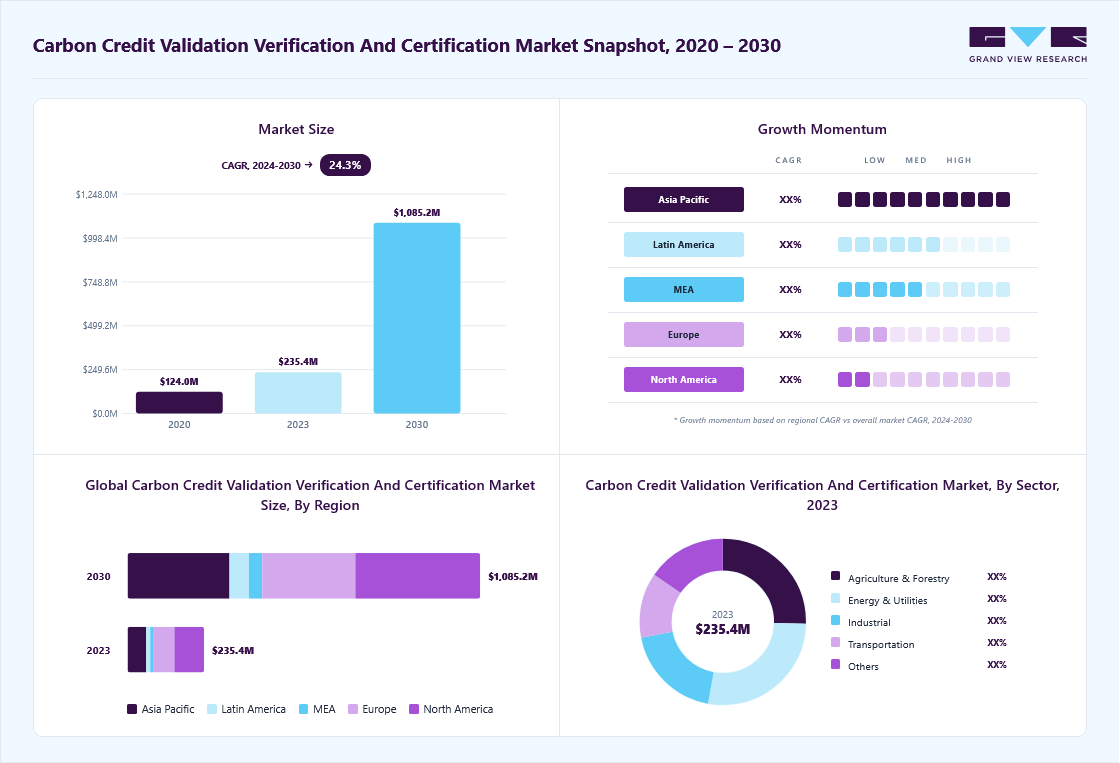 Source: Grand View Research, IR Documents, Primary Interviews, Paid DatabasesTo learn more about this report,
 Download Free Sample Report
 Key Market Trends & Insights
- By service: The verification segment held a significant 56.7% revenue share in 2025.
- By type: The voluntary segment held the largest revenue share in 2025.
- By sector: The energy & utilities segment held a significant 26.9% revenue share in 2025.
Regional Highlights
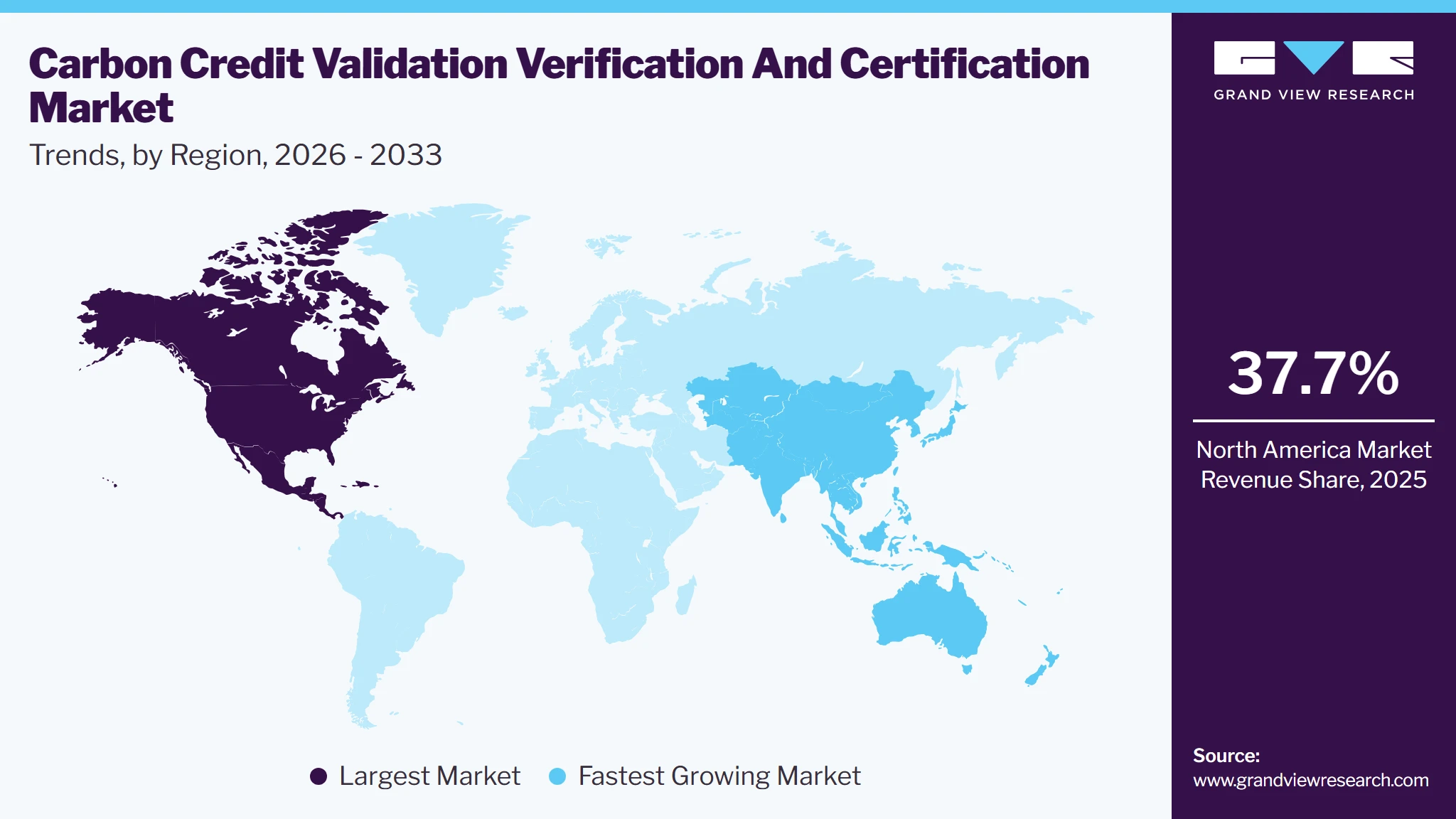
- Largest regional market: North America (37.7% revenue share, 2025)
- Fastest growing regional market: Asia Pacific (highest CAGR, 2026-2033)
- By country: The U.S. held the largest market share in 2025.
Market Size & Forecast
- Market size in 2025: USD 366.6 Million
- Estimated market size in 2026: USD 455.0 Million
- Projected market size by 2033: USD 2,069.2 Million
- CAGR (2026-2033): 24.2%
Three ways to get this report
Buy it, customize it, or ask a question.Ask an Analyst
Analyst response in 1 business day
- AccessReport author, directly
- Reply timeWithin 1 working day
- No sales callDirect answer only
- FormatEmail reply
- CostFree, no cost
Get the Full Report
What the study covers
- FormatsPDF · Excel · Dashboard
- Timeline2026–2033 annual, 2025 base
- Coverage20+ countries, 5 regions
- Companies10+ key players profiled
Customize the Report
20% free customization
- IncludeCountries, segments, points
- TailorTo your product definition
- ExtendDeeper competitor detail
- OrA fully bespoke study
- Turnaround5–10 working days
Participation in both voluntary and compliance carbon markets continue to increase across industries. This is driving demand for reliable validation, verification, and certification services to ensure the credibility of carbon credit projects. Growing carbon markets and the adoption of nature-based solutions, such as reforestation and soil carbon sequestration, are boosting demand for reliable validation services. Technological advancements, including satellite imagery and blockchain, have enhanced the efficiency and transparency of carbon credit certification. Emerging carbon exchanges and voluntary offset programs across various global regions further fuels this expansion.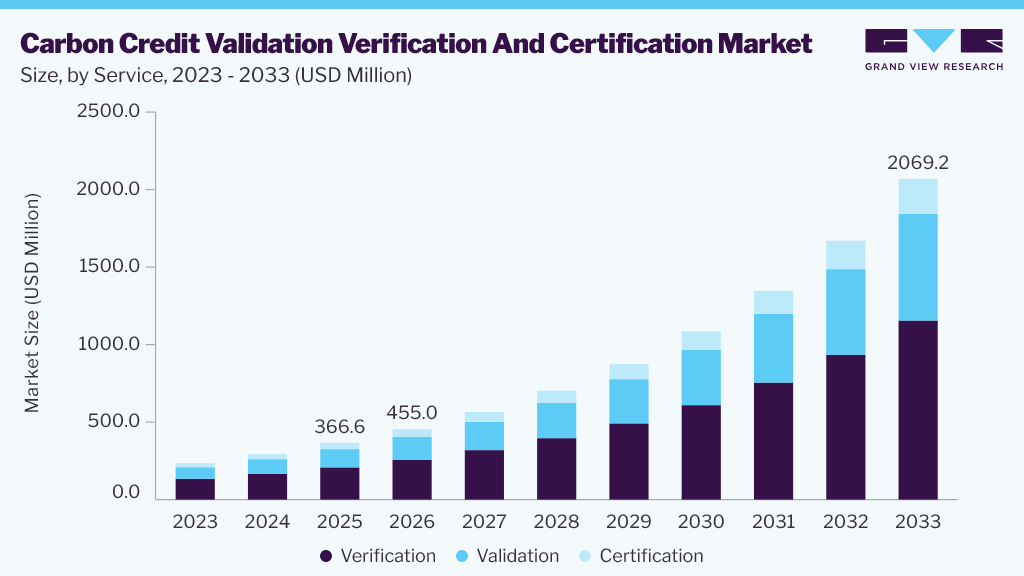 To learn more about this report, Download Free Sample Report
 The Voluntary Carbon Markets (VCMs) are expanding rapidly as companies and individuals increasingly purchase carbon credits outside regulatory frameworks to offset emissions and meet Corporate Social Responsibility (CSR) goals. Financial incentives, such as cap-and-trade systems and carbon taxes, are driving businesses to participate in carbon markets, boosting demand for certification services. The emergence of new carbon offset projects across various industries, including carbon capture, renewable energy, and energy efficiency, further fuels the need for validation. As corporate net-zero commitments rise, companies are seeking verified carbon credits to offset unavoidable emissions, which increases the demand for credible certification services.
Growing investor interest in green finance and sustainable investments, including green bonds and ESG funds, is driving demand for certified carbon credits and related services. International collaboration on climate initiatives, such as the UN's REDD+ program, is promoting carbon offset projects in developing countries, creating a global demand for certification services. Technological advancements in AI, satellite imagery, and blockchain are enhancing the efficiency of verification processes, lowering costs, and improving access to these services. As the global carbon market expands, the need for credible, transparent validation services continues to grow, mainly across emerging and developed markets.
Market Dynamics
The carbon credit validation, verification, and certification market is experiencing steady growth due to increasing global efforts to reduce greenhouse gas emissions. Rising participation in voluntary and compliance carbon markets is driving demand for credible validation and verification services. Organizations are seeking independent certification to ensure the transparency, quality, and integrity of carbon credit projects. Strengthening climate regulations and corporate net-zero commitments are further supporting market expansion. Continuous advancements in digital monitoring, reporting, and verification technologies are also improving the efficiency and reliability of carbon credit certification.
The growing commitment of governments and corporations to achieve net-zero emissions is driving demand for carbon credit validation, verification, and certification services. The expansion of voluntary and compliance carbon markets is increasing the need for independent assessment to ensure the credibility, transparency, and integrity of carbon credit projects. As carbon trading activities continue to increase, organizations are placing greater emphasis on high-quality, verified carbon credits.
Organizations are increasingly seeking certified carbon credits to meet sustainability targets, comply with evolving climate regulations, and strengthen environmental reporting. In addition, the growing number of carbon reduction and carbon removal projects across renewable energy, forestry, agriculture, waste management, and industrial sectors is increasing the demand for validation and verification services. These factors are supporting the continued growth of the carbon credit validation, verification, and certification market.
The carbon credit validation, verification, and certification market faces challenges due to the complexity and cost associated with project assessment, monitoring, and compliance requirements. Carbon projects often require extensive documentation, baseline assessments, continuous monitoring, and independent third-party verification, which can increase operational expenses and extend project development timelines. These requirements can be particularly challenging for small and medium-sized project developers with limited technical and financial resources.
In addition, varying standards, methodologies, and regulatory frameworks across voluntary and compliance carbon markets can create uncertainty for project developers and carbon credit buyers. The lack of harmonized global standards may delay project approvals, increase administrative complexity, and limit market participation, restraining the growth of the carbon credit validation, verification, and certification market.
The increasing focus on carbon removal and nature-based climate solutions is creating significant opportunities for the carbon credit validation, verification, and certification market. Governments, corporations, and investors are supporting projects such as reforestation, afforestation, soil carbon sequestration, blue carbon, and direct air capture to achieve long-term decarbonization and net-zero targets. The expanding pipeline of these projects is increasing the demand for reliable validation and verification services.
As organizations place greater emphasis on high-quality and credible carbon credits, the need for independent certification is becoming more important. Growing participation in voluntary carbon markets, combined with increasing corporate sustainability commitments, is expected to create new growth opportunities for validation, verification, and certification providers over the forecast period.
Market Concentration & Characteristics
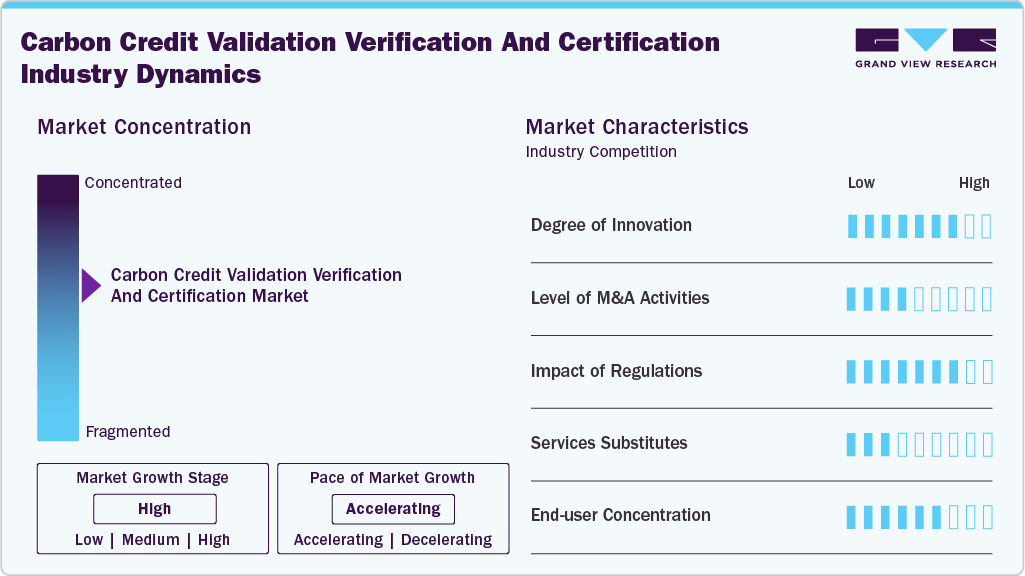
The carbon credit validation, verification, and certification market is moderately concentrated, with a small group of globally recognized standards bodies and certification organizations holding significant influence. These players benefit from strong credibility, wide acceptance across voluntary and compliance carbon markets, and established accreditation frameworks, which allow them to manage large-scale and cross-border carbon projects efficiently. Their dominance is further supported by long-standing relationships with corporates, project developers, and regulatory bodies.
 To learn more about this report, Download Free Sample Report
 However, the market does not function as a fully consolidated structure due to the presence of several regional and specialized verification bodies that serve local markets and niche project categories. This creates a competitive environment where global leaders coexist with smaller accredited firms, particularly in developing carbon markets. As a result, the industry maintains a balanced structure, combining strong global influence with fragmented regional participation, which keeps overall concentration at a moderate level.
Analyst Perspective
The carbon credit validation, verification, and certification market is witnessing steady growth, supported by expanding voluntary and compliance carbon markets. Market participants are strengthening verification capabilities to address increasing demand for high-integrity carbon credits. Regulatory developments and evolving international standards are increasing the need for independent validation and certification services. Digital technologies, including AI, blockchain, and remote monitoring, are improving the efficiency and transparency of verification processes. The market outlook remains positive as organizations increase investments in credible carbon reduction and removal projects.
Service Insights
Based on service, the verification segment led the market with the significant revenue share of 56.7% in 2025, primarily due to its vital role in ensuring the credibility and accuracy of carbon credits. Verification is essential for confirming that emissions reductions or carbon offset projects have met the required standards and criteria, which is necessary for both compliance and voluntary carbon markets. As more organizations pursue carbon neutrality and emission reduction goals, the demand for third-party verification has surged to ensure transparency, reliability, and trust in carbon credit transactions. In addition, growing regulatory enforcement and the rise of new carbon markets have further fueled the need for verification services.
The certification segment within the carbon credit validation verification and certification market is experiencing significant growth due to the increasing demand for verified credits, driven by both regulatory frameworks and voluntary markets. As corporate net-zero commitments rise, businesses seek certified carbon credits to meet their ESG goals and enhance their reputations, emphasizing the importance of legitimacy. The growing number of carbon projects, mainly in sectors such as renewable energy and forestry, fuels the need for certification to make credits market ready. Regulatory pressures and compliance requirements, such as those from the EU Emissions Trading System and California’s Cap-and-Trade Program, further drive demand for certified credits.
Type Insights
Based on type, the voluntary segment led the market with the largest revenue share of 57.6% in 2025, fueled by the increasing number of companies committing to sustainability and net-zero targets. Rising awareness of climate change among consumers and investors has spurred a greater emphasis on proactive carbon footprint reduction, expanding voluntary carbon offsetting efforts. The market’s expansion is supported by new initiatives and trading platforms, providing opportunities for diverse and innovative offset projects. Global corporate commitments and consumer preferences for strong environmental safety further boost demand for voluntary credits.
The compliance segment is experiencing significant growth due to stricter regulatory frameworks and mandatory emission reduction targets. Governments and international bodies, such as the EU's Emissions Trading System and California's Cap-and-Trade Program, are enforcing more stringent regulations that require companies to purchase compliance carbon credits to meet legal requirements. The market has become more established with widespread participation and offers more stable pricing compared to voluntary markets; demanding businesses seek predictable costs for carbon reduction. Increased transparency and reporting requirements further drive demand for verified compliance credits.
Sector Insights
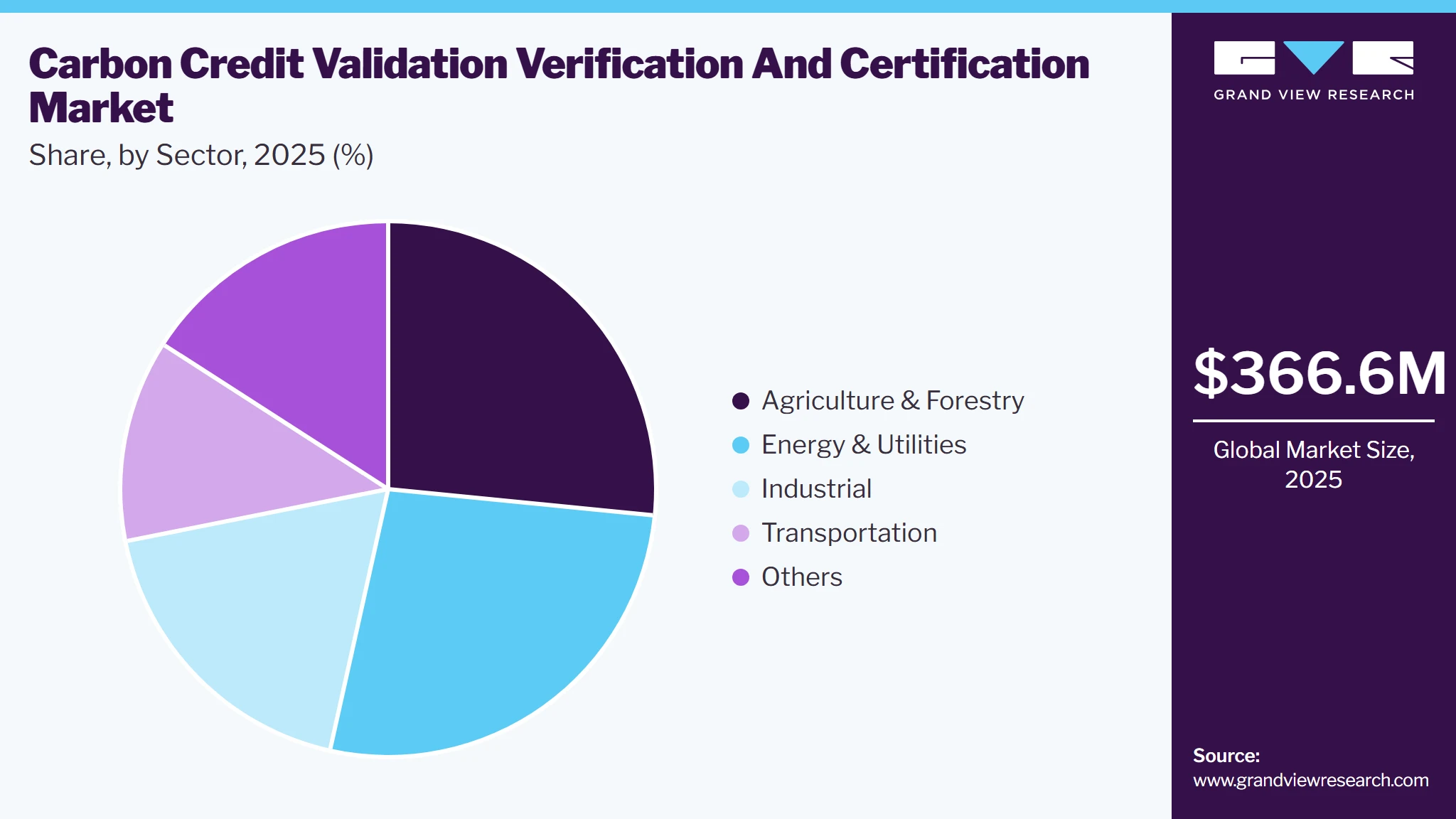
Based on sector, the energy & utilities segment led the market with a significant revenue share of 26.9% in 2025 due to its significant carbon emissions from power generation, oil and gas extraction, and other utility services. Regulatory frameworks, such as emissions trading systems and cap-and-trade programs, impose stringent requirements on this sector, driving high demand for carbon credit validation and certification. The sector's numerous large-scale projects, including renewable energy initiatives and carbon capture and storage, generate a substantial volume of carbon credits that need thorough validation. Investment in cleaner energy sources and technologies further contributes to the need for certification services.
 To learn more about this report, Download Free Sample Report
 The agriculture & forestry segment is expected to grow significantly due to its vital role in nature-based solutions such as reforestation, afforestation, and soil carbon sequestration, which are essential for capturing and storing carbon dioxide. These sectors offer substantial carbon sequestration potential, attracting investment and driving demand for rigorous validation and certification of carbon credits. Increased funding and incentives from governments, NGOs, and private investors further support the development of carbon offset projects in agriculture and forestry. As companies and consumers prioritize sustainability, there is a growing demand for carbon credits from these sectors to meet environmental commitments.
Regional Insights
North America dominated the carbon credit validation verification and certification Market with the largest revenue share of 37.7% in 2025, driven by advanced regulatory frameworks such as the U.S. Cap-and-Trade Program and Canada's federal carbon pricing system. The region's high corporate participation, spurred by stringent regulations and voluntary sustainability goals, significantly boosts demand for validated and certified carbon credits. Established carbon markets in North America involve substantial trading volumes, necessitating rigorous validation to maintain market integrity. Further, the region's advanced technological and analytical capabilities enhance the accuracy of measurement and verification processes.
 To learn more about this report, Download Free Sample Report
 U.S. Carbon Credit Validation Verification And Certification Market Trends
The Carbon credit validation verification and certification Market in the U.S. held the largest share in the North America region in 2025, driven by the strengthening of regulatory frameworks such as potential federal carbon pricing and emissions reduction targets under initiatives such as the Inflation Reduction Act. Corporate sustainability commitments are also fueling demand as U.S. companies increasingly purchase carbon credits to meet their net-zero goals. Technological advancements in monitoring and verification are enhancing the efficiency of managing carbon offset projects.
Europe Carbon Credit Validation Verification And Certification Market Trends
The carbon credit validation verification and certification market in Europe is gaining significant traction due to regulatory frameworks such as the European Union Emissions Trading System (EU ETS), which enforces strict validation and certification standards. Europe's climate goals, including carbon neutrality by 2050 and substantial emissions reductions by 2030, further drive the demand for certified carbon credits. High corporate engagement in sustainability and carbon neutrality initiatives across various industries contributes to this demand as businesses seek reliable carbon credits to meet their targets. In addition, the expansion and integration of regional carbon markets in Europe, including the development of new trading platforms, requires thorough validation and certification processes.
Asia Pacific Carbon Credit Validation Verification And Certification Market Trends
The Asia Pacific carbon credit validation and certification market is poised for significant growth. In China, the national carbon market and climate goals fuel the demand for rigorous validation services. India's investment in renewable energy and participation in the voluntary carbon market creates a strong need for certification. Japan's carbon pricing initiatives and corporate sustainability targets, along with South Korea's comprehensive emissions trading scheme and Green New Deal, drive market expansion.
Key Carbon Credit Validation Verification And Certification Company Insights
Key players in the industry have strengthened their market presence through a strategic mix of product launches, expansions, mergers and acquisitions, contracts, partnerships, and collaborations. These initiatives serve as vital tools for enhancing market penetration and strengthening their competitive edge within the industry. For instance, in June 2024, VERRA introduced the VM0049 Verified Carbon Standard (VCS) Methodology for Carbon Capture and Storage (CCS). This new methodology provides a universally applicable framework for technology-driven CCS projects, which produce Carbon Dioxide Removals (CDRs) and emission lowerings. Carbon Dioxide Removals (CDRs) are viewed as a crucial component of corporate strategies aimed at achieving net zero emissions.
Key Carbon Credit Validation Verification And Certification Companies
The following key companies have been profiled for this study on the carbon credit validation verification and certification market.
-
ACR
-
AENOR
-
Bureau Veritas SA
-
CarbonCheck
-
Gold Standard
-
SGS SA
-
SustainCERT.
-
The ERM International Group Limited
-
TÜV SÜD
-
VERRA
Competitive Benchmarking
Operating Strategies
Competitive Edge
Weaknesses
Mature Players: Verra, Gold Standard, SGS SA, Bureau Veritas SA
- Mature players follow a compliance-driven operating model built on globally recognized standards and long-established verification frameworks. Their approach emphasizes regulatory alignment, audit consistency, and strong governance across carbon projects. Operations are supported by extensive international auditor networks and long-term client relationships across both compliance and voluntary markets.
- Mature players benefit from strong global credibility, long-standing accreditation, and widespread regulatory acceptance across carbon markets. Their extensive auditor networks and established methodologies enable consistent and reliable certification at scale. Deep relationships with corporates, governments, and project developers further strengthen trust and market positioning.
- Mature players often face slower turnaround times due to complex, standardized verification processes and heavy compliance requirements. Their legacy systems and traditional audit-heavy workflows can limit scalability in fast-growing voluntary carbon markets. High service costs and lower operational flexibility may also reduce competitiveness in price-sensitive segments.
Emerging Players: CarbonCheck, SustainCERT
- Emerging players adopt a technology-led and agile operating model focused on digital verification, automation, and faster project processing. They rely on AI-enabled monitoring and platform-based workflows to reduce verification time and improve cost efficiency. Growth is often driven through partnerships and scalable digital ecosystems targeting voluntary carbon market opportunities.
- Emerging players gain advantage through technology-led differentiation, including digital MRV systems, automation, and faster verification cycles. Their agile operating models allow quicker adaptation to evolving carbon market requirements. Cost efficiency and platform-based service delivery support stronger penetration in high-growth voluntary carbon credit projects.
- Emerging players face challenges related to limited global recognition and weaker accreditation strength compared to established certification bodies. Their smaller auditor networks and narrower geographic presence can restrict large-scale project execution. Dependence on technology platforms also exposes them to scalability and trust-building constraints in regulated carbon markets.
Recent Developments
-
In March 2024, Kotyark Industries Limited became the first Indian company in the bio-diesel sector to be accredited under VERRA, a globally recognized carbon certification standard. By implementing eco-friendly practices, the company earned 57,874 carbon credits for the period from September 2020 to March 2022, as per the Verra registry dated March 2, 2024.
-
In February 2024, the Ministry of Power Govt. of India, in partnership with the Bureau of Energy Efficiency (BEE), revised the Carbon Credit Trading Scheme (CCTS), adding an offset mechanism to the compliance regime. The revised scheme enables non-obligated entities to voluntarily register projects across designated sectors, earning tradable carbon credit certificates with the goal of decarbonizing the economy. These certificates are issued after evaluation by BEE-accredited agencies, recognizing efforts to reduce, remove, or avoid greenhouse gas emissions.
-
In January 2024, the CMA-India partnered with the Voluntary Carbon Markets Integrity Initiative to support stakeholders in carbon credit trading. The partnership aims to guide industry players through project registration, monitoring, and transparent carbon credit trading while promoting a high-integrity voluntary carbon market aligned with India's climate and socioeconomic policies.
Carbon Credit Validation Verification And Certification Market Report Scope
Report Attribute
Details
Market size value in 2025
USD 366.6 million
Market size value in 2026
USD 455.0 million
Revenue forecast in 2033
USD 2,069.2 million
Growth rate
CAGR of 24.2% from 2026 to 2033
Base year for estimation
2025
Historical data
2021 - 2024
Forecast period
2026 - 2033
Quantitative units
Revenue in USD million, and CAGR from 2026 to 2033
Report coverage
Revenue forecast, company ranking, competitive landscape, growth factors, and trends
Segments covered
Service, type, sector, region
Regional scope
North America; Europe; Asia Pacific; Latin America; MEA
Country scope
U.S.; Canada; Mexico; Germany; UK; France; China; Japan; India; Australia; South Korea; Brazil; KSA; UAE; South Africa
Key companies profiled
ACR; AENOR; Bureau Veritas SA; CarbonCheck; Gold Standard; SGS SA; The ERM International Group Limited; SustainCERT; TÜV SÜD; VERRA
Customization scope
Free report customization (equivalent up to 8 analysts' working days) with purchase. Addition or alteration to country, regional & segment scope.
Pricing and purchase options
Avail customized purchase options to meet your exact research needs. Explore purchase options
Global Carbon Credit Validation Verification And Certification Market Report Segmentation
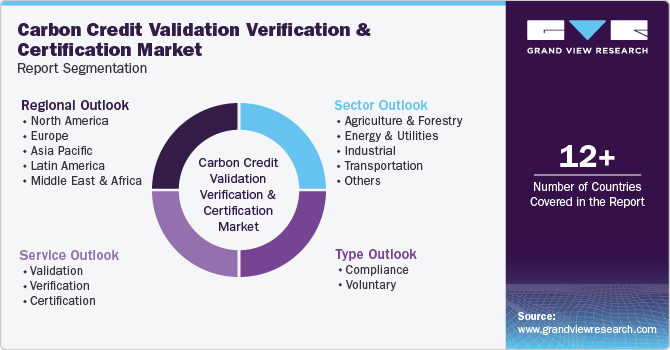
This report forecasts revenue growth at global, regional, and country levels and provides an analysis of the latest industry trends in each of the sub-segments from 2021 to 2033. For this study, Grand View Research has segmented the global carbon credit validation verification and certification market report based on service, type, sector, and region.
 To learn more about this report, Download Free Sample Report
 -
Service Outlook (Revenue, USD Million, 2021 - 2033)
-
Validation
-
Verification
-
Certification
-
-
Type Outlook (Revenue, USD Million, 2021 - 2033)
-
Compliance
-
Voluntary
-
-
Sector Outlook (Revenue, USD Million, 2021 - 2033)
-
Agriculture & Forestry
-
Energy & Utilities
-
Industrial
-
Transportation
-
Others
-
-
Regional Outlook (Revenue, USD Million, 2021 - 2033)
-
North America
-
U.S.
-
Canada
-
Mexico
-
-
Europe
-
UK
-
Germany
-
France
-
-
Asia Pacific
-
China
-
India
-
Japan
-
Australia
-
South Korea
-
-
Latin America
-
Brazil
-
-
MEA
-
UAE
-
South Africa
-
KSA
-
-
Research Methodology
The carbon credit validation verification & certification market figures in this report are based on a proven research process that combines executive interviews with secondary research from proprietary databases, company filings, and recognized regulatory and institutional sources. Market size is built through value-chain sizing - reconciling supply-side and demand-side estimates - and triangulated with bottom-up and top-down approaches. Every estimate passes multiple levels of expert validation before publication, with each carbon credit validation verification & certification segment quantified using the revenue-capture definitions in the table below.
Segment Definition
Segment - Service
Revenue Capture Definition
Validation
Revenue is generated when carbon projects are assessed at the design stage to confirm eligibility, methodology compliance, and baseline accuracy before implementation begins.
Verification
Revenue is earned through independent evaluation of reported emission reductions or removals using monitoring data to ensure accuracy and adherence to approved methodologies.
Certification
Revenue comes from issuing formal approval that confirms verified carbon credits meet required standards for registration and trading in carbon markets.
Segment - Type
Revenue Capture Definition
Compliance
This revenue stream is associated with regulated carbon markets where organizations must undergo validation and verification to meet mandatory emission reduction rules.
Voluntary
Revenue is driven by organizations participating in voluntary carbon markets to meet ESG targets and sustainability goals without regulatory obligations.
Segment - Sector
Revenue Capture Definition
Agriculture & Forestry
Revenue is derived from carbon projects focused on land-use activities such as afforestation, reforestation, and soil carbon storage.
Energy & Utilities
Revenue is generated from projects that reduce emissions through renewable energy deployment and improved energy efficiency in power and utility systems.
Industrial
Revenue originates from decarbonization efforts in manufacturing and heavy industries, including emissions reduction and process optimization initiatives.
Transportation
Revenue is linked to carbon reduction activities in logistics, aviation, shipping, and road transport through fuel efficiency and alternative energy adoption.
Others
Revenue includes emerging carbon initiatives such as waste management, carbon capture technologies, and blue carbon ecosystem projects.
Estimation Model
Layer Name
Key Question
Description
End-User Layer
Who generates demand for carbon credit validation, verification, and certification services?
This layer includes all organizations that create demand for carbon credit services, such as corporates, project developers, governments, NGOs, and sustainability-driven enterprises across sectors like energy, agriculture, forestry, transportation, and industry.
Procurement Activity Layer
Who actively engages in purchasing validation, verification, and certification services?
This layer filters end users based on their participation in carbon markets, ESG commitments, net-zero targets, regulatory obligations, and active involvement in carbon offset or emissions reduction projects.
Project & Service Consumption Layer
What types of carbon projects and services are assessed and certified?
This layer covers the range of carbon credit project types such as renewable energy, afforestation, reforestation, soil carbon, methane capture, industrial decarbonization, and carbon removal technologies that require validation and verification services.
Revenue Capture Layer
How is revenue generated within the carbon credit validation, verification, and certification ecosystem?
Revenue is generated through project validation, periodic verification of emission reductions, certification issuance, audit services, registry registration support, and ongoing monitoring, reporting, and verification (MRV) services across voluntary and compliance carbon markets.
Delivered Customizations
This report has been delivered with the following In-depth customizations
Client Objective
Custom Research Modules Delivered
Strategic Value / Business Impact
Market Entry & Expansion Assessment
Demand sizing, customer segmentation, competitive benchmarking, regulatory and channel analysis
Supports entry strategy, identifies growth markets, and enables investment planning Product Positioning & Competitive Intelligence
Product benchmarking, pricing analysis, brand perception, competitor evaluation
Strengthens differentiation, optimizes pricing, and improves market positioning Customer & End-User Insights Study
Adoption analysis, journey mapping, satisfaction and usage behavior assessment
Improves targeting, reveals demand for drivers, and supports retention strategy Frequently Asked Questions About This Report
The global carbon credit validation verification and certification market size was estimated at USD 366.6 million in 2025 and is expected to reach USD 455.0 million in 2026.
The global carbon credit validation verification and certification market is expected to grow at a compound annual growth rate of 24.2% from 2026 to 2033, to reach USD 2,069.2 million by 2033.
Some key players operating in the carbon credit validation verification and certification market include ACR; AENOR; Bureau Veritas SA; CarbonCheck; Gold Standard; SGS SA; The ERM International Group Limited; SustainCERT ; TÜV SÜD; VERRA
Key factors that are driving the carbon credit validation verification and certification market growth include investment in carbon offset projects, and implementation of emission regulations.
North America dominated the carbon credit validation verification and certification market with a share of 37.7% in 2025. The region's high corporate participation, spurred by stringent regulations and voluntary sustainability goals, significantly boosts demand for validated and certified carbon credits. Established carbon markets in North America involve substantial trading volumes, necessitating rigorous validation to maintain market integrity.
About the Author(s)
Next Generation Technologies Research Team
Technology · Next Generation TechnologiesThis report was authored by the next generation technologies research team at Grand View Research - comprising two research analysts, one senior research analyst, and one industry expert - with specialized expertise in the next generation technologies segment of the technology industry. All findings are based on proprietary technology databases, executive interviews, and regulatory analysis, subject to internal peer review prior to publication.
Last Updated:
Speak to Analyst

Customize this report to your needs - add regions, segments, or data points, with 20% free customization.
Or view our licence options:


ISO 9001:2015 & 27001:2022 Certified
We are GDPR and CCPA compliant! Your transaction & personal information is safe and secure. For more details, please read our privacy policy.


