
- Home
- »
- Advanced Interior Materials
- »
-
Carbon Fiber Prepreg Market Size, Share Report, 2026-2033GVR Report cover

Carbon Fiber Prepreg Market (2026 - 2033) Size, Share & Trends Analysis Report By Resin Type (Thermoset, Thermoplastic), By End Use (Aerospace & Defense, Automotive, Wind Energy, Sporting Goods), By Region, And Segment Forecasts
Market Size, 2025
$12.8BMarket Estimate, 2026
$14.2BMarket Forecast, 2033
$23.3BCAGR, 2026–2033
7.4%Carbon Fiber Prepreg Market Summary
The global carbon fiber prepreg market size was valued at USD 12.8 billion in 2025 and is projected to grow from USD 14.2 billion in 2026 to USD 23.3 billion by 2033, growing at a CAGR of 7.4% from 2026 to 2033. North America dominated the global market with the largest revenue share of 39.0% in 2025. Demand for carbon fiber prepreg is increasing steadily due to its superior strength-to-weight ratio, high fatigue resistance, and excellent dimensional stability, making it ideal for high-performance applications.
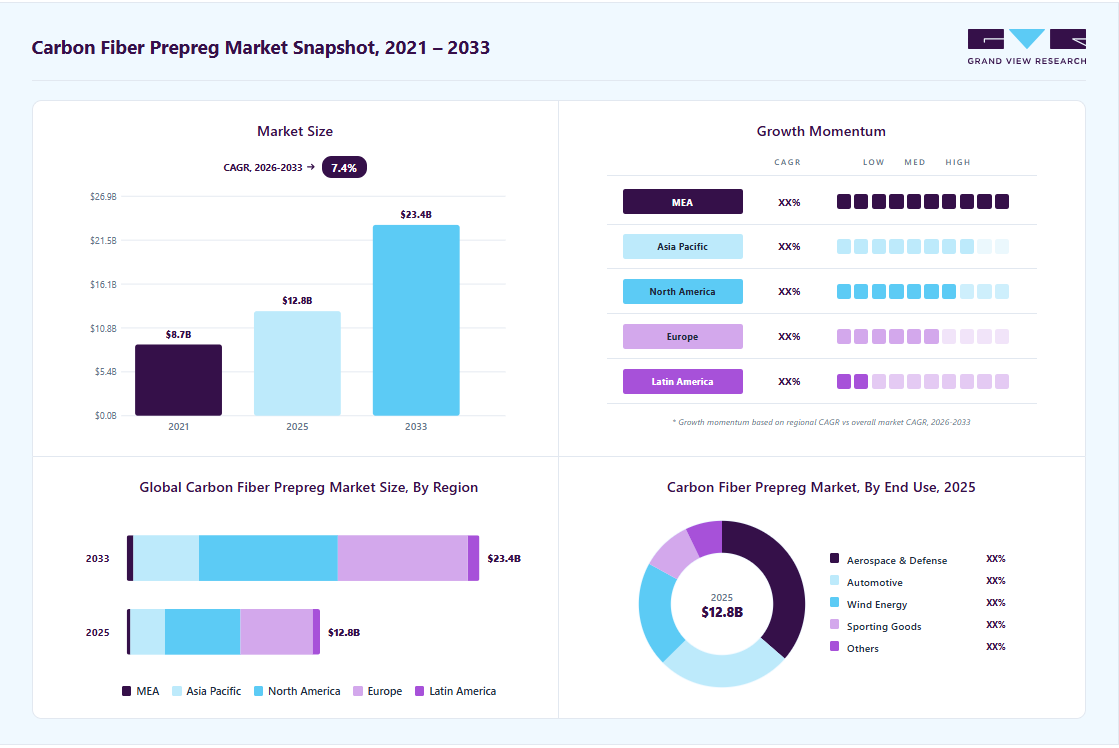 Source: Grand View Research, IR Documents, Primary Interviews, Paid DatabasesTo learn more about this report,
 Download Free Sample Report
Key Market Trends & Insights
- By resin type: Thermoplastic segment is expected to grow at the fastest CAGR of 7.7% over the forecast period.
- By end use: Automotive segment is expected to grow at the fastest CAGR of 8.0% over the forecast period.
Regional Highlights
- Largest regional market: North America (39.0% revenue share, 2025)
- Fastest-growing regional market: Middle East & Africa (highest CAGR, 2026-2033)
- The carbon fiber prepreg market in Latin America is an emerging market for carbon fiber prepregs
Market Size & Forecast
- Market size in 2025: USD 12.8 Billion
- Estimated market size in 2026: USD 14.2 Billion
- Projected market size by 2033: USD 23.3 Billion
- CAGR (2026-2033): 7.4%
Three ways to get this report
Buy it, customize it, or ask a question.Ask an Analyst
Analyst response in 1 business day
- AccessReport author, directly
- Reply timeWithin 1 working day
- No sales callDirect answer only
- FormatEmail reply
- CostFree, no cost
Get the Full Report
What the study covers
- FormatsPDF · Excel · Dashboard
- Timeline2026–2033 annual, 2025 base
- Coverage20+ countries, 5 regions
- Companies10+ key players profiled
Customize the Report
20% free customization
- IncludeCountries, segments, points
- TailorTo your product definition
- ExtendDeeper competitor detail
- OrA fully bespoke study
- Turnaround5–10 working days
Aerospace manufacturers are increasingly using carbon fiber prepregs in fuselages, wings, and structural components to reduce aircraft weight and improve fuel efficiency. The automotive sector, particularly electric vehicles, is also adopting prepregs to enhance driving range through lightweighting. In addition, the expansion of wind energy projects is driving demand for long, lightweight, and durable turbine blades manufactured using carbon fiber prepregs. Growing usage in defense, sports equipment, and industrial applications further supports sustained demand growth. To learn more about this report, Download Free Sample Report
Key drivers include the rapid growth of the aerospace industry, with increased aircraft production and fleet modernization programs emphasizing lightweight composite materials. The shift toward electric and hybrid vehicles is another major driver, as carbon fiber prepregs help manufacturers meet efficiency and emission reduction targets. Rising investments in renewable energy, particularly wind power, are accelerating adoption due to the material’s high stiffness and fatigue resistance. Technological advancements such as automated fiber placement and improved resin systems are enhancing production efficiency and product performance. In addition, increasing focus on high-performance materials in defense and space applications continues to fuel market growth.
 To learn more about this report, Download Free Sample Report
The carbon fiber prepreg industry is witnessing strong innovation focused on enhancing performance, sustainability, and manufacturing efficiency. High-temperature and toughened resin systems are being developed for demanding aerospace and defense applications. Manufacturers are investing in automation technologies such as automated fiber placement to reduce waste and improve consistency. Sustainability trends include the development of recyclable prepregs and bio-based resin systems to lower environmental impact. Digitalization and process monitoring technologies are also being adopted to ensure quality control and optimize production cycles. These innovations are expanding the application scope of carbon fiber prepregs across multiple industries.
Market Dynamics
The increasing deployment of wind energy projects and renewable energy infrastructure worldwide is significantly driving the growth of the carbon fiber prepreg market. Carbon fiber prepregs are widely utilized in wind turbine blades due to their high strength-to-weight ratio, excellent fatigue resistance, corrosion resistance, and superior structural performance, which help improve blade efficiency, durability, and operational reliability. Growing investments in offshore and onshore wind energy projects, coupled with rising global focus on clean energy generation and carbon emission reduction, are accelerating demand for advanced composite materials globally.
In addition, the trend toward manufacturing larger, more efficient wind turbine blades is driving the adoption of carbon fiber prepregs, as they enable lightweight blade structures with improved stiffness and enhanced energy generation capacity. Technological advancements in resin systems, automated composite manufacturing processes, and recyclable prepreg technologies are further expanding the application scope of carbon fiber prepregs across renewable energy and industrial sectors. Increasing government support for renewable energy expansion, sustainability initiatives, and next-generation infrastructure development is encouraging manufacturers to develop high-performance prepreg solutions with improved processing efficiency and long-term durability.
One of the major restraints in the carbon fiber prepreg market is the high cost associated with carbon fiber manufacturing, advanced resin systems, specialized processing equipment, and controlled storage requirements. Carbon fiber prepregs require sophisticated manufacturing environments, autoclave curing processes, and skilled fabrication techniques, which significantly increase production and operational costs. In addition, fluctuations in raw material prices, long production cycles, limited recyclability of thermoset prepregs, and supply chain disruptions further challenge widespread market adoption, particularly in price-sensitive industries. Competition from alternative lightweight materials, such as aluminum alloys and glass fiber composites, also affects broader commercialization and profitability for manufacturers.
Market Concentration & Characteristics
The carbon fiber prepreg industry is moderately concentrated, with a limited number of global players dominating production due to high capital investment requirements and strict quality standards. Established manufacturers benefit from long-term supply contracts with aerospace and automotive OEMs. High entry barriers such as technological complexity, certification requirements, and raw material dependency restrict new entrants. Strategic partnerships and capacity expansions are common as companies aim to strengthen their regional presence and secure supply chains.
 To learn more about this report, Download Free Sample Report
Carbon fiber prepregs face substitution threats from glass fiber composites, aluminum, and advanced thermoplastic composites. Glass fiber offers cost advantages but lacks the strength-to-weight performance required in high-end aerospace and automotive applications. Metals such as aluminum remain relevant in cost-sensitive or less weight-critical applications but fail to meet advanced performance demands. Thermoplastic composites are gaining traction due to recyclability and faster processing, posing a moderate substitute threat in select applications. However, carbon fiber prepregs continue to dominate where high mechanical performance is essential.
Resin Type Insights
The thermoset segment led the market with the largest revenue share of 76.5% in 2025, due to its widespread adoption in aerospace and defense applications, where high mechanical strength, thermal stability, and excellent fatigue resistance are critical. Thermoset prepregs, particularly epoxy-based systems, offer superior structural integrity and long service life, making them suitable for primary aircraft structures and high-performance industrial components. Their well-established processing methods and extensive certification history further reinforce their dominant market position.
The thermoplastic segment is expected to grow at the fastest CAGR of 7.7% over the forecast period, driven by increasing demand for faster processing cycles, recyclability, and improved impact resistance. Thermoplastic prepregs enable shorter production times through remelting and reforming, making them attractive for high-volume applications such as automotive and industrial manufacturing. Advancements in high-performance thermoplastic resins are expanding their use beyond secondary components into more structurally demanding applications, supporting strong future growth.
End Use Insights
The aerospace & defense segment led the market with largest revenue share of 36.4% in 2025, owing to the extensive use of carbon fiber prepregs in aircraft structures, military platforms, and space applications. Strict performance, safety, and durability requirements favor prepreg materials due to their consistent quality and superior mechanical properties. Continuous aircraft production, defense modernization programs, and rising demand for fuel-efficient aircraft continue to sustain high consumption levels within this segment.
 To learn more about this report, Download Free Sample Report
The automotive segment is expected to grow at the fastest CAGR of 8.0% over the forecast period, as manufacturers increasingly focus on lightweighting to meet emission regulations and enhance electric vehicle range. Carbon fiber prepregs are being adopted in structural and semi-structural components to improve strength while reducing overall vehicle weight. Growing penetration of electric and high-performance vehicles, along with improvements in cost efficiency and processing technologies, is accelerating prepreg adoption in the automotive sector.
Regional Insights
North America dominated the global carbon fiber prepreg market with the largest revenue share of 39.0% in 2025, due to its well-established aerospace and defense industries. The presence of major aircraft manufacturers and tier suppliers drives consistent demand for certified, high-performance prepreg materials. Growth in wind energy capacity, particularly onshore and offshore projects, is further boosting material usage in large turbine blades. The region is also witnessing increased adoption of lightweight materials in automotive and electric vehicle applications. Advanced manufacturing capabilities, strong R&D investments, and early adoption of automation technologies support efficient production. These factors ensure sustained demand across multiple end-use industries.
 To learn more about this report, Download Free Sample Report
U.S. Carbon Fiber Prepreg Market Trends
The carbon fiber prepreg market in the U.S. is driven by continuous innovation in aerospace, defense, and advanced mobility sectors. Aircraft production, maintenance, and modernization programs rely heavily on carbon fiber prepregs to enhance performance and fuel efficiency. Defense applications emphasize high-strength and high-temperature materials, supporting premium prepreg demand. The growing focus on electric vehicles and sustainable transportation is encouraging automotive lightweighting initiatives. In addition, investments in wind energy infrastructure are contributing to rising usage of prepregs in renewable applications. Strong research ecosystems and collaboration between manufacturers and OEMs further reinforce long-term market growth.
Asia Pacific Carbon Fiber Prepreg Market Trends
The carbon fiber prepreg market in Asia Pacific is a significant growth engine for the carbon fiber prepreg industry, driven by rapid industrial expansion and the increasing adoption of advanced composite materials. The region benefits from strong aerospace manufacturing growth, rising electric vehicle production, and large-scale investments in renewable energy, particularly wind power. Governments across Asia Pacific are actively supporting domestic aircraft programs, defense modernization, and clean energy transitions, all of which rely heavily on lightweight, high-performance materials. Expanding manufacturing bases in China, Japan, South Korea, and India are improving regional supply chains and reducing dependency on imports. Additionally, growing investments in infrastructure and high-speed transportation systems further strengthen demand.
The China carbon fiber prepreg market is a critical contributor to carbon fiber prepreg demand, driven by its aggressive expansion in wind energy, electric vehicle manufacturing, and aerospace development. The country’s large-scale wind turbine installations require high-strength, fatigue-resistant materials, thereby directly supporting prepreg consumption. Domestic aircraft development programs and increasing defense expenditures are accelerating the adoption of advanced composites in structural applications. China is also investing heavily in developing its local carbon fiber and prepreg manufacturing capabilities to reduce reliance on imports. Supportive industrial policies and funding for advanced materials research further strengthen market growth.
Europe Carbon Fiber Prepreg Market Trends
The carbon fiber prepreg market in Europe is shaped by stringent environmental regulations and a strong push toward sustainability. Automotive lightweighting initiatives, particularly for electric and hybrid vehicles, are major demand drivers across the region. Europe is also a global leader in wind energy, with increasing installation of larger and more efficient turbines requiring advanced composite materials. Aerospace manufacturing remains another key contributor, supported by continuous innovation and fleet modernization programs. Government-backed sustainability goals and emission-reduction mandates encourage the substitution of materials for high-performance composites.
The Germany carbon fiber prepreg market plays a central role in Europe’s region, due to its strong automotive engineering base and growing electric vehicle production. Automakers increasingly use carbon fiber prepregs to reduce vehicle weight while maintaining structural integrity and safety standards. The country is also actively expanding wind energy, supporting demand for fatigue-resistant composite materials. Germany’s emphasis on advanced manufacturing, precision engineering, and high-quality standards promotes innovation in prepreg processing technologies. Strong collaboration between research institutions and industry players further enhances material development.
Latin America Carbon Fiber Prepreg Market Trends
The carbon fiber prepreg market in Latin America is an emerging market for carbon fiber prepregs, supported by gradual industrial development and increasing awareness of advanced composite materials. Aerospace, industrial equipment, and sports goods applications are slowly adopting prepregs to enhance performance. Renewable energy investments, particularly in wind power, are creating new opportunities for the use of composite materials. While cost sensitivity limits rapid adoption, improving manufacturing capabilities and foreign investments are helping expand market penetration. Regional growth remains steady but uneven across countries.
Middle East & Africa Carbon Fiber Prepreg Market Trends
The carbon fiber prepreg market in the Middle East & Africa is anticipated to grow at the fastest CAGR during the forecast period. The Middle East & Africa region is developing, driven primarily by demand in aerospace, defense, and industrial applications. Several countries are investing in aviation infrastructure and defense modernization, which supports the use of advanced composite materials. Industrial diversification efforts are encouraging the adoption of high-performance materials in manufacturing and infrastructure projects. Renewable energy initiatives, including wind and solar projects, are also creating future demand potential. Although the market remains relatively small, long-term investments and strategic partnerships are expected to drive gradual growth.
Key Carbon Fiber Prepreg Company Insights
Some of the key players operating in the market include Toray Industries, Inc., Mitsubishi Chemical Corporation
-
Toray Industries, Inc. is a leading global manufacturer of advanced materials, with a strong presence in carbon fiber and composite solutions. The company is a pioneer in carbon fiber technology and is widely recognized for its high-performance prepregs used in aerospace, automotive, wind energy, and industrial applications. Toray’s vertically integrated operations, from carbon fiber production to resin systems and prepreg manufacturing, enable consistent quality and supply reliability.
-
Mitsubishi Chemical Corporation is a major global chemical company with a strong portfolio in carbon fiber, composite materials, and advanced resins. Through its composite materials division, the company supplies high-performance carbon fiber prepregs for aerospace, automotive, and industrial applications. Mitsubishi Chemical focuses on developing lightweight, high-strength, and thermally stable materials that meet stringent performance and certification standards.
FIBERMAX and Bharat Composites are some of the emerging market participants in the carbon fiber prepreg industry.
-
FIBERMAX is an emerging composites manufacturer specializing in carbon fiber-based materials and customized composite solutions for industrial and performance-driven applications. The company focuses on delivering high-quality carbon fiber fabrics, prepregs, and engineered composite components tailored to customer specifications. FIBERMAX serves sectors such as aerospace components, automotive parts, sporting goods, and industrial equipment.
-
Bharat Composites is an Indian composite materials manufacturer catering to aerospace, defense, automotive, and industrial sectors. The company specializes in advanced fiber-reinforced composites, including carbon fiber-based solutions for high-strength, lightweight applications. Bharat Composites benefits from increasing domestic demand driven by defense indigenization initiatives and infrastructure development.
Key Carbon Fiber Prepreg Companies:
The following key companies have been profiled for this study on the carbon fiber prepreg market.
- Hexcel Corporation
- Mitsubishi Chemical Corporation
- Toray Industries, Inc.
- SGL Carbon
- TEIJIN LIMITED
- Arvind Composite
- Bharat Composites
- FIBERMAX
- ACP COMPOSITES, INC.
- Bhor Chemicals and Plastics Pvt. Ltd.
Competitive Benchmarking
Operating Strategies
Competitive Edge
Weakness
Mature Players: Hexcel Corporation, Mitsubishi Chemical Corporation, Toray Industries, Inc., SGL Carbon, TEIJIN LIMITED
- Expansion of global prepreg manufacturing capacity and long-term OEM supply agreements
- Strong investments in advanced resin systems and automation technologies
- Strong technological leadership and diversified product portfolio
- Established global customer base across aerospace and automotive
- High production and R&D costs
- Exposure to cyclical aerospace demand and raw material price volatility
Emerging Players: Arvind Composite, Bharat Composites, FIBERMAX, ACP COMPOSITES, INC., Bhor Chemicals and Plastics Pvt. Ltd.
- Focus on cost-effective and customized composite solutions
- Expansion into regional and niche industrial applications
- High flexibility and faster response to demand changes
- Strong presence in price-sensitive and niche segments
- Limited global presence and scale
- Lower access to advanced R&D and certifications
Recent Developments
-
In May 2025, Hexcel and Specialty Materials introduced a new high modulus, high compression unidirectional prepreg material.
-
In December 2025, Mitsubishi Chemical Corporation announced capacity expansion for high-end carbon fiber production in Japan and the U.S.
-
In November 2025, SGL Carbon announced a new carbon fiber prepreg production facility opening in North America to increase regional supply capacity.
Carbon Fiber Prepreg Market Report Scope
Report Attribute
Details
Market size in 2025
USD 12.8 billion
Market size value in 2026
USD 14.2 billion
Revenue forecast in 2033
USD 23.3 billion
Growth rate
CAGR of 7.4% from 2026 to 2033
Base year for estimation
2025
Historical data
2021 - 2025
Forecast period
2026 - 2033
Quantitative units
Revenue in USD million/billion, and CAGR from 2023 to 2033
Report coverage
Revenue forecast, company ranking, competitive landscape, growth factors, and trends
Segments covered
Resin type, end use, region.
Regional scope
North America; Asia Pacific; Europe; Latin America; Middle East & Africa
Country scope
U.S.; Canada; Mexico; Germany; UK; Italy; France; China; Japan; India
Key companies profiled
Hexcel Corporation; Mitsubishi Chemical Corporation; Toray Industries, Inc.; SGL Carbon; TEIJIN LIMITED; Arvind Composite; Bharat Composites; PotlatchDeltic Corporation; ACP COMPOSITES, Inc.; Bhor Chemicals and Plastics Pvt. Ltd.
Customization scope
Free report customization (equivalent up to 8 analysts working days) with purchase. Addition or alteration to country, regional & segment scope.
Pricing and purchase options
Avail customized purchase options to meet your exact research needs. Explore purchase options
Global Carbon Fiber Prepreg Market Report Segmentation
This report forecasts revenue growth at regional & country levels and provides an analysis on the industry trends in each of the sub-segments from 2021 to 2033. For this study, Grand View Research has segmented the global carbon fiber prepreg market report based on the resin type, end use, and region:
 To learn more about this report, Download Free Sample Report
-
Resin Type Outlook (Revenue, USD Billion, 2021 - 2033)
-
Thermoset
-
Thermoplastic
-
-
End Use Outlook (Revenue, USD Billion, 2021 - 2033)
-
Aerospace & Defense
-
Automotive
-
Wind Energy
-
Sporting Goods
-
Others
-
-
Regional Outlook (Revenue, USD Billion, 2021 - 2033)
-
North America
-
U.S.
-
Canada
-
Mexico
-
-
Europe
-
UK
-
Germany
-
France
-
Italy
-
-
Asia Pacific
-
China
-
Japan
-
India
-
-
Latin America
-
Middle East and Africa
-
Delivered Customizations
This report has been delivered with the following In-depth customizations
Client Request
Customization Delivered
Value Adds
Regional Segmentation
Detailed analysis of carbon fiber prepreg demand and market performance across North America, Europe, Asia Pacific, Latin America, and Middle East & Africa, including country-level insights and end-use industry distribution.
Helps identify high-growth regional markets, understand demand concentration, and support region-specific expansion and investment strategies.
Competitive Benchmarking
Benchmarking of key global and regional manufacturers based on production capacity, technological capabilities, product portfolio, certifications, R&D focus, and end-use industry penetration.
Enables assessment of competitive positioning, identification of strategic gaps, and development of differentiation and growth strategies.
Opportunity Assessment
Evaluation of growth opportunities across aerospace & defense, automotive, wind energy, sporting goods, and emerging applications such as UAVs and EV lightweighting, along with technology adoption trends.
Supports identification of high-potential application areas and guides long-term investment, innovation, and market entry decisions.
Frequently Asked Questions About This Report
The global carbon fiber prepreg market size was estimated at USD 12.8 billion in 2025 and is expected to reach USD 14.2 billion in 2026.
North America dominated with a 39.0% revenue share in 2025.
Middle East & Africa is the fastest-growing region over the forecast period.
The thermoset segment led the market with the largest revenue share of 76.5% in 2025, due to its widespread adoption in aerospace and defense applications, where high mechanical strength, thermal stability, and excellent fatigue resistance are critical.
The aerospace & defense segment led the market with largest revenue share of 36.4% in 2025
The global carbon fiber prepreg market is expected to grow at a compound annual growth rate of 7.4% from 2026 to 2033 to reach USD 23.3 billion by 2033.
The thermoset segment held the highest revenue market share of 76.5% in 2025, due to its widespread adoption in aerospace and defense applications, where high mechanical strength, thermal stability, and excellent fatigue resistance are critical.
Some of the key players operating in the carbon fiber prepreg market include Hexcel Corporation, Mitsubishi Chemical Corporation, Toray Industries, Inc., SGL Carbon, TEIJIN LIMITED, Arvind Composite, Bharat Composites, PotlatchDeltic Corporation, Bhor Chemicals and Plastics Pvt. Ltd., and ACP COMPOSITES, INC.
Rising demand for lightweight, high-strength materials in aerospace, electric vehicles, wind energy, and defense applications, supported by sustainability regulations and advances in automated composite manufacturing, is driving the carbon fiber prepreg market.
About the Author(s)
Advanced Interior Materials Research Team
Advanced Materials · Advanced Interior MaterialsThis report was authored by the advanced interior materials research team at Grand View Research - comprising two research analysts, one senior research analyst, and one industry expert - with specialized expertise in the advanced interior materials segment of the advanced materials industry. All findings are based on proprietary advanced materials databases, executive interviews, and regulatory analysis, subject to internal peer review prior to publication.
Last Updated:
Speak to Analyst

Customize this report to your needs - add regions, segments, or data points, with 20% free customization.
Or view our licence options:


ISO 9001:2015 & 27001:2022 Certified
We are GDPR and CCPA compliant! Your transaction & personal information is safe and secure. For more details, please read our privacy policy.


