
- Home
- »
- Renewable Energy
- »
-
Carbon-neutral Fuels Market Size, Industry Report, 2033GVR Report cover
![Carbon-neutral Fuels Market Size, Share & Trends Report]()
Carbon-neutral Fuels Market (2025 - 2033) Size, Share & Trends Analysis Report By Type (Biofuels, E-fuels, Green Hydrogen), By Application, By Region, And Segment Forecasts
- Report ID: GVR-4-68040-766-2
- Number of Report Pages: 110
- Format: PDF
- Historical Range: 2021 - 2023
- Forecast Period: 2025 - 2033
- Industry: Energy & Power
- Report Summary
- Table of Contents
- Segmentation
- Methodology
- Download FREE Sample
-
 Download Sample Report
Carbon-neutral Fuels Market Summary
The global carbon-neutral fuels market size was estimated at USD 98.67 billion in 2024 and is projected to reach USD 184.36 billion by 2033, growing at a CAGR of 7.2% from 2025 to 2033. The global transition toward low-carbon energy alternatives and stricter environmental regulations across developed economies continues to serve as a significant growth driver for the carbon-neutral fuels sector.
Key Market Trends & Insights
- North America dominated the carbon-neutral fuels market with the largest revenue share of 33.80% in 2024.
- The carbon-neutral fuels industry in the U.S accounted for the largest market revenue share in North America in 2024.
- By type, the biofuels segment led the market with the largest revenue share of 50% in 2024.
- Based on the application, the transportation segment accounted for the largest market revenue share in 2024.
Market Size & Forecast
- 2024 Market Size: USD 98.67 Billion
- 2033 Projected Market Size: USD 184.36 Billion
- CAGR (2025-2033): 7.2%
- North America: Largest market in 2024
- Asia Pacific: Fastest growing market
Over the past few years, the transportation, industrial, and power generation sectors have increasingly adopted carbon-neutral fuels to reduce greenhouse gas (GHG) emissions, driving steady market expansion. Biofuels, e-fuels, and green hydrogen have emerged as dominant contributors, reflecting the broader push toward sustainable energy sources and the decarbonization of traditional fuel systems.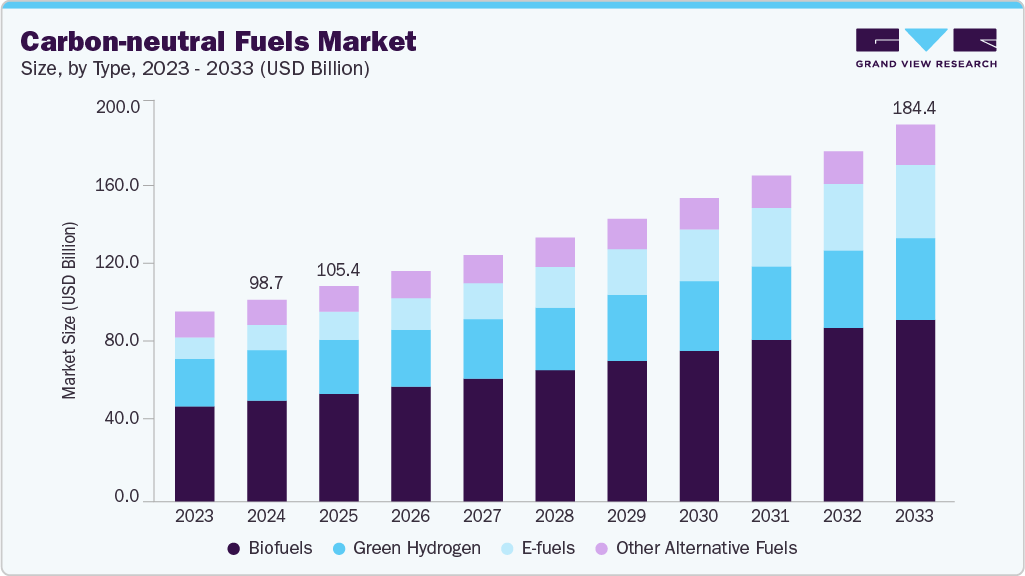
In the United States, market growth is supported by federal and state-level incentives, including subsidies for sustainable aviation fuels (SAF) and biofuel blending mandates. The growing adoption of biofuels in transportation and industrial applications is further reinforced by abundant renewable feedstock, particularly biomass and waste-derived fuels. The country’s energy transition is accelerating as natural gas and carbon-neutral alternatives increasingly replace conventional fossil fuels, while rising fuel prices and corporate sustainability targets create additional demand. These factors, combined with ongoing investment in R&D for e-fuels and green hydrogen, are expected to sustain strong market momentum throughout the forecast period.
Europe represents a key market for carbon-neutral fuels, with Germany at the forefront due to its aggressive decarbonization policies and renewable energy infrastructure. Investments in sustainable aviation fuel production, advanced biofuels, and hydrogen technologies have been instrumental in accelerating market growth. As the country continues to reduce dependence on imported fossil fuels, it is expected to drive significant regional demand for carbon-neutral fuels. The broader adoption of e-fuels and green hydrogen across European transportation and industrial sectors will further reinforce the region’s contribution to the global market.
Drivers, Opportunities & Restraints
The global carbon-neutral fuels industry is primarily driven by the urgent need to reduce greenhouse gas (GHG) emissions, achieve energy transition targets, and diversify fuel sources across transportation, industrial, and power generation sectors. National net-zero commitments, international climate accords, and stringent emission regulations are prompting governments to implement favorable policies, including biofuel blending mandates, subsidies for sustainable aviation fuels (SAF), and incentives for green hydrogen production. At the same time, advancements in production technologies for biofuels, e-fuels, and green hydrogen are improving efficiency and reducing costs, making carbon-neutral fuels increasingly competitive with conventional fossil fuels. The growing demand for low-carbon solutions across transport, industrial manufacturing, and energy sectors supports large-scale adoption and integration of these fuels.
Opportunities are rapidly evolving in the carbon-neutral fuels landscape. Technological innovations such as advanced bio-refineries, electrolysis-based green hydrogen production, and power-to-liquid e-fuels enhance fuel yield, efficiency, and grid compatibility. The rising focus on sustainable aviation, shipping, heavy-duty transportation, corporate sustainability goals, and long-term power purchase agreements (PPAs) drives demand. Expanding renewable electricity generation in emerging markets and increasing biomass and waste feedstock availability further create growth avenues.
However, challenges remain. High production costs, limited large-scale production infrastructure, and technological complexity constrain widespread adoption. The intermittent availability of feedstock, regulatory uncertainties, and financing risks for large-scale biofuel and hydrogen projects present additional hurdles. Furthermore, integration into existing fuel infrastructure, distribution challenges, and competition with established fossil fuels continue to pose barriers to market expansion.
Type Insights
The biofuels segment led the market with the largest revenue share of 50% in 2024, reflecting their widespread adoption across transportation, industrial, and power generation applications. As one of the most mature and scalable carbon-neutral fuel technologies, biofuels are pivotal in reducing greenhouse gas emissions, diversifying energy sources, and supporting national decarbonization targets. Their compatibility with existing fuel infrastructure and ability to be blended with conventional fuels make them a cornerstone of sustainable energy strategies worldwide.
Biofuels enable significant carbon reductions in road transport, aviation, and shipping while supporting energy security and rural economic development through biomass and feedstock supply chains. The segment’s growth is reinforced by technological advancements in second- and third-generation biofuels, declining production costs, and supportive government policies such as blending mandates, subsidies, and tax incentives. Increasing corporate commitments to sustainable fuel adoption and expanding bio-refineries and logistic infrastructure further strengthen market momentum. As global industries and transport sectors accelerate the transition to low-carbon energy, biofuels’ scalability, established technology base, and environmental benefits position the segment as the leading driver of market growth.
Application Insights
The transportation segment led the market with the largest revenue share of 50% in 2024. The growing adoption of biofuels, e-fuels, and green hydrogen across road transport, aviation, shipping, and rail sectors drives this dominance. Transportation is a high-emission segment, and the shift toward low-carbon fuels is crucial for meeting regulatory emission targets, corporate sustainability commitments, and international climate goals. The demand is particularly strong for sustainable aviation fuels (SAF) and biofuel blends, which provide immediate emissions reduction while leveraging existing fuel infrastructure.
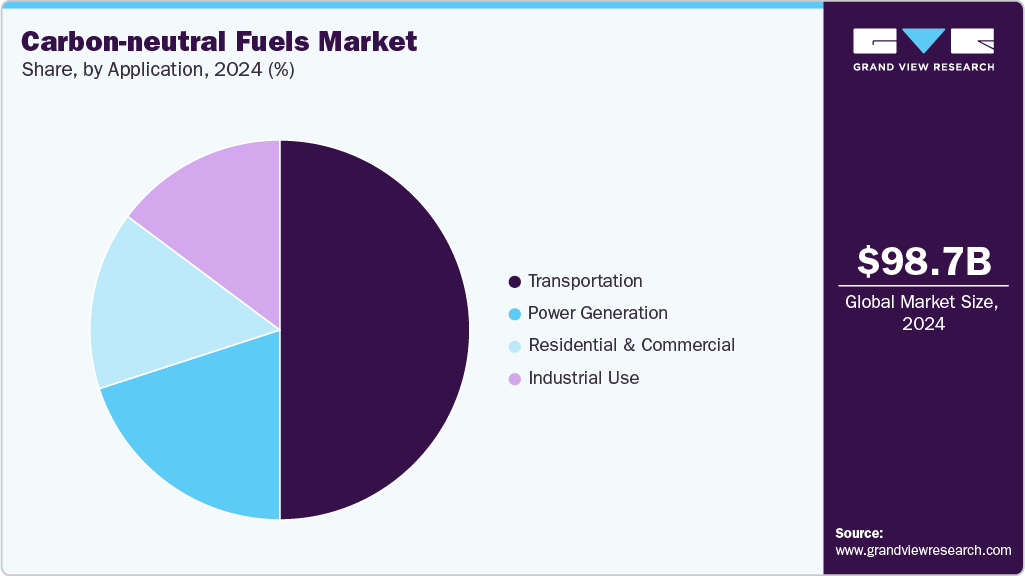
As decarbonization becomes a strategic priority for transport operators, investments in sustainable fuel procurement, blending facilities, and hybrid fuel systems are rising. For instance, airlines increasingly integrate SAF into their fuel mix, while shipping companies adopt biofuel blends to comply with IMO emission regulations. Government incentives, carbon pricing mechanisms, and corporate commitments to net-zero emissions further reinforce the segment’s growth. With transportation demand projected to expand due to urbanization, global trade growth, and fleet electrification trends, this application segment will remain the leading driver of carbon-neutral fuel adoption globally throughout the forecast period.
Regional Insights
North America dominated the carbon-neutral fuels market with the largest revenue share of 33.80% in 2024. The region’s leadership is driven by large-scale investments in sustainable fuels, strong regulatory frameworks, and growing corporate commitments to decarbonization. The United States is accelerating the adoption of biofuels, e-fuels, and green hydrogen across transportation, industrial, and power generation sectors. Federal and state-level policies create a favorable investment climate, including blending mandates, tax incentives, and funding for sustainable aviation fuels (SAF) and green hydrogen projects.
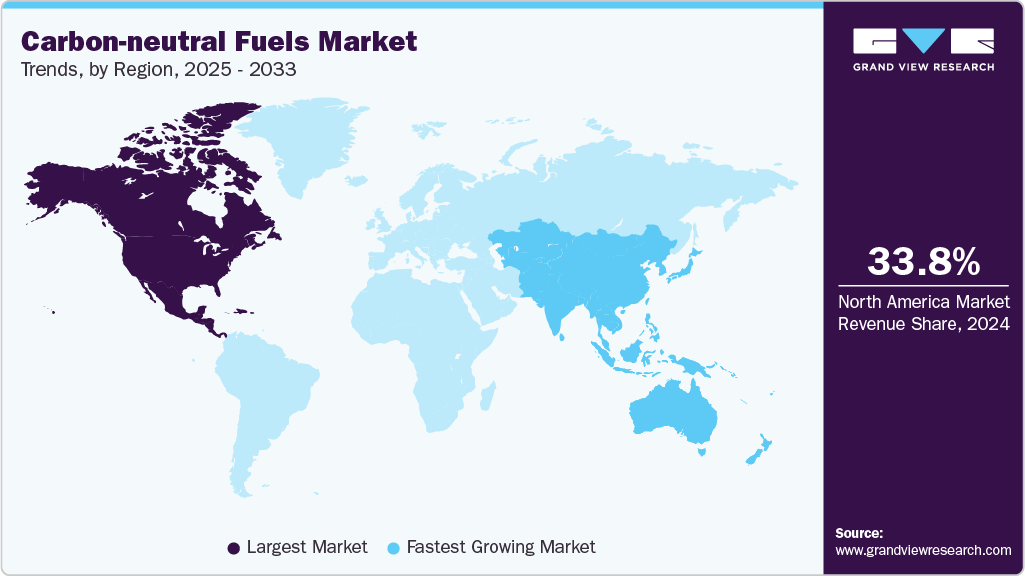
Technological advancements in fuel production, combined with abundant feedstock availability, are supporting large-scale commercial deployment. Utilities, transportation operators, and industrial players increasingly integrate carbon-neutral fuels into their operations to reduce greenhouse gas (GHG) emissions, meet regulatory requirements, and achieve sustainability goals. Canada also contributes to market growth through biofuel and hydrogen initiatives, supported by provincial incentives and research programs. With continued public-private collaboration, policy support, and expanding clean fuel infrastructure, North America is expected to remain the largest and most dynamic carbon-neutral fuels industry globally throughout the forecast period.
U.S. Carbon-neutral Fuels Market Trends
The carbon-neutral fuels market in the U.S. accounted for the largest market revenue share in North America in 2024, as strong federal policies, state-level clean fuel mandates, and growing corporate commitments to decarbonization fuel market growth. The Inflation Reduction Act, renewable fuel standards (RFS), and incentives for sustainable aviation fuels (SAF) and green hydrogen projects have created a favorable investment environment, enabling the rapid scaling of biofuels, e-fuels, and hydrogen production.
The U.S. transportation sector, particularly aviation, shipping, and heavy-duty road transport, is driving demand, while industrial users are adopting carbon-neutral fuels to meet emission reduction targets and sustainability goals. Investments in fuel blending infrastructure, bio-refineries, and R&D for next-generation fuels are further supporting market expansion. Increasing electrification, corporate sustainability pledges, and government-backed initiatives for low-carbon fuel adoption continue to strengthen the market. With robust policy support, technological innovation, and abundant feedstock availability, the U.S. will remain the largest and most dynamic market for carbon-neutral fuels globally throughout the forecast period.
Asia-Pacific Carbon-neutral Fuels Market Trends
The carbon-neutral fuels market in the Asia-Pacific is emerging as a key growth region, driven by rapid industrialization, urbanization, and strong policy support for sustainable fuels. Countries such as China, India, Japan, and South Korea actively invest in biofuel production, green hydrogen facilities, and e-fuel technologies to reduce fossil fuel dependence and meet ambitious climate targets. The region benefits from abundant biomass feedstock, expanding renewable electricity generation for hydrogen production, and increasing corporate adoption of low-carbon fuels in transportation and industrial applications.
Government initiatives like blending mandates, subsidies, and research incentives are accelerating market adoption. In addition, growing logistics, storage, and fuel distribution infrastructure supports regional scalability. With rising energy demand, environmental awareness, and industrial electrification, the Asia-Pacific region is expected to register robust growth and significantly increase its share of the global market over the forecast period.
Europe Carbon-neutral Fuels Market Trends
The carbon-neutral fuels market in Europe continues to play a critical role in the global market, supported by strict emission reduction regulations, ambitious net-zero targets, and strong investments in sustainable fuels. Germany, France, and the Netherlands are leading the charge, with biofuels, green hydrogen, and e-fuels increasingly deployed across transportation, industrial, and power sectors. Policies such as blending mandates, tax incentives, and funding for R&D projects facilitate market expansion, while a mature infrastructure for fuel distribution enhances adoption.
The region’s transition to low-carbon transportation, decarbonized industry, and integration of hydrogen in power systems drives sustained demand. Continued innovation in e-fuels and advanced biofuels, combined with supportive regulations, ensures Europe remains a significant contributor to the global market throughout the forecast period.
Latin America Carbon-neutral Fuels Market Trends
The carbon-neutral fuels market in Latin America is gaining momentum rapidly, with Brazil, Mexico, and Argentina emerging as key contributors. The region leverages abundant biomass resources, favorable climatic conditions, and a growing focus on sustainable transportation fuels. Government initiatives promoting biofuel blending, industrial decarbonization, and regional energy security further support market growth.
Increasing adoption of biofuels in road transport and industrial sectors, coupled with investment in fuel production and distribution infrastructure, positions Latin America as a high-potential market. Public-private partnerships, international funding, and policy reforms aimed at sustainable energy development are expected to sustain regional growth over the forecast period.
Middle East & Africa Carbon-neutral Fuels Market Trends
The carbon-neutral fuels market in the Middle East & Africa region is gradually expanding, driven by energy diversification goals and climate action initiatives. Leading economies such as Saudi Arabia, the UAE, Egypt, and South Africa are investing in biofuel and green hydrogen projects to reduce reliance on fossil fuels and support sustainable transportation and industrial sectors.
In Sub-Saharan Africa, focus remains on off-grid solutions and smaller-scale biofuel projects to enhance energy access in remote regions. Policy support, international funding, and public-private collaborations are key enablers of market development. With rising awareness of low-carbon alternatives and increasing infrastructure for production and distribution, MEA is poised to steadily increase its contribution to the global market over the forecast period.
Key Carbon-neutral Fuels Company Insights
Some of the key players operating in the global carbon-neutral fuels industry include Archer Daniels Midland Company (ADM), Chevron Corporation, TotalEnergies S.E., ExxonMobil Corporation, Shell plc, BP plc, Neste Corporation, Raízen, LanzaTech, and Praj Industries. These companies invest heavily in research and development, bio-refineries, sustainable aviation fuel production, green hydrogen projects, and advanced e-fuel technologies.
Key Carbon-Neutral Fuels Companies:
The following are the leading companies in the global carbon-neutral fuels market. These companies collectively hold the largest market share and dictate industry trends.
- Archer Daniels Midland Company (ADM)
- Chevron Corporation
- TotalEnergies S.E.
- ExxonMobil Corporation
- Shell plc
- BP plc
- Neste Corporation
- Raízen
- LanzaTech
- Praj Industries
Recent Developments
- In April 2025, Neste Corporation announced the commissioning of a new Sustainable Aviation Fuel (SAF) production facility in Rotterdam, Netherlands. The facility is expected to produce up to 200,000 tons of SAF annually, enough to supply several major European airlines, while reducing greenhouse gas emissions by approximately 600,000 metric tons of CO₂ equivalent per year.
Carbon-neutral Fuels Market Report Scope
Report Attribute
Details
Market size value in 2025
USD 105.36 billion
Revenue forecast in 2033
USD 184.36 billion
Growth rate
CAGR of 7.2% from 2025 to 2033
Base year for estimation
2024
Historical data
2021 - 2023
Forecast period
2025 - 2033
Quantitative units
Revenue in USD million/billion, and CAGR from 2025 to 2033
Report coverage
Revenue forecast, competitive landscape, growth factors, and trends
Segments covered
Type, application, region
Regional scope
North America; Europe; Asia Pacific; Latin America; Middle East & Africa
Country scope
U.S.; Canada; Mexico; Germany; UK; France; China; India; Japan; South Korea; Brazil; Saudi Arabia; UAE
Key companies profiled
Archer Daniels Midland Company (ADM); Chevron Corporation; TotalEnergies S.E.; ExxonMobil Corporation; Shell plc; BP plc; Neste Corporation; Raízen; LanzaTech; Praj Industries
Customization scope
Free report customization (equivalent up to 8 analysts working days) with purchase. Addition or alteration to country, regional & segment scope.
Pricing and purchase options
Avail customized purchase options to meet your exact research needs. Explore purchase options
Global Carbon-neutral Fuels Market Report Segmentation
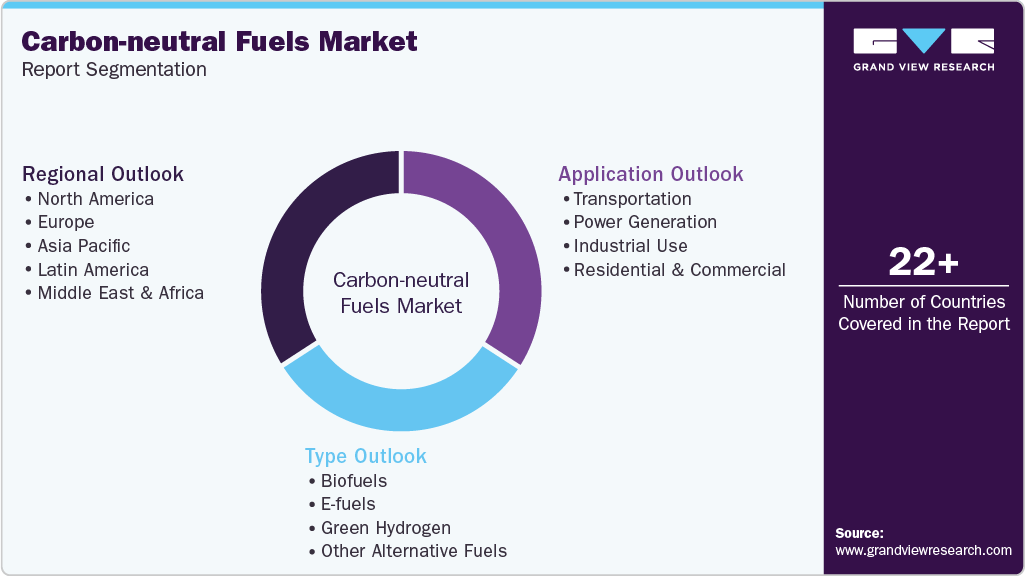
This report forecasts revenue growth at global, regional, and country levels and provides an analysis of the latest industry trends in each of the sub-segments from 2021 to 2033. For this study, Grand View Research has segmented the global carbon-neutral fuels market report based on the type, application, and region:
-
Type Outlook (Revenue, USD Billion, 2021 - 2033)
-
Biofuels
-
E-fuels
-
Green Hydrogen
-
Other Alternative Fuels
-
-
Application Outlook (Revenue, USD Billion, 2021 - 2033)
-
Transportation
-
Power Generation
-
Industrial Use
-
Residential & Commercial
-
-
Regional Outlook (Revenue, USD Billion, 2021 - 2033)
-
North America
-
U.S.
-
Canada
-
Mexico
-
-
Europe
-
Germany
-
UK
-
France
-
-
Asia Pacific
-
China
-
India
-
Japan
-
South Korea
-
-
Latin America
-
Brazil
-
-
Middle East & Africa
-
Saudi Arabia
-
UAE
-
-
Frequently Asked Questions About This Report
b. The global carbon-neutral fuels market size was estimated at USD 98.67 billion in 2024 and is expected to reach USD 105.36 billion in 2025.
b. The global carbon-neutral fuels market is expected to grow at a compound annual growth rate of 7.2% from 2025 to 2033 to reach USD 184.36 billion by 2033.
b. Based on the type segment, Biofuels held the largest revenue share of more than 50% in 2024.
b. Some of the key players operating in the carbon-neutral fuels market include Archer Daniels Midland Company (ADM), Chevron Corporation, TotalEnergies S.E., ExxonMobil Corporation, Shell plc, BP plc, Neste Corporation, Raízen, LanzaTech, and Praj Industries.
b. The key factors driving the carbon-neutral fuels market include the rising need to decarbonize hard-to-abate sectors such as aviation, shipping, and heavy industry, coupled with growing commitments to achieve net-zero emissions by mid-century. Governments worldwide implementing clean fuel standards, blending mandates, and carbon pricing mechanisms to accelerate adoption.


Share this report with your colleague or friend.
Need a Tailored Report?
Customize this report to your needs — add regions, segments, or data points, with 20% free customization.


ISO 9001:2015 & 27001:2022 Certified
We are GDPR and CCPA compliant! Your transaction & personal information is safe and secure. For more details, please read our privacy policy.
Trusted market insights - try a free sample
See how our reports are structured and why industry leaders rely on Grand View Research. Get a free sample or ask us to tailor this report to your needs.













