
- Home
- »
- Biotechnology
- »
-
Cell Painting Market Size, Share & Growth Report 2026-2033GVR Report cover
![Cell Painting Market (2026 - 2033)Report]()
Cell Painting Market (2026 - 2033)
Size, Share & Trends Analysis Report By Product & Services (Instruments, Services), By Cell Type (Cancer Cell Lines, Primary Cells), By Technology, By Application, By End Use, By Region, And Segment Forecasts
Market Size, 2025
$850.7MMarket Estimate, 2026
$959.6MMarket Forecast, 2033
$2,359.4MCAGR, 2026–2033
13.7%Cell Painting Market Summary
The global cell painting market size was valued at USD 850.7 million in 2025 and is projected to grow from USD 959.6 million in 2026 to USD 2,359.4 million by 2033, at a CAGR of 13.7% from 2026 to 2033. The market in North America dominated with a revenue share of 39.6% in 2025. The market growth is driven by increasing adoption of high-content phenotypic profiling, advances in artificial intelligence and image analysis, and expanding applications of cell painting in compound characterization, target identification, and toxicity assessment.

Key Market Trends & Insights
- By product & services: Reagents & consumables segment held the largest market share of 45.7% in 2025.
- By technology: High-content imaging segment held the largest market share in 2025.
- By application: Drug discovery & development segment held the largest market share of 45.1% in 2025.
- By cell type: Cancer cell lines segment held the largest market share in 2025.
- By end use: Pharmaceutical & biotechnology companies segment held the largest market share of 43.7% in 2025.
Regional Highlights
- Largest regional market: North America (39.6% revenue share, 2025)
- Fastest-growing regional market: Asia Pacific (highest CAGR, 2026-2033)
- By country: The U.S. held the largest market share in 2025
Market Size & Forecast
- Market size in 2025: USD 850.7 Million
- Estimated market size in 2026: USD 959.6 Million
- Projected market size by 2033: USD 2,359.4 Million
- CAGR (2026-2033): 13.7%

Market Dynamics
The cell painting industry is witnessing significant growth, driven by increasing adoption of phenotypic profiling and growing demand for high-dimensional cellular data. The expansion of large-scale screening initiatives and the availability of standardized imaging workflows are strengthening market penetration. In addition, advancements in automated microscopy, assay miniaturization, and computational analysis are improving scalability and reproducibility, supporting broader commercialization of cell painting technologies.
The increasing use of cell painting in drug discovery and toxicity screening is driving the market by enabling detailed analysis of cellular changes, compound activity, and mechanisms of action. According to a Cell Systems article published in May 2026, researchers applied cell painting to 1,085 compounds in primary human hepatocytes and found that morphological profiles detected compound bioactivity at lower concentrations than standard cytotoxicity assays. This demonstrates the potential of cell painting for sensitive toxicity assessment and compound profiling, supporting its growing use in drug discovery and safety studies.
The availability of alternative high-content screening technologies may limit market growth, as fluorescent ligand-based approaches can provide targeted readouts, simpler workflows, and faster analysis for specific screening applications. According to an article published by Celtery in November 2025, fluorescent ligands offer a scalable alternative to cell painting, with lower reagent requirements, simpler workflows, improved data interpretation, and live-cell compatibility. The availability of these alternatives may increase competitive pressure on cell painting, particularly in targeted screening applications.
The development of live-cell painting technologies presents a market opportunity by expanding phenotypic profiling beyond fixed-cell imaging and enabling the capture of time-dependent cellular responses. For instance, in November 2025, Saguaro Biosciences received more than USD 780,000 through the CQDM Quantum Leap program to further enhance its ChromaLIVE technology in collaboration with a global pharmaceutical company. Moreover, this project aims to improve phenotypic resolution and generate large-scale live-cell image-based datasets for drug discovery and safety assessment.
Market Concentration & Characteristics
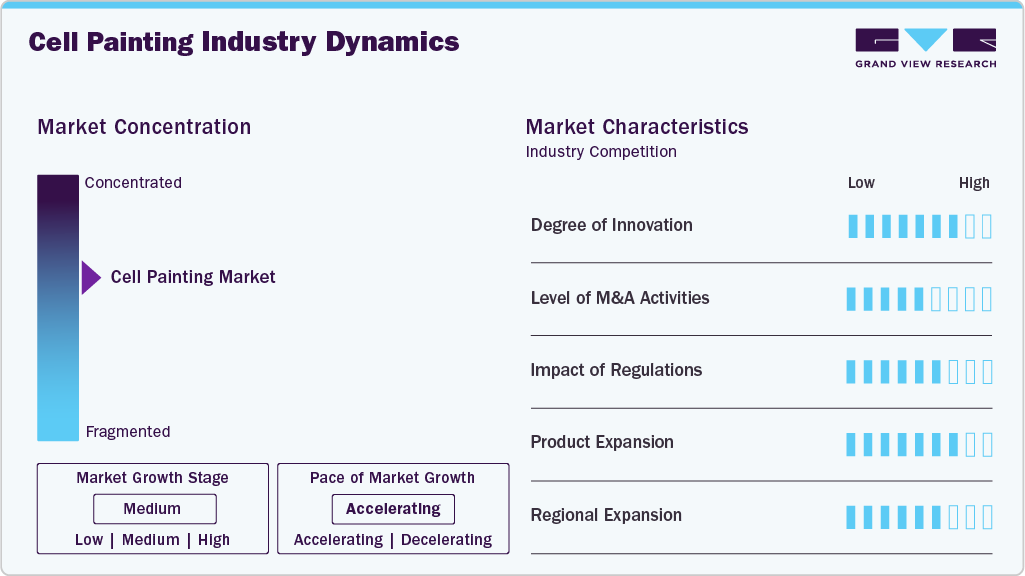
The degree of innovation in the market is high, driven by advances in high-content imaging, multiplexed fluorescence, artificial intelligence, and large language models that improve the analysis and interpretation of complex cellular phenotypes. According to an article presented at ICLR 2026, researchers introduced CP-Agent, an agentic multimodal large language model that combines cell painting images with experimental information to identify treatment effects and generate interpretable mechanism-of-action insights. This approach supports more detailed and scalable analysis of cell painting data for drug discovery and toxicity assessment.
The cell painting industry is witnessing M&A activity as companies expand their capabilities in high-content imaging and phenotypic analysis. For instance, in May 2026, InSphero acquired PhenoVista Biosciences, a provider of high-content imaging and phenotypic assay technologies and services, including cell painting. The acquisition strengthened InSphero’s capabilities in cell painting and functional cellular analysis, supporting applications in drug discovery, safety assessment, neuroscience, and neurotoxicity testing.
“Joining forces with InSphero represents a highly exciting opportunity for PhenoVista, our employees, and our customers. Both organizations share a strong commitment to advancing drug discovery through innovative assay technologies, advanced analytics, and artificial intelligence-driven approaches. By combining PhenoVista’s strengths in high-content imaging and assay development with InSphero’s leadership in scalable 3D biology and predictive in vitro models, we can deliver even greater scientific value and broader capabilities to customers worldwide.”
- James G. Evans, Ph.D., CEO, PhenoVista Biosciences, Inc.
The cell painting industry is influenced by regulatory requirements regarding the validation, reliability, reproducibility, and quality of in vitro methods used in drug development and safety assessment. These requirements support consistent experimental procedures, appropriate controls, standardized data analysis, and proper documentation. As the use of cell painting increases in phenotypic screening and toxicology research, regulatory expectations support greater confidence in the quality and use of cell painting data in preclinical studies.
The cell painting industry is witnessing product expansion through the launch of new solutions for live-cell phenotypic profiling. For instance, in October 2025, Saguaro Biosciences launched ChromaLIVE+ ER, a live-cell painting product that combines ChromaLIVE with ER-LIVE, a non-toxic endoplasmic reticulum dye. This development improves bioactivity detection and phenotypic profiling by capturing additional cellular features, supporting broader applications of live-cell imaging in high-content screening and drug discovery.
The cell painting industry is experiencing geographic expansion as companies and research service providers expand the availability of high-content imaging and phenotypic profiling capabilities across markets. The growing adoption of cell painting workflows in drug discovery, toxicology, and biological research is supporting wider access to these technologies. Companies are also strengthening their regional service and technology capabilities to address increasing demand for advanced cellular profiling solutions.
Analyst Perspective
The market is expected to witness moderate growth, driven by increasing adoption of high-content phenotypic profiling and growing demand for detailed cellular data in drug discovery and toxicity assessment. Expanding applications in compound characterization, target identification, functional genomics, and biomarker discovery are supporting market expansion. Advancements in high-content imaging, automated microscopy, artificial intelligence, and machine learning are further improving the analysis of complex cellular phenotypes and enabling scalable screening workflows. In addition, market participants are focusing on innovative reagents, advanced imaging platforms, computational tools, and integrated screening solutions to address evolving requirements across pharmaceutical and biotechnology research.
Product & Services Insights
The reagents & consumables segment accounted for the largest revenue share, exceeding 45.7% in 2025, driven by rising demand for cell-painting dyes, staining reagents, and other consumables used in high-throughput cell-based assays. For instance, in October 2025, Saguaro Biosciences entered into a distribution agreement with Bio-Techne to distribute its innovative live-cell imaging reagents, including non-toxic, wash-free dyes for live-cell imaging and cell painting applications. This agreement is expanding access to specialized reagents used in cell painting workflows.
“This distribution agreement marks a significant milestone for Saguaro. Bio-Techne’s reputation for quality and its global reach make them the ideal partner to bring our non-toxic dyes to a broader audience of researchers seeking better, more reliable data.”
Louis Turcotte, CEO and Co-Founder of Saguaro.
The software & computational tools segment is expected to register the fastest CAGR during 2026-2033, driven by increasing use of image analysis and data-processing tools in cell painting studies. These tools support image segmentation, feature extraction, phenotypic profiling, and analysis of high-dimensional cellular data generated through high-content imaging. Growing adoption of automated image analysis and machine learning is further improving the processing and interpretation of cell painting datasets.
Technology Insights
The high-content imaging segment dominated the market with a 40.4% share in 2025, driven by the use of automated imaging for detailed analysis of cellular phenotypes. For instance, in April 2026, Navinci announced a collaboration with Uppsala University, SciLifeLab, the Chemical Biology Consortium Sweden, and Pixl Bio on the Spatial Interactomics with cell painting (SIXP) project, with SciLifeLab providing high-content imaging and screening capabilities. This collaboration is expanding the use of high-content imaging in cell painting and drug-response research.
The artificial intelligence & machine learning segment is expected to register the fastest CAGR during 2026-2033, driven by the increasing use of AI-based methods for analyzing complex cell painting images and extracting phenotypic information. For instance, in December 2025, insitro announced the validation of its CellPaint-POSH platform, which combines cell painting, high-content imaging, and self-supervised deep learning to identify gene functions and therapeutic targets. The development demonstrates the growing use of AI and machine learning in cell painting-based drug discovery.
“Biology doesn’t organize itself according to the features we’ve learned to measure. In-situ’s POSH platform has demonstrated that self-supervised models trained on unbiased cellular morphology can reconstruct gene function and causal relationships without being told what to look for. We’re finally able to interrogate the genome at scale while preserving the phenotypic complexity where disease mechanisms actually live.”
Daphne Koller, Ph.D., founder and CEO of insitro.
Application Insights
Drug discovery & development accounted for approximately 45.1% of the application segment in 2025, making it the leading segment, driven by the growing need for efficient, scalable approaches to evaluate drug candidates. Cell painting enables researchers to capture diverse cellular responses and generate detailed phenotypic profiles from a single assay. In addition, its compatibility with automated imaging and computational analysis facilitates the evaluation of larger compound libraries during early-stage drug development.
The functional genomics & biomarker discovery segment is projected to register the fastest CAGR during 2026-2033, driven by the use of cell painting to study gene function, genetic perturbation, and disease-associated cellular phenotypes. However, this approach enables researchers to link changes in cell morphology with genetic alterations and identify phenotypic signatures relevant to biomarker research. In addition, integration of cell painting with other biological datasets is improving the understanding of gene function and cellular responses.
Cell Type Insights
The cancer cell lines segment accounted for approximately 40.8% share in 2025, making it a leading cell type segment. Growth is driven by increasing use of cell painting for phenotypic profiling, drug screening, and evaluation of cellular responses. According to an article published in PLOS One in October 2025, cell painting was used to profile small molecules in HCT116 colorectal cancer cells and identify distinct phenotypic responses. This study demonstrates the use of cancer cell lines as a model for cell painting-based compound profiling and drug discovery.
The stem cells & iPSCs segment is projected to witness the fastest CAGR during 2026-2033, driven by increasing use of cell painting for cell characterization, differentiation studies, disease modeling, and drug screening. Stem cells and iPSCs provide relevant models for studying cellular changes and disease mechanisms. In addition, advances in high-content imaging and phenotypic profiling are enabling more detailed analysis of iPSC-derived cell types, supporting their use in cell painting applications.
End Use Insights
Pharmaceutical & biotechnology companies accounted for the largest revenue share of 43.7% in 2025. Growth is driven by the increasing adoption of cell painting for drug discovery, compound screening, target identification, and phenotypic profiling. Pharmaceutical and biotechnology companies use cell painting to evaluate cellular responses and generate morphological profiles across compound libraries. In addition, growing investment in high-content screening and phenotypic drug discovery is increasing the use of cell painting across pharmaceutical and biotechnology research.

The contract research organizations segment is projected to witness the fastest CAGR during 2026-2033, supported by increasing outsourcing of phenotypic screening, compound profiling, and cell-based research. CROs provide access to specialized cell-painting workflows, high-content imaging, and image-analysis capabilities without requiring extensive in-house infrastructure. Moreover, growing adoption of outsourced drug discovery services is increasing the use of cell painting for compound screening and phenotypic profiling.
Regional Insights
North America dominated the cell painting market, accounting for the largest revenue share of 39.6% in 2025, driven by strong pharmaceutical R&D activity, increasing adoption of phenotypic drug discovery, and established capabilities in high-content cellular imaging and analysis. The region also has a strong cell painting research base, led by academic-industry collaborations focused on applying morphological profiling to drug discovery. The availability of large-cell painting datasets and established screening infrastructure is supporting the broader use of the technology in pharmaceutical research.

U.S. Cell Painting Market Trends
The cell painting market in the U.S. is expected to grow over the forecast period, supported by increasing use of phenotypic screening and high-content imaging in drug discovery. For instance, in April 2025, U.S.-based Araceli Biosciences secured USD 11.2 million in seed financing to expand its high-content imaging platform and AI-based image analysis capabilities. The investment is expected to support the development of imaging technologies used for cellular phenotypic analysis and drug discovery.
Europe Cell Painting Market Trends
The cell painting market in Europe is anticipated to grow significantly over the forecast period, supported by the increasing use of phenotypic screening in drug discovery and the growing adoption of image-based cellular profiling. For instance, in May 2025, the EU-OPENSCREEN consortium released its first open-source cell painting dataset, generated by four European screening platforms using two common cell lines and compounds from the European Chemical Biology Library. Moreover, the consortium also planned to generate additional datasets using more than 100,000 compounds, supporting drug discovery and molecular phenotyping research across Europe.
The UK cell painting market is expected to grow over the forecast period, driven by growing adoption of morphological profiling for compound evaluation and increasing research activity in image-based drug screening. According to a research article published in PLOS ONE in May 2025, researchers at the University of Dundee developed a high-throughput cell painting platform to screen human iPSC lines from different donors against 52 FDA-approved drugs. In addition, the study identified differences in drug responses and demonstrated the use of cell painting for comparative drug screening.
The cell painting market in Germany is anticipated to grow significantly over the forecast period, supported by the country’s strong pharmaceutical and chemical research base and growing use of phenotypic screening. The adoption of image-based cellular profiling is increasing for compound characterization, mechanism-of-action studies, and toxicity assessment. Advances in high-content imaging and computational analysis are also improving the ability to process complex morphological data, supporting the use of cell painting in drug discovery and chemical research.
Asia Pacific Cell Painting Market Trends
The cell painting market in the Asia Pacific is expected to grow at the fastest CAGR of 17.5% during the forecast period, supported by expanding pharmaceutical R&D activities, increasing investment in phenotypic screening, and growing adoption of automated cellular analysis. The region is also strengthening its drug discovery capabilities through investments in advanced screening infrastructure and computational approaches for analyzing complex cellular phenotypes. These developments are increasing the use of morphological profiling for compound characterization, particularly in early-stage research and target validation.
China cell painting market is expected to grow over the forecast period, supported by growing research activity in cellular morphology analysis and increasing application of cell painting in therapeutic research. According to a research article published in Respiratory Research in March 2025, researchers from the Beijing Institute of Radiation Medicine and other Chinese institutions developed CPHNet, a deep learning-based pipeline that uses cell painting images to screen potential treatments for high-altitude pulmonary edema. In addition, the study generated more than 100,000 cell painting images and identified ferulic acid and resveratrol as potential therapeutic candidates.
The cell painting market in Japan is witnessing rapid growth driven by increasing adoption of image-based drug discovery and growing investment in phenotypic screening technologies. For instance, in July 2025, Japan-based LPIXEL was selected for investment by the GHIT Fund to develop a cell-painting-based compound-profiling platform for antimalarial drug discovery and mechanism-of-action classification. This project combines high-content imaging with AI-based image analysis to characterize the biological effects of antimalarial compounds.
Latin America Cell Painting Market Trends
The cell painting market in Latin America is expected to grow steadily over the forecast period, supported by advances in high-content imaging and morphological profiling. Research in Brazil is advancing cell painting toward viable-cell analysis, enabling time-resolved measurements of cellular morphology and phenotypic responses across applications in cellular biology, pharmacology, and toxicology.
MEA Cell Painting Market Trends
The cell painting market in MEA is growing steadily, supported by expanding biomedical research, increasing investment in drug discovery, and growing adoption of high-content cellular analysis. Improved research infrastructure and access to advanced imaging technologies are supporting the use of cell painting for compound profiling and cellular response analysis across the region.
Key Cell Painting Company Insights
The market is characterized by increasing competition, with market participants focusing on high-content imaging, multiplexed fluorescence imaging, automated image analysis, reagents, software, and integrated screening solutions. Companies are strengthening their market presence through product development, technological advancements, strategic collaborations, and expansion of screening capabilities. Competitive positioning is influenced by product portfolio, technological capabilities, geographic presence, customer base, and application scope across drug discovery, toxicology, disease modeling, functional genomics, and biomarker discovery.
Key Cell Painting Companies
The following key companies have been profiled for this study on the cell painting market
-
Thermo Fisher Scientific Inc.
-
Revvity
-
Charles River Laboratories
-
Evotec
-
Molecular Devices, LLC.
-
Evident (Olympus)
-
Nikon Corporation
-
Bio-Rad Laboratories, Inc.
-
Tecan Trading AG
-
Merck KGaA
-
Bruker
Competitive Benchmarking
Category
Operating Strategies
Competitive Edge
Weakness
Established Players (Thermo Fisher Scientific Inc.; Revvity; Charles River Laboratories; Evotec; Molecular Devices, LLC.; Nikon Corporation)
Expanding cell painting assays, HCS platforms, imaging, analysis software, reagents, and screening services; investing in R&D and strategic collaborations.
Strong technology portfolios, established customer bases, global presence, R&D capabilities, and integrated imaging and analysis solutions.
High development costs, complex workflow integration, capital requirements, data-processing challenges, and intense competition.
Emerging Players (Evident (Olympus); Bio-Rad Laboratories, Inc.; Tecan Trading AG; Merck KGaA; Bruker)
Expanding cell painting assays, HCS platforms, imaging, analysis software, reagents, and screening services; investing in R&D and strategic collaborations.
Specialized imaging, microscopy, automation, and analytical capabilities with established research infrastructure.
Limited cell painting-specific positioning, high equipment costs, workflow integration challenges, and competition from established players.
Recent Developments
-
In September 2025, Evotec collaborated with the JUMP cell painting Consortium and the Broad Institute of MIT and Harvard to deliver AI/ML- and knowledge-graph-based analyses of the largest publicly available genetic cell painting dataset, profiling the phenotypic effects of perturbing approximately 75% of the human protein-coding genome in U2OS cells, published in Nature Methods.
-
In January 2025, Molecular Devices, LLC. launched the ImageXpress HCS.ai High-Content Screening System, an automated high-content imaging platform integrating advanced image acquisition with AI-assisted image analysis. The system supports cell painting assays and multiplexed phenotypic profiling, strengthening applications in drug discovery and high-content cellular analysis.
"In the life sciences, excellence should never come at the cost of compromise, where researchers are forced to choose between image quality and speed, or between ease of use and analytical accuracy. Our extensive experience in engineering industry-leading high-content screening solutions, has culminated in the ImageXpress HCS.ai High-Content Screening System. We’re setting a new standard in image acquisition and AI-powered analysis, helping customers make the most of their investments now and in the future.”
- Mary Duseau, President of Molecular Devices
Cell Painting Market Report Scope Table
Report Attribute
Details
Market size in 2025
USD 850.7 million
Estimated market size in 2026
USD 959.6 million
Projected market size by 2033
USD 2,359.4 million
Growth rate
CAGR of 13.7% from 2026 to 2033
Historical data
2021 - 2025
Forecast period
2026 - 2033
Quantitative units
Revenue in USD million, and CAGR from 2026 to 2033
Report coverage
Revenue forecast, company ranking, competitive landscape, growth factors, and trends
Segments covered
Product & services, technology, application, cell type, end use, region
Regional scope
North America; Europe; Asia Pacific; Latin America; MEA
Country scope
U.S.; Canada; Mexico; UK; Germany; France; Italy; Spain; Norway; Denmark; Sweden; China; Japan; India; South Korea; Australia; Thailand; Brazil; Argentina; Saudi Arabia; South Africa; UAE; Kuwait
Key companies profiled
Thermo Fisher Scientific Inc.; Revvity; Charles River Laboratories; Evotec; Molecular Devices, LLC.; Nikon Corporation, Evident (Olympus); Bio-Rad Laboratories, Inc.; Tecan Trading AG; Merck KGaA; Bruker
Customization scope
Free report customization (equivalent up to 8 analysts' working days) with purchase. Addition or alteration to country, regional & segment scope.
Pricing and purchase options
Avail customized purchase options to meet your exact research needs. Explore purchase options
Global Cell Painting Market Report Segmentation
This report forecasts revenue growth and provides an analysis of the latest trends in each of the sub-segments from 2021 to 2033. For this report, Grand View Research has segmented the global cell painting market report based on product & services, technology, application, cell type, end use, and region:
-
Product & Services Outlook (Revenue, USD Million, 2021 - 2033)
-
Reagents & Consumables
-
Instruments
-
Software & Computational Tools
-
Services
-
Others
-
-
Technology Outlook (Revenue, USD Million, 2021 - 2033)
-
High-Content Imaging
-
Multiplexed Fluorescence Imaging
-
Image Analysis
-
Artificial Intelligence & Machine Learning
-
Data Analytics
-
-
Application Outlook (Revenue, USD Million, 2021 - 2033)
-
Drug Discovery & Development
-
Toxicology & Safety Assessment
-
Disease Modeling & Mechanistic Biology
-
Functional Genomics & Biomarker Discovery
-
Other Applications
-
-
Cell Type Outlook (Revenue, USD Million, 2021 - 2033)
-
Cancer Cell Lines
-
Primary Cells
-
Stem Cells & iPSCs
-
Immune Cells
-
Neuronal Cells
-
Other Cell Types
-
-
End Use Outlook (Revenue, USD Million, 2021 - 2033)
-
Pharmaceutical & Biotechnology Companies
-
Contract Research Organizations
-
Academic & Research Institutes
-
Other End Users
-
-
Regional Outlook (Revenue, USD Million, 2021 - 2033)
-
North America
-
U.S.
-
Canada
-
Mexico
-
-
Europe
-
UK
-
Germany
-
France
-
Italy
-
Spain
-
Denmark
-
Sweden
-
Norway
-
-
Asia Pacific
-
Japan
-
China
-
India
-
Australia
-
Thailand
-
South Korea
-
-
Latin America
-
Brazil
-
Argentina
-
-
Middle East and Africa (MEA)
-
South Africa
-
Saudi Arabia
-
UAE
-
Kuwait
-
-
Segment Definition
Product & Services
Revenue Capture Definition
Reagents & Consumables
Revenue generated from reagents and consumables used in cell painting workflows, including fluorescent dyes, stains, assay reagents, cell culture materials, fixation reagents, and other laboratory supplies required for cellular phenotypic profiling.
Instruments
This segment captures income from imaging and laboratory instruments used for cell painting, including high-content imaging systems, automated microscopes, plate-handling equipment, and associated hardware for image acquisition and cellular analysis.
Software & Computational Tools
Market value in this category stems from software and computational platforms used for image processing, segmentation, feature extraction, phenotypic profiling, data management, visualization, and computational analysis of cell painting datasets.
Services
Revenue generated from outsourced cell painting services, including assay development, cell preparation, staining, imaging, image analysis, phenotypic profiling, data analysis, and screening support provided by specialized service providers.
Others
This segment captures income from other cell painting-related products and solutions not classified under reagents and consumables, instruments, software, and computational tools, or services.
Technology
Revenue Capture Definition
High-Content Imaging
Market value in this category stems from high-content imaging systems and related solutions used to capture multiparametric cellular images across multiple wells, fields, and fluorescence channels for phenotypic profiling.
Multiplexed Fluorescence Imaging
Revenue generated from multiplexed fluorescence imaging solutions that simultaneously visualize multiple cellular structures and biological features using distinct fluorescent stains, markers, or imaging channels.
Image Analysis
This segment captures income from image-analysis technologies used for image preprocessing, segmentation, feature extraction, object identification, phenotype classification, and quantitative analysis of cell painting images.
Artificial Intelligence & Machine Learning
Market value in this category stems from AI and machine-learning tools used for automated image interpretation, phenotype classification, pattern recognition, dimensionality reduction, and identification of biologically meaningful cellular signatures.
Data Analytics
Revenue generated from data analytics solutions used to process, visualize, compare, and interpret large-scale cell painting datasets and identify phenotypic patterns, relationships, and biological insights.
Application
Revenue Capture Definition
Drug Discovery & Development
This segment captures income from cell painting applications used for compound screening, mechanism-of-action studies, target identification and validation, lead optimization, phenotypic drug discovery, and assessment of cellular responses to therapeutic candidates.
Toxicology & Safety Assessment
Market value in this category stems from cell painting applications used to evaluate cellular toxicity, adverse phenotypic responses, compound safety profiles, and mechanisms associated with drug-induced cellular damage.
Disease Modeling & Mechanistic Biology
Revenue generated from cell painting applications supporting disease models and mechanistic studies by characterizing cellular phenotypes, pathway changes, and morphological responses associated with disease mechanisms.
Functional Genomics & Biomarker Discovery
This segment captures income from cell painting applications used to investigate gene-function effects, genetic perturbations, cellular phenotypes, and morphological biomarkers for biological research and biomarker discovery.
Other Applications
Market value in this category stems from cell painting applications outside drug discovery, toxicology, disease modeling, and functional genomics, including other research and phenotypic profiling applications.
Cell Type
Revenue Capture Definition
Cancer Cell Lines
Revenue generated from cell painting workflows using established cancer cell lines to characterize morphological phenotypes, compound responses, genetic perturbations, and disease-associated cellular changes.
Primary Cells
This segment captures income from cell painting applications using primary cells isolated from biological tissues to study physiologically relevant cellular phenotypes, responses, and disease mechanisms.
Stem Cells & iPSCs
Market value in this category stems from cell painting workflows involving stem cells and induced pluripotent stem cells to assess differentiation, cellular states, disease phenotypes, and responses to treatments or genetic perturbations.
Immune Cells
Revenue generated from cell painting applications using immune cell populations to characterize morphology, activation states, cellular responses, and phenotypic changes associated with compounds, diseases, or biological stimuli.
Neuronal Cells
This segment captures income from cell painting workflows using neuronal cells to investigate cellular morphology, differentiation, neurobiological phenotypes, disease mechanisms, and responses to therapeutic compounds.
Other Cell Types
Market value in this category stems from cell painting applications involving cell types other than cancer cell lines, primary cells, stem cells and iPSCs, immune cells, and neuronal cells.
End Use
Revenue Capture Definition
Pharmaceutical & Biotechnology Companies
Revenue generated from cell painting products, platforms, and services used by pharmaceutical and biotechnology companies for phenotypic screening, drug discovery, mechanism-of-action studies, biomarker research, and cellular response profiling.
Contract Research Organizations
This segment captures income from CROs using or providing cell painting technologies for outsourced screening, assay development, image analysis, phenotypic profiling, drug discovery, and related research services.
Academic & Research Institutes
Market value in this category stems from cell painting technologies used by universities, research institutions, and government laboratories for cellular biology, disease research, functional genomics, drug discovery, and mechanistic studies.
Other End Users
Revenue generated from cell painting products, technologies, and services used by end users outside pharmaceutical and biotechnology companies, CROs, and academic and research institutes.
Estimation Model
Stage
Description
Top-Down
Commodity Flow Analysis: Market size was estimated by analyzing revenues generated by key Cell Painting assay providers, high-content imaging companies, and specialized screening service providers. Company financials, assay portfolios, service offerings, pricing data, industry databases, and primary research were used to assess revenue contributions from major and regional participants across Cell Painting workflows and related image-based profiling services.
Parent Market
Parent Market & Penetration-Based Analysis: The Cell Painting market was evaluated within the broader Cell Analysis Market. Penetration of Cell Painting across high-content screening, phenotypic drug discovery, toxicity assessment, mechanism-of-action studies, target identification, and cellular profiling was analyzed based on adoption by pharmaceutical companies, biotechnology firms, academic institutions, and research organizations to estimate addressable market opportunities.
Segmentation
Country-Level Segment Share Modeling: Market shares across product & services, technology, application, cell type, end use, and region were estimated using country-level pharmaceutical R&D activity, high-content imaging infrastructure, screening capacity, biotechnology research, and adoption of image-based profiling. Weighted calculations incorporated differences in research intensity, technology availability, computational capabilities, and commercialization to derive regional and global segment distributions.
Validation
Data Triangulation & Validation Model: Market estimates were validated using company revenues, assay volumes, screening throughput, service pricing, primary and secondary research, and adoption data. Estimates were cross-checked against the Cell Analysis Market for consistency across product & services, technology, application, cell type, end use and regions.
Forecasting
Forecasting & CAGR Modeling: Market forecasts were developed using trends in phenotypic drug discovery, high-content screening, AI-based image analysis, pharmaceutical R&D, automated microscopy, toxicity testing, and adoption of morphological profiling. Historical growth, technology penetration, screening activity, industry indicators, and regression analysis were applied to estimate future Cell Painting market growth and CAGR across key segments.
Delivered Customizations
This report has been delivered with the following In-depth customizations
Client Request
Customization Delivered
Value Adds
Cell Painting Assay & Image Analysis Assessment
Detailed assessment of selected cell painting workflows, including assay design, staining protocols, imaging requirements, image processing, and phenotype extraction.
Helps clients identify workflow requirements, understand key analytical challenges, and assess opportunities to improve assay performance.
Cell Painting Screening & Compound Profiling Analysis
Analysis of cell painting applications across drug discovery, phenotypic screening, mechanism-of-action studies, and compound profiling, with a focus on selected therapeutic areas or research programs.
Helps clients understand how cell painting is being applied in research and identify high-value screening use cases.
Cell Painting Data Analysis & AI/ML Assessment
Assessment of image-analysis and machine-learning approaches used for feature extraction, phenotype classification, compound similarity analysis, and mechanism-of-action prediction.
Help clients evaluate emerging analytical approaches and identify opportunities to strengthen data interpretation and screening capabilities.
Frequently Asked Questions About This Report
The global cell painting market size was valued at USD 850.7 million in 2025 and is estimated at USD 959.6 million for 2026.
The reagents & consumables segment led with a 45.7% revenue share in 2025.
North America dominated with a 39.6% revenue share in 2025.
The market growth is driven by increasing adoption of high-content phenotypic profiling, advances in artificial intelligence and image analysis, and expanding applications of cell painting in compound characterization, target identification, and toxicity assessment.
Thermo Fisher Scientific Inc.; Revvity; Charles River Laboratories; Evotec; Molecular Devices, LLC.; Nikon Corporation, Evident(Olympus); Bio-Rad Laboratories, Inc.; Tecan Trading AG; Merck KGaA; and Bruker
Asia Pacific is the fastest-growing region over the forecast period.
The high-content imaging segment led with a 40.4% revenue share in 2025.
The drug discovery & development segment led with a 45.1% revenue share in 2025.
The pharmaceutical & biotechnology companies segment led with a 43.7% revenue share in 2025.
The global cell painting market is expected to grow at a CAGR of 13.7% from 2026 to 2033, reaching USD 2,359.4 million by 2033.
About the Author(s)
Biotechnology Research Team
Healthcare · BiotechnologyThis report was authored by the biotechnology research team at Grand View Research - comprising two research analysts, one senior research analyst, and one industry expert - with specialized expertise in the biotechnology segment of the healthcare industry. All findings are based on proprietary healthcare databases, executive interviews, and regulatory analysis, subject to internal peer review prior to publication.
Last Updated:
Speak to Analyst


Customize this report to your needs — add regions, segments, or data points, with 20% free customization.
Or view our licence options:


ISO 9001:2015 & 27001:2022 Certified
We are GDPR and CCPA compliant! Your transaction & personal information is safe and secure. For more details, please read our privacy policy.


