
- Home
- »
- Clinical Diagnostics
- »
-
Cell Viability Assays Market Size, Growth Report, 2026-2033GVR Report cover
![Cell Viability Assays Market (2026 - 2033)Report]()
Cell Viability Assays Market (2026 - 2033)
Size, Share & Trends Analysis Report By Product (Consumables, Instruments), By Application (Drug Discovery & Development, Stem Cell Research), By End Use (Biopharmaceutical & Pharmaceutical), By Region, And Segment Forecasts
Market Size, 2025
$1.9BMarket Estimate, 2026
$2.0BMarket Forecast, 2033
$4.2BCAGR, 2026–2033
10.9%Cell Viability Assays Market Summary
The global cell viability assays market was valued at USD 1.9 billion in 2025 and is projected to grow from USD 2.0 billion in 2026 to USD 4.2 billion in 2033, at a CAGR of 10.9% from 2026 to 2033. North America cell viability assays market held the largest revenue share of over 35.0% in 2025. Rising pharmaceutical and biotechnology R&D activities, particularly in oncology and biologics development, are fueling demand for cell viability assays.
Key Market Trends & Insights
- By product type: The consumables segment held the largest revenue share of over 60.0% in 2025.
- By application: The stem cell research segment held the largest revenue share of over 41.0% in 2025.
- By end use: The biopharmaceutical & pharmaceutical companies held the largest revenue share of over 31.5% in 2025.
Regional Highlights
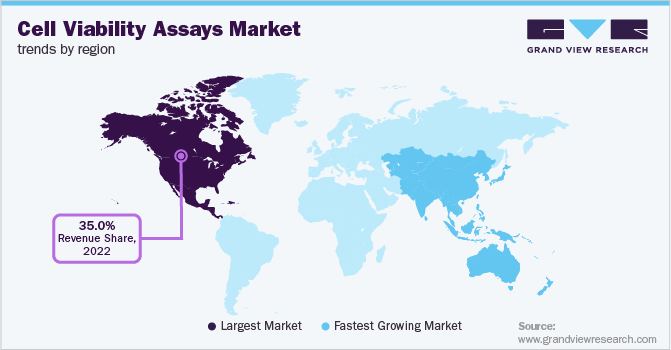
- Largest regional market: North America (over 35.0% revenue share, 2025)
- Fastest-growing regional market: Asia Pacific (highest CAGR, 2026-2033)
Market Size & Forecast
- Market size in 2025: USD 1.9 Billion
- Estimated market size in 2026: USD 2.0 Billion
- Projected market size by 2033: USD 4.2 Billion
- CAGR (2026-2033): 10.9%
These assays play a critical role in evaluating drug efficacy and toxicity, making them essential tools in modern drug development and cell-based research workflows. The increasing funding for cell-based research is creating more growth opportunities in the cell viability assays market. For instance, in November 2025, Aspen Neuroscience, Inc., a biotechnology company focused on autologous regenerative therapies, closed a USD 115 million Series C financing round to advance its lead program, ANPD001, for moderate-to-advanced Parkinson’s disease. Similarly, TTP Cellular Origins secured USD 40 million in Series A funding to accelerate the development of scalable cell-therapy manufacturing technologies. These investments show a growing interest in cell therapy innovation, which relies heavily on cell viability assays for process improvement, quality control, and effectiveness checks.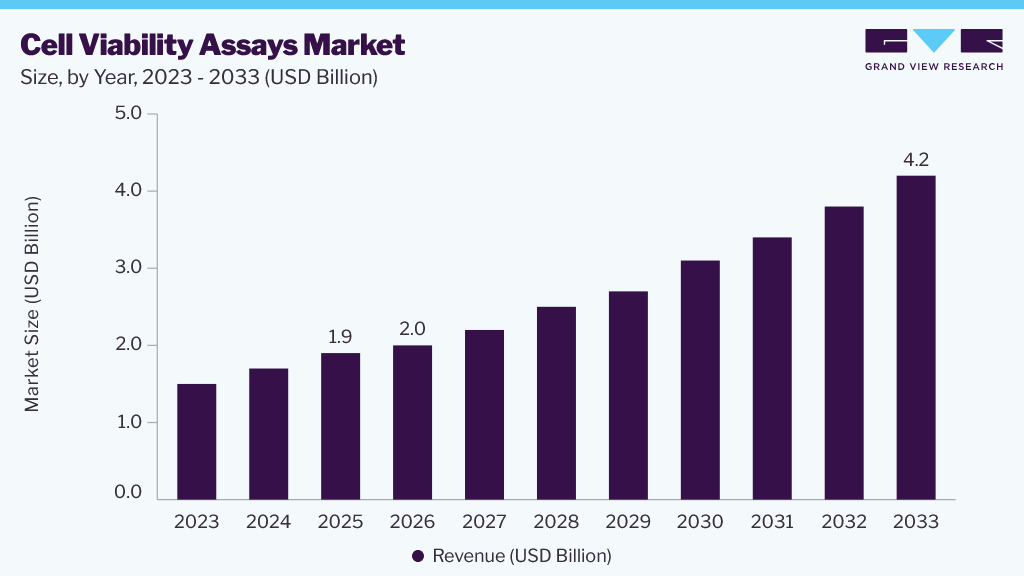
In addition, key market players are introducing advanced analytical technologies to meet the growing demand from pharmaceutical, biopharmaceutical, and research organizations. In May 2025, Becton, Dickinson and Company (BD) launched a next-generation cell analyzer that combines spectral analysis and real-time cell imaging capabilities. This allows for deeper insights into cellular behavior with greater accuracy and efficiency.
Furthermore, government and institutional funding for stem cell research is boosting market growth. In January 2025, the California Institute for Regenerative Medicine (CIRM) awarded nearly USD 100 million to support regenerative medicine projects at various stages. Similarly, in October 2025, the Maryland Stem Cell Research Commission provided USD 4.7 million in grants to promote stem cell-based therapeutic development. Together, these initiatives are expected to significantly increase the use of cell viability assays in life sciences research and clinical applications.
Market Dynamics
The rising interest in cell and gene therapies, along with increased biopharmaceutical research and development investments, drives the cell viability assays market. As more cell-based therapy candidates appear in clinical pipelines, there is a growing need for reliable assessments of cell health, viability, and treatment response. This need exists throughout drug discovery, preclinical studies, clinical trials, and regulatory approval processes. Cell viability assays have become essential tools in modern drug development. They allow researchers to evaluate therapeutic effectiveness and safety profiles accurately. Regulatory agencies including the U.S. Food and Drug Administration require detailed cell viability and functional data to support drug approval processes, which highlights their importance. Moreover, more government funding and private investments in stem cell research and regenerative medicine are speeding up adoption in academic institutions, biotechnology companies, and clinical laboratories. For instance, in April 2025, the FDA approved Zevaskyn, the first cell-based gene therapy for treating Recessive Dystrophic Epidermolysis Bullosa (RDEB). This approval showcases the growing momentum in cell therapy development and indirectly boosts the demand for cell viability assay technologies in drug development.
The high cost of instruments and the shortage of skilled professionals are major factors limiting the growth of the cell viability assays market. Platforms including high-content screening systems, real-time imaging technologies, and automated assay analyzers require a significant investment. This makes them less accessible for small and mid-sized research labs, academic institutions, and early-stage biotechnology companies. Along with high initial costs, ongoing expenses for reagents, consumables, calibration, and maintenance further raise the total cost of ownership, making it harder for broader adoption. In addition, the market struggles with a lack of trained professionals who can design experiments, operate complex analytical systems, and interpret large, multidimensional datasets accurately. Even well-equipped labs may see lower efficiency and less reliable data without the necessary expertise. Together, these financial and skill-related challenges slow down the widespread use of advanced cell viability assay technologies, especially in research environments with limited resources and in emerging markets.
Analyst Perspective
The cell viability assays market is growing due to increased research in drug discovery, cancer biology, and regenerative medicine. Pharmaceutical and biotechnology companies, along with academic and research institutions, are turning to cell viability testing to assess drug efficacy, cytotoxicity, and cellular responses. The rise in chronic diseases and cancer is also increasing the demand for advanced cell-based assays in preclinical studies. Technological advances such as high-throughput screening, fluorescence-based detection, and automated imaging systems are improving the accuracy and efficiency of laboratory workflows. Market players have the chance to develop sensitive, automated, and cost-effective assay platforms that speed up drug screening, enhance reproducibility, and integrate easily with digital lab systems.
Product Insights
The consumables segment dominated the market in 2025 and captured over 60.0% share. The segment is also anticipated to expand at the fastest rate during the forecast period. This can be attributed to the utility of consumables in various pharmaceutical and biopharmaceutical, diagnostic, and stem cell research applications. In addition, several players in the market are offering a wide range of cell viability assay reagents that are non-toxic and ready to use and offer instant high-quality results. Luminometric assays held a dominant share in 2025 and are anticipated to witness the fastest growth in the projected timeframe due to their simple protocols, uncomplicated equipment requirement, robustness, and superior sensitivity. Fluorometric assays accounted for the second-largest share in 2025 due to their advantages over colorimetric and dye exclusion assays since they are more sensitive. These qualities altogether enable easy scalability and adaptability from bench research to high throughput applications. Such features of cell viability assay are boosting the consumables segment growth.
The instruments segment is expected to witness significant growth during the forecast period. The need for automation, precision, and high-throughput analysis is encouraging the use of advanced instruments such as spectrophotometer, microscopy, cell imaging and analysis system, flow cytometry and high-content screening systems. These instruments allow for accurate measurement of cell health, metabolic activity, and treatment response. Ongoing technology improvements, including real-time imaging and multi-parameter analysis features, are speeding up instrument use in research and clinical settings.
Application Insights
The stem cell research segment held the largest share of over 41.0% in 2025 and is anticipated to register the fastest CAGR during the forecast period. Stem cell therapy is quickly becoming a promising area of biomedical research. This growth has increased the need for cell viability tests to evaluate cell growth, differentiation, and survival. The rising interest in regenerative medicine and complex 3D cell culture models is driving the creation of new analytical tools to support effective research workflows. For instance, in July 2025, Sartorius launched the Incucyte CX3 Live-Cell Analysis System. This system improves 3D cell culture analysis with confocal fluorescence imaging, flexible throughput options, and integrated software. It aims to simplify laboratory workflows and enhance real-time decision-making in drug discovery and development. These technological advancements are increasing the use of cell viability assays in stem cell therapy research. They help researchers better assess cellular behavior and accelerate progress in regenerative medicine applications.
The drug discovery and development segment held the second-largest share in 2025. Cell viability assays play a vital role in various stages of drug discovery and development due to their versatility, flexibility, and adaptability. Cell viability assays are fundamentally used for screening the response of the cells against a chemical compound or a drug during the drug discovery and development process. Furthermore, they are used to estimate the cellular variations related to cell death, such as modifications in protein expression and loss of membrane integrity in enzymatic activity upon exposure to a test compound. Such applications of cell viability assay in drug discovery and development are driving the segment.
End-user Insights
The biopharmaceutical and pharmaceutical companies segment captured the largest revenue share, at over 31.5%, in 2025. This growth is due to the widespread use of cell viability assays to evaluate the biological effects of therapeutic compounds on living cells. These assays are commonly used in oncology research to test drug effectiveness against tumor cells and to assess cytotoxicity and overall safety during both the early and late stages of drug development. Their ability to provide important insights into cellular responses makes them a vital tool throughout various stages of the drug development process. In addition, strong investments in research and development for biologics, targeted therapies, and new treatment methods are boosting their use in this segment.
CROs and CMOs are expected to grow at the fastest rate of xx% over the forecast period. Pharmaceutical companies are entering into collaborations with CROs and CMOs for numerous reasons. These collaborations have the potential to improve process efficiency, cut costs, and decrease time to market. Contract research organizations and contract manufacturing organizations are increasingly using cell viability assays to enhance outsourced drug development and manufacturing services. The trend of outsourcing in pharmaceutical research and development, along with the cost and scalability benefits offered by CROs and CMOs, is driving the demand for standardized, high-throughput assay solutions that ensure consistent and reliable results across various client projects.
Regional Insights
North America dominated the market, accounting for over 35.0% of revenue in 2025. This major share can be attributed to the rise in investment initiatives by the government, the increasing incidence of chronic diseases such as cancer, and the presence of high-quality infrastructure for clinical and laboratory research in North America. For instance, according to the American Cancer Society, approximately 2,041,910 new cancer cases were recorded in the U.S. in 2025, with nearly 618,120 deaths. Thus, the rising prevalence of chronic and infectious diseases and the increasing focus on cell-based therapeutics are expanding the growth prospects of the market.
Asia Pacific Cell Viability Assays Market Trends
Asia Pacific is expected to witness the fastest growth over the forecast period due to rising demand for novel therapeutics in the region. Furthermore, this growth stems from the quick expansion of the pharmaceutical and biotechnology industries, more investment in life sciences research, and a growing use of new drug discovery technologies. Increased government funding for stem cell research and regenerative medicine, especially in countries including China, India, Japan, and South Korea, is also driving demand. In addition, a rising number of contract research organizations (CROs) and budget-friendly R&D capabilities are also helping the regional market grow.
Key Cell Viability Assays Company Insights
Major players in the market are executing numerous strategies including novel product launches, partnerships, collaborations, mergers and acquisitions, and geographical expansion to expand their market presence.
-
In March 2026, Elabscience launched its next-generation Cell Viability Chemiluminescence Assay Kit. This new ATP-based luminescence solution provides a reliable way to measure cell viability. The assay works on the idea that ATP, a vital energy molecule in oxidative phosphorylation, indicates cellular metabolic activity and viability levels. The product has a wide detection range of 500 to 50,000 cells, making it ideal for both high- and low-density samples, including rare or limited cell populations.
-
In March 2025, Sphere Bio, a provider of advanced picodroplet-based microfluidics solutions launched the Viability Assay Kit and Cyto-Cellect Human IgG Kappa. This is the first multiplexed assay designed for the company’s newly introduced Cyto-Mine Chroma platform, further expanding its capabilities in high-throughput single-cell screening and analysis.
Key Cell Viability Assays Companies
The following key companies have been profiled for this study on the cell viability assays market.
-
Thermo Fisher Scientific, Inc.
-
Agilent Technologies, Inc.
-
Bio-Rad Laboratories, Inc.
-
Merck KGaA
-
Waters Corporation
-
Revvity, Inc.
-
Promega Corporation
-
Biotium
-
Creative Bioarray
-
Abcam plc
-
Charles River Laboratories
Cell Viability Assays Market Report Scope
Report Attribute
Details
Market size in 2025
USD 1.9 billion
Estimated market size in 2026
USD 2.0 billion
Projected market size by 2033
USD 4.2 billion
Growth rate
CAGR of 10.9% from 2026 to 2033
Base year for estimation
2025
Historical data
2021 - 2024
Forecast period
2026 - 2033
Quantitative units
Revenue in USD million, and CAGR from 2026 to 2033
Report coverage
Revenue forecast, company ranking, competitive landscape, growth factors, and trends
Segments covered
Product, application, end use, region
Regional Scope
North America; Europe; Asia Pacific; Latin America; MEA
Country Scope
U.S.; Canada; Germany; UK; France; Italy; Spain; Denmark; Sweden; Norway; Japan; China; India; South Korea; Australia; Thailand; Brazil; Mexico; Argentina; South Africa; Saudi Arabia; UAE; Kuwait
Key companies profiled
Thermo Fisher Scientific, Inc.; Agilent Technologies, Inc.; Bio-Rad Laboratories, Inc.; Merck KGaA; Waters Corporation; Revvity, Inc.; Promega Corporation; Biotium; Creative Bioarray; Abcam plc; Charles River Laboratories
Customization scope
Free report customization (equivalent up to 8 analysts working days) with purchase. Addition or alteration to country, regional & segment scope.
Pricing and purchase options
Avail of customized purchase options to meet your exact research needs. Explore purchase options
Global Cell Viability Assays Market Report Segmentation
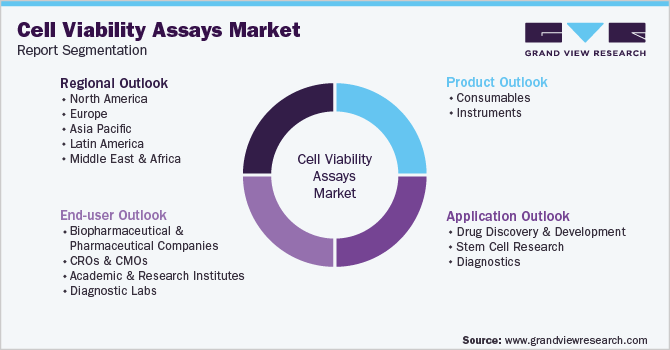
This report forecasts revenue growth at the global, regional, and country levels and provides an analysis of the latest industry trends and opportunities in each of the sub-segments from 2021 to 2033. For this report, Grand View Research has segmented the global cell viability assays market report based on product, application, end use, and region:
-
Product Outlook (Revenue, USD Million, 2021 - 2033)
-
Consumables
-
Reagents And Assay Kits, By Type
-
Dye Exclusion Assays
-
Colorimetric Assays
-
Fluorometric Assays
-
Luminometric Assays
-
-
Microplates
-
-
Instruments
-
Spectrophotometer
-
Microscopy
-
Cell Imaging And Analysis System
-
Flow Cytometry
-
Others
-
-
-
Application Outlook (Revenue, USD Million, 2021 - 2033)
-
Drug Discovery And Development
-
Stem Cell Research
-
Diagnostics
-
-
End-user Outlook (Revenue, USD Million, 2021 - 2033)
-
Biopharmaceutical & Pharmaceutical Companies
-
CROs & CMOs
-
Academic & Research Institutes
-
Diagnostic Labs
-
-
Regional Outlook (Revenue, USD Million, 2021 - 2033)
-
North America
-
U.S.
-
Canada
-
-
Europe
-
Germany
-
UK
-
France
-
Italy
-
Spain
-
Denmark
-
Sweden
-
Norway
-
-
Asia Pacific
-
Japan
-
China
-
India
-
South Korea
-
Australia
-
Thailand
-
-
Latin America
-
Brazil
-
Mexico
-
Argentina
-
-
Middle East & Africa
-
South Africa
-
Saudi Arabia
-
UAE
-
Kuwait
-
-
Frequently Asked Questions About This Report
North America dominated with a 35.0% revenue share in 2025.
Key players include Thermo Fisher Scientific, Inc.; Agilent Technologies, Inc.; Bio-Rad Laboratories, Inc.; Merck KGaA; Waters Corporation; Revvity, Inc.; Promega Corporation; Biotium; Creative Bioarray; Abcam plc; Charles River Laboratories
Consumables dominated the E-commerce logistics market with a share of 60.0% in 2025, while stem cell research is the fastest-growing segment.
The global cell viability assays market size was valued at USD 1.9 billion in 2025 and is estimated at USD 2.0 billion for 2026.
The global cell viability assays market is expected to grow at a CAGR of 10.9% from 2026 to 2033, reaching USD 4.2 billion.
About the Author(s)
Clinical Diagnostics Research Team
Healthcare · Clinical DiagnosticsThis report was authored by the clinical diagnostics research team at Grand View Research - comprising two research analysts, one senior research analyst, and one industry expert - with specialized expertise in the clinical diagnostics segment of the healthcare industry. All findings are based on proprietary healthcare databases, executive interviews, and regulatory analysis, subject to internal peer review prior to publication.
Last Updated:
Speak to Analyst


Customize this report to your needs — add regions, segments, or data points, with 20% free customization.
Or view our licence options:


ISO 9001:2015 & 27001:2022 Certified
We are GDPR and CCPA compliant! Your transaction & personal information is safe and secure. For more details, please read our privacy policy.


