
- Home
- »
- Plastics, Polymers & Resins
- »
-
Cellulose-based Cosmetic Polymers Market Report, 2033GVR Report cover
![Cellulose-based Cosmetic Polymers Market (2026 - 2033)Report]()
Cellulose-based Cosmetic Polymers Market (2026 - 2033)
Size, Share & Trends Analysis Report By Polymer Type (Hydroxyethyl Cellulose, Cationic Cellulose Derivatives), By Function (Thickener & Rheology Modifier, Conditioning Agent), By Region, And Segment Forecasts
Market Size, 2025
$517.5MMarket Estimate, 2026
$550.7MMarket Forecast, 2033
$862.3MCAGR, 2026–2033
6.6%Cellulose-based Cosmetic Polymers Market Summary
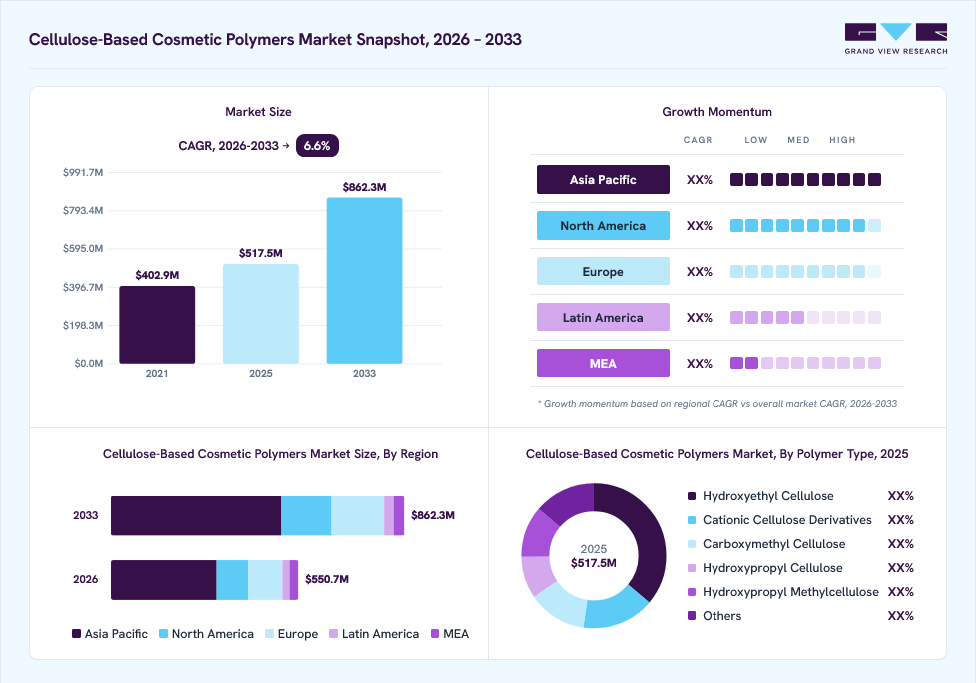
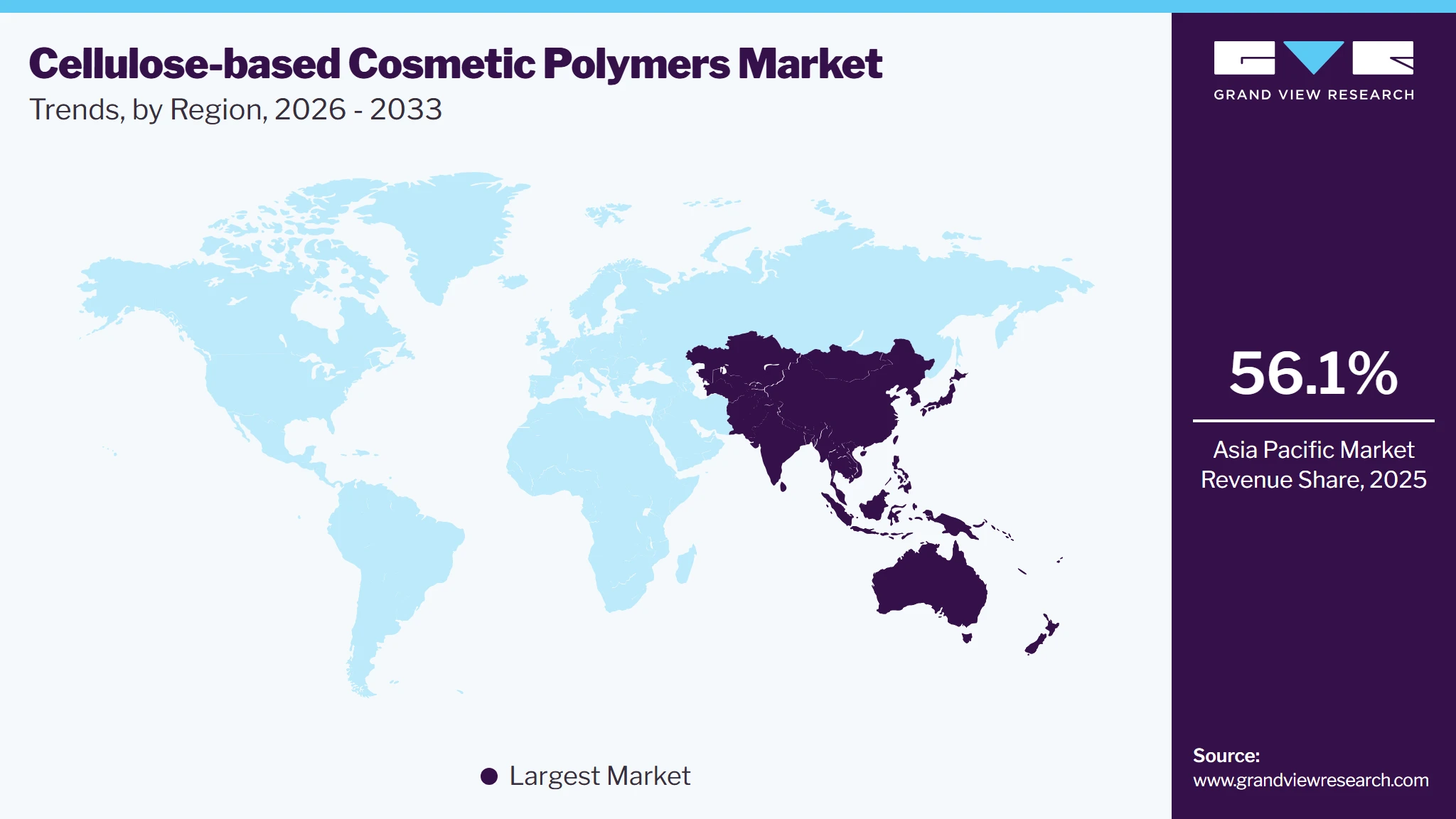
The global cellulose-based cosmetic polymers market size was valued at USD 517.5 million in 2025 and is projected to grow from USD 550.7 million in 2026 to USD 862.3 million by 2033, at a CAGR of 6.6% from 2026 to 2033. Asia Pacific dominated the market, accounting for a revenue share of 56.1% in 2025. The cellulose-based cosmetic polymers market is driven by rising demand for plant-derived and multifunctional formulation ingredients, particularly in skin care, hair care, and personal care products.
Key Market Trends & Insights
- By polymer type: The cationic cellulose derivatives segment is anticipated to grow at a CAGR of 7.9% in the polymer type segment.
- By function: The thickener & rheology modifier segment led the market by function, accounting for 43.3% of revenue in 2025.
Regional Highlights
- Largest regional market: Asia Pacific (56.1% revenue share, 2025)
- By country: The U.S. held the largest market share in 2025.
Market Size & Forecast
- Market Size in 2025: USD 517.5 Million
- Estimated Market Size in 2026: USD 550.7 Million
- Projected Market Size by 2033: USD 862.3 Million
- CAGR (2026-2033): 6.6%
Three ways to get this report
Buy it, customize it, or ask a question.Get the Full Report
What the study covers
- FormatsPDF · Excel · Dashboard
- Timeline2026–2033 annual, 2025 base
- Coverage20+ countries, 5 regions
- Companies10+ key players profiled
Customize the Report
20% free customization
- IncludeCountries, segments, points
- TailorTo your product definition
- ExtendDeeper competitor detail
- OrA fully bespoke study
- Turnaround5–10 working days
Ask an Analyst
A direct answer, usually in 1 working day
- AccessReport author, directly
- Reply timeWithin 1 working day
- No sales callDirect answer only
- FormatEmail reply
- CostFree, no cost
A key trend in the cellulose-based cosmetic polymers market is the development of multifunctional grades that combine thickening, stabilization, film formation, and sensory benefits in one ingredient. Formulators are increasingly using HEC, HPC, HPMC, and CMC derivatives to simplify complex formulations while maintaining viscosity and texture.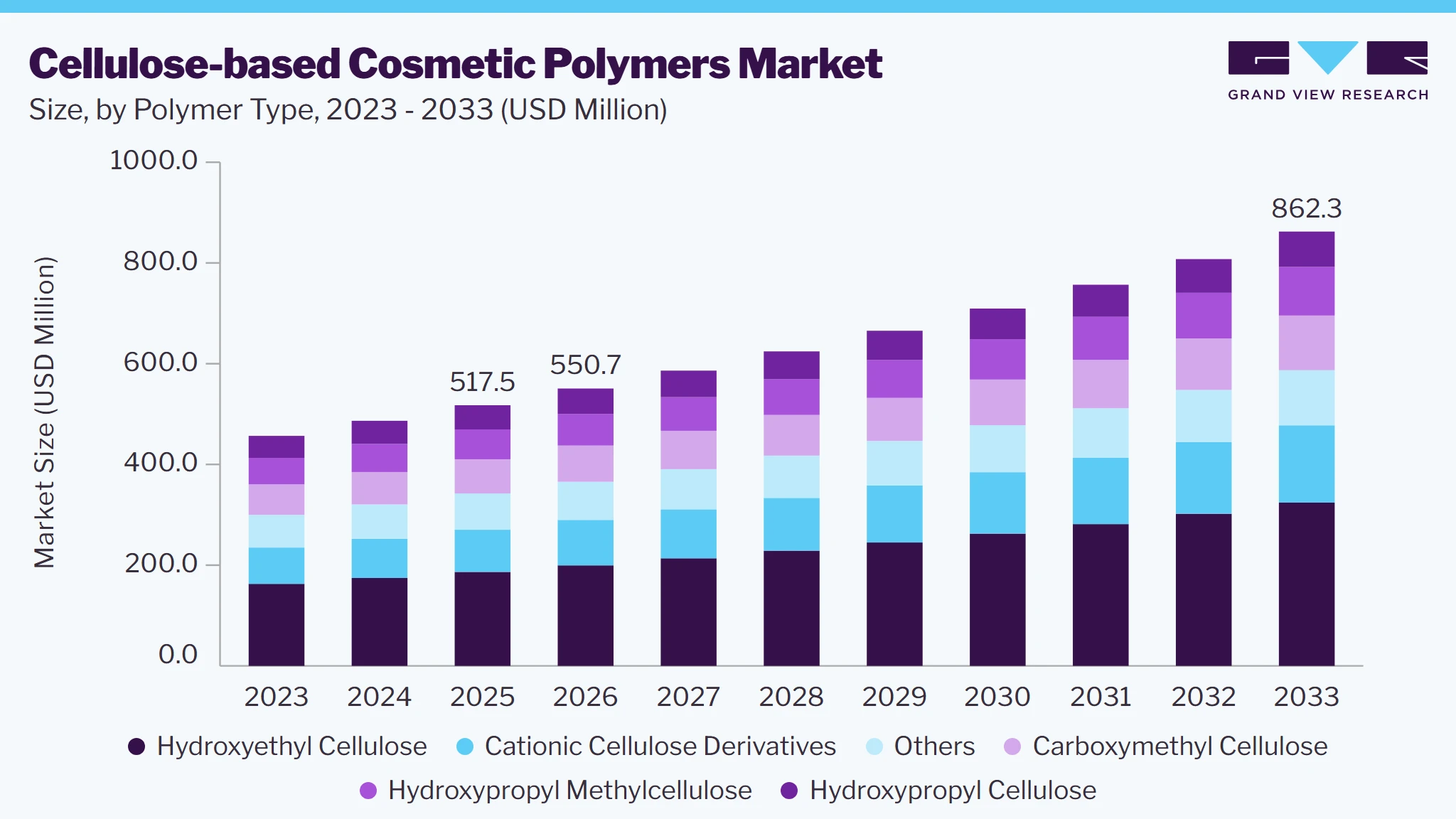
Cellulose polymers are also gaining relevance in low-surfactant and surfactant-free systems. Research demonstrates their potential to stabilize emulsions while improving rheology and product feel.
Market Dynamics
Demand for cellulose-based cosmetic polymers is supported by the growing preference for plant-derived, multifunctional formulation ingredients in skin care, hair care, and personal care products. Cellulose derivatives provide formulation performance without relying solely on conventional synthetic rheology modifiers, making them suitable for brands seeking ingredients that combine functionality with naturally positioned product concepts. Hydroxyethyl cellulose (HEC), hydroxypropyl methylcellulose (HPMC), hydroxypropyl cellulose (HPC), and carboxymethyl cellulose (CMC) offer viscosity control, suspension, stabilization, film-forming, and binding properties across a broad range of formulations.
Their compatibility with water-based systems further supports adoption as cosmetic manufacturers develop lightweight, mild, and consumer-friendly products. These polymers can improve texture, consistency, spreadability, and formulation stability in shampoos, conditioners, creams, lotions, gels, cleansers, and toothpaste. Growing demand for multifunctional ingredients also encourages formulators to use cellulose derivatives to address several formulation requirements with a single ingredient, supporting their application across both mass-market and premium personal care products.
A key restraint is the variable performance of cellulose polymers across different cosmetic formulations. Polymer selection depends on viscosity grade, substitution level, pH, electrolyte concentration, surfactant composition, active ingredients, and processing conditions. For instance, anionic CMC can show lower electrolyte tolerance than nonionic HEC, limiting its use in some complex systems. Formulators may therefore require extensive compatibility testing and grade optimization before replacing established rheology modifiers, increasing development time and qualification costs.
The market presents an opportunity for high-performance cellulose grades tailored to premium cosmetic formulations. Demand is increasing for clear gels, lightweight serums, leave-on hair products, and sophisticated emulsion systems that require precise rheology and sensory control. Nonionic HEC and HPMC grades can provide viscosity, film formation, stabilization, and formulation compatibility. Suppliers can capture higher-value applications by developing grades with faster hydration, improved clarity, controlled flow, and enhanced compatibility with active ingredients and surfactant systems.
Market Concentration & Characteristics
The market growth stage is medium, and growth is accelerating. The market exhibits fragmentation, with key players dominating the industry landscape. Major companies such as Ashland, Shin-Etsu Chemical Co., Ltd., Dow, CP Kelco, Daicel Corporation, LOTTE Fine Chemical Co., Ltd., Celotech Chemical Co., Ltd., Borregaard AS, Nouryon, Roquette and others play a significant role in shaping the market dynamics. These leading players often drive innovation in the market by introducing new products, technologies, and materials to meet the industry's evolving demands.
Innovation in the cellulose-based cosmetic polymers market is increasingly focused on functional customization rather than basic thickening performance. Manufacturers are developing cellulose grades with controlled rheology, improved clarity, faster hydration, enhanced suspension, and better compatibility with surfactants and active ingredients. This supports premium applications such as clear gels, lightweight skin-care products, and advanced hair-care formulations. Innovation is also moving toward multifunctional polymers that combine stabilization, film formation, and sensory modification, helping formulators reduce the number of ingredients required in complex formulations.
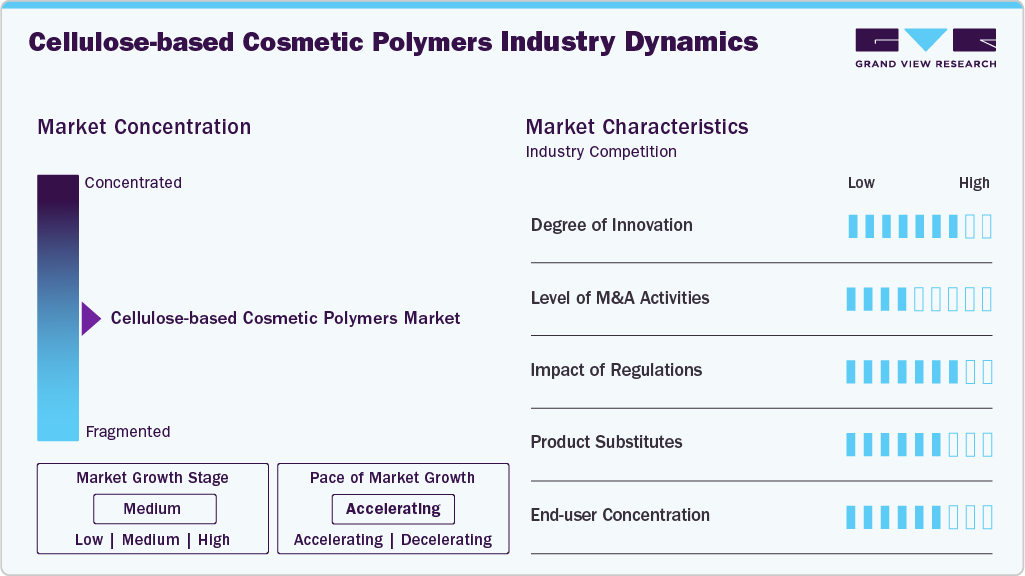
Regulatory requirements are shaping cellulose polymer selection through stricter expectations for ingredient safety, traceability, labeling, and formulation compliance. In the EU, Regulation (EC) No 1223/2009 requires cosmetic manufacturers to complete safety assessments and maintain defined ingredient information before market placement. The European Commission also updated the common cosmetic ingredient glossary in 2025, reinforcing consistent ingredient identification. For cellulose polymers, regulatory scrutiny increasingly encourages suppliers to provide detailed composition, safety, and documentation data, raising compliance requirements across global supply chains.
Analyst Perspective
The cellulose-based cosmetic polymers market is shifting from volume-led adoption toward value-driven, high-innovation growth across skin, hair, and color cosmetics. Premium formulations are driving demand for multifunctional polymers—such as HEC, cationic cellulose, and HPMC—that provide rheology control, film formation, and enhanced sensory profiles. Rising regulatory scrutiny will make safety documentation, supply transparency, and verified sustainability essential for market entry. Market leaders will stay ahead through advanced cellulose chemistry, integrated production, and strong co-development partnerships with formulators. However, volatility in raw material costs, lengthy product qualification cycles, and competing synthetic polymers will continue to squeeze margins. To maintain long-term profitability, companies must prioritize specialty grade development, sustainable processing, and resilient regional supply chains.
Polymer Type Insights
The hydroxyethyl cellulose dominated the market across polymer type segmentation in terms of revenue, accounting for 36.1% market share in 2025, and is forecast to grow at a 7.2% CAGR from 2026 to 2033. Hydroxyethyl Cellulose (HEC) benefits from its broad formulation compatibility and reliable performance in water-based cosmetics. As a nonionic polymer, HEC can provide viscosity control without strongly interacting with charged surfactants or electrolytes. This makes it suitable for shampoos, body washes, gels, creams, and color cosmetics. Recent supplier offerings emphasize bio-based content, biodegradability, electrolyte tolerance, formulation clarity, and cold processing. These attributes strengthen HEC demand as formulators develop simpler, water-rich, and naturally positioned cosmetic systems.
The cationic cellulose derivatives segment is expected to expand at a 7.9% CAGR in the cellulose-based cosmetic polymers market over the forecast period. Cationic cellulose derivatives are gaining traction in hair care because their positively charged functionality promotes deposition onto hair and improves conditioning performance. This supports demand in shampoos, conditioners, two-in-one products, and leave-on treatments. Current commercial grades such as Polyquaternium-10 and Polyquaternium-67 target softness, wet and dry combing, detangling, frizz control, and silicone deposition. Their cellulose backbone also supports bio-based positioning. The segment is therefore moving beyond basic conditioning toward targeted performance for damaged, chemically treated, and difficult-to-manage hair.
Function Insights
The thickener & rheology modifier segment led the market by function, accounting for 43.3% of revenue in 2025, and is projected to grow at a 7.1% CAGR from 2026 to 2033. The thickener and rheology modifier segment is supported by the need for precise product viscosity and flow behavior across modern cosmetic formats. Cellulose polymers allow formulators to control spreadability, suspension, stability, and application feel without substantially changing the formulation architecture. HEC is particularly relevant because it can deliver efficient viscosity building, emulsion stabilization, clarity, and electrolyte tolerance. Recent research also indicates potential for HEC in surfactant-free serums, where it can improve structural stability and hydration durability. This expands its relevance beyond conventional cleansing products.
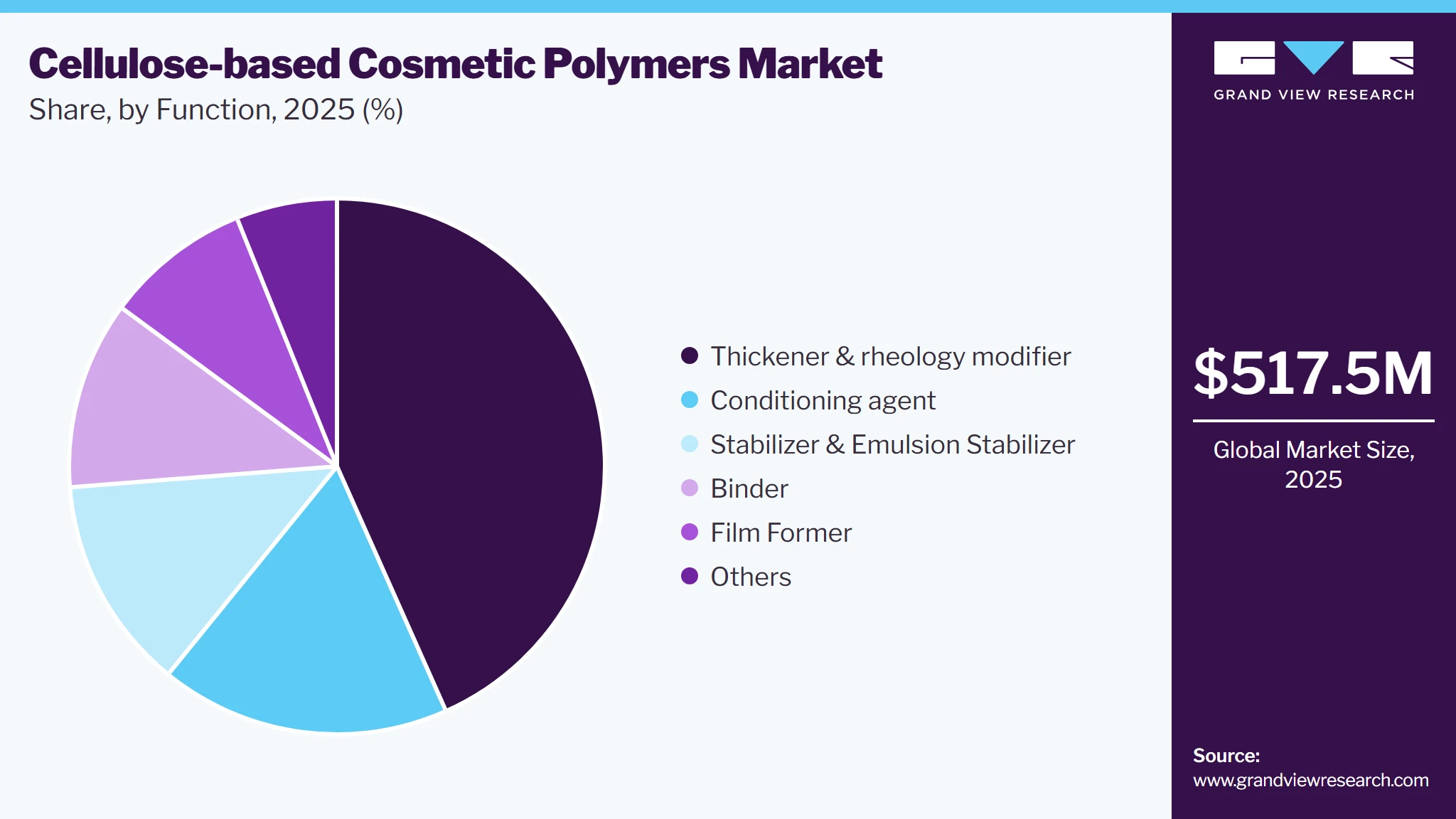
The conditioning agent segment is expected to grow at the fastest CAGR of 7.7% over the forecast period. The conditioning agent segment is being shaped by demand for effective hair treatment without excessive buildup or loss of volume. Cationic cellulose polymers provide substantive conditioning while supporting wet and dry combability, softness, manageability, and frizz control. Their compatibility with clear shampoos and silicone-containing or silicone-free systems broadens formulation flexibility. Commercial development is also targeting controlled deposition of active ingredients and silicones. This positions cellulose-based conditioning polymers as useful performance enhancers for premium hair-care products, particularly formulations designed for damaged or chemically treated hair.
Regional Insights
The Asia Pacific cellulose-based cosmetic polymers market held the largest revenue share of 56.1% in 2025. The region is expected to grow at a CAGR of 7.1% over the forecast period. Asia Pacific is supported by expanding beauty consumption, rapid product innovation, and increasing demand for specialized skin and hair care formulations. China, Japan, South Korea, and emerging Southeast Asian markets are important formulation and manufacturing centers. Cellulose polymers benefit from their suitability for shampoos, facial products, gels, lotions, and other water-based formats. Regional formulators are also developing products around lighter textures and targeted functionality. This favors cellulose grades offering precise rheology, suspension, clarity, and compatibility with active ingredients.
India Cellulose-based Cosmetic Polymers Market Trends
India is emerging as an attractive demand market as beauty and personal care consumption expands across organized retail, e-commerce, and premium product categories. India’s beauty and personal care market is experiencing strong growth, supported by rising consumer spending and increasing demand for beauty products. Online beauty sales are gaining significant traction, driven by expanding e-commerce penetration and growing consumer preference for convenient digital shopping. This expansion supports consumption of formulation ingredients used in shampoos, skin care, styling products, and creams. Cellulose polymers can benefit from growing demand for functional, naturally positioned, and cost-efficient ingredients suited to mass and premium formulations.
North America Cellulose-based Cosmetic Polymers Market Trends
North America benefits from an integrated cosmetics supply chain and strong demand for premium skin and hair care products. According to the Personal Care Council, the regional cosmetics and personal care industry recorded USD 9.3 billion in two-way North American trade in 2025, supported by closely connected U.S., Canadian, and Mexican manufacturing networks. This structure favors cellulose polymer suppliers that can provide consistent grades across borders. Demand is particularly relevant for rheology modifiers, stabilizers, and conditioning polymers used in sophisticated, water-based formulations.
The U.S. represents a major demand center due to its large and highly diversified personal care industry. Product development increasingly emphasizes multifunctional formulations, formulation efficiency, and ingredient transparency. This creates opportunities for cellulose polymers that deliver viscosity control, stabilization, conditioning, and film formation within a single system. The regulatory environment also supports stronger ingredient safety documentation. Under U.S. cosmetics requirements, manufacturers remain responsible for ensuring product and ingredient safety, increasing the value of suppliers with robust technical and safety data.
Europe Cellulose-based Cosmetic Polymers Market Trends
Europe presents demand for cellulose-based cosmetic polymers through its strong focus on sustainable formulation, ingredient transparency, and regulatory compliance. The European Commission maintains detailed requirements for cosmetic ingredients and continues to update the regulatory framework based on safety assessments. Growing scrutiny of environmental claims and cosmetic ingredients encourages manufacturers to select well-documented, traceable materials. Cellulose polymers can benefit where their plant-derived origin and multifunctionality support formulation objectives. Suppliers with strong safety dossiers, standardized quality, and clear sustainability documentation are positioned to gain preference.
Latin America Cellulose-based Cosmetic Polymers Market Trends
Latin America is driven by strong consumer participation in beauty and personal care, with Brazil acting as the region's primary demand and innovation hub. Hair care and skin care are particularly relevant applications for cellulose polymers because formulators require viscosity control, conditioning, stabilization, and sensory modification. Brazil's high product-launch activity also encourages ingredient suppliers to offer differentiated cellulose grades for diverse hair textures and tropical-use formulations.
Middle East and Africa Cellulose-based Cosmetic Polymers Market Trends
The Middle East and Africa market is supported by rising interest in premium personal care, hair care, and naturally positioned beauty products. South Africa provides an important regional manufacturing and distribution base, with hair care representing its largest cosmetics subcategory. Local demand for African hair and skin care solutions is also encouraging product development tailored to regional requirements. Cellulose polymers can support these formulations through conditioning, viscosity control, and stabilization. Growing interest in indigenous ingredients and localized manufacturing creates additional opportunities for specialty cellulose-based formulation systems.
Key Cellulose-based Cosmetic Polymers Company Insights
Some of the key players operating in the market include Shin-Etsu Chemical and Dow
-
Shin-Etsu Chemical maintains a strong position in cellulose-based cosmetic polymers through its METOLOSE and TYLOSE personal-care grades. The company offers cellulose derivatives for cosmetics within a broader specialty materials portfolio, supported by manufacturing and technical operations in Japan, Germany, and the U.S. Its cellulose ether capabilities cover viscosity modification and formulation support for personal-care products. This combination of established cellulose expertise, global production, and application development strengthens its competitiveness in premium cosmetic formulations.
-
Dow competes strongly through its CELLOSIZE Hydroxyethyl Cellulose portfolio, which targets hair care, skin care, and color cosmetics. Its grades provide thickening, emulsion stabilization, foam stability, electrolyte tolerance, and texture enhancement. Dow is also positioning newer grades around bio-based content and biodegradability. CELLOSIZE PCG-10 Europe, for example, contains 60% bio-based carbon and supports formulations across a pH range of 3 to 10. This sustainability-oriented product development strengthens Dow's relevance as cosmetic formulators seek multifunctional rheology modifiers.
Celotech Chemical is one of the emerging participants in the cellulose-based cosmetic polymers market.
-
Celotech Chemical is expanding its position as a specialized cellulose ether supplier through its CELOPRE portfolio for cosmetics and water-based systems. The company offers HEC and HPMC grades targeting shampoos, body washes, facial cleansers, and lightweight skin-care gels. CELOPRE H300, for instance, is designed for precise viscosity control and lower dosage requirements. Its focused cosmetic portfolio and broad viscosity range provide customization opportunities, while its smaller global footprint leaves significant room for geographic and customer-base expansion.
Key Cellulose-based Cosmetic Polymers Companies:
The following key companies have been profiled for this study on the cellulose-based cosmetic polymers market.
-
Ashland
-
Shin-Etsu Chemical Co. Ltd.
-
Dow
-
CP Kelco
-
Daicel Corporation
-
LOTTE Fine Chemical Co., Ltd.
-
Celotech Chemical Co., Ltd.
-
Borregaard AS
-
Nouryon
-
Roquette
Company Categorization
Operating Strategies
Competitive Edge
Weakness
Mature Players: Ashland, Shin-Etsu Chemical, Dow, CP Kelco, Daicel Corporation, LOTTE Fine Chemical, Borregaard, Nouryon, Roquette
- Develop broad portfolios of cellulose ethers, specialty cellulose, microfibrillated cellulose, and related bio-based polymers for skin care, hair care, color cosmetics, and personal care.
- Invest in rheology control, stabilization, conditioning, sensory modification, biodegradability, and formulation compatibility.
- Expand through global manufacturing, application laboratories, technical support, distributor networks, customer partnerships, and customized grades for specific cosmetic systems.
- Established cellulose chemistry and extensive formulation know-how support consistent performance across demanding cosmetic applications.
- Broad product portfolios allow suppliers to address thickening, rheology modification, stabilization, film formation, conditioning, suspension, and texture control.
- Strong global presence provides access to major cosmetic formulation centers and multinational personal-care manufacturers.
- Large portfolios and established manufacturing networks can result in higher operating and product-development costs compared with specialized regional suppliers.
- Cellulose polymers compete with synthetic rheology modifiers, natural gums, starches, and other hydrocolloids across cost-sensitive formulations.
- Maintaining consistent viscosity, purity, hydration behavior, and sensory performance across grades requires stringent raw-material and process control.
Emerging Players: Celotech Chemical
- Focus on cellulose ether specialization, particularly HEC and HPMC grades for cosmetic and water-based formulations.
- Develop application-specific grades targeting lightweight shampoos, transparent body washes, facial cleansers, and lightweight skin-care gels.
- Emphasize formulation efficiency, dosage optimization, viscosity control, and technical customization.
- Focused cellulose expertise enables Celotech to respond to specific formulation requirements without the broader portfolio complexity of diversified chemical companies.
- Its suitability for transparent and lightweight formulations supports applications aligned with current cosmetic texture trends.
- A specialized business model can support faster customer-level formulation adjustments and potentially stronger cost competitiveness.
- Smaller geographic reach, manufacturing scale, and corporate resources limit its ability to match the global distribution and technical infrastructure of leading multinational suppliers.
- A narrower cosmetic polymer portfolio increases dependence on selected cellulose ether applications compared with diversified competitors.
- Building long-term relationships with multinational cosmetic companies requires extensive qualification, regulatory documentation, and consistent global supply.
Recent Developments
-
In April 2025, Ashland showcased Natrathix bio cellulose at in-cosmetics Global, presenting it as a bio-based thickener with suspension capabilities for skin care and sun care creams, lotions, and gels. The launch positioned cellulose-based technology as an alternative to conventional carbomer systems while addressing emulsion stability and sensory requirements.
-
In April 2025, Nouryon launched BeautyCreations, an AI-driven personal care formulation discovery tool developed with Albert Invent. The platform enables formulators to search Nouryon’s formulation database across skin and hair care applications and identify suitable ingredients, including cellulose gums and cellulose ethers, supporting faster formulation development and supplier-customer collaboration.
Cellulose-Based Cosmetic Polymers Market Report Scope
Report Attribute
Details
Market size in 2025
USD 517.5 million
Estimated market size in 2026
USD 550.7 million
Projected market size by 2033
USD 862.3 million
Growth rate
CAGR of 6.6% from 2026 to 2033
Historical data
2021 - 2025
Forecast period
2026 - 2033
Quantitative units
Revenue in USD million/billion, volume in kilotons, and CAGR from 2026 to 2033
Report coverage
Revenue & volume forecast, competitive landscape, growth factors, and trends
Segments covered
Polymer type, function, region
Regional scope
North America; Europe; Asia Pacific; Latin America; Middle East & Africa
Country scope
U.S.; Canada; Mexico; Europe; Germany; UK; France; Italy; Spain; China; India; Japan; South Korea; Australia; Brazil; Argentina; Saudi Arabia; UAE; South Africa
Key companies profiled
Ashland; Shin-Etsu Chemical Co., Ltd.; Dow; CP Kelco; Daicel Corporation; LOTTE Fine Chemical Co., Ltd.; Celotech Chemical Co., Ltd.; Borregaard AS; Nouryon; Roquette
Customization scope
Free report customization (equivalent to up to 8 analyst working days) with purchase. Addition or alteration to country, regional & segment scope
Pricing and purchase options
Avail customized purchase options to meet your exact research needs. Explore purchase options
Global Cellulose-based Cosmetic Polymers Market Report Segmentation
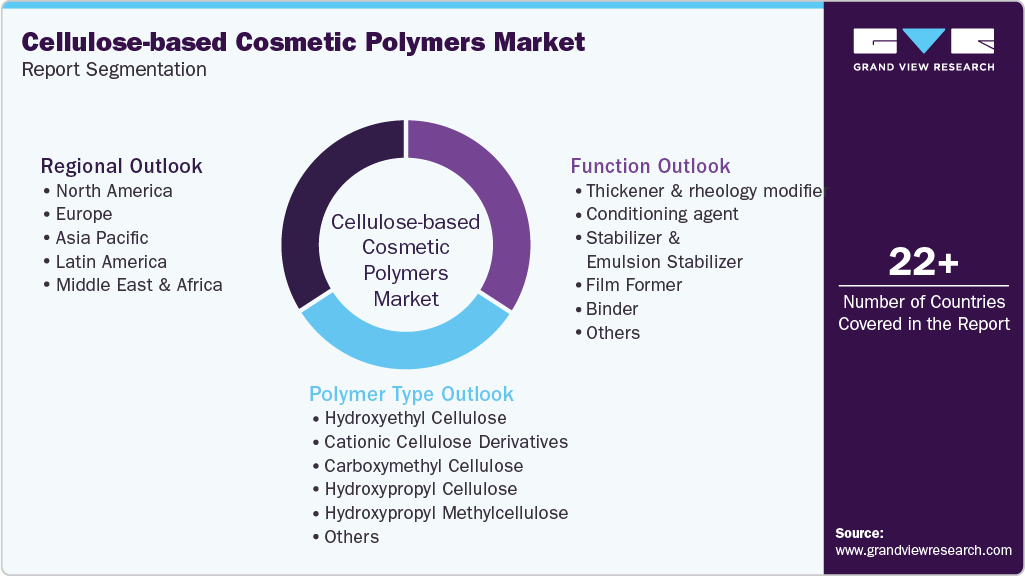
This report forecasts revenue growth at the global, regional, and country levels and provides an analysis of the latest industry trends across sub-segments from 2021 to 2033. For this study, Grand View Research has segmented the global cellulose-based cosmetic polymers market report based on polymer type, function, and region:
-
Polymer Type Outlook (Volume, Kilotons; Revenue, USD Million, 2021 - 2033)
-
Hydroxyethyl Cellulose
-
Cationic Cellulose Derivatives
-
Carboxymethyl Cellulose
-
Hydroxypropyl Cellulose
-
Hydroxypropyl Methylcellulose
-
Others
-
-
Function Outlook (Volume, Kilotons; Revenue, USD Million, 2021 - 2033)
-
Thickener & rheology modifier
-
Conditioning agent
-
Stabilizer & Emulsion Stabilizer
-
Film Former
-
Binder
-
Others
-
-
Regional Outlook (Volume, Kilotons; Revenue, USD Million, 2021 - 2033)
-
North America
-
U.S.
-
Canada
-
Mexico
-
-
Europe
-
Germany
-
UK
-
France
-
Italy
-
Spain
-
-
Asia Pacific
-
China
-
India
-
Japan
-
South Korea
-
Australia
-
-
Latin America
-
Brazil
-
Argentina
-
-
Middle East & Africa
-
Saudi Arabia
-
UAE
-
South Africa
-
-
Research Methodology
The cellulose-based cosmetic polymers market figures in this report are based on a proven research process that combines executive interviews with secondary research from proprietary databases, company filings, and recognized regulatory and institutional sources. Market size is built through value-chain sizing—reconciling supply-side and demand-side estimates—and triangulated with bottom-up and top-down approaches. Every estimate passes multiple levels of expert validation before publication, with each cellulose-based cosmetic polymers segment quantified using the revenue-capture definitions in the table below.
Segment Definition
Segment - Polymer Type
Revenue capture definition
Hydroxyethyl Cellulose (HEC)
Revenue is captured through Hydroxyethyl Cellulose used in cosmetic and personal-care formulations as a water-soluble, nonionic polymer providing viscosity control, rheology modification, suspension, stabilization, and texture enhancement. Functions include shampoos, conditioners, skin-care gels, lotions, creams, cleansers, and other water-based formulations requiring controlled flow, formulation stability, and consistent sensory performance.
Cationic Cellulose Derivatives
Revenue is generated through cationic cellulose derivatives used primarily in hair-care formulations requiring conditioning, detangling, softness, manageability, and improved deposition of functional ingredients. These polymers are used in shampoos, conditioners, two-in-one products, styling products, and leave-on treatments where positively charged cellulose derivatives interact with the hair surface to enhance conditioning performance and product feel.
Carboxymethyl Cellulose (CMC)
Revenue is captured through Carboxymethyl Cellulose used as a thickener, stabilizer, suspending agent, and rheology modifier in cosmetic and personal-care formulations. CMC supports products such as creams, lotions, cleansers, toothpaste, and other aqueous systems requiring viscosity control, ingredient dispersion, emulsion stability, and consistent product texture.
Hydroxypropyl Cellulose (HPC)
Revenue is generated through Hydroxypropyl Cellulose used in cosmetic formulations requiring viscosity modification, film formation, stabilization, and texture control. HPC is applied in hair-care products, skin-care formulations, gels, styling products, and other specialty systems where controlled film formation, smooth application, and formulation compatibility are required.
Hydroxypropyl Methylcellulose (HPMC)
Revenue is captured through Hydroxypropyl Methylcellulose used as a multifunctional formulation polymer providing thickening, stabilization, film formation, and suspension properties. Demand comes from creams, lotions, gels, cleansers, hair-care products, and other personal-care formulations requiring controlled rheology, product stability, and desirable application characteristics.
Others
Revenue comes from other cellulose-based cosmetic polymers and modified cellulose derivatives used for specialized formulation functions. These include cellulose derivatives designed for targeted viscosity control, stabilization, film formation, conditioning, suspension, or sensory modification across skin care, hair care, cleansing, color cosmetics, oral care, and other personal-care applications requiring customized performance.
Segment - Function
Revenue capture definition
Thickener & Rheology Modifier
Revenue is generated through cellulose-based cosmetic polymers used to increase viscosity and control the flow behavior of creams, lotions, shampoos, cleansers, gels, and other formulations. These polymers enable formulators to achieve targeted consistency, spreadability, suspension, and application feel while maintaining formulation stability across different processing and storage conditions.
Conditioning Agent
Revenue is captured through cellulose-based polymers, particularly cationic cellulose derivatives, used in hair-care formulations to improve softness, combability, manageability, smoothness, and frizz control. These materials are incorporated into shampoos, conditioners, treatments, and styling products where polymer deposition on hair helps improve wet and dry hair performance and overall sensory characteristics.
Stabilizer & Emulsion Stabilizer
Revenue is generated through cellulose polymers used to maintain formulation uniformity and prevent separation of dispersed ingredients. These polymers support emulsions, suspensions, creams, lotions, and cleansing products by controlling viscosity and improving the physical stability of oil-water systems. Demand is linked to formulations requiring consistent appearance, texture, and performance throughout shelf life.
Film Former
Revenue is captured through cellulose-based polymers used to create a continuous or protective film on skin or hair. These materials support applications such as hair styling, skin care, long-wear cosmetics, and protective formulations requiring improved adhesion, surface coverage, moisture retention, or durability. Performance requirements include uniform film formation, flexibility, and compatibility with other cosmetic ingredients.
Binder
Revenue is generated through cellulose-based polymers used to bind and maintain the cohesion of cosmetic ingredients, particularly in solid and semi-solid formulations. Applications include pressed powders, makeup products, tablets, and other personal-care formats requiring improved structural integrity, ingredient distribution, and processing performance. Cellulose polymers can also support consistent product shape and handling characteristics.
Others
Revenue comes from cellulose-based cosmetic polymers performing additional functions such as suspension, dispersing, moisture retention, texture modification, and controlled ingredient deposition. These applications span skin care, hair care, color cosmetics, cleansing products, oral care, and specialty personal-care formulations where cellulose derivatives provide targeted formulation performance beyond their primary thickening, conditioning, stabilization, film-forming, or binding roles.
Estimation Model
Layer No.
Layer Name
Key Question
Description
1
Top-Down Cellulose-Based Cosmetic Polymers Demand Assessment Layer
What defines overall market demand?
Establishes overall global demand for cellulose-based cosmetic polymers across Hydroxyethyl Cellulose, Cationic Cellulose Derivatives, Carboxymethyl Cellulose, Hydroxypropyl Cellulose, Hydroxypropyl Methylcellulose, and other cellulose derivatives used in skin care, hair care, cleansing, color cosmetics, oral care, and other personal-care applications.
2
Function Demand Validation Layer
Where is demand concentrated?
Maps demand across thickener & rheology modifier, conditioning agent, stabilizer & emulsion stabilizer, film former, binder, and other functions based on formulation requirements, product texture, viscosity control, stability, conditioning performance, film formation, ingredient compatibility, and increasing use of multifunctional cosmetic ingredients.
3
Consumption-to-Revenue Conversion Layer
How is demand monetized?
Converts cellulose polymer consumption into market revenue using polymer type, functional performance, viscosity grade, purity, formulation concentration, application requirements, production scale, manufacturing costs, grade specifications, supplier positioning, and prevailing pricing structures. The layer also considers the premium associated with specialty cosmetic grades and customized polymers offering enhanced formulation performance.
4
Regional Demand Verification Layer
Where is demand validated?
Validates market demand across North America, U.S., Asia Pacific, India, Europe, Latin America, and Middle East & Africa using cosmetic manufacturing activity, personal-care consumption, regional formulation trends, cellulose polymer production capabilities, import and supply patterns, regulatory requirements, sustainability preferences, and adoption of specialized skin-care and hair-care formulations.
Delivered Customizations
This report has been delivered with the following In-depth customizations
Client Request
Customization Delivered
Value Adds
Regional segmentation
Assessed the Cellulose-Based Cosmetic Polymers Market across North America, U.S., Asia Pacific, India, Europe, Latin America, and Middle East & Africa. Regional analysis considers cosmetic manufacturing activity, demand for personal care formulations, local formulation trends, and adoption of cellulose-based rheology modifiers and conditioning polymers.
Identifies regional demand centers and highlights markets with stronger potential for cellulose polymer adoption. Supports geographic expansion and regional prioritization strategies.
Cross-segmentation
Developed cross-segment analysis linking polymer types such as Hydroxyethyl Cellulose, Cationic Cellulose Derivatives, and other cellulose derivatives with functions including thickener & rheology modifier, conditioning agent, stabilizer, film former, and binder. Functions were assessed across skin care, hair care, cleansing, and other personal care formulations.
Reveals high-potential combinations of polymer type, function, and application. Helps identify where specific cellulose grades can generate greater formulation value and where suppliers can develop application-specific products.
Opportunity assessment
Identified opportunities in multifunctional cellulose polymers, premium skin care, advanced hair care, water-based formulations, lightweight textures, conditioning systems, transparent gels, sustainable ingredients, and customized cosmetic grades. HEC, HPMC, HPC, and cationic cellulose derivatives were evaluated according to their ability to deliver multiple formulation functions.
Provides a forward-looking view of application and product opportunities. Helps suppliers prioritize higher-value cosmetic segments where multifunctionality, formulation efficiency, sustainability, and customized performance can support market differentiation.
Frequently Asked Questions About This Report
The cellulose-based cosmetic polymers market was valued at USD 517.5 million in the year 2025 and is estimated at USD 550.7 million in 2026.
The hydroxyethyl cellulose dominated the market, accounting for 36.1% market share in 2025.
The key players in the cellulose-based cosmetic polymers market are Ashland, Shin-Etsu Chemical Co. Ltd., Dow, CP Kelco, Daicel Corporation, LOTTE Fine Chemical Co., Ltd., Celotech Chemical Co., Ltd., Borregaard AS, Nouryon, and Roquette.
The cellulose-based cosmetic polymers market is supported by growing demand for plant-derived, multifunctional ingredients in skin care, hair care, and personal care. Cellulose derivatives offer viscosity control, stabilization, film formation, and texture enhancement in water-based formulations.
Asia Pacific dominated the market, accounting for a revenue share of 56.1% in 2025.
The thickener & rheology modifier segment led the market by function, accounting for 43.3% of revenue in 2025.
The cellulose-based cosmetic polymers market is expected to grow at a CAGR of 6.6% from 2026 to 2033 to reach USD 862.3 million by 2033.
About the Author(s)
Plastics, Polymers & Resins Research Team
Bulk Chemicals · Plastics, Polymers & ResinsThis report was authored by the plastics, polymers & resins research team at Grand View Research - comprising two research analysts, one senior research analyst, and one industry expert - with specialized expertise in the plastics, polymers & resins segment of the bulk chemicals industry. All findings are based on proprietary bulk chemicals databases, executive interviews, and regulatory analysis, subject to internal peer review prior to publication.
Last Updated:
Speak to Analyst


Customize this report to your needs - add regions, segments, or data points, with 20% free customization.
Or view our licence options:


ISO 9001:2015 & 27001:2022 Certified
We are GDPR and CCPA compliant! Your transaction & personal information is safe and secure. For more details, please read our privacy policy.


