
- Home
- »
- Plastics, Polymers & Resins
- »
-
Chemical Waste Packaging Market Size, Share Report, 2035GVR Report cover

Chemical Waste Packaging Market (2027 - 2035)
Size, Share & Trends Analysis Report By Material (Plastic, Metal, Glass), By Packaging Type (Drums & Barrels, Pails & Buckets), By Waste Type, By End-use, By Region, And Segment Forecasts
Market Size, 2026
$18.7BMarket Estimate, 2027
$19.9BMarket Forecast, 2035
$34.8BCAGR, 2027–2035
7.2%Chemical Waste Packaging Market Summary
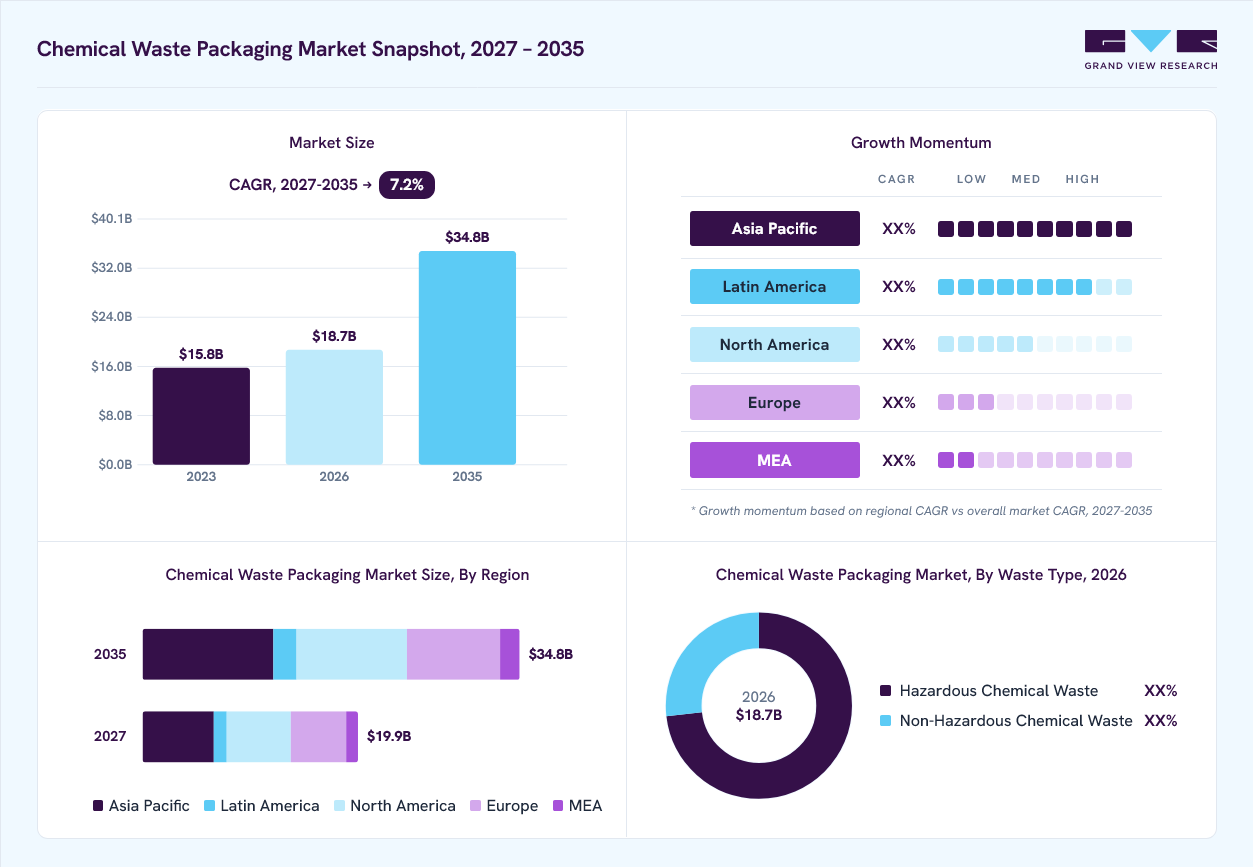
The global chemical waste packaging market size was valued at USD 18.7 billion in 2026 and is projected to grow from USD 19.9 billion in 2027 to USD 34.8 billion by 2035, at a CAGR of 7.2% from 2027 to 2035. Asia Pacific dominated the market, accounting for a revenue share of 32.9% in 2026. The market is primarily driven by stringent hazardous waste management regulations and the growing need for safe containment, storage, and transportation of chemical waste across chemical manufacturing, pharmaceuticals, healthcare, and industrial processing sectors.
 Source: Grand View Research, IR Documents, Primary Interviews, Paid DatabasesTo learn more about this report,
 Download Free Sample Report
Key Market Trends & Insights
- By waste type: Hazardous chemical waste segment dominated the market, accounting for 73.1% of revenue in 2026.
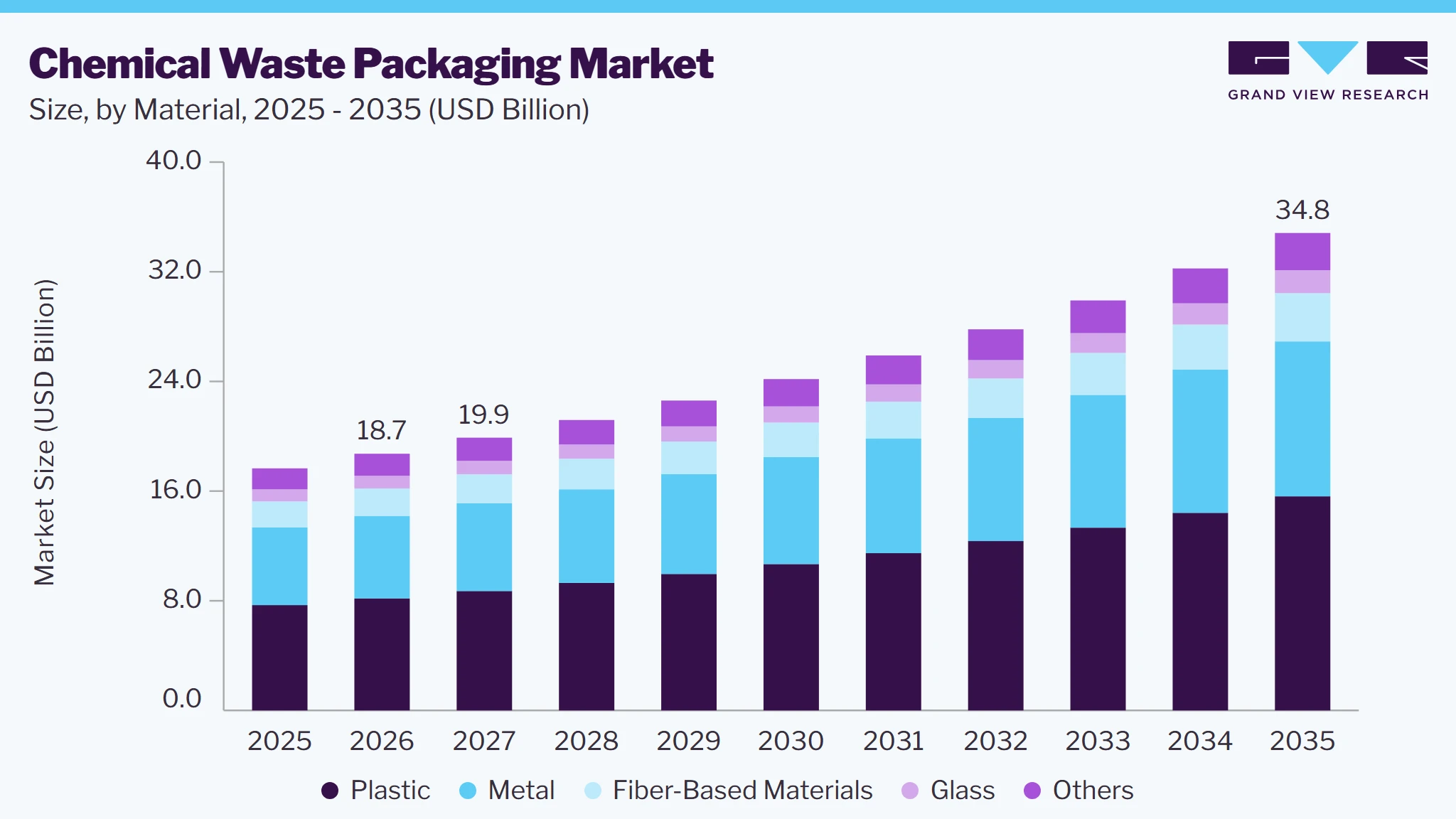
- By material: Plastic segment held the largest revenue share of 43.6% in 2026.
- By packaging type: Drums and barrels segment dominated the market, accounting for the largest revenue share of 30.5% in 2026.
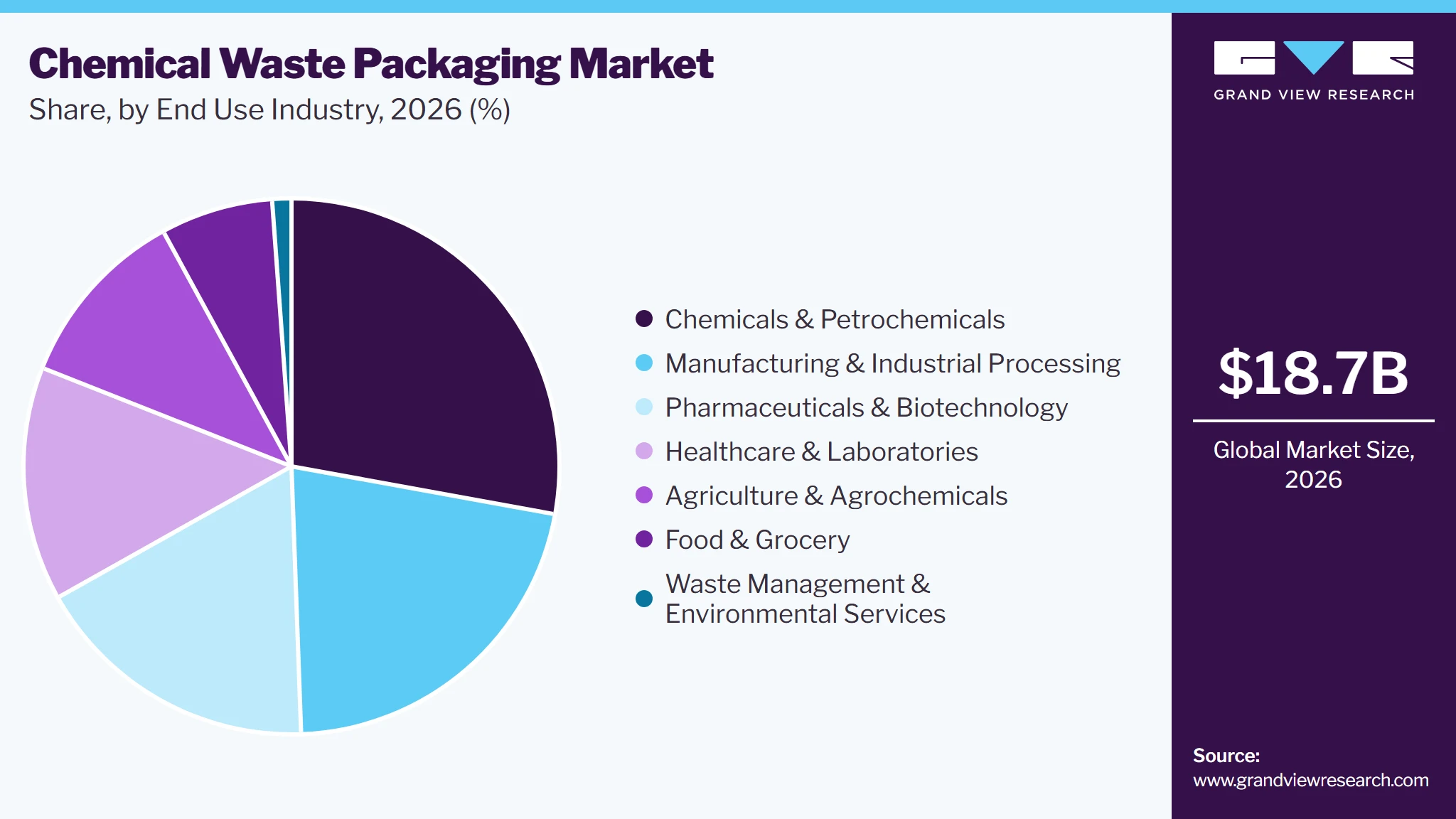
- By end-use: Chemicals and petrochemicals segment accounted for the largest revenue share of 27.9% in 2026.
Regional Highlights
- Largest regional market: Asia Pacific (32.9% revenue share, 2026)
- By country: China held the largest market share in 2026.
Market Size & Forecast
- Market Size in 2026: USD 18.7 billion
- Estimated market size in 2027: USD 19.9 billion
- Projected Market Size by 2035: USD 34.8 billion
- CAGR (2027-2035): 7.2%
Prism AI by Grand View Research Free to tryAsk a question about the chemical waste packaging marketTry asking✓Every figure cited from GVR research Prefer the report? Download free sample →Increasing emphasis on environmental protection, workplace safety, and the prevention of chemical leaks and contamination is further supporting demand for durable, compliant, and specialized chemical waste packaging solutions. The chemical waste packaging market is driven by the growing need for safe containment, storage, and transportation of chemical waste across chemical manufacturing, petrochemicals, pharmaceuticals, and industrial processing sectors. The handling of hazardous residues, corrosive substances, and chemical by-products is increasing demand for packaging solutions that offer leak prevention, chemical resistance, and structural durability. Drums, intermediate bulk containers (IBCs), and specialized containers play an important role in minimizing spillage risks and ensuring the safe movement of chemical waste throughout industrial supply chains. Increasing emphasis on operational safety and compliant waste handling is further supporting market growth.
 To learn more about this report, Download Free Sample Report
Stringent environmental regulations and rising awareness of the risks associated with improper chemical waste disposal are expected to strengthen demand in the coming years. Industries are prioritizing packaging that maintains containment integrity during filling, storage, handling, and transportation. Plastic containers are gaining traction because of their corrosion resistance, lightweight construction, and versatility, while metal packaging remains important for applications requiring high strength and robust containment. Growing pharmaceutical, biotechnology, and healthcare activities are also contributing to demand for specialized packaging capable of supporting the safe management of diverse chemical waste streams.
Sustainability and operational efficiency are also shaping the evolution of the chemical waste packaging market. Manufacturers are focusing on durable container designs, material efficiency, and reusable packaging formats where chemical compatibility and waste-handling requirements permit reuse. The growing adoption of intermediate bulk containers reflects the need for efficient handling of larger waste volumes, while continued demand for plastic and metal packaging highlights the importance of matching container materials to the properties of the waste being handled. These developments are reinforcing the role of reliable, application-specific packaging in improving chemical waste management and reducing environmental and workplace risks.
Market Dynamics
The chemical waste packaging market is driven by the growing need for safe containment, handling, storage, and transportation of chemical residues across industrial and commercial operations. Increasing waste generation from chemical manufacturing, petrochemicals, pharmaceuticals, laboratories, and agricultural chemical production is strengthening demand for packaging designed to withstand chemical exposure and prevent leakage. Material compatibility, container durability, and compliance with hazardous waste handling requirements are key considerations in packaging selection. At the same time, the need to manage disposal costs, meet environmental obligations, and reduce workplace risks is encouraging manufacturers to develop more reliable and application-specific packaging solutions.
The growing need to manage hazardous chemical waste safely is a major driver of the chemical waste packaging market. Chemical processing, pharmaceutical production, laboratory operations, and industrial manufacturing generate waste streams that may be corrosive, toxic, reactive, or otherwise harmful to people and the environment. These materials require suitable packaging to maintain containment integrity during collection, storage, internal handling, and transportation to treatment or disposal facilities.
As industries strengthen their waste management practices, demand is increasing for chemical-resistant drums, intermediate bulk containers (IBCs), pails, and specialized containers suited to different waste characteristics. Packaging selection increasingly considers chemical compatibility, closure integrity, structural strength, and resistance to leakage under expected handling conditions. The expansion of pharmaceutical and biotechnology activities, alongside continued chemical and petrochemical production, is further supporting demand for dependable packaging that helps reduce exposure risks and facilitates safer waste logistics.
A key restraint is the cost and complexity of meeting applicable packaging, storage, and transportation requirements for chemical waste. Containers must be compatible with the chemical properties of their contents to prevent material degradation, leakage, and contamination. Specialized designs, protective linings, secure closures, and performance testing can increase packaging procurement and operating costs. Differences in hazardous waste regulations across regions further complicate product standardization, creating additional compliance challenges for manufacturers and end users, particularly small and medium-sized businesses.
A significant opportunity lies in the development of durable, reusable, and material-efficient packaging solutions. Industrial facilities and waste management companies are seeking ways to reduce packaging replacement costs, optimize waste collection, and improve resource utilization. This creates opportunities for robust plastic drums, reusable intermediate bulk containers (IBCs), and metal containers designed for repeated use where chemical compatibility and regulatory requirements permit. Advances in container durability, closure systems, and reconditioning processes can further support efficient waste handling while helping reduce packaging consumption and lifecycle costs.
Market Concentration & Characteristics
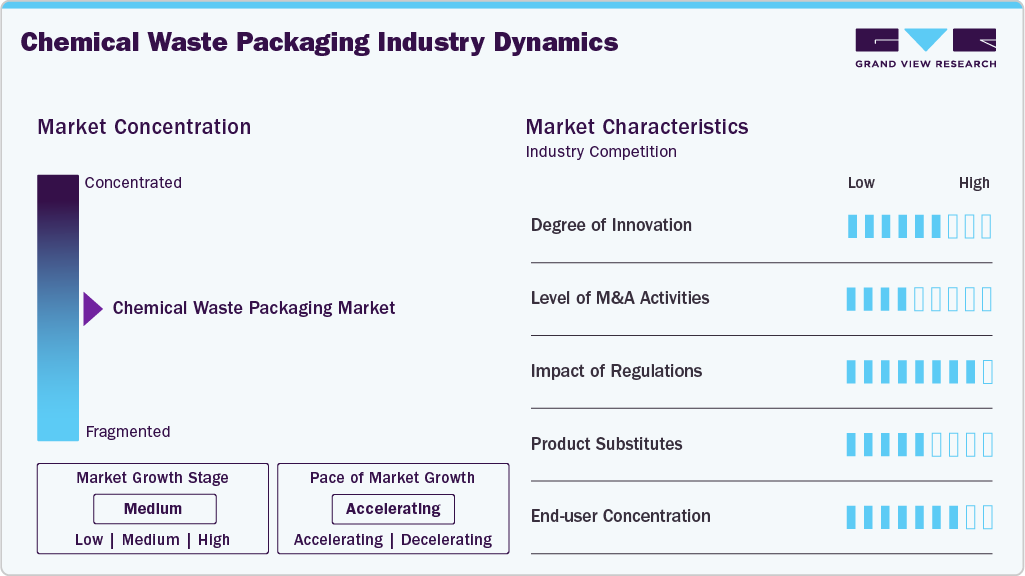
The chemical waste packaging market is characterized by stringent safety requirements, application-specific packaging needs, and a strong emphasis on containment reliability rather than mass-market cost efficiency alone. Packaging solutions must accommodate diverse waste streams, including corrosive residues, toxic substances, chemical by-products, and contaminated industrial materials. Drums, intermediate bulk containers (IBCs), pails, and specialized containers are selected according to waste composition, compatibility, volume, and handling conditions. Manufacturers therefore prioritize chemical resistance, closure integrity, structural strength, and leak prevention to support safe collection, storage, and transportation. Unlike conventional packaging markets, product selection is closely linked to the potential hazards of the contents and the operational requirements of waste generators, transporters, and treatment facilities.
 To learn more about this report, Download Free Sample Report
A defining characteristic of the industry is its reliance on durable plastic and metal packaging, with material selection determined by chemical compatibility, containment performance, and applicable regulatory requirements. Intermediate bulk containers support the efficient handling of larger waste volumes, particularly in industrial and chemical processing operations. At the same time, hazardous waste packaging requirements, transport standards, and environmental obligations influence container design, testing, labeling, and handling practices. These factors are encouraging manufacturers to improve packaging durability, closure systems, material efficiency, and reusable container solutions where appropriate, while maintaining the containment performance required for safe chemical waste management.
Analyst Perspective
The global chemical waste packaging market has evolved from conventional industrial containers toward specialized packaging solutions designed to ensure safe containment, storage, and transportation of hazardous and non-hazardous chemical waste. Historically driven by chemical and petrochemical industries, the market is now supported by broader demand from pharmaceutical manufacturing, laboratories, and industrial waste management services. Looking ahead, growth is expected to be shaped by stricter waste-handling requirements, increasing environmental awareness, and expanding industrial activity, particularly in emerging economies. Demand for chemically compatible containers, durable IBCs, and reusable packaging solutions where appropriate is likely to create opportunities for manufacturers that prioritize safety, regulatory compliance, and operational efficiency.
Material Insights
The plastic segment dominated the chemical waste packaging market, accounting for the largest revenue share of 43.6% in 2026. Plastic packaging is widely used for chemical waste containment due to its lightweight construction, corrosion resistance, and versatility across industrial applications. High-density polyethylene (HDPE) drums, containers, and intermediate bulk containers (IBCs) are suitable for compatible chemical waste streams, offering ease of handling and reliable containment. Demand is supported by the need to manage corrosive residues and industrial chemical waste while improving storage and transportation efficiency. The material’s adaptability to different container sizes and designs further strengthens its position across chemical manufacturing, pharmaceuticals, and waste management operations.
The metal segment is expected to grow at the second-fastest CAGR of 7.4% during the forecast period. Metal packaging, particularly steel drums and containers, is widely used for chemical waste streams that require high structural strength, impact resistance, and secure containment. Its durability makes it suitable for demanding industrial environments where packaging must withstand frequent handling, storage, and transportation. Demand is supported by chemical and petrochemical operations that require robust packaging for compatible hazardous residues and industrial by-products. The potential for reconditioning and reuse, where permitted by waste characteristics and applicable regulations, further enhances the value of metal containers in chemical waste management.
Packaging Type Insights
The drums and barrels segment dominated the market, accounting for the largest revenue share of 30.5% in 2026. Drums and barrels are widely used for collecting, storing, and transporting chemical residues, hazardous liquids, and industrial waste due to their structural strength, secure closures, and availability in plastic and metal formats. Their versatility across chemical manufacturing, petrochemicals, pharmaceuticals, and industrial processing supports widespread adoption. Packaging selection depends on chemical compatibility, containment requirements, and handling conditions, making drums and barrels an established solution for managing diverse chemical waste streams.
The intermediate bulk containers (IBCs) segment is expected to grow at the fastest CAGR of 7.8% during the forecast period. IBCs are increasingly preferred for handling larger volumes of chemical waste because they combine substantial capacity with efficient storage, movement, and transportation. Their stackable designs and compatibility with industrial material-handling systems can improve space utilization and streamline waste collection operations. Demand is further supported by the need for efficient bulk containment across chemical processing and manufacturing facilities. Reusable IBC systems, where permitted by chemical compatibility and regulatory requirements, also offer opportunities to improve container utilization and manage packaging costs.
Waste Type Insights
The hazardous chemical waste segment led the market, accounting for the largest revenue share of 73.1% in 2026. Hazardous chemical waste, including toxic, corrosive, flammable, and reactive residues, requires specialized packaging to maintain containment integrity and minimize risks during collection, storage, and transportation. Demand is supported by waste generation across chemical manufacturing, petrochemicals, pharmaceuticals, and industrial processing, where packaging must be selected according to the chemical properties of the waste. Durable plastic drums, steel containers, and intermediate bulk containers (IBCs) are used for compatible waste streams, with material resistance, secure closures, and leakage prevention remaining essential selection criteria.
The hazardous chemical waste segment is also expected to grow at a faster CAGR of 7.6%, compared to non-hazardous chemical waste, which is projected to grow at 6.3% during the forecast period. Growth is driven by the need for reliable containment as industries strengthen hazardous waste handling practices and environmental risk management. Increasing emphasis on regulatory compliance, worker safety, and contamination prevention is supporting demand for packaging designed for specific chemical hazards and transportation conditions. The continued expansion of chemical processing and pharmaceutical manufacturing is further expected to reinforce the need for compliant, durable, and application-specific packaging solutions.
End-use Insights
The chemicals and petrochemicals segment accounted for the largest revenue share of 27.9% in 2026. Chemical and petrochemical facilities generate diverse waste streams, including process residues, contaminated solvents, corrosive substances, and chemical by-products, creating consistent demand for reliable containment solutions. The need for chemical-resistant materials, secure closures, and durable packaging supports adoption across industrial waste collection, storage, and transportation operations.
 To learn more about this report, Download Free Sample Report
The waste management and environmental services segment is expected to grow at the fastest CAGR of 9.2% during the forecast period. Growth is supported by the growing importance of specialized waste collection, treatment, recycling, and disposal services, which require dependable packaging to handle diverse chemical waste streams. Waste management providers rely on suitable containers to maintain containment integrity during collection, transfer, temporary storage, and delivery to treatment facilities. As industries increasingly outsource waste handling and strengthen environmental management practices, demand is expected to rise for durable, transport-compatible packaging that supports efficient waste logistics and reduces leakage and contamination risks.
Regional Insights
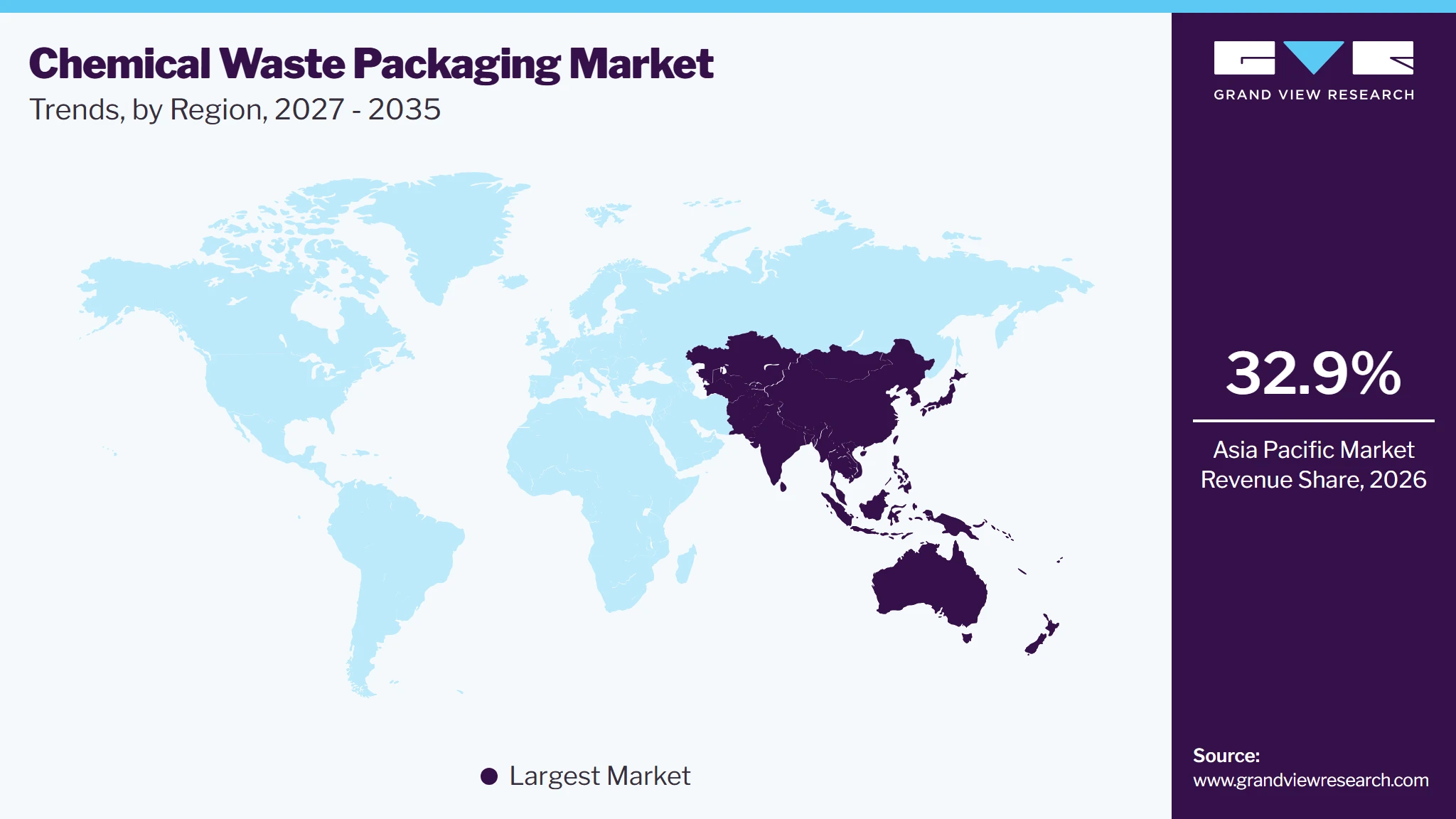
Asia Pacific dominated the global chemical waste packaging market with a revenue share of 32.9% in 2026 and is projected to register the fastest CAGR of 7.9% from 2027 to 2035. Regional demand is supported by extensive chemical manufacturing, expanding pharmaceutical production, industrialization, and the growing need to manage waste generated by manufacturing and processing facilities. Increasing attention to industrial pollution control and hazardous waste management is strengthening demand for chemical-resistant containers, drums, and IBCs. The region's expanding manufacturing base and waste treatment capacity are expected to support further adoption of application-specific packaging solutions.
 To learn more about this report, Download Free Sample Report
China Chemical Waste Packaging Market Trends
The China chemical waste packaging market is supported by its large chemical and petrochemical manufacturing base, industrial processing activities, and pharmaceutical production. These industries generate diverse waste streams requiring appropriate segregation, containment, and transportation solutions. Demand for plastic drums, steel containers, and bulk packaging is linked to the need to handle chemical residues and contaminated materials safely across production sites and waste treatment networks. Continued attention to industrial waste management is expected to support demand for reliable packaging systems.
The chemical waste packaging market in India is expected to benefit from expanding chemical manufacturing, pharmaceutical production, and industrial processing activities. The generation of spent solvents, chemical residues, and contaminated materials across these sectors creates demand for suitable packaging for collection, storage, and transportation. Growing industrial waste management requirements and the development of specialized treatment services are also supporting the need for durable containers that meet the handling requirements of different waste categories.
North America Chemical Waste Packaging Market Trends
The chemical waste packaging market in North America is supported by established chemical manufacturing, pharmaceutical production, and industrial waste management activities. Demand is reinforced by the need for secure containment of hazardous residues, contaminated materials, and chemical by-products across industrial facilities. Emphasis on hazardous waste handling, transportation safety, and environmental compliance supports the use of durable drums, intermediate bulk containers (IBCs), and specialized chemical-resistant packaging. The region's developed waste collection and treatment infrastructure further sustains demand for packaging suited to different waste streams.
The chemical waste packaging market in the U.S. benefits from its extensive chemical and petrochemical industry, pharmaceutical manufacturing base, and specialized hazardous waste management services. Industrial facilities require packaging that maintains containment integrity during waste segregation, temporary storage, and transportation to treatment or disposal facilities. Compliance with applicable hazardous waste and transport requirements also influences container selection, labeling, and handling practices, supporting demand for reliable packaging solutions across industrial and laboratory operations.
Europe Chemical Waste Packaging Market Trends
The chemical waste packaging market in Europe is shaped by established industrial activity and a strong emphasis on environmental protection, waste traceability, and responsible chemical handling. Chemical producers, pharmaceutical companies, and industrial processors require packaging that supports safe waste segregation and movement through regulated waste management systems. The region's focus on resource efficiency and circular economy practices is also encouraging interest in durable containers and reuse or reconditioning systems where contamination risks, chemical compatibility, and regulations permit.
Germany chemical waste packaging market is supported by its substantial chemical, pharmaceutical, and advanced manufacturing industries. The handling of process residues, spent chemicals, and contaminated industrial materials creates demand for robust drums, IBCs, and other containers designed for specific waste characteristics. The country's established industrial and environmental services infrastructure also supports demand for packaging that can integrate into organized collection, transport, and treatment operations.
The chemical waste packaging market in the UK is influenced by demand from chemical processing, life sciences, laboratories, and industrial waste service providers. Businesses require suitable containers to segregate chemical waste, reduce leakage risks, and support compliant movement to authorized treatment or disposal facilities. Greater attention to waste documentation, environmental management, and safe handling across supply chains is reinforcing the importance of packaging with secure closures, clear identification, and appropriate material compatibility.
Latin America Chemical Waste Packaging Market Trends
The chemical waste packaging market in Latin America is projected to grow steadily, supported by chemical processing, mining-related activities, agriculture, and industrial manufacturing. These operations generate waste streams that require secure containment and appropriate handling throughout collection and transportation. Demand varies by industry and local waste management infrastructure, creating opportunities for drums, IBCs, and specialized containers suited to different chemical properties and operating environments. Greater emphasis on environmental management is expected to support gradual market development.
Brazil chemical waste packaging market is supported by its chemical industry, agricultural input production, industrial processing, and broader manufacturing activities. Chemical residues and waste generated by these sectors require packaging that provides secure containment and withstands the conditions associated with handling and transportation. Demand is linked to the management of industrial and agrochemical waste, with container selection depending on chemical compatibility, waste volume, and applicable requirements.
The chemical waste packaging market in Argentina is associated with demand from chemical production, agrochemical operations, pharmaceutical manufacturing, and industrial facilities. Packaging solutions are needed to manage chemical residues and contaminated materials while limiting leakage and exposure risks. Drums, pails, and bulk containers can serve different applications depending on the waste's characteristics and the requirements of collection and treatment services. The development of industrial waste management practices is expected to influence future demand.
Middle East & Africa Chemical Waste Packaging Market Trends
The chemical waste packaging market in the Middle East & Africa is supported by chemical and petrochemical processing, oil and gas operations, industrial development, and expanding waste management requirements. These activities generate chemical residues and contaminated materials that require suitable containment during storage and transportation. Demand is influenced by the scale of industrial operations, access to specialized waste treatment services, and applicable environmental and transport requirements. The need for reliable packaging in demanding operating environments continues to create opportunities for durable plastic and metal containers.
Key Chemical Waste Packaging Company Insights
Some key companies in the chemical waste packaging market include Greif, CurTec, THIELMANN, and Carrick Packaging. The market is characterized by demand for durable, chemical-resistant, and secure packaging solutions designed for the containment, storage, and transportation of hazardous and non-hazardous chemical waste. Key participants focus on improving container integrity, material compatibility, handling efficiency, and regulatory suitability across industrial applications. Product development includes plastic and metal drums, intermediate bulk containers (IBCs), reusable bulk containers, and specialized packaging formats tailored to different chemical properties and waste-handling requirements.
-
Greif is a global industrial packaging manufacturer offering plastic and steel drums, intermediate bulk containers (IBCs), and other packaging formats for specialty chemicals. Its portfolio includes solutions designed to support safe containment, regulatory requirements, and efficient handling of chemical materials, making its products relevant to compatible chemical waste packaging applications. Official product page.
-
CurTec develops high-performance plastic drums, pails, and jars for life sciences and fine chemicals. Its UN-certified packaging is designed for the safe handling and containment of sensitive materials, including hazardous solids, making it relevant to chemical waste applications that require secure closures and reliable containment.
Key Chemical Waste Packaging Companies
The following key companies have been profiled for this study on the chemical waste packaging market.
-
Greif
-
CurTec
-
THIELMANN
-
Carrick Packaging
-
Georg Utz Holding AG
-
PackGen
-
Craemer GmbH
-
Time Technoplast Ltd.
-
Core Plastech International Inc.
-
BMRAJ
Competitive Benchmarking
Category
Operating Strategies
Competitive Edge
Weakness
Established Players (Greif; THIELMANN; Time Technoplast Ltd.; Georg Utz Holding AG)
Focus on expanding industrial packaging portfolios, improving chemical-resistant container designs, and strengthening production capabilities for drums, IBCs, and bulk containers. Emphasize product durability, safe containment, regulatory compliance, and reusable packaging solutions.
Established manufacturing capabilities, broad industrial packaging portfolios, technical expertise, distribution networks, and strong relationships with chemical and industrial customers support market competitiveness.
High manufacturing and material costs, regulatory compliance requirements, and the need to maintain chemical compatibility and packaging integrity across diverse waste streams can increase operating complexity.
Specialized and Emerging Players (CurTec; Carrick Packaging; PackGen; Craemer GmbH; Core Plastech International Inc.; BMRAJ)
Focus on specialized plastic and metal containers, hazardous-waste packaging, UN-certified packaging formats, and application-specific containment solutions. Strengthen market presence through product customization, durable designs, and packaging suited to industrial waste handling and transportation.
Product specialization, flexibility in container design, expertise in chemical packaging, and the ability to address specific waste containment requirements support differentiation in targeted applications.
Comparatively narrower product portfolios or geographic reach for some players, dependence on specific industrial applications, and costs associated with certification, material testing, and specialized packaging development may limit expansion.
Recent Development
-
In April 2026, Greif collaborated with Oleon on a pilot project involving low-carbon steel drums for industrial packaging. The initiative uses steel produced with lower-emission processes and aims to reduce packaging-related carbon emissions while maintaining the performance and safety of conventional drums. This development highlights growing interest in more sustainable metal packaging for chemical and industrial applications.
-
In October 2026, CurTec announced a USD 10 million expansion of its U.S. manufacturing and warehouse operations in Westminster, South Carolina. The investment includes additional warehouse capacity and a new blow-molding production line, with plans to expand local production of smaller packaging formats. The development is intended to improve supply reliability for North American life sciences and fine chemicals customers, supporting demand for specialized chemical packaging.
Chemical Waste Packaging Market Report Scope
Report Attribute
Details
Market size in 2026
USD 18.7 billion
Estimated market size in 2027
USD 19.9 billion
Projected market size by 2035
USD 34.8 billion
Growth rate
CAGR of 7.2% from 2027 to 2035
Base year for estimation
2026
Historical data
2023 - 2025
Forecast period
2027 - 2035
Quantitative units
Revenue in USD billion and CAGR from 2027 to 2035
Report coverage
Revenue forecast, company ranking, competitive landscape, growth factors, and trends
Segments covered
Material, packaging type, waste type, end-use, region
Regional Scope
North America; Europe; Asia Pacific; Latin America; Middle East & Africa
Country Scope
U.S.; Canada; Mexico; Germany; France; UK; Italy; Spain; China; India; Japan; South Korea; Australia; Brazil; Argentina; Saudi Arabia; UAE; South Africa
Key companies profiled
Greif; CurTec; THIELMANN; Carrick Packaging; Georg Utz Holding AG; PackGen; Craemer GmbH; Time Technoplast Ltd.; Core Plastech International Inc.; BMRAJ
Customization scope
Free report customization (equivalent up to 8 analysts working days) with purchase. Addition or alteration to country, regional & segment scope.
Pricing and purchase options
Avail of customized purchase options to meet your exact research needs. Explore purchase options
Global Chemical Waste Packaging Market Report Segmentation
This report forecasts revenue growth at the global, regional, and country levels and provides an analysis on the latest industry trends and opportunities in each of the sub-segments from 2023 to 2035. For this study, Grand View Research has segmented the global chemical waste packaging market report on the basis of material, packaging type, waste type, end use, and region:
-
Material Outlook (Revenue, USD Billion, 2023 - 2035)
-
Plastic
-
Metal
-
Fiber-Based Materials
-
Glass
-
Other Materials
-
-
Packaging Type Outlook (Revenue, USD Billion, 2023 - 2035)
-
Drums & Barrels
-
Intermediate Bulk Containers (IBCs)
-
Pails & Buckets
-
Bottles, Cans & Carboys
-
Bags & Flexible Containers
-
Tanks, Bins & Other Bulk Containers
-
-
Waste Type Outlook (Revenue, USD Billion, 2023 - 2035)
-
Hazardous Chemical Waste
-
Non-Hazardous Chemical Waste
-
-
End-use Outlook (Revenue, USD Billion, 2023 - 2035)
-
Chemicals & Petrochemicals
-
Pharmaceuticals & Biotechnology
-
Healthcare & Laboratories
-
Manufacturing & Industrial Processing
-
Agriculture & Agrochemicals
-
Food & Grocery
-
Waste Management & Environmental Services
-
-
Regional Outlook (Revenue, USD Billion, 2023 - 2035)
-
North America
-
U.S.
-
Canada
-
Mexico
-
-
Europe
-
Germany
-
France
-
UK
-
Italy
-
Spain
-
-
Asia Pacific
-
China
-
India
-
Japan
-
South Korea
-
Australia
-
-
Latin America
-
Brazil
-
Argentina
-
-
Middle East & Africa
-
Saudi Arabia
-
UAE
-
South Africa
-
-
Research Methodology
The chemical waste packaging marketfigures in this report are based on a proven research process that combines executive interviews with secondary research from proprietary databases, company filings, and recognized regulatory and institutional sources. Market size is built through value-chain sizing-reconciling supply-side and demand-side estimates-and triangulated with bottom-up and top-down approaches. Every estimate passes multiple levels of expert validation before publication, with eachchemical waste packagingsegment quantified using the revenue-capture definitions in the table below.
Segment Definition
Material Type
Revenue capture definition
Plastic
Revenue from plastic drums, IBCs, pails, buckets, and containers used for the safe containment, storage, and transportation of hazardous and non-hazardous chemical waste.
Metal
Revenue from steel drums, barrels, tanks, and metal containers designed for durable containment and transportation of chemical waste.
Fiber-Based Materials
Revenue from fiber drums, paperboard containers, and reinforced fiber packaging used for compatible chemical waste handling and storage.
Glass
Revenue from glass bottles, jars, and carboys used for chemical waste containment in laboratory, pharmaceutical, healthcare, and industrial applications.
Other Materials
Revenue from composite, multilayer, and other specialized packaging materials used for chemical waste containment, storage, and transportation.
Packaging Type
Revenue capture definition
Drums & Barrels
Revenue from plastic and metal drums and barrels used for the safe containment, storage, and transportation of hazardous and non-hazardous chemical waste.
Intermediate
Bulk Containers (IBCs)
Revenue from rigid and composite IBCs designed for bulk containment, storage, handling, and transportation of chemical waste.
Pails & Buckets
Revenue from plastic and metal pails and buckets used for collecting, storing, and transporting smaller quantities of chemical waste.
Bottles, Cans & Carboys
Revenue from bottles, cans, and carboys used for the containment and handling of liquid chemical waste in industrial, laboratory, and pharmaceutical applications.
Bags & Flexible Containers
Revenue from flexible bags, liners, and bulk containers used for collecting, containing, and transporting compatible chemical waste and contaminated materials.
Tanks, Bins & Other
Bulk Containers
Revenue from tanks, bins, and specialized bulk containers used for large-volume chemical waste storage, handling, and transportation across industrial and waste management operations.
Waste Type
Revenue capture definition
Hazardous Chemical Waste
Revenue from packaging used for the containment, storage, and transportation of hazardous chemical waste, including toxic, corrosive, flammable, and reactive residues.
Non-Hazardous Chemical Waste
Revenue from packaging used for the collection, containment, storage, and transportation of non-hazardous chemical residues and industrial chemical waste that does not meet hazardous waste classification criteria
End Use
Revenue capture definition
Chemicals & Petrochemicals
Revenue from chemical waste packaging used to contain, store, and transport process residues, spent chemicals, solvents, and petrochemical by-products.
Pharmaceuticals & Biotechnology
Revenue from packaging used for chemical residues, laboratory reagents, solvents, and process waste generated during pharmaceutical and biotechnological manufacturing.
Healthcare & Laboratories
Revenue from packaging used for chemical waste generated by hospitals, diagnostic laboratories, research facilities, and testing centers.
Manufacturing &
Industrial Processing
Revenue from packaging used to contain and transport chemical residues, industrial solvents, and process waste generated across manufacturing and processing facilities.
Agriculture & Agrochemicals
Revenue from packaging used for waste generated by agrochemical production and handling, including pesticide residues, fertilizer-related chemicals, and contaminated materials.
Food & Grocery
Revenue from packaging used for chemical waste generated during food processing, cleaning, sanitation, and related industrial operations.
Waste Management &
Environmental Services
Revenue from packaging used by waste collection, treatment, recycling, and disposal providers for the safe containment, storage, and transportation of chemical waste.
Estimation Model
Layer Name
Key Question
Description
Chemical Waste Generation Layer
Where is packaging demand generated?
Estimate demand based on chemical waste generation across chemicals and petrochemicals, pharmaceuticals, healthcare, manufacturing, agriculture, food processing, and environmental services.
Waste Classification Layer
What type of waste requires packaging?
Assess packaging demand according to hazardous and non-hazardous chemical waste, considering waste characteristics, chemical compatibility, and containment requirements.
Packaging Material & Format Layer
Which packaging solutions are required?
Evaluate demand for plastic, metal, fiber-based, glass, and other materials across drums, IBCs, pails, bottles, flexible containers, tanks, and bulk containers.
Market Revenue Capture Layer
How is market revenue generated?
Calculate revenue generated from the sale of chemical waste packaging products, considering packaging type, material, application requirements, and demand across end-use industries and regions.
Delivered Customizations
This report has been delivered with the following In-depth customizations
Client Request
Customization Delivered
Value Adds
Competitive Benchmarking
Comparative assessment of key chemical waste packaging companies based on product portfolios, packaging materials, container formats, chemical compatibility, hazardous waste packaging capabilities, certifications, manufacturing presence, and strategic developments.
Helps evaluate competitor positioning, identify product portfolio gaps, benchmark packaging capabilities, and develop effective differentiation and expansion strategies.
Cross-Segmentation Analysis
Comprehensive analysis across Material (Plastic, Metal, Fiber-Based Materials, Glass, Other Materials), Packaging Type (Drums & Barrels, IBCs, Pails & Buckets, Bottles, Cans & Carboys, Bags & Flexible Containers, Tanks, Bins & Other Bulk Containers), Waste Type, End Use Industry, and regional markets.
Identifies high-potential material and packaging combinations, industry-specific demand patterns, and regional growth opportunities to support targeted product development and market expansion.
Opportunity Assessment
Evaluation of emerging opportunities across hazardous and non-hazardous chemical waste packaging, reusable containers, bulk packaging solutions, chemical-resistant materials, and demand from pharmaceutical, industrial, and waste management sectors.
Enables businesses to prioritize attractive market segments, identify unmet packaging requirements, assess growth opportunities, and align investments with evolving safety, compliance, and waste management needs.
About the Author(s)
Plastics, Polymers & Resins Research Team
Bulk Chemicals · Plastics, Polymers & ResinsThis report was authored by the plastics, polymers & resins research team at Grand View Research - comprising two research analysts, one senior research analyst, and one industry expert - with specialized expertise in the plastics, polymers & resins segment of the bulk chemicals industry. All findings are based on proprietary bulk chemicals databases, executive interviews, and regulatory analysis, subject to internal peer review prior to publication.
Last Updated:
Speak to Analyst

Customize this report to your needs - add regions, segments, or data points, with 20% free customization.
Or view our licence options:


ISO 9001:2015 & 27001:2022 Certified
We are GDPR and CCPA compliant! Your transaction & personal information is safe and secure. For more details, please read our privacy policy.


